Showing posts with label Berkley Nanofil. Show all posts

Sunday, May 13, 2012

Nanofil - FBO's Final Analysis and Review

I've used Nanofil exclusively on my open water spinning tackle, with the four pound test on my ultralight panfish set up, and for my bass and walleye finesse fishing rigs, I'm sold on the twelve pound test.
Using the twelve pound Nanofil allows me to put the boots to 'em on my hooksets.  I no longer worry about break offs and still get great casting distance while casting all of my finesse bass stuff.
Why twelve pound?  Because I was tired of breaking off on the hook set.  It was too much for my feeble mind to remember to hold back.  I like to put the boots to the fish on the hookset.  It's habit, and I've been doing it for years.  The good thing using the twelve pound test is that, although I've sacrificed the casting distance that the thinner diameter Nanofil had to offer, I'm still casting further than any other line that I've used in the past, and I have yet to break a fish off on the hook set.

Edit:  When I had problems with the lighter versions of Nanofil, I was used a Palomar and Double Palomar knots.  With the twelve pound Nanofil, I've used the Palomar without any issues.

The only maintenance that I've done to keep the breakoffs from happening is that the line will fray after a while and weaken, so I trim a couple feet off prior to each trip.  To keep the spool full, all I have to do is to replace the lost line every once in a while with backing (by transferring from one spool to another).

Memory?  There is no memory.

About the visibility?  I have yet to use my fluorocarbon spool or a fluorocarbon leader in over six months of fishing with it.  The fish don't seem to mind the white color even in gin clear water, and between you and me, I can see it better and that makes for good jigging in my book.
Even when fishing gin clear water, the Nanofil twelve pound with the white color passed my test.  I have yet to use any fluorocarbon leader or my other fluorocarbon spool in over six months since using Nanofil line.
Nanofil isn't quite as strong as similar diameter super lines, but it's pretty close, and stronger than monofilament or fluorocarbon lines of the same diameter.  Also, like superlines, it doesn't have any stretch.

Also, after putting the light stuff on my panfish set up, I haven't gone back to mono or fluoro either, and I've caught a ton of panfish in the last six months.  I haven't had any breaks on the hook set, but also using a slower action ultralight power panfish rod may help with that.  And, I've caught some decent bass and chain pickerel on that set up while panfishing.  Using the Nanofil also allows me to cast my ultralight jigs further than with other lines.
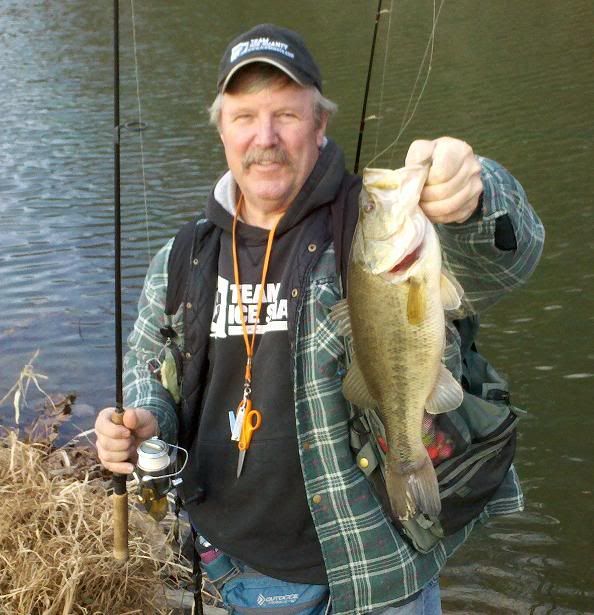
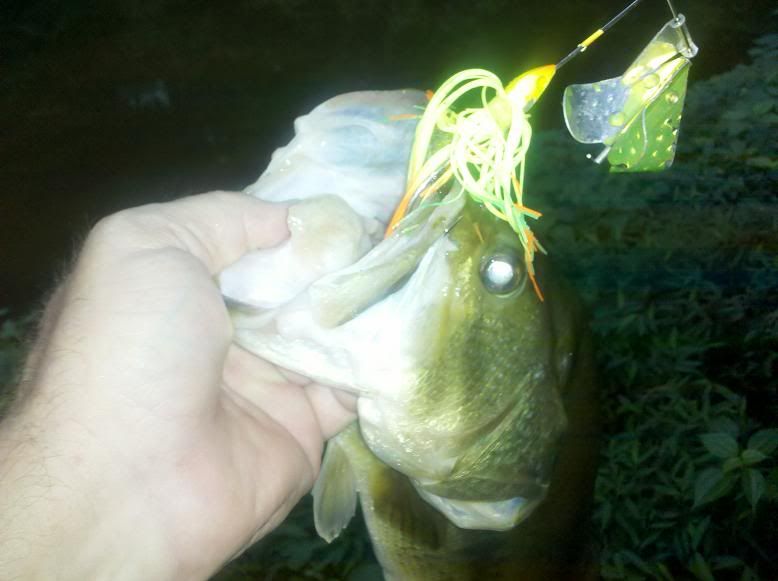
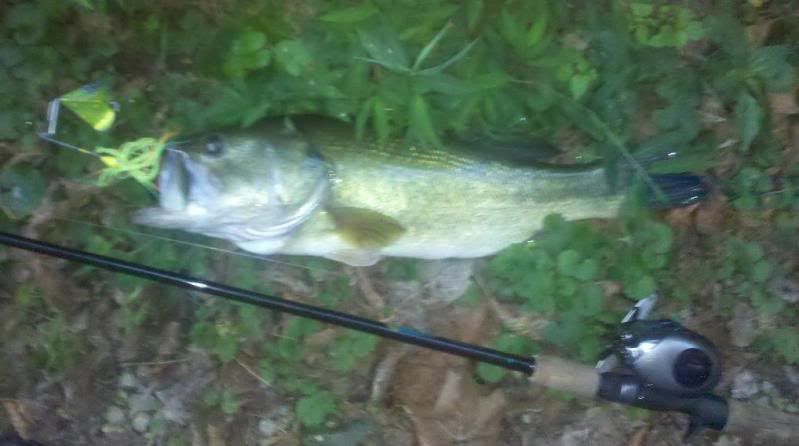
While panfishing, the Nanofil held up well for me on chain pickerel and plenty of bass like this one...
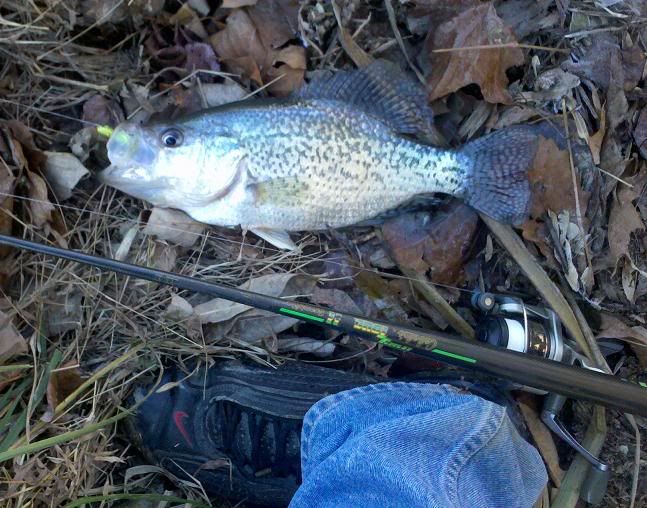
...and plenty of slab crappie have fallen victim to my ultralight rig and jigs using Nanofil.
I'm sold on this line until something better comes out.  Is it perfect?  Nope, but it's the best that I've used to date.  What step in technology that will get me to change?  How about making a line just like this with the clarity of fluorocarbon line?

Bottom line on the line, is that when using this stuff for the right purpose, and choosing the right diameter for the right application, this line should produce for you too.  Is it for every application?  I don't know the answer to that.  I like it for working finesse plastics for bass, and for catching panfish on my ultralight set up.  I've also caught some nice walleye in our local rocky rivers, chain pickerel in weedy ponds, and even striped bass while bass fishing without any issues.

For those that have recently started following this blog and missed the other reviews, you can find them here:

http://fatboysoutdoors.blogspot.com/2011/08/berkley-nanofil-product-review.html

http://fatboysoutdoors.blogspot.com/2011/08/nanofil-product-review-update.html

http://fatboysoutdoors.blogspot.com/2011/10/nanofil-product-review-update-to-update.html

Sunday, March 4, 2012

Save Money on Braided Line

Everyone knows that superlines like braid, fused lines like Fireline, or molecularly linked Nanofil, are much more expensive than monofilament and fluorocarbon lines.  But the advantages are that superlines last much longer, are much more durable in most situations, have much stronger breaking strength than other lines, are much more sensitive, have no memory, and have no stretch for rock solid hook sets.  If you are fishing for species that don't make long runs when hooked, here's a tip that will save you money and stretch out the cost of these no superlines.

Don't put it all on one reel spool!  Fill them all!
Suppose you just purchased a new spool of braided line.  When spooling up your new line, don't empty your old spool of monofilament or old fluorocarbon lines.  Rather, peel off about half 50 to 75 yards of line and leave the rest on as backing for your new braided line.  That way, depending on the diameter of the line and spool size that you're filling, you can fill several reel spools of line and stretch your fishing dollars.

You will lose some line inevitably from changing lures and other reasons, so when your spool gets a little low, peel off the braid and wrap it around an empty Coke bottle or something, and add some backing to replace the amount of braid that you lost, then reconnect your braid and spool it back on.  Voila, you now have a full spool again.

I like to add new line each season, but with braid, you should be able to get more life out of your line depending on how much you fish.  So, here's another tip within a tip.  Instead of trashing your old braid, tie off the end to a fence post (or something outside) and pull off the braid by walking.  When your braid is out of your spool and rod, clip it off from the backing.  Walk back to the fence post and reconnect the other end of your braid that was once your most used end to the backing.  Then, reel it back on.  The end that was once connected to your backing is now the end that you tie your lures on, and is just as good as newly spooled braid.  Since I've been doing this, I've been changing my superlines out every other year.

How does this save money?  If you assume that 150 yards gives you two spools using 75 yards, then switch the ends as described above, you actually get four spools of line out of your 150 yard purchase.

This is the first of a series of fishing tips posts.  I will be posting periodic fishing tips and will index them on a separate page.  If you check back and have missed my tips posts, rather than scrolling through old posts, check the fishing tips index page and click on the ones that interest you.

Tuesday, August 30, 2011

Nanofil Product Review: Update

Last week I wrote about my first impression of Nanofil fishing line.  When I purchased this line, my plan was to use it for finesse plastics on largemouth bass.  I purchased the six pound test, that has a thin diameter comparable to two pound test.  I wanted maximum casting distance, minimum visibility, and the most strength possible given the first two qualities.  I only logged one hour of fishing time, and in a nutshell, I was impressed with the line that it exhibited the above qualities.  It seemed strong, casts very well, the fish didn't seem to mind the visibility, and it had similar qualities to other superlines.  I was able to fish a few more hours last night, with mixed results this time.  Basically, all of the qualities that the line exhibited the previous trip were still apparent.  The only thing wrong was that I broke off four times on the hookset. 

This largemouth bass nailed a four inch ringworm through
a weed mat using Berkley Nanofil line.  My plan was to hop
the lure over the weeds and drop it off the ledge, but the
bass had other ideas exploding on it through the mat.
Now, before I go on, let me explain that I've found this same issue to be true with all of the superlines that I've tried with that same small diameter, including Fireline, Power Pro, Spiderwire, and Suffix 832.  I solved the problem with those lines by increasing the pound test and diameter, sacrificing some of the castability of the line for strength.  I've also had issues with fluorocarbon lines doing this in the past, but changed brands and upped the pound test and haven't had problems since.  So, the problem is the only one that I've noticed so far, and I believe that the problem can be solved by taking that same approach.  So, my plan is to purchase and test either the eight or ten pound test Nanofil line.  Which one I purchase and test depends on how it feels when I pay a visit to the store.  A nice feature of many of the superline brands is that they attach a sample of the line and pound test to the package so you can get an idea what it's like prior to purchase.

One of my first bass last night caught using Nanofil.
What will I do with the thin two pound diameter version that I have now?  I'll use it until my new line arrives, and I'll solve the immediate problem by just being aware when I set the hook to not set it too hard.  Let me say that I wasn't putting out bone jarring hooksets last night.  I used the same short quick snap hookset that I've always used with superlines in the past, but just doing it a bit more gingerly.  Admittedly, I was frustrated after losing those four fish, but it wasn't the end of the world.  I was sight fishing and the fish that I tried to catch were not all that big to begin with.  And, to correct the problem, I cut back on the power that I put into the already short hookset, and it worked out just fine.  

This nice bass was caught using six pound test Nanofil.
What about the strength of the line?  I have yet to lose a fish via breakoff during the fight, and I've pulled some decent bass through the slop (weeds galore) without any problems.  So, the actual strength of the line is fine.  Also, every now and then the line will wear and fray at the end, so I had to clip off a couple feet as the evening wore on.  In fact, the instructions included in the package recommend that this be done once in awhile.  This is no different than when I used mono or fluorocarbon in the past. 

So, how did I do fishing last night?  I can't have this post be totally about a product, so I have to include some fishing pics.  I finished with nineteen largemouth bass in three hours and a rock bass, seventeen of which came via the plastic worm on Nanofil.   The other two bass came via a Strike King Tri-Wing Buzz King buzzbait that I modified by adding a clacker to produce more noise.  Of the nineteen bass, my biggest six bass were 20, 19, 18, 17, and two 16 inch bass, plus a good many bass in the thirteen to fourteen inch size.  So, it was a fun night indeed.  Not bad for three hours of fishing!

A nice "Slop and Drop" largemouth.  This is the same fish
shown in the first picture on todays post.
One of the techniques that worked as a substitution for a frog pattern that I term "Slop and Drop" to my fishing buddies.  I didn't have my frogs with me, and plastic worms work nicely.  Basically, when you have a mat of weeds or leaves, you cast your lure on the top of the weeds and jig your rod tip quickly while reeling slowly, causing the bait to hop like a critter across the mat.  Usually, I'll do this with a frog lure, like many people do, but I didn't pack any last night (forgot them), and had to do it with a plastic worm.  You have to use light weight to accomplish this to keep it on top of the mat, kind of the opposite of punching.  The cool thing is that the light bullet sinker bounces up and down on the mat, making vibrations, that make this technique very effective at times.  You can also use it with other soft plastics, in fact, Chompers twin tails work great at this.  Then, when you get to the edge of the mat, let the lure drop off the edge.  The light weighted soft plastic bait falls slowly and draws strikes when faster falling baits might not.  So, at least a dozen or so of my nineteen bass were caught this way.  In some cases, as the lure falls off the mat, you can see the bass shoot out and take the worm.  If they are big, man is that exciting.  One of the bass couldn't wait for the worm to get to the mats edge and just exploded through the weeds.  The light Nanofil line held up nicely on many of these fish, bringing in the "salad" with the fish.

My buddy Howard with a nice largemouth caught last night.
My buddy Howard and I found one large mat of weeds that had several fish underneath.  I caught six in seven casts, and finished fishing that mat with ten of my bass landed.  Howard caught six fish out of that hole too.  Many of those fish were keeper sized, and most of them came via plastic worm and the "Slop and Drop".

As daylight ended, it became tough to see what we were doing with the worm, and the fishing seemed to slow, so out came the buzzbaits.  I caught a fish on my first buzzer cast, a chunky fourteen incher.  I fan casted the spot without a hit, so I thought about all those fish under the mat.  I tossed my Tri-Wing modified Strike King buzzer to the back edge of the mat, cranked and had it moving as soon as it landed so as to not hang up on the weeds, and skittered it across the mat.  The buzzbait cleared the mat and not two feet later, KERSPLOOSH!  A fat nineteen inch largemouth hammered the buzzer.  That experience was so cool and I was so fired up after landing that fish, that I hooted and hollered so loud that I believe that I spooked every great blue heron along the river for at least a mile! 

This fat bass hammered my buzzbait last night.
That was my last bass of the evening.  Howard caught two more on the buzzbait and had several huge blow ups, and I had a couple blow ups but didn't hook up.  It was a very productive evening at one of our favorite places to fish especially on the weeknights.

In summary, I still have a lot of questions about Nanofil line, but so far I'm pleased with the results.  Part of the hookset breakoff problems were my fault, both by purchasing a thin diamter that I knew might be risky for my technqiue, but also by putting too much pressure on the hooksets.  Part of that is getting used to the line, and learning it's strengths and weaknesses.  And, this learning experience taught me what I have to do next, and that's to purchase the pound test that is best for the job.  I won't give up on the two pound diameter though, because I think it could be a great line for winter ice fishing.  I will provide more information as I experience this product in the future.  Hopefully for now, you'll benefit from my experience with it, albeit for a short amount of time.  Also, I hope you enjoyed my report of last night's fishing experience.  It's a night that I won't soon forget.

Saturday, August 27, 2011

Berkley Nanofil Product Review and Fishing Report

I've been slow on the blog write ups primarily because I've been out fishing as much as possible.  So, with hurricane Irene heading our way in a matter of a few hours, I figured the next best thing to fishing would be to write about fishing.  All I can think about is my last fishing trip, which was pretty good given the amount of time that I had to fish.  So, I'm going to write about that trip even though it only lasted an hour and a half or so.  One of the reasons that trip might be special is that I recently purchased a spool of Berkley Nanofil.  Yeah, I heard the hype about this line that is supposed to cast further per diameter than any other line.  I've heard claims about various braided lines in the past and have found that they aren't a lot different than standard mono when it comes to casting distance.  Plus, Nanofil is touted to have the same qualities as the other superlines, being low stretch, high strength per diameter, and durability.  When I set out to start this blog, I set a goal to not do product reviews.  I'm not endorsed by anyone, nor do I want to be.  I want to fish without any ties, to be unbiased and to work with what I feel are the best products.  But in this case, I felt that this product warrants my analysis.  Nanofil differs from other superlines because it's not constructed the same way.  Rather than having strands of microdyneema fibers and other fibers either braided or fused together, Berkley labels Nanofil as a uni-filament.  The next paragraph is the promo from Berkley, what they say about their new line:

"Not a Mono. Not a Braid. The Next Generation of Fishing line. NanoFil is made out of gel-spun polyethylene, much like a superline. This ultimate spinning reel fishing line consists of hundreds of Dyneema® nanofilaments that are molecularly linked and shaped into a unified filament fishing line. Dyneema, The World’s Strongest Fiber™, gives this line superline type strength and our uni-filament process makes it feel and handle like a smooth monofilament."

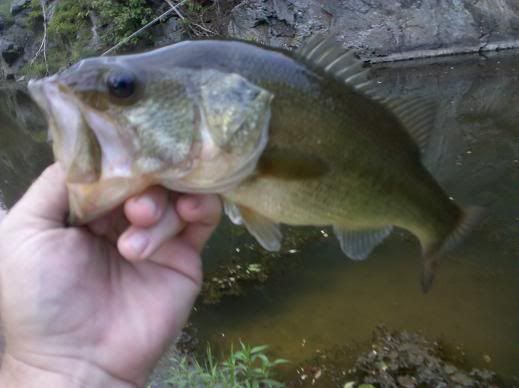
I caught this small bass using the Nanofil line/worm combo,
 all of the fish were this size (11-12") that I caught using it last night.
OK, I had about an hour and a half to fish.  The water was gin clear.  I caught seven largemouth using the Nanofil, and I didn't lose a single fish.  I'd like to think that was due to my fishing ability rather than the line, but I'll let y'all draw your own conclusions.  I fished from shore last night, and with the water so clear I was sight fishing.  Every fish that I saw except one, I caught.  The one that I didn't see was interested, but didn't strike.  (Edit:  let me explain, I didn't see the fish before my cast, until it poked it's head out of the weedbed, nosed my worm, and then decided not to bite).  I was using a 4" plastic worm, light weight, light wire worm hook, and 2 pound diameter 6 pound test Nanofil.  It casts like a dream, much further than any other braid or fused line that I've ever used even of the same diameter.  It's far more smooth than other braids, and shoots through the guides with ease.  It was so smooth that it almost felt weird, and it casts so far that I actually over shot my target a few times until I got used to it.  Like other superlines, it has no stretch.  I think that Nanofil is stronger than the pound test rating.  You don't need a massive hook set, just a quick snap of the wrist and the hook is driven home, just like other braids.  Even though the line is white, I didn't see it in the water hardly at all, but granted it was low light conditions the last hour prior to dark.  The fish definitely didn't care.  The action of the plastic worm looked great as it should with this bait.  I had no problems at all with loops coming off the spool, "wind" knots, or anything like that and I think that I even overfilled the spool.  So far so good.  I know that this little bit of testing isn't much, but so far I'm very impressed.  Time will tell if further experiences are positive or not.  I'll report back later after extended use.

I caught this nice bass on my third cast with a modified
Strike King Tri-Wing Buzz King buzzbait.  The modification
is the clacker that I added to give it that much more noise.
I could have kept catching that size fish the entire time, they were cruising everywhere.  They were on the hunt, as if preparing for the massive storm that was on it's way up the East Coast.  But, I switched tactics right at dark for two reasons.  One, I started seeing frogs everywhere.  When they become active, so do the bass.  And, I began seeing quite a bit of surface activity.  It wasn't as if fish were chasing minnows, but the shorelines became agitated.  It's the same kind of surface disturbance that you see when you walk up on a bass and spook it...except, these fish weren't spooked.  To me, that kind of activity should be fished by something big, loud, and fast to cover more water, so I went to a buzzbait.  It's not that the finesse pattern wouldn't catch big bass, but during the last hour of daylight, search baits, like buzzbaits, work a bit better in tempting big bass into striking.  I was working a weed patch when, on my third cast, a fish slurped my buzzer.  I managed to land that fish, a nice twenty one inch largemouth bass, although it seemed to be all head, and no belly.  This bass resembled those Lake Erie largemouth, all head and not a lot of weight.  Still, it was a quality bass. 

Here's the same fish.  I carefully laid her down on the weeds
to snap this photo.  All head and no belly, probably an older fish.
I'm dedicating the catch of this bass to Tom Boyd, who writes
the blog "Fishing with Dad" linked to the right.  Tom is at home
recovering from knee replacement surgery.  Here's a bass
for him to keep his spirits up during his long painful recovery.
I tossed a buzzer for about 20 minutes more, working the weedy and woody cover thoroughly.  I had three more blow ups, but the fish seemed way behind the lure.  I tried following up with my finesse rig, but the fish weren't interested in that once it became dark.  I decided to call it a day and look forward to the next outing.  Not too shabby, eight largemouth bass in a little over an hour, including a nice one.

Up until I tried the Nanofil, Suffix 832 seemed like the best casting line of the braids that I've been using.  I've fished with Power Pro, Fireline, and various Spiderwire versions.  All of them were pretty good, but none of them really stood out over the other until I tried the Suffix 832.  How did the Nanofil compare?  Nanofil casts much better for the same pound test, it's thinner too.  It's not as stiff as 832, is much more limber than I expected, and seems to come off the spool and through the guides smoothly.  Casting was effortless with the Nanofil.  With the 832, I had to put some oomph into my casts just to get close to the distance.  So far, the Nanofil was pretty tough and handled the fish nicely.  It's still early in my analysis though. 

So, for the future, I'll keep testing this line.  I still have questions to be answered:

How durable is this line after hours, days, or weeks of use?  I've only put an hour of use on it so far.

What issues with the poundage/breaking strength might I have?  I may not have any problems.

What about line twist, coils, memory, "wind knots", and other problems after the lines been used and on the spool a while?

How will it perform using other lures and techniques?

How will smallmouth in clear streams react to the visibility of the line?

So far, I like this stuff a lot, especially for jigging with finesse plastics.  But, only time will tell when it comes to answering these questions.

Suffix 832 withstood all the tests and only one time did I have to switch to fluorocarbon to get bites.  I wonder if the Nanofil will be as successful.  I will report back after a few trips, but so far, I think it's worth the investment.

My last question is, what will happen if this becomes the line that everyone is trying to beat technology wise?  Can you imagine?  The fishing line technology race may result in a superline that runs clear like fluorocarbon!