One thing about being a high strung addicted bass angler is the urge to fish places that always hold good numbers of big fish, to try and top your biggest bass each year again and again. I'm no different. I'm competitive in my own way, not against my fishing buddies which is a real turn off, but rather against myself. It's really undue pressure and not really necessary. However, over the years I've learned to calm down and enjoy the experiences and all that comes with bass fishing, not just big bass, but everything about it. One of the best ways to do that is to just have fun, and I can't think of a better place than fishing small water for smallmouth bass. It's fun because you can find solitude, catch lots of unpressured fish, and enjoy a day with maybe not seeing a single person on some very scenic water.
In my home state and neighboring states, there are lots of tributaries that hold smallmouth bass. Many of them receive little, if any, fishing pressure. How do you find good spots? Not by reading my blog, but rather, do your homework. Get a good map of your area and start with public access, ramps, and bridge crossings. In some cases you might have to ask permission, some cases not, but it depends on the laws of your state or territory. There are lots of maps out there, USGS maps, on-line topo maps, Google and Mapquest satellite maps, trail and canoeing maps...you name it, the info is out there. You'll find the best spots by trial and error.
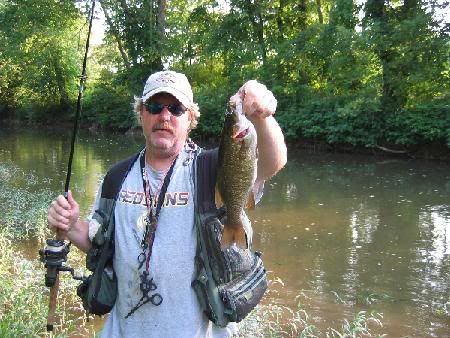
Most small stream smallies aren't monsters, but like their river brothers they are strong from life in the current, and most of them are very scrappy. And, every now and then you can catch a big one. Here's a nice size small stream bronzeback.
Tackle set ups? Basically, anything goes. Once you get a feel for the average size of the fish in your small stream, you adapt your tackle accordingly. When I first started fishing small streams, I automatically assumed that the stream was best fished with ultralight tackle because they may have had small fish in them. It was fun landing fish on UL spinning tackle, 4 or 6 pound line, and tiny lures. But later, after learning the hard way and getting broken off or losing big fish on the hook set, I beefed up my strategy. Now the big fish call me as before, it's in my nature, so I target them. But, what I found out is that I caught just as many as ever, but didn't miss the big ones or lose them nearly as often. I use slightly different size lures on 8 lb. test fluorocarbon line on a medium or medium light spinning rod.
Lure choices should include your favorites, whatever you have confidence in. For me, I carry a selection of minnow imitations, jerkbaits, small crankbaits, and topwater plugs. I also carry small spinnerbaits and buzzbaits. And most of all, I carry my finesse stuff. For the most part, the same stuff that works in my rivers works in the creeks. Plastics include 4" plastic worms, tubes, soft jerk baits like Zoom Super Flukes, Senkos, and Sluggos, beaver type baits, and grubs (twister tails), usually in 3 basic colors depending on water conditions. In clearer water, I prefer variations of green pumpkin, watermelon, and smoke or maybe something with some flash or metal flake. Smoke/purple is an awesome color for me. In dingy water, I prefer darker baits, perhaps black or even green pumpkin, or bright colors like chartreuse, or something with a chartreuse tail. White is also a great color for murky water. Spinnerbaits work well under these conditions. Muddy water? I pretty much fish other places, not because you can't catch fish, but usually the water is higher than normal and you can't see the bottom to wade, which can be dangerous. I prefer wading water that I can see the bottom.
My confidence is in plastics, that is, I know when the chips are down that I'm going to catch fish on my favorite plastics. But my approach is to start with a search lure, perhaps a small buzzbait. Often I'll use a beat up plastic worm as a trailer. When the fish are on that bite you can catch a lot in a hurry, and they are big fish magnets. When the fishing is tough, then I go to the plastics.
Before I go on about actually fishing, what about how I access or others access? Most of my small stream fishing is done by wading. I can work slowly and thoroughly. Most people like to wade upstream, I actually see advantages in going either up or down stream. When going up stream, basically you don't cloud the water ahead of you when you wade. Also, most of the fish are in ambush holding patterns facing up current, so well placed casts and retrieves put the lure beyond the fish and let the current bring it to them. In deeper pools, this might be best to cast up above the pool and let the current bring your bait down toward the bottom, getting it deeper. OK, we've all probably heard that before, so let's take a stance that blows that theory away...working down stream. Honestly, I can fish the pool ahead of me without entering it, and position myself on each pool so that any silt that I kick up washes down away from the prime fish holding structure. But, here's another kicker: sometimes stirring up the bottom a little gets bait fish excited and feeding, and that in turn can turn smallies on. Also, keep in mind when fishing down and across, stronger currents keep your bait up. Sometimes the fish like that, but if you're not getting hits, cast up and bring it across to get your lure deeper. Either way, a stealthy approach is best. Plan your wading route ahead of time and position yourself in such a way as to not spook fish but at the same time giving you the best opportunity to present your lure to the fish. Keep a low profile and
don't make a lot of noise or wade too fast as to disturb fish. Also, wading downstream is easy to cover water with search lures like buzzbaits, fish them across and down. Don't be afraid to toss them in the riffles, at the base of rapids, or at the tail of the pool. Let the current pull it all the way across the stream.
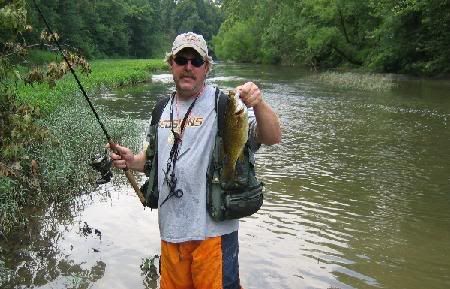
This bass fell for a buzzbait fished across and down through the base of the riffles
Kayaking and possibly canoe floats are other effective ways to fish small streams. Even if you have to portage a few times, or get out and wade once in awhile, it still is a way to reach fish that you might not reach otherwise. I'm not a kayak expert but I've fished a few times out of them and they are fun, and relatively stealthy if you plan your positioning ahead of time.
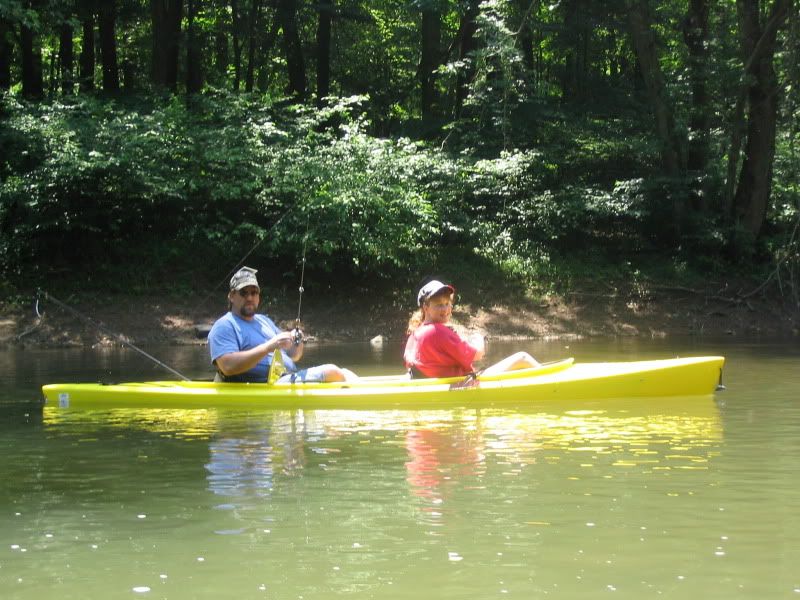
Kayaking a small stream is an effective way to sneak up on wary smallmouth bass.
Where do the fish hold? Think of your small stream as you do your river, or even your trout stream. Smallies like to hold on current edges of eddies, or behind rocks, logs, boulders, weeds, etc. Here's what goes though my mind, "if I was a smallmouth bass, where would I position myself to best take advantage of the current to get an easy unsuspecting meal"? Also, other factors influence holding locations, such as water clarity, water temperature, shade and oxygen among others. Most of my wading is done in the summer, so hot weather is the norm, so if the fishing is tough because of heat, I look for shade, current, riffles, tributary mouths, springs...anything that might keep a fish comfortable. I look for each holding spot in a pool. If I think that there's a fish there, I make multiple casts until I'm sure one isn't there. Often, like trout fishing, getting that good drift or presentation might take more than one cast especially if the fish are picky and don't want to move far to chase your offering. And, just because a spot is shallow, don't rule them out. I've caught some decent size smallmouth in the summer holding behind a rock in the middle of the riffles!
Another method of catching smallmouth in small streams is fly fishing. Matching the hatch, like trout, will often produce good numbers of bass. Smallies will gorge on huge mayfly hatches, like the August white miller hatch. They also like dragonflies, so watch the stream around you to get ideas. Pay attention to any fish activity, what are they eating. Often they will jump way out of the water to eat a dragonfly or damselfly. Streamers and nymphs, especially crayfish, minnow, and hellgrammite imitations work wonderfully. Don't forget topwater action, small poppers can bring many a smallie to the top. You don't need much, maybe a 5 weight rod/line set up will do. If you like using bigger flies, then by all means don't let that stop you, fishing a 7 weight will still catch fish. You might not get the numbers that smaller flies do, but you'll get the size.
What equipment should you bring? Well, it's up to you. Typically, I wear a fishing vest with the pockets stuffed like they've never been stuffed before. I have separate small boxes for my jigs, hooks/sinkers/rattles, and crankbaits. I carry my spinnerbaits and buzzers in a Ziploc. I'll stuff Ziploc bags full of my soft plastics into my vest pockets, each with it's own type and color. I also carry extra spools for my reel, worm dye, worm glue, wacky rig tool, line clippers, braid scissors, forceps, a can of Reel Magic, bug spray, sunscreen, plenty of water, sometimes lunch depending on how long the wade. Remember the movie,
"A Christmas Story", where the Mom dresses up the little kid in his snow suit and layers of clothing, and he couldn't put his arms down? My vest kind of resembles that. Also, don't forget polarized sunglasses
-- oh --
that reminds me, polarized sunglasses are a must, because you often can sight fish ahead in the pools you are approaching. If you can see fish and they don't see you first, you have a high probability to catch them. Back to equipment, comfortable clothing if you wet wade or waders during cold weather. Don't forget when it's cold to wear a wading belt. I highly recommend wading shoes designed for wading streams. I used to use felt studded soles, but my state has since banned the use of them, so now I use Simms wading shoes with the sticky vibram bottoms. I have yet to try them but will write a review after my first trip in them. Some people like to use a wading staff. I don't use one because the small streams that I fish have very manageable flow. Finally, I try to bring a camera with extra batteries or memory. I used to keep mine in a Ziploc bag and that was OK, but I was always worried about it. That camera expired due to constant abuse on my part, so I'm in the market for a new one. There are ones that are now waterproof to say, 15 feet, and very durable. I'm currently interested in the Sony version once my budget allows. This will give me the ability to film fishing shots, scenery shots and perhaps underwater ones...and videos too.
A note about etiquette: If you encounter others, don't wade through their pool. If it's the only way around them, ask first, usually they will let you go. Or, get out of the stream and walk around the entire pool away from the water so as to not spook their fish. A better option is to turn around and go fish the other direction. If you're fishing with a buddy, give your buddy equal chance at catching fish. Either share the same pools if they are big enough, trading head and tail of pools each time, or take turns hitting the next pool first. If you are floating, don't float over the areas shore anglers are fishing, i.e. the fish holding structure unless it's absolutely necessary, rather, position your kayak to float closer to them (unless the fish are between their legs). Ask landowners permission if necessary, and carry out more than you take in as far as trash goes. Pick up line that you might find on the stream side, etc. And most of all, when in doubt, be courteous to others first. There's plenty of fish to go around for everyone.
Another fun thing about fishing small streams is that there is a potential for catching a variety of species. Often you can catch quite a mixed bag, which makes the trip more interesting sometimes. In addition to smallmouth, in the streams that I've fished I've caught largemouth, walleye, chain pickerel, musky, redbreast sunfish, bluegills, pumpkinseeds, rock bass, warmouth, crappie, rainbow trout, channel catfish, black bullheads, fallfish, creek chubs, and carp. I've probably left a few out.
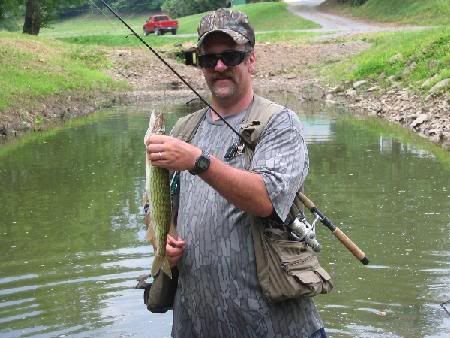
Here's a nice chain pickerel that my buddy Bill, a.k.a. Genz Man, caught a few years ago on one of our small stream smallie trips.
Another cool thing, literally, about wading small streams is that during those hot dog days of summer, you can take your gear off, put it on a rock, and go for a swim. I've really cooled off doing this in the deeper pools, often standing there letting the current run over the back of my neck while minnows feed on my leg hairs. Sitting back against small stream riffles as if in an easy chair is also quite refreshing.
So, if you want to get away from it all, get to fish some awesome scenery, see wildlife action that most people may never see, catch lots of fish and maybe a big one now and then, try fishing for smallmouth bass on a small stream near you.
Finally, I'd like to dedicate this post to one of the best small stream anglers that I know, Jim Cumming a.k.a. Jim C. on
http://www.myfishfinder.com/. If it wasn't for him I would have missed out on all this. I learned a lot from that guy!!!!!!!!!! Thanks Jim!
Until next time, tight lines!