Showing posts with label lipless crankbaits. Show all posts

Thursday, May 2, 2019

How About a Little Bait, Big Bass Story?

Here's another campfire type story that brings back fond bass fishing memories for me, one of a big bass caught while finesse fishing on a rather small lure.  Only this big bass wasn't caught by me, rather, it was caught by my fishing pal, Captain Steve Kelley.

It was early spring, near the end of March.  Cloudy skies, light winds, air temperatures in the upper fifties, and water temperatures in the low fifties were ideal conditions to catch pre-spawn big bass.  Water visibility was about two feet, which was really good for such a windy month.  We started out fishing with a moving incoming tide in our favor.

Recently, in previous trips, we'd done well casting lipless crankbaits, and we expected similar results on this trip.  Basically, the hot pattern at the time was to find emerging weedbeds, cast out a crankback, and as you reeled it in, tick the tops of the weeds with it.  Often, if you lighly snagged a weed during the retrieve and jerked the crankbait off it, you'd provoke a bass to strike.   Lipless crankbaits work great with this method. 

Click Here for more info on fishing lipless crankbaits and fishing this weed pattern.

We reached our first location of the day around mid morning, a cove at the mouth of a creek that had a fair amount of sunken wood and plenty of fallen timber along the bank.  The bottom consisted of pea gravel along the bank, and a muddy bottom out toward the middle of the cove.  Bass consistently spawn in this cove, so we felt that was a great reason to start there for the day.  This cove usually had a fair amount of weeds, so we thought that the crankbait pattern be the perfect method.

However, the fish had other plans for us, at least at this spot, at that particular time.  Steve finally hooked up on his first largemouth, an eighteen incher, after about a half hour cruising the cove on a crankbait.  I picked up a couple of punk fish, but the bite wasn't as fast and furious as it had been during previous trips.  For some reason, the weeds hadn't grown as they had in the past at this spot.

Sometimes, when things are slow in the cove, it often winds up being better fishing inside the creek.  We fished our way into the creek.  As we entered the creek, Steve commented that he often caught fish on plastic worms off one of the points.  At the tip of this point, there was a log that created a small current break during an incoming tide.  Steve picked up his rod, rigged with light weight, a light wire hook, and four inch green pumpkin ringworm, and pitched his worm perfectly into the eddy created by the log.  Almost immediately, he yelled, "Fish!  It's a good one!"

After hearing that, I reeled in my lure and grabbed the net.  The current swept us further into the creek as Steve battled the fish on eight pound fluorocarbon line spooled on a medium light action spinning rod and reel combo.  As the fish neared the boat, I had the net in the water at the ready, but the fish saw the net, and took off for a run.  At this point, neither of us got a good look at her.

It peeled off a little line, and then Steve worked her back in.  After a few head shakes under the boat, Steve brought the fish out from under the boat and I eased the net underneath her.  This fish was a fat girl for sure.  After I netted her and took pictures, Steve placed her on the measuring board and she went twenty one and a half inches long.  We didn't have a scale, but I'd guess, based on her girth, that she weighed about six pounds, perhaps a little more.  At the time, this was Steve's personal best tidal river bass.  What a beast!
Steve's twenty and a half inch personal best tidal river largemouth bass inhaled a four inch finesse worm!
In recent blog posts, I posted stories about big bass caught on big lures, and that is such a true saying worth repeating.  But, this bass was caught on a finesse style worm, texas rigged fished with a light bullet sinker on light line.  It wasn't a new pattern for either of us, as this rig has caught lots of fish, for both of us.  And, I personally have caught several five pound or better fish on this rig.  It's productive.  During a tough bite, you can't beat it.  But, this fish was caught finessing on a day when the crankbait bite should have been king, and at the end of the day, it was. 
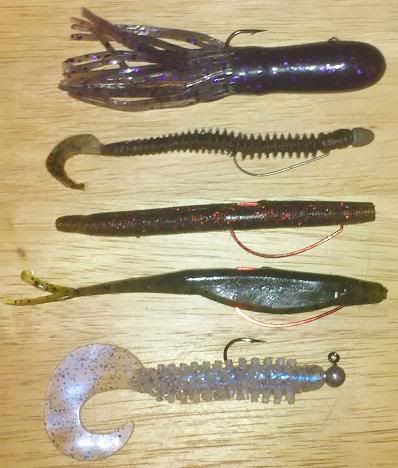
Pictured here are a few productive finesse soft plastic lures.  The second lure from the top, a four inch green pumpkin ringworm, fished with a light wire hook, and a light 1/16 ounce bullet sinker on eight pound line caught Steve's lunker fish.
After that fish, we moved to another spot with a good weedbed, where the fish really turned on to the lipless crankbait pattern.  I don't remember if he caught any more on a worm, but, it's tough to finesse fish when your boat partner is cranking in big fish and covering water.  In other words, when the crankbait bite is on, it's a tough choice to put that lure down.  Let's face it, lures like that cover a lot of water, and when they're hot, you can really rack up the numbers of good fish in a hurry.

We fished into the early afternoon and then he had to be off the water for a family function.  Steve finished with fifteen bass, all of the over three pounds, including his personal best fish.  I had a great day as well, finishing with sixteen bass, including nineteen incher and several in the seventeen to eighteen inch range, along with a couple fifteen inch fish.
I had a good day as well, as I caught good numbers of bass, including this nineteen incher.
What made this day memorable, other than fishing with a good friend, and other than the fact that we caught good numbers of nice sized bass in a short amount of time, was that I got to experience my fishing pal catch his personal best tidal river largemouth bass.  It was my honor to net and photograph this fish.  I can't wait to do the same when he catches his next personal best bass, if I'm lucky enough to be there when he does!

Friday, April 26, 2019

Steve's New Boat, a Maiden Voyage Big Bass Story

When I first considered writing about my big bass stories, I pretty much had a few of my bigger bass in mind.  As I pondered my plans for blogging these stories in the future, it occurred to me that I need to include my fishing buddies big fish stories as well (for those trips that we shared).  After all, it's our fishing world, not just mine.  So, from now on, I'll tell their tales as I saw them, with pictures, if I have them.  Not only can I share our experiences with you, but my fishing buds and I can look back and enjoy these memories.  This particular story tells of two memorable bass caught on the same trip.

March 19th, 2012 marked a new day in the history of Captain Steve Kelley and his fishing career, the maiden voyage of his brand new Mako boat.  His boat is similar to a bass boat, with a front deck and a strong trolling motor, but has a center console.  It has a 200 horsepower outboard and is pretty fast for a bay style boat.  He likes to fish saltwater as well as the tidal waters of our state.
Steve's boat is a perfect match for what he loves to do, fish the tidal rivers and the Chesapeake Bay. 
After launching his new rig, on our way out from the ramp, we debated whether to fish the main stem of the river, or fish a nearby tidal creek.  Just a couple days earlier, I fished with another buddy of mine in the creek and did well, so I convinced Steve to give that spot a shot, and then try the main river later.

A chrome/blue back Rat-L-Trap was my lure of choice to start with.  In my opinion, this lure somewhat resembles a blueback herring or other flashy shad like baitfish.  The chrome coloration, tight but heavy vibration, and lots of flash on the retrieve are irresistible to hungry springtime bass.  I felt it was a good choice for a sunny day.  Actually, I did well on that lure a couple days prior, therefore, I had confidence in it, more importantly, it was already tied on, and I was too lazy to tie on anything else.  Meanwhile, Steve had a Yo Zuri version of a lipless crankbait tied on in the same basic color scheme.

The tide was low, water visibility was about 2 feet or so.  Water temps were in the upper fifties.  It was a beautiful, seventy degree, sunny day with just a small amount of wind.

Our plan was to cast lipless crankbaits and focus on the vast emerging weed beds.  The wind is our ally when fishing like this because if you position your boat correctly, you can use the wind to your advantage, drift, and cover quite a bit of water, saving juice on the trolling motor.

We started along a deeper channel where it met a large weed bed that was at least four or five acres in size.  As I rearranged the weeds with my crankbait, Steve hooked up on his very first cast, and landed his biggest tidal river largemouth as of that date, a stout twenty one inch hawg that I’d say weighed about six pounds, although we didn’t have a scale.  How's that for a start on the maiden voyage of your boat?

He worked the lure back, and made sure to just tick the top of the weeds with the lure. When the lure hung up slightly on the weeds, Steve ripped it off the weeds and the bass hammered his crankbait.  Most of our bass that day bit when we jerked the lures off of the weeds.  The trick was to not snag the weeds so much that you had a glob of weeds on the end.  Rather, your lure had to barely touch the weeds and maybe grab one with a treble hook, and then you had to rip it off with a sharp jerk of the rod.  The bites mostly happened when you ripped the lure off of the weeds.
My friend Steve with his personal best (at the time) tidal river largemouth bass, caught on his maiden voyage of his new boat, on the first cast of the day.
Just a few casts later, Steve tied into and landed a fat eighteen and a half inch chunk of a bass, using the same technique.  Of course, we were pretty pumped to find that the bass were still attacking crankbaits.

Meanwhile, as Steve boated nine pounds of fish in just a few casts, I politely used my retrieving technique to clear a path through the weeds so he could work his lure more effectively.  I had trouble with not snagging too many weeds.  In other words, Steve was catching the protein, and I was collecting the salad.  

He proceeded to catch another nice seventeen inch bass a few casts later.  Not long after that, I was on the board hooking into a less than massive twelve inch skinny male largemouth.  Hey, it was a dink, but, at least the skunk was broken.

Then, the tide stopped moving, and although we both had a few more hits, the water was lower and it was difficult to work that pattern.  The tide was so low that the weed tops were nearly up to the surface.  We tried different lures and worked the weedy surface and the channel edges without any luck.  We knew that if we stayed in the creek, it would have eventually produced, but Steve was itching to play with his boat and run it a bit, so out of the creek and off to main stem of the river we went.

We stopped at the mouth of another creek to see if the weeds had emerged yet.  If we found weeds, were were likely to find willing bass.  This spot had always been good to us, but on this day, the weeds weren't there yet.  Fishing was slow, but Steve managed to catch a white perch on his crankbait, but no bass bites.

Steve changed tactics and worked the woody shoreline with a Texas rigged plastic worm.  He caught a couple chunky largemouth and a couple yellow perch with that rig.  I continued to work the crankbait, but it didn't happen for me at that spot.  

After a while, I decided to try something different, and do a bit of finessing.  I pulled out my trusty spinning rod rigged with a 1/8 oz. jighead, a Mann’s Sting Ray grub dabbed in Smelly Jelly (that actually smells pretty good), and proceeded to snag on my first cast with it.  I tried to straighten the hook with my strong braided line, but must have had a nick in it and broke it off…I could have waited for Steve to move the boat as he was willing to do so, but got impatient.  So I tied on another jig and proceeded to catch a yellow perch and a couple fifteen inch fat largemouth.

As we moved toward the creek mouth, we noticed that the tide was coming in, so I switched back to my Rat-L-Trap, and hooked up with a nice chunky bass that would have been about three pounds.  Would have been?  Yes, would have been.  I lost it while trying to yoke it in the boat,  Bassmaster style!  Dumb…fishing was tough, and I should have thought to be more careful to make every bite count.  I had a couple more hits and misses, but at least the activity picked up.  

We decided it was time for a spot change and to find some different weed beds.  We pulled up to a spot that my friend, Mark, and I found a couple days earlier that held fish.  I finally hooked up and landed a decent bass that crushed my Rat-L-Trap, that was just shy of nineteen inches. 
I finally hooked into a decent bass after having a tough morning.
I caught a couple more smaller keeper sized bass over the next half hour.  After that, we moved to check out another large weed bed.  I started to get some consistent action, and landed some more fat bass that were scattered among the weeds, but really had to work for them.  

Steve decided to fish the bank and work the wood with a green pumpkin plastic worm.  On his first cast, he landed a fat seventeen inch bass, followed by a yellow perch.  A few casts later, he hooked into a fish that catapulted out of the water on the hook set.  This fish almost performed a back flip.  I yelled out, “snakehead”!  Sure enough, Steve landed his first snakehead ever.
Steve hooked into an extremely acrobatic northern snakehead.  Man, did that fish ever fight!
I’m not sure if it was the next cast or not, but he hooked into another one shortly after, not quite as big.  We wondered if they were pairing up to spawn, and, perhaps he caught the mated pair.  
Steve's second snakehead of the day.  What a thrill these are to catch!
I also really wanted to catch a snakehead.  At that point in time in my life, I hadn't caught one.  I tried to fish a plastic worm and caught a couple yellow perch.  But, really wanted to catch a snakehead.  I had a bite and the fish bit me off, so unless chain pickerel are in there, my guess is that may have been a snakehead.  I guess it just wasn't meant to be on that day.  I was still snakehead challenged by the end of the day.

By then, it was late afternoon, and we wanted to get back and finish where we started the day.  We knew that the fish were there.  So, we went back to the spot where Steve caught his big bass, and worked it thoroughly.  The tide was up, so it was much easier to work our crankbaits over the tops of the weeds.  We had a couple hits, but no fish landed, then decided to let the wind drift us toward the Northern shoreline.  

We noticed a bass, definitely a bass, in shallow water, doing some sort of evasive maneuver, leaping out of the water several times like baitfish fleeing a big bass.  It didn’t look like it was feeding.  Rather, it appeared as if it was leaping for its life.  We thought it might have been chased by a snakehead, gar, or perhaps a large blue catfish.  I'd never seen a bass behave like that before.

Both Steve and I managed to catch a few more fat bass on the trap while probing a different weedy area, a place that we vowed to keep in mind for next time.  We drifted to a point that dropped into deep water and after a few casts, I hooked into another big bass.  I landed it, and noticed that the beast was barely hooked by the back treble of my crankbait!  She measured twenty one and a half inches long, my biggest bass in the past few years.  Man, she was fat and heavy.
This bass was twenty one and a half inches long.  Although it wasn't my personal best, she was my biggest bass caught in quite a few years.
To sum things up, Steve started out with the hot hand, and landed his personal best tidal river bass.  He also landed his first two snakeheads, ever.  Despite my tough start, I also caught my biggest bass in several years.  We each had a blast.  We caught several big bass as well as decent numbers of fish, and a mixed bag of species as well.  Not bad for the maiden voyage of his boat!  What an epic day it was!


Thursday, March 28, 2019

Spring is Here: Time to Break Out the Lipless Crankbaits

Ah, spring is here in the D.C. area.  The cherry blossoms are about to bloom, the forcythias are in bloom, the buds on our trees are about to pop, the robins returned, blue birds are flirting with each other, fish of all species are on the feed, and my lipless crankbaits are screaming out to me.  Not too many fishing patterns get my blood pumping more than when big fish munch on lipless crankbaits.
Not only can you catch good numbers of fish on lipless crankbaits, but big ones too.  This one fell for a Bill Lewis Rat-L-Trap in the Chrome Blue Back color.
In our tidal rivers, blueback herring run into the skinny waters while largemouth bass, chain pickerel, and striped bass wait in ambush.  Upriver, our smallmouth bass are on the feed.  And, in local lakes and ponds, golden shiners swarm in the shallows, with predatory bass and pickerel ready to attack them for a tasty meal.
My friend Brad with a nice tidal largemouth bass that fell for a lipless crankbait.
One of the best types of lure to offer these predatory fish are lipless crankbaits.  I don't know if it's the vibration, rattling sound, or flash that drive these fish nuts enough to attack, or if it appeals to their extreme urge to feed prior to a rigorous spawn.  I've heard arguments about both.  But, seriously, when they're attacking these crankbaits, it doesn't matter why, just that they're hitting.
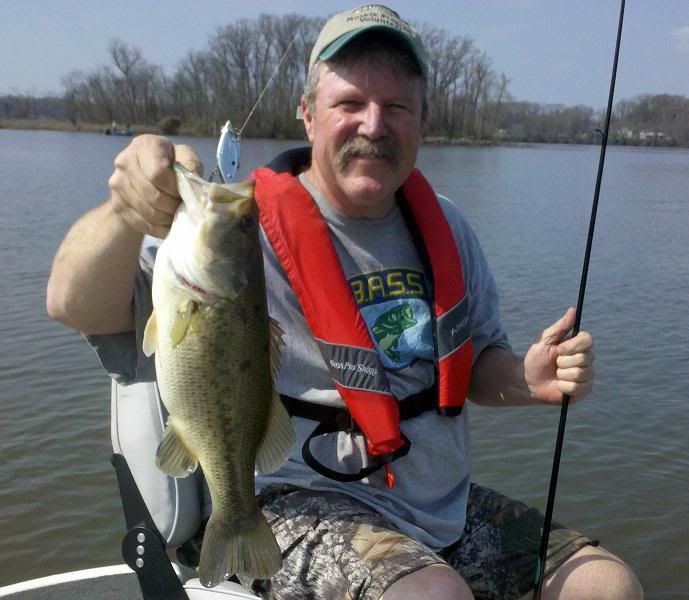
Largemouth bass love lipless crankbaits, or hate them, depending on your view of why they attack them so violently.
It's true, that I've seen fish come from a long way to hit these lures.  Stripers are notorious for chasing down baitfish at high speeds.  Largemouth bass are known to have extremely quick ambush attack speeds, but can also chase down a quickly retrieved lipless crank.  Why?  Like I said, who cares?  Just that they do it, but honestly, it could be a combination of reasons.

Lipless crankbaits provide plenty of vibration that can be detected by an extremely sensitive organ in fish called the lateral line.  When predatory fish sense these vibrations, the vibrations could provoke them into striking whatever is making them.  Also, this extra sensitive organ allows fish to hone in on these lures from long distances away.  The rattles in these lures could appeal to a feeding response, or just tick them off.  At any rate, most of these lures have a loud rattling sound, teamed with their tight vibration, designed to trigger strikes.  And, they most certainly do that well.
Gotta love what I call "trappin'" bass.  Mark fooled this nice bass on a lipless crankbait.
Whether you're fishing various colors or metallic finishes, most of these lures provide a measure of flash that could trigger strikes.  I love the metallic finishes when skies are bright or if I'm fishing clearer water.  Bright colors, like chartreuse, are great for fishing dingy water or dark days.  In fact, dark colors also work well in those conditions.  The action of the crankbait is key though, as the tight vibrating wiggle provides a flash that mimics their prey.  This feature could also trigger reaction strikes or appeal to their feeding urges.

For anglers, these baits are attractive because you can fish them so many ways.  You can just toss them out and crank them in.  You can cast them out and jig them back, or fish directly below the boat in deep water and vertical jig.  You can cast them out, let them sink, count them down, and fish them at any depth you desire.  Or you can fish them slowly across the tops of weed beds and rip them off the weeds (more on that later).  How much more versatile of a lure is there than that?
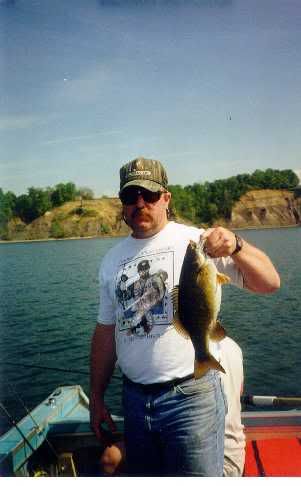
There are many ways to fish these crankbaits.   This pre-spawn Great Lakes smallmouth bass slammed a deep, slowly cranked lipless crankbait.
One huge advantage to fishing this type of lure is that they cover a lot of water quickly.  They're great search lures, especially when fishing new lakes.  They're perfectly designed for finding for schooling predatory fish, or perhaps fish ambushing baitfish on a windy point.  When the fish are on, you can catch good numbers of them on these lures for this reason, and not only that, potentially big fish.  They're big fish baits!
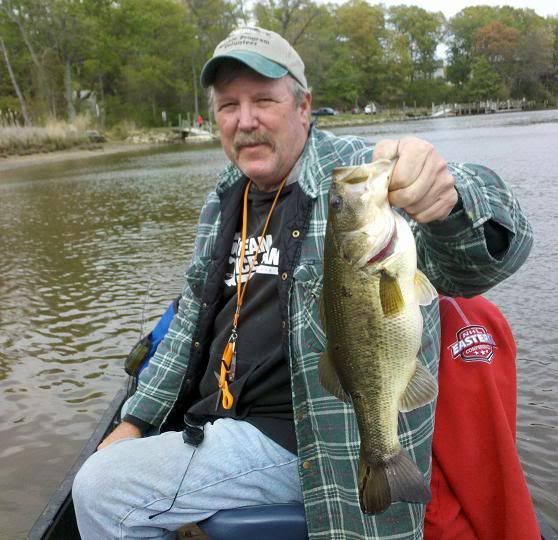
You cover water with lipless crankbaits to find chunky largemouth bass like this.
So, for those out there who don't know what a lipless crankbait is, they're basically a type of plug that is about a half inch or less in width, laterally compressed (almost flat), that sink on the fall, and don't have a lip like other crankbaits do.  Most of them have some sort of rattling system inside them.  The line tie is at the top of the "head" of the lure.  All of these features make them unique.

There are many brands out there, most of them produce well.  We all have our favorites.  I fish several different brands, because each one has a slightly different presentation, but they all have similar traits mentioned above.  I like the Bill Lewis Rat-L-Trap, Rapala Rattlin' Rap, Strike King Red Eyed Shad, and Yo-Zuri Rattl'n Vibe.  Each has their place in my box.  I carry four different sizes, depending on what I'm fishing for, being 1 oz., 3/4 oz., 1/2 oz. and 1/4 oz.  There are other brands that probably work just as well, but it's up to you to find your favorites.

If I had to say that I have a favorite or "go to" version, the first one that I tie on, one that catches just about any predatory fish, it's a 1/2 ounce Bill Lewis Rat-L-Trap.  I love the Chrome Blue Back color when fishing our tidal waters, as I feel it resembles the blue back herring.  Maybe it does, or maybe it doesn't, but that thought gives me confidence that this will work, and it usually does.
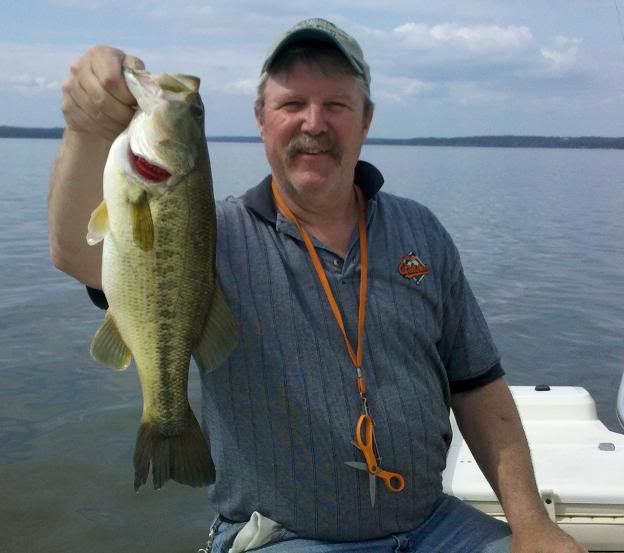
Shad and blueback herring run up river to spawn in the spring.  Lipless crankbaits are great imitators of these baitfish.  I like the Chrome Blue Back Rat-L-Trap for this purpose.  Nice largemouth, like this one, stripers and other predatory fish feast on them, and will do the same on your lipless crankbait.
For lakes and ponds, I love the Gold Black Back color this time of year.  I think that they resemble golden shiners, and in tannic acid stained waters, maybe resemble shad as well.  That said, there are other colors that could be effective in other situations or water conditions.  The colors mentioned above work best for me if there is about two feet or more visibility.  Truthfully, I think that color is the least important feature, except perhaps the metallic finishes, because they provide a lot of flash, as do baitfish.
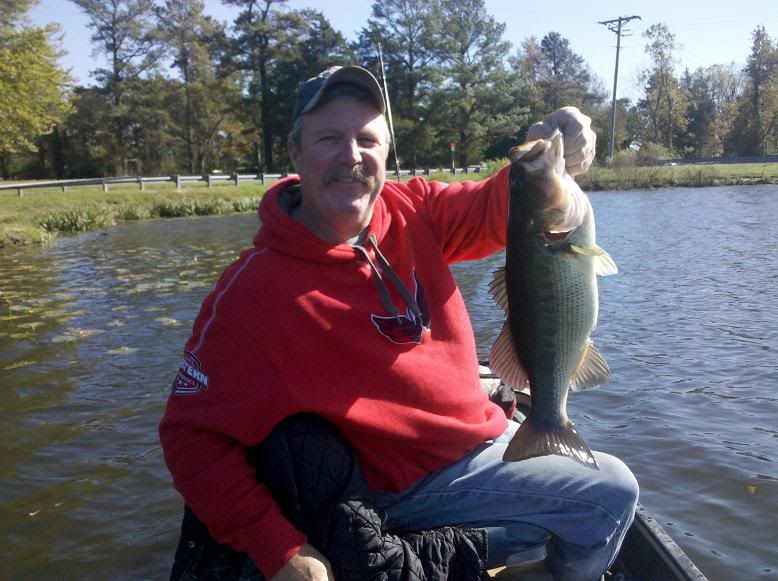
This chunky largemouth fell for a Gold Black Back 1/2 ounce Rat-L-Trap.  There are plenty of golden shiners in our lakes, so if your lakes have a good population of them, try the gold "trap".
Chain pickerel love the golden shiner imitation as well.
So, how do you fish them?  Like I said above, there are many ways to fish lipless cranks.  But, in spring time, which is the focus of this article, I'll mention my favorite pattern for largemouth.  During spring, some weeds are beginning to grow, while others have already been growing and are now filling in, and these weeds attract baitfish.  Equally important, is that weeds provide ambush cover and break up the silhouette of predatory fish on the bottom.  Most predatory fish, like bass, are dark on the top, and light underneath.  So, when they sit on the bottom in wait, they blend in with the weeds very well.  When cover like this attracts both predators and prey, it's a fishing hot spot.

In this situation, I try to fish just over the top of the weeds and let the treble hooks tick the tops of the weeds.  When the lure gets to the edge of the weed bed, I let it drop and flutter down, then rip it up and crank it back.  Often, when bass fishing, ripping a lure like this off the bottom will trigger strikes.  Also, lures that flutter down over weed bed edges could provoke a predatory fish hiding below.  As the crank flutters down, the fish think it is an easy meal, and attack it on the fall.
Steve will tell you that fishing over the top of weed beds with lipless crankbaits will catch big bass, and here's the proof!
When fishing over top of the weeds, your lure will hang up on weeds occasionally.  Don't just reel your lure in and clean it off.  When that happens, as long as it isn't a thick mat, rip the lure from the weeds with the rod tip and continue fishing the lure.  As with ripping a lure off the bottom, ripping one off weeds may also provoke vicious strikes from largemouth.  Again, the flash, vibration, and darting action of the lure when ripped off the weed is key, I believe, to provoking bass into striking.  This is the pattern, really.

How do I keep a sinking lure above the weeds?  I keep my rod tip up when reeling, and if the weeds are a foot under the surface, keep it higher.  This also allows you to reel in the lure a little slower, and I feel, making the lure more attractive to bass.  If you do this while keeping your rod tip down, you will have to fish the lure much faster to keep the lure up enough, or you will bury your lure in the weeds, leading to frustration and less productive casts.

I prefer using a long, fast action baitcasting bass rig for this, with braided line.  I used to use fluorocarbon line, and that worked well too.  The low stretch lines and long, fast action rods enable you to keep the lure above the weeds, and to rip the lure off of the weeds and clear it, while also provoking fish to strike.  My pitching rod and reel work great for this technique.
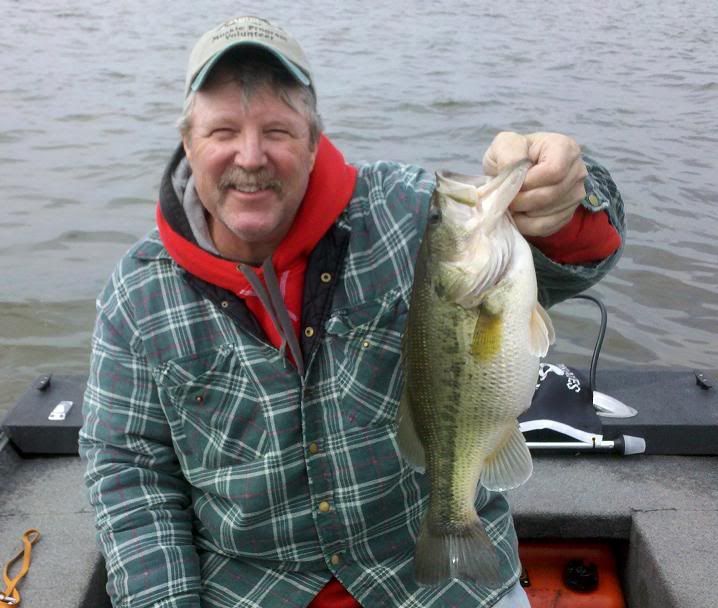
This largemouth, and countless others like this, were caught on the weed pattern described above.
Striped bass, or stripers or rockfish, as they call them in my neck of the woods, love lipless cranks too.  You can fish them any number of ways, but if I had to say one thing about them for stripers is that they like them fast, and they like erratic.  So, crank it in, let it stop, rip it, then crank as fast as you can, then rinse, repeat.  Stripers can out swim your lure no matter how fast you reel, if they want it.  That said, if they're deep, you have to let it sink down there so they can see it first.  That's the beauty of these lures, really, their versatility, and that they simply catch fish.
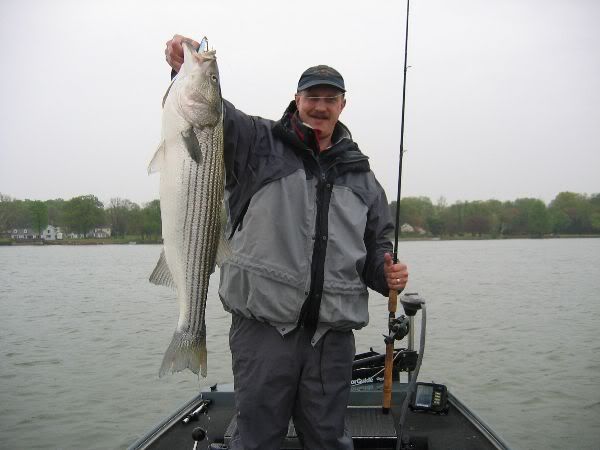
My buddy Bob with a nice striper that he caught on a 1 ounce Rat-L-Trap.

Carson (left) and his Dad, Bob, with a nice chainside caught on a lipless crankbait.  This time, the fish fell for a 1/4 oz. Rat-L-Trap in the Chrome Blue Back color.
The lure shape resembles a shad remarkably well.  When you think about it, they could resemble just about any form of baitfish as long as the predators don't have much time to examine the lure.  Perhaps that is why these lures are so effective?
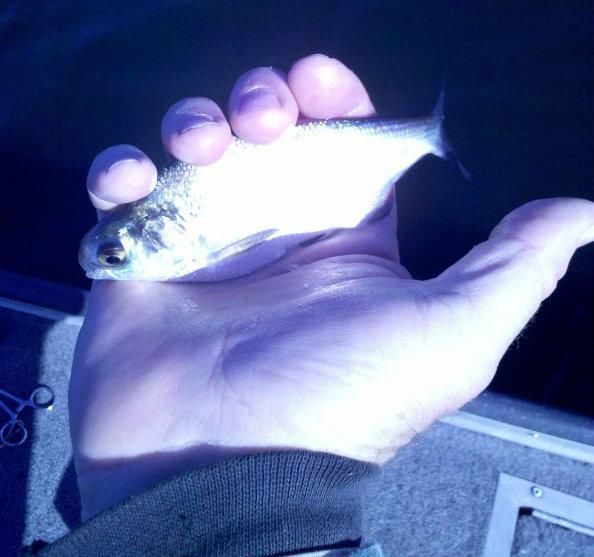
Shad, like this one, are abundant in our rivers, and in some of our lakes and ponds.  Lipless crankbaits are great lures that mimic these baitfish.   Lipless crankbaits match them in size, shape, flash, and even action.
I fish the larger sizes for larger predators, like stripers, pike, and even musky.  I prefer the half once size for bass, but there are times when the 1/4 ounce size is necessary.  The 1/4 ounce size will also catch perch, crappie, trout and other panfish.

The coolest thing about lipless crankbaits is that they can catch just about any predatory fish out there.  I caught my biggest king salmon on a black Cotton Cordell Hot Spot, and another huge one on a chartreuse Rat-L-Trap.  I've caught northern pike, walleye, lake trout, steelhead, large brown trout, and even catfish on them.  These lures work well on many saltwater species as well, especially bluefish and sea trout.  Talk about a versatile lure, eh?
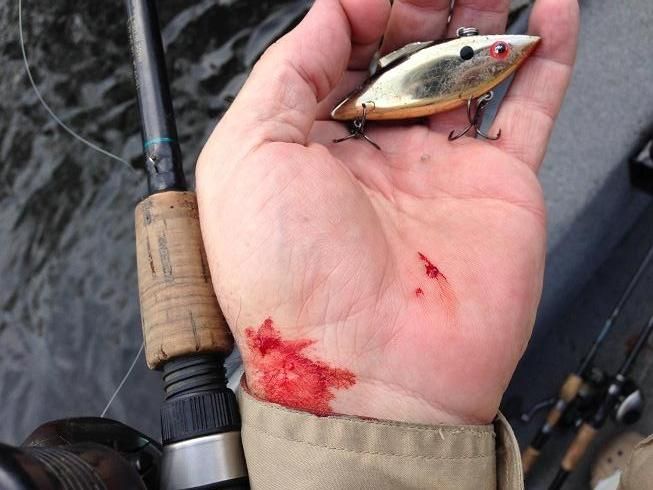
Oh yeah, a warning, as with any treble hooked lure, when unhooking fish, be careful.  I reached to unhook a chain pickerel, and the slimy fish slid down and the hooks both lodged into my hand, still attached to the fish while it thrashed about.  Talk about painful!  Luckily, this time, I was able to grab the fish while my buddy got the hooks out of it.  The hook that went into the middle of my palm popped right out, but the hook mark on the left took some handy plier work.  Fortunately, it came out quickly.  After all, I'm not a surgeon, but I did stay at a Holiday Inn a few times!
So, when the early signs of spring reach your area, if you haven't already, give lipless crankbaits a try.  By the way, they work well all year.  However, they're my "go to" lure during spring and early fall.  So get out there and give them a try!  If this helps you catch a big fish, please leave me a comment and tell me the story!