Welcome to Fat Boy's Outdoor Blog. I'll blog about fishing, hunting, and fossil collecting from my perspective of the outdoors. Everything posted here is dedicated to my brother, Kyle C. Wilson, who passed away unexpectedly in 2007.
Always for you Bro!
Note: I don't make a penny of this blog. I write for fun, to give back to the community, and to help others learn as others have taught me. I hope you all enjoy it.
Showing posts with label Crappie Fishing. Show all posts
Showing posts with label Crappie Fishing. Show all posts
I noticed that, on some of the social media ice fishing groups, some folks are interested in learning about how to catch crappie at night through the ice. So, since this is one of my favorite ice fishing activities, I thought about putting together this post so that I can provide more detail than I possibly could on a social media response.
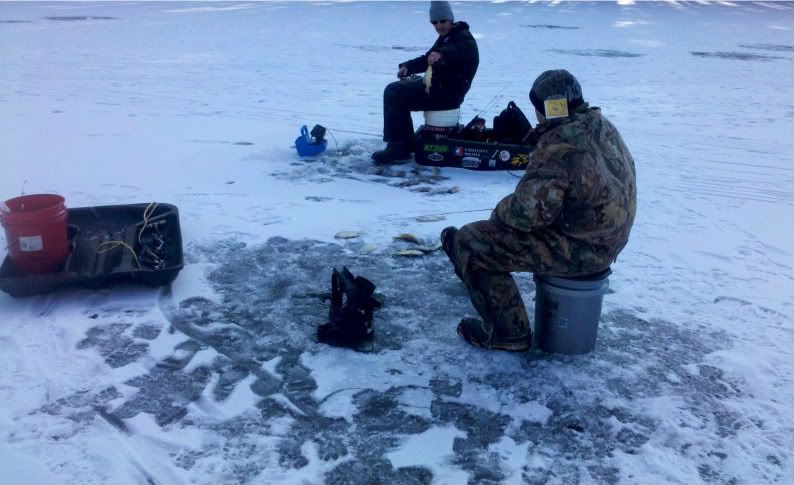
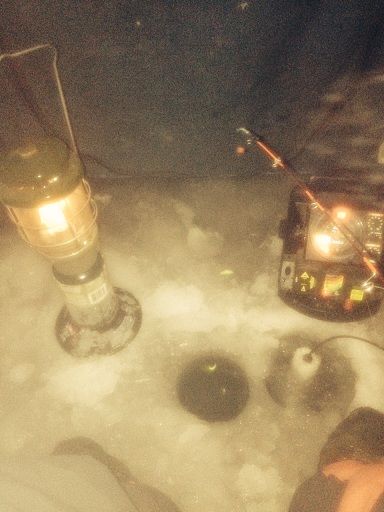
My Brother, Kyle, setting up for the crappie fishing night bite at one of our favorite lakes.
One of my greatest wintertime thrills is to jig for panfish at night through the ice, and especially for crappie. In this blog post, I'll present to you my strategies that will, hopefully, help you find and catch crappie at night. I love icefishing, and I'll do it from dawn to dusk, but, there's no question in any of my fishing buddy's minds that my favorite time to be out there is at night jigging for crappie. That's when I'm usually on my game.
Jigging at night for crappie can be rewarding as it is exciting.
It's no secret that I love to catch crappie, especially big ones. I love chasing them at any time of year. When they're active, it's some of the most fun fishing that you could possibly have. It can take the most serious of anglers and cause them to giggle like school kids. For one such crappie fishing adventure, you can read back to one of my old posts: the Joy of Crappie Fishing.
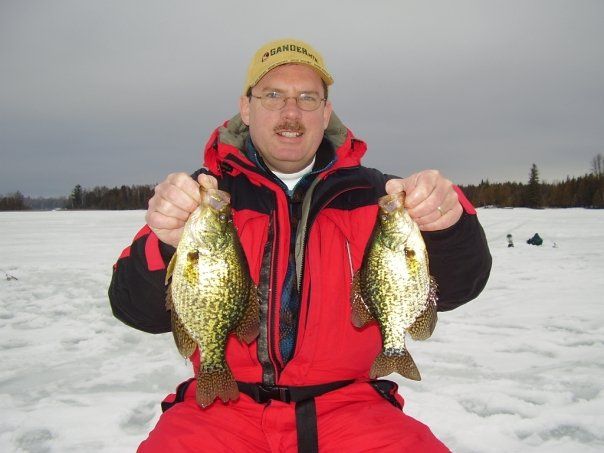
I love crappie fishing any time of year, especially where you can catch slabs like these consistently. With good action, it's about as fun as fishing can get. Getting fish like this through the ice at night is a little more challenging, but can be very rewarding.
So, what's my strategy to find good nighttime crappie action? Keep in mind that this is my strategy and I have my opinions. I don't have much science to back it up. It's not necessarily the "right" way or the only way, rather, it's my way. But, I have plenty of experience and, hopefully, some of these tips will help you find and catch more crappie through the ice at night.
Now, for the details of the strategy. The first step is to choose a lake that is known for having good numbers and size of crappie. I learned how to do this based on my experiences fishing various lakes either during open water or during ice fishing season. These days, we have the advantage of researching on the internet or through shared experiences on social media. A good topographic lake map of your lake, if available, will help you to identify places to try once your find a lake that you want to fish.
Next, finding nighttime crappie, especially on a new lake, means that you have to start during the beginning of your ice fishing trip. Early morning bite locations for crappie tend to also be good spots for night fishing. But, if you catch one, or even better, several crappie from one particular are during your day trip, chances are that you'll find them at that spot at night as well, or at least, close by. It doesn't always work out, but more times than not, it does.
I think crappie behave in the summer kind of like they do in the winter, but without a thermocline. So, locations on a lake during the summer that hold crappie, might be good spots to check in the winter. Such places might be shoreline woody cover on deep water shoreline slopes, or, perhaps the deepest basin in the area. That could be a cove on a large lake, or near the dam on small lake. I search for them over depths ranging from ten to forty feet deep, with the mid-twenties being a good place to start in our waters.
But, it depends on the lake. Some lakes that we fish have a maximum depth that is shallow compared to our reservoirs. In some lakes we fish, the deepest area in the lake could be as shallow as eight or fifteen feet, while our reservoirs could be extremely deep comparatively. So, I can't tell you that any particular depth is the right depth, but I can tell you that I rarely search for crappie in depths exceeding forty feet. You can determine a good area to try based on the topographical features of your lake and what type of lake it is.
Crappie also behave differently at different stages of our ice fishing season. Generally, they can be found in early season where you might expect them or when you caught them right before the ice formed. During the middle of the ice season, when the winter is at it's coldest and ice is building fast, try a deeper area and maybe look for marks closer to the bottom. During late ice, when the days start to get longer and perhaps the lake edges start to warm, they may move into shallow water cover, like weed beds, stumps or fallen logs. These places can also be productive during early ice. Crappie are like other predators, they follow the food chain. Where aquatic insects and minnows thrive, so do crappie.
Another tip that I can offer to you is to read the ice. On public lakes, or lakes where people don't "claim" a spot as always theirs, you can determine likely areas by reading the ice. It's kind of like reading the currents on a river or a stream for fish holding spots, but, rather, looking for evidence on the ice that a spot might be good, especially when visiting a lake for the first time.
Visual clues include, obviously, areas where a lot of anglers concentrate. Personally, I don't like fishing in a crowd. I prefer to be away from the crowd for several reasons. Crowds often make noise, which I feel, can shut feeding fish down, whether it's music, a lot of people walking around, noisy power augers (or even a hand auger cutting a lot of holes), and, as some people claim, that sonar might cause fish to become inactive. If there are a lot of sonar units out there, could that slow the fishing, perhaps?
I personally don't know if sonar causes fish to not bite or become inactive. I can't dispute it one way or another. But, the likelihood of seeing interference on your sonar rises the closer you get to another sonar unit, especially if there are a lot of different sonar brands on the ice with you. Let's face it, dealing with sonar interference can be annoying.
Next, I would look for evidence on the ice that indicates perhaps a good spot. It doesn't always work, but, sometimes, it does help, and could make the difference in being successful or not, especially if you don't have many hours to fish. It narrows down your search. Let's discuss some of the types of evidence that you may encounter.
Holes: Lots of holes cut in an area, are such evidence. New, open holes, obviously, means that someone fished there recently. But, old holes give clues too. A line of holes far apart may indicate that angler was searching for fish. A cluster of holes might indicate a good spot. Two holes or three cut close together might mean that someone thought that this spot was good enough to put their sonar and/or camera in adjoining holes to the one that they fished. Lots of times, people that nightfish together leave this type of evidence. Open holes save time, allowing you to check them quickly with your sonar, moving from one spot to another looking for suspended fish. At night, this could be key if the first area you chose didn't pan out.
Blood: blood on the ice could mean many things, but usually, that's evidence that someone either kept fish that they caught on the ice, or, heaven forbid, some other tragic personal event!
Evidence of bait: Discarded minnows, saw dust from spike or waxworm containers, discarded waxworms or spikes (the more the better, that means someone spent some time there).
Trash: Maybe discarded bait containers. It stinks that people leave trash on the ice. But, it is evidence. I clean the big stuff up if I find it, unless, it appears that someone left something out there to purposely mark a spot. Recently, there was a beer bottle buried in the ice that we couldn't remove. Either someone littered, or they put it there purposely. I believe that they did it to mark a spot, because, it was buried halfway in a cut hole.
Lots of tobacco stains: Huh? Yes, evidence that someone fished here for more than a minute or two. The more tobacco stains, the better.
Footprints: they also tell a tale. If someone used tip ups, you can see trails that connect a series of holes. You can also see where they chose their base. That may or may not pan out for jigging. However, if you see a couple holes or a few holes close together, or a lot of old frozen holes, and even better, with lots of footprints, someone spent time there. If an area is well used, you can't identify individual footprints. The entire area is mashed down.
You can imagine why footprints can indicate a good fishing area, at least until new snow covers them up. When guys find a good spot, like my buddies Geoff and Yaz did here, their footprints kind of give it away that they had something going on here.
Lots of sled tracks: They can be road maps to good locations, especially if there are holes cut in a line or direction that are far apart, but lead you to a bunch of holes that indicated that they may have found fish and opened up the area. That said, the evidence or clues that I mention here in this post don't guarantee that the previous anglers knew what they were doing. But, it doesn't hurt to check such spots. The best evidence is when you cut or check a hole with your sonar, and you mark fish. If you see sled tracks that leads to lots of footprints around a hole, that could mean something.
Wood sticking up through the ice: could be structure to fish in lakes that are shallow. If there are holes around it, it could be a good spot to find nighttime crappie. Be careful around these spots during early or late ice if the ice conditions aren't great, as wood or other debris can absorb heat and weaken the nearby ice.
Weeds on the ice: often, these are pulled up by augers or reeled in after being snagged. But, they indicate the presence of a weed bed. Find where those weeds meet deeper water, that could be a good crappie spot.
Lake shoreline contours: Finally, the slope of the shorelines and shapes of the points and coves can lead you to a good area, especially if you did your homework by researching a lake contour map. If there aren't any contour maps available, check the lake out by using the satellite feature on your favorite browser's maps application. Such aerial images can point out shallow weedy areas, long sloping points, underwater sand bars, the deepest water, and other types of structure.
When you know of a good spot ahead of time, my suggestion is, if your not nearby, head to that spot before the magic hour (the last hour of daylight before dusk) and use that as your starting point of your search. You'll probably catch other species there too, but, the crappie will start getting aggressive around that time. If you find fish, it can be hectic from that point on until about an hour after dark, maybe longer.
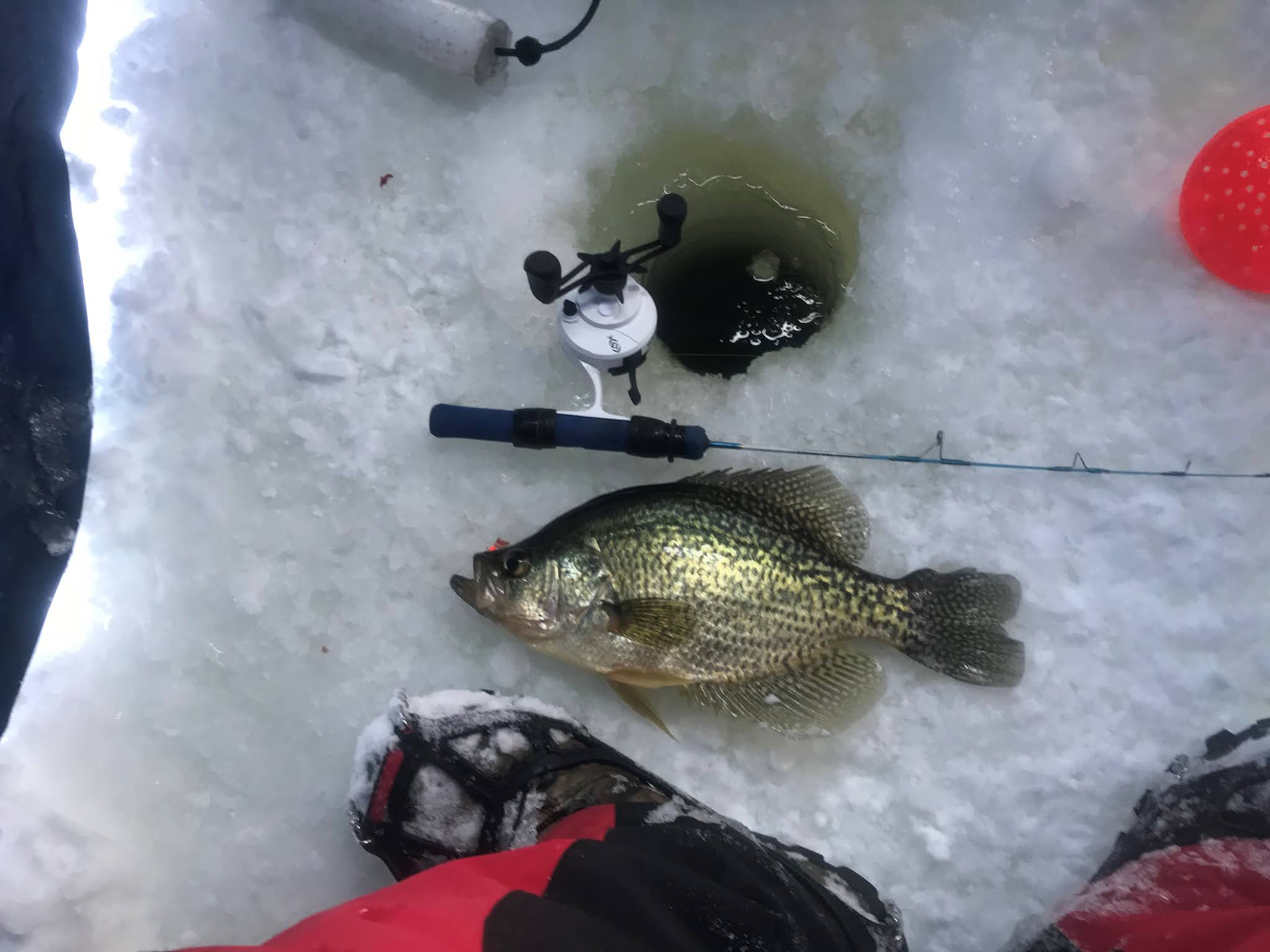
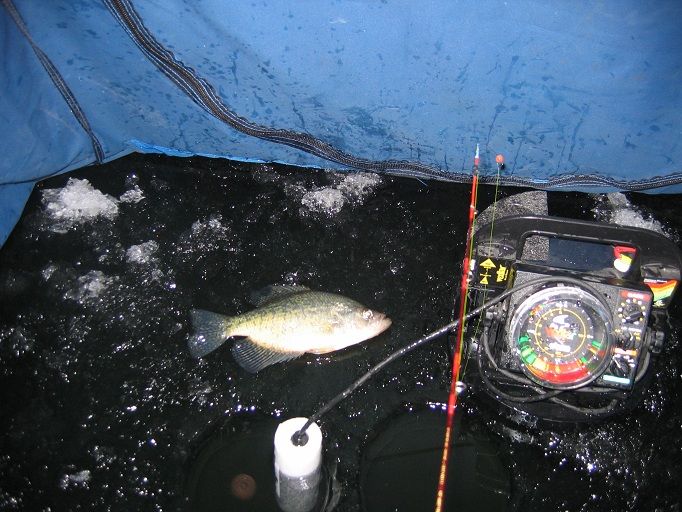
Steps to finding crappie at night: Step 1: Find a lake with a good population of large crappie - check. Step 2: Mark a bunch of suspending fish during the day - check. Step 3: Catch a crappie during the day, remember that spot for the night bite - check. Step 4: Go back to that spot and fish at night - check. Step 5: Catch crappie at night: ugh...not this time. It was a tough day and this jumbo crappie was caught at 10 AM during the day. We went back and tried that spot at night, but it didn't pan out this time. The system usually works, but not always.
Also, at any time during the day, if you mark a lot of suspending fish and they are aggressive, that could also be a good place to try later after dark. If you arrive at the lake late in the afternoon, cut holes until you find suspended fish, or, at the very least, mark a fish on your sonar. Remember these spots especially if you catch a crappie.
Of course, if you fish a favorite lake often and have had success at various areas of that lake before at night, that could really narrow down your search and give you a good place to start. Most of the time, the best spots to fish are similar from year to year.
Next, it helps to have the right tools. Can you catch fish without some of them, especially the more expensive ones? Sure, but, you could be missing out on a good bite if you don't know where the strike zone is. You can develop strategies to figure that out, but, it's a lot more work and more time consuming.
So, what are my preferred tools? My must have tools, in my humble opinion, are a flasher style sonar, a sensitive ultralight ice fishing rod spooled with two pound test, and a selection of jigs that you know catch crappie. I prefer glow in the dark jigs for night fishing, for the most part. As far as electronics go, any sonar will do, but most anglers prefer flashers.
A flasher style of sonar will not only find fish, but you can see your lure and also how fish interact with the lure. This is critical for nighttime crappie fishing since often the fish are suspended.
The latest technology in electronics allows you to switch views between traditional fish finder screens to a flasher screen. These new and improved sonar units have improved with very close to real time responses to activity. Flashers, in the past, held an advantage in this area. What do I mean by that? When you jig your lure, a flasher will show that in real time, so when a fish bites, you will see that in real time also, allowing you to focus either on your rod tip or sonar at the correct time.
The main point here is that electronics hold a huge advantage to finding and fishing for crappie at night. Not only can you find fish, or see them on the bottom or suspended, but you can see your lure and how the fish react to it. Once you buy and use sonar, and later fish without it, it feels as though you are fishing blind.
Another key piece of equipment that I think really helps is to have a bright lantern out there with you. I use a Coleman Northstar lantern that puts out 1,500 lumens. I'm a firm believer that fishing with one or more fishing buds that have lanterns in the same area really helps. The more light that you have, the more zooplankton is attracted to the area, which, I theorize, brings in more fish. Some people also use submersible lights. I've never tried that as I don't own them.
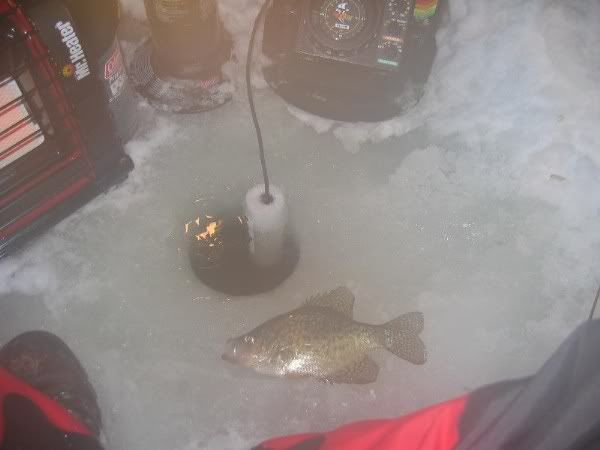
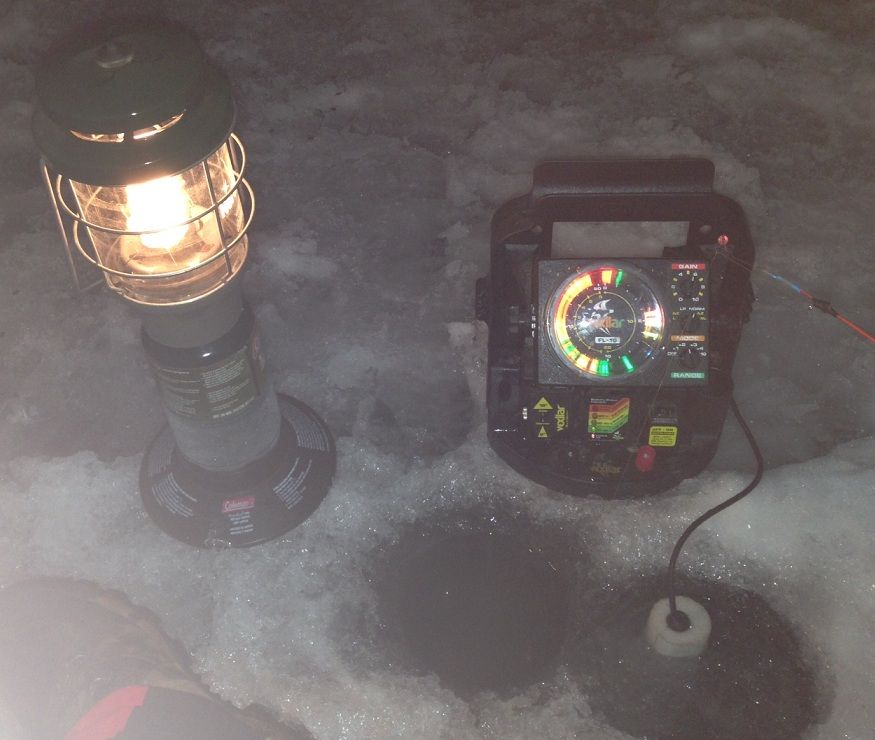
In this photo, you can see three of my most regarded pieces of equipment, my sonar, lantern, and a sensitive ultralight ice fishing rod with a glow in the dark jig tied on.
Supplemental lighting also helps, not only for seeing bites and your rod tip, but also for finding things in your sled or tying on lures. Usually, light from the lantern to see all my stuff in my sled is blocked by me, so the additional headlamp helps. Seeing your rod tip and line is key to catching crappie at night, especially when they are not that aggressive. A strong LED headlamp or other LED lighting can really help. Plus, they make a great backup if you run out of propane or forget your lantern.
Supplemental lighting also helps. A good LED headlamp will also not only allow you to see anything at night, but will help you catch fish by focusing a light beam on your rod tip so you can see bites. I also use a magnetic shop light that sticks to the metal base of my seat rail on my sled. In this picture, both came in handy when my lantern ran out of propane that night. Note to self: always carry a spare can of propane...
The last piece of equipment that I personally like is my pullover shanty/sled. I have a Clam Fish Trap Pro and have been using it for many years. I love it, I love fishing inside it, and it helps me in so many ways. Before purchasing it, I sat out in the cold and fished, and usually, it's much colder at night.
A pullover shelter/sled, like my Clam Fish Trap Pro, helps me get out of the elements and stay warm. Being out of the wind helps you catch more fish. Being more comfortable helps you catch more fish. And, being mobile helps you find and catch more fish. If I need to move, all I do is flip my canvas top back, gather my gear and go.
Fishing inside my shanty is warmer naturally because you're out of the elements. Your lantern helps provide heat as well as light inside. I can remember fishing when temperatures outside my hut were in the teens, and I had layers peeled off inside while wearing just a flannel shirt! The shanty also provides a nice wind break, making it easier to see bites without the wind messing things up. Plus, the extra warmth helps keep the holes from freezing up on you.
And, if you like to fish in privacy, it's a great way to escape the eyes of neighboring anglers that might want to get in on your action if you're catching fish. Usually, I don't mind company, and I like to share my spot with friends, but, it's nice to have a couple fish under your belt before they all come join you. Sometimes, their holes are producing anyway, so they may not have the need to fish close to you.
I've been using a flasher style sonar on the ice for over thirty years now. My friend and ice fishing mentor, Jeff Redinger, not only taught me the fine points of ice fishing, he also was the first person that I ever saw using a flasher on the ice. I fished with him for a couple years without using sonar, relying on him for intel as to where the fish were. I can tell you that, even though he shared info, he always out fished us by at least 8 fish to our one, maybe even more.
One of the guys who introduced me to ice fishing and the use of sonar on the ice, including teachings of Dave Genz, is my good friend and ice fishing mentor, Jeff Redinger. Here Jeff shows the results of his talents with a couple jumbo slab crappie.
Jeff was a big fan of Dave Genz at the time, and used what he learned from Mr. Genz to become a top notch ice angler. Dave Genz basically made famous the use of sonar to find and catch fish through the ice, and his tactics of constantly moving to find active fish, rather than sit on one hole all day waiting for a bite. Jeff was my mentor, but I have to also give credit to Mr. Genz for what he showed the world. He wasn't the first or only person to use sonar on the ice back then, but, he certainly made it famous. As far as his strategy to find fish, many people did that too, but, he was certainly a pioneer in that regard as well.
Jeff, a couple other buddies and I went to a particularly good lake known for big crappie in hopes of repeating success that he had on a previous trip. We fished hard all day long and caught fish here and there. We set up at right before dark at an area where Jeff marked fish earlier and caught a crappie. He used his sonar while fishing small live minnows on a light aberdeen hook with a split shot on one rod, and a jig tipped with a waxworm on the other. We jigged glow jigs tipped waxies within 12 feet of him.
Jeff relayed info to us about what depth he was seeing fish. As he yanked in one after another, it was apparent that we pay heed to what he was saying if we wanted to catch fish. Without sonar, most guys, including me at the time, would fish the bottom three feet. He'd tell us that they were suspended at a certain depth, so we'd try to keep our lure at that depth and jig. We had to guess that we were at the right depth, of course.
By Jeff using his sonar, he could see his jig, see the fish, and see how they reacted to his jig. That feedback allowed him to alter his jigging cadence to get the fish to bite. He could also see his live minnow and if fish were looking at it or not, and adjust if necessary.
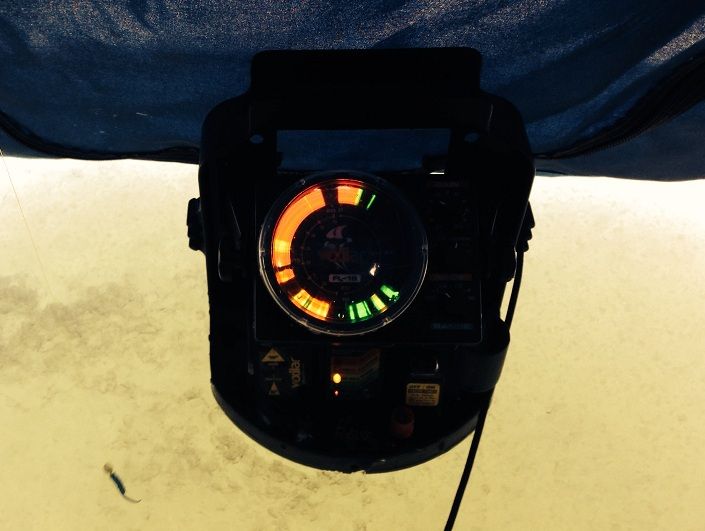
Here, you can see fish suspended on my flasher on the right side of the sonar screen, at two o'clock down to a couple feet off the bottom at 5 o'clock). I try and drop my jig just above those marked fish
We caught fish, just based on what he said, that we probably wouldn't have caught had he not been there, or if he didn't have sonar. Fishing with sonar through the ice is so valuable to me, and many anglers, that after purchasing one, we can't realize what we'd do without it, and wonder how we caught fish all those years without using one.
Using sonar was quite a revelation, let me tell you. Definitely, a game changer. My friend, Glenn, purchased one the next year, and I got one the year after that. Ever since then, it changed the way that I approached jigging for panfish forever.
I have to give credit to the other guy that introduced me to ice fishing, my good friend, Glenn Cumings. If it wasn't for Glenn convincing me to go to one of his ice fishing workshops, I would never have set foot on the ice. You see, people just didn't ice fish where I live. I met Jeff at that first workshop. A few days later, they talked me into going to ice fish a local lake. I was scared to death out on four inches of clear ice, but, I was hooked after that. Here, Glenn shows a crappie caught at night during a recent trip.
Not only that, while fishing other lakes with my new sonar, I had people come up to me and ask what I was doing. I showed each of them how the sonar worked, that you could find and see fish, that you could see your lure, and you could see them react to your lure. In most cases, I gave up my seat and let them try it out and catch a few fish.
As time went on, over the years, some of them found me on the ice or on the ice fishing forums and told me that they wound up purchasing sonar too as a result of that experience. I became friends with most, if not all, of those guys. Some of them recognized me on my favorite ice fishing forum, Iceshanty.com. By the way, my user name on that forum is also Fat Boy (the origination of the Fat Boy name for this blog).
Over the past 30 years, sonar has become more and more widely used. In fact, almost everyone that I see on the ice today has some form of fishing electronics with them. I'm certain that the popularity of flashers started with television shows and magazines, but it really exploded as the internet emerged as a dominant source of information for anglers.
So, how does a flasher style sonar unit help at night while fishing for crappie? Well, in my opinion, I feel that crappie tend to "feed up", so, when I'm successful at night fishing for crappie, I try to entice them to follow my lure by fishing my lure just above their depth. When they chase or follow my lure, I know pretty much that I'm going to get a bite. So, having the sonar is key to knowing what depth to fish. How can you work a lure above them if they're suspended, and you're fishing the bottom?
Crappie often suspend, and seeing them on the sonar helps you figure out best how to work your lures. It also helps you determine if the fish are in a biting mood or not. In this photograph, the bottom is at about six o'clock on the sonar, and the red marks are so thick that they fill up the screen all the way to four o'clock. The green marks above that are suspended fish. Usually, those are the most aggressive. On this particular trip, the fish were all seven to nine inches long, not big, but, we caught a lot of them, so it was fun.
Well, experienced anglers that don't have sonar know that crappie suspend, so they set baits at various depths (especially if using live minnows) to try and tempt fish that may see their baits. They also jig the entire water column, starting at the bottom and working their way up. That works, but, it's certainly not as effective as if you use sonar.
Do you need sonar to be successful fishing for crappie at night? No, but it certainly helps. If you know a good spot, and it's consistently good from year to year, then you can set up and fish without sonar and catch crappie.
I can remember at one lake that we used to love to fish, a bunch of guys would sit together in a circular group, each with two holes cut, one for each rod rigged with minnows, and each having a lantern fired up. All those guys, lanterns and minnows grouped together over a good spot resulted in them catching a lot of nice sized crappie. We saw them almost every time we visited that lake.
But, think about it. All of the elements that I've discussed in the last example, save the sonar, were at play. There is also a social benefit to fishing this way. At least now, with COVID guidelines, people can't get too close to fish to you if they follow the six foot distance rule! Even that is too close sometimes!!!
What kind of lures do I like? Crappie will hit a wide variety of ice fishing jigs and spoons. There's no denying that. I have my favorites, and I'll share them here. Some work really well for me at night, and those are my go to baits.
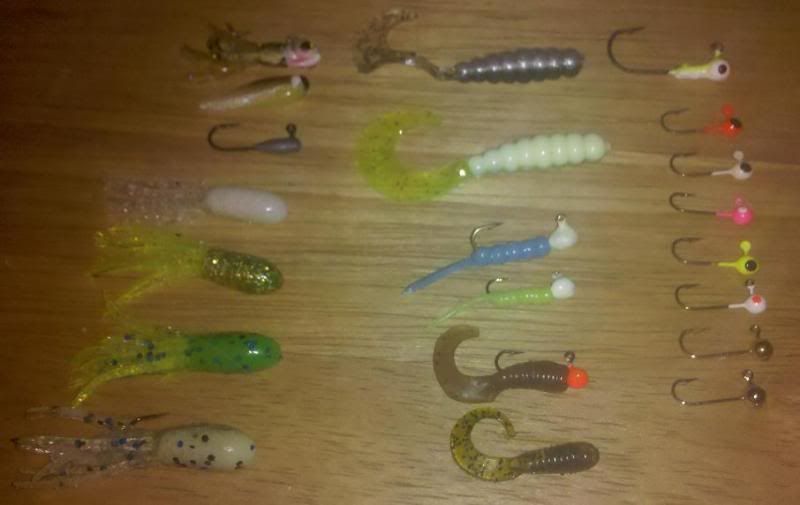
Probably my favorite rig is two glow colored Custom Jigs n' Spins Ratsos rigged in tandem, one above the other about 8 to 12 inches apart. These lures have caught me more night time crappie than I can ever count. The slow fall and enticing plastic tails tempt crappie just about every time I'm out at night fishing for them. They also work great during open water fished under a float. They come in various sizes, but I like the two smaller sizes the best. Guess who turned me on to the Ratso? Why, Jeff Redinger, of course!
One of the first lure combinations that I've had great success with over the years was a simple 1/64th ounce jighead teamed with a Bass Pro Shops pumpkinseed Squirmin' Grub. Panfish love 'em. For night fishing, put them on a glow jighead, or even a Ratso head.
The smaller Ratso in this picture (middle column, third from the bottom) and the Bass Pro Shops Squirmin' Grub in pumpkinseed (just below the Ratso are two of my favorite crappie ice fishing favorites. I like the Ratso's glow colors best (pink, blue and green) when night fishing.
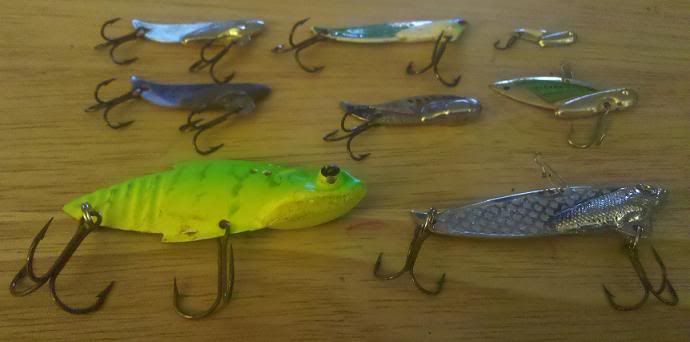
Another favorite when targeting big crappie for me is the 1/16 oz. Cicada. It produces a lot of vibration and calls fish in nicely during the day or after dark. I haven't caught a ton of fish on this lure, but I've caught my biggest crappie on this lure. I pull this one out when I know that the lake that I'm fishing has jumbo sized crappie up to 15 inches long.
I always have a blade bait rigged up. Often, if I need a break to stand up or the fishing slows at the hole that I'm sitting over, I'll get out and bounce around and try this lure at every open hole around me. I can cover a lot of water quickly. I drop the blade bait down to the bottom, lift it up to just off the bottom, then rip it up so that my rod tip is about eye level. Then, I let the jig fall on a tight line. Hits will come either on the fall or as the lure stops at the bottom.
I can't tell you how many bass and big crappie that I've caught this way during open water or through the ice. You don't need your sonar for doing this, but it's fun to watch, so also try it at the hole that you were fishing before too.
The 1/16 oz. Cicada (right side, middle row) is one of my favorite lures when targeting big slab crappie. I've caught some real hawgs on this lure. Bass and other predators like it too.
Another really good ice fishing jig for night time crappie over the years is the Custom Jigs and Spins Demon in the orange glow brite color, but any of the glow colors will do. I carry a variety of sizes and colors with me. This is probably my favorite vertical presentation bait. The glow feature on these are fantastic, and offer a bigger glow profile than other jigs. They flutter on the fall like a spoon, and are deadly when tipped with waxworms or spikes.
This is the Custom Jigs and Spins Demon jig. It's a vertical jig that has lots of fluttering action. The glow colors glow exceptionally bright, making them one of my favorite nighttime crappie jigs. This isn't the smallest size, maybe the next size larger than the smallest.
I also carry a whole bunch of ice jigs in various sizes and colors. I have a good selection of horizontal jigs (like the Ratso) and vertical jigs (like the Demon). I also fish a bunch of different sizes and colors of the tungsten jigs like the Fiskas jigs that you can get at Your Bobbers Down. I've caught crappie on the smallest and largest sizes.
You can tip these with live bait like spikes or waxworms, or fish them with a variety of soft plastic lures. I choose something that glows for night fishing. Some of them have a glow bead, that shows a small glow profile to the fish at night, while other colors might cause the entire jig to glow. Try different ones until you find one that works the night that you're fishing. In general, if they're finicky, I go to the smaller sizes. Conversely, if they're really aggressive, I'll choose the larger sizes.
But, honestly, you don't need to carry a ton of lures around with you. I think that I can catch fish on usually what I have rigged up. But, there are times when fish are finicky and you need to solve the puzzle, when a different lure might make a difference.
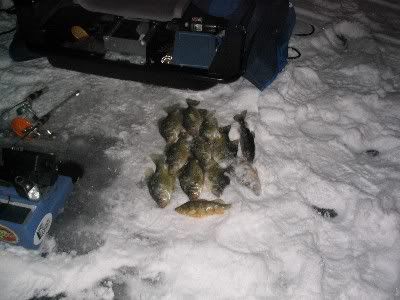
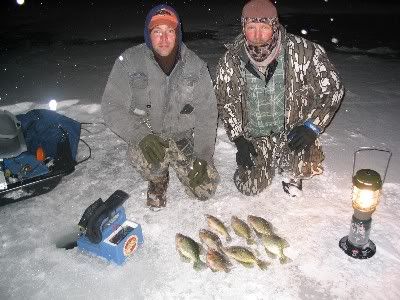
Here are some slabs that my Brother, Kyle, and I kept one night. Kyle and I, caught a bunch of fish that night and kept just enough for a couple meals. These fish hit a tiny Marmooska jig with a small glow dot on the front of the lure tipped with a couple spikes.
Tungsten jigs fish heavier than lead because it's a much more dense material. What that means to me is that I can fish a much smaller jig and get it down to the fish faster than a lead jig. When they're aggressive, especially in deeper water, after you catch a fish, you want to get that lure back down there quickly before the fish move off and lose interest so you can catch another one.
OK, so let's discuss the Ratso. What makes this lure so special? It's not tungsten, but is lead, so it has a slower fall than other lures. I think that, in itself, draws strikes when faster falling jigs don't. I like it best when the fish are holding in 25 feet of water or less. I'm not afraid to fish it in deeper water, but it takes a long time to get the lure back down there to the fish. The soft plastic is small, relative to the Bass Pro Shops grub or soft plastic tube jigs. But, that stinger tail will twitch on the slightest movement of your rod tip. One is great, but two in tandem are deadly.
Custom Jigs and Spins now offers a tungsten version of the Ratso that is called the Tutso. I plan on getting some of them too for fishing deeper water. Edit: I just ordered some of them directly from the company. Please don't tell my wife about that!
Generally, if I'm marking a lot of suspended fish, I let the lure drop down through the school and watch my line and rod tip. If I see the line go slack, then I set the hook. That means that a fish intercepted the lure and inhaled it as the lure fell. If there are a lot of fish down there, it's tough to distinguish your lure from the fish.
If I don't draw a strike on the fall, then I'll jig it up slowly, using 1/8 inch hops of my rod tip, raising the Ratso 1/8 inch at a time. I don't hop the jig up and down. I just jig it up and keep it up. I keep raising it to see if fish follow it. If they do, I keep on raising it up. My favorite cadence is almost as if my rod tip is like a pencil, and I'm drawing a pig tail style line from bottom to top vertically with 1/8 inch circles. I don't know, but doing that keeps me focused on that spring bobber. I do all of this when I have the attention of the fish.
But what if they don't seem to be interested? Sometimes, they just aren't looking in the direction of your lure. You have to jig more aggressively to get their attention. Once they react to your jig, especially if they move right to it, then the above cadence works great.
What if you were marking lots of fish, but, then they seem to vacate your screen? Try aggressively jigging again to "call" them back in. Once they show up, usually others follow. If you try this often and no fish appear, then perhaps it's time to scout out other holes and move. For me, once I'm on fish at night, they rarely leave. I think that the lantern lights attract and keep them there. Plus, the activity of fish feeding (being caught) seems to draw others in. That's my theory, anyway.
Speaking of spring bobbers, for my Ratso rig, that's a key component. Crappie are notorious light biters, and often, you don't see the bite with just a rod. With my spring bobbers, I can see the bites easily. If a fish hits without pulling the spring down, it may create slack line, and often the spring will move up, or relax. If you see that, set the hook.
In the video below, I talk about my tandem Ratso rig and my home made DIY ugly as sin but effective spring bobber. What I don't mention in the video is that the light wire was purchased from a lure making vendor so I could make weedguards for my buzzbaits.
Even though I make my own spring bobbers out of light lure making wire, there are some very good commercially made ones out there that fasten to just about any rod that you own, and, they're much prettier than my springs. I highly recommend that you have at least one spring bobber set up for fishing at night for crappie, or at least, a very sensitive rod.
This is one of my home made spring bobbers. It's not pretty, but it works. Basically, I bent the wire to my desired shape, added a bead at the end so it's easy to see, then formed a loop that my line goes through. At the other end, I shrink wrapped the end and glued it onto the tip of an old broken rod. Years ago, I accidentally broke the tip off the original rod, which I loved, but now, it catches even more fish with my spring at the end.
Sometimes, when they're really aggressive, they'll charge right to the lure and hit it. Other times, they'll follow it way up the water column, maybe a few feet or even all the way to just under the ice. As long as a fish is interested, I keep working it until I get a bite.
If the fish is just below the lure, you can see that separation on your sonar. When the fish is even with the lure, take your eyes off of the sonar and watch your rod tip. If you see anything out of the ordinary, from slack line to a tiny twitch of the rod tip that you didn't do, set the hook, it's a bite.
If you know that the school is aggressive, you can drop the lure to just above the school, and they will rise up to your lure. If I'm using my tandem Ratso rig, then I'll drop the bottom jig right to the top fish or just below. Why? I might catch two at a time that way.
When the fish are really inhaling the lure, your rod tip or spring bobber might bend slowly and strongly. When that happens, you know it's a good crappie swimming off with your jig. Set the hook!
I don't always catch big crappie at night, but many of my bigger crappie do come at night.
Everyone knows about that magic hour during the last hour of daylight. Some stay a while longer. But often, after most leave, and you have the ice all to yourself, the action really picks up.
There is a small lake local to me that we fish often. It closes at 9 PM, so we have to be off the water by then and packed up, ready to leave the property. Anyway, it always seems that there is a lot of activity at dusk, and for the next hour or so. Then, it slows a bit. But, it always seems to pick up around 8:30 PM, of course, on this lake, right as you have to leave.
On other lakes when you can fish all night, you'll find that often the action is steady all night. During our last trip, we were planning on leaving for home around 9 PM, but, the crappie kept on coming. We kept fishing until just before midnight, and with our three and a half hour drive home, wound up getting back around four in the morning. But, it was worth it.
Fishing at night can be fun and rewarding, especially when you get on some big slabs. Hopefully, my strategy and tips will help you find crappie at night. If you enjoy catching panfish through the ice during the day but have never tried ice fishing for crappie after dark, give it a try. You might discover a whole new aspect of ice fishing and make it your favorite time to be out fishing on the ice.
Last week I put my boat into the Upper Tidal Potomac and took my buddy to a spot that has been producing for me. Now, I could give you a fishing report, but really something more interesting to me happened, although the fishing was also pretty doggone good. We ran into Gene Mueller’s long time buddies, Andy Andrzejewski and Marty Magone as they were also targeting any fish that was willing to bite that day.
Pictured are Gene Mueller's buddies, Andy Andrzejewski (left) and Marty Magone that we met for the first time on the water.
I had never met either of them before, but because of Gene’s blog titled, “Gene Mueller’s World of Fishing & Hunting”, I felt as if I’ve known them for some time. That said, when I recognized them, I was a bit apprehensive about introducing myself at first. But, being the fishing social butterfly that I am, I blurted out a less than subtle, “Are you Andy?”
Andy’s reply was, “Yeah”. The tone sort of sounded kind of like a, "what about it?", or "who the hell are you?", or "what’s it to ya?" type of thing. For the record, he didn’t say any of those things, and he probably wasn’t thinking any of them either. That was my own insecure alter ego speaking to me. But he asked if the reason that I knew of him was because of Gene’s blog. I replied, “Yes, and also because I’m a fellow outdoors blogger and internet friend of Gene's… Fat Boy’s Outdoors?”
I was hoping that would break the ice, and that they’d recognize my blog name since Gene graciously added my link to his site, and often points folks to my blog. But it dawned on me that maybe they didn’t know of it, or if they did, what if they didn’t like it? I think that if that was true, then I’d have fired up the motor and scooted on outta there faster than leaving the house on a fishing trip with chores to be done!
Fortunately, after a pause, Andy blurted out, “Oh yeah! I’ve heard of you and your blog!” And Marty added something to the effect of, “ Funny, you’re not as fat as I thought you’d be!” (although that wasn’t exactly what he said, it was the gist of it).
All I could do is laugh at that point. The ice was broken, and all of a sudden, it was obvious that I wasn’t a fishing threat to them. You know, the kind of threat like, why the heck are you moving in on my honey hole? Still, we kept our distance so as to not disturb their fishing and give them appropriate elbow room, fishing the outskirts of the hole.
Andy then opened up and told us that the crappie bite up to that point hadn’t been all that hot, but they had boated over a dozen bass already. But it didn’t take long for both Andy and Marty to start nailing the slab crappie, one after another. Meanwhile, Rodger and I were getting a few hits and misses every now and then, and finally started catching a few.
Rodger had never fished there before, and in fact, had never fished for crappie before. He may have been getting bites and not recognizing them. We were jigging for them, and the bites were subtle. Just a twitch of your line could be a fish, and you may or may not feel the tap of the bite. Sometimes, you saw or felt nothing other than perhaps a little weight at the end of your line, like a spongy feeling like when you have a large leaf stuck to your lure. I told Rodg to set the hook on anything. He still struggled.
Finally, I pulled out the secret weapon…Smelly Jelly. I smeared his lure with it and the very next cast he caught his first slab crappie. Then, it was one after another.
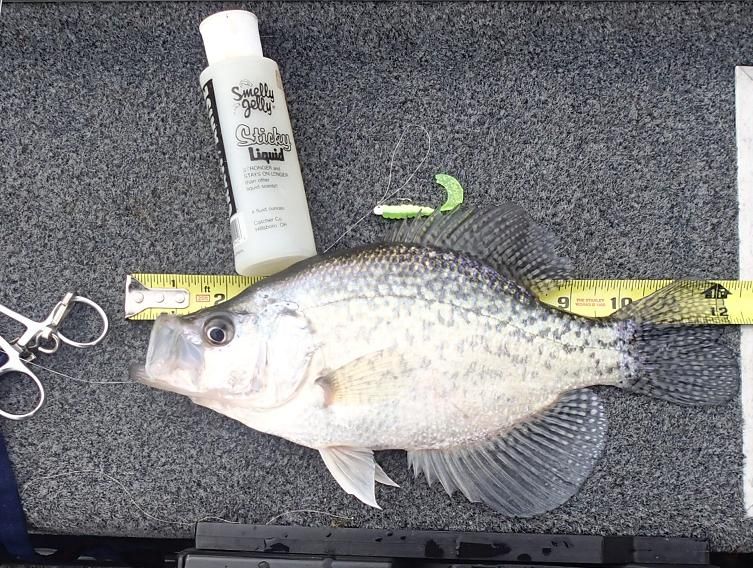
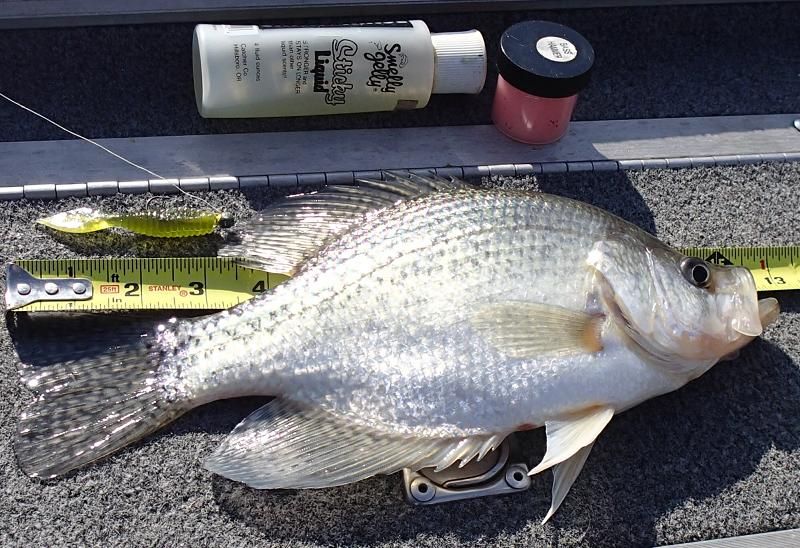
Smelly Jelly was the ticket to get Rodger into slab crappie like this one. Later, the Kalin's grub pictured above took one crappie after another all day long.
Andy wanted to get a picture of each of us holding one, but the problem was that we weren’t getting doubles. He said to put one in the livewell, but my boat doesn’t have a live well, so we had to hope for a double. Eventually, we gave up on that because, even when we caught doubles, one of the fish wouldn’t be large enough for a good photo.
We chatted about various things, from fishing, about Gene, about boats, about musky fishing. In fact, my mouth ran so much that maybe I was distracting their fishing! But, it was fun and cool for me, adding to my good time.
But Rodger and I wanted to improve our bite, so we moved to another area of the hole out of view of those guys. We immediately got into some good fish, and some good sized ones. I found out that the crappie were a bit finickier than the last time we were out, preferring a down sized lure. The Kalin’s two inch Triple Threat Grub in the lemon meringue color was the ticket. I was dropping it over the side of the boat and they were nailing it. Later, using it under a float caught crappie every cast. Rodger was catching them also using a three inch Bass Pro Shops Tripple Ripple Grub in the pumpkin/chartreuse color.
Rodger showing off a slab crappie that fell for a Bass Pro Shops Tripple Ripple Grub smeared with Smelly Jelly.
Andy and Marty moved over to us and mentioned that they were heading out to try some other spots in search of bigger bass. Before leaving they tried again to get some better pictures, but we couldn’t seem to produce a double with two quality crappie. By quality, the smaller ones that we were catching were a mere twelve inches long, big by most standards in lakes in our area, but not ones fit for this fishing hole.
While we fished and talked, they took a lunch break before leaving. Marty pulled out one of his famous egg splatter sandwiches and asked if I had heard of them. I told him that I’ve read it about it in Gene’s blog many times, but this had been the first time I had seen one. It was a Dagwood sandwich if I had ever seen one. It looks like you almost need a tire jack to open your jaw wide enough to take that first bite! Andy also noted that Gene makes a mighty three meat sandwich too. They asked what we had to eat. I, in an embarrassing tone, replied, “Seven Eleven hot dogs with no bun”.
Andy replied, “Cold Seven Eleven hot dogs???” I know, it doesn’t sound very appetizing. And once again, I’m doing the low carb thing, trying to get my weight down. I explained to them it was so I could keep the boat on a plane in the upper river and allow me to tote along more tackle. Andy said that I might have to change my blog name to Skinny Boy’s Outdoors if I lost as much weight as I wanted to!
After chatting/fishing a little while longer, those guys left to find that lunker. Wouldn’t you know it? Right after leaving we started picking up doubles of lunker sized crappie? That’s how it goes sometimes.
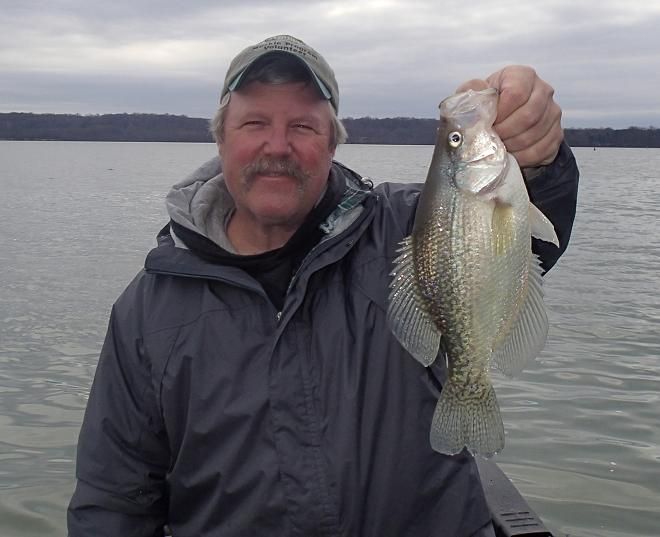
After those guys left, we nailed crappie like this all day long!
After they left, the fishing improved as the tide changed, as it always seems to do on tidal water. Slack tide is always tougher fishing, but when the water moves, so does the bait, and so do the predators. Find ambush points on the edges of the current and you’ll find the predators. It’s not different in the late fall or winter, except the deeper holes tend to concentrate the fish a little bit. As Gene noted in his blog post, Rodger and I caught a lot of crappie and bass. The slabs had shoulders, and even a few of the bass were decent sized. My biggest largemouth bass was a respectable 18 ½ inches long.
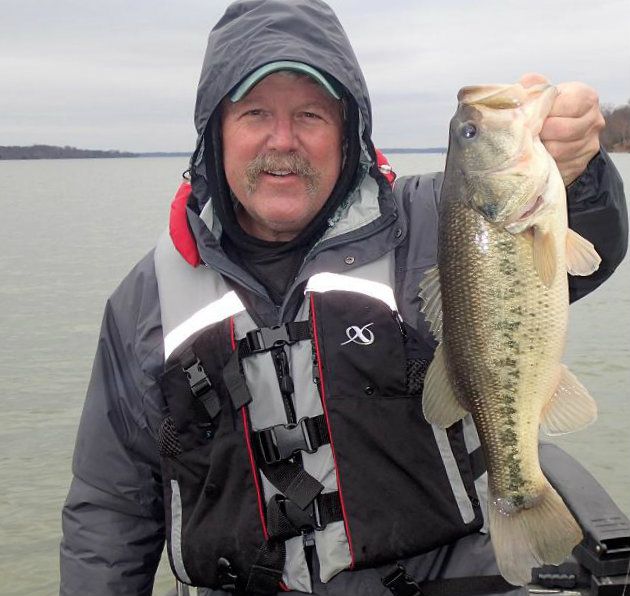
I did catch a bunch of bass that day, with this one being the biggest at 18 1/2 inches long. Most were on the small side, but I'd say that about a dozen and a half of them were "keeper" sized.
I really had a great time fishing with my buddy Rodger that day, and meeting Andy and Marty made it even better. They both have a great sense of humor, and it’s always a special treat to talk fishing with people that have that vast fishing knowledge that they do. I can certainly see why Gene enjoys fishing with those two good friends of his.
If you ever want to read more about them along with Gene’s fishing adventures, make sure that you visit Gene Mueller’s blog, “Gene Mueller’s World of Fishing & Hunting”. Not only will you enjoy the many fishing and hunting stories that he shares with his readers, you’ll also learn a thing or two. Throughout his posts are some great fishing tips that I’m sure would apply to many parts of the country, not just our corner of the world.
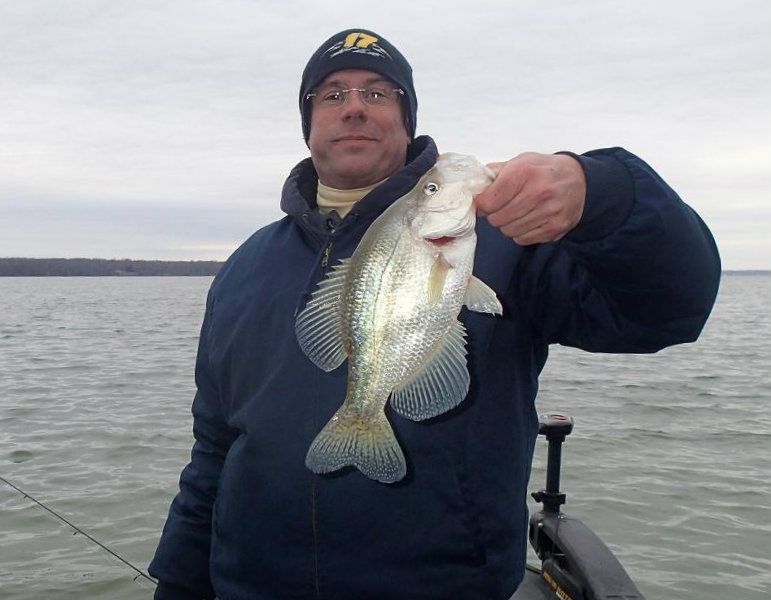
Gene Mueller with a slab Tidal Potomac crappie caught on a bobber and jig. Gene provides some great fishing tips on his website, "Gene Mueller's World of Fishing & Hunting".
And finally, after meeting Andy, a licensed fishing guide that works the Upper Tidal Potomac River, I’m convinced that anyone hiring him would have a great time with him and also catch a boat load of fish. You can book a trip by calling (301) 932-1509.
My Zebco spincast reel was not in very good shape. The line was old and full of memory. Turning the reel handle was a chore, and casting was even worse. Our tackle selection was pitiful, with a handful of rusty spoons and spinners, a few split shot, and some snelled Eagle Claw hooks. The hooks were about the only items in my rusty tackle box that were in any decent shape at all. At least they were sharp.
After tying a hook on to my fishing line, my Dad threaded an angleworm on my hook. He spent an hour looking for them in our back yard before we left for our fishing adventure. I didn't have a bobber in my box, so my Dad improvised by tying a thick piece of a stick on my line to use as a float. We were ready to fish.
Since my rod and reel combo wouldn't cast but a few feet, my Dad peeled off about thirty feet of line, and swung the stick, bait and hook in a circular motion, like David winding up a sling to defeat Goliath. With a skilled release, my Dad launched the stick and bait out into the lake. My stick bobber and worm splashed down just far enough to reach the drop off to deeper water about twenty feet away.
My Dad reeled up the coiled slack line as much as possible and handed the rod back to me. It didn't take long for my stick to twitch and slowly submerge. My Dad yelled, "Kevin, give the rod a big yank", to set the hook, of course. I listened to his advice and set the hook into a fish. After a short fight, I landed my first largemouth bass at the young age of eight years old.
My Dad wasn't much of an outdoorsman, not caring for hunting and fishing at all, preferring golf and bowling as his hobbies. But one thing that I'll never forget was him taking the time to take me fishing, not only that day, but many other days. And for him, that was a labor of love. We didn't know what we were doing and lacked good fishing tackle. But, he fished the only way that he knew how, as he did as a youngster from a family with very little money in rural Colorado fishing for trout and bluegills.
After catching that twelve inch bass, it took the rest of the year for that smile to wear off my face. My Dad was my hero.
So when I took my good friend Bob and his Son, Carson, to a tidal river crappie honey hole last weekend, the thought of helping to put a smile on Carson's face brought back that memory of my Dad.
Bob and Carson fishing out of their Riverpro LoPro inboard jet boat. Bob's equipment, boat and tackle and lures are much more advanced than anything my Dad had, but both he and my Dad were successful in the same way, putting a smile on their son's face and memories that would last a lifetime.
When the crappie bite is on, there aren't many kinds of fishing that can be as fun as landing a mess of fat slab crappie. And this day would live up to our hopes because the bite was on. At first, we tossed jigs rigged with Mann's Stingray Grubs, dabbed with a bit of Smelly Jelly, as crappie hit them on the fall. And, if that didn't work, they'd hit a slowly hopped jig right off the bottom worked back to the boat.
Slab crappie like these fell for the Mann's Stingray Grub teamed with a 1/8 ounce jighead, smeared with Smelly Jelly fish attractant, a pattern and tip provided by Gene Mueller. Click here to check out Gene's website: "Gene Mueller's World of Fishing & Hunting".
When that bite slowed, Bob figured out that a jig with more of an action tail might pick up more of the suspended crappie, and his hunch proved correct. Swimming a curly tail Bass Pro Shops Tripple Ripple Grub with a slow straight retrieve provoked one strike after another. Bob had the hot hand, landing well over 120 crappie that day, and Carson wasn't far behind in his numbers.
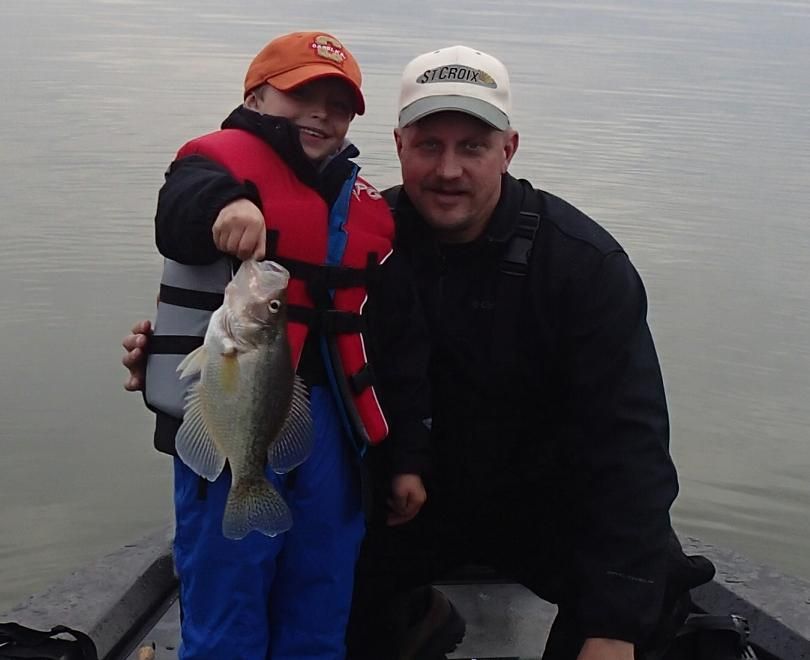
Carson, with Dad looking on, posing with a monster crappie that fell for a Tripple Ripple Grub. The smile on Carson's face says it all...The joy of crappie fishing with Dad.
I don't know what occurred more, comments like, "Got another one" and "Look how fat this slab is," or the giddy giggles of an eight year old child fishing prodigy, or similar child like giggles from his Dad, as they boated one slab papermouth after another. I'm convinced that God put crappie on this earth for the sole purpose of bonding with your boy.
I'm sure that God, in his master plan, gave us crappie with the sole purpose of making father/son memories like these.
I personally have had countless good crappie fishing days over the years. It's so fun that even experienced adult anglers often act like giddy kids when the bite is on. This day was no different. But Bob hadn't had much experience with crappie in the past. He had been intrigued by them and, after reading my last crappie blog post (Fall Slab Crappie), had asked me to put him and his boy on some crappie. After two hours, Bob had already caught more crappie than he had his entire life. So, who had the most fun, the Son or the Dad?
After catching crappie after crappie all day long, it was harder to tell who had the most fun, Carson or his Daddy!
Not only did they have fun, but so did I. I caught a mess of fish too including a bunch of crappie and eighteen largemouth bass (although they could have been bigger), which is fun enough. But even more fun was seeing my friend and his boy with smiles so large and often that they might stick on their face for some time. I really enjoyed that. Like my Dad was to me, Bob is Carson's hero.
Just look at the smile on this boys face, and you can see the positive effect that slab crappie fishing can have on a youngster. And that's a fine crappie for anyone to catch, much less an eight your old boy.
So really, for a fall fishing trip, if you want to make someone happy, take them out for some slab crappie. And if you have a child that might have the slightest interest in fishing, be a hero like my Dad or Bob is to Carson, and take your kid crappie fishing. You might wind up with just as big a smile on your face when all is said and done. Ahhhh...The joy of crappie fishing!
It was the day after Thanksgiving. The air temperatures hovered at just above freezing with the afternoon forecast to hit nearly sixty degrees, and the water temperatures were in the upper to mid forties. My buddy Howard and I decided to launch my boat and head out for some mixed bag tidal river freshwater fishing in search of bass and crappie, and anything else that wanted to bite.
I could barely zip up my personal flotation device (PFD) because belly remained stuffed from my Thanksgiving turkey the night before. In fact, I was wearing my backup PFD, because Howard was complaining about the same thing, and my PFD was the only one that would fit him. He said it was because he had so many clothes on...Hmmmm. Yeah, right... Finally he admitted it was also due in part to massive eating syndrome the night before.
The moon was full, and a Southwest wind backed the tidal waters up to create an unusually high tide. A wet dock greeted us at the launch, making it a little too slippery for my liking, so care had to be taken when boarding the boat. On our run to our fishing hole, logs, leaves and debris littered the river making navigation difficult, even clogging my jet drive outboard half way to our destination, leaving my hand soaked and freezing cold for the remainder of the trip. But it was worth it.
We reached our destination, a spot along the river where the river depths chanced from about five feet to a deep hole that was about twenty feet deep. When the tides change, currents can be strong, so we also had to find an area that was somewhat sheltered from the strong tidal currents, where predators could wait in ambush of baitfish. I started out in search of largemouth bass using a four inch finesse plastic worm. It didn't take long for that first bite.
I was stoked to get bit so early, and really looked forward to a nice battle with a tidal bass. I set the hook and had a decent fight, but it wasn't a big bass. As it turned out, it was a fat slab crappie. This fish had shoulders too, a saying that anglers often say when they refer to a muscular healthy fish.
I was after largemouth bass, but when crappie like these inhale your bass baits in an area that could have them bunched up, you could have a heck of a fun fishing day. We had a crappie day after all!
Meanwhile, my buddy Howard listened to the advice of a friend of ours, Gene Mueller, to try a lure that, quite frankly, doesn't look like much. Please visit his outdoor blog for some fine articles on fishing, hunting and other outdoor news at Gene Mueller's World of Fishing and Hunting. Howard tied on a three inch Mann's Stingray Grub in the avocado color rigged on a one eight ounce jighead, and, per Gene's advice, smothered it in Smelly Jelly. I kept after the bass, but Howard started slaying the crappie, one after another.
Gene's Stingray Grub/Smelly Jelly combo recommendation paid off time and again, yielding slab crappie like these all day long. You can't ask for a more fun fishing day catching good numbers of fish like this.
With this lure, you really don't know what you're going to catch next. These deep tidal holes attract predatory fish of all kinds. While thumping the slabs, Howard tied into a decent fat but not especially large bass. But that bass was spunky, peeling drag off his spinning reel before finally being landed. Not an hour into our trip, we knew we'd had fun, and found a spot that gave up one fish after another.
Howard with a chunky two pounder, a bass that inhaled his Stingray Grub.
I hadn't tied the Stingray on yet, and was itching to do so, but the action was hot, so I went with what I had, a small two inch chartreuse grub tied onto my panfish rod. While he was catching slab crappie and bass, I was catching smaller crappie and bluegills on that set up.
While Howard was catching big fish on his Stingray Grub, I was getting bluegills and smaller crappie on my panfish set up. It doesn't take a rocket scientist to figure out that I needed to change tactics.
The truth is, while spending the hour drive down to the ramp from my house, I talked up the Stingray Grub and couldn't wait to tie one on. Howard must have been plotting to beat me to the punch. He knows my habits, my lazy habits, of starting out with the lures that I had tied on from my previous trip.
So, after falling behind in the bigger fish numbers, I made the change, tying on a Stingray Grub. After a cast or two, the crappie let me know how they wanted it. I'd let it sink, and they'd either hit it on the fall, and if that didn't work, I'd slowly drag it across the bottom with an occasional slight jigging action.
Gene says that the Stingray Grub is a special bait in our tidal waters because it's a good imitation of local forage, a bull minnow. Actually, these minnows live in many of the Mid-Atlantic tidal rivers, so this pattern should hold for just about any of those waters.
Howard shows off a fourteen inch slab crappie that fell victim to a Mann's Stingray Grub.
For several hours, the action seemed non-stop. We caught one crappie after another, and then, when the tide became slack the bite slowed. It didn't stop, but we had to work harder for them. We still picked up the occasional fish. I took some time to go back to my plastic worm, and proceeded to catch a mixed bag of smaller largemouth bass and crappie. I was after the bass, but the bigger crappie seemed to like the bigger bait too. I wasn't all that dissapointed!
I moved back into largemouth fishing, tossing a finesse plastic worm. I managed to catch some small bass, but slabs like this didn't mind engulfing my offering. Howard, meanwhile, stuck to Stingray fishing.
At the end of the day, we finished with so many crappie boated that we lost count. We had many many doubles (both of us landing fish at the same time). I managed to catch four species of fish, bluegill sunfish, black crappie, largemouth bass, and even a yellow perch. Just about anything will bite that Stingray Grub, and when fishing tidal water wintering holes, you really never know what's on the end of your line when you set the hook. But who cares, right? Catching fish and having fun is what it's all about.
This yellow perch rounded out the mixed bag of fish, four different species boated.
So if you want to catch fish this winter, visit Gene's blog and read the many posts on this subject, take his advice, and you'll catch plenty of fish. Better yet, if you can do it, take his advice and hire a guide to show you how to do it. His buddy, Andy Andrzejewski, a licensed guide on the Upper Tidal Potomac River, would be a great choice. You can reach him to book an outing at (301) 932-1509.
So, while others are out there hunting, it's a great time to get out on the water and catch lot's of fish. Dress warmly in layers to stay comfortable and enjoy the late fall and winter bounty that your tidal waters offer, including big slab crappie like the ones that we caught yesterday.






_springbobber.jpg)