One of the great things about fishing is to experience the outdoors. Until recently, during most fishing trips, I’d forget to take the time to appreciate what was going on around me. I sort of had blinders on that kept me in focus to catch the species of fish that I was targeting that day, to catch the most, to catch the biggest, to reach my ultimate goal, a personal best. I had fun at the same time, but, even though I was in tune with what went on around me to be a successful angler, to establish patterns to catch fish, I didn't always take the time to observe more closely to see the subtle beauty of what is behind it all. So, perhaps I really wasn't experiencing the outdoors as much as I could have after all.
In the past, for most of my fishing trips, my appreciation of the outdoor experience other than actually the act of fishing was to take a little time for lunch, or a drink, or take a quick photograph of a deer or other wildlife, or a scenery shot. So, now I’ve incorporated a new concept to some of my fishing trips, where conditions permit, to add some underwater photography to my fishing arsenal and also to take some time to observe the critters that live there and their behavior.
 |
| Until recently, scenery and wildlife shots while eating lunch or taking a break for a drink would make up the time I took to appreciate the ecosystem that I was fishing. But gin clear water like this paired with an underwater camera allow me in to take a closer look. |
So, what conditions would be needed for this? Clear water, the clearer the better, which is usually opposite of what most anglers feel are ideal fishing conditions. But, I don’t seem to have trouble catching fish in clear water, so that’s not a problem. Also, how I fish would be another. Wading is much easier to get a clean picture because you're motionless, and can remain so for fish to get used to you and lose fear of you so you can get a good picture. I'm not saying that you can't do this from a kayak, canoe or boat, but it would be more difficult. Another factor is the weather or the time of year. My experiences doing this have been in the summer. If I decide to extend this aspect of fishing to colder weather or season, then I'll have to adjust and buy a wet suit. Also, make sure that you have a decent camera that you can use underwater.
 |
| A juvenile smallmouth bass cruises the shallows in search of prey. Just ahead of him is a large minnow or perhaps a small creek chub. |
So, where did I get this epiphany about my new way to fish? It wasn’t my idea, many people have done this before. Actually, let me back track a bit, because, while fishing small streams, I took occasional breaks to sit on rocks and watch minnows and darters, but I needed to look deeper (no pun intended) to really see. Seriously, I can thank the members of the
North American Native Fishes Association (NANFA). There, you’ll find anglers, aquarists, outdoors enthusiasts, and outdoor and environmental professionals that all love the beauty of our native ecosystems. They share tons of beautiful photos, videos and articles on the forum, website, and in their publication (American Currents). I joined as a member a couple years ago, and will remain so as long as I can do that.
 |
| A greenside darter poses for a quick picture along a rocky and weedy river shoreline. |
If you visit the
NANFA website (linked here and on my blog side bar), check out the reports or photography sections of their forum and you’ll see tons of beautiful pictures and videos of some of the most beautiful fish in the world with as much color as you’d see in tropical aquariums that you may not have known about that are right under your nose. I was so amazed at what I saw on there, and learned about what I formerly thought of as “bait”, that it inspired me to learn more about the places that I frequent on my free time most often.
 |
| Minnows seem to dance around weeds and current while feeding, not caring that I'm there to observe. |
There are so many beautiful species of fish, minnows, chubs, darters, sculpins and other species in their breeding colors to observe where I fish. My pictures in this post don't do them justice though, because I'm relatively new at this. To get a sense of what I'm talking about, please visit the
NANFA forum and check out the reports. Many people (including me soon) set up aquariums for their favorite species. For me, I have a passion for the darters. They are so cool to observe in the wild. My love affair for them is not new, I've always watched for them and had a native tank with darters, minnows and chubs years ago when I was in college. I really loved that tank.
I'd love to have many of these species in an aquarium because of their tremendous beauty, but many of the species that we target while fishing on each trip also are beautiful. They are too big for my aquariums, but I love watching them in their natural habitat. We frequently post pictures of the fish that we catch after unhooking them, but they are also so interesting underwater doing what they do every day. Smallmouth bass, largemouth bass, and sunfish of all types display beauty that rival many fish found in the tropical aquaria that come right up to you for close up visits if you are patient, don't move, and let the habitat around you settle down.
 |
| I'd love to capture such beauty in an aquarium, but for now, I'll observe and admire in awe. |
 |
| There are a couple greenside darters along with a juvenile redbreast sunfish feeding as minnows cruise by. Can you see the darters? Darters are a bottom dwelling species that lacks a swim bladder. They blend in so well! |
So the next step in the near future for me to further enjoy the experience will be to obtain quality snorkeling gear and carry it with me on my wading trips, when conditions are right. Not only will I fish, but I will also make sure that I will take some time to observe what is going on around me. Without snorkeling gear, it's tough to see underwater from above when it's windy. Getting the right gear will allow me to more effectively observe and photograph. All I have to do is figure out how to lug it around when I fish!
 |
| This redbreast sunfish decided to come in for a closer look. |
I've always been a fan of the Hook 'n Look TV fishing show. It always fascinated me and made me think about what it was like "down there" while I was fishing. So, maybe this fascination with observation and underwater photography was there all along?
 |
| Look who else decided to check me out! I'm not sure of the identity of this fish, perhaps a juvenile chub or an adult minnow. |
 |
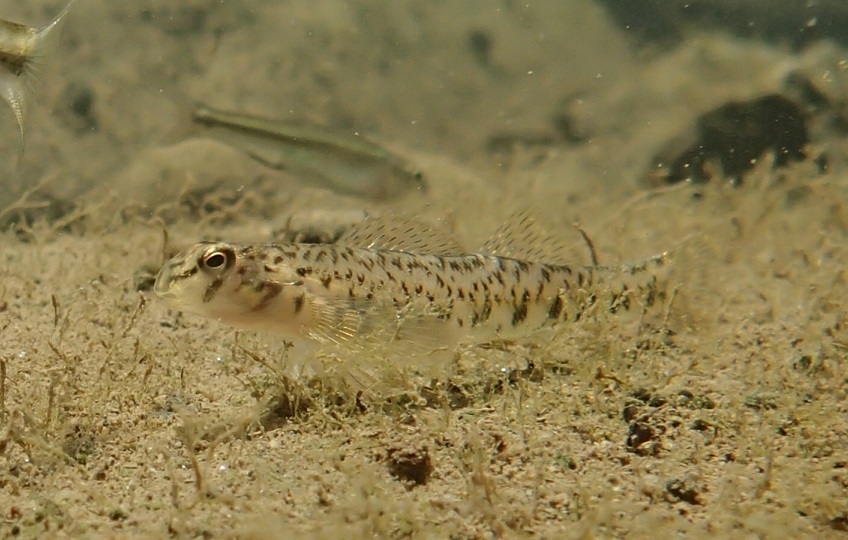
| It didn't take long for this greenside darter to move in to check me out either. |
 |
| The darter forgot about me and decided to nip on something for lunch. Notice how well they blend into their surroundings. It looks like a tail of another darter just behind this one, but it's hard to tell for sure. |
 |
| After that, the darter struck quite a pose for me! |
One problem for me will be getting good photographs in deeper water if I plan to do the combo fish and snorkel trip thing. Adding a weight belt to get deeper would help for better pictures, but I don't want to lug weights around me when I fish. I may have to go on an observation only trip, no fishing, to get better photographs in deep water. Shooting pics from the surface in water deeper than three feet, even in a gin clear river, show up on the camera as being a bit murky, as the next couple photos show.
 |
| What I think may be a northern sucker searches for food in some deeper water just ahead of me. I think that having snorkeling gear will allow me to get closer pictures in some of the deeper areas. The light penetration in shallow water makes a huge difference even when the river appears crystal clear. |
 |
| I was able to coax this juvenile smallmouth bass in for a quick picture with my camera in one hand, and with my other hand, using my fishing rod dabbling a plastic worm into close range in about 3 feet of water. My buddy Howard was laughing at me as I must have looked pretty silly doing this. |
So for me, this is my new way to catch fish, to catch with by rod and reel, but also with a camera, to enjoy the beauty around me, the wonder of the food chain at all levels and the circle of life in the ecosystems that I visit and fish. As far as my improvement as an angler, these observations are bound to improve my ability to catch fish and establish patterns. I encourage you all to take a closer look, observe and appreciate all that nature gives us. And while you're at it, take a look at the
NANFA website and consider joining. Their mission is a worthy one, the info they provide is fascinating, and their magazine is terrific. I've learned so much. After typing all this up, I am getting myself worked up and can’t wait to get out there again!
 |
| I didn't take this picture on the same fishing trip as the other photos above. Rather, my daughter and I checked out a small stream with only the camera in hand to snap off a picture of a beautiful rainbow darter. These fish in their breeding colors are spectacular. Either this was a male prior to displaying such color, or a female, whose colors are more subdued. Anyway, I thought it was worthy of sharing...until next time. |
Also, at this time, I’d like to wish my brother a Happy Birthday. He passed away unexpectedly in 2007 at the young age of 36. I miss him greatly, and all that I do on this blog, including this post, is dedicated to him. He would have loved doing this too. You can read more about his story on a page of this blog, linked here:
Tribute to My Brother Kyle