Showing posts with label bluegill. Show all posts

Monday, March 18, 2019

How to Catch Crappie, Bluegill, Perch and Other Panfish

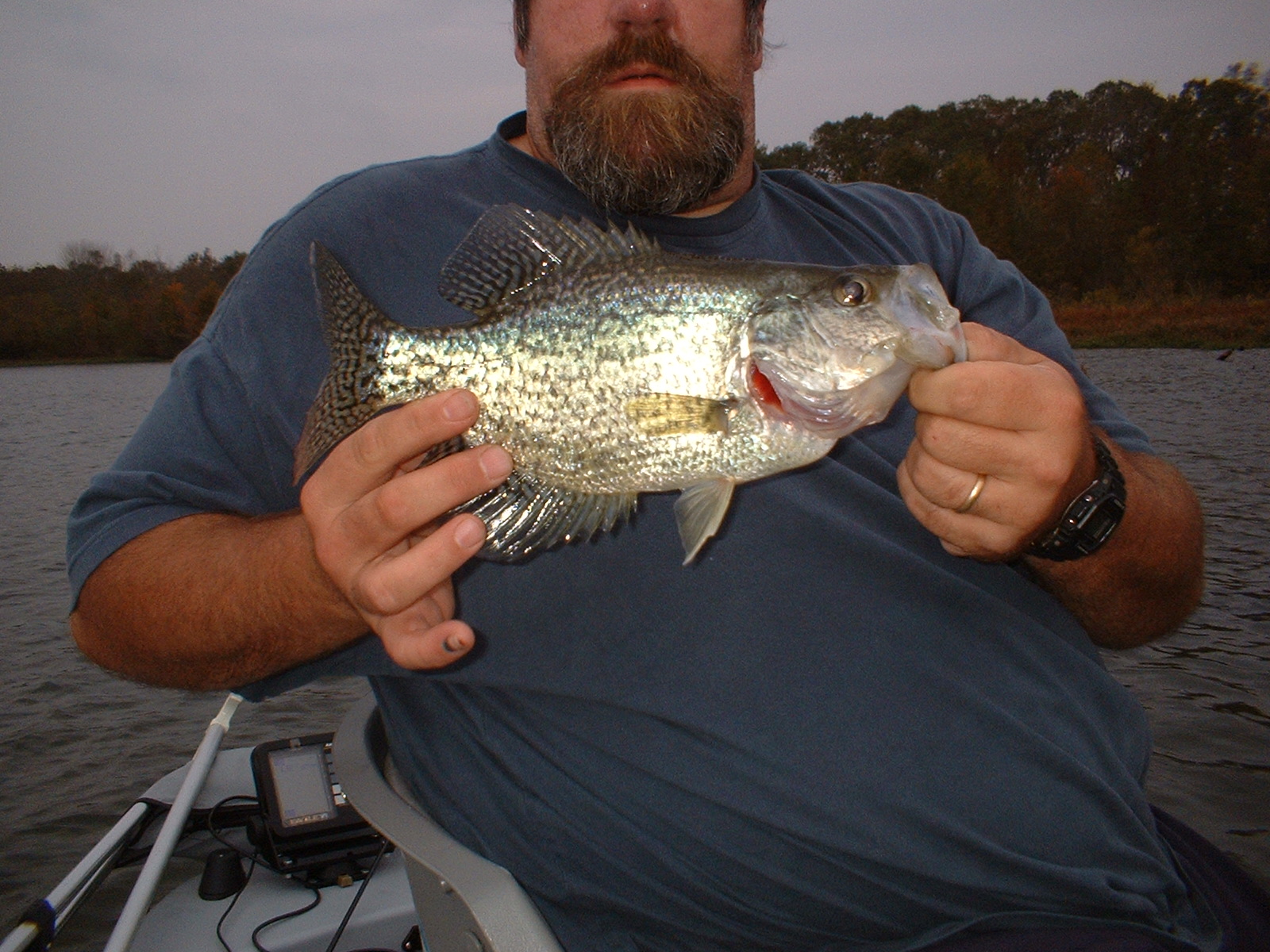
In this post, I'll describe some easy techniques, tackle, and lures to use to catch crappie, bluegills, perch and other panfish.  This crappie inhaled a leadhead jig tipped with a plastic twister tail grub while casting for crappie.
Catching panfish is a fun, easy, and inexpensive way to enjoy fishing.  In this post, I'll describe the basics of how we catch panfish on a regular basis using artificial lures.  We'll cover what rods, reels, and tackle that I like to use, as well as a few easy techniques and strategies that will help you catch more panfish.

Later in life, I learned to fish artificial lures, mainly because I accidentally kept leaving my worms and other bait in the trunk of my Dad's car.  When the bait died, it stunk up his car, and I had no ride to fish in.  My choices to adapt were to either improve my memory or change techniques.  So, I decided to change techniques.  I forget why...

...Oh yeah, mainly because using artificial lures to catch panfish is relatively cheap, and it doesn't leave a mess.  Not only that, using lures rather than bait keeps me relatively mobile, generally speaking.  The more mobile that I am, the more fish that I will find to catch.  That said, sometimes I'll carry some live bait to tip my jigs with to tempt finicky fish during colder months, but we'll discuss that later in the post.

First, lets discuss the tackle that you'll need.  Personally, I have rods dedicated to this type of fishing.  If I fish for multiple species, I'll have rods rigged for those species with me too, but if there is a chance that I may target panfish, I'll always bring my panfish rig.  My basic panfish rig is a simple one, an ultralight six foot, six inch ultralight rod, with a small reel (2000 series), matched with light line, usually 4 pound test.  For tackle, I carry an assortment of bobbers, or floats, a box of with an assortment of jigs and jigheads, and a box loaded with my favorite small soft plastic lures.
You can see my rig in this picture, an ultralight rod with a Shimano 2000 series reel, teamed with light 4 pound test line, and a small jig.  You can't see the bobber in this picture, but I was using one.  The jig is a chartreuse panfish tube in chartrueuse.
Now, let's talk about a couple easy techniques, and we'll start off with one of my favorites, the "Bobber and Jig" technique.  Many of us started out catching fish with our Dad or other adult as a kid, usually tossing out a live worm under a red and white plastic bobber.  When fishing like that, we learned the basics of catching fish under a float.  We'd cast the rig out, sit and wait for fish to bite, then, when the float moved or went under water due to actions other than our own, we'd set the hook.  So, let's delve a bit deeper into this technique and adapt it to using artificial lures rather than live bait.

The Bobber and Jig rig can be simple or complicated, depending on how seriously you take this kind of fishing.  I'd say I'm semi-serious about it, because I like to keep things simple.  I usually use a simple red or chartreuse round styrofoam weighted bobber that is about an inch in diameter that clips to my line.  Under that, at whatever distance I think the fish will be, I'll attach one or two small jigs.  I make sure that my jigs are tied so that they sit horizontally in the water, as much as possible.  I believe that I get more bites because a horizontally presented jigs best resemble panfish prey better than jigs that dangle vertically.  You may have to adjust the jigs throughout the day to keep them in a horizontal position.
This is the basic "Bobber and Jig" rig that I use.  The amount of line below the float can be as much as five feet under the float at times, but most of the time, when fish are active, I'll keep the jigs about a foot to three feet down.  I cinch the jig up tight so that it stays horizontal, as pictured above.
Now that we understand the basic rig, let's discuss how to fish it.  You have many options.  One way is just to cast it out to a likely fish holding spot, and let it sit until a fish hits.  Another way is to do that, but if you don't get a bite right away, give a the rod a twitch or two to "pop" the bobber a little bit.  How much to move the bobber depends on how active the fish are.  If the fish are active, a few sharp pops may do the trick.  If they aren't active and want a more subtle presentation, I've even gently pulled the bobber over just a tiny bit.  That little action will bounce the jig underwater a half inch or so and maybe move the jig a few inches in a certain direction. That may be enough to induce a strike.  This technique is effective if you know specifically where the fish are, especially in colder weather.

If there is a little chop on the water due to wind, you can just let the wind do the work, allowing the ripple waves to bounce the bobber while the wind pushes your rig along the drift that you wish.  Using the wind to cover water is a great way to locate where the fish are.  Once fish start biting, remember where you had your bite so that you can make sure to achieve the same drift on your next cast.  Chances are good that, once you have bites at a certain spot, more fish are there than just one.
My buddy Bill, with a slab crappie caught while bobber and jig fishing.  I don't know if I took this picture or not, but this is not how to take a good picture.  I don't think Bill would like to see the top of his head missing.  But, it's a nice fish anyway.
If it isn't windy, and the fish don't like the lure just sitting there, and popping it in place doesn't seem to draw strikes, or your not covering water, you can try a very slow retrieve, maybe mixing in a few rod twitch pops along the way.  This and the wind drift techniques are effective when searching for fish.  And, of course, depending on conditions, you can try a mix of all of the techniques above to try and draw strikes...and you should!  But, the basic thing to remember is that, no matter which method you choose, if you see your bobber stop, go under water, bounce, or move in a way that neither you or the wind made it do, set the hook, because it's likely a fish.  Anything different, set the hook.

When fishing a bobber and jig, for open water, I may try tying on two jigs.  Sometimes, when fish are aggressive, you may catch two at a time!  If I'm fishing cover, I will only go with one.  I always start by fishing my jigs about two or three feed down at first, then adjust either deeper or shallower if I don't get bites.  If I see fish dimpling the surface or cruising around, I fish shallower.  It it's cold or I don't see activity, I may try fishing deeper.  Let the fish tell you what to do.

I usually also fish small jigs when bobber and jig fishing.  I'll start with one or two 1/80 or 1/64 ounce jigs tipped with my favorite soft plastics.  I also try changing up colors until I find one that the fish like.  But, if I had to state a general rule, I'd say bright colors in darker water or darker skies, and natural colors during sunny skies and clear water.  However, I also think that white and chartreuse are tough to beat.  A former Potomac River fishing guide once told me, that when fishing that river, "If it ain't chartreuse, it ain't no use"!  Try different things until you get the results that you want.  You'll find your favorites once you start catching fish.
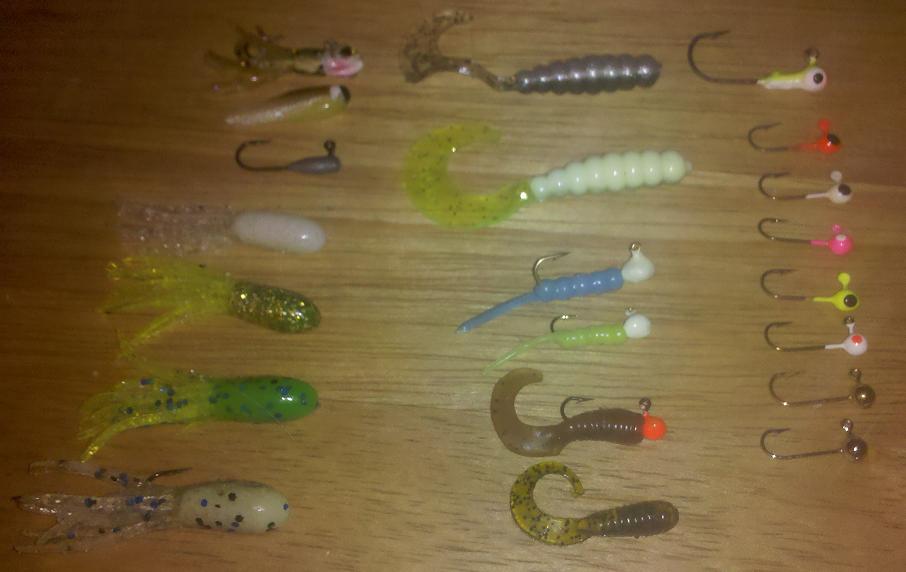
These are some of my favorite jigs for panfish.  On the left, you can see the small 1/64 oz. tube jighead that I use, and a selection of tubes.  On the right you can see an assortment of jighead sizes and colors that I use, from 1/32 oz. down to 1/64 oz.  Not picture here are similar colors in the 1/80 oz. size.  In the center, the top two larger "grubs", or twister tails, can be fished with or without a bobber.  The two jig/plastic combos below that are from Custom Jigs n Spins tackle company, called Ratsos, in 1/64 and 1/80 oz. sizes.  Below that are Bass Pro Shops one inch Squirmin' Grubs in pumpkinseed and watermelon colors.  I find BPS tubes and grubs to be very effective.  They're inexpensive and have a good color selection as well.
Here's the deal though, it's a cheap way to get into fishing, but, expect to lose some tackle.  Bobber and jig rigs are not the easiest, most accurate rig to toss, and you might end up casting your rig into trouble.  Even when experienced at this, people will still find a tree to hang their lures in, or cast too far into cover, or, just snag on a log while casting and jigging.  It happens.  If you can't retrieve it, break it off and tie on another one.  If you're shore fishing, maybe you'll get lucky and the wind will blow your float back to you.  That's why I carry a good assortment of lures and floats.  It's a good thing that this stuff isn't expensive.

Oh, another thing to remember, is that someone else's misfortune could help you find a good place to fish.  Good spots always seem to have bobbers hanging from them, or from trees just overhead.  We had a spot that was so good that we found, it has so many bobbers in it that it looked like a Christmas tree!  Just a good tip that may help you find a good spot on a new lake.

Now, a quick word about floats...there are many types out there.  You don't have to be stuck on my favorites.  Try different ones out and see what works for you.  I like the weighed round styrofoam ones because they're cheap and easy to cast a long way, and they work great for me.

For fishing really deep water, you can try using slip bobbers.  Basically, the way that they work is that you have a piece of rubber, called bobber stop, on the line, say, 15 feet from the jig, that is wound into you reel.  When you cast, it slips through the guides easily.  Then, when the rig hits the water, the line feeds through the float until the float stops at the bobber stop, and your jig reaches the depth that you want, in this example, 15 feet.  You may need to add split shot above the jig so that the line feeds through and gets to the right depth.  Anyway, you can cast these deep water rigs much easier than trying to use a snap on float when fishing deeper than four feet.  I usually use the snap on ones when fishing five feet or shallower.

Also, there are more expensive floats that are very sensitive, if you want to refine your techniques.  Here, I'm just giving you basics.  Now, as far as float shapes go, in general, the more resistance a float has to the water, the more fish can feel it and the more difficult it is to sink under the water.  You have to match the amount of weight of your lures to the right float.  Thinner, cigar or pencil shaped floats are very sensitive and go under easily without fish feeling them.  Fat, round, large floats are best used for heavier baits, as they provide a bunch of resistance.  You may never see a panfish biting a lure using large floats like these.  That's why I like the one inch size.

Where are the fish?  They can be hiding in weeds, in deep water near a dam, hiding in a log jam, or on the back side of a windy point or current break.  Panfish are predators and will find places to ambush their prey.  They can be found in tidal or non-tidal rivers, lakes or creeks.  Most likely, you can find them in a body of water close to home.  Just think to yourself, if I were a panfish, where would I hide so that the wind or current might bring me a nice minnow snack?  These places may vary depending on the time of year.  During colder months, you might find them around deeper water.  During warm spells during that time, or when it warms up, try areas where shallows next to deep water warm up from the sun quickly.
Slab perch like these may be mixed in with crappie, bluegills and other fish.  We found a bunch of fish on this day fishing behind a point that provided a wind break.  The fish were stacked up on the backside of the island, as the wind created current that pushed baitfish to the predators in wait.
A nice location would be on a northern shoreline, where the southern sun shines and warms the shallows.  If you find some nice cover there, like a tree or brush, that is a great place to try and cast to find fish, especially if that cover provides a current break.  Sometimes, when fishing a northern shoreline, if a south wind piles up along the bank, it will bring warmer temperatures to that area and along with it, active fish.  So, during colder months, try and find the warmest spot on a body of water, the best cover that will hold fish, and try your luck casting there.  Most likely, you'll get into some panfish.
When my buddy Bob, and his son, Carson tried some winter panfishing with me, they had a blast catching slabs like this all day long while casting jigs with soft plastic twister tails.
Once you find some cover, like a bush or tree in the water, you don't have to always cast into the thick of it.  In fact, unless you become an expert at casting a bobber and jig, just try to get close.  These rigs are not as easy to cast as only having a lure on the end.  If you're close to the cover, most of the time, active fish will come out of the cover to check it out.  Only during tough cold fronts, when fish may not be active, you may need to fish tighter to the cover.  But try out a foot or two, if you can, first.
Large bluegills are extremely fun to catch using these techniques.  Just look at the colors on this fish!  What a blast you can have when you catch dozens of these guys.
Once you get the hang of finding and catching fish, if the fish you're catching are small, then you can start the process over on other bodies of water until you find some bigger fish.  When you find actively feeding panfish, you will start catching good numbers of these fish.  You may have hundred fish days or certainly enough action to keep you entertained.  Once you find your favorite "honey holes", you may have days when fishing is tough.  This is where tipping your lure with live bait, like spikes (or maggots), waxworms, or just about any bait may trigger some bites.  If they're not biting after that, you can try changing locations on the body of water to find a new spot, or change lakes.  Don't sit and wait for fish or you may get skunked.  Move, that is the key, and it may save your day.
Rodger will tell you that catching panfish like these can really be a blast.  The techniques and suggestions described in this post will help you find fish like these too.
Another technique is to just tie the jig directly on your line without the float.  This is very effective if you're fishing an area with less snags, it's not that windy out, and the fish are aggressive.  I usually fish 1/32 or 1/16 ounce jigs when casting, depending on how much wind there is.  Wind will put a bow in your line, so more weight counteracts the wind.  If it's too windy, you may find it best to add the float and let the wind do the work.  When not using a float, if you're boat fishing, you can vertical jig or cast to spots.  Most of the time, if you shore fish, you may have to cast, but sometimes if you have access to boat docks, piers, or bridges to fish, you can try vertical jigging.  Just drop the jig down into the water, and twitch your rod tip to make the jig dance.  Dancing jigs attract fish.
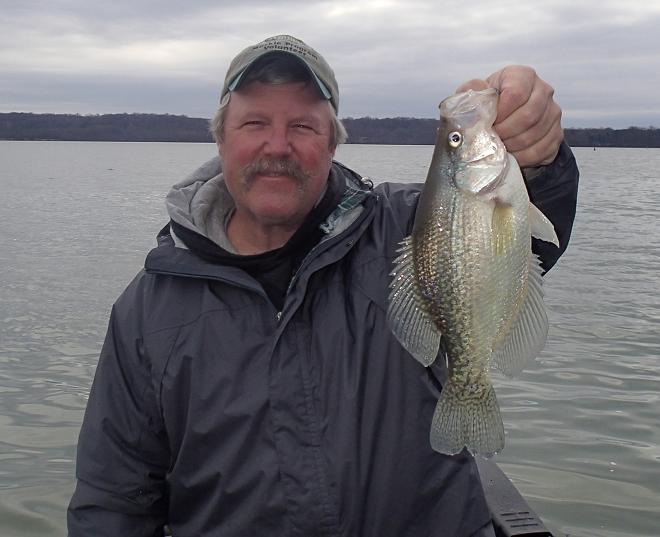
My buddy Howard loves catching slab crappie using these techniques!  We were fishing deeper water winter condtions on this day, using both techniques.  The fish weren't deep, but they were over deeper water.
When casting, you can try jigging it, but sometimes the fish will hit the lure on a slow fall.  If they do this, you will see the line twitch or move at the water line or maybe even feel the bite.  For this reason, it's very important to watch your line where it enters the water.  Often, you may not feel it, so, if you see anything different, set the hook.  And, of course, if you feel a "doink", set the hook.  Sometimes, after letting your lure sink a slow retrieve might work.  Like bobber and jig fishing, try different things to get them to bite.

When to use the bobber and jig vs. casting a small jig for panfish?  It depends on how active the fish are, how big the fish are, and the conditions that you're fishing.  For me, if I'm fishing when the fish are active and it's not windy, I probably would start casting a larger jig, say, 1/32 with a two inch twister tail.  If it's windy, I may try vertical jigging if possible.  If the fish are finicky, or it's too windy to cast, then I'll go with the bobber and jig and downsize to smaller lures.  If the fish are really finicky, then I may go as small as a 1/80 oz. jig.

One thing that I love about fishing small jigs like this is, that you never know what you're going to catch when you get a bite.  You can catch almost anything.  In addition to the panfish that I've targeted, I've caught everything from golden shiners, trout, largemouth and smallmouth bass, chain pickerel to even catfish and carp!  It's a lot of fun.  Give it a try!
Large golden shiners will hit these small jigs too.  Usually, on some lakes that we fish, we will find them mixed in with the panfish that we target.  I like catching just about anything that swims, and bobber and jig fishing can do that for you.
You never know what you're going to catch using small jigs while targeting panfish.  While targeting yellow perch, I caught this nice largemouth bass on a 1/32 oz. jighead tipped with a two inch chartreuse plastic twister tail grub.  What fun, huh?
If you aren't catching fish now, doing what you're doing, then maybe try the techniques above.  If you do, you're sure to succeed.  Good luck, and give me a comment back and let me know how you do, if this post helped you.


Monday, March 3, 2014

On the Hardwater - Salvaging a Tough Day

In my last blog post, I discussed my approach to finding fish on a small lake.  The major theme basically was to move until you find good sized fish, ingnore the sniffers, and move away from catching small fish, or "dinks".  Usually by following the plan laid out in that post, On the Hardwater - Attacking a Small Lake for Panfish, you will eventually find the fish that you are looking for, although it may take time and a ton of effort cutting many holes.   But what happens when you try those suggestions and things just don't work out?  How can you salvage a tough day?
My enthusiastic ice angling friend, Glenn Cumings, working fish that he marked during mid morning.  Glenn kept moving and eventually found a few nice bluegills mixed in with mostly small bluegills.  Remembering what he did at this hole helped us finally solve the puzzle later.
My buddy Glenn Cummings and I decided to hit a lake known for good sized panfish.  In the past, we've had great success icing a mixed bag of fat keeper sized perch, slab crappie, and bull bluegills.  My experience on this particular lake was at a different area than we opted to fish.  Glenn insisted that this spot, new to me, would produce the output that we were hoping for.  Conditions were perfect, leaving us both feeling very enthusiastic about our chances at finding big panfish.
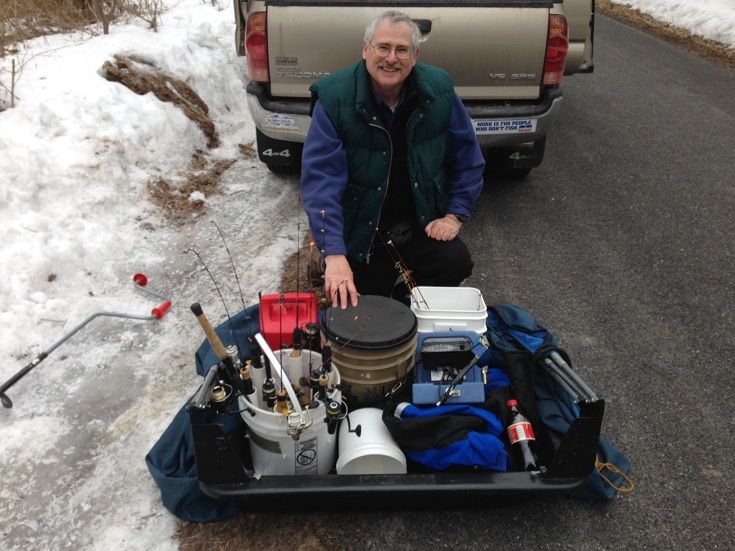
After finding a suitable parking place to access our lake, Glenn poses with his gear, nearly ready to attack our small lake in search of jumbo sized panfish.
Glenn and some of my other buddies have had good experience at this new spot on our lake, and Glenn assured me that he could put us on fish.  I was game to expand my horizons and find new spots.  My past experiences were very productive at my spots on this lake, so previously, I had no reason hunt for new spots.

Once out there, we began our regimen by moving out to the mid basin of the cove, a typical location to find panfish during mid winter ice.  I cut a series of holes through sixteen solid inches of ice with my hand auger until my shoulders cramped.  Twenty six cranks on each hole had me stop after six holes, each spaced about thirty feet apart.  But, it was enough that I could scoop out the ice chips and check them with my sonar.  Each hole was over twenty four feet of water, a prime area for this time of year.

Well, things looked up right off the bat as I marked fish at each hole, some suspended and some on the bottom.  The next step, of course, is to drop a lure down there and find out what we're dealing with.  My rig of choice was my favorite dual Ratso rig, my hottest set up of the year so far.  But the fish were sniffers in each of the holes.  It was weird because the fish charged up off the bottom, then either bit very lightly or not at all.  My first impression was that I was dealing with dinks.

I moved toward the far shore a bit and cut six more holes.  Again, after checking the holes and marking fish in each one, I dropped a different offering down there to see if that would make a difference, this time, a tiny tungsten chartreuse Northland Fireball Jig teamed with a pair of spikes to add some scent, in case the sniffers were decent sized finicky fish.  This time, a fish charged up and nailed my jig, confirming my earlier suspicion.
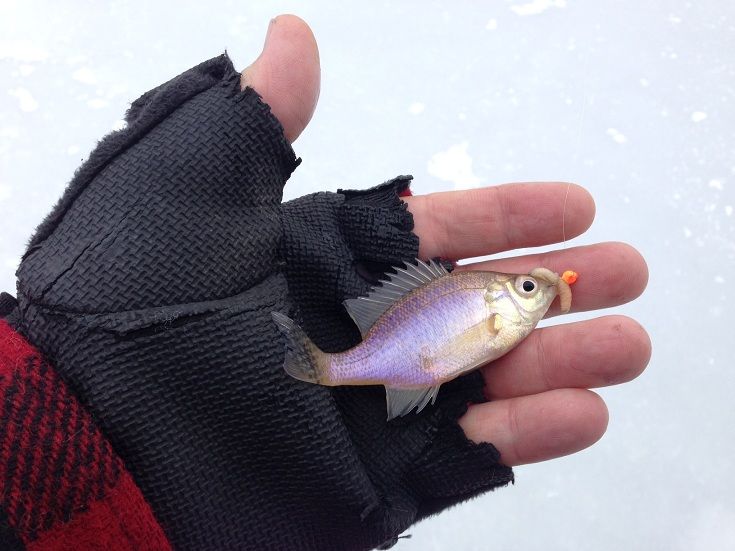
My first fish confirmed my suspicion...dink.  that's a tiny lure, and a very tiny bluegill.  I wasn't interested in catching these all day.
Meanwhile, Glenn was doing the same thing, but heading toward the center of the cove.  He was also catching dink bluegills now and then.  After chatting with another guy on the ice, Glenn used some of his new intel to move to another spot.  His next hole produced a few nice bluegills mixed with the dinks.

I, on the other hand, moved again.  I noticed that one shoreline had a nice draw, leading to me to think that a spring or creek, even a runoff one, might provide enough structure out into the lake to hold fish.  I moved over to that area and mustered enough energy to cut eight more holes.  Again, I marked fish in every hole, this time in twenty one feet of water.

After working these fish a while, I picked up a few nice bluegills, a decent yellow perch, and a small crappie mixed in with some dinky bluegills.  I bounced around from hole to hole and caught fish here and there, but didn't have that hot hole so that I could set up my camera and haul 'em in.  Plus, the water seemed too dingy to use the camera.  The dingy water may have played a role in the mood of the fish too.

We had action, and including the dinks, my totals were just shy of twenty fish for about five hours of fishing.  That's not the bite that I'd hoped for.  Plus, the size of the fish weren't impressing me.  So, at three in the afternoon, with the magic hour looming, I convinced Glenn to make a major change.  He agreed, because it really wasn't happening for him either.

We had two options for a major change, move on this lake to an entirely different depth and structure, or make a spot change to another lake.  We figured that the latter would waste too much time, so we took a hike to a new previously productive area.
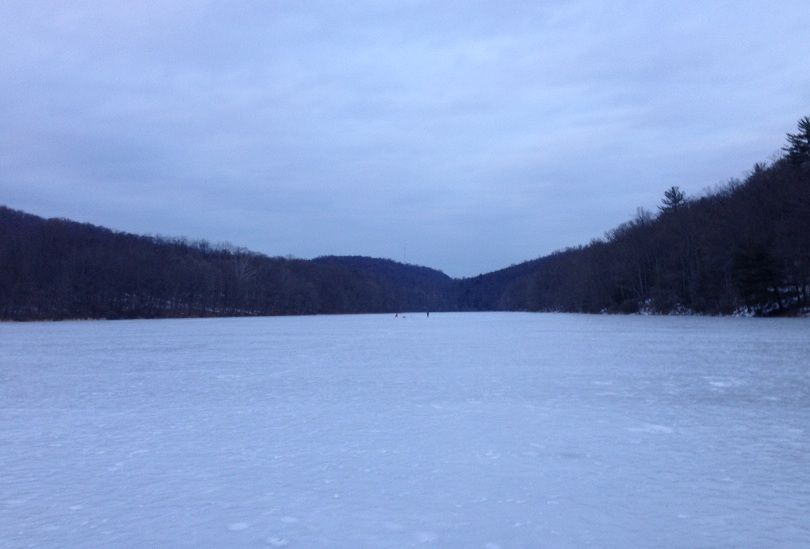
The major move included a long hike during prime fishing time, past the guy on the left and around the point to a deep thirty eight foot basin.
We had a nice hike ahead of us, but with the ice pretty slick, towing our portable Fish Traps full of gear wasn't an issue. But, it did use up valuable fishing time.  We went to one of my past productive spots, around a point and into another cove.  We head out to the deeper water basin, a notorious hangout for fat yellow perch and crappie in the past.

I cut eight more holes.  Again, each hole held fish, and the result was the same.  I quickly managed a seven inch perch and a small bluegill, but not the size of the fish that I had hoped.  This group of fish were far more active, but my third yellow perch of the day sealed my decision to move again.  It may have been the smallest yellow perch that I've caught in my life.  It couldn't have been even three inches long!

Glenn was working the fish in his holes, and hooked and lost a couple fish on his ultralight outfit.  But, he agreed that this might not have been a good move.  I headed toward a long sloping point, hoping to find twenty to twenty five feed of water off the end of the point.  After cutting five more holes, I found that spot.  My first four holes didn't mark fish, but my fifth one did.  I caught that one fish, another dinky bluegill.

Now, I was getting discouraged, and after Glenn met up with me, he was too.  So, we agreed that we had enough time to hike back up the lake to our original spot.  Again, another half hour of hiking wasting fishing time.  By the time that we reached our old holes, the magic hour was half over.
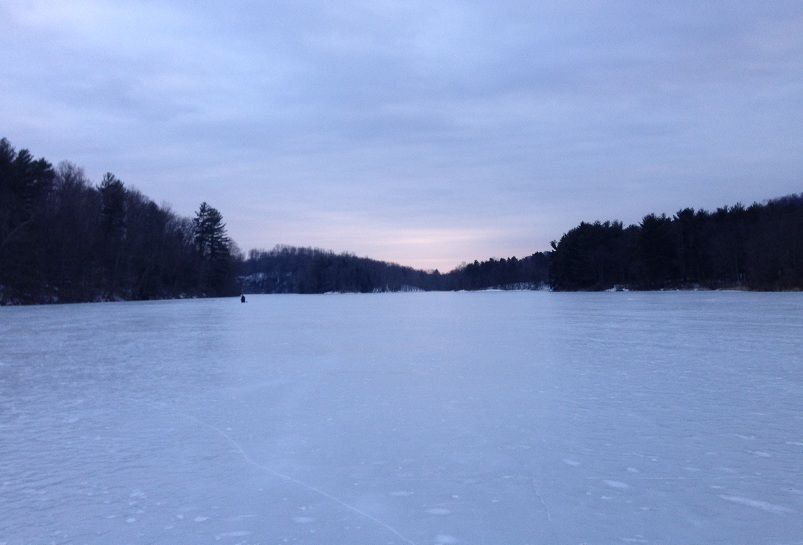
Our long walk back to our original holes cost us half of the magic hour.  Our destination was beyond those folks in the distance.
Remember in my last post when I wrote this?
"Later in the day though, it might be wise to remember where those sniffers are, especially if you catch one and it's a good sized fish.  Because, often low light conditions, commonly thought of at the magic hour, that last hour of daylight, finicky fish might become more active later."
I checked my best holes from earlier and one of them had fish stacked on the sonar.  So, I set up camp there for the evening bite.  My first drop with my tandem Ratso rig resulted in a nice fat crappie.  The next drop was a bigger bluegill, followed by another one.  After that, I lost a slab crappie at the hole that was easily thirteen inches.

Daylight ran out quickly, so Glenn, who had also been catching better sized fish, and I fired up our lanterns and set up for the night bite.  After dark, the fish became finicky again, but, if you worked them enough, you could coax them into a solid bite.  The bite wasn't hot, but I marked enough fish to keep me interested, and enough of them were reacting to my lures.
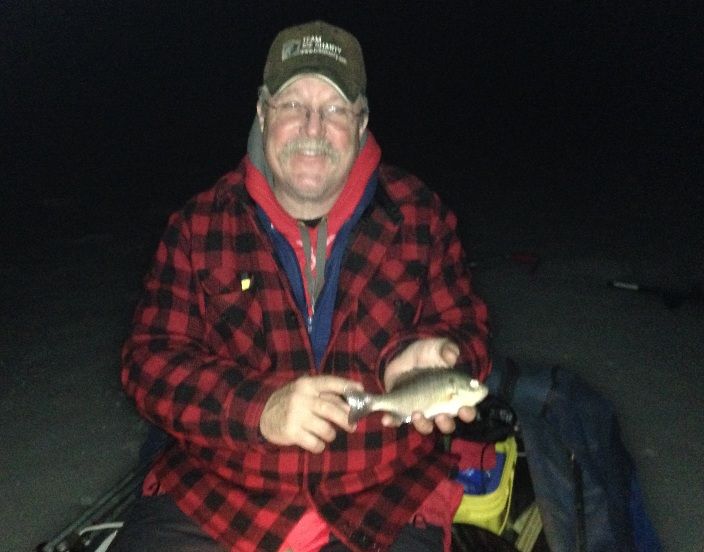
This isn't a monster bluegill by any means, but a much better average size compared to the dinks earlier in the day.  I caught several of these after dark, jigging aggressively, trying to imitate the tiny hopping crustaceans that flooded my sonar.  The fish were mixed with them, actively feeding.
I caught several more crappie and a nice bluegill that was suspended at ten feet over twenty four feet of water.  Glenn struggled a bit with tackle problems and also problems with his lantern, but managed to catch some nice crappie and bluegills too.

Remember earlier in the post that I mentioned that the water was dingy?  I think that the fish didn't seem aggressive because they had a hard time seeing the lure in the murky water.  I used glow jigs and worked them very aggressively.  As it turns out, when the fish finally found the lure, they were very active and hit readily.
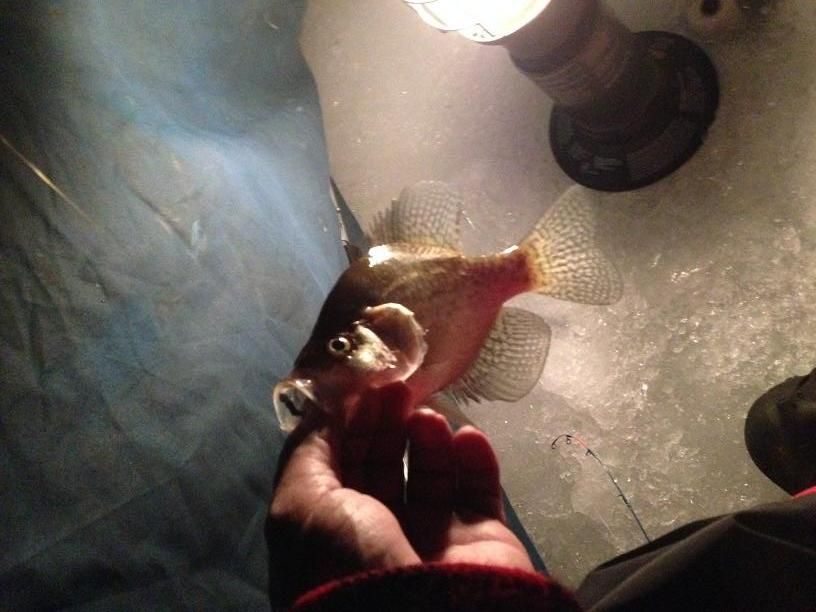
Here's a medium crappie that I worked for and caught after dark.  Aggressive jigging in the dingy water was the key to catching this crappie along with several more of his buddies.
I finished with a forty fish plus day, if you include the dinks, but we worked hard for them.  It was my toughest day of the year on the ice.  But, that final move paid off, the one where we went back to old semi-productive holes where the sniffers were actually decent sized panfish.

I'm sore today, two days later, from cutting holes.  We had twelve inches of snow last night, so shoveling my hundred foot driveway isn't helping my aging bones either.  I was miffed at my decision to make that major move to deep water, because it may have cost us a dozen or more nice sized fish from wasting half the magic hour.  But looking back, even though it was a tough day, the reward was that we finally solved the puzzle.

The system worked, finally.  But, perhaps some patience would have worked better this time by sticking to holes that gave up a few nice fish early.