Welcome to Fat Boy's Outdoor Blog. I'll blog about fishing, hunting, and fossil collecting from my perspective of the outdoors. Everything posted here is dedicated to my brother, Kyle C. Wilson, who passed away unexpectedly in 2007.
Always for you Bro!
Note: I don't make a penny of this blog. I write for fun, to give back to the community, and to help others learn as others have taught me. I hope you all enjoy it.
Showing posts with label shark tooth collecting. Show all posts
Showing posts with label shark tooth collecting. Show all posts
Every year on this day, I think about my Brother, Kyle, who passed away in 2007. I can't believe it was 13 years ago today that this tragic event happened. And when I think about him, I think about why I started this blog in the first place, to dedicate and document my outdoor experiences and share what I've learned over the years.
The last time that I posted was a year ago today. I've been negligent about keeping this blog up to date, and for that, I apologize to my brother to those of you that follow my blog. I also vow to regularly post and keep this blog up to date. I appreciate the following and hope to keep it up, not for my sake, but to honor my brother.
So, with tears in my eyes, I'm going to move on and write this next post. Kyle, if you're reading this from heaven, this is for you.
My outdoors experiences have evolved once again. I have many new topics to cover. Probably the biggest direction with my fishing has been targeting rockfish (a.k.a. striped bass or stripers) and other fish species in the Chesapeake Bay.
Kyle loved fishing the Chesapeake Bay from my Dad's sailboat. He mostly trolled surgical eels for bluefish. He caught quite a few "slammers and choppers" off that boat. Slammers are medium sized bluefish in the five to ten pound range, while choppers are bigger bluefish in the ten to fifteen pound range.
Kyle loved fishing the Chesapeake Bay out of my Dad's sailboat. The area around the Chesapeake Bay Bridge (pictured above) was his stomping ground. The Chesapeake Bay has become one of my favorite fishing spots too. (photo by Captain Steve Kelley)
While trolling for bluefish, Kyle would occasionally catch a nice rockfish. Back then, all rockfish had to be released, because there was a moratorium on them. Since then, the striped bass fishery has rebounded nicely, and they are once again, the most prevalent predator in the Bay. Blues still show up, but not in the numbers found back in Kyle's day. Kyle would have loved fishing the Bay for rockfish.
I promise to post more about fishing the Chesapeake Bay, my experiences and other topics surrounding fishing for stripers and other Bay species. I've learned so much and have so much to share. But, for this post, I'm going to keep it to a few pictures of some of the rockfish that I caught this year and dedicate those fish to Kyle.
I'll post more on how I caught these fish among other adventures on the Bay in future posts. I'll keep the blabbering to a minimum, so I'm going to stop here. After all, a picture is worth a thousand words.
This was my biggest rockfish of 2020, a 41 inch fat brute of a striper, caught and released back in March. It's not my personal best, but might be the fattest one that I've ever caught. You can see my personal best pictured in a prior blog post about that day.
This is the same fish pictured above, a 41 inch rockfish. This picture gives you a good idea of the girth of this fish. Notice the large soft plastic lure used, a ten inch Bass Kandy Delight (BKD) on a 2 ounce jighead. Big lures catch big fish!
We caught a good many keeper sized rockfish this year on topwater lures. What a blast. Kyle would have loved doing that.
Here's a nice rockfish that I jigged up using a skirted one ounce jig with a soft plastic fluke style lure.
Here's another nice striper caught on a skirted jig/soft plastic combo. I'll cover topics about jigging for rockfish with light tackle in future blog posts.
Another thick rockfish. You can see why fishing for these can be addictive. We caught quality fish like this throughout the year, but there is nothing like fishing for this species in the fall.
This was a summer time rockfish caught jigging bridge pilings. As you can see, I've come to rely on sun protective clothing. For fair skinned folks like me, these types of clothing are a must.
Catching fish like these are a blast on top. I get pumped when I see schools of fish like this breaking. Then, after tossing a topwater lure nearby and seeing fish like this blow up on it...what a thrill, let me tell you!
I owe a debt of gratitude to my good friend and fishing/hunting buddy, Steve Kelley (shown here with a nice rockfish that he jigged up), who put me on the fish pictured above. In addition, I caught my personal best striper off of his boat. Meet Captain Steve Kelley. He's not a charter boat captain, but he's every bit as good as one... I've mentioned him in past blog posts, but you'll read more about him in future blog posts.
Our nice mako and juvenile meg two teeth on the right, along side Cris' meg (left)
When my wife and her friend planned a get together trip in Central Florida earlier this year, she asked if we wanted to turn it into a mini vacation. Always with fossil collecting in mind, and knowing the rich bounty of fossils that Florida has to offer, my daughter, Riley, and I convinced her to give us a day to go fossil collecting. This post depicts the planning and actual events of our fossiling experience.
But, where to start? We know that there are tons of fossils in Florida, but, it's a big state, and all of it was submerged throughout various periods of geologic history. Our interest this time focused shark teeth, with a chance at finding the prized megatooth, of the largest predatory sharks in recorded history, Carcharocles megalodon. If you do some research, you can find the popular public place to collect, where you can beachcomb or sift for shark teeth. But, it would involve a lot of driving and testing to locate spots, and that takes time, and we didn't have the luxury of time.
So, we figured that the best thing to do was to do what anglers do when they want to find a trophy fish, hire a guide. So, we researched and found some guides that really interested us. It didn't hurt that we also discovered that someone we "knew" (virtually) from our past experiences on The Fossil Forum and their once heralded chat room that turned out to be a guide. We booked a trip with Fossil Voyages' PaleoCris and WILDKYLE (their YouTube and Instagram names). Of course, we had some questions about what to bring, etc. and they answered all of our questions, making it easier to prepare.
Still, this was a February trip, and the trip that we booked called for wading in creeks while shoveling and sifting for fossils. Our main concern was weather or not to bring waders or hip boots, or if we could we wet wade or not. In February, we wondered if the water temps in Central Florida were too chilly to wade in. As it turned out, not at all, this time. The weather was in the mid-80s all week while we were there, and nighttime lows weren't low enough to chill the water, so wet wading was fine. After all, why bring heavy waders and pay for another checked bag on the plane? We were trying to keep our vacation as cheap as possible. As for other needed equipment, really, all that we needed was ourselves, dressed to get dirty and wet, a change of clothing, sunscreen, bug spray, some snacks and water. Cris and Kyle supplied all of the collecting equipment.
First, we met them at a public shopping area, and then followed them to one of their favorite spots to take their clients. From our vehicles, it was a short hike to the creek, and not a long wade to the area to start our fossil search.
So, we started sifting and...well...did they put us on fossils? You tell me. On our first and third sifts of the day, we found a nice juvenile meg (short for megalodon) in near perfect condition, and a monster giant mako shark (Carcharodon plicatilis). This shark is considered by most experts in the field as a direct ancestor to our modern great white shark, Carcharodon carcharias. The only difference in their teeth are the lack of serrations on the extinct shark. Other than that, the teeth in each position of the jaw are nearly identical in shape and form. The colors on this tooth were striking. In the pic at the top of this article, these two teeth are the smaller of the three teeth pictured.
So, the shoveling and sifting adventure started with a couple huge finds. Man, I thought then that this would be easy and we'd be wading in meg teeth in no time! Of course, it's never easy. You have to work for it, and yes, even here. Just like catching a monster bass on your first cast, many times you have to work your butt off to find good fish the rest of the day. That was the case here too. Now listen, I'm not complaining at all, because at the end of the day, our combined finds were quite amazing for such a short time collecting. Just a note, we collected until I couldn't take it any more. Our guide friends would have accommodated us longer and they certainly worked hard for us all day.
About our guides, let me say here that they are first class, nice, friendly and certainly fun, and both Riley and I really enjoyed their company. But, they were also very knowledgeable, helping Riley and I identify our finds as needed. We knew about the teeth IDs, but some of the other vertebrate fossils and artifacts required their assistance, and that was much appreciated. Not only that, my aching back slowed my shoveling pace later in the day, and both Cris and Kyle helped us fill both our sifters. We couldn't have asked for better guides.
I won't chronicle the rest of the events while collecting, because you can see pretty much what happened for yourself in the two videos that I'll link later in this post. I highly recommend that you watch and "like" them both, and subscribe to both channels. But the bottom line is that it was a productive day, and we had an absolute blast, and a pleasure meeting these two avid paleontologists.
In the following pics, I'll explain some of the finds. Riley and I found most of these finds, but about 1/4 of them were thrown in that Cris and Kyle found, maybe more. I couldn't remember exactly who found what for the most part. Riley and I were a team, so anything that I say that I found, or Riley found, we actually found together.
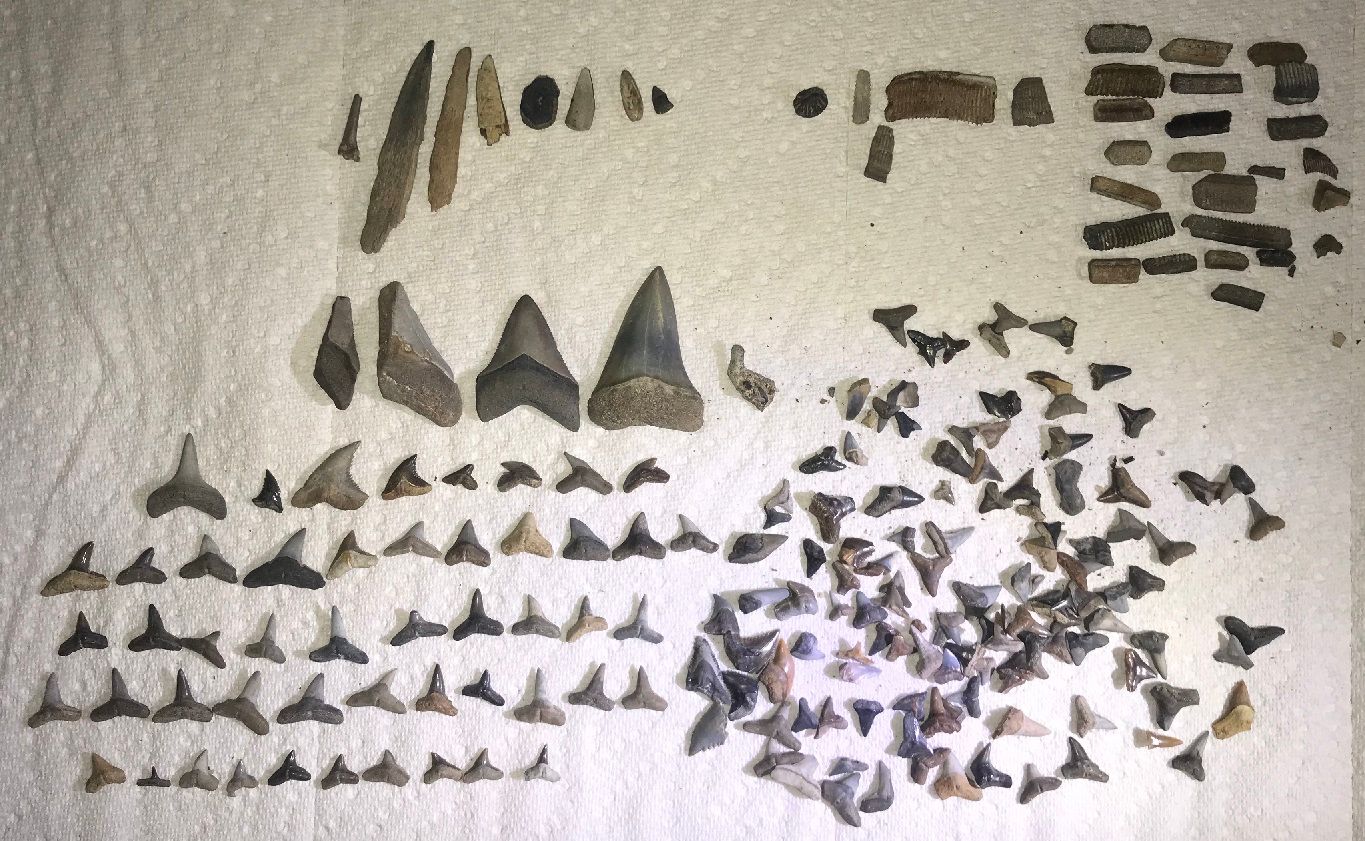
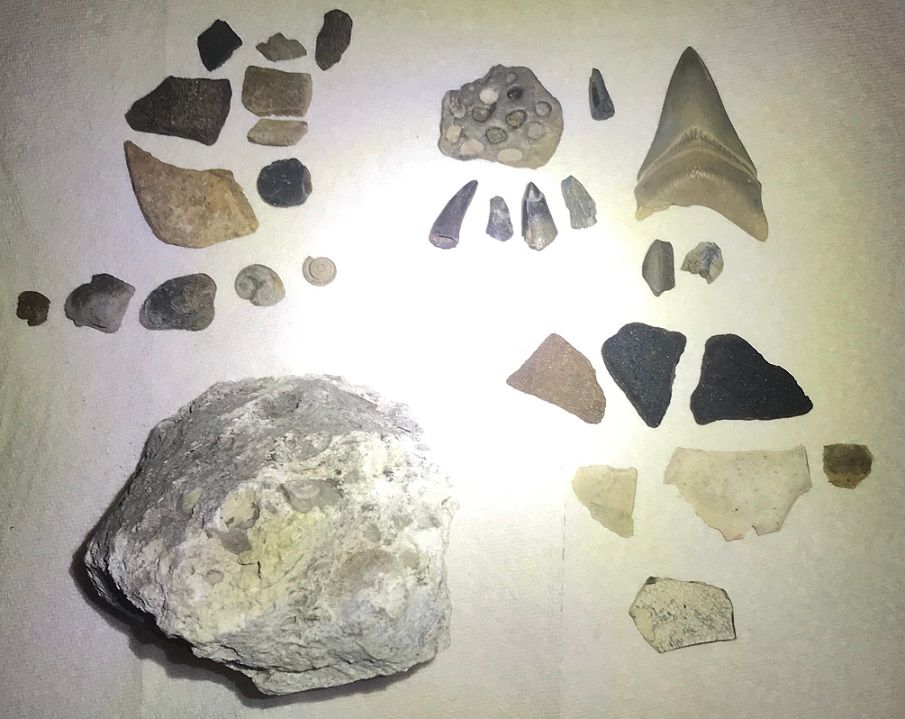
These are the shark teeth, stingray dental plate fragments, and fish fossils found on the day. The largest complete tooth in the middle is the large giant mako that we found on the third sift, and the small meg to the left was found on the first sift of the day. Above those teeth are the fish fossils, including three sections of a sawfish rostrum, a catfish spine, a barracuda tooth and some other fish teeth. Below the mako tooth are various smaller shark teeth found during the day, including a smaller mako tooth found by Cris, some snaggletooth shark teeth (Hemipristis serra), tiger shark teeth, and below them lots of lemon and requiem shark teeth.
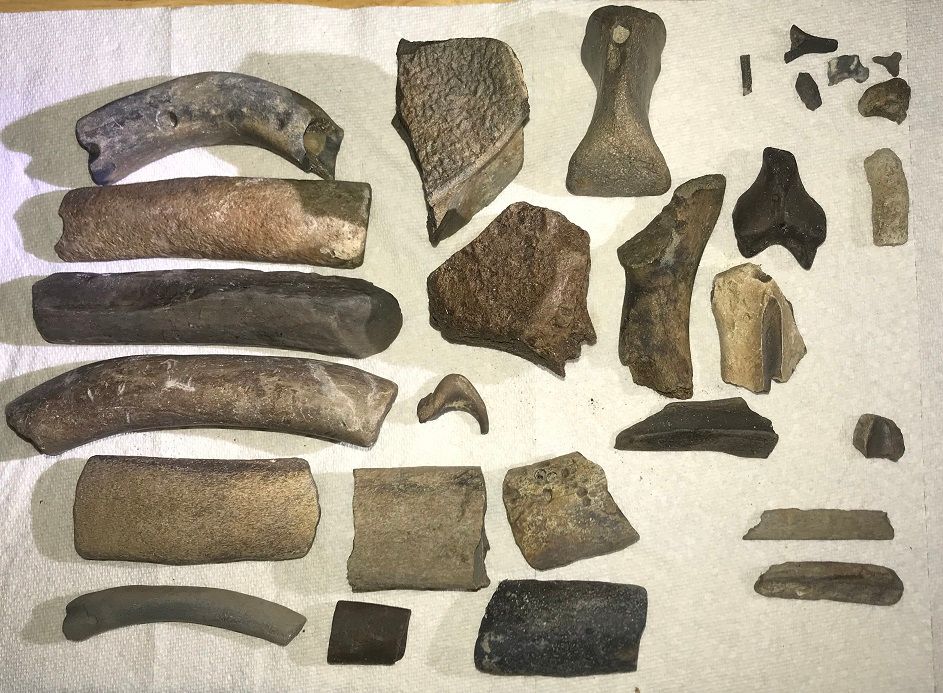
Most of these bones and vertebrae are dugong (Metaxytherium floridanum) bones. The two bones below are dolphin, and the one above that may be a fragment of a Gomphothere tooth. A Gomphothere is an extinct elephant like mammal.
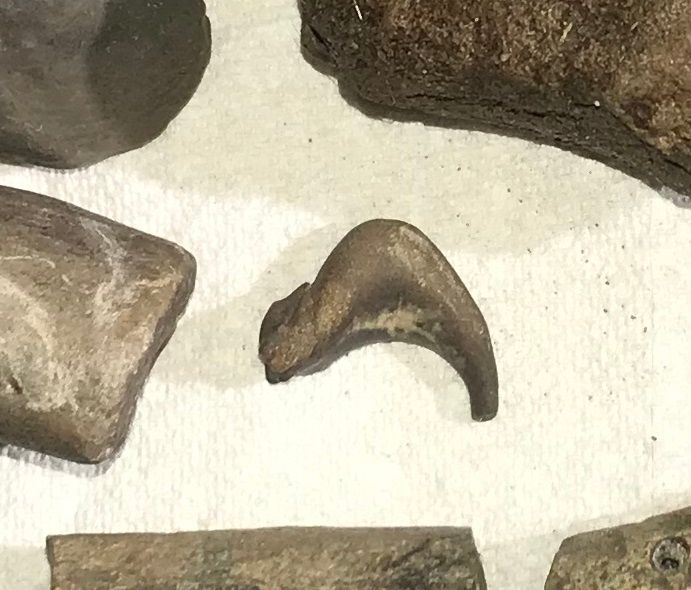
The bone in the center of the pic above is enlarged here. It's a dugong ear bone, and apparently not very common. Riley found this beauty in her sifter.
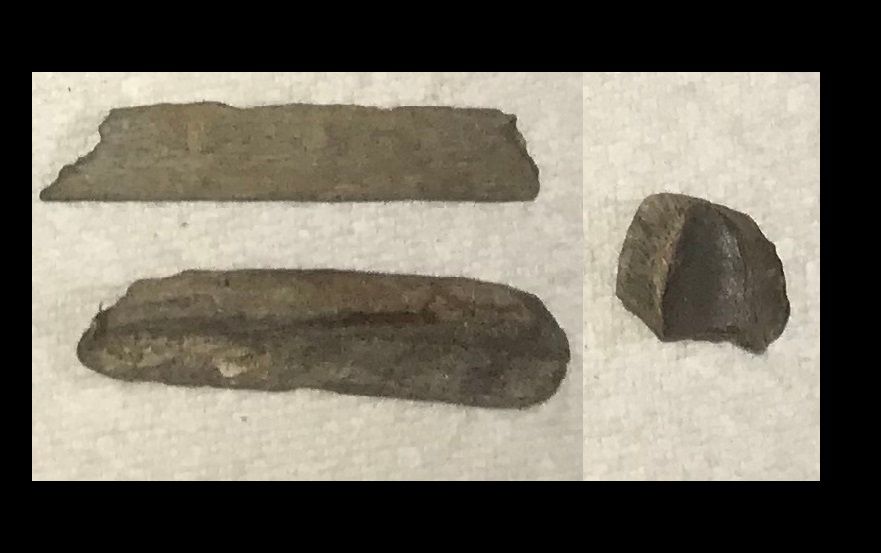
The two bones on the left are partial dolphin jaw bone fragments. In person, you can easily see the slots that the teeth were placed. This picture is not very clear. The fossil to the right is the Gomphothere tooth fragment.
The fossils in the upper left quarter of this picture are turtle shell fragments, and below that, some shells and internal molds of snails and clams. The fossils in the upper right include the crocodile (Thecachampsa americana) scute that Cris found, and some croc teeth that Riley, Kyle and I found. To the right of that is the meg tooth that Cris found. The bottom half of the picture are the Native American artifacts that we found collectively, with the hammer stone to the left, some chert reject pieces (likely split when trying to manufacture points), and three pieces of pottery. The bottom piece of pottery is old, but modern. As both Cris and Kyle pointed out in the videos below, we were able to collect these artifacts because they were found on private property. Incidentally, the hammer stone is a tool made from a chunk of dense limestone that is also packed with fossilized bivalves and other critters, so it's an artifact and fossil one one!
These fossils are from the late Miocene, about 8-9 million years old, and are from the Coosawhatchie Formation.
At the end of the day, I was exhausted from shoveling and sifting. My back was in a ton of pain, and really reminded me of how out of shape I was. We still had an hour and a half drive back to where we were staying, so, I was in a bit of a hurry to get out of there.
Cris and Kyle had some more work to do to close out their videos, so they did that while I cleaned up the fossils. I accidentally scooped up Cris' meg into my container, not paying attention. I didn't realize it until we returned from where we were staying. I immediately texted Cris and apologized, and offered to ship it back to him, but he declined and told me to add it to our collection in our Florida riker mount. I couldn't believe his generosity and humbly accepted his forgiveness. I felt awful about the whole thing. What the heck was I thinking? Our entire collection is of stuff that we found, except for some stuff that we traded at the request of others that really wanted some of what we had. Now, that isn't the case, and it troubles me. I just hope it doesn't jeopardize our chances to book future trips.
Anyway, on to more good stuff for you guys to follow, the videos and YouTube Channels of both Cris and Kyle. I hope you like them as much as I do. They're fun, informative, and keep you hooked to the next one. Please subscribe to their channels, and if you get a chance, contact them and book them. I highly recommend it. Please watch both videos, they each have some different stuff about our finds. Also, please find and follow them on Facebook and Instagram. You can contact them via Instagram to book a trip.
I received my new shark tooth collecting tool, the Sand Dipper, prior to my Maine ice fishing trip that I blogged about in my last post. My plan was to give you my first impression of this product right as soon as I received it, but last minute planning for the fishing trip, the fishing trip, my anniversary, and last weekend another fishing trip away from home kept me away from the keyboard. But, here we are!
Let me just say that when I opened the box, like a kid at Christmas, and pulled out my new Sand Dipper, I was really impressed with the quality of this product. All of the features advertised on the website, The Sand Dipper, turned out to be as nice as they were described on the website.
All of the advertised features that are improvements over my home made versions. I really like the comfortable cork handle, the strap that allows you to free the use of your hands without setting the tool down, the extendable shaft, and the overall quality of the product.
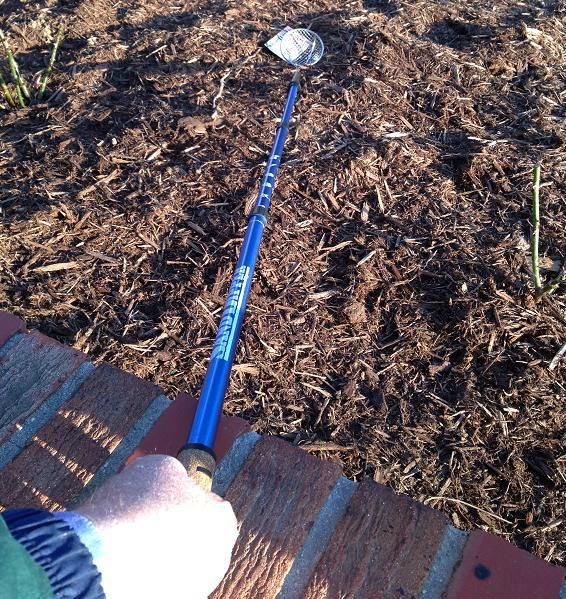
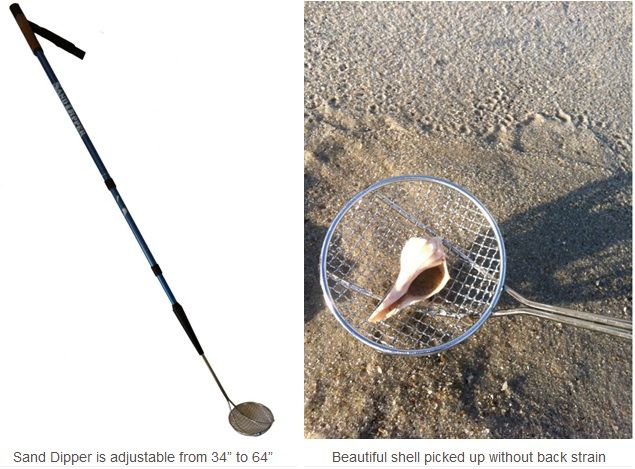
The Sand Dipper extends to over five feet long so you can reach those shark teeth from afar.
Another thing that I like about it is that it seems pretty durable and it's light. You can extend the handle to reach far away spots, perhaps when you're walking the beach and don't want to get your feet wet. When I compared the Sand Dipper to my other home made versions, I noticed that the "basket" was a bit smaller than the one that I've been using. Of my home made versions, I've tried various sizes of frying skimmers and found that the smallest one allowed me to dig in the sand easier and be more precise in what I pick up. I think that will hold true here too, but will report on that once I try out the Sand Dipper in the field.
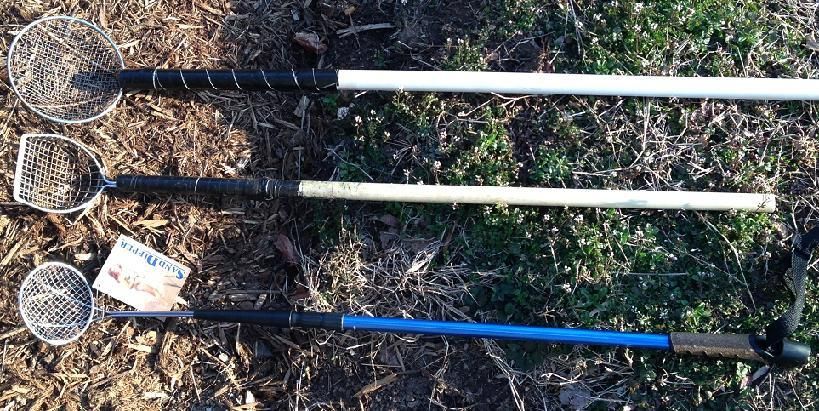
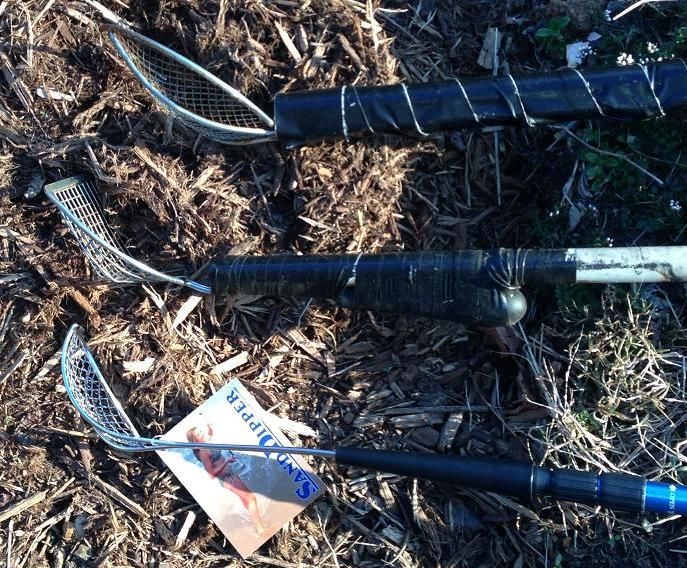
Prior to me obtaining my new Sand Dipper (bottom), my favorite home made version is pictured here at the top. The "basket" is a bit bigger than the Sand Dipper, but is the smallest of the King Kooker style that I have, and seemed to be much easier to use than the larger sizes. My thought is that this will also hold true with my newest addition.
If you look at the picture above and compare the features of my old homemade skimmer version, you can see that the cork handle gives you a much more comfortable and less slippery grip than PVC pipe. The middle one, another home made version, seemed like a great choice at the time, but it also has limitations.
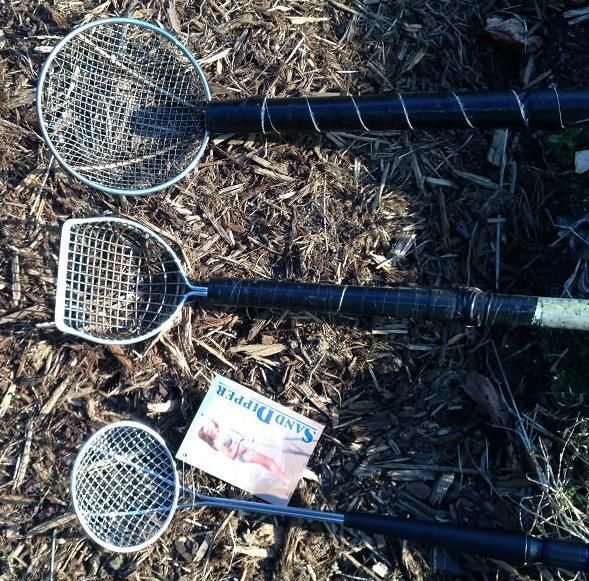
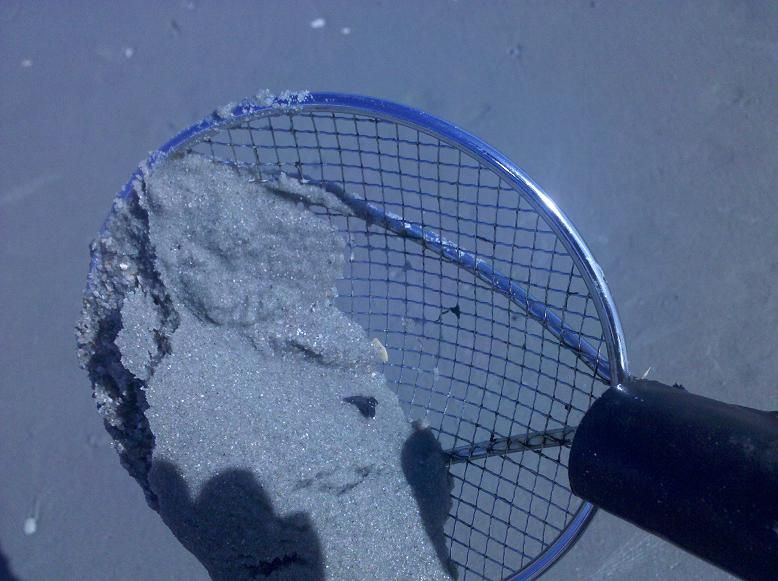
This picture compares a close up view of the collecting baskets of the Sand Dipper to my home made versions.
In the above picture, you can see clearly that the quality of the mesh is much nicer in the sand dipper, it's thicker and is made of stainless steel. The King Kooker versions wore out quickly once they began to rust, and the thinner mesh couldn't hold up very long to collecting along rocky or really shelly shorelines. The middle one above is another home made version with a different basket, which is very strong and durable, and made of stainless steel, and has a very strong frame that is great for digging into substrate. However, if you look closely, you'll see larger gaps in the mesh that surround the base of the basket, and many nice shark teeth slipped through those gaps, so I stopped using that one. Now it collects dust.
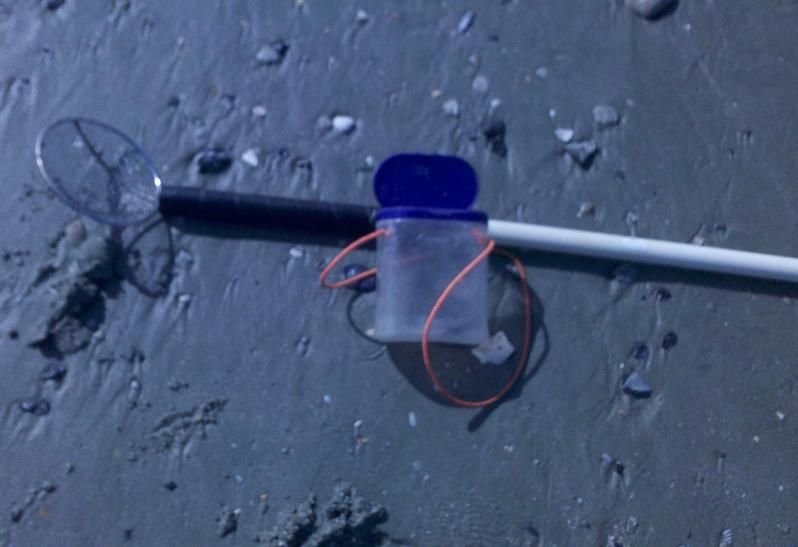
Here's a side view comparing the baskets, handles and such.
To sum up this product review, which is a first for me of anything outside of the fishing world, I'm really impressed with the Sand Dipper. Now I need to get out and test it in the field. After giving it a go, I'll report back to you all on my findings. I'm confident that it will be a positive experience based on what I've seen so far.
Finally, here's a big thank you to Skip for designing and marketing such a nice product. People approached me on the beach all the time and asked me about my home made version. Now, they too can purchase such a handy collecting tool. I've seen other commercial version on the beach, but they were cheaply made and no where near as nice as my home made versions, which fall short of the Sand Dipper in quality too. No longer will they have to strain their backs after bending down to pick up stuff off the beach a thousand times a day. In addition to that, for shark tooth collectors, your odds increase in collecting teeth in the surf because now many of those that the waves stole from you, you can now collect. Now you can collect with ease and confidence.
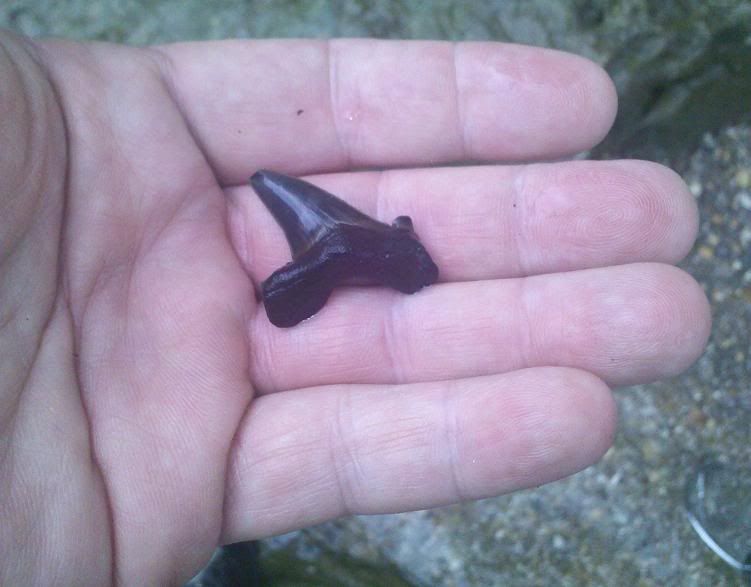
To find shark teeth like this, all you need is the will and a good set of eyes, and to learn the shapes and features of shark teeth. But a tool to help you pick them up can save you back pain and make your beachcombing experience much more enjoyable. Check out the Sand Dipper, a tool similar to the one that I made but much improved.
Want to find shark teeth and other beach collectables without straining your back a thousand times each day by bending over time and again to pick up something that you may or may not want to keep? Many years ago I came up with a solution. I found a King Kooker skimmer and used electrical tape to attach it to section of PVC pipe. This really solved my problem of an aching back. Not only could I poke and prod stuff on the beach, but I could pick them up either with an entire glop of sand or let the water filter the sand out and pick up larger objects. Beachcombing life was good.
Pictured above is my collecting tool, a King Kooker frying skimmer taped to a section of PVC pipe. It works well, but has limitations which, over time, wind up costing money. There is a better solution, I believe.
Over the years, the tool proved effective, but it did have limitations. My intention, of course, was to tinker with the idea and solve the various problems. What problems might you ask? The worst one was that these things rust, and if used in salt or brackish water like I do most of the time, the oxidation process is quite quick. Another issue is that the PVC pipe can become slippery and I wound up dropping it now and then. What good is something designed to save your back from picking it up when you keep dropping it all the time? So my thought was to add a golf grip, and perhaps a strap. All of these modifications are possible and would definitely improve my home made version.
The skimmer allows you to pick up individual items and "sift' them out with water, or just pick up an entire glop of sand.
But, there's a better solution. It's called the Sand Dipper, with the website linked here for your convenience. It's basically the same thing that I use with all of the improvements. If you add up the cost of making my tool with all of those imrpovements, it would exceed the cost of the Sand Dipper. So, here I am at the point of purchasing a marketed version of this tool that has all of the improvements that I wanted in my own for a price that is less expensive than my own version, even factoring in shipping. Another feature that I didn't even think of was that the Sand Dipper is collapsable. And, more importantly, they are stainless steel and won't rust. I'd go through a King Kooker skimmer each year because of rust alone, so the cost adds up over time.
Here's the Sand Dipper, with all of the improvements that I had in mind for mine and quite affordable, actually cheaper than if I made the same improvements to my version.
I plan on obtaining one of these cool products soon, and will report back once I receive it, and provide a review once I've had a chance to test it out. I'm very optimistic. And if they work out as I hope, I can see them as a great Christmas or holiday gift for my family members! I'm really looking forward to trying one out.
Serenity. Peace. One with nature. The thrill of discovery and the satisfaction of the find. The gentle slapping of waves against the shoreline acting as natures sorting machine while lulling you into imagining what life must have been like 65 million years ago along these waters. That pretty much describes my experiences while beachcombing for fossilized shark teeth. And it's even better as a family activity. Imagine walking a beach, perhaps having the beach all to yourself with the only stress being how to navigate by wading around fallen trees or other obstacles, or perhaps climbing over them, to get to fresh collecting areas. And it's even better when you have someone to share it with.
With fossil material all over the beach, all you have to do is enjoy the peace and quiet, and pick the fossils up off the beach. What a great activity to share with my daughter, and bring home some of natures treasures as well.
In my case, it's a perfect way for me to bond with my daughter. We've been collecting shark teeth and other fossils together for many years now. Each trip results in the satisfaction of finding shark teeth, but more important than that, memories that last a lifetime sharing the experience with a loved one. The great thing about my daughter now, is that although she's grown into a lovely college aged woman, she still loves to go with me. And now she's getting back into fishing too, which is even better.
Our last trip was to a location where the finds consisted of Palaeocene shark, ray, and reptilian fossils. For more information on fossils from this era, check out my post titled, "Catching Prehistoric Sharks". We took some good friends from New York that were down for the weekend on a fossiling trip along with us in hopes of finding Otodus obliquus teeth, fossilized teeth of a gigantic great white shark of that era that grew from thirty to forty feet in length or perhaps some of the rarer teeth from that era.
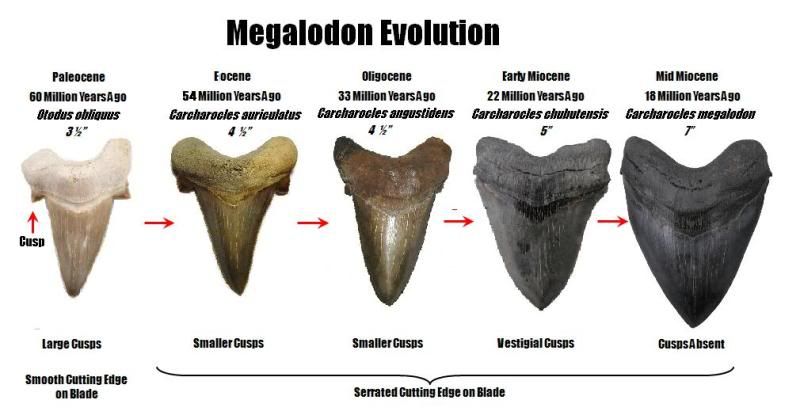
Otodus obliquus, far left, was believed to be an ancestor of the famous gigantic shark Carcharocles megalodon (far right).
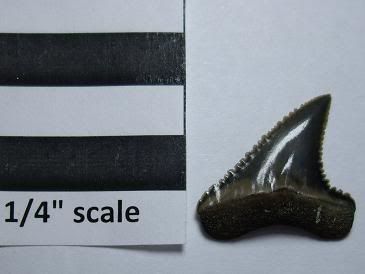
Palaeocarcharodon orientalis. Photo courtesy of Kevin May.
We all had a goal of finding teeth from two species of fossilized shark teeth from that time are very rare, the pygmy great white shark Palaeocarcharodon orientalis, and a bottom dwelling shark similar to todays cat sharks, Paraorthacodus clarkii, along with the impressive Otodus teeth. You also have a chance to find crocodile and ratfish teeth. But the most common type of tooth found there are those of the sand tiger sharks.
Sand tiger sharks were the dominant species of that time. Not that they were the most dominant of sharks, rather, the number of species of that type of shark far outnumbered other types of sharks.
Last week, one of our friends found a worn but rather large (for this location) Palaeocarcharodon orientalis tooth within the first ten minutes after our arrival. Amazing. You never know what or when you'll find something like that! My daughter and I weren't so lucky, but we did manage to find a good many shark teeth including some nice Otodus obliquus teeth and a pile of sand tiger shark teeth.
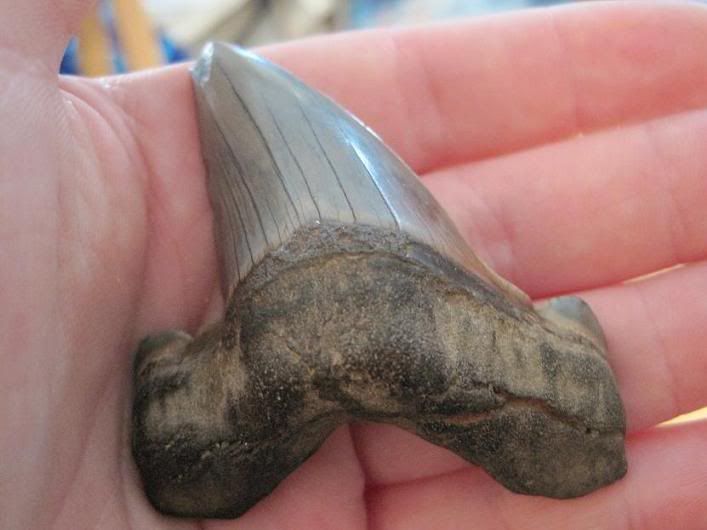
Otodus teeth like this one found by my daughter a couple years ago of this size are rare. Although we didn't find any like this one on this trip, we did find several teeth up to an inch and a half long though, which are also a nice addition to our collection.
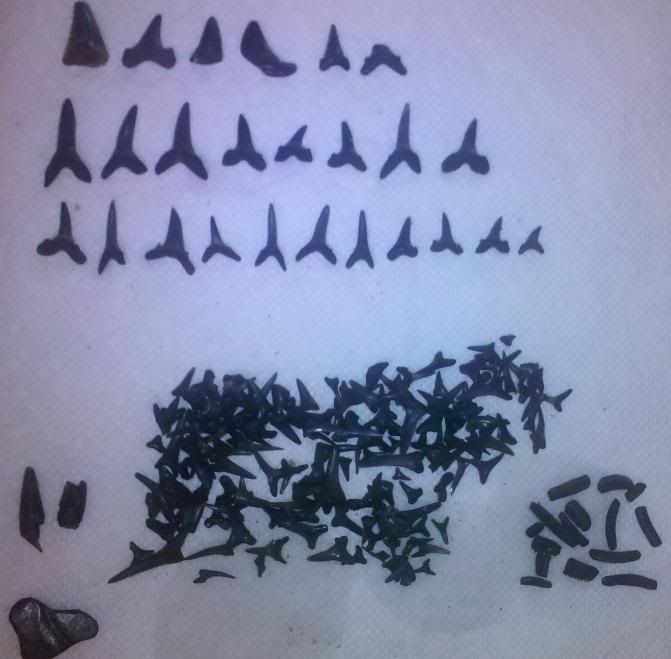
Although I didn't find the rare teeth, I did manage to find six nice Otodus teeth (top row) with the biggest having a slant height of an inch and a half. I also found a piece of pottery (bottom left).
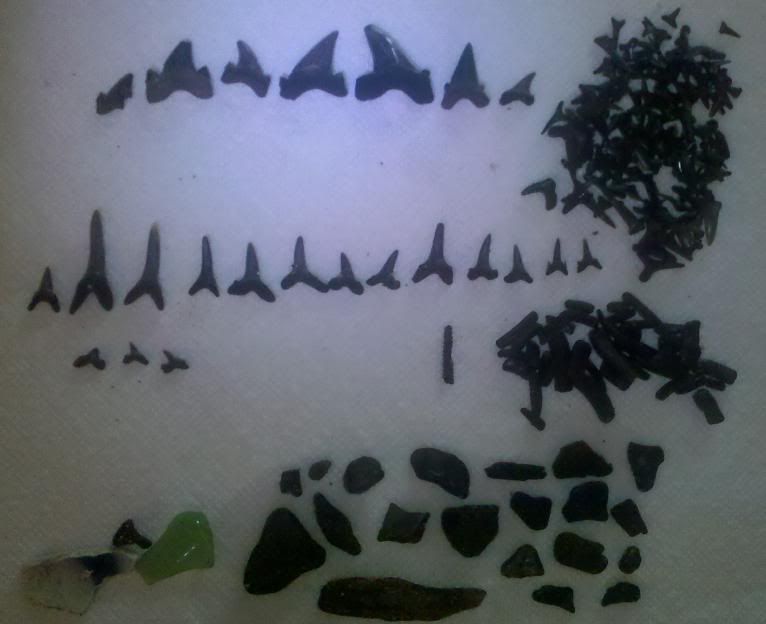
My daughter's finds on the trip, including a crocodile tooth (bottom left just above that piece of turtle shell). She found some huge sand tiger shark teeth too (second and third row).
Finding shark teeth on the beach can be easy as some of them just seem to appear by themselves on the beach. Others are much tougher to find because they blend in with the rocks, pebbles, sand and shell fragments making them difficult to see. All it takes is one wave to wash away some sand and uncover a tooth. There are other fossils there too, like internal molds of gastropods or even entire shells. I've added a few of these to my collection over the years, but my preference is to collect vertebrate fossils, especially shark teeth.
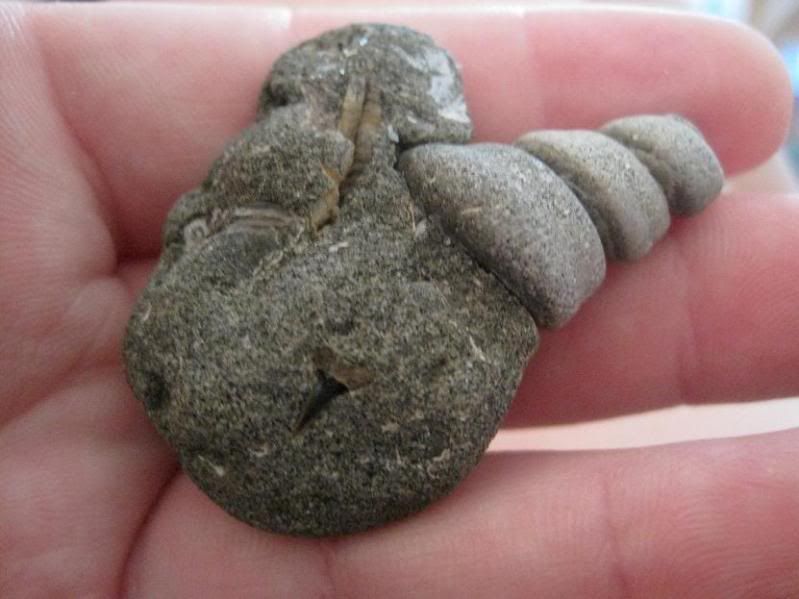
Although I prefer to collect vertebrate fossils like shark teeth but have added some gastropod fossils to my collection over the years, sometimes it's nice to find them all in one nice neat package. Here is a shark tooth in matrix combined with an internal mold of the gastropod, Turritella.
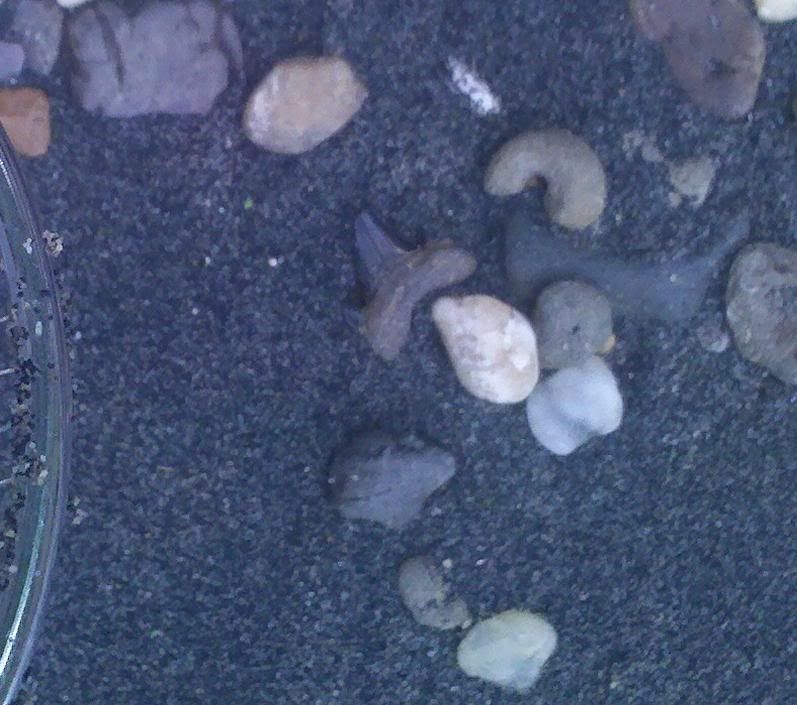
See the Otodus tooth? It's to the right of my skimmer tool.
Here's a close up of the Otodus tooth.
All it takes is one wave to wash a little sand away and uncover a tooth (center).
When the wave clears, here's the treasure left behind. A nice sized Otodus tooth.
We also observed tournament anglers practicing for a big tournament later that weekend. Prior to them moving to our location, large fish were feeding on the surface just a cast off shore. The commotion was far too much for largemouth bass, so my guess was that they were either large striped bass feeding on shad or herring, or perhaps big blue catfish. Either way, the fish busting the surface were massive. I wondered if any of those anglers had hooked anything like that during the day while targeting largemouth.
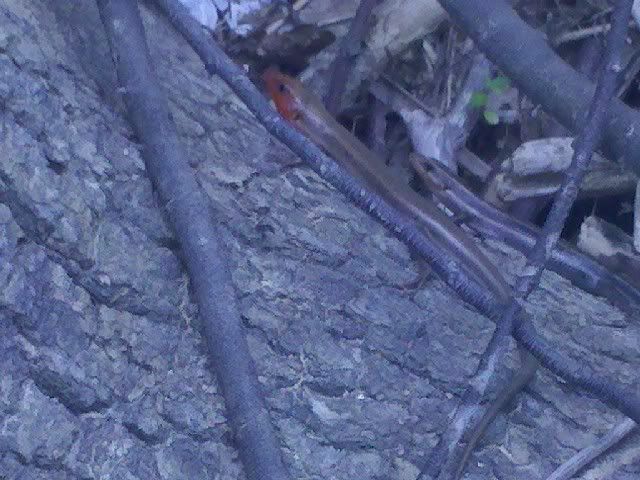
Another plus while beachcombing for shark teeth is that you often see things that most people don't get to see when it comes to nature. Like hunting and fishing, fossil collectors often encounter wildlife. Sometimes we'll encounter deer, fox, mink, or just about any animal that frequents a river bank. The other day, we found a breeding pair of five lined skink. These beautiful lizards could care less that we were there and let us sneak up to take a picture.
We were able to sneak up and take a picture of this breeding pair of five lined skinks.
So, last week we had a great time sharing a fossiling spot with our friends Mike, Mike and Nick from New York. In return, they invited us to collect at some of their spots further North. I think that we'll take them up on their offer. We had a great time socializing with them and collecting.
For me, any time I can get out with my daughter outdoors is a great day, whether it's finding shark teeth on the beach or out on a fishing trip. I can't think of a better way to spend time with someone you care about. Can you?