Showing posts with label Chesapeake Bay. Show all posts

Wednesday, December 23, 2020

"The Sickness"

The call of the wild drives our passion for the outdoors.  That's what drives us to get outdoors as often as we do.  It's primeval.  Every now and then, as one season ends prior to another one beginning, I explain to my wife, when bargaining for fishing time, that maybe this is the last best chance that I'll have for the season to get out and catch or bag whatever it is that I'm after.  Her response is that it's all one big season, that they all run together, and they never end... "So, just go, if that will make you happy.".  

Each season ends and butts up against another one.  It's so true.  And each season can be as addicting as the last, whether it's hunting or some aspect of fishing.  But, my friend Steve and I have one major addiction that crosses all seasons and overrides all other addictions.  That addiction is fishing for rockfish, and it's an all year long affliction.  My friend, Captain Steve Kelley calls it, "The Sickness".

Fishing for rockfish is an addiction.  We call it, "The Sickness".  If you catch a bunch of these, you'll understand.

It's not just an addiction, it's an obsession.  It's grown into this monster that pushes us to get out in extreme (not unsafe) conditions to fill the need to feel that bite, set the hook, and fight fish that just don't quit, even after they've been landed.  

Let's face it, the striped bass (Morone Saxitilis) is one tough hombre.  In 1881, Dr. James Henshall wrote a book titled, "Book of the Black Bass".  Within that book is an oft-quoted passage, that smallmouth bass are "inch for inch, pound for pound, the gamest fish that swims".  Although I agree with the premise that smallies are among the strongest fighters for their size, I have to wonder if Dr. Henshall ever hooked into a striped bass.  If he had, then perhaps he might have revised that statement to "one of the gamest fish that swims". 
"Inch for inch, pound for pound, the gamest fish that swims."  -Dr. James Henshall from his 1881 book, "Book of the Black Bass".  Although I love smallies and understand his passion, it's obvious to me, Dr. Henshall had never hooked into a big rockfish. Pictured:  Bob Barber with a nice Susquehanna smallmouth.

In a nutshell, that's why they are addicting.  Rockfish are so strong that I often hook a decent one and claim that it's a better fish than it is, often shouting to my fishing pals, "This is a good one!" as a little drag peels off, and then realize later in the fight that it's the same size that I've been catching all along.  I'll follow up with a statement like, "well it's a future forty incher!"  

However, when you actually hook into a jumbo rockfish, you can tell it's an entirely different class of fish.  Let me tell you, the big ones can really test your light tackle skills.  No big rockfish is caught until you've either got a hold of it or it's in the net, because they simply have no quit.  

On my last trip out, I hooked a fish on a topwater plug, and it turned out to be a jumbo rockfish.  I hooked it on a medium spinning rod with ten pound braid, and that fish took me around the boat.  My fishing pals were all fighting fish too, so I had no help.  I was on my own to land this fish.  No biggie, right?  I've done it hundreds of times.  This fish was just a little bigger.  With my rod in my left hand raised as high as I could, I eased the lunker rockfish toward my hand.  The huge mouth that could have almost enfulfed my head had my large Stillwater Smack-it all the way inside it's mouth.  We didn't have a net large enough for a fish like this, so I tried to grab it's lower jaw, as it seemed that the fight was over.  

The fish had other ideas.  It took off straight down under the boat like a shot, and my 20 pound Seaguar Fluorocarbon leader snapped.  The fish escaped with my favorite topwater lure, leaving me with an empty line and leader blowing in the wind.  I almost cried.  What an amazing species.  It showed me who's boss!

Fishing for rockfish isn't new to my circle of fishing buddies.  We've fished the tidal catch and release areas for brute migratory rockfish for years.  The exception was this past spring, because our local laws changed to prohibit catch and release fishing in the major tributaries of the Bay.  That was painful.  Prior to last year, it's been an annual April tradition.  

Over the years, those spring runs have produced some tremendous days, with catches yielding rockfish over 40 inches numerous times.  Casting crankbaits has been our pattern of choice for targeting big spring rockfish.  The crankbait bite is truly an addiction within this addiction.  There's nothing like the vicious hit of a rockfish on a crankbait.  It's pretty amazing when a big one smashes it and nearly dislocates your shoulder on the strike.  You work the crankbait fast and erratically, and then all of a sudden, one crushes it.  It feels like you've hooked a bucking bronco.  That feeds the addiction alone, nevermind the ten or twenty minute fight that you have coming.

Crankbaits rock when it comes to catching big spring rockfish.

The truth is that we stumbled on the tidal crankbait pattern.  One day, many years ago, my friends, Bill Dowd, Bill May and I were bass fishing out of his bass boat.  It was a frosty early April morning.  Bill May caught a nice chunky three pound largemouth that hammered a spinnerbait from under a partially floating log, but, other than that, the bass fishing was very slow.  We used the trolling motor to venture out from shore in an effort to mark fish along a drop off or in a channel.  It seemed like it took forever to move from three feet of water to six.  Then, it went rather quickly down to twelve feet of water, and lo and behold, we marked fish.  

Bill May, dropped a green pumpkin bass tube jig down to the bottom and had a nice fish hit it immediately.  That fish came unbuttoned just out of sight under the boat.  We all thought it was a big largemouth.  Then, I hooked up and fought a nice fish as well, and it turned out to be about a six pound fish, but...it was a striped bass!  We repeated the drift and observed the sonar, and noticed them holding in a twelve foot trough for about a mile mile long.  

After repeated drifts down the trough, we caught numerous stripers all day long.  We caught fish on bass lures, mostly four inch tube jigs, Rat-L-Traps, spinnerbaits, small crankbaits, and jigging spoons.  My friend Bill Dowd caught one that went just over 30 inches, and I managed to boat a 34 incher that hit a jigging spoon, which was my personal best at the time.  

After hearing about our trip, my good friend Bob Barber invited Steve and I to fish out of his boat and we found them again in the same "trough".  We caught lots of 18 to 30 inch rockfish by jigging or trolling sassy shads and Rat-L-Traps.  Steve and Bob pounded them all day on the jigs.  

Stubborn me, on the other hand, wanted to fish crankbaits.  I caught a few fish on a Rat-L-Trap, but the action was a little slow on that lure.  The crankbait action was hot the prior trip at the end of the day, and I wanted to duplicate that with more time.  I was frustrated as Bob and Steve landed fish after fish, about three or four to my one.

During the late afternoon, the tide changed and the action picked up, and things started to change for me as well.  Bob fought a nice mid-twenty inch fish to the boat, and, right at boatside, a monster striper rose from the depths and tried to eat the smaller rockfish, and nearly knocked it off of Bob's hook.  We all stood there with our mouths agape.  In the movies, one might say something like, "We're gonna need a bigger boat..."

I immediately dug into my tackle box looking for the biggest crankbait that I could find, and pulled out a seven inch Bomber Long A.  If I remember correctly, it was about the third cast, just as Bob swung the boat around with his trolling motor, a fish hammered my Long A.

I fought that fish for a long time.  It seemed like forever.  In my mind, it seemed like maybe forty minutes, but, in reality, it was probably only ten or fifteen minutes.  I'd have to have Bob or Steve chime in on that.

We were using light tackle, and this big fish fought extremely hard against the spinning rod that I typically used for fishing plastic worms for largemouth bass.  I was using twelve pound Fireline that day.  It took me quite a while to get that fish to the boat after several runs.  It was a monster, a 45 1/2 inch striper and weighed 38.1 pounds!  That fish remains my personal best to this day.  I'm glad that I stuck with fishing crankbaits!  After an excellent job putting that fish into Bob's undersized net, we admired the fish and set her free.  Bob and Steve both tied on big cranks and caught good fish for the rest of the day.

The Long A really turned my day around, as my biggest four fish went 45 ½ inches and 38.1 pounds., 37 inches and 21 pounds, 34 inches and 15.2 pounds, 31 inches and 11 pounds, and I caught several between eight and ten pounds.  It was nice to have a scale to record the weights of the fish.  Because of that day, I have a good idea of how much the fish we catch today weigh.  

I'd love to share pics with you of any of those fish.  But, I can't.  You see, this was way before any of us owned a digital camera or a phone with a camera, and, earlier in the day, we used up all of our film on the smaller fish.  We had no idea monster rockfish were in the area.  The only proof that I have are the eye witness accounts of my friends, Bob and Steve.

What a day!  That changed everything.  That's when the striper addiction started for us, way back in 2002.  From then on, we went back to that area in an attempt to repeat our previous success.  Conditions vary during the spring there, and you have to hit the conditions just right to fish crankbaits for stripers.  The right conditions need to be the right water temperature, good water clarity, light winds, and the fish have to be there.
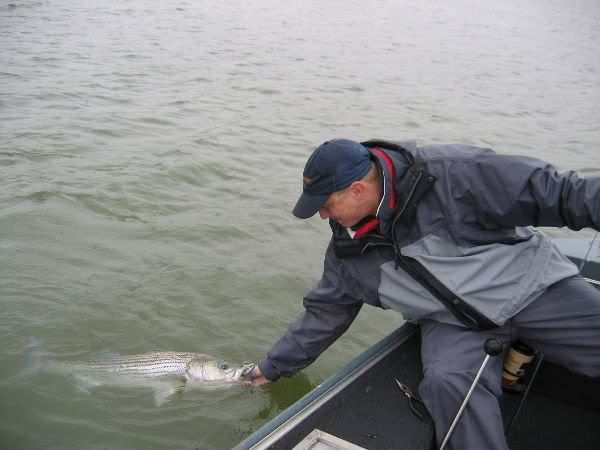
My friend Bob Barber, Steve and I had a great day back in 2002.  Here, a few years later, Bob lands a really nice rockfish that he caught on a crankbait during a past April catch and release season.

We've had some successful days since then, but, you had to time it right.  Finding suitable fishing or boating conditions doesn't always coincide with when the fish are there.  The weather in April is usually not the most stable.  Wind is the enemy, because, not only does it result in small craft advisories, it muddies up the water.  Dirty water is not a good condition for fishing crankbaits for striped bass.  You need some visibility.  It doesn't have to be gin clear, but clear enough for the fish to see your lures.  

A few years ago, out of Steve's boat, I was nearly able to match that 45 1/2 inch rockfish, with a really fat 44 and 3/4 inch fish.  It may have been heavier than the one that I caught in 2002, but, we never weighed it.  I'll post the details of that memorable day in a future post.

This 44 3/4 inch beast hammered an 8 inch Bomber Long A.  You can see why, when you catch a trophy like this, you're addicted for life and crave ever so more...

After that, we were all obsessed with the catch and release spring striper fishing, so much so, that we'd forget all of those other good fishing opportunities available to us for other species.  I mean, I was a largemouth bass fanatic from way back.  I never thought that I'd pass up fishing for largemouth bass in April for anything.  For the month of April, fishing is good just about everywhere for any species.

Don't get me wrong, the good Lord knows that I love catching three to five pound largemouth or smallmouth bass, or slab crappies, or big white perch.  But, put each of those fish up against a trophy rockfish, and the choice is clear, at least for me, what I'd rather target.

I caught this big largemouth on a Rat-L-Trap off of Captain Steve Kelley's boat also.  We both love fishing for largemouth bass in the spring.  But, our first choice is to target rockfish in April.

When the spring crankbait bite is on, you can't beat the thrill or the action, especially when you have the chance at the fish of a lifetime.  But, the spring trophy catch and release "season" is short lived, as the bigger fish leave the tributaries and head out to the Bay and into the Ocean in a matter of weeks.  In other words, our addiction pretty much ended when that "bite" was over.  It was truly a short term sickness.

Summer traditionally for me was the time to wade fish for smallmouth bass.  I love small stream fishing.  But anytime Steve invited me out to the Bay, the chance of catching a big rockfish trumped stream fishing for bass.  No offense to my stream fishing buddies, but I like variety, and getting out on the Bay was a welcome change.

When Steve invited me to fish the Bay with him in the summer, we always had the goal of getting a few keeper fish and simply have fun.  We'd drift bait back to the bridge pilings and catch a few keeper rockfish mixed with white perch.  It was fun, because you never really knew what you were going to catch.  Rockfish, toadfish, drum, trout, flounder, perch, bluefish, and sea bass catches always kept you guessing.

We were convinced that bait was the way to go to catch big fish, and, although we knew that anglers regularly jigged for rockfish successfully, we clung to the notion that bait was the best way to go.  It's no secret that live or fresh bait will tempt big fish of all species.

Steve with a nice rockfish caught by drifting bait to bridge pilings.  Bait will catch fish, big fish, consistently.  However, learning to catch big fish on jigs really stoked our addiction for striped bass fishing.

After we'd run out of bait, we'd head out and look for breaking fish under birds or find spots with good current and structure that held rockfish.  Once we found such places, we'd toss paddle tail swimbait jigs to catch lots of schoolie sized rockfish.  It was fun, and, although we both heard that big fish may be under the smaller fish, we didn't know how to find them or fish for them.  Still, we had fun fishing the Bay that way.  Every now and then, we'd catch a smaller sized "keeper" fish.  Even though we had fun, we didn't really feel the rockfish addiction as we did during the spring catch and release bite.

We both wanted more.  We tried jigging with limited success around the Bay Bridge pilings, but still were convinced that bait was the ticket for bigger fish.  Steve and I researched the internet to learn more.  We watched YouTube videos about fishing the Chesapeake Bay, read blogs, and fishing forum posts.  

I purchased Shawn Kimbro's books after we watched every single one of his videos.  The books and videos were not only very informative, they were also inspiring.  We did everything that we could do, purchased the right tackle, practiced the right techniques, and did everything that he recommended.  That was the start of "The Striper Jigging Revelation".  

You can read all about that by clicking on the blog post link above, or simply scroll down the page to post below this one.  That article contains information about jigging techniques and recommended tackle.  Each trip out, Steve and I learn something new.  Every time we successfully found and jigged up nice rockfish, it was like  putting the bigger puzzle together, one piece at a time.  

However, it's more than that.  Our growing rockfish success caused us to give up other outdoor activities.  Steve and I both bow hunt.  Since my Brother, Kyle, passed away, Steve's been the only person that I've hunted with on a regular basis.  We each have our own spots too.  Neither of us missed hunting season for anything.  It was another seasonal addiction.

But, last winter, we wanted to catch stripers so bad, that neither of us purchased a hunting license.  Steve typically winterized his boat each year around late October or November or so.  Last year was the first year that he didn't do that.  We kept fishing, and never sat in a tree stand.  We gave up one addiction for another.  That's sick!!!

October though mid-November used to be reserved for bow hunting during the rut.  Now, those months have become addictive striper fishing months.  Now, we fully understand the Maryland term for that time of year, "Rocktober".  Our bow hunting time has been relegated to a late season phenomenon.

Dan Ricker knows the sickness too as he sports a fat slob of a rockfish caught on a Coach Jig Head rigged with a Bust'em Baits Fat Boy.  Dan constantly barks out how he'd rather be walleye or crappie fishing, but you can tell that he's as addicted as we are.

So, for those of you that know this disease and suffer the same affliction as we do, then you recognize the symptoms.  That's when you know you have it bad.  All you think about is the jig, topwater or crankbait bite, and the fight of a big rockfish that peels drag off and fights so hard.  All you think about is how you can find more pieces of the rockfish puzzle to achieve further fishing success.  Instead of watching television with your family, your mind drifts off to another world as you scan the Navionics app on your phone, looking for good structure that might attract rockfish via current breaks and ripping tides.

You can't put down Shawn's books.  You've read them until you've almost memorized them.  You scour the internet and read every local fishing report that you can find, or any web forum post about striper fishing, for that matter.  You can't stop scrolling through the Facebook posts of your fishing groups to read rockfish reports for the days that you couldn't fish.  

Catching fish like this just aggravated Steve's symptoms.  After a fish like this, you'll get "the sickness".  

You go through and organize your tackle and repair the rigs on your striper rods even though you may not have a trip planned yet.  You order tackle on-line, or visit the local tackle shops to get more of what worked for you.  If you're broke like me this time of year, you visit on-line tackle stores and add items to your cart or wishlist, knowing that you can't afford to pay for them yet.  You may visit a local tackle shop to buy some tackle for a fishing friend as a holiday gift, but, of course, you can't help picking up some tackle for yourself.

You find that, while doing other things, whether it's shopping at the local hardware or grocery store, doing errands around the house, sitting in a tree stand, or even other types of fishing, you dream of jigging for rockfish.  You find yourself always checking the weather...not at home.  No.  You check, at multiple locations around the Bay using various weather apps to find out wind and wave conditions for the next ten days.

Check out our buddy Rodger Moran's expression after catching this rockfish.  Think he's got "The Sickness" or what?  

You also call your fishing friend network to find out the latest intel.  When your fishing pals are out there on days that you can't go, you text them constantly for updates, knowing full well that if you were out there and the bite was on, that you would focus on fishing and ignore your phone.

You dream about jigging for rockfish, and you set the hook in your sleep and accidentally knock your spouse in the arm.  Or, perhaps you have a dream where, on every cast, big rockfish are knocking your topwater plug out of the water or crushing it so hard that they set the hooks themselves.  These are recurring dreams, by the way.  

You've got it bad.  There is no cure.  Your only hope is to treat the symptoms.  How?  By going out fishing for rockfish.  

You've got "The Sickness"! 


Wednesday, December 16, 2020

The Striper Jigging Revelation

Probably the biggest change with my outdoor experience over the past year and a half was how my fishing buddy, Captain Steve Kelley, and I approach fishing for rockfish (a.k.a. striped bass, stripers, rock, etc.).  The biggest change was that we learned how to find and jig for nice sized rockfish no matter the time of year.

In the past, we tossed crankbaits in tidal catch and release areas of the Chesapeake drainage or fished live bait over structure.  We caught nice fish along with some monsters in the spring, but that bite is hit or miss, depending on the weather, water quality, and water temperatures.  During the summer, we worked crankbaits and jigs and caught mostly schoolies (smaller sized stripers in the 14 to 18 inch range).  Most, if not all, of our bigger fish came on bait.  Every time we fished, while he fished bait and caught keeper sized rockfish, I would try unsuccessfully to catch stripers on lures. 

Then, a year ago in the late summer, Steve got me hooked watching and reading about jigging for stripers in the Bay using light tackle.  That convinced us to take the inevitable path that we both really wanted, to be more proficient with catching rockfish on lures with light tackle.  So, we both invested in the right tackle, rigged our rods appropriately, and then gave it a try.

I remember the very first day that we took jigging seriously was a year ago from this past September.  We searched everywhere as we looked for birds and fished for the fish pushing bait up under them.  We had no idea what we were doing, really as we caught a few smaller fish on smaller baits.  

That evening, right before sunset, a last ditch effort on a frustrating day, we found a nice current rip over a large long rock pile type structure, shallow water next to deep on both sides.  Steve lobbed his 3/4 ounce skirted Coach Jig Head teamed with a seven inch Bust 'em Baits Fat Boy trailer and instantly hooked up on a trophy size sea trout.  I can't remember exactly, but it was about 25 inches long, and, without a doubt, the fattest trout that I'd ever seen.  Literally, three casts later on the next drift, Steve hooked up again on back to back keeper sized rockfish sized in the mid twenty inch range.  We both became believers and have been addicted to jigging for rockfish ever since.

Steve Kelley's tank of a sea trout jump started our jigging addiction.

I struggled that evening.  I didn't have the knack of feeling that striper jig bite yet, despite having the right tackle set up.  I was hampered by tackle problems.  I snagged on my first cast, but got the lure free.  On the next cast, however, since the braided line became buried in the spool of my baitcasting reel, the shock of the next cast caused my lure and leader to break off.  I became mesmerized as I watched my lure fly off into oblivion.  As I tried to tie on another leader and lure, that's when Steve hooked into his second striper.  

But man, Steve had it down pat.  I always thought of him as the "Striper Whisperer" anyway, ever since our crankbait striper fishing days, as he has a sixth sense of when a rockfish is around his lure and ready to bite, just by the feel of what is going on with his lure.  That's when he'd take action to make that fish bite with erratic jerks of his crankbait.

About a couple weeks prior to that night, Steve searched YouTube videos about fishing the Chesapeake Bay.  Several videos stood out, most notably were those done by Shawn Kimbro and Jeff Little.  Shawn and Jeff have some great "how to" stuff that they share, from every topic you can imagine when it comes to jigging for stripers.  I linked both of their channels in my favorite haunts section of this blog to the right.  Please check them out.  

Anyway, we listened, and after that first night, we really took notice and focused on what we needed to do.  In fact, for both of us, it became an obsession.  Now, jigging for rockfish is all we think about.  Last week, we both reminisced about having dreams of fish biting and us setting the hook.  Steve's wife caught him physically setting the hook in his sleep one night and has been teasing him about it ever since.  You don't want to wake up from dreams like that.  Even more, you don't want to leave the water when the fishing day is over when that bite is for real.

We had no idea that you can catch fish like that all year long consistently.  I purchase two of Shawn's books (you can purchase them from his blog, Chesapeake Light Tackle site or on Amazon).  These books offer a ton of good information and I highly recommend them.  My failures that first night combined with Steve's success drove me to learn as much as I could, and, I'm still learning.  These books were a great start.

These two books by Shawn Kimbro are chock-full of great information that will help you fish light tackle on the Chesapeake Bay, or anywhere, for that matter.  Not only that, but both books are a great read.  I highly recommend them if you want to improve your fishing in the Bay.

It took me most of last fall to get the hang of it.  Steve picked things up right away.  It wasn't unusual for him to catch two stripers to my one.  Things started to change for me after I purchased my first rod and reel dedicated to striper fishing.  For Christmas last year, I bought a St. Croix 6 foot 8 inch, extra fast action, medium power baitcasting rod matched with a Shimano Tranx baitcasting reel.  I spooled it with light braid.  I absolutely love this set up.  Now, I can feel the lightest of bites.  

With a sensitive rod, you can determine what exactly is a bite, and what could lead to a bite.  Sometimes rockfish nose your jig but don't quite bite, almost like short striking largemouth bass, and the action necessary to get that fish to bite is needed.  You know a fish is there, you've marked them on the finder, they're interested in your lure, but you need to make it happen.  I truly think that when I struggled, I felt fish there, but didn't realize it.  I thought that perhaps what I was feeling were jellyfish being cut by my line or stuff like that, when probably, most of the time, fish were nosing my jig.  That's where jigging techniques come in to play, turning those short strikes into hits.  More on that later in this post.

A year and a half ago, we never thought that you could jig up fish like this in the summer.  We thought that live bait was the ticket for big fish.  Boy, were we wrong, and we are thrilled that we were.  You can jig rockfish like this all year long with light tackle.

First, what tackle works best?  Basically, a medium power, fast or extra fast action, graphite 6 foot 6 inch (or 6' 8") baitcasting rod teamed with a reel that holds a fair amount of line but is light enough to jig with, has a good drag, and a high speed gear ratio works best.  Baitcasters give you better control of how much line you have out, which is critical to catching big stripers.  But, there is a trade off.  Baitcasters tend to not quite cast as far as spinning rods.  Most of the time you don't need to make really long casts.  But, when I feel the need to, I also have a spinning outfit rigged with similar tackle as my baitcaster.  I use that when I need a long cast to reach fish that the other rod can't reach.  

What about line?  Most of the experienced light tackle striper anglers use ten to fifteen pound braided line, matched with fluorocarbon twenty or thirty pound leader, depending on the size of the fish.  Lighter braid allows your lure to get deeper with less drag.  The leader should be long enough to reach past the sharp spines and of the size fish that you are targeting.  For most of the year, and for fish under thirty inches, two to three feet of twenty pound leader works fine.  For the big slob stripers that show up in early spring and late fall, it's probably best to up that to thirty pound leader.  These fish are so strong, and so much can go wrong, and you probably don't want to lose a fish of a lifetime.  

Lures are, of course, a matter of personal preference.  I will mention my favorites for jigging, but the key is always getting the lure in front of the fish and taking action to make them bite.  My advice is, go with what you are confident in.  If you find a lure that works for you, stick with it until you find something that works better.  My suggestions below might help if you're struggling, but please know that there are lots of choices out there.  The suggestions below work for me and have reduced my learning curve.  Starting off with good tackle also saves money, because you benefit from the experience of others, as I have.

I like the Coach Jig Heads made by Shawn's fishing pal, Rich Jenkins.  They come in a variety of sizes and colors.  I think I use one ounce size most often.  However, there are times when the tide, current and winds aren't as strong, where a 3/4 ounce or lighter jighead might perform better.  You can fish them with or without a skirt.  By skirt, I mean skirts that are designed for spinnerbaits and buzzbaits.  When the currents are strong and the wind picks up, you may wish to up the weight of the jighead to an ounce and a half or maybe two ounces, especially if you are fishing bigger soft plastics.  Use whatever the lightest weight jig is that gets the lure to the fish effectively given the conditions.  If the fish are finicky, a heavier lure might be dropped by the fish quicker, or the action might not be right to get a fish to bite.

Fish will bite on these jigs whether or not they have a skirt.  Skirts give the jig and soft plastic combo a little bigger profile and movement.  But, if you need to lure to get down, say for strong windy conditions of lots of current, maybe leave the skirt off, as it creates drag, preventing your lure from perhaps getting to the bottom.  I personally like fishing the skirted jigs because I have confidence with them.  But, I've also caught nice fish without the skirts.

The three brands of soft plastics that I like are made by Z-man, Bust'em Baits, and Bass Kandy Delights (BKDs), not necessarily in that order.  The seven inch sized fluke style baits made by each company resemble "bunker", the bait that the bigger fish prefer.  But, bunker can grow as large as ten or twelve inches, so the ten inch sized plastics work well when you find big fish feeding on big bunker.  In fact, my biggest fish this year was a fat 41 incher that fell for a ten inch BKD on a two ounce Coach Jig Head without a skirt.

This beast of a rockfish nailed a ten inch Bass Kandy Delight (BKD) earlier this year.  As it turned out, it was my biggest rockfish of 2020.  Big lures catch big fish!

As far as color goes, go with what you feel confident in.  Anything that you can do to get a fish to bite, whether adding a skirt, dying the soft plastic to give it contrast and scent, trying contrasting colors, or anything like that is worth a try.  When you are successfully catching fish, file that into your memory about what you were using, the conditions you faced, and how you worked the lure.  I'm a big fan of the color chartreuse.  In fact, a former Potomac River bass guide, Glenn Peacock, had a saying that I adopted and repeat to this day, that "if it ain't chartreuse, it ain't no use!"  

That said, popular colors in the Chesapeake Bay are white or chartreuse, or a combination of that.  But, other colors work just fine.  Think about the conditions.  If your favorite lure isn't working and your fishing pal is catching fish, take note of what your fishing buddy is doing or what he is using and adapt.  Adapting is the key to catching fish.  

Don't be afraid to use scented dyes to alter or add a little extra oomph to the lure.  I've been dying the tails of my plastic worms chartreuse while fishing for bass for years.  I made my plastic worms seem less monotone and more lifelike, plus, the added garlic scent certainly seemed to help get me more bass bites.  The dyed tails always reminded my of how a bluegill looks while swimming off.  At the very least, my repeated success using soft plastic dye gives me confidence. 

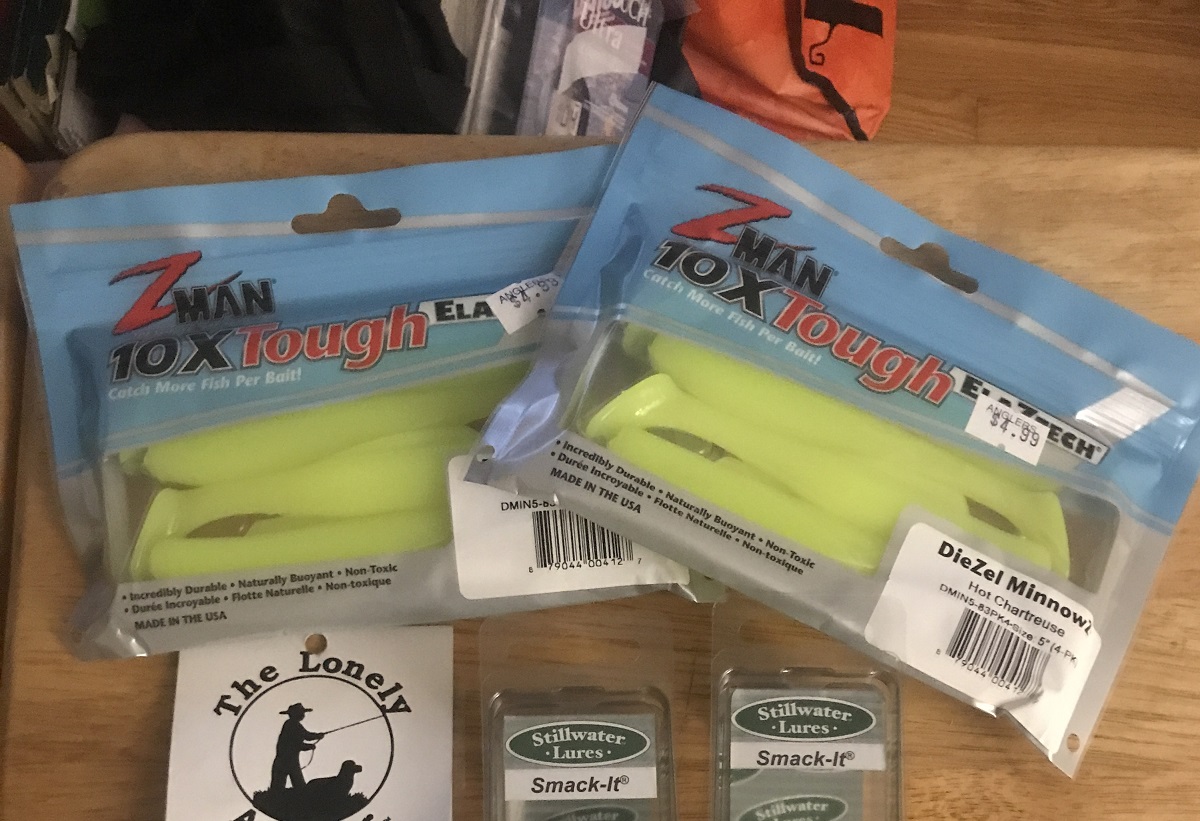
The shad style soft plastics work great, but sometimes, a paddle tail soft plastic will catch fish and generate more bites.  I really like the 5 inch Z-man Diezel Minnowz for many reasons as my favorite shad tail bait, but mostly they catch fish.  In fact, when bluefish are around, the Z-man baits can, most of the time, withstand a bluefish bite while other brands become cut in half.  That's probably my primary reason for using them as often as I do.  When is a good time to fish a paddle tail?  When the fish are super active and are in chasing mode, or, when they aren't very active and dragging the bottom produces.  

Of course, you can jig these using the same techniques as the shad tails.  I've caught some really nice fish this past year using this bait just by snap jigging it.  I've had particular success catching nicer fish under feeding birds with this bait too.  For these, I use a long spinning rod so I can get that extra casting distance and reach more fish.  

I've caught bunch of nice fish on these swim tails, the Z-Man DieZel Minnowz.  I don't know what it is about them, but stripers like them. 

Each of the aforementioned brands of soft plastic has worked well for me.  If I'm not getting hits on one brand, size or color, then I'll switch to another.  BKD's, Z-Man 7 inch Jerk Shadz, Bust'em Baits 7 inch Fat Boys have caught me so many fish that I can't count.  I've linked Coach Jig Heads above, so I'll link these soft plastics here.  Coach Jig Heads, Bass Kandy Delights, and Bust'em Baits are all made locally in the Maryland section of the Chesapeake Bay, but you can order directly from them on-line.  I really believe in supporting our locally produced products.  But, not only that, they work wonderfully! They all have great customer service.  

Bass Kandy Delights (BKDs) 

Bust'em Baits Fat Boys

Z-Man Jerk Shadz

By the way, the Bust'em Baits "Fat Boy" has nothing to do with the name of this blog, but it is fitting, I guess.  My blog name comes from the name of an ice fishing jig.


Steve Kelley showing us a nice rockfish caught on a skirted Coach Jig Head teamed with a 7 inch Bust'em Fat Boy.  The color?  "It ain't no use if it ain't chartreuse!"

Look, the brands of lures mentioned above aren't the only ones that catch rockfish.  There are many brands.  It's not the lure that catches them, it's you.  If you have a brand of lure that you like and have confidence in, then give it a try.  If it works, stick with it.  The entire point of this is that the size, weight and shape of the lure play a big roll in getting the lure down deep enough to the fish.  Also, it needs to resemble the baitfish that they feed on.  What you do with the lure, presentation, is the most important thing.  You can use the "right" lure, but if you don't work it properly, you probably won't catch as many fish as someone next to you that may work their lure properly.  And believe me, that type of thing frustrates me.  I simply named a few lures that I rely on and have had success with to show you as examples of the types of jigs that catch fish.  

What about techniques to catch rockfish on jigs?  Snap jigging is a popular method to get fish to bite when they won't otherwise.  The snap is usually so hard and fast, that you can actually hear a whipping sound.  The erratic quick movement of the lure when snapped like this really draws strikes.  Sometimes, multiple quick snaps are necessary to trigger a good strike.  Stripers tend to strike short often, almost like they're trying to taste the lure first.  That extra snap fires them up into biting.

Click here to watch Shawn Kimbro's Snap Jigging Video, where he demonstrates his technique that he made famous in our area.  Snap jigging is the primary technique that I use to jig up nice size rockfish.  

The most important thing when snap jigging, or when jigging for stripers in general, is to always keep slack out of your line, keep the line as tight as possible, as the lure falls at the end of the snap.  That's when most bites occur, and most often, the bites are very light.  Be ready to set the hook at any time, because rockfish sometimes bite at the very top of your snap.  If your line is slack, you won't feel the bite.  If you feel anything, set the hook.  Even better, become a line watcher.  If you see the line go slack, or twitch in a way that it shouldn't, set the hook.  Sometimes, you see the bite before you even feel it.  

Other times, you feel something that doesn't feel like a bite so much, almost like a spongy feeling or something like a jellyfish hitting your line.  If you feel that, jig aggressively, because it could be fish nosing the lure or something like that.  Often, you can entice them to inhale the jig rather than just mess with it.  Don't assume it's not a bite until you know it isn't.

OK, before I go on, you may be wondering why I mentioned jigging with a spinning rod after previously stating that I purchased a dedicated baitcasting rod for jigging.  I think that they have a place in my own arsenal.  It's your preference, really.  For me, I have a muscle cramping disease, and after lots of jigging and catching fish with one rod, my jigging arm cramps up.  When that happens, I have to switch to fishing with my right arm, and the spinning rod fits that need.  I jig my baitcaster with my left arm, meaning that I cast with my right hand and switch hands, old school style...it's how I learned.  I cast and jig a spinning rod with my right hand and arm, so having the ability to switch between rods and jigging arms actually gives me more fishing time.  So, in addition to what I said about spinning rods above, I have my own personal reasons.

There are other ways to generate strikes.  Sometimes, simply dragging your lure on the bottom will get rockfish to bite.  For me, that usually happens when I try to grab a drink or eat a bite of lunch.  I always leave my line in the water as much as possible, because of the old saying, you can't catch fish if you're lure isn't in the water. 

Of course, just swimming a bait can also catch really aggressive fish.  There are times when you may reel in quickly to make another cast, and have a super aggressive rockfish nail your lure on the way in.  I find situations like this to be a bit random though.  Dragging the lure or speed reeling is a technique to catch fish, but not really a jigging technique.  However, when you combine that with jigging, you can really get a fish to bite.

For example, my fishing pal, Steve Kelley, has a very effective technique to draw rockfish hits.  He often makes a long cast, lets the lure sink to a desired depth, then jigs it, reels it very fast for a few cranks, snap jigs it a couple times, then let's it fall while keeping a tight line, again, waiting for that hit on the fall.  If no hit occurs, he repeats that process, perhaps several times, all the way back to the boat.  This technique evolved from our spring crankbait fishing days.  Erratic action draws strikes.

Don't be surprised if a rockfish nails your lure at boat side.  Don't remove the lure so quick for that next cast.  If you just let it hang there for a second before going on to another cast, you just might get that boat side hit.  I can't tell you how many times I've had nice fish take a swipe at my lure as I've lifted it out of the water.

Another key is to always fish your lure in the strike zone.  Use your sonar to determine where the fish are.  Are they on the bottom?  Are they suspended?  Or, are they breaking on top, or just finished doing so?  Obviously, if they're on the bottom, let it sink to the bottom, and then keep jigging to the boat.  If they are at mid depth, let it fall part way and start jigging the lure back to the boat.   If they are in the upper third of the water column, cast out and start jigging aggressively right away back to the boat.  If they are all over the screen, big fish tend to be deeper than the smaller fish breaking on the surface, so get the lure down to the deepest fish marked, and jig.  If no bites, crank it up a bit and jig different depths until you get a bite.

Basically, just jig to where the fish are.  As an example, if they are suspended, you probably don't want to fish the bottom and fish underneath the fish you are marking.  You should try and put and keep your lure where the fish are, the strike zone.  It makes sense, right?

Not everyone can see the sonar at the same time in Steve's boat.  So, when Steve and I fish together, the one who can see the screen will constantly communicate where the good marks are.  Teamwork like this helps everyone in the boat consistently catch nice fish.  It's always more fun when everyone is happy catching rockfish. 

Over the past year, I've caught more nice size rockfish than I have my entire fishing career.  It just gets better and better the more we learn.  I'm blessed to have fishing buddies, especially Steve, to learn or jig with along the way.  I haven't discarded any of my crankbaits or topwater lures, as there is always a place in my box and often a need for them, but jigging has become my primary method to catch big rockfish.  I think that applying these techniques may prove useful for targeting stripers in reservoirs as well.

One last thing about light tackle jigging in the Chesapeake Bay for rockfish, that this is nothing new around here, just new to me.  There are many good jigging anglers out there in the Bay area that use these techniques.  Some have been a huge influence on us.  Thank you to those pioneers that are willing to share their knowledge, like Shawn Kimbro and Jeff Little, their friends, and many others.  

Also, I'd like to formally thank Steve Kelley for introducing me to this wonderful fishery.  We've caught a lot of big fish together over the years of different species, and these experiences just add to those great memories.  Steve's not a charter boat captain, but could be, because he's that good of a fisherman. It's a nickname that I gave him since we most often fish out of his boat.  I still call him "Captain" when we're chasing other species in the upper rivers out of my jet boat. 

Steve sporting his well deserved personal best 42 inch beast of a rockfish.

There will be more posts about fishing for rockfish, so stay tuned.  In the meantime, check out the references mentioned in this article for more information.  

Thanks for following the blog.  I hope the info here helps you catch fish.  I think that it's important for me to share stuff like this, to help others, as others have helped me.  Until next time, good fishing!


Wednesday, June 14, 2017

Camping, Fishing and Good Friends

Sometimes it's nice to just get away.  This time, my good friends Rusty and Donna invited our mutual friend Terry and I for a camping/fishing trip a few weekends ago to fish the mighty Chesapeake Bay.  Our fishing goal was to target the last few remaining jumbo striped bass but the main goal was to fish, hang out and have fun together.

Now this isn't the type of camping that I spent most of my life doing.  Throughout my younger years, I sought more primitive and remote camping experiences.  Even sleeping under a tent was considered a bit wimpy among my peer group.  Sleeping under the stars in a sleeping bag under certain conditions was wonderful experience as long as conditions were right.  That was when my youthful body could take sleeping on the hard ground and other things nature threw at us.  Now-a-days, I can fully appreciate the full comforts of home especially after a tough day on the water.

This wasn't the type of camping that I grew up doing, but let me tell you, it's comfortable, relaxing, a lot less painful,  and a heck of a lot of fun!  Here's Terry checking out the campsite.
No, this camping was much more luxurious, more like staying than camping.  But, man, let me tell you, my old aching bones really enjoyed it.  Rusty's daughter, Crystal, was kind enough to let Terry and I occupy their spacious beautiful trailer with all the comforts of home, including a big screen TV, sofas, easy chairs, a kitchen, you name it.  Rusty and Donna's trailer was even more luxurious.  There is something to be said about staying in comfort, especially after a rough day on the water when you still have wobbly sea legs and muscle aches from muscles that aren't used to choppy water.

The bay was a bit rough when we took to the water in Rusty's boat, but we tossed out tandem bucktail rigs with varying weights so that you could cover different depths.  We put out four rigged rods and set them in his standard rod holders.  He didn't have outriggers or planer boards that allow you to get out the maximum number of rods and cover more water, but we had enough tempting lures out there to nail a big rockfish (as they're known in the Bay area) if one passed by them.

After about an hour of trolling around, a couple naval vessels approached us and asked us to leave the area so that they could conduct target practice.  I've fished with friends in this area for years and this is only the second time that we've been run out of the good fishing hole.  Their target area covers nearly all of the good spots along the eastern channel.  So, we had to make the most of a tough situation.

After trolling through less than productive areas, and with the wind picking up leaving the Bay choppier than Captain Rusty likes to fish in, we pulled in our rigs and headed back in.  But we couldn't get skunked, so when we moved into more protected waters, we tossed some jigs and found some willing smaller stripers to get some fish under our belt.  We tried crankbaits and jigs, and this time, jigs were the ticket.
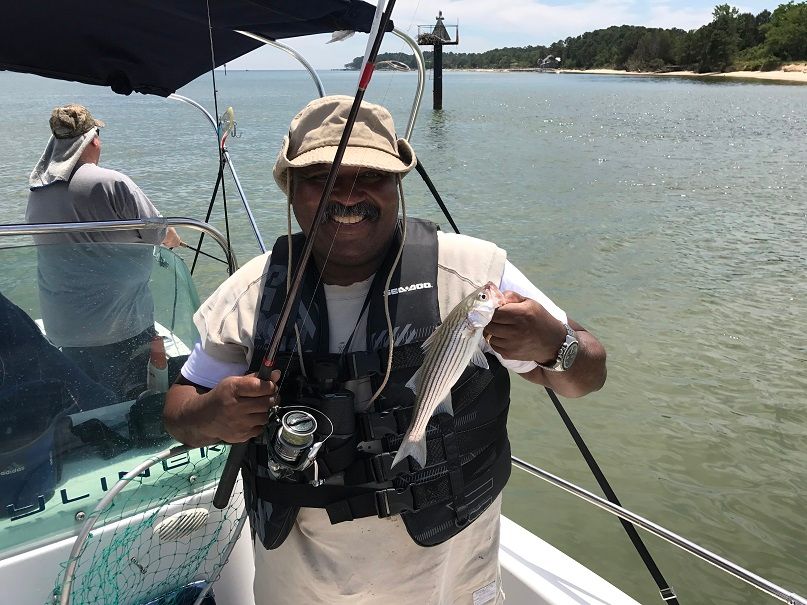
Here's Terry after catching a small but feisty rockfish.  They're a lot of fun jigging for them on light tackle .
Let me say right now that Rusty's wonderful wife, Donna, is quite the fisher.  She ties up rigs, baits hooks, and captains the boat like a pro.  It's almost like being on a charter boat!  She likes to catch fish also, and is very good at it, but she seems to enjoy making sure everyone else has a good time equally as well.  Not only that, she also cooked several breakfast and lunch meals for us, spoiling us every step of the way!  Kind, considerate, putting others before herself...it's just the way that she is.  With friends like Rusty and Donna hosting you, how could you not have a good time?
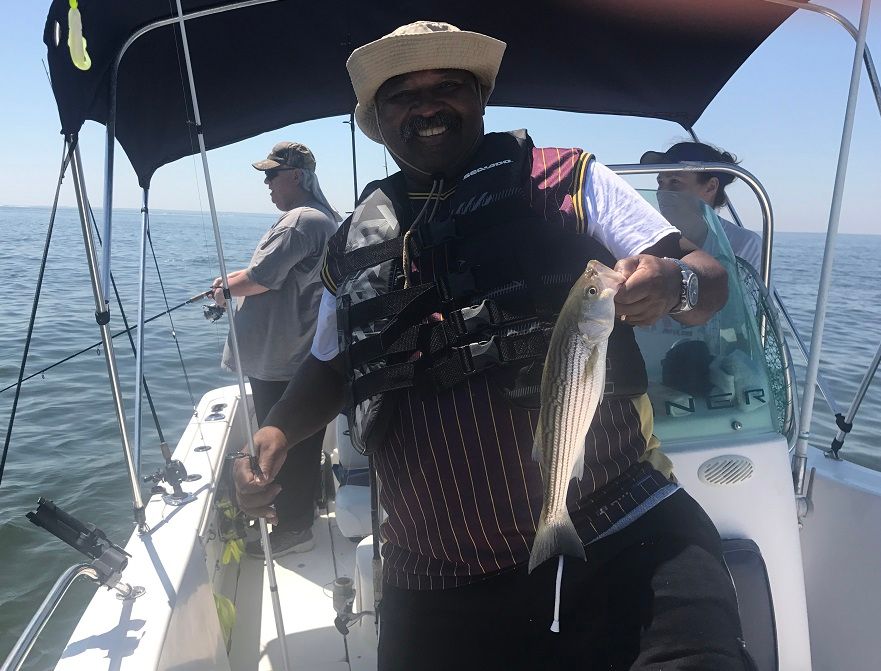
Terry boats another striper while Donna controls the boat with Rusty jigging in the background.  
But this time for lunch, since the Bay was a bit rough, we headed off the water to a stuff ourselves with all you can eat crab legs at Captain Pat's Seafood restaurant in Lexington Park.  What a meal!  After that, we "camped" while watching an NBA playoff game on their big screen TV.  Now, that's camping!!!

The next day, the wind died down and we put in more fishing time, this time jigging for stripers around a couple inshore points.  The bite was pretty good for the most part, and we caught a couple "keepers" but released them to fight another day.  Most of the rockfish that we caught were undersized, but are feisty on light tackle and are a ton of fun.

At one spot, you couldn't really jig the bottom, otherwise you'd snag a cow nosed stingray and man, did they put a strain on your tackle.  We tried to net one and when it saw the net, it took off for the open ocean with my drag screaming, and actually broke my old bass jigging rod!  It was OK though, that old Cabela's rod served me well for over 25 years and caught many fish.  I replaced it that night at our next trip to town.  At that spot though, you had to work the middle of the water column to the top to catch the stripers.  From that point on, if we snagged a ray, then we just broke it off.  After all, jigs are cheaper than rods!

We put in several hours on the water and caught good numbers of fish, but thunderstorms were moving in so we headed back to camp.  No problem, because after a brief nap, we all headed out to the Tiki Bar at Solomon's Island for some relaxation.  Grill Sergeant BBQ is right next door, and they combine to provide music, good food, drinks and relaxation.  The only problem was that it was outdoors and a thunderstorm moved through.  We were protected from the rain, but the lightning made it a bit spooky, albeit beautiful.  As the storm passed, we enjoyed a nice sunset mixed with light rain and lightning in the background.
We had a relaxing evening at the Tiki Bar while eating BBQ and watching the thunderstorm pass, completed by a beautiful sunset of Solomon's Island.
The next day, we had planned to fish all day but a front moved through and the Bay was very rough due to high winds.  So, we packed it up after Donna's delicious breakfast and we headed home.  Thanks to Donna and Rusty for being such gracious hosts, and for Crystal and Christian for allowing us to stay their beautiful trailer.  We had a wonderful time.

So, it's not always about fishing, sometimes, it's the overall experience that brings joy into our lives.  This trip had all of that!