Showing posts with label fishing small streams. Show all posts

Wednesday, January 11, 2012

Small Streams...Arctic Style

By Guest Author Jim Cumming

No matter where you are in the country, December through March produces the coldest weather of the year.  For sure, where I currently live in the Northeast, the “depths of winter” are colder and longer than in states to the South, often expanding to include much of November and April.  Nonetheless, even the Mid-Atlantic region rarely escapes a prolonged cold snap that changes the game on small streams.  The fish have taken their fall feedbags off and spring conditions are months away.  I ice fish for much of the winter, but there are days when I change things up and I am drawn back to the small streams that captivate me for much of the year.  For sure, winter open water outings rarely result in fast action.  You will often fish hard for a few bites.  At the same time, the solitude, crisp air, and beauty of the winter landscape will make your time on the frigid water pass all too quickly even if the fish aren’t cooperating.  Hopefully, this article will give you a few ideas leading to the added bonus of a few fish brought to hand when Old Man Winter blurs the line between open water and ice.
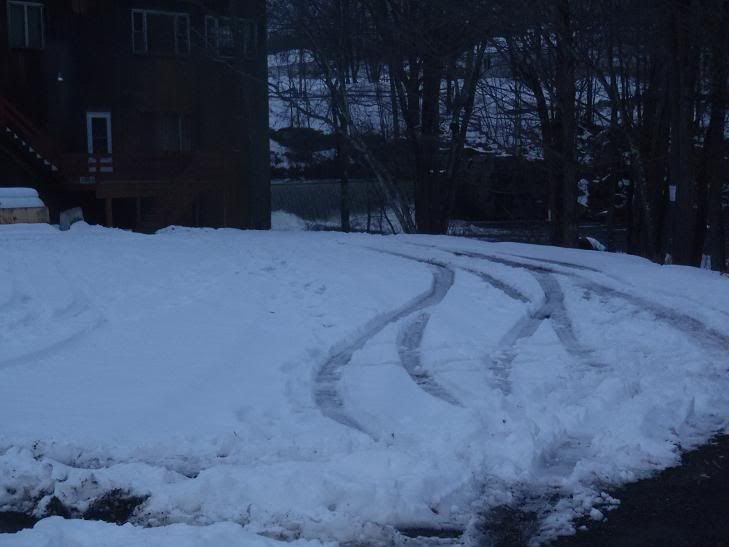
Many times your tracks will be the only ones in the parking lot.  You can often enjoy a nice winter bite to go along with the solitude.
Many of the concepts covered in my “Small Stream Magic…..Going with the Flow” article in Fat Boy’s blog last month can be applied to your pursuit of fish during winter months.  Fish in winter often behave like fish in high water conditions during warmer months.  Rarely will you find them holding in swifter currents or shallow areas.  The spots to focus on are the deeper, more placid sections of pools.  I call these areas “soft water.”  Scour areas behind larger boulders within pools can be particularly productive “spots within a spot” to target. 
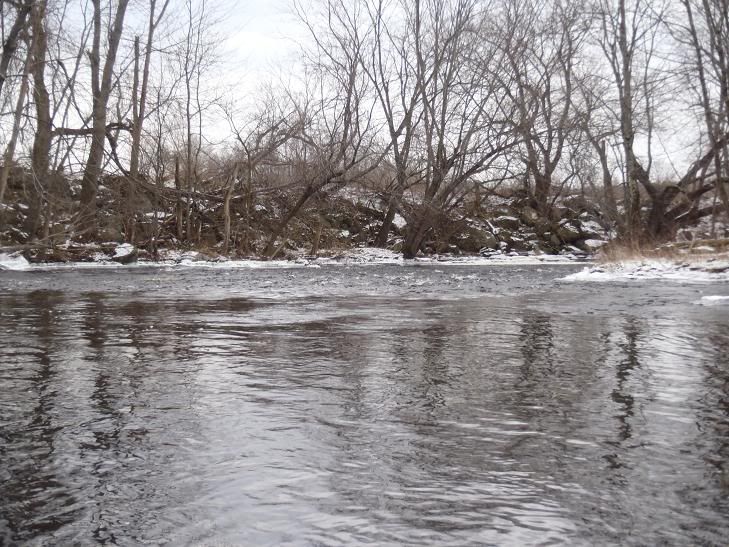
This deep run with a moderate current is a prime holding area for winter trout.
While these are prime spots, winter fish can be full of surprises.  More than once, I’ve fought off the skunk or come up with a bonus fish by fishing the tail out areas of large pools.  Such spots can be fairly shallow and have a strong current.  One December outing with my buddy Warren comes to mind.  We had pounded the previously mentioned “sweet spots” with nary a tap.  Before packing it in, I decided to probe the tail out of a pool practically within sight of the parking area.  I made my first cast across stream and allowed my crankbait to swing seductively as the current pulled it downstream and I slowly retrieved.  To say that the twenty inch brown slammed the lure would be overly dramatic, but the sudden added weight and headshake were unmistakable.  Well….sort of.  Winter bites are often met with disbelief at first rather than excitement.  I managed a hook set that was good enough and a weak, “Warren, fish,” was all I uttered to alert my buddy that the game was on.  The war whoops would wait till that fine trout was in the net.
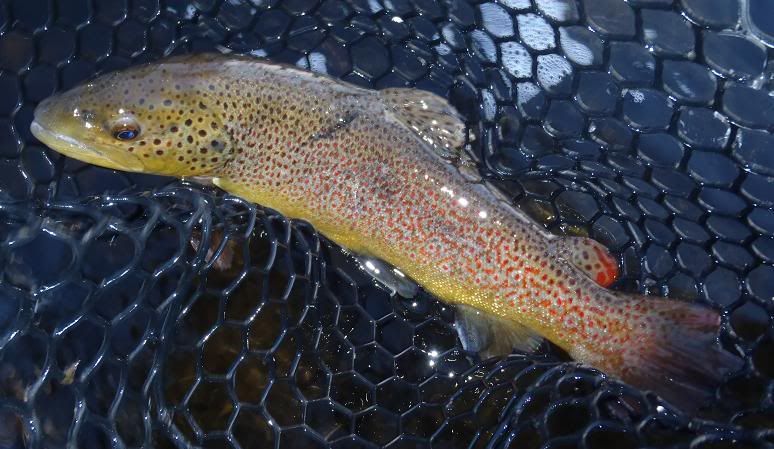
This twenty inch brown trout grabbed a crankbait in 32 degree water in a pool tail out.
With an idea of the in-stream spots to target for winter fish, let’s turn the focus to the prime times to pursue them.  A concept that applies to winter fishing is that “all 32 degree water is not created equal.”  I’ve had action packed days in ice water in December, while that same water temperature in April will find the same stream seemingly lifeless and find me tugging at my few remaining hairs as I search fruitlessly for answers.  I liken this to the “inertia” principle.  Just like an “object in motion tends to stay in motion”, a “fish on the feed tends to stay on the feed.”  Fish in December and the first half of January will often remain in their fall feeding mode and hit aggressively before going into a period of relative lockjaw till the first real thaws of spring arrive.  This is not to say that there aren’t bursts of feeding activity throughout the winter months, and there are ways to maximize your chances of being on the water for these windows of opportunity.

The low light periods of dawn and dusk that generate good action throughout much the year, are often unproductive during the winter.  It is best to focus your winter angling around mid-day.  My fishing log contains many entries such as “brown trout landed 11:15 AM”, “lost fish on at Noon” and so forth, with very few entries for success late in the day.  The mid-day sun may not cause a noticeable uptick in degrees on my water thermometer, but a slight warm-up of a dark bottom area or boulders is apparently just enough to activate a few scud, stonefly larvae, or other feed to activate the predators if only for a brief time.

While a slight warm-up on a given day may generate a brief feeding period, an extended warming trend (especially with warm overnight low temperatures) can produce bursts of exceptionally fast action.  Just as you look for “spots within spots” when prospecting a stream, there are also the “best times within prime times.”  One such time is when a cold front or storm approaches as a warm spell is about to end.  There is often an intense bite just as winter closes back in.  Once a prolonged cold spell settles in (with overnight temperatures plunging into the teens or lower), the bite will often seemingly shut off until the next warming trend arrives and the cycle starts over.

A warm rain or some snow melt (enough for a slight bump in the flows, but not enough to blow the streams out) can trigger a bite and clear out ice that may have prevented you from fishing some prime winter fish-holding spots.
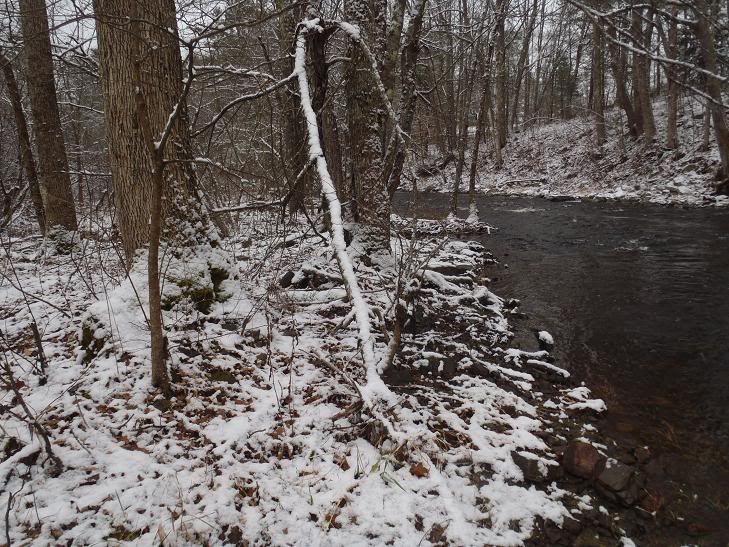
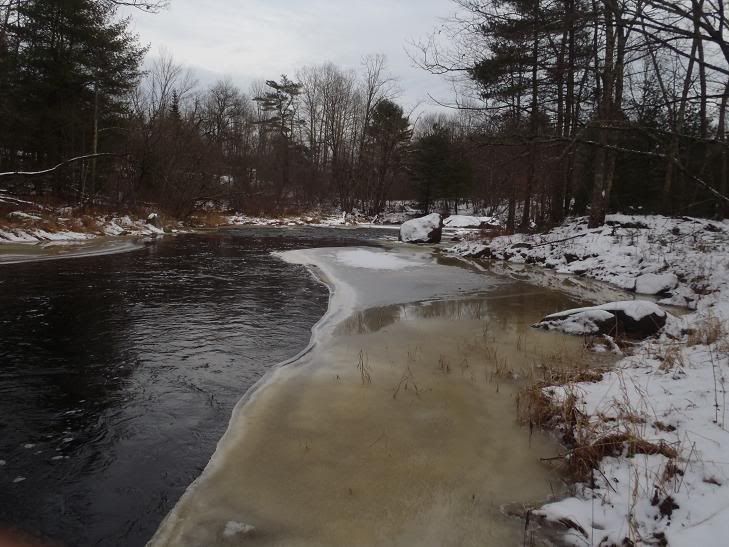
Good winter timing.  A warm spell raised the water level and cleared the stream of ice.  The cold front that followed delivered a fresh dusting of snow, but also triggered a mini blitz.
As I discussed in “Small Stream Magic….Going with the Flow” in Fat Boy’s blog last month, it pays dividends to locate spring seeps during low water conditions in summer.  Don’t ignore their potential as fish magnets during the colder months as well.  The springs continue to deliver ground water that remains at a relatively stable temperature when compared to surface water in the icy grip of winter, and can become a fish-holding area.

With the topics of holding water and prime times explored, let’s turn the discussion to what lures to throw.  This is not to say that natural bait won’t work.  In my area, on the streams that are legal to fish in winter, regulations allow for the use of artificial lures only.  I’ll limit my discussion to the use of artificials.  Intuitively, you would expect a slow approach with a lure or fly close to the bottom to be the way to go for winter fish.  However, I’m amazed how often a fish in ice water will intercept a crankbait as if it was still October.  In fact, a review of my records for open water fishing at water temperatures of 32 degrees or below shows that nearly sixty percent of the fish caught fell for Rapalas, Rebels, Yozuri pin minnows, and other crankbaits.  For sure, I’m not burning the lures back on the retrieve...a “stop and go” or “hold in the current and dive” gets the most attention...but the effectiveness of crankbaits in the dead of winter is an eye opener.  The key thing is to cover the water thoroughly.  A slightly different drift, retrieve, or other variation can turn “fishless” into “fish on!” 

To cover all the bases, I use what I call an “over and under approach.”  The “over” refers to working a pool for “overactive” fish with a crankbait first, trying for a few quick bites.  My fishing log also contains numerous entries like “fish hit on the first cast at Henry’s Pool.”  I’ll often work through a series of pools with a crankbait before taking a lunch break and then working back over the same water with the “under” approach...working a pool with jig, Berkley trout worm, or something similar trying to trigger reluctant biters (what I call “underactive” fish).  I usually do best by suspending the lure below a float at a depth where it just ticks off bottom occasionally as it drifts at the same speed as the current.  I find that if the bite is really tough, a small marabou jig will out-produce tube jigs and other plastics.  Whatever jig you use, keep it small.  I carry a selection of colors in the 1/100th to 1/32nd ounce range.  Experiment with colors…on some days, natural colors like olive, brown, or black are the ticket, while on other days pink, white, chartreuse, or other bright colors ring the dinner bell.  Bites on the bobber and jig technique are often subtle...just a slight pause or jiggle of the bobber.  Set the hook!  Better to find a snag then to be left with that nagging, unanswered question, “Was that a fish?”

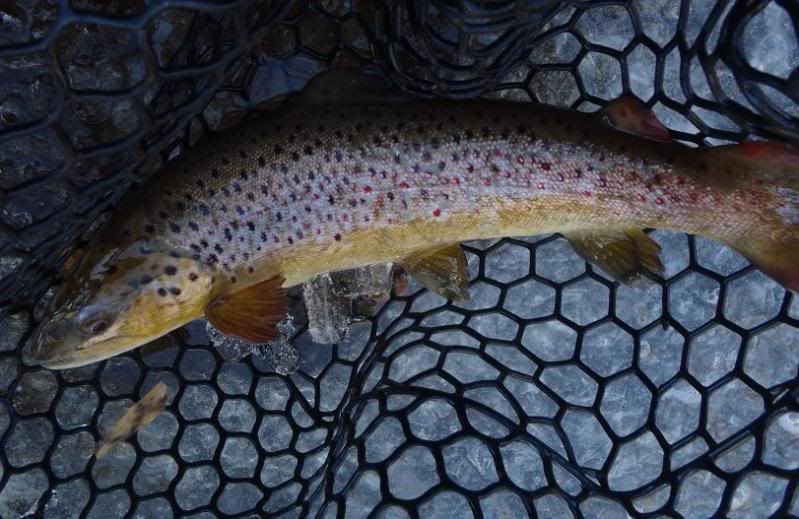
It took a small tube jig suspended under a bobber to trigger this brown on an icy January afternoon.  The fish was released, so it was kept submerged for the photo to avoid the tissue damage that could result from the freeze-up that can be seen in the upper part of the net.
There was a saying back in my Coast Guard days when it came to heading out on an emergency call, “You have to go out, but you don’t have to come back.”  Chasing winter fish doesn’t rise to the level of risk that comes with saving lives and property at sea.  However, winter fishing does bring with it a set of hazards that are unique to the cold weather months.  I feel it important to point some of these dangers out, so you do come back from your fishing adventures!  I will not delve into cold weather clothing and hypothermia to any extent since I’m certain that most of Fat Boy’s readers are avid and well-equipped outdoors men and women.  Instead, I will focus on physical hazards in the winter small stream environment that can lead to injury or worse. 

There is often a fairly steep slope descending down a stream bank to the water.  This can be hazardous at any time of the year, but it’s made even trickier by ice and snow.  As you near the water’s edge, dropping water levels may have left a thin coating of ice on all surfaces.  Within the stream, you often find shelf ice built out from the shore, moving ice in the flow, and even anchor ice adhered to the bottom in frigid waters.  All can lead to a soaking and early ending outing at best if things go wrong (which they can in a hurry). 

Twenty years ago, I took a chance on traversing a slope that had been slickened by a freezing rain storm.  Even with cleats, I lost my footing and was forced to sacrifice my shoulder to avoid a potentially deadly plunge into a raging river thirty feet below.  While I’ll never know for sure, this incident and injury likely planted the seeds for the failure of the rotator cuff in my casting arm years down the line. 
The author was able to safely get past shelf ice to hook this New Year's Eve trout...
...But had to pass on fishing this productive run when weak shelf ice built out from the shore into about five feet of water -  A sure prescription for a potentially deadly dip.
My recommendations for winter small stream safety are:

  • Wear cleats (Korkers, Stabilicers, etc.) or wading shoes with studded rubber soles.
  • Avoid felt soled wading shoes.  Even if they are legal where you are, they are prone to hazardous ice and snow build-up. 
  • Minimize wading, especially above your waist, and always where a wading belt.
  • Fish with a buddy or at the very least give someone your itinerary.
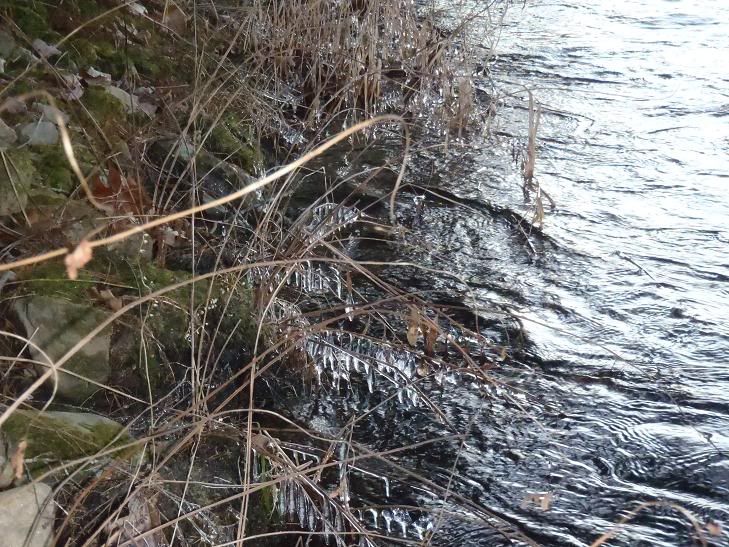
Proper footwear and caution can get you safely around these "landmines"...shoreline moss and a glaze left behind by falling water levels along a swift run that drops off quickly to nearly six feet.
I’ve presented a few thoughts that I hope will enhance your small stream angling when winter grips the landscape in your area.  The fishing may not always be fast, but just getting out on a crisp, clear day is its own reward.  And with persistence and a little luck, you will connect with a few of the battlers that call the ice water home.

January 10, 2012...everything came together.  A warming trend, with favorable stream flows, and an imminent cold front created a window of opportunity for a burst of action.  Within a few hours, the air temperature had dropped to ten degrees and that window closed.

Blogger's Comment:  Thanks Jim for the wonderful article.  I'm sure that you've inspired some die hard anglers to get outside, fish, and possibly catch fish in conditions that they never dreamed that they could catch fish from, and perhaps offer relief from cabin fever.  I look forward to your next article.

Friday, December 9, 2011

Small Stream Magic...Going With the Flow

By guest author Jim Cumming

The twenty inch brown trout added an exclamation point to what was already rising to the rank of a career day.  It strained my four pound test in the strong flow, but everything held and my net hand was true.  After a brief moment of admiration and a snap of the shutter, he zipped off to join ten other browns that had slammed my Yozuri Pin Minnow in the course of the last couple hours.  I took in the scene for a moment, enjoyed the satisfyingly strong pull of the current against my chest waders, and chuckled at my fortune for having escaped the “you should have been here yesterday” mantra that eats so many well-intentioned trips for breakfast.  My revelry was broken by a dimly visible figure working his way down the bank toward me in the failing daylight.  It was a county sheriff’s deputy.  I had to strain a bit to hear him over the current.  “Hey, buddy, I received a call about someone in trouble in the water.  You OK?”  As humorous as the situation may have been to me, I realized that this area had been under a flood warning just two days earlier as the first strong cold front of the fall plowed into what was left of summer’s stickiness.  To be sure, I no longer waded as surely as a blue heron and my sporadic stumbles probably attracted some attention.  Still, there was only one answer for the deputy’s question, “I’m fine.  REAL fine.”  No field sobriety test was administered, and he left me with, “All right.  Just be careful.  I don’t want to get called back here later tonight to fish you out.”  Well past sunset now, there was just a sliver of light left on the western horizon.  Still time for a final cast or two.  Enough for another chunky brown before hitting dry land.

The sheriff’s deputy had worried about me being in trouble, and perhaps I was, but for a different reason.  I was nearly two hours late when I pulled into the driveway, but my wife was unfazed.  “Was the fishing good?”  I’m sure she knew the answer before the question left her lips.  I’m almost always on time, almost to the minute, unless to quote myself, “Something dramatic happens.”  On this evening, the fishing clearly had risen to that level.  By why?  What were the triggers?  Ah, let the small stream journey begin.  It’s a journey that I started nearly forty years ago and is still my calling to this day.  Like any trip, it is best broken down into smaller, easily navigated segments.  By their very nature, small streams can change more quickly than lakes and other more stable parts of the water world.  Seemingly, they can morph from nearly dry streambeds to raging torrents overnight.  It only makes sense to start the small stream adventure by “going with the flow.”


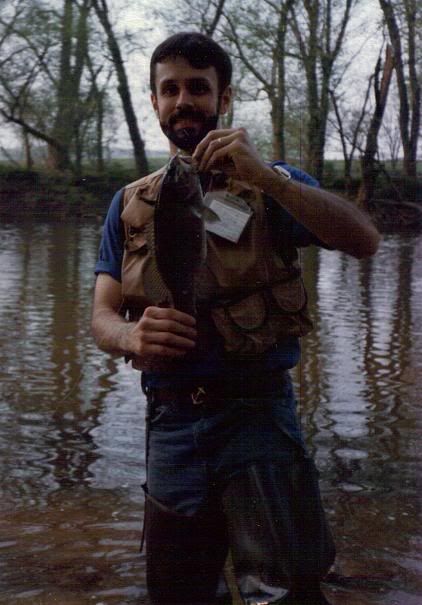
Hair styles have changed since he caught these brown trout in 1976 and a smallie
in 1985, but the author's passion for small stream angling has only grown.
Going With the Flow
The very things that can make fishing small streams challenging and difficult can also make them easy to master if you keep a few basics in mind.  Fish relate to current in predictable ways regardless of a stream’s geographical location.  Fish rely on current to bring them food; however they will rarely stay in open current areas for long periods of time in order to avoid expending too much energy fighting the current.  This makes current breaks behind boulders, below riffles, or behind woody cover key spots to target.  The fine September evening described previously provides an example of two other locations that are often keys on a small stream……the outside of bends in the streambed and a confluence with a smaller tributary.  I encountered the brown trout that night at a spot where the water deepened below a set of riffles, while at the same time bending to the left.  This meant that the right descending bank (the outside part of the bend) was scoured out and deeper.  It was all the better that a smaller tributary flowed into the stream at this point, creating a small fish-holding eddy.  This was a classic, “textbook” stretch of stream, with three or four great things going on within 100 yards or less of each other.  You don’t find that everyday!  But finding and recognizing even one of these fish-holding features on your favorite stretch of stream will maximize your chances of finding a concentration of fish.

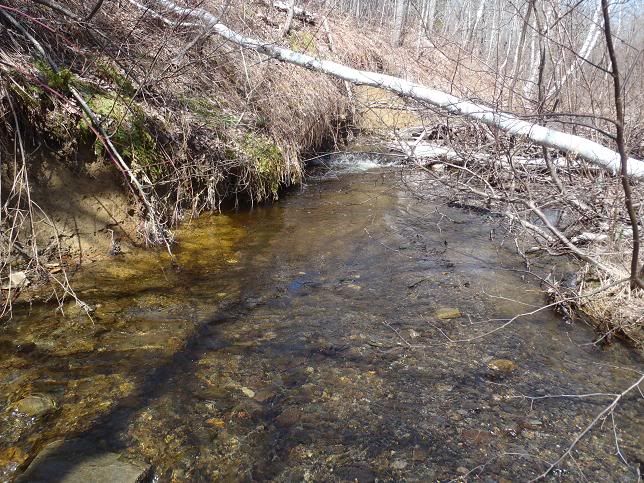
This stretch of a Maine coastal stream has many key fish-holding elements...a deep pool, a current break, an undercut bank, and even a nearby confluence with tidal water.
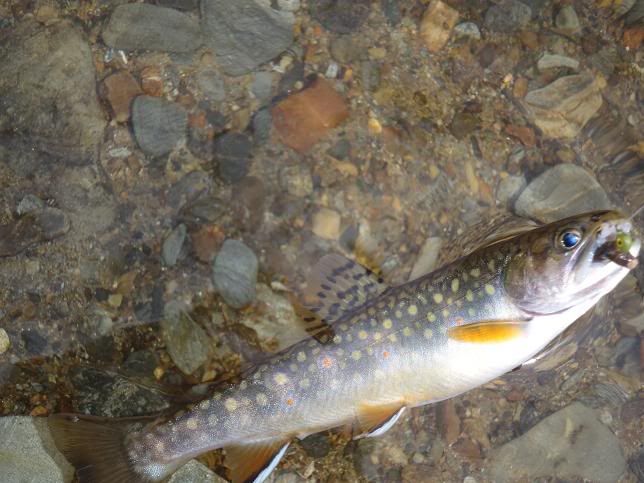
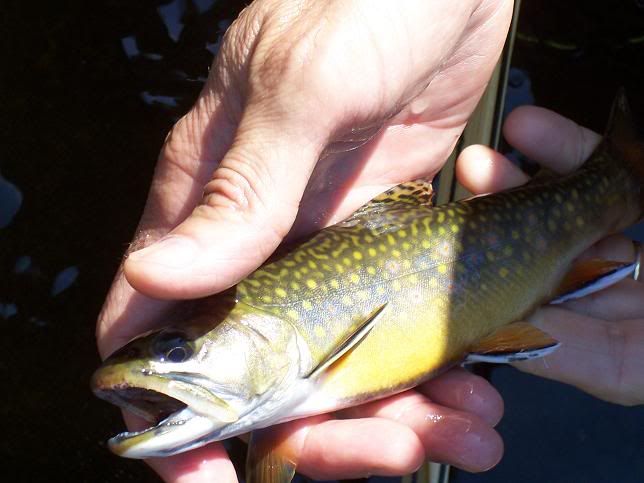
The spot yielded this fine early spring sea run brook trout for the author.
Riffles and pools are important structural elements of small streams.  As their gradients increase, streams quicken as they pass through shallower, faster riffle areas.  Further downstream, the gradient lessens, the current subsides, and depth increases into a pool.  At the downstream end of the pool, the depth decreases, the current picks up, and the next set of riffles marks the beginning of a repetitive stream bed pattern.  The eternal question with this and every other situation on the water is, “Where are the fish?”  The answer will vary with the stream flow, time of day, time of year, and other factors, with stream flow usually being the most critical. 

Fish tend to hold in predictable locations based on the stream flow.  As a rule of thumb, I’ve found that fish tend to hold in the large numbers at the head (upstream end) of a pool under lower flow conditions.  The same can be said of the tail (lower end) of the pool where currents increase approaching the next set of riffles downstream.  On the other hand, when flows are up from rainfall or snowmelt, the current at the head and tail a of pool tends to be swift.  Fish are no different that the rest of us…..they love food on their dinner plates, but want to avoid expending too much energy in getting those tasty morsels to their mouths.  Fish in pool and riffle sequences handle high water conditions by holding in the deeper, more placid sections of pools. 

The drop off into a pool below a set of riffles is a classic spot for pre-spawn fall brown trout.
This large brown responded to a well-placed crankbait.
At bends in the stream bed, fish also react to flow changes.  In low or normal flows, fish will tend to stack up in the deeper outside part of the bends.  On the other hand, the same current that scours out these outside bends to create what is normally good holding water, will become too swift for comfort after rain or snowmelt.  When flows go up, fish will often slide up into the shallower flats on the inside parts of bends.  This provides an important example of why you should cast the shallows first before wading in and potentially spooking fish. 


The small stream game is a multi-species affair.  Even crappie and white perch congregate in pools below riffles.
Smaller tributaries can be an ally in several ways when flows on the main part of a stream go up.  The confluence of a tributary and the main stream creates a relatively placid, fish holding eddy.  I remember a particular outing in May 2009 on the Androscoggin River in Maine.  May is still “early spring” at that latitude, and snowmelt is still very much a factor.  My buddy Dick and I had ventured out in his canoe on a pleasant Saturday.  Quite honestly, as good as his company was, I was thinking that yard work would have been a pleasant alternative (that speaks a mouthful for me) after having fought with the canoe in the current for the whole morning with only a fish or two to show for it.  We decided to tuck back into a protected cove to get out of the current for lunch.  The cove was located where a small tributary flowed into the main river, creating an eddy area.  Two bites into his sandwich and Dick’s glance fixed on the eddy, “Was that a fish?”  I turned in time to see the spreading rings of a surface swirl.  Lunch would have to wait, but it tasted a lot better after we’d brought a dozen or more quality smallies to hand. 

The author with a large smallie that was holding in an eddy where a small tributary entered a swollen main river.
Smaller tributaries themselves can give you a nice “Plan B” if you find a larger river unfishable.  They have smaller watersheds and won’t blow out as badly after a rainfall event.  In addition, if the water gets high enough on the main stream or river, fish will move up into the lower reaches of the tributary.  An outing with Fat Boy back in November 1985 comes to mind.  We had planned an outing during the week for late fall smallies on the Upper Potomac.  Vacation time approved, gear packed, and anticipation building.  What could go wrong?  Moisture-laden Hurricane Juan, that’s what and that monsoon muddied our plans as surely as it did the Potomac.  Never being inclined to throw in the towel in our fishing pursuits, Fat Boy and I were determined to make lemonade out of the weather lemonade we’d been dealt.  Plan A would become Plan B, C, or Z if needed.  The selected back-up plan of attack was to hit the lower reaches of a few tributaries to beat the main river blowout.  The first tributary we tried was what I call “high, fishable” and only slightly muddied.  Twenty five plus years have a way of muddying your memory more than that tributary, so I can’t recall with certainty which one of us scored first.  I do know that, “Fish on!”, “I’ve got another one”, “Good smallie”, and other simple phrases dominated our conversation throughout the day.  No need for deep, philosophical discussions on the meaning of life when the bite is on.

There are other factors that can trump all considerations for fish location in riffle and pool sequences on streams.  Forage fish like chubs will spawn literally right up in the shallowest part of riffles, with predators following them into the bony water.  One particular day in late April 1998 in Maine comes to mind.  Large brown trout pursued chubs up into spawning gravel, with their spotted backs breaching the surface as they chased their prey and made visible wakes as they homed in on a properly placed crankbait.  I shared that day with my buddy George.  George stays beyond busy as a restaurant owner, and we rarely get a chance to chat, let alone fish together.  Though whenever we cross paths, the conversation rarely seems to go more than ten words before we launch into our “remember the day” discussion about that blitz gone by.

I’ve also seen smallies drawn into shallow riffle areas to sip on diminutive mayflies that thrive and hatch in abundance in the turbulent, well-oxygenated water.  Anyone who doubts that smallmouth bass can be selective feeders has never fished for them in these situations.  “Matching the hatch” with Size 18 dry flies and getting the right drift in this scenario can be about as technically demanding as fishing gets.  But when your hook set into that little dimple of a rise leads to a heavy fish blasting off like a torpedo, all of the temporary frustration is forgotten. 

As critical as water levels are to stream fishing, it pays to check out stream flows when planning a trip.  I like to use the real-time stream flow data available from the U.S. Geological Survey at http://waterdata.usgs.gov/nwis/rt.  This web site provides a map that allows you to click on your state and access real-time stream flow conditions.  Dam operators and power companies often have hotlines or web sites where you can also access flow information.  While most of the flow data you obtain will be for main rivers, over time you will be able establish how the flows on the bigger rivers correlate with the flows on the small streams covered in this article.

As with any type of fishing, it pays to constantly seek ways to improve your game.  On small streams, in addition to mastering riffles, pools, bends, and other features, it pays big time to look for “spots within spots.”  For example, if a nice pool also has some wood structure, the potential for action will often skyrocket.  Wood provides shelter for both predators and prey, plus it is the focus for insect hatches and a “drop in” site for grasshoppers and other terrestrial insects.  In other words, wood is a fish magnet.

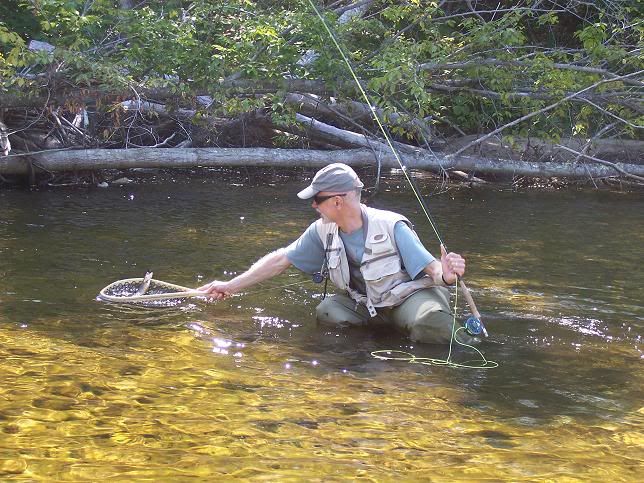
The author prepares to net a native brook trout that hit a fly drifted by a downed tree.
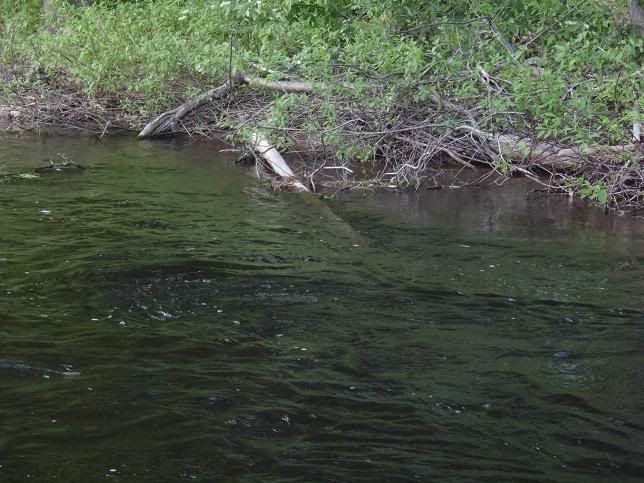
This current seam with the benefit of sunken wood looked fishy in full daylight.
The author returned at dark to entice this stocky brown trout with a dry fly.
It can also pay dividends to locate spring seeps, particularly during low water conditions in summer.  In addition to noticeably cooler water in the vicinity of spring seeps, their location will often be marked by lush shoreline vegetation.  In summer, fish will seek out the cooler water that springs provide.  At times of low flows, I’ve seen streams literally bone dry above significant springs, while at the same time having substantial flow below.  It can also pay to make a mental note of these spring holes for winter fishing.  The springs deliver ground water that remains at a relatively stable temperature when compared to surface water in the icy grip of winter.

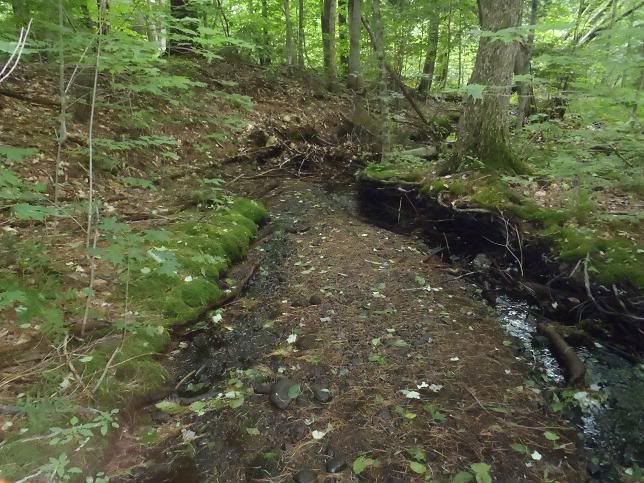
A dry spell left the upper reaches of this stream as dry as a bone in early August.
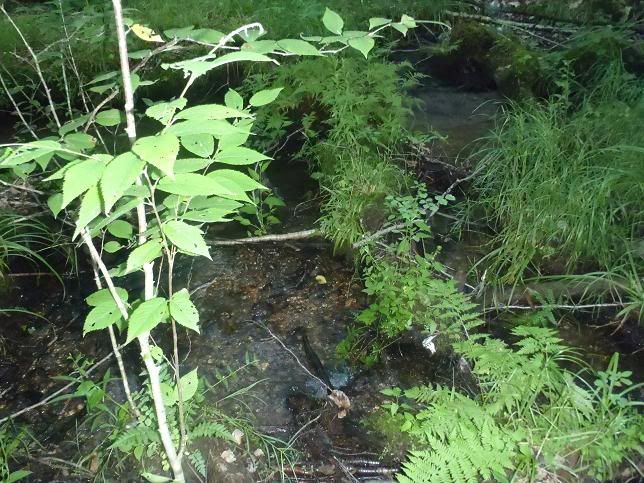
A mile hike through the woods led to a series of spring seeps which increased flow and created a veritable oasis.
A gorgeous August brook trout caught downstream from a set of springs.
I’ve presented a few thoughts about the relationship between fish location, flows, currents, and other factors.  I hope you find the information helpful on whatever you call your home waters.  If Fat Boy will have me back to his blog in the future, I plan to explore water temperatures, seasonal considerations, safety, resource protection, record-keeping, and other items that will enhance your success and enjoyment on small streams.

Jim Cumming has written fishing articles for the Great Lakes Angler magazine amongst other periodicals.  I've known Jim for many years, and have yet to meet anyone with the passion for small stream fishing that he has, whether it be fishing for trout or warm water species.  I hope that you all enjoyed Jim's piece as much as I did, and look forward to his next article as much as I do. 

Jim, thank you for your contribution to my blog.

Wednesday, June 1, 2011

Small Stream Smallies = Big Time Fun


One thing about being a high strung addicted bass angler is the urge to fish places that always hold good numbers of big fish, to try and top your biggest bass each year again and again.  I'm no different.  I'm competitive in my own way, not against my fishing buddies which is a real turn off, but rather against myself.  It's really undue pressure and not really necessary.  However, over the years I've learned to calm down and enjoy the experiences and all that comes with bass fishing, not just big bass, but everything about it.  One of the best ways to do that is to just have fun, and I can't think of a better place than fishing small water for smallmouth bass.  It's fun because you can find solitude, catch lots of unpressured fish, and enjoy a day with maybe not seeing a single person on some very scenic water.

In my home state and neighboring states, there are lots of tributaries that hold smallmouth bass. Many of them receive little, if any, fishing pressure.  How do you find good spots?  Not by reading my blog, but rather, do your homework.  Get a good map of your area and start with public access, ramps, and bridge crossings.  In some cases you might have to ask permission, some cases not, but it depends on the laws of your state or territory.  There are lots of maps out there, USGS maps, on-line topo maps, Google and Mapquest satellite maps, trail and canoeing maps...you name it, the info is out there.  You'll find the best spots by trial and error.

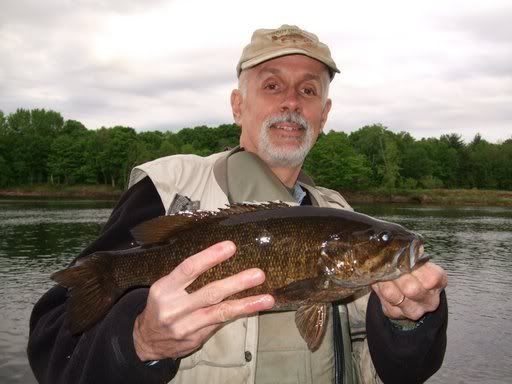
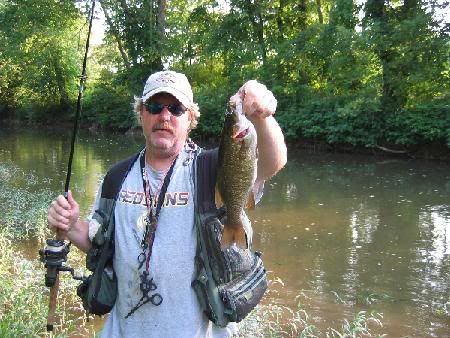
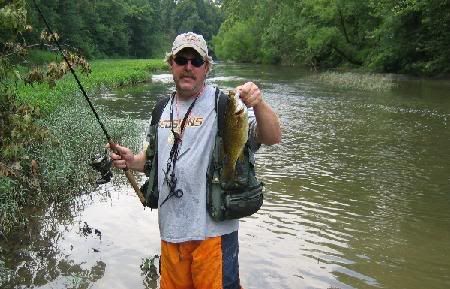
Most small stream smallies aren't monsters, but like their river brothers they are strong from life in the current, and most of them are very scrappy.  And, every now and then you can catch a big one.  Here's a nice size small stream bronzeback.

Tackle set ups?  Basically, anything goes.  Once you get a feel for the average size of the fish in your small stream, you adapt your tackle accordingly.  When I first started fishing small streams, I automatically assumed that the stream was best fished with ultralight tackle because they may have had small fish in them.  It was fun landing fish on UL spinning tackle, 4 or 6 pound line, and tiny lures.  But later, after learning the hard way and getting broken off or losing big fish on the hook set, I beefed up my strategy.  Now the big fish call me as before, it's in my nature, so I target them.  But, what I found out is that I caught just as many as ever, but didn't miss the big ones or lose them nearly as often.  I use slightly different size lures on 8 lb. test fluorocarbon line on a medium or medium light spinning rod. 

Lure choices should include your favorites, whatever you have confidence in.  For me, I carry a selection of minnow imitations, jerkbaits, small crankbaits, and topwater plugs.  I also carry small spinnerbaits and buzzbaits.  And most of all, I carry my finesse stuff.  For the most part, the same stuff that works in my rivers works in the creeks.  Plastics include 4" plastic worms, tubes, soft jerk baits like Zoom Super Flukes, Senkos, and Sluggos, beaver type baits, and grubs (twister tails), usually in 3 basic colors depending on water conditions.  In clearer water, I prefer variations of green pumpkin, watermelon, and smoke or maybe something with some flash or metal flake.  Smoke/purple is an awesome color for me.  In dingy water, I prefer darker baits, perhaps black or even green pumpkin, or bright colors like chartreuse, or something with a chartreuse tail.  White is also a great color for murky water.  Spinnerbaits work well under these conditions.  Muddy water?  I pretty much fish other places, not because you can't catch fish, but usually the water is higher than normal and you can't see the bottom to wade, which can be dangerous.  I prefer wading water that I can see the bottom.

My confidence is in plastics, that is, I know when the chips are down that I'm going to catch fish on my favorite plastics.  But my approach is to start with a search lure, perhaps a small buzzbait.  Often I'll use a beat up plastic worm as a trailer.  When the fish are on that bite you can catch a lot in a hurry, and they are big fish magnets.  When the fishing is tough, then I go to the plastics.

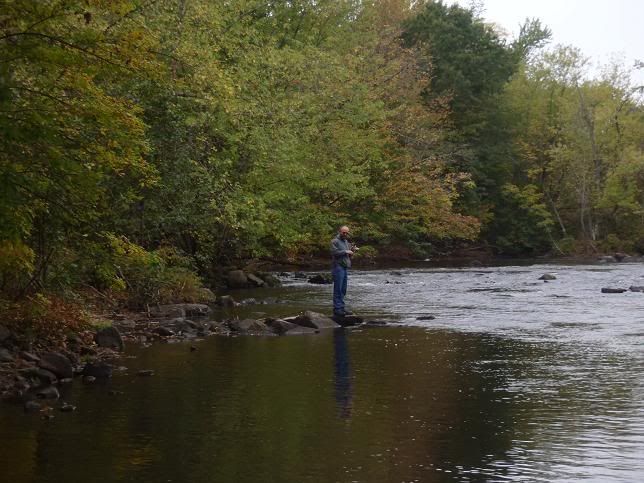
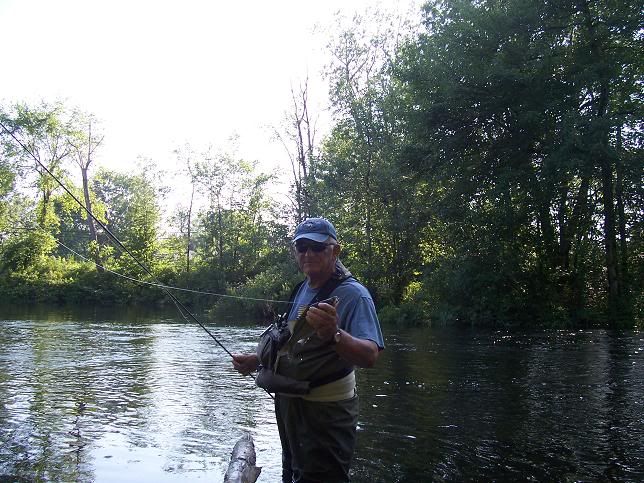
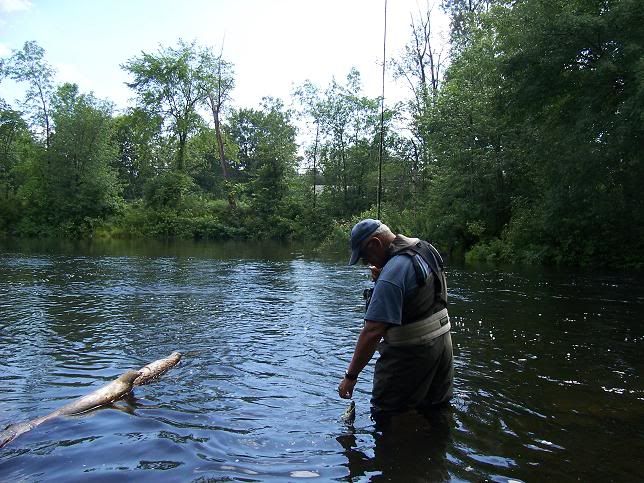
Before I go on about actually fishing, what about how I access or others access?  Most of my small stream fishing is done by wading.  I can work slowly and thoroughly.  Most people like to wade upstream, I actually see advantages in going either up or down stream.  When going up stream, basically you don't cloud the water ahead of you when you wade.  Also, most of the fish are in ambush holding patterns facing up current, so well placed casts and retrieves put the lure beyond the fish and let the current bring it to them.  In deeper pools, this might be best to cast up above the pool and let the current bring your bait down toward the bottom, getting it deeper.  OK, we've all probably heard that before, so let's take a stance that blows that theory away...working down stream.  Honestly, I can fish the pool ahead of me without entering it, and position myself on each pool so that any silt that I kick up washes down away from the prime fish holding structure.  But, here's another kicker:  sometimes stirring up the bottom a little gets bait fish excited and feeding, and that in turn can turn smallies on.  Also, keep in mind when fishing down and across, stronger currents keep your bait up.  Sometimes the fish like that, but if you're not getting hits, cast up and bring it across to get your lure deeper.  Either way, a stealthy approach is best.  Plan your wading route ahead of time and position yourself in such a way as to not spook fish but at the same time giving you the best opportunity to present your lure to the fish.  Keep a low profile and don't make a lot of noise or wade too fast as to disturb fish.  Also, wading downstream is easy to cover water with search lures like buzzbaits, fish them across and down.  Don't be afraid to toss them in the riffles, at the base of rapids, or at the tail of the pool.  Let the current pull it all the way across the stream.

This bass fell for a buzzbait fished across and down through the base of the riffles

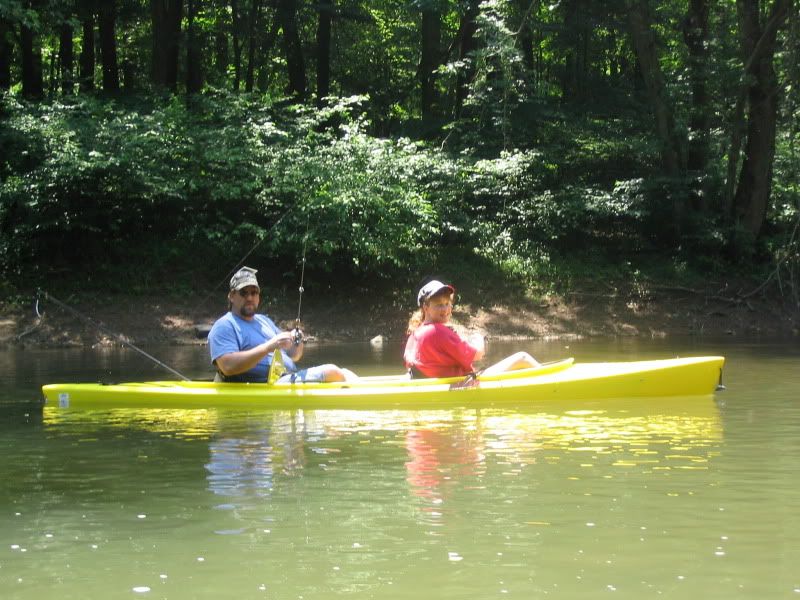
Kayaking and possibly canoe floats are other effective ways to fish small streams.  Even if you have to portage a few times, or get out and wade once in awhile, it still is a way to reach fish that you might not reach otherwise.  I'm not a kayak expert but I've fished a few times out of them and they are fun, and relatively stealthy if you plan your positioning ahead of time.

Kayaking a small stream is an effective way to sneak up on wary smallmouth bass.

Where do the fish hold?  Think of your small stream as you do your river, or even your trout stream.  Smallies like to hold on current edges of eddies, or behind rocks, logs, boulders, weeds, etc.  Here's what goes though my mind, "if I was a smallmouth bass, where would I position myself to best take advantage of the current to get an easy unsuspecting meal"?  Also, other factors influence holding locations, such as water clarity, water temperature, shade and oxygen among others.  Most of my wading is done in the summer, so hot weather is the norm, so if the fishing is tough because of heat, I look for shade, current, riffles, tributary mouths, springs...anything that might keep a fish comfortable.  I look for each holding spot in a pool.  If I think that there's a fish there, I make multiple casts until I'm sure one isn't there.  Often, like trout fishing, getting that good drift or presentation might take more than one cast especially if the fish are picky and don't want to move far to chase your offering.  And, just because a spot is shallow, don't rule them out.  I've caught some decent size smallmouth in the summer holding behind a rock in the middle of the riffles!

Another method of catching smallmouth in small streams is fly fishing.  Matching the hatch, like trout, will often produce good numbers of bass.  Smallies will gorge on huge mayfly hatches, like the August white miller hatch.  They also like dragonflies, so watch the stream around you to get ideas.  Pay attention to any fish activity, what are they eating.  Often they will jump way out of the water to eat a dragonfly or damselfly.  Streamers and nymphs, especially crayfish, minnow, and hellgrammite imitations work wonderfully.  Don't forget topwater action, small poppers can bring many a smallie to the top.  You don't need much, maybe a 5 weight rod/line set up will do.  If you like using bigger flies, then by all means don't let that stop you, fishing a 7 weight will still catch fish.  You might not get the numbers that smaller flies do, but you'll get the size.

What equipment should you bring?  Well, it's up to you.  Typically, I wear a fishing vest with the pockets stuffed like they've never been stuffed before.  I have separate small boxes for my jigs, hooks/sinkers/rattles, and crankbaits.  I carry my spinnerbaits and buzzers in a Ziploc.  I'll stuff Ziploc bags full of my soft plastics into my vest pockets, each with it's own type and color.  I also carry extra spools for my reel, worm dye, worm glue, wacky rig tool, line clippers, braid scissors, forceps, a can of Reel Magic, bug spray, sunscreen, plenty of water, sometimes lunch depending on how long the wade.  Remember the movie, "A Christmas Story", where the Mom dresses up the little kid in his snow suit and layers of clothing, and he couldn't put his arms down?  My vest kind of resembles that.  Also, don't forget polarized sunglasses
--  oh --
that reminds me, polarized sunglasses are a must, because you often can sight fish ahead in the pools you are approaching.  If you can see fish and they don't see you first, you have a high probability to catch them.  Back to equipment, comfortable clothing if you wet wade or waders during cold weather.  Don't forget when it's cold to wear a wading belt.  I highly recommend wading shoes designed for wading streams.  I used to use felt studded soles, but my state has since banned the use of them, so now I use Simms wading shoes with the sticky vibram bottoms.  I have yet to try them but will write a review after my first trip in them.  Some people like to use a wading staff.  I don't use one because the small streams that I fish have very manageable flow.  Finally, I try to bring a camera with extra batteries or memory.  I used to keep mine in a Ziploc bag and that was OK, but I was always worried about it.  That camera expired due to constant abuse on my part, so I'm in the market for a new one.  There are ones that are now waterproof to say, 15 feet, and very durable.  I'm currently interested in the Sony version once my budget allows.  This will give me the ability to film fishing shots, scenery shots and perhaps underwater ones...and videos too.

A note about etiquette:  If you encounter others, don't wade through their pool.  If it's the only way around them, ask first, usually they will let you go.  Or, get out of the stream and walk around the entire pool away from the water so as to not spook their fish.  A better option is to turn around and go fish the other direction.  If you're fishing with a buddy, give your buddy equal chance at catching fish.  Either share the same pools if they are big enough, trading head and tail of pools each time, or take turns hitting the next pool first.  If you are floating, don't float over the areas shore anglers are fishing, i.e. the fish holding structure unless it's absolutely necessary, rather, position your kayak to float closer to them (unless the fish are between their legs).  Ask landowners permission if necessary, and carry out more than you take in as far as trash goes.  Pick up line that you might find on the stream side, etc.  And most of all, when in doubt, be courteous to others first.  There's plenty of fish to go around for everyone.

Another fun thing about fishing small streams is that there is a potential for catching a variety of species.  Often you can catch quite a mixed bag, which makes the trip more interesting sometimes.  In addition to smallmouth, in the streams that I've fished I've caught largemouth, walleye, chain pickerel, musky, redbreast sunfish, bluegills, pumpkinseeds, rock bass, warmouth, crappie, rainbow trout, channel catfish, black bullheads, fallfish, creek chubs, and carp.  I've probably left a few out.


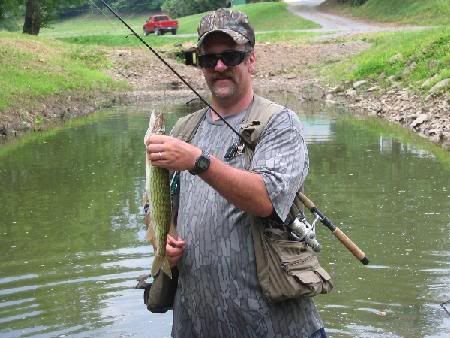
Here's a nice chain pickerel that my buddy Bill, a.k.a. Genz Man, caught a few years ago on one of our small stream smallie trips.

Another cool thing, literally, about wading small streams is that during those hot dog days of summer, you can take your gear off, put it on a rock, and go for a swim.  I've really cooled off doing this in the deeper pools, often standing there letting the current run over the back of my neck while minnows feed on my leg hairs.  Sitting back against small stream riffles as if in an easy chair is also quite refreshing.

So, if you want to get away from it all, get to fish some awesome scenery, see wildlife action that most people may never see, catch lots of fish and maybe a big one now and then, try fishing for smallmouth bass on a small stream near you.

Finally, I'd like to dedicate this post to one of the best small stream anglers that I know, Jim Cumming a.k.a. Jim C. on http://www.myfishfinder.com/.  If it wasn't for him I would have missed out on all this.  I learned a lot from that guy!!!!!!!!!!  Thanks Jim!

Until next time, tight lines!