Showing posts with label Vexilar. Show all posts

Sunday, February 16, 2014

The Century Mark on the Ice!

Last week I met up with a musky fishing friend of mine, Mike Carrigan, and a couple of his buddies on small local lake.  My buddy Wayne also met me there.  The plan was to find some willing crappie at first light, and for me to make a day of it.  Wayne planned to stick it out with me, while Mike and his buddies were only fishing a partial day.
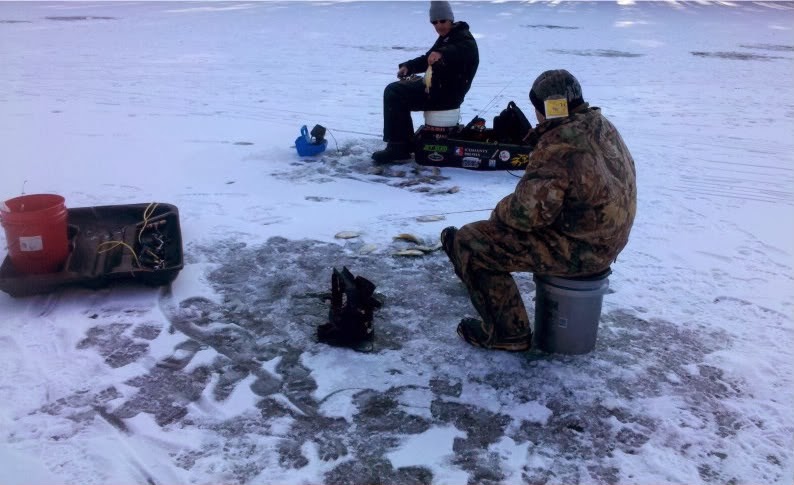
My friend Mike Carrigan fishing out of a Clam Fish Trap and using a Vexilar FL-18 flasher.  Mike caught some decent trout and crappie throughout the morning.  He found some active fish out of this particular hole.
Most of the snow from the previous week had melted and refroze, forming a nice white layer of slick ice on top of a good nine inches of clear ice.  The weather was cloudy but pleasant, not much wind, right below the freezing mark all day.

I arrived after sunrise, getting a later start than I had wanted.  Wayne, Mike and his buddies were all on the ice already.  As I was getting ready, first Wayne showed up to greet me, then went back out and fished, followed by Mike a short time later.  It took me a while to get my stuff organized and ready to roll.

Mike and his buddies were about a hundred yards away from Wayne.  They were fishing the deeper water near the dam, while Wayne was working the deeper drop off out from a main point not too far from the dam.  I decided to cut holes in between all of them, to connect the dots, if you will!
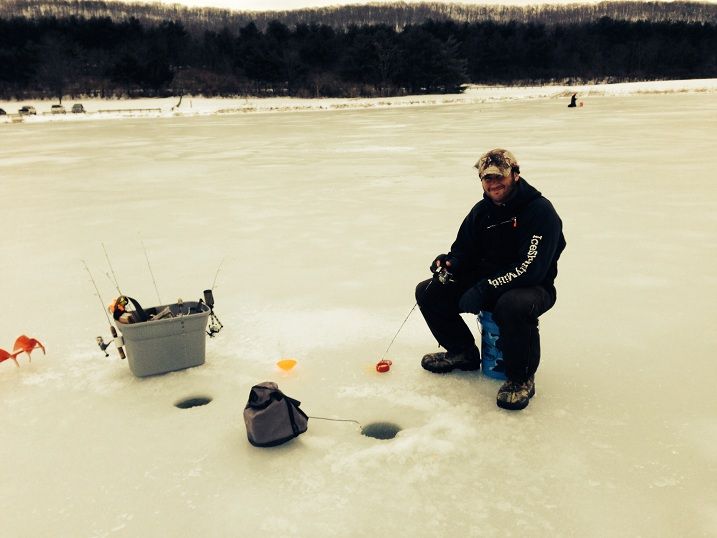
Wayne had already located a school of active bluegills and a few crappie, out in the channel closest to the main lake point.  Here's he is using his sonar to watch the reaction of the fish as he teases them into biting.
I proceeded to cut half a dozen holes, scooped out the ice chips, and dropped my sonar down to see if I could mark fish.  I marked fish in every hole.  They weren't suspended, but were holding tight to the bottom.  I dropped my twin Ratso soft plastic rig down and drew the fish off the bottom  in each hole, but they either bit really lightly or lost interest quickly.  I went back and covered each hole with a smaller jig rigged with two maggots to see if I could get those finicky "sniffers" to bite something tipped with bait.
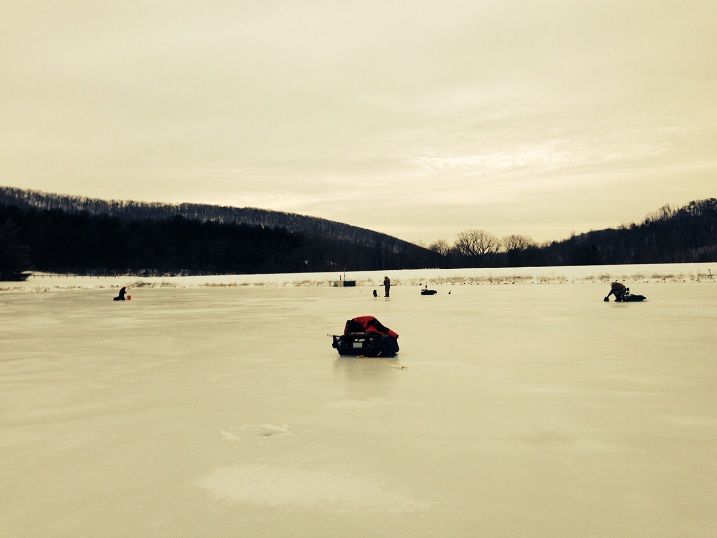
Starting near my sled,  I cut holes between Mike and his buddies and my friend Wayne, hoping to mark and find some active fish.
Spikes or waxworms as bait act as a nice tasty treat to the fish and provide a little bit of scent to trigger their feeding instinct.  When the fish are active, I prefer to use the soft plastics and not mess with constantly replacing bait when the fish pick the maggots or waxworms off the lure.  But, sometimes, they only thing they will bite are the baited jigs.

Mike was catching medium and small sized crappie now and then, while Wayne, over by the point was getting a pretty good bluegill bite going with an occasional crappie.  Meanwhile, I was having a hard time getting solid hits.  So, I kept cutting holes.

I walked over to see how Mike was doing, and he found a hole that held a few pretty aggressive fish.  I watched him fish for a bit while chatting about the fishing on this lake, and took a nice little video of him in action, showing us how it's done.  Please note that this fish is one of the small finicky crappie, not one of the bigger ones that he caught throughout the morning.  The fact that this catch is on video is merely because I spent way more time fishing than walking around taking videos.  Yet, it does illustrate how to use a flasher to catch fish.

Mikes buddies were catching some stocked rainbow trout on tip ups, and Wayne was jigging a few up too.  But one of the small trout had something sticking out of its gullet, a set of shooting ear plugs!  At least five inches were down it's throat.  We all got a laugh out of that!
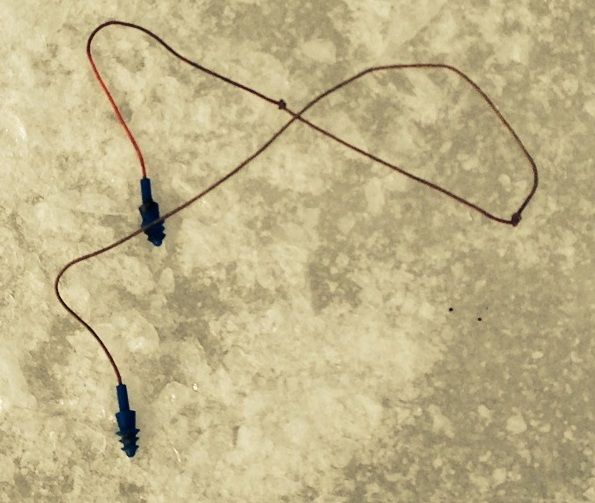
These were the earplugs that were found in a trouts gullet that Mike's buddy Phil caught on a tip up.  We cracked up, saying that maybe he should put this back on a tip up and try for another!
I wasn't satisfied with the holes that I had cut so far.  I wanted active fish, not sniffers.  So, I cut another half dozen holes along the basin of a cove not far away where I'd found a good crappie bite in the past with similar results.  I caught a couple small bluegills and crappie, about one fish caught out of every four holes, with lot's of sniffers in each hole.  And the sniffers that bit seemed to prefer the tiny jig/maggot combination.
Every hole marked fish, but when I caught them, they were on the small side.  These were the finicky fish, the sniffers.  When you get this type of inactivity or finicky fish, move and find bigger more active fish.
My next move was back near where I started.  In one of the holes that I cut, I marked what I thought at first was a fish, but it was some sort of structure.  Perhaps it was a tree limb or something.  This particular spot didn't mark any fish, or at best, a sniffer or two.  It was almost what I was looking for, structure, but lacked the fish that I'd expect there.

So, I decided to cut a half dozen more holes around that area.  The first hole that I checked was loaded with fish, suspended off the bottom over nineteen feet of water from the bottom ten feet.  This was late morning, and the fish were stacked like cord wood.

I remember saying to myself, "This is the spot!"
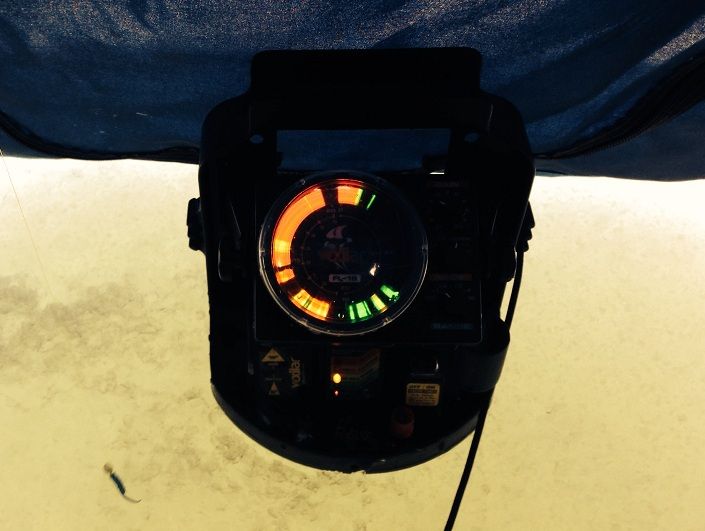
My flasher lit up like a Christmas tree!  The bottom of the lake is at about 8:40, which was nineteen feet deep, and there was a tree branch at about 7:35, about four feet off the bottom.  The rest of the marks were fish, showing all the way up to ten feet off the bottom (about  3:20 on a clock).  The surface is at high noon, with a couple marks that are noise from the ice surface.  You can see the fish were stacked like cord wood here!  This was the spot!
As I've described in recent posts, my tactic when finding fish stacked like this is to set up and fish over them for a while.  Most of the time, you'll catch a good number then the bite dies off and you're off on the search again for more active fish.  However, this spot seemed different.  This was late morning, and the fish were suspended.  My graph was lit up like a Christmas tree (a popular saying among ice anglers when they mark a bunch of suspended seemingly active fish).  This is the type of spot that can make your day.

My way of setting up is to cut a couple holes, one for my electronics, and one to fish out of.  Since there were a bunch of fish showing up, I decided to set up my underwater camera.  It took me a couple minutes to set up my shanty and the underwater camera so that I could see my jigs, but it took even less time for me to start hooking up.  I can't see much on the camera out in the open because of the glare, so I need to close up Clam Fish Trap Pro (my portable flip over shelter ), so I could see the camera.  Please note that I don't waste the time or energy to set up this way unless I know for a fact that I'm on a hot spot.
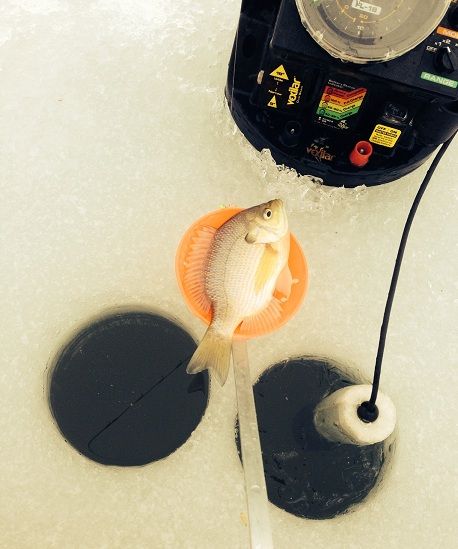
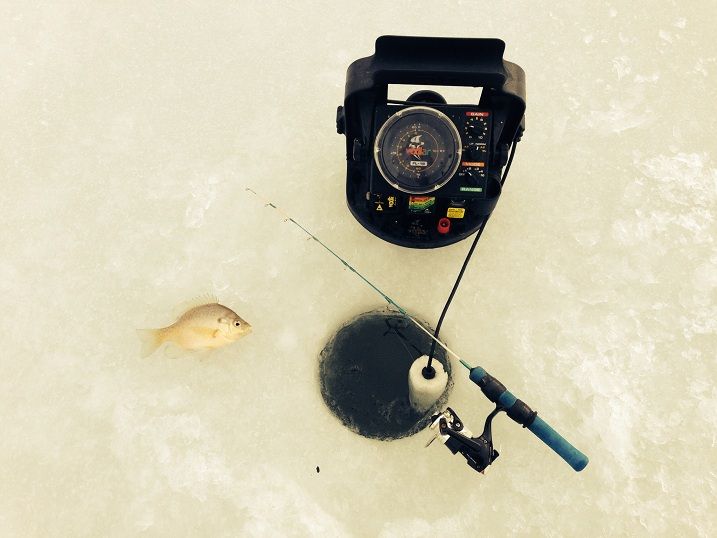
When I find a good spot with lot's of fish marked, I'll cut one hole for my electronics, and one to fish out of.  I took this picture shortly after marking tons of fish.
I lowered my camera to about ten feet off the bottom, the upper range of the suspended fish.  The water clarity was a bit cloudy, not as clear as I'd like for this type of set up, but it would have to do.  I could see only about two feet at the most below the camera, which is set to look down on the fish.  As soon as I picked up my rod and jigged, I saw a crappie swim in very quickly and miss my lure.  The next attempt from a different fish resulted in the fish sucking my jig in.

When I set the camera up, I dropped down my tandem Ratso rig down there because they're easier to find. The top Ratso was the one that the crappie inhaled, so I set the hook.  These weren't the dink crappie that I was getting earlier, these were decent for this lake.  They weren't big, but they were fat mediums, most good enough for a nice filet at nine to ten inches long.

The fish were ferocious.  As soon as I dropped the Ratso's into camera view, a crappie would swoop in to inhale it, aggressively.  And my sonar was showing a lot of fish down there.  I was catching them one after another, giggling like a little kid.  So, before the school left, I decided to coax Mike over to give the camera a try.

Mike spent about fifteen minutes in there playing with the camera and catching a few.  I heard him laughing as he was getting used to fishing versus what he was seeing on the camera.  It takes getting used to for sure, but he was having fun.  He didn't want to take up my fishing time, so he turned my shanty back over to me.

For the next two hours, the crappie kept showing up, actively attacking my soft plastic jigs.  I lost a couple nice crappie at the hole but for the most part, I landed about eighty percent of the fish that decided to bite.  I lost some time when crappie or bluegills decided to wrap themselves around my camera cable during the fight, but landed those fish.  The time lost was setting it up again so I could see my jigs.

By now it was snowing lightly.  I've always seemed to have good luck with the crappie while it was snowing, so this seemed to be the case again.

Over the next two hours, I managed to ice thirty four crappie and seven bluegills.  Then, they seemed to disappear.  But, one solid mark remained about four feet off the bottom and didn't more or react to any of my lures.  I couldn't see it on my camera, but I was pretty sure it was a larger branch of that tree that I found earlier.  I felt that the fish would return, so I decided to stick it out.

During the following few hours, I picked up crappie and bluegills now and then.  But, the fish became a bit finicky.  I could see them on the camera at times, and they'd move in and check out my lure and either bite or swim off.  I also was able to fish off the bottom and coax a decent bluegill into biting every now and then, below the tree mark.
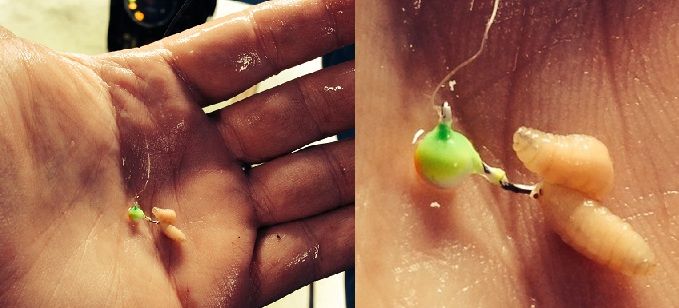
Sometimes finicky fish, especially bluegills, will prefer a smaller jig tipped with a couple spikes.  This tiny Northland Tungsten Fireball jig fishes heavy and shows a nice mark on my sonar.
I took a break and socialized a little bit, and during the meantime checked some of the other holes out without electronics while jigging a Salmo Chubby Darter, a jigging lure that resembles a lipless crankbait and an effective technique for catching bass, trout and jumbo crappie.  I didn't get any hits, but Mike and his buddies, Phil and Nick, were pretty much calling it a day during early afternoon.

Meanwhile, Wayne was consistently catching bluegills and the occasional crappie out of his spot.  I went back to my hole and noticed that the suspended fish had returned, with more and more of them appearing on my flasher.  They snubbed my tandem plastics for the most part, but willingly hit the tiny jig/maggot combination.  They were bluegills.  Not the sniffing dinks from the morning, but decent sized ones.  I wouldn't say they were big, but they were decent, averaging seven to eight inches long.
Wayne with a small crappie caught earlier in the morning.  Later, we both caught quite nicer ones.  Like I said earlier in the post, when the bigger fish are really biting well, it's tough to be a camera man!
Bluegills fight like crazy and easily wrap around the camera cable, so I quickly pulled the camera out.  They were so active that using the sonar was highly effective.

These fish became very active and aggressive toward my smaller offering.  Every now and then, I'd hook a crappie.  By late afternoon, the bite was frantic again. The bluegills were all around the tree, both above it and below it, and sometimes suspending ten feet off the bottom, and extremely aggressive.  The crappie bite earlier in the day was quite impressive, but this bluegill bite was something else!
The bluegills preferred this small round ball jig tipped with a couple spikes.
Our hope was to fish into the dark for the crappie, that since we found them during the day here in decent numbers, that they'd return.  Usually, that's a good plan for setting up for a night time crappie bite.  But, I didn't want to leave this great bluegill bite to go back to my truck and get my lantern!

Wayne had moved closer so we could share the lantern light once the night bite began, and also was getting into the bluegills at a rapid rate.  He also had a knack for catching several trout on the day while jigging, and also a couple largemouth bass as well.
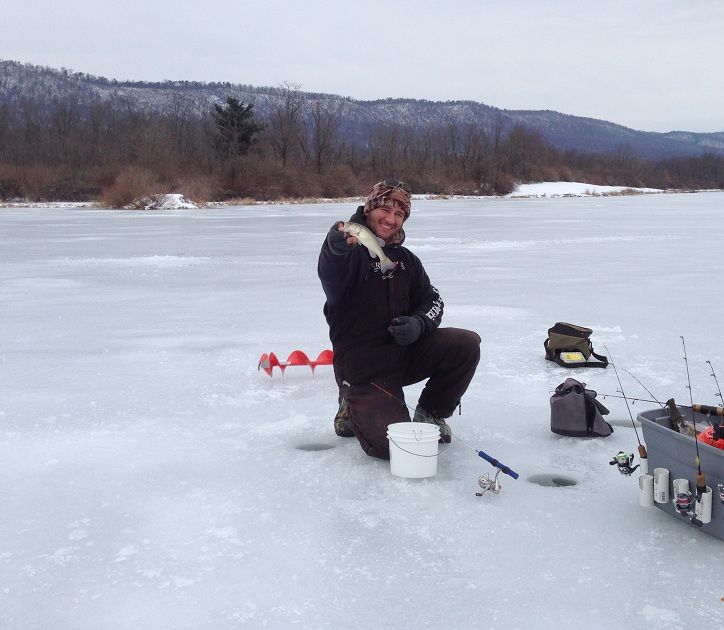
In between catching crappie and bluegills, Wayne caught trout and a few small largemouth bass, which are fun on the light ice panfish set ups.
I finally decided to quickly go get my lantern and return before it was too late.  But the bluegills didn't let me down, they kept on biting.  It was a great evening bite.  I managed to also catch a small bass.  Then, the sun dropped as well as the temperatures.
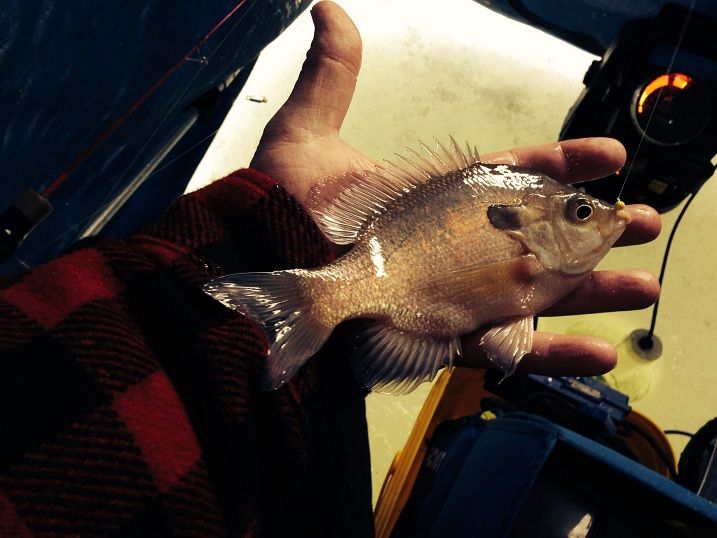
This hand sized bluegill liked that Northland Tungsten Fireball jig!
Wayne and I caught a few bluegills and crappie after dark, but the bite wasn't what we'd hoped for.  The fish became finicky but we marked them regularly.  I've noticed this before when fishing murky water, that those lakes don't make for great night bites for crappie.  So, we called it quits.

My numbers were my best trip of the year, and the size of the fish, although not large, was decent.  At least it was from the standpoint of having a good time.  I finished with forty two crappie, sixty three bluegills, and a largemouth bass.  That one hot hole produced 101 fish!  That is a great day on the ice, for me, a total of 106 fish on the day.  I'm sure Wayne had similar numbers.

Any time you hit the century mark with numbers of fish, on or off the ice, it's a trip to remember.  Hence, I thought that I'd share it with you!

What a fun day on the ice!

Tuesday, December 17, 2013

Why Do You Love to Ice Fish? i.e. Why I love to Ice Fish!

I haven't done a generic type post about ice fishing in a long time.  But after discussing a certain topic about ice fishing with someone on my favorite web forum, Iceshanty.com, I got to thinking...why do I still love to ice fish?

I mean, after all, most people, my wife included and most of my friends (since I live South of what is really ice fishing territory) think that I'm nuts.  And, we ice anglers really are off our rockers!  We spend all kinds of money on stuff to keep us comfortable to cut a hole through the ice and fish, and in some cases (even though we know it's "safe") there is enough risk that we always have to be careful, and often we're out there in cold nasty weather when 99% of society would rather wrap up in a blanket next to a fire and rent movies all day.  I won't go into how ice anglers spend a ton of money on ice fishing tackle, gear, and clothing just to catch fish through a hole in the ice.  All anglers are considered crazy for our fishing spending from the viewpoint of the non-angling crowd.

So, why do you love to ice fish?  What is it about our sport that pushes your buttons to keep on getting out there, year after year, in sometimes brutal conditions to try and catch fish through the ice?  Please feel free to post your answer in the comments section.
______________________________________________________________________________

OK, for me, here it goes.  First, I like the fact that I can catch fish all year, and ice fishing extends my fishing season.  I like the fact that you really never know for sure what you're about to catch.  I like that you can pretty much get to fishing holes that only a boat can get to, and sometimes get to hot spots that boats can't even get to.  And, not only that, you can find fish and stay over them and not worry about drifting away.  No boat control to worry about!  And, you can catch fish, often a lot of them, and sometimes bigger than any other time of year.  And, you can haul all kinds of gear out there to catch fish and to keep you almost as comfortable as those folks wrapped in their blankets next to their fires watching movies.  Ice fishing can also be a great social activity shared with friends, or to make new friends.
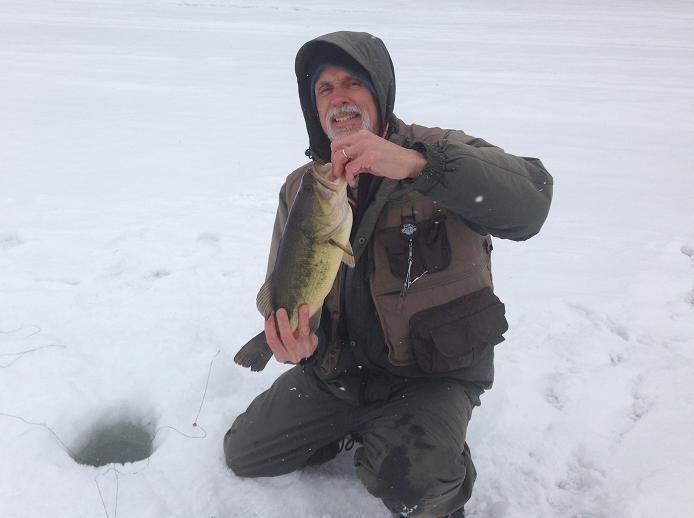
Of course, a joy of ice fishing is when you can share it with friends, or even make new friends.  Here, my good friend Jim Cumming sports a fat largemouth bass that he caught while tending his tip-ups.  I was fortunate enough to introduce Jim to ice fishing many years ago when he lived down my way.
But, that's all great, and many of you probably share the same views.  But here's what really gets me stoked up, why I love ice fishing more than just like to do it:

I have always enjoyed vertically jigging for active fish.  On the ice, I mostly target panfish.  I still primarily target panfish but also bring enough tackle to jig for predators.  But really floats my boat is jigging over active fish and watching it all on my underwater camera, inside my portable shanty, and doing it productively.
Many ice anglers appreciate the seclusion of fishing in a shanty.  It's quiet.  Just you, your gear, and the fish, and you're out of the harsh elements.  But it's also quite beautiful out in the open air.  I always try to spend some time jigging outside too, to gain that appreciation and beauty of my surroundings, and move around and hit a few holes nearby to cover water.
So the crux of this post is basically that I really get my jollies while using my underwater camera.  When fishing with an underwater camera, the question I always read on forums is:  "Do you need to or not?  Or, do you wish to be more challenged or not?"  I guess it's like cheating to some, but I think it's more fun to watch the fish eat your lure than to watch a rod tip.  So yeah, I'll "cheat" for that extra fun.  Heck with the challenge.  If I want challenge, then I'll find some open water and musky fish.  If I find active panfish, then I'll watch, fish, and catch them.  If they are finicky, like most good ice anglers, I will move and use my sonar to find another school of active fish, then drop the camera down there again if I'm getting multiple fish.
This is my set up under my portable shanty...you can see the bottom and my jig easily.  It's great once you find a school of active panfish like yellow perch especially when the schools hang around for a while.  I can observe their behavior, figure out exactly what they want or what turns them off, watch them inhale my lure, and...SET THE HOOK!  It's so much fun.  
Sure, you can catch a bunch of fish using your sonar and not bring a camera!  But I think that the camera nets me even more fish under certain conditions than I would if I didn't use the camera.  Why?  Because I can see bites that I would definitely miss watching my sonar, a rod tip, a spring bobber, my line, or while trying to feel a bite.  I used to come home from a trip and dream about my spring bobber.  Now I dream about watching my camera and catching fish!
Sure you can catch plenty of fish using just your sonar.  I used to do it all the time, and still often do.  My buddies Geoff and Jack are doing just that in this picture.  It's a ton of fun too.  While they were catching a ton of fish, I was doing the same thing using my camera and took a break to get a picture of them in action.
Sometimes the fish bite so light that even a spring won't detect it.  But that camera doesn't miss the bite.  When you see your bait disappear, set the hook quick enough and you will get that fish.  If you miss, then it's not the fault of your electronics, it's probably due to slow reaction time (old age can cause that speaking from experience).  I just get a kick out of watching the fish and their reaction to what I'm doing.  When fish leave my bait or lose interest, usually I can see exactly why (like the lure spinning thing or if they've cleaned the maggots off my jig).

But even cameras have limitations.  For the type of productivity that I describe above, you really have to find a good school of fish or have a great spot.  It takes some time to set up your gear over them.  You lack the mobility and ability to follow a moving school.  Using the flasher, you can stay more mobile.  When you're having one of those "one fish per hole" days, those are the days that the flasher works much better than a camera.  Both are tools, use them under the right conditions to maximize your catch and your fun.

My underwater camera model doesn't work well at night for that evening crappie bite.  At least, I haven't figured out how to make it work.  The light needed to generate an image on the camera end attracts zillions of zooplankton grouped in a cloud that is so thick that you can't see anything, much less your lure or fish.  The newer models of underwater cameras have come a long way though, and may have solved that problem.  Some day I will investigate and get back to you on that.
I recommend bringing both a camera and sonar for your day trips.  Use the sonar to locate large schools of active fish.  Cut a ton of holes if necessary, but be active and find them.  Once you find them, set up your camera and have fun.  If the fish disappear and you stop seeing them or stop getting bites, start the process over and find new fish.  Also, the sonar will save you at night for fishing for suspended crappie.  At least in my case, the camera isn't that useful after dark, but the sonar always shines.
A huge advantage using the underwater camera is that I always know what type of fish are down there, whether or not they are dinks or fish worth targeting.  And it's really cool when a predator stops by.  Yeah, you can see the blip on your sonar, but you really don't know what kind of fish it is.  With the camera, you can identify it and see their mood and why they appeared.  Was it random or did you jig that fish in?  It's a big fish, but is it a carp, a bass, a pike, or a big walleye?  If it's a larger predator, then I can quickly adapt and drop something down there that might tempt them more than a tiny panfish jig.  Also, it's pretty fun when you're fishing for, let's say yellow perch, and all of a sudden a bass, pickerel, pike or musky shows up and tries to eat the camera!  My camera is an Aqua Vu and the camera is shaped like a fish.  I guess I need to attach a treble hook to the camera!
But using a camera can clue you into bigger fish too!  I dropped a bigger gulp minnow down the hole to catch this bass that was drawn in with my smaller panfish jig and wouldn't bite it.
With sonar, you can get a general idea of what the bottom is like, if the bottom has weeds, or is soft or hard.  But with the camera, I can see exactly what makes up the bottom.  I not only see weeds, but what type of weeds.  I can see logs, stumps, rocks, algae, if it's a muddy or a rocky bottom.  I can see baitfish move through and predators follow.  I can see why the fish are there.  I can see pretty much everything.  It's like fishing TV and I'm the producer.  I wish I could be the director and then I'd even catch more fish!

I've seen other guys hole hop and use the camera in shallow water flats to search for pods of fish, and that's effective too.  But for deeper water (10 to 25 feet deep or deeper), which is just about everywhere in the lakes that I fish, I cut a lot of holes and use my sonar to find fish then hone in and watch and fish with the camera.
My friend Scott using his old Aqua Vu to check a bunch of shallow water holes to locate schools of fish while positioning  it to view horizontally so that he could see all around the hole, not just under it.  He'd drop the camera down and spin the cable 360 degrees to check out the areas around the hole to look for schools of fish.  If he spotted a bunch nearby, he'd stop and drop a jig down there and catch a bunch of fish.  It's a great technique to find shallow water bluegills and other panfish, and also to get an idea what type of cover is down there.
Another thing that I do that most people don't like doing is that I like to set my camera to look down on the fish.  I feel that I can more effectively target them while viewing down on the fish.  I can see the fish come from any angle.  Sometimes, if the water is clear enough, I can set the camera about six to eight feet off the bottom and see all the way to the bottom.  It's not right or wrong if people like to watch horizontally, in fact, most people probably fish with their cameras that way.  I simply prefer to look down on 'em..  I rarely see fish approach from above the camera, but sometimes they surprise you and do just that.  But if you're using your camera to find fish in the shallows, then it's probably better to set the camera to view horizontally for sure.
Here's a nice sunfish caught while jigging and using my camera.  You can see the actual camera unit laying on the ice showing that it's shaped and painted to resemble a sunfish.  Maybe this fish was attracted by the camera thinking he met a buddy?
It's so fun to fish that way to me that I think that it's kept my interest up in ice fishing even more than ever, especially given the lean ice years we've had the past decade that really make me wonder of those long drives to even find ice are worth the effort or not... Now I'll make those long drives like I used to do when I was younger and first addicted to ice fishing in general.

These fat yellow perch and a nice chain pickerel were caught using a camera while jigging.  It was so fun to see that pickerel move in, literally with it's snout right up against my lure.  When I gave the jig a quick snap up, he attacked with lightning speed and the fight was on.  Not only did the camera help me set the hook, but I was able to witness the entire scene!
You know what is funny?  When the Aqua Vu first came out, I was a skeptic.  I thought it was a waste of money.  Now I think it's the most fun thing about ice fishing to me.  It's like I'm down there diving with them!  So really, I can be warm and toasty in my portable shanty and watch TV all day long just like those folks wrapped up in a blanket on their couch renting movies on TV, but even better because I'm a participant!

So now you have somewhat of an understanding about my approach to ice fishing.  I love to jig, I try to use my electronics effectively, and most of all, I have fun doing it.  That's what it's all about.  Since we've had some cold temperatures, snow and our lakes are icing up recently, my mind has been occupied about getting out on the ice again to do some jiggin'.   Maybe I'll see you out there!

Please also visit Iceshanty.com if you are interested in learning more about ice fishing.  If you're an avid ice fisher, then I believe that you'll enjoy the site just as much.  It's free to join, no spam and it's a very friendly web forum with plenty of people to interact with that are more than willing to help you about our sport.  Hope to see you on the forum!

So, please leave a comment and tell me why you love to ice fish!