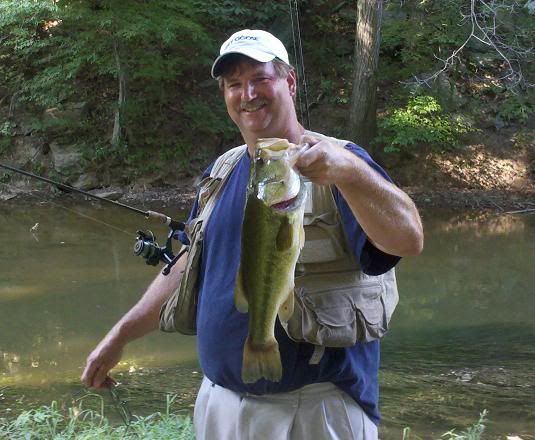
It's pitch black outside and past your normal bed time. It's really humid and still fairly hot considering that the sun had disappeared over the horizon hours earlier, and you're already drenched with sweat. You opted to fish the nighttime hours rather than endure extreme daytime temperatures during the latest mid summer heat wave. You're in an area where you know big bass lurk, but you can't see far enough into the dark well enough to place an accurate cast as you would normally do during the daytime. Bugs are buggin' you, mosquitos buzz your ears, face, arms and legs seeking kinks in your armor of Deet. Have you ever noticed that they always wait to bite while your reeling in your lure? They dive bomb your ears sounding like World War I style planes attacking King Kong on the empire state building. Tree frogs scream in the distance while a chorus bull frogs, green frogs and leopard frogs sound off around the lake. The more humid, the more active the frogs seem to be. Bats flit and dart around and above you, sweeping down upon you at the slightest movement of your rod tip. Katydids and cicadas attempt to drown out the sound of the amphibious choir in the background, chirping their own nighttime chorus. Unlike the day light hours, night time gives you the impression of a rainforest alive with activity that most people never experience. Fireflies flash streaks of yellow light everywhere. You cast your buzzbait, oblivious to possible snags that may lurk in the distance while using only your memory of your honey hole as your guide. After you cast, your lift your rod tip as the lure hits the water and begin cranking just prior to splashdown. Your metal bladed buzzer never sinks and produces a constant plop plop sound combined with the high pitch squeaking of metal rubbing metal. You've covered this area with several casts and are confident that big bass are on the feed here. Even though the outdoors is alive with frogs and bugs, it seems peaceful yet tranquil. You are very relaxed yet aware and focused on every sound around you. You near the end of your retrieve and just as you attempt to lift the lure out of the water there is a massive explosion that nearly causes you to lose control of your bowels. Your fishing partner jumps two feet in the air while yelling something that I dare not print in text. With only about six feet of line out, mayhem ensues with a very ticked off largemouth bass on the other end of your line going ballistic, flipping, flopping, leaping and thrashing. As you try to control the beast it finally dives and takes some drag and suddenly you have control and wear it down somewhat. As the bass tires, you bring him back to the surface. You reach down and lip the behemoth and turn to your partner with a smirk on your face while silently demanding that he snaps a photo of your prize. Prior to you landing the fish, he's had the camera at the ready. The digital camera's range finder appears image free and pitch black, but as the photo is snapped there's enough light to see you and your fish, a twenty inch, four pound largemouth that you'd love to catch each time out. That's what hot summer nighttime buzzin' for bass is all about. There's nothing like having a bass scare the you know what out of you when they annihilate your offering.
 |
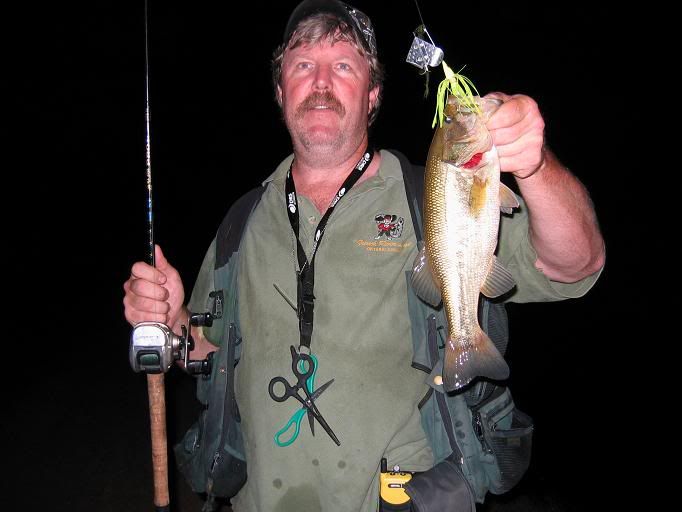
Howard Boltz caught this nice largemouth bass
on a Strike King Tri-Wing Buzz King buzzbait. |
Yes, it's the dog days of summer. It's widely known that fishing for largemouth bass through the hottest hours of the summer slows during mid day, but early morning and late evening hours tend to be quite a bit more productive. Most bass anglers make sure that they're on the water during dusk or dawn, tempting aggressive actively feeding bucketmouths with a variety of lures, especially topwater lures. Then, during the heat of the day, they probe the depths for lethargic largies, sometimes with success, other times not so much. But most anglers overlook the time when the bigger bass prefer to feed during the hot summer, and that's during the pitch black hours during the night and wee hours of the morning. You may or may not have a lot of strikes, but often the ones that you boat are fish that are a cut above those in size that you catch during the day.
Anglers that fish the last few hours of daylight at dusk may decide to stay an extra hour or so and fish and discover a dramatic drop off in the number of bites once the sun drops over the horizon. In fact, it may stop completely, giving the angler the impression that the fish stopped biting all together. When you think about it, when you're out in the dark, it takes a while for your eyes to adjust. I believe it's the same thing with largemouth, needing about an hour or so for their eyes to adjust to key on prey. Bass have good eyesight in the dark and combined with their sixth sense, the lateral line that senses vibrations under water, they effectively key on noisy prey. Buzzbaits offer a big profile or silhouette and certainly emit strong enough vibrations to send a bass into attack mode. So, before packing it in, if you have the time to fish late, stay an hour longer than you normally would before deciding if the buzzbait bite is on or not.
My favorite buzzbait spots are have shorelines with abundant cover but are shallow with deep water nearby. Combinations of wood and weeds are optimal. If frogs are abundant, so much the better. Big bass spend the hot days in deep water sanctuaries but move shallow to feed during the night time hours. It's my opinion that frogs are the key to night fishing in general. When they're out, bass know it, and you should too. Summer time temperatures slow the bass during the day, but the night time cooler temperatures are much more comfortable for bass and allow them to feed heavily on abundant prey while expending the least amount of energy. When they sense a critter, or your buzzbait, splashing into the water, they hone in on that sound and track further vibrations to the point of the strike. In other words, they hear it, feel it, find it, see it, and strike it. Often, they'll follow it quite a ways before exploding on your lure, sometimes right at the bank or boat just a few feet away. It's as if they strike at the last minute before their prey can escape. If you're lucky enough to place your cast close to a bass waiting in ambush, the strike could be instantaneous with your lure entry.
 |
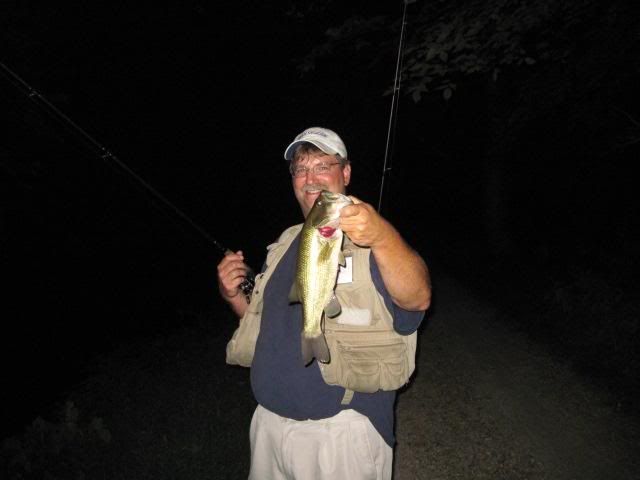
This two pounder struck a Strike King triple blade buzzer
leaving yours truly with that deer in the headlights look! |
When casting buzzbaits, make sure that after you launch your bait into the dark, that you raise your rod tip and begin cranking prior to your lure hitting the water. This will prevent your buzzer from dropping below the surface and increase the amount of time the lure is operating properly to give the maximum amount of vibration through the strike zone. Work it all the way back to the boat or bank because strikes could come at any time. Bass will follow a potential meal quite a ways in the darkness without fear of being prey themselves. Don't set the hook when you hear or see the strike until you feel the weight of the fish, because if the bass misses then you'll yank the lure away losing a chance at a follow up strike. Fish make mistakes at night and often miss, but they will keep trying to catch up to it. So, it's important to maintain the cadence of your retrieve to give the fish the opportunity to strike again. If you cast and a fish misses, follow up with several casts because sometimes they'll attack it again. The only time that I've found that didn't work is if you hook the bass and lose it. They don't seem to strike once you sore mouth them.
Another technique is to let your buzzer dangle in the water a couple seconds before yanking it out to make another cast. Bass will sometimes hit with your lure just hanging there. If you're bank fishing though, please be advised that bullfrogs will also hit your buzzer as it's dangling there in front of them! Some anglers have found that bass will strike at the boat and miss, and try the figure eight technique that pike and musky anglers employ, they sometimes will draw a follow up strike. To do that, at the end of your retrieve with the lure still in the water with a few feet of line still out, work your rod tip in a large figure eight motion at the side of the boat a few times. Sometimes bass will hang out there and strike again. Personally, I've tried it without success, but have had friends tell me that it's worked for them. So, I'll keep trying. It can't hurt, right?
Vary your retrieve speeds and let bass tell you what they want. If they want it, believe me, you'll know! Often the strikes are explosive, but other times they'll just slurp the lure. If you keep missing fish, try using a trailer hook. Sometimes they like it burned across the surface, usually when there's some ambient light or moonlight to assist them in tracking the lure. If it's really dark out, I prefer slowing the bait down to a crawl, just fast enough to keep the blades working. That gives them time to find your lure. If you're not getting strikes, make a change to either your presentation, type of buzzbait, or size of buzzbait. Try different casting angles including a very productive one, casting parallel to shore. Bass like to hug the shoreline in ambush of frogs, so casting parallel keeps your bait in the strike zone longer. In fact, if there are multiple bass in the area, your odds are greatly increased because you're covering a lot of strike zones of individual bass.
 |
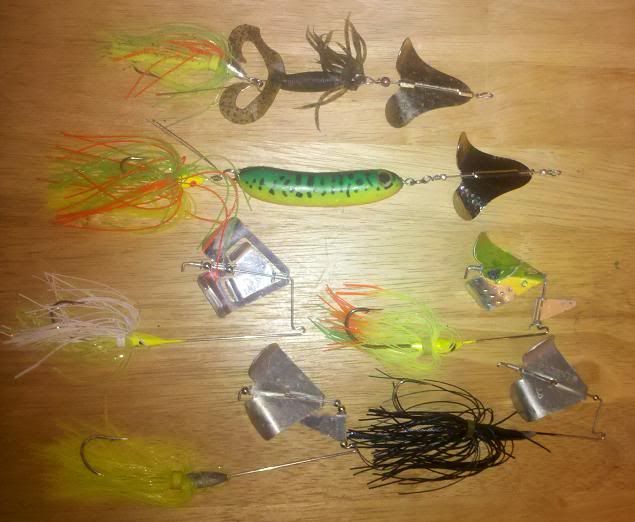
The top two are in-line buzzbaits, the third row shows a
tradtional buzzbait and a triple wing with a clacker, the
bottom row shows a clacker style buzzbait and a black
traditional model. All of these have metal blades but you
can also find them with plastic blades for a different sound. |
There are many styles of buzzbaits out there and they all pretty much work. Double bladed buzzbaits provide more chop on the water and more noise. Buzzbaits with clackers put our more noise and vibration. Metal blades give you a noisy squeaking sound that helps bass home in on your lure, while plastic blades offer a more subtle plopping sound for less aggressive bass. In-line buzzers ride higher on the water, are easy to cast, easier to keep on top, and very snag free but they have reduced hooking ability. Traditional buzzbaits provide more wind resistance on the cast, but have better hooking ability because the hooks ride further under the surface. There are some with really long shafts too that tempt shy fish into striking. Different sizes provide different sounds and vibrations. If the fish seem really active and aggressive, big noisy buzzers can call them in from far away. If they are less aggressive, more subtle buzzbaits like those with plastic blades or smaller sizes may draw strikes when the large noisy ones don't.
What about colors? I like chartreuse because, at least in my mind, it suggests frogs. If a smart guy like me (yeah right) thinks it's a frog, then certainly an animal with the brain the size of a pea will think so too. White is also visible at night because it reflects light the best, so if there's any ambient light it should be easy to see. But, probably the most popular color to use is black or another dark color. Why? Because it offers a great silhouette and is easy for bass to see especially when there's a fair amount of moonlight. Of all the qualities of a buzzer though, I think color is the least important when using them at night. Noise and vibration come first in my opinion. These are reaction baits, not finesse baits, and the reaction strike is the one that you're going to get. That's what, after all, makes them the most exciting lure to use.
 |
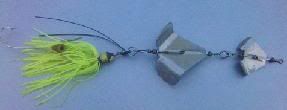
This is one of my favorite in-line buzzbaits, noisy and
squeaky, and I made it myself! |
Make sure that you match your rod, reel, and line to the weights of your lures to get maximum action and performance out of them, including castability and distance. I prefer baitcasting gear, medium heavy to heavy action, six and a half to seven foot rods to toss buzzbaits 1/4 of an ounce or greater, and at least 14 pound test line. I like the longer rod simply because you can keep your line off the water and get better action on your lures. I use a copolymer line because it has less stretch than mono but more than fluorocarbon or braided lines. That way you're not yanking the lure out of their mouth if they hit at your feet. The added line stretch gives you some measure of control over the fish during such a chaotic moment. I feel that braid puts too much pressure on the fish, and when they're thrashing about they can tear open a hole in the mouth of your bass at the hook and possibly increase their chances of pulling free. For 1/8 ounce buzzers, spinning tackle seems to work best using eight or ten pound test but you may have to go with heavier line depending on the cover that you're fishing.
 |
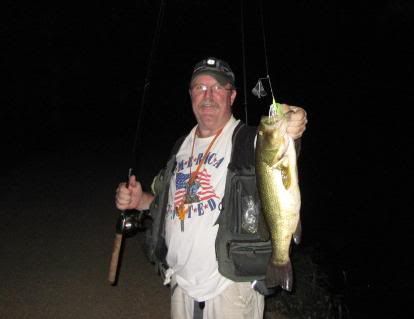
This one hit a buzzer about ten feet from me. This fish went
ballistic on me. What fun! I'm still shaking from that ordeal! |
You can "tune" traditional style buzzbaits to run straight or veer to one direction by bending the wire containing the blade one way or the other. This is a valuable technique for fishing in daylight hours especially around boat docks. But for night fishing, I prefer them to run straight simply because most of the time you can't see what cover is around you anyway and at least you can visualize where your lure is at all times if you can't see it. It could be easier for bass to track your lure as well.
Other night fishing tips, bring a light so you can re-tie, tie on a new lure after losing one, or change baits easily and see what your doing. Also, when night fishing, things happen. All it takes is a snag that you've freed to wrap line around your lure impeding it's action or that ties knots around your rod tip that you could never design yourself if you tried, or even picking out the dreaded backlash. Having some light to remedy such a situation really can save your trip. Lights that clip to your hat or wear on your head allow you to keep your hands free to do what you need to do. Try to not shine the light over the water that you're fishing if at all possible. I'm not sure if it makes a difference, but I'd rather not let the fish know that I'm there, so why take the chance? It couldn't hurt to be as stealthy as possible. Try to avoid making a lot of boat noise. Bring bug spray with a high content of Deet or some other way to keep insects from biting you. Mosquitos are the primary enemy in my neck of the woods. Even though it's not the hottest part of the day, I make sure to drink plenty of fluids too. And, probably the most obvious is to know the water that you're fishing because you can visualize the cover and be reasonably accurate with your casts. Also, know your water that you're boating on for safety reasons.
Don't forget to read my posts about making your own buzzbaits so that you can increase your buzzer arsenal while saving money. If you haven't already read them, here are the links:
and
In summary, largemouth bass are very active at night, especially the big fat females that we all love to catch. There are many baits or lures that will catch them at night, but there's nothing that is as thrilling or exciting as a big fat bucketmouth exploding on your buzzbait when it's pitch black outside. And, you can have it all to yourself.