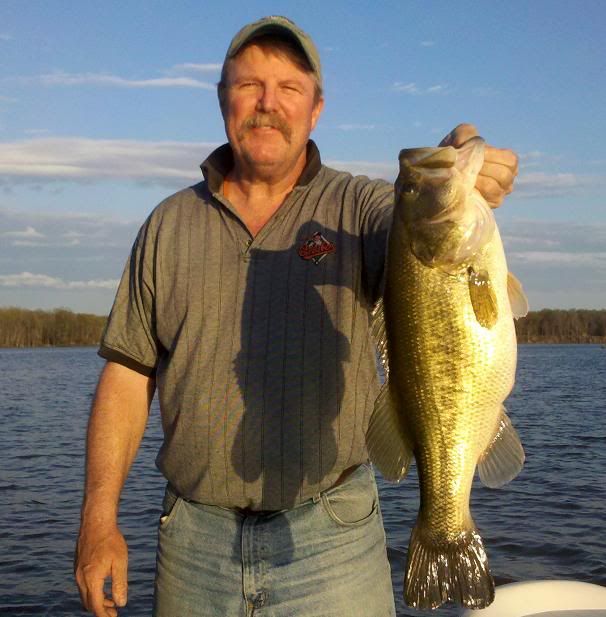
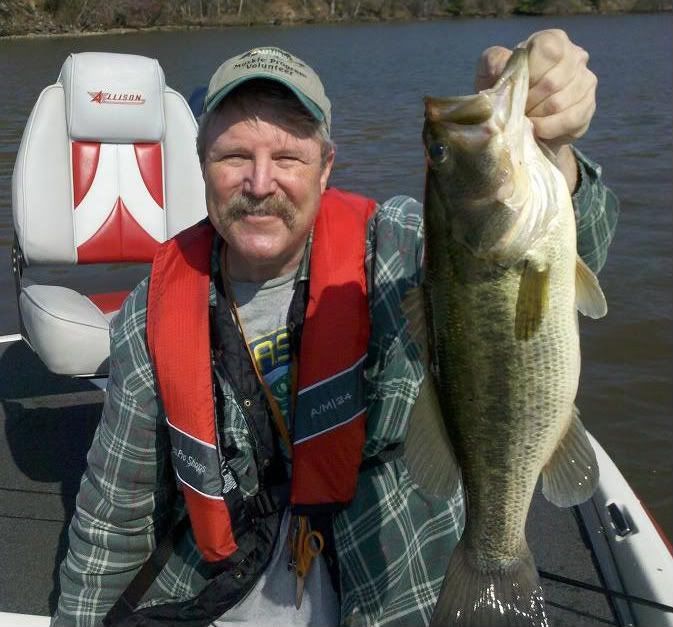
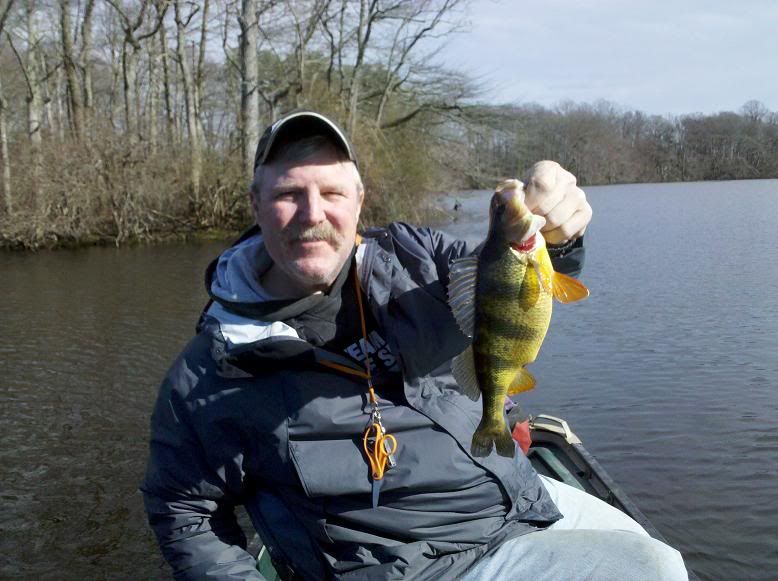
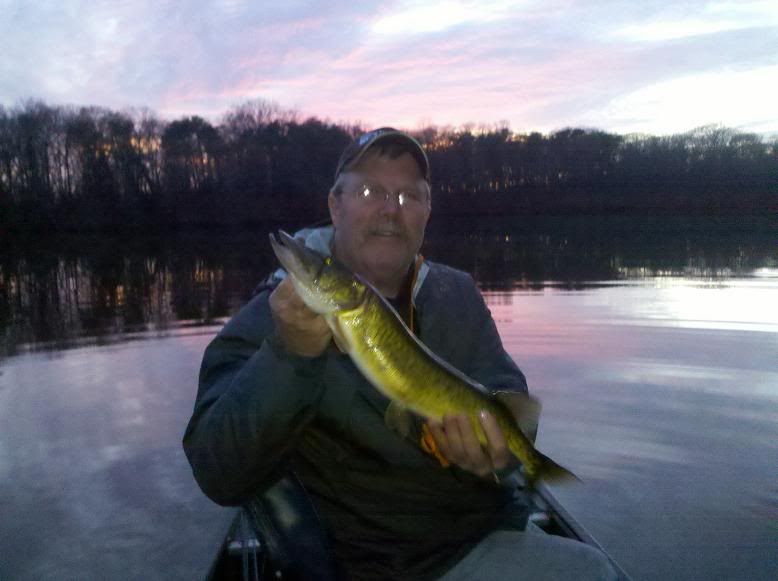
Welcome to Fat Boy's Outdoor Blog. I'll blog about fishing, hunting, and fossil collecting from my perspective of the outdoors. Everything posted here is dedicated to my brother, Kyle C. Wilson, who passed away unexpectedly in 2007.
Always for you Bro!
Note: I don't make a penny of this blog. I write for fun, to give back to the community, and to help others learn as others have taught me. I hope you all enjoy it.
I received my new shark tooth collecting tool, the Sand Dipper, prior to my Maine ice fishing trip that I blogged about in my last post. My plan was to give you my first impression of this product right as soon as I received it, but last minute planning for the fishing trip, the fishing trip, my anniversary, and last weekend another fishing trip away from home kept me away from the keyboard. But, here we are!
Let me just say that when I opened the box, like a kid at Christmas, and pulled out my new Sand Dipper, I was really impressed with the quality of this product. All of the features advertised on the website, The Sand Dipper, turned out to be as nice as they were described on the website.
All of the advertised features that are improvements over my home made versions. I really like the comfortable cork handle, the strap that allows you to free the use of your hands without setting the tool down, the extendable shaft, and the overall quality of the product.
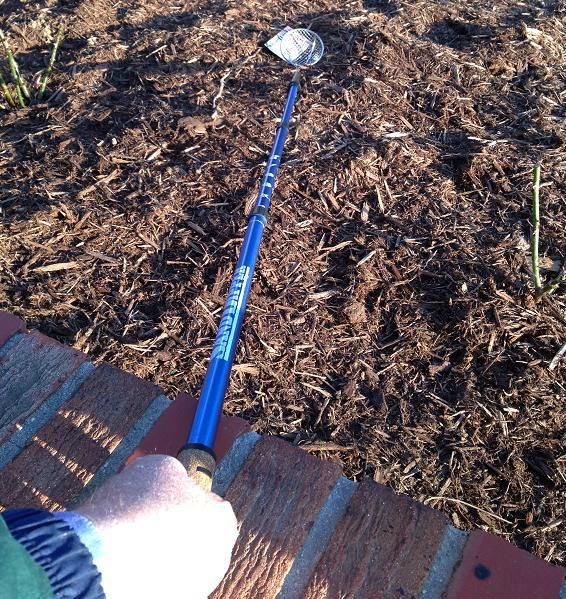
The Sand Dipper extends to over five feet long so you can reach those shark teeth from afar.
Another thing that I like about it is that it seems pretty durable and it's light. You can extend the handle to reach far away spots, perhaps when you're walking the beach and don't want to get your feet wet. When I compared the Sand Dipper to my other home made versions, I noticed that the "basket" was a bit smaller than the one that I've been using. Of my home made versions, I've tried various sizes of frying skimmers and found that the smallest one allowed me to dig in the sand easier and be more precise in what I pick up. I think that will hold true here too, but will report on that once I try out the Sand Dipper in the field.
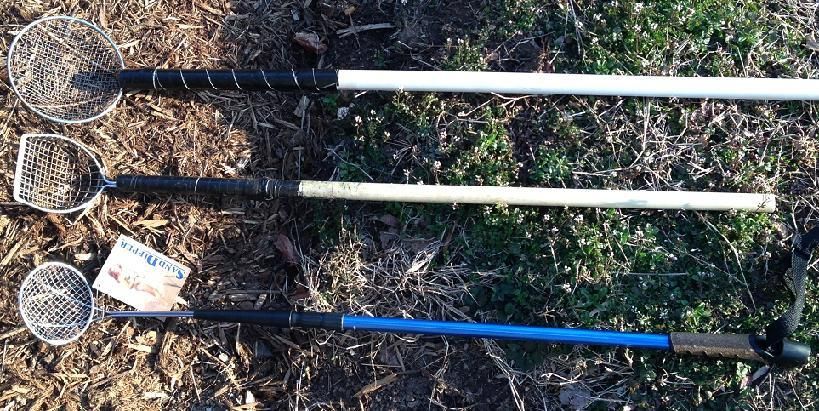
Prior to me obtaining my new Sand Dipper (bottom), my favorite home made version is pictured here at the top. The "basket" is a bit bigger than the Sand Dipper, but is the smallest of the King Kooker style that I have, and seemed to be much easier to use than the larger sizes. My thought is that this will also hold true with my newest addition.
If you look at the picture above and compare the features of my old homemade skimmer version, you can see that the cork handle gives you a much more comfortable and less slippery grip than PVC pipe. The middle one, another home made version, seemed like a great choice at the time, but it also has limitations.
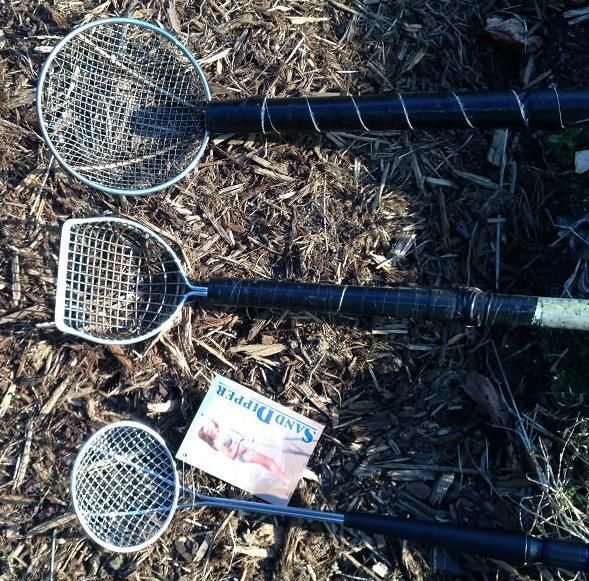
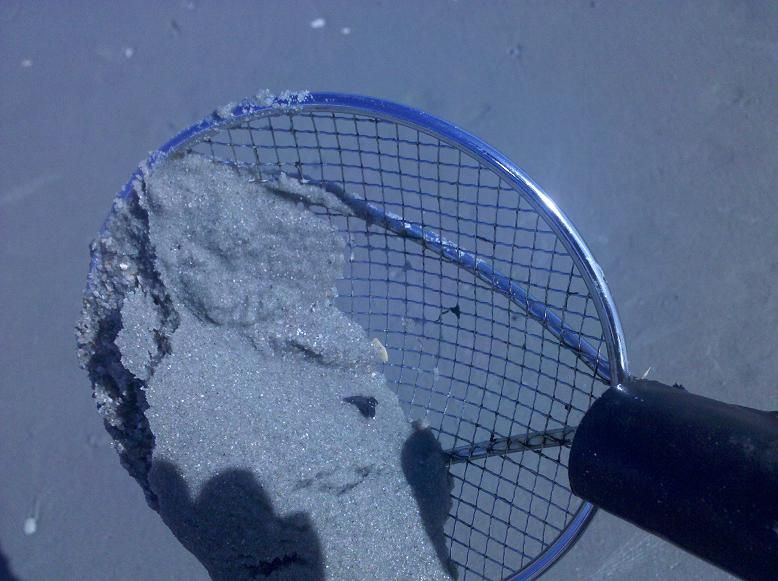
This picture compares a close up view of the collecting baskets of the Sand Dipper to my home made versions.
In the above picture, you can see clearly that the quality of the mesh is much nicer in the sand dipper, it's thicker and is made of stainless steel. The King Kooker versions wore out quickly once they began to rust, and the thinner mesh couldn't hold up very long to collecting along rocky or really shelly shorelines. The middle one above is another home made version with a different basket, which is very strong and durable, and made of stainless steel, and has a very strong frame that is great for digging into substrate. However, if you look closely, you'll see larger gaps in the mesh that surround the base of the basket, and many nice shark teeth slipped through those gaps, so I stopped using that one. Now it collects dust.
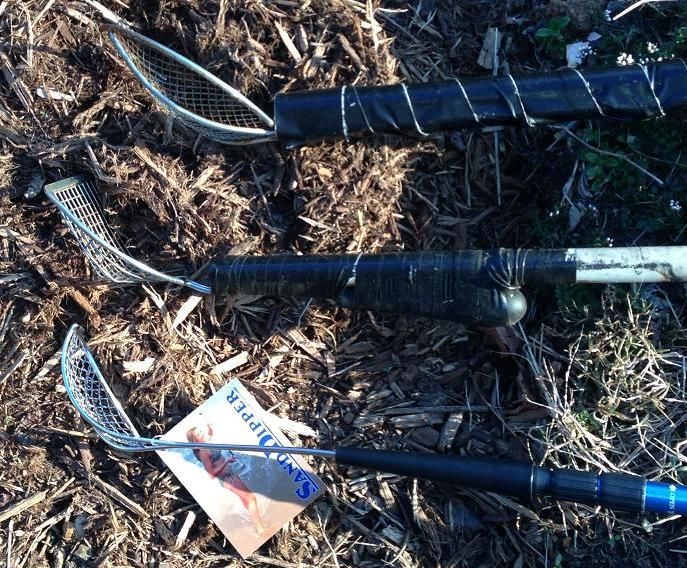
Here's a side view comparing the baskets, handles and such.
To sum up this product review, which is a first for me of anything outside of the fishing world, I'm really impressed with the Sand Dipper. Now I need to get out and test it in the field. After giving it a go, I'll report back to you all on my findings. I'm confident that it will be a positive experience based on what I've seen so far.
Finally, here's a big thank you to Skip for designing and marketing such a nice product. People approached me on the beach all the time and asked me about my home made version. Now, they too can purchase such a handy collecting tool. I've seen other commercial version on the beach, but they were cheaply made and no where near as nice as my home made versions, which fall short of the Sand Dipper in quality too. No longer will they have to strain their backs after bending down to pick up stuff off the beach a thousand times a day. In addition to that, for shark tooth collectors, your odds increase in collecting teeth in the surf because now many of those that the waves stole from you, you can now collect. Now you can collect with ease and confidence.
Now that I’m an old man, one of the things on my bucket list was to visit my buddy, Jim Cumming, for some ice fishing. So, on Friday, I made the trip North after stopping and paying a visit to my friend, Geoff Cerrelli in Pennsylvania, who graciously gave me some maggots. I added that period for humor’s sake, maggots are also commonly known in the ice fishing world as spikes, which make for a very effective bait to tip lures, spoons, and ice jigs with to catch hungry panfish through the ice. Since then, I’ve passed on the maggots to their new owner who will get some use out of them, my Maine host on the trip, Jim Cumming.
The ice conditions were sloppy to say the least. It snowed every day, not much, but enough to be annoying, especially when I left my tennis shoes at home and wore Crocs during my leisure non-fishing time up there. Temperatures ranged from the upper twenties during darkness, to mid thirties throughout the day with periodic snow squalls and light winds. Fifteen miles per hour plus winds in Maine is considered light apparently, and about the only thing good about slush and snow on the ice is that your portable shanty won't blow away. On the ice, we found a good five inches of snow on top of about four inches of slush, on top of about twenty inches plus of mixed white and clear ice, all of which made mobility very limited.
Mobility is the key to my ice fishing strategy. Meaning, if you aren’t on fish, you move to find them. First, you have to get to the area that you’d like to fish, then, in theory, you cut a bunch of holes until you find the fish. Then, when they stop biting, you repeat the process. Usually, productive holes when the bite stops will once again be productive after a short while, especially with yellow perch as their schools move around quite a bit. You can bounce from hole to hole and keep on the school that way.
However, the conditions described above really do limit your ability to do much of that. This is especially true when you’re old, fat and out of shape like me. First of all, to get to Jim’s prime spots, we had to trudge through all that slush and snow while dragging our sleds that were heaped full of ice fishing gear gear nearly half a mile or more. Needless to say, I had to stop and rest several times, even taking a seat to catch my breath and the scenery at the same time. I guess you could say that I found the scenery breathtaking!
Jim, on the other hand, is like the energizer bunny, and scampered out to his spot in no time. All I could do is watch him pull away, and try to stop, rest, and regain my ability to breath before gathering up enough energy and will to trudge forward.
That's Jim off in the distance. As you can see, you'd think that I couldjust follow his footprints for easier walking, but Jim apparently doesn't believe in walking a straight path! Actually, sometimes you have to improve your own mobility by finding less sloppy stuff to walk through, and that's what he was doing.
Like many guys, Jim’s approach is a varied and effective one common to many ice anglers, to set tip ups, or “traps” (as they are referred to by Mainahs), to catch larger predatory fish, and when time permits, use a jigging rod to catch smaller panfish or anything else that wants to bite while waiting for “flags”. Although this limits mobility in some cases, it does allow the ice angler to fish the best of both worlds.
For those of you that aren't familiar with them, tip ups basically wooden or plastic stand fitted with a line filled spool that fits across the hole in the ice, with the line having a leader, perhaps a weight, and a baited hook dangling to tantalize potentially hungry fish. The tip up has a spring loaded mechanism that, when a bite occurs, allows a flag to shoot up and alert you that a fish has taken your bait. The videos below show Jim in action working tip ups to catch some nice predatory fish, filmed on our first day this past Saturday.
My approach is a bit different, I prefer to jig. Although I lack experience in using them, I’m open to using tip ups. In fact, I actually did try them on our second day at a trout lake. Jim showed me how to use some and I promptly caught nothing on mine. In fact, that day, we both got skunked, so not much detail will be provided except that the sloppy conditions were a bit better, only we trudged twice as far to get to the spot where we were skunked, and I was twice as worn out at the end of the day. Jim summed up that second day quite nicely, the fishing stunk, but the company was awesome. The cool thing about tip ups is that you really never know what you’re going to catch. Any predator that lives in the lake could be on the other end of your line, in that lake, it could have been pike, brown trout, brookies, splake, lake trout or big bass.
On that first day, I think Jim caught fifteen warm water predators (chain pickerel, largemouth bass, and smallmouth bass) on his “traps” and jigged up about as many other fish in between flags. Those other fish included yellow and white perch. I caught about half as many fish jigging, a mixed bag between yellow perch and white perch, and one other species that I’d never caught before, a smelt. It was my first fish of the trip.
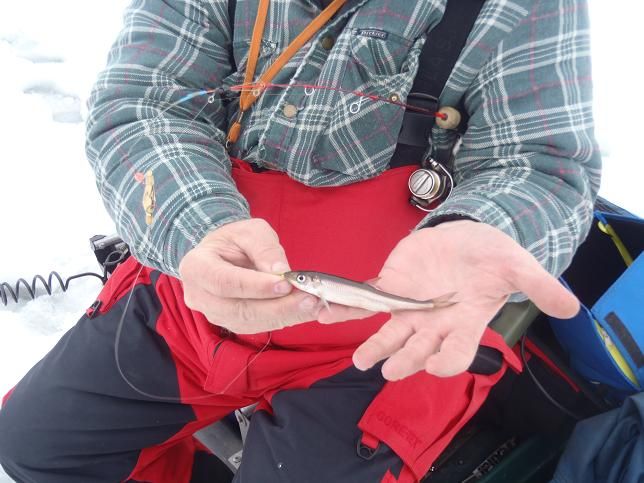
My first Maine fish through the ice...a minnow! As it turns out, this baitfish is also a highly coveted delicacy, the smelt. People try to catch these guys by the bucket full, bring them home, smoke or fry them, and feast.
Here's Jim working a tip up.
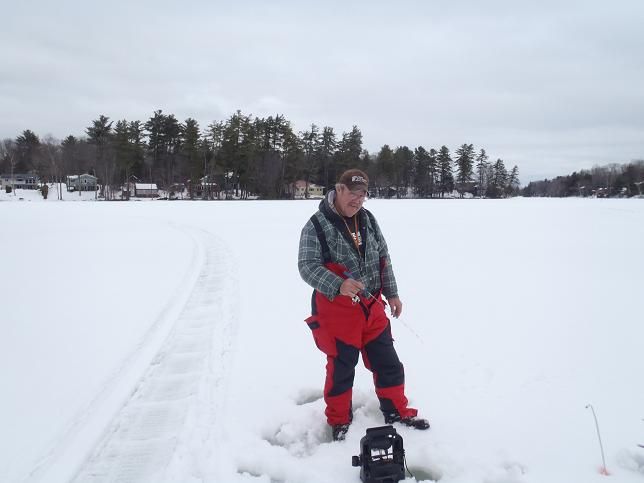
While Jim kept watch of his tip ups, I jigged.
The tip ups do catch big fish, the pictures below are evidence of their effectiveness.
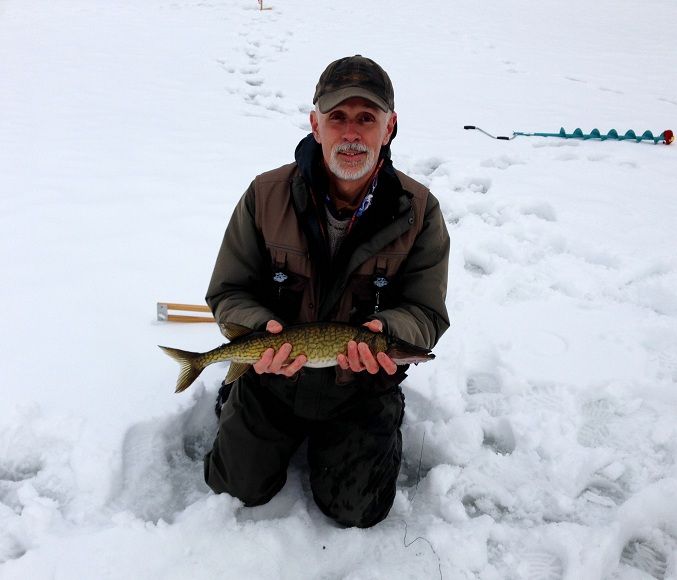
Jim sports a fat Maine chain pickerel.
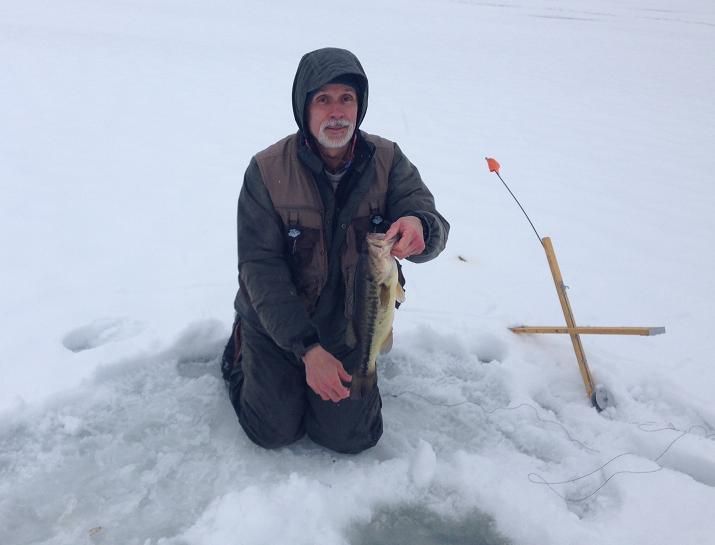
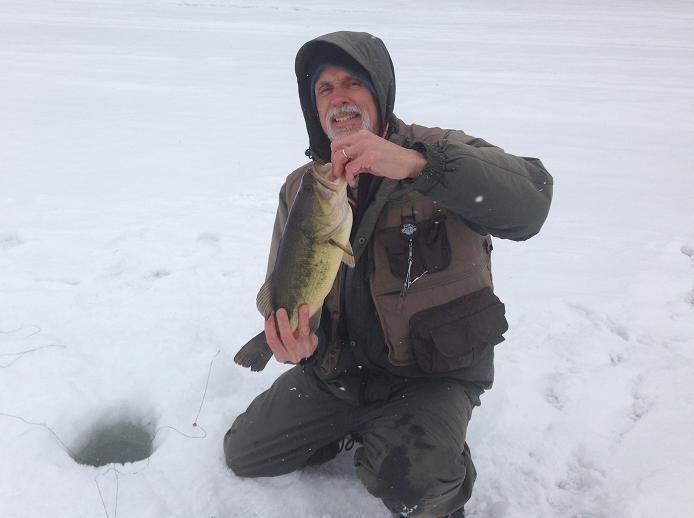
Jim with a chunky iced largemouth bass caught on a "trap", released to fight another day. Jim uses circle hooks that greatly reduce deeply hooked fish and allow for clean healthy releases. They nearly always are hooked in the corner of the mouth. Don't "set" the hook in the traditional way. Instead, apply steady pressure on the fish as you hand line them up, which moves the hook to the corner of the fishes mouth.
Jim's tip ups brought many fat bass like this to the icy surface on our first day.
Day three, March 4th, measured up to what I had hoped, and basically turned out to be my ice fishing season. Honestly, I'm not picky about what I catch through the ice, as long as I can get on a good jigging bite and the fish put up a decent fight on my light tackle. As it turned out, I couldn't ask for a better day, with a great bite, on the same lake as day one, but with a much closer hike to his spot. The bad news was that the sloppy conditions on the ice were even worse.
Snow insulates the slush and water between it and the ice, and the weight of the snow pushes down on the ice, allowing water to seep up through holes cut in the ice throughout the lake, making it even worse. Despite the sloppy conditions, higher winds, constant snow, rain or drizzle all day long, the fish didn’t care and bit all day long.
Jim, early on, stepped into and old eight inch hole that someone had cut perhaps a few days prior, and had a wet foot which could have ruined his day had temperatures been a bit colder. There's nothing more miserable while ice fishing than cold wet feet. Warm insulated boots and wool socks that even insulate when wet helped Jim remain somewhat comfortable. But, even after that, and also having to battle a stomach ache, he hung in there and stuck the day out. Good fishing can put some of that at ease, and that was the case. This was our two hundred fish combined day, a mixed bag of bass, pickerel, perch, sunfish, and fallfish.
It was my kind of day though. We found fish quickly, and I think that I cut three holes all day long, and it was all that was needed. In addition to trudging through all that slop, cutting a hole with a hand auger through twenty plus inches of ice can wear and old fat guy like me out quickly. Well, I actually cut seven holes, because once I was on fish, I had to cut holes for my electronics too. I do this to keep the fish from tangling in the camera cable or transducer cable of my sonar.
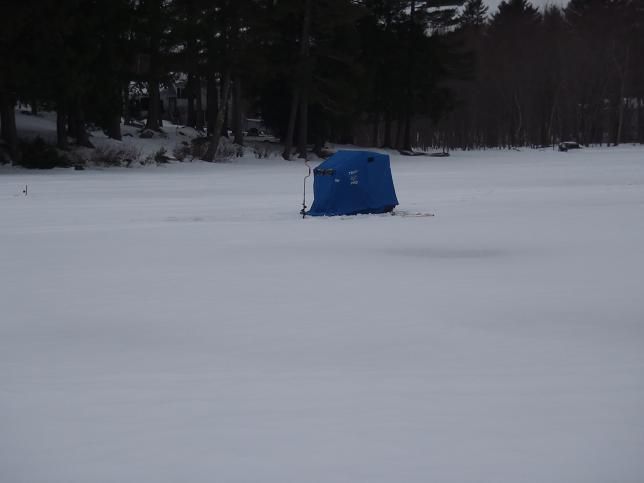
I was able to handle the elements easily, tucking myself inside my cozy Fish Trap portable ice fishing shanty. Not only does it protect me from the elements, it also allows me to view my camera monitor much easier, providing a dark house of sorts, with just enough light inside to see what was going on. My Fish Trap also has windows where I can view what is going on outside.
Shown here is my hiding spot, out of the wind, comfy, and able to easily view my underwater camera screen.
I offered as often as I could to invite Jim to either join me or take my place inside to warm up now and then, and to try out my electronics (which he did for a bit) especially since he wasn’t feeling well. But, Jim’s a tough guy and put up with what Mother Nature dealt him, and having good fish bite all day long helped him cope, I’m quite sure. He seemed to be more focused on me having a good time than his personal well being. What a great host and a great friend!
This is the view of my set up while inside my comfy portable ice fishing haven. The hole on the right was for my electonics. In this picture, my sonar wasn't being used to conserve the battery as fish were moving into camera view for a long period of time. This hole was home to my camera cable, with the actual camera down the hole positioned to look down on the fish toward the bottom, where you can see weeds scattered alogn the bottom. In the center of the screen is my jig. Where you find weeds while ice fishing, fish are usually nearby.
I typically use my sonar to locate the fish, checking hole after hole until they are located. Then, I’ll drop a jig down the hole to check if the fish are active and will bite. On the sonar screen, you can actually see your lure sink toward the bottom, and see the fish rise off the bottom to your bait (or move in from the side). Once the bar on the sonar (flasher) representing a fish moves even with the one representing your lure, you take your eye off the sonar unit and focus on your rod tip and watch for any movement of that rod tip. If it twitches, set the hook and you most of the time will catch a fish. Sometimes the bites are very subtle, and all that might move is your line. If anything weird like that happens, set the hook. Crappie are notorious for doing that.
Actually, to be effective on the ice, sonar is really all you need. You can most certainly use the sonar all day long to put you on fish, watch your lure and the fish, and get a sense of how they are reacting your entire day. Sonar can give you enough information, but it can't tell you everything. What you don’t know is what kind of fish they are or how big those fish are. You can read the sonar to determine the type of bottom, hard or soft, and even read weeds or other cover. If you are on a good fish bite, this is where the camera comes in handy. You can see what the bottom is like, even what kind of weeds are present.
Personally, I view the sonar and the camera as separate tools with different purposes. The sonar puts me on fish, the camera refines and improves my ability to catch them. They are simply effective tools to fish. Do you need them both? No, but they both really do improve your odds. In addition, I find it extremely fun. You can drop the camera down, see the fish, how big they are, what the bottom is like, what kind of weeds are there, stumps, branches, whatever. And, you can watch the fish actually inhale or bite your lure. Not only that, you can see the fish that aren’t after your lure at the time too.
It’s so much fun, like watching an interactive TV show with you and the fish as stars. I'll sit there and watch the fish inhale my lure and then set the hook and the fight is on, all day long, with me giggling like a kid the entire time. The advantage the camera gives you is that you know exactly when to set the hook. There is no doubt when you have a bite, and even the most subtle bites aren’t missed unless you’re too slow to react. The result is that the hookup percentage is higher.
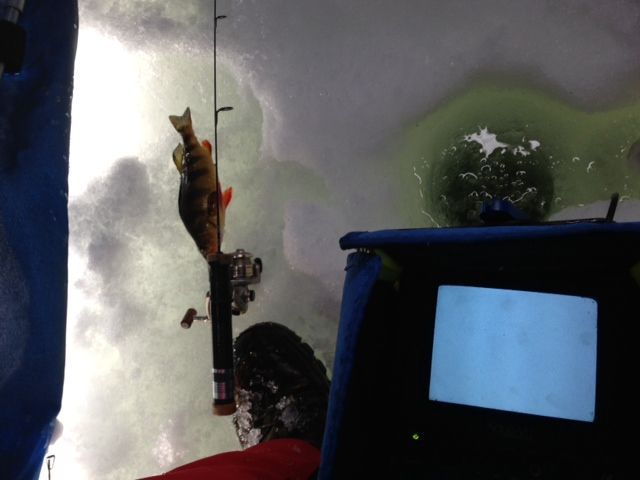
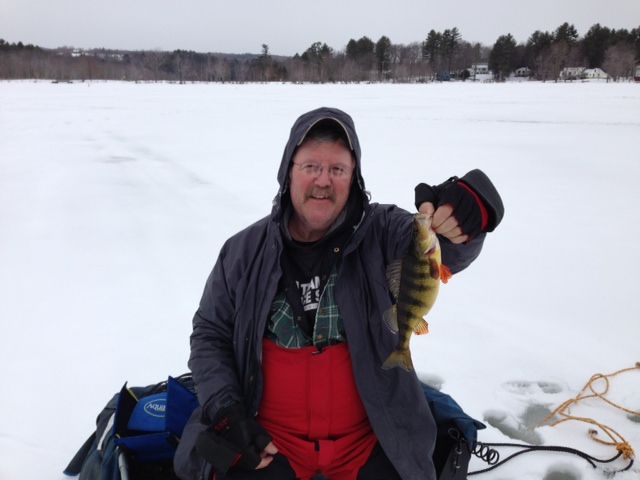
Pictured here is a medium sized yellow perch that fell victim to my set up. The fish was released unharmed after his photo op. This was my last spot, my third set of holes on the day, that proved to be the most productive spot. You can see on the camera that this spot showed less weeds than that other spot in the previous picture, and it was a mere fifteen feet away. You can't see the fish in this picture, but they were moving through often, like a highway following the weed edge.
I landed sixty nine yellow perch, and at least fifty of them were between ten and thirteen inches long. In addition, the sunfish were active. Jim caught a ton of them, and I finished with twenty one of chunky sunnies, a mix of pumpkinseed and red ear sunfish.
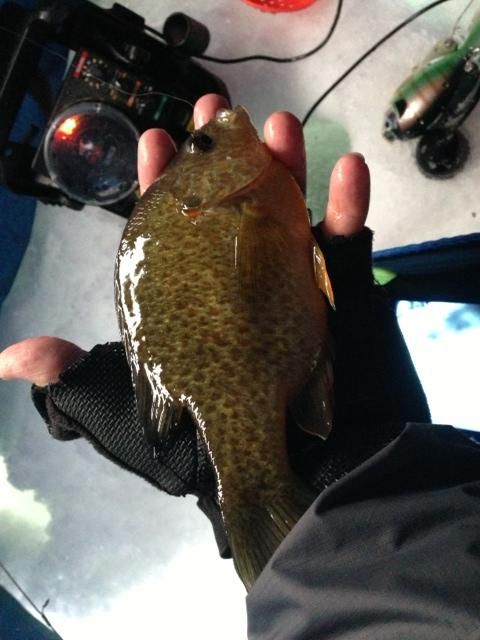
Here was my biggest sunfish of the day. All of them were nice, but this one was a brute.
In the picture above, you can see the camera on the ice. I had to pull it, my line, and the fish out all together because this guy wrapped himself around my camera cable. You can also see the sonar or flasher at work here. Sometimes it helps to use both, to use the flasher to see what’s outside of the range of your camera, to gain a clue that fish are approaching.
Jim didn’t have much tip up action that last day, but did manage to land a dandy fat largemouth bass. It took a lot of line too, as you can see it strewn across the ice in the picture below.
Nice bass Jim!
While Jim jigged away catching sunnie after sunnie, I hammered perch like this one all day long. I'm sitting on a modified bass boat seat installed in my Fish Trap, pictured here with the shanty in the open position.
Of course, jigging is an effective way to put panfish on the ice. But, you can also jig up predators. I also landed two small chain pickerel and three largemouth. At one point when the perch action slowed, I was watching my Berkley one and a half inch Gulp Smelt Minnow on my 1/32 ounce Ratso glow jighead, putting myself in a trance while jigging. I set my rod down to take a drink of my Pepsi Max, when, what looked like a submarine appeared on my camera moving right up to my jig. I picked up the rod and gave it a twitch, and the submarine opened its mouth and sucked in my jig. It was a massive largemouth, at least for ice fishing in my world, and probably was in the four pound range. It took off, taking drag while I was backreeling. I fought this fish for quite a while as I didn’t want to break this fish off. I had to be careful because my perch jigging rod was set up with only one pound test. Things were going well but I took one hand to pull the camera and cable up and out of the hole to keep the fish from wrapping around the cable, while the bass took drag, and it broke me off. Well, that explains why the panfish dissappeared!
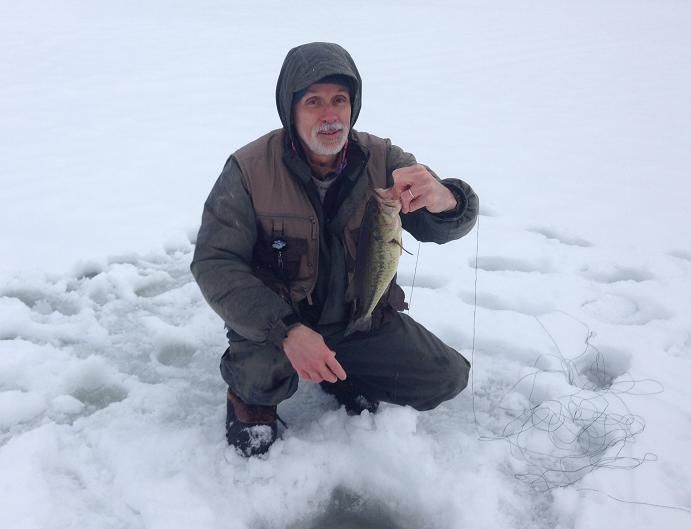
Not too long after that, I had a repeat performance, only this time I successfully landed the fish, a largemouth bass, not quite as large as the first one, but a healthy fish that was eighteen inches on my measuring tape.After a quick photo shoot, I released it back to the depths under the ice.
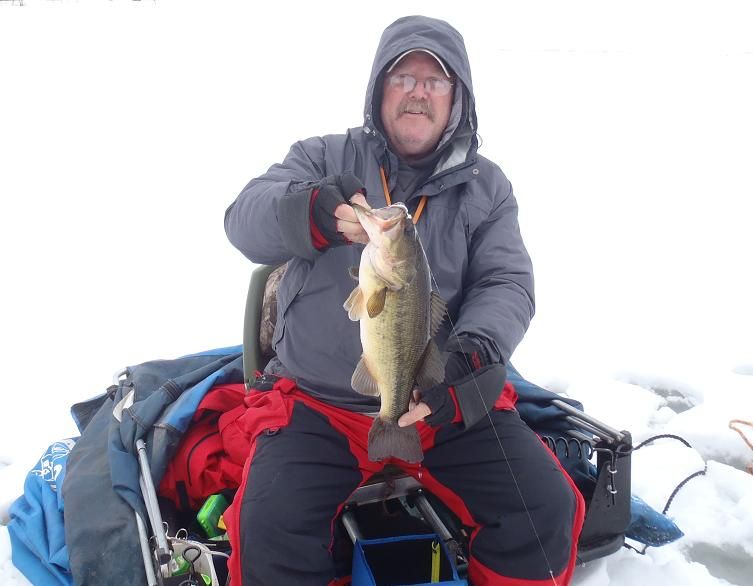
Here was my biggest fish of my trip, a nice eighteen inche largemouth bass. Not bad for using a perch rod and reel combo spooled with one pound test!
So, that was my last day on the ice, and it made my ice fishing season. I’d say, in fact, it was my ice fishing season. Jim and I had hoped to get out on Tuesday for one more go at these fish, but the approaching storm caused me to reevaluate my plans and cut my trip short one day. I just couldn’t risk leaving my wife stranded at home without power. I considered staying an extra day to wait it out, but the storm was due to hit New England the next day, so that option was out. Nevertheless, my first ever visit to Maine to visit my good friend Jim proved to be very memorable. It wasn't much of a season, but it was one that I'll never forget. Now I want more! I will be back. And, in addition, next time I hope to meet up with some of my other Maine Iceshanty friends.
I can’t wait to get back up there again on the ice or open water. I purchased a yearly Maine license, so more than likely it will happen. I owe a huge thank you to Jim Cumming for being such a gracious host, fantastic guide, and most of all a great friend. Also, a big thanks go out to Geoff Cerrelli for helping me out with some last second bait. It was great to meet up and talk with him again, and we will hit the softwater together before long. Perhaps that adventure will result in a future blog post!
To find shark teeth like this, all you need is the will and a good set of eyes, and to learn the shapes and features of shark teeth. But a tool to help you pick them up can save you back pain and make your beachcombing experience much more enjoyable. Check out the Sand Dipper, a tool similar to the one that I made but much improved.
Want to find shark teeth and other beach collectables without straining your back a thousand times each day by bending over time and again to pick up something that you may or may not want to keep? Many years ago I came up with a solution. I found a King Kooker skimmer and used electrical tape to attach it to section of PVC pipe. This really solved my problem of an aching back. Not only could I poke and prod stuff on the beach, but I could pick them up either with an entire glop of sand or let the water filter the sand out and pick up larger objects. Beachcombing life was good.
Pictured above is my collecting tool, a King Kooker frying skimmer taped to a section of PVC pipe. It works well, but has limitations which, over time, wind up costing money. There is a better solution, I believe.
Over the years, the tool proved effective, but it did have limitations. My intention, of course, was to tinker with the idea and solve the various problems. What problems might you ask? The worst one was that these things rust, and if used in salt or brackish water like I do most of the time, the oxidation process is quite quick. Another issue is that the PVC pipe can become slippery and I wound up dropping it now and then. What good is something designed to save your back from picking it up when you keep dropping it all the time? So my thought was to add a golf grip, and perhaps a strap. All of these modifications are possible and would definitely improve my home made version.
The skimmer allows you to pick up individual items and "sift' them out with water, or just pick up an entire glop of sand.
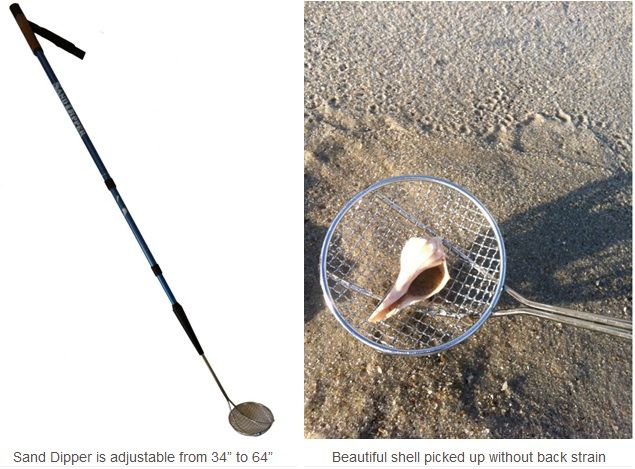
But, there's a better solution. It's called the Sand Dipper, with the website linked here for your convenience. It's basically the same thing that I use with all of the improvements. If you add up the cost of making my tool with all of those imrpovements, it would exceed the cost of the Sand Dipper. So, here I am at the point of purchasing a marketed version of this tool that has all of the improvements that I wanted in my own for a price that is less expensive than my own version, even factoring in shipping. Another feature that I didn't even think of was that the Sand Dipper is collapsable. And, more importantly, they are stainless steel and won't rust. I'd go through a King Kooker skimmer each year because of rust alone, so the cost adds up over time.
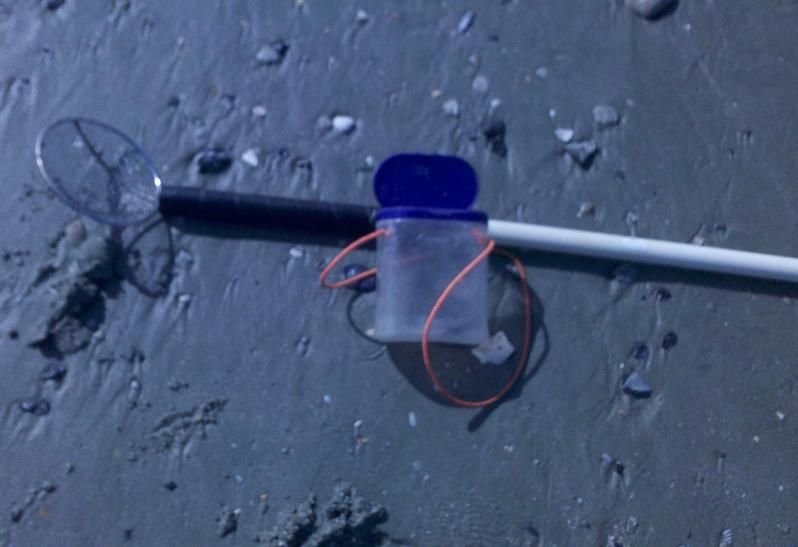
Here's the Sand Dipper, with all of the improvements that I had in mind for mine and quite affordable, actually cheaper than if I made the same improvements to my version.
I plan on obtaining one of these cool products soon, and will report back once I receive it, and provide a review once I've had a chance to test it out. I'm very optimistic. And if they work out as I hope, I can see them as a great Christmas or holiday gift for my family members! I'm really looking forward to trying one out.
OK, I'll come clean. I'm not talking about ice safety, although it's a topic for another day. I'm talking about the use of scent on your fishing lures to further sweeten your lures, to tempt finicky fish to bite while jigging for panfish through the ice. I'll talk about a few that I use during this post, but I'm not endorsing those particular products. There are others out there that are probably well worth using. The point is, use them when the bite is tough.
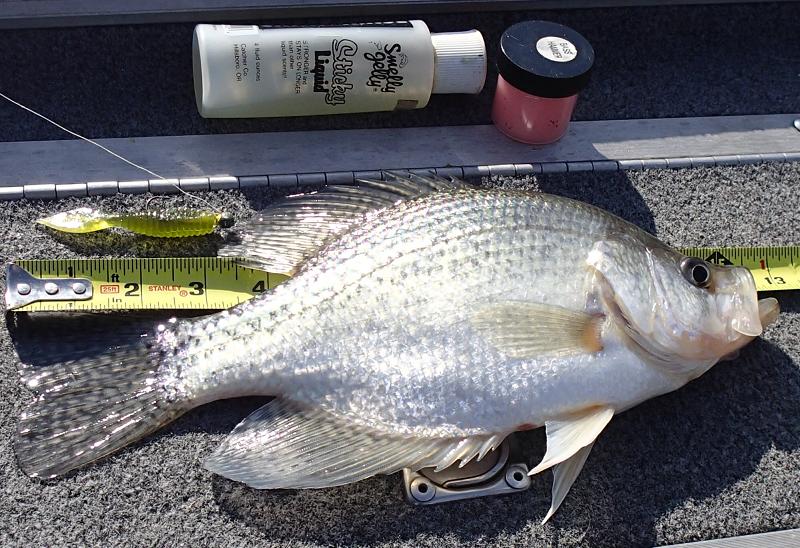
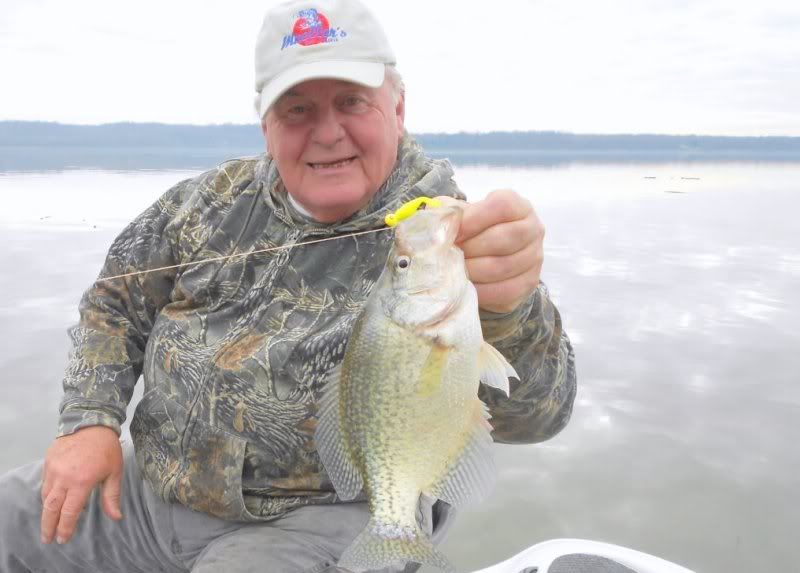
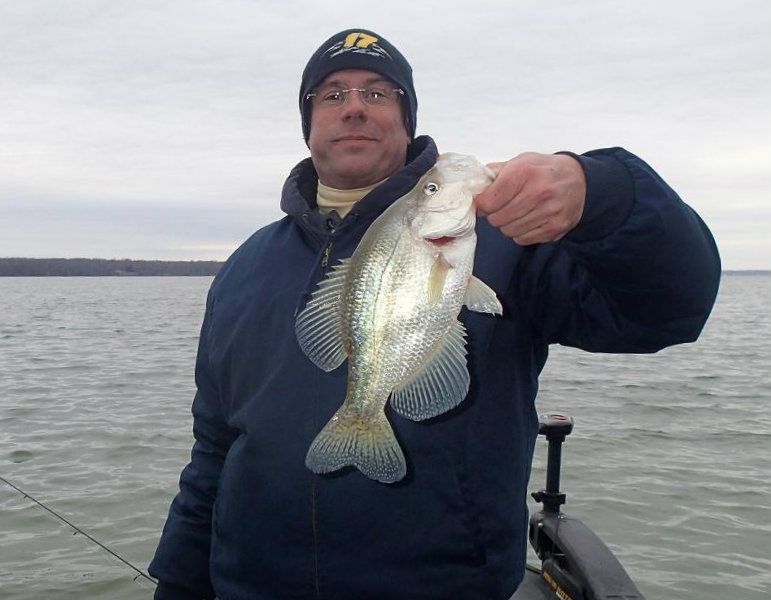
Use common scents...like Smelly Jelly, to put more panfish like this slab crappie on the ice. This one was caught on the open water, but Smelly Jelly resulted in more bites than when we didn't use it on this trip.
Most ice anglers that jig for panfish tip their lures with some sort of bait. Waxworms, maggots (commonly called spikes), mousees, perch eyes, or belly meat are commonly added to jigs to sweeten the offering. The panfish are not actively feeding on these baits under the ice until you introduce them. In other words, schools of maggots aren't down there swimming around. So, why do they work? Scent and taste.
It's no secret that taste and scent are closely related senses, especially to fish. Sweetening your jigs with these baits will not only draw strikes, but keep them hanging on. So, when things get tough, obviously, toting these baits on the ice with you is a good idea. I always carry a container of spikes and waxworms with me on the ice.
However, over the past ten years or so, soft plastics have become increasingly popular for targeting panfish through the ice. One advantage to using soft plastics is that you don't have to stop fishing to add bait to your jig during a hot bite, and the soft plastics last through a lot more fish than a maggot or waxworm.
I personally started using them over twenty years ago, dropping Bass Pro Shops one inch Squirmin' Grubs down the hole for willing perch, crappie, bluegills and bass. Later, the now famous Ratso and Shrimpo lures iced many a pannie for me on the ice. But as good as these lures are, there are times when fish won't touch them.
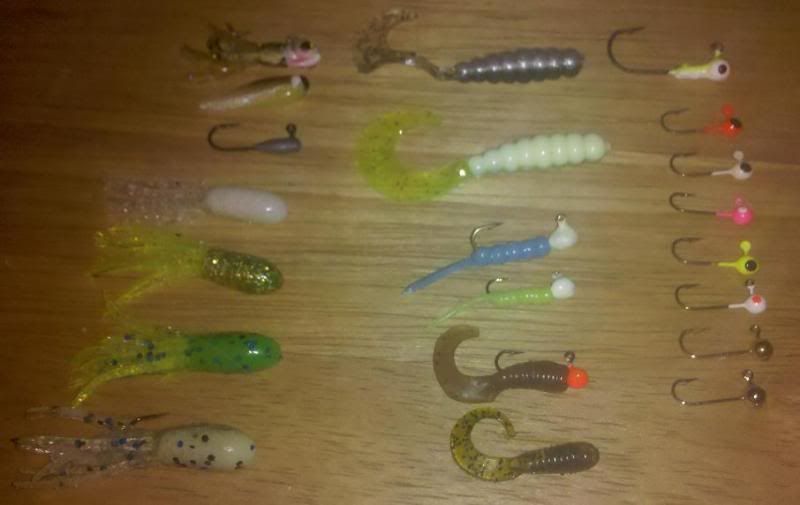
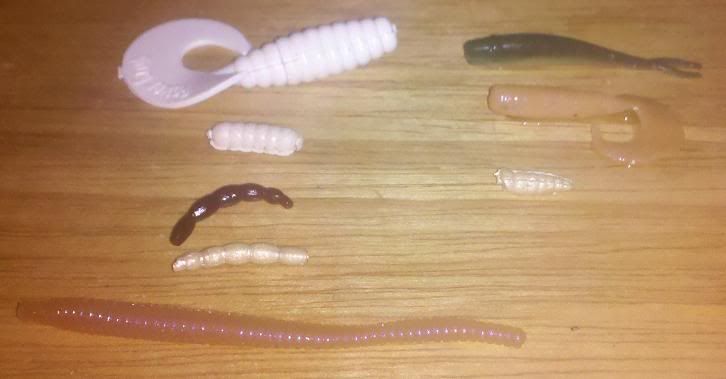
Soft plastics like these have become popular fished through the ice. The blue and green ones in the center of the picture are Ratsos, and the two below that are the Bass Pro Shops Squirmin' Grubs. But sometimes these just aren't good enough by themselves to draw strikes. A little bait or scent added to sweeten them up might draw strikes or get them to hold on longer when they do.
One way to sweeten them up is to add bait, but another way is to dab some Smelly Jelly, Fish Formula, or Bang on them. These aren't the only scents that work. Some people make their own concoctions, and one common theme seems to involve anise oil. Garlic is also a quite popular additive.
Many years ago, some soft plastic manufacturers discovered that they could add scent to the lures during their production or packaging. It was as simple as adding salt or liquid scents in the package, but other companies, like Berkley, added scent to their plastic formula with their invention of Powerbait. Other lure manufacturers mixed salt, garlic and other additives in their plastic formulas.
Even more recently, specialized formulas were not only mixed into the plastic formula, but also added to the packaging, storing them in jars and literally soaking the soft plastics in their secret formula. Berkley Gulp, Gulp Alive products, Yum soft plastics, and Trigger X have produced complex scented and productive soft plastics.
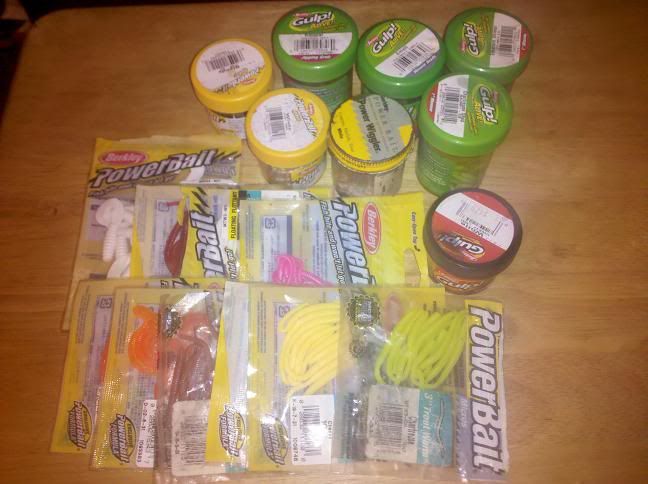
The plastics to the left are Berkley Powerbait, to the right are Gulp and Gulp Alive products. All are scented and will draw strikes or get panfish to hang on. The company claims that these lures outproduce live bait. I don't think that's always true, but there are times when it seems that way.
More Berkley Powerbait and Gulp products. I always bring these on the ice with me. There are times when these outproduce everything else.
Gene Mueller, retired Washington Times Newspaper outdoor columnist and outdoors blogger praised the use of Smelly Jelly just about every winter in his fishing reports, touting the advantage given to anglers that chose to use it. Gene is also likes using the Berkley Gulp and Powerbait products. My memory isn't what it used to be, but I'd say the odds are pretty good that it was his newspaper fishing reports that turned me on to using scent in my younger fishing days, and I've been using it ever since. If I had to sum up what I learned from Gene about the use of scent in two words? It works. By the way, be sure to visit Gene's wonderful blog, Gene Mueller's World of Fishing & Hunting.
Gene Mueller showing us the benefit of using Smelly Jelly, his favorite fishing scent. Nice slab, huh?
So if these scents make a difference on the softwater, it stands to reason that they should make a difference on the hardwater too, right? I think that these scents not only cover our human scent, or scents that give off a negative reaction to fish, like tobacco and gasoline, but actually attract them in some cases. And, they seem to cause fish to hang on to soft plastic lures longer, and even ingest them. So, they must taste good to the fish too.
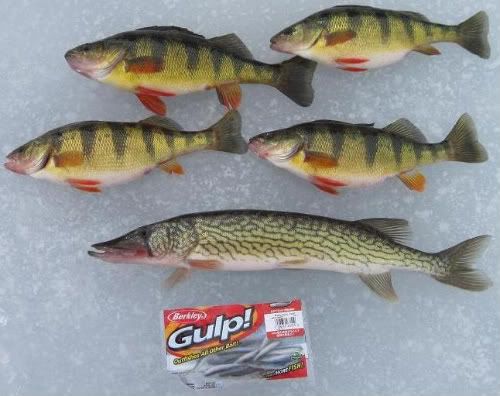
These were just a few of the nice yellow perch and pickerel that I caught during my first use of Berkley Gulp on the ice several years ago. Since then, I've not only used their soft plastics, but have also dipped my other soft plastic lures in their Gulp Alive scent to sweeten my offerings.
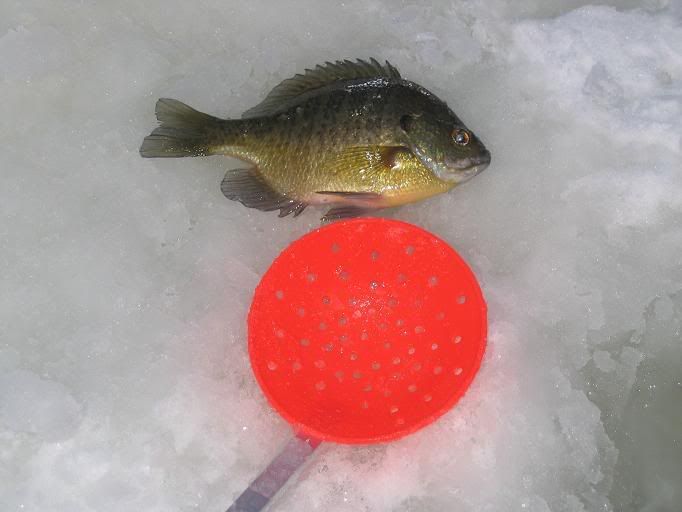
Bluegills like this one will chomp on jigs with soft plastic trailers sweetened with scent as well as jigs tipped with waxworms or maggots.
I'm not saying that these products are the answer all the time when fishing is tough, but it doesn't hurt to give them a try. There are times when they could turn your day around on the ice. Success while using them will give you added confidence in the use of soft plastics through the ice at the very least, and could put more fish on the ice and into your frying pan. So, please use some "common scents!"
I hope that 2013 brings you the best outdoor experiences possible. For me, my hopes to have an even better fishing year are promising. In fact, I can pretty much say that for all of my outdoors activities. One way to jump start my fishing year would be to have some ice to fish on in 2013 since we were ice free last year. The upcoming winter forecasts are promising, and ice is building as I type this. While I wait for ice, it's also a good time to reflect on 2012.
Now that I look back, about the only things that didn't happen for me are that I didn't get to ice fish, and I didn't put some deer meat in the freezer. Fortunately, my 2012-2013 hunting season is still open, and I have late archery opportunities ahead. Other than that, I had some great fishing times with some great people. I have been fortunate to have some great fishing buddies, some that I've fished with for many years, some that I've recently been fishing with, and some that I have yet to fish with.
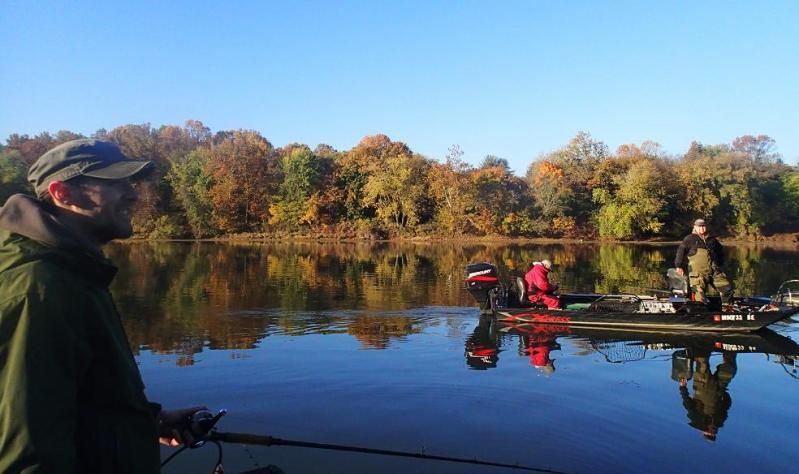
I managed to meet and fish with some guys for the first time. Here, Jeremy Tyson (foreground) and Ed Lewandoski on a recent outing. Not only are they awesome and knowledgeable anglers, but nice people too. I'm looking forward to fishing with them in the future.
I'm going to keep the typing to a minimum here, and trust me, my diarrhea of the keyboard is tough for me to control. So, this post will be picture heavy with a few captions. Hope you enjoy the pictures.
I had the pleasure of fishing with Bob Franko a couple weeks ago. Bob is a fishing guide on the Susquehanna and will definitely put his clients on fish, whether it's smallmouth, walleye, or musky fishing. I have his website linked in the right hand column.
I've had the pleasure of fishing with Shawn Reardon (right) this year a couple times. He's another fanatic angler and a really good guy. Pictured left is Mike Schiffbauer. I haven't fished with Mike, but probably will some day. He's another top notch fisherman.
Blast from the past. Here's my friend, Rodger Moran, that took up fishing not long ago. I haven't seen Rodger for several years. He didn't used to fish, and we lost touch. But he found me on a fishing forum after recently taking up fishing, and we've had some fun fishing this year. Now he's hooked on this addicting habit! Good to see you again Rodg.
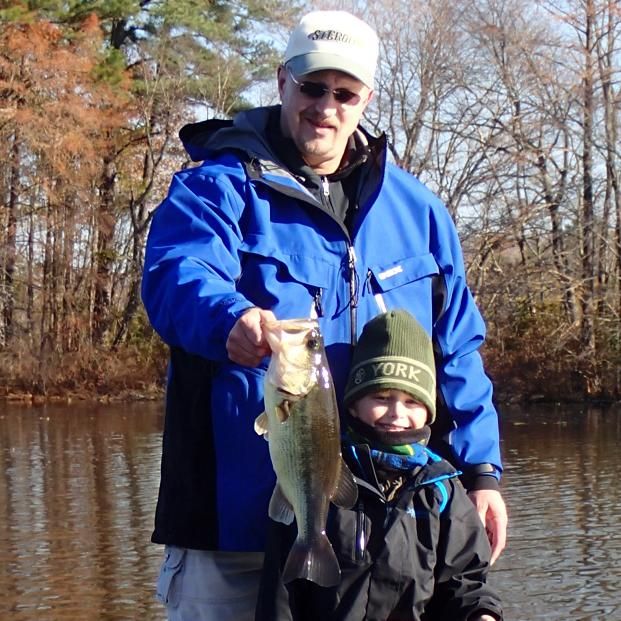
Here's my friend Bob with his eight year old fishing prodigy son and fishing buddy, Carson. Any fishing buddy of his is a fishing buddy of mine. Carson landed his biggest bass on a trip this fall. Nice fish Carson! This was a banner year for Bob too. He also purchased a new boat, the boat of his dreams, a Riverpro LoPro. I now own his old boat!
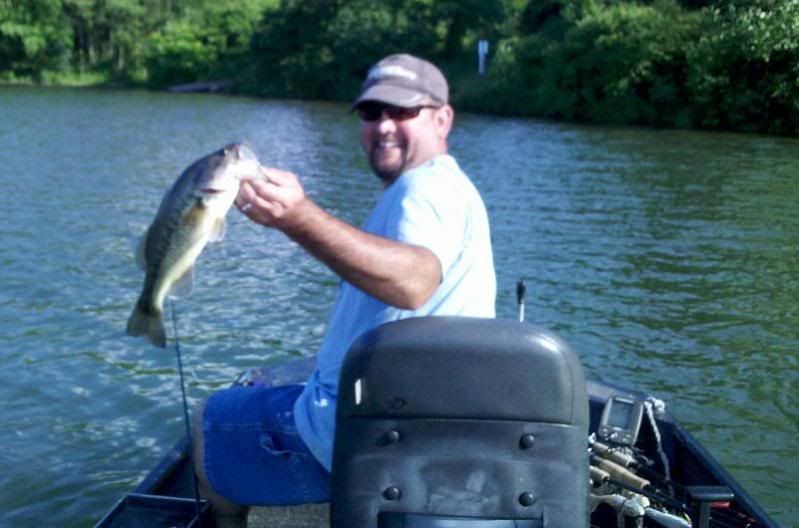
Of course, I can't leave out my best bud, Howard Boltz. We've been fishing together since the 80's, and this year was a great year for both of us. We've caught a lot of nice fish over the years. Here, Howard sports a chunky largemouth caught while fishing out of his boat this year. I look forward to many more trips in 2013 with Howard.
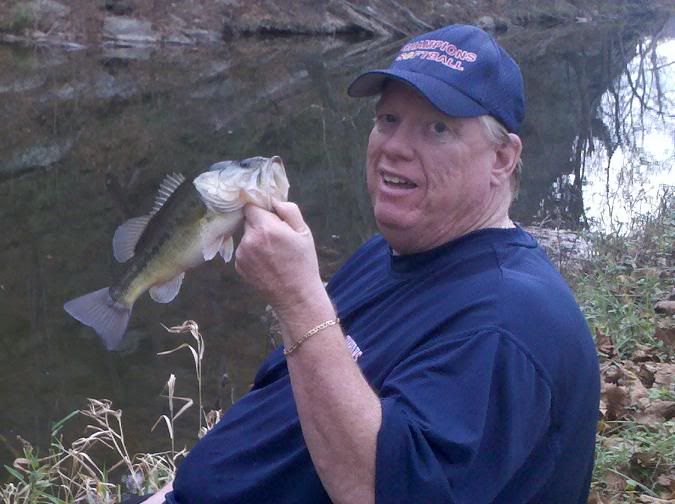
A new fishing pal, Rocky Droneburg, shown here with a fat largemouth bass. Rocky and I fished a couple times together in 2012. I hope to get out with him again on the water. What a great guy, and a heck of an angler too!
Here's my friend Dave Roberts sporting a fat largemouth that he caught this past spring while he fished out of his boat. Dave and I have had some great spring fishing trips. This year, I hope to have him as a guest on my boat, since our favorite lake together is my home water. Now I have a craft to invite him to fish out of.
I had the pleasure of fishing with Steve Pilkerton (left) this fall. Also pictured are Rocky and Tony Ashby. Steve is a very analytical angler, much like myself. We didn't figure the fish out that day, but it was fun trying to put together a pattern. I hope to fish with all of these guys in 2013.
.
Here's my friend, Steve Kelley, who also had a monumental year. He purchased the boat of his dreams, and it paid off for him. In this picture, he proudly shows us what I think is his personal best largemouth bass. I was honored to be fishing with him out of his new boat on that day. What a historic moment for both of us.
My friend, Rusty Dillon, with a largemouth bass caught last year. Rusty loves to fish. I hope to have him out for some fishing in 2013 where he'd have a chance at a personal best bass.
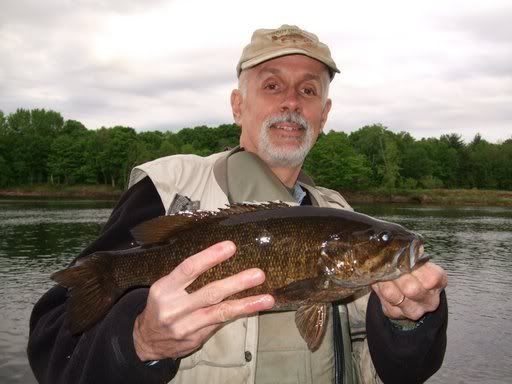
I had the pleasure of fishing with my friend, Mark McWilliams this past year several times. Here he is fishing out of his boat with a nice Smith Mountain Lake smallmouth bass. Mark and I had some great trips together. I need to get him out on my boat in 2013 for some different species. How about some walleye fishing Mark?
Here's a picture of my friend, Gene Mueller. I have yet to fish with him. In fact, I have yet to meet him in person. I actually met him on-line as a result of this blog. He's a great guy, and I've already learned a lot from him about writing and fishing. Thanks Gene. Here's to a great 2013 and meeting and fishing with you some day in person!
Here's my buddy Jim Cumming, also a guest author on a couple wonderful Fat Boy Outdoors posts. If you like small stream fishing, you need to check them out. Jim and I learned a lot together over the years both on and off the water. I haven't fished with him for some time now. We're planning a trip on the ice soon to fish together. I look forward to that very much.
To read Jim's fishing articles, here are the links:
Please take the time to read these outstanding articles. I'm sure that Jim would be happy to hear if you enjoyed them or not, so please post a comment at the end of each post providing him with your feedback.
Two other people are interested in fishing with me in 2013, my wife and daughter. I really look forward to those trips. I nearly fell out of my chair when my wife told me that she wanted to go fishing with me! Those pictures and experiences will be subject for future posts, hopefully in 2013.
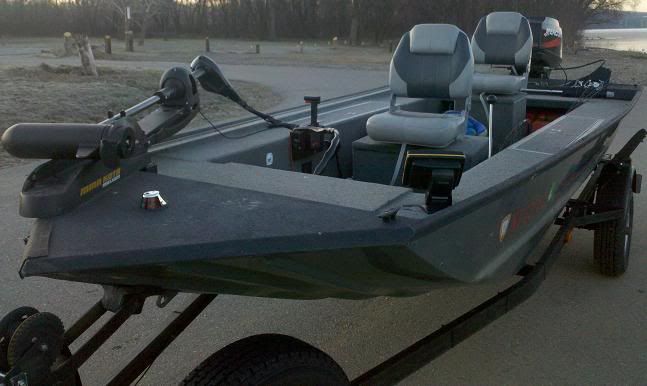
I purchased this boat from my friend, Bob, in the summer of 2012. I had so much fun taking "her" out and have already had some memorable fishing trips. 2013 looks to be a very promising fishing year.
So you may have noticed what was most important to me in 2012, and what will also be the case in 2013. The basic theme of this post is that my family and friends are most important to me, more than the fishing or outdoors activities that I do. Those activities are a means of enjoyment and fun, for sure, but sharing those experiences are what it's all about.
That said, I've caught some great fish this year with help of my fishing buddies. I'd say that, without them, I may not have caught most of my bigger fish this year. Here's a recap of some of the best fish that I've caught in 2013.
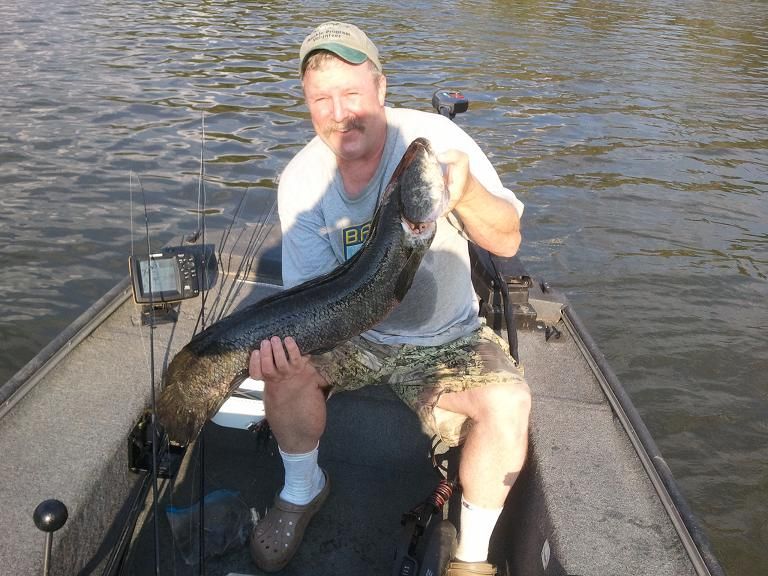
Here's my first snakehead ever, a 36 inch toothy nasty looking beast!
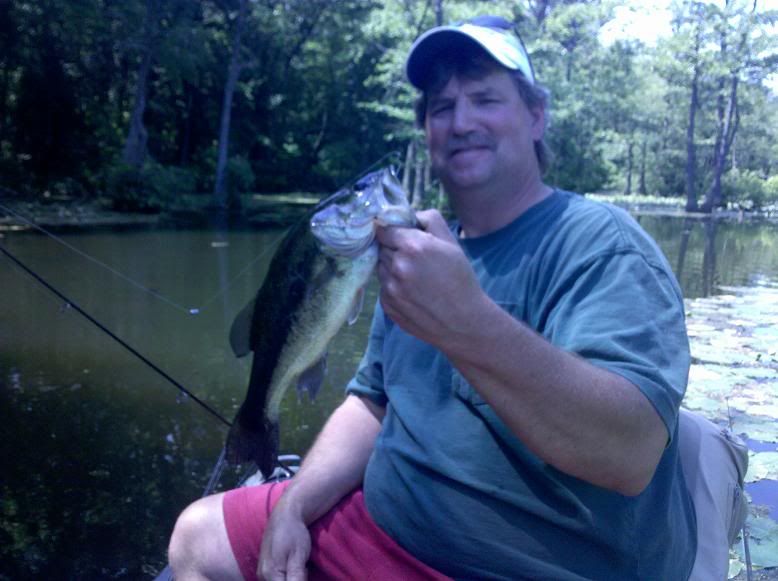
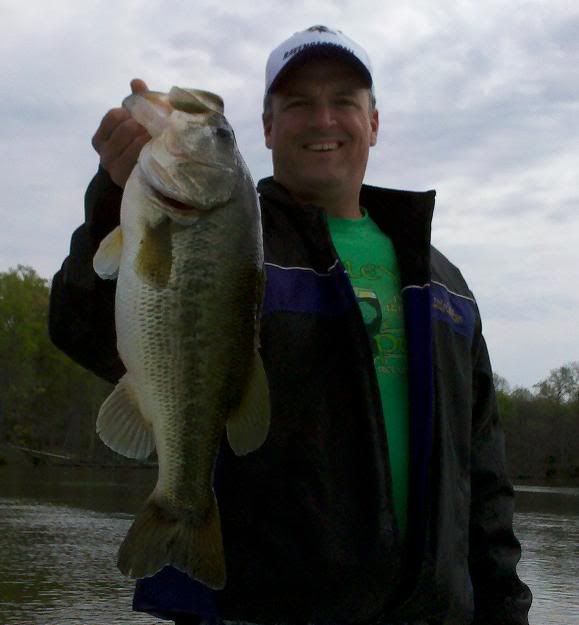
I caught a ton of nice bass this year. Here's one of my biggest in 2013, a fat Tidal Potomac largemouth.
Here's another nice fat bass caught this past spring. I caught so many nice bass this year, it was hard to choose which pics I liked most. These last two I guess are my favorite ones.
How about this slob yellow perch? I hope to get a bunch of these on the ice this year.
Here's a nice chain pickerel. I caught a bunch of gator chainsides this year. These guys are like mini muskies!
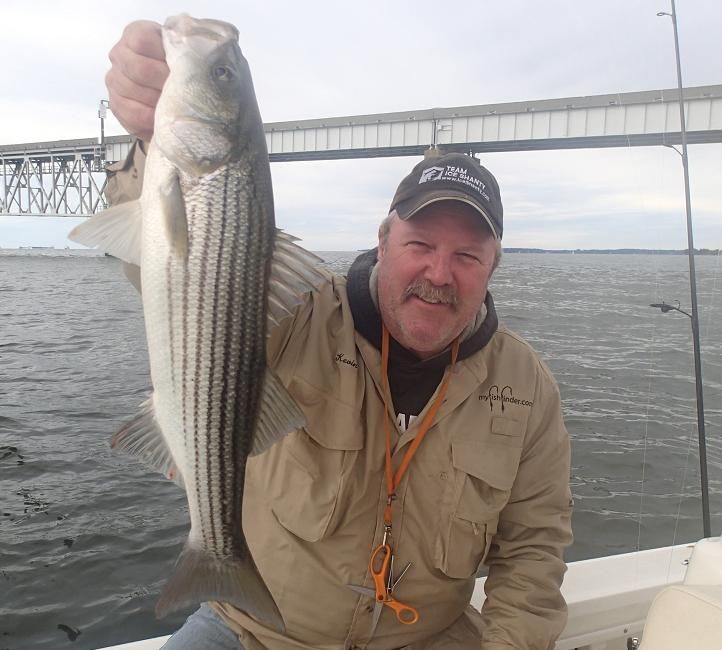
This isn't a very big striper, but it was fun catching lots of them like this in 2012. I hope to get some sow stripers in 2013. Until I get one of those, there are plenty of ones this size to keep me entertained.
Well, there you have it. A Fat Boy's Outdoors year in review. Here's to a wonderful 2013 and a Happy New Year to all of you. Thank you for visiting my blog and I hope that you enjoyed my work on here.