Showing posts with label Fall Bass Fishing. Show all posts

Sunday, November 18, 2012

Experience+Luck=Good Fall Bassin'

My wife loves those crisp cool sunny fall days, but bass anglers either love 'em or hate 'em.  Why? Bass anglers love those days when the feeding bell seems to ring all day long as bass binge on any active bait that they can find, or hate those same kind of fall weather days where cold front bluebird skies can cause bass to hunker down and not bite, appearing to have lock jaw.
Windy sunny days with bluebird skies can be hot or tough, who knows why or when.  Either way, they make for beautiful scenic photographs.
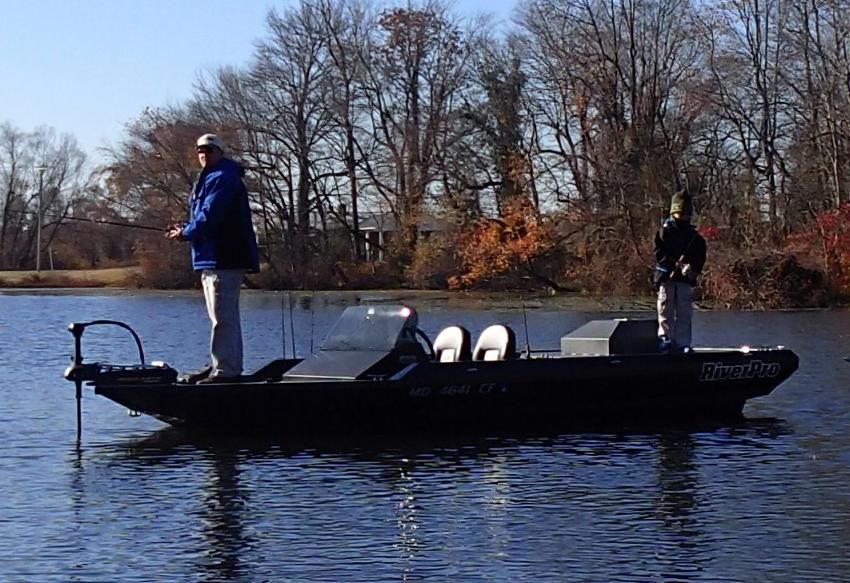
Yesterday, my buddy Howard and I hit one of our favorite small lakes in search of a mixed bag of bass, chain pickerel and crappie.  My buddy Bob, who I purchased my boat from, wanted to tag along with his boat, and bring a special guest, his eight year old Son, Carson.  Howard and I have a history of hitting lakes like this in the fall, and every year we seem to learn something new.
Bob and Carson fishing out of Bob's new dream boat, the Riverpro LoPro.
Experience... One of the elements in my equation titling this post.  Last year we hit this spot and had a really tough day most of the day.  We had an early morning start and by noon, not even a bite, fishing for bass or pickerel.  We hit all of the woody and weedy cover and nothing.

Not two weeks earlier did we have a banner day, all day, boating many chainsides and chunky bass that were hammering our chatterbaits and soft plastics.  The upper end of the lake that week was loaded with predators, and massive schools of bait to keep predatory fish happy.  Golden shiners and schools of shad were on the upper lake menu that day.
Last year, prior to the cool down, we caught bass like this and chain pickerel all day long on woody and weedy cover.  They were chasing baitfish in the upper end of the lake.
So where were the predators?  Where they just suffering from lockjaw due to the weather and cold temperatures?  Or did they move?  Not only did we not catch anything in the upper end of the lake or on any of the cover, but we didn't see any baitfish either.

It was so tough we resorted to fishing for crappie and bluegills.  Not that panfishing is bad.  Not at all, they can save a trip and turn a bad day into a good one.  In fact, when the crappie bite is on, fishing days are far from crappy.  They can be as fun as any fishing day of the year.  But, we were spoiled.  Chunky bass and big toothy pickerel were still on our minds.

On that day last November, we had Northeast winds blowing down the lake all day.  The forecast called for wind speeds in the five to ten miles per hour range, but they turned out to be more like ten to twenty.  It made for tough fishing and tough boat control.

While we were drifting from one crappie spot to the next, we remarked how the wind was piling up on the Southern shore.  Of course, warmer temps would be there, it was the deepest part of the lake, and that might be where the bait went.  So, we opted to try for predators once again.

My mind couldn't shake the sight of bass and chain pickerel chasing baitfish two weeks earlier, so I opted to tie on a gold half ounce Rat-L-Trap to imitate the golden shiners that are prevalent in this lake.  Neither Howard nor I had ever fished rattling lipless crankbaits in this lake.  Normally, these lures are hot during the spring, so it wouldn't previously have been my top choice in the fall.  But they do cover water quickly, and do resemble the forage for this lake.

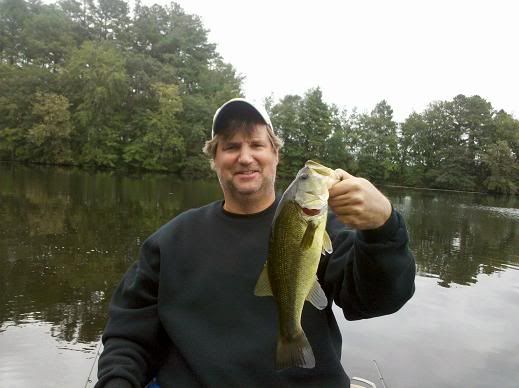
My first cast toward the deep end resulted in too deep of a retrieve and hooks full of snot grass (bottom scum like algae). So, I tried another cast keeping my rod tip up and cranking medium speed, and wham, nice fish on.  After a nice fight, I landed a chunky four and a half pound bass (weighed four pounds seven ounces and went twenty inches long).
Matching the hatch, a gold Rat-L-Trap imitating a golden shiner, proved the ticket to land this fat bass, combined with finding the right location.
The pattern held all afternoon after that.  The rattling lipless crankbait boated several nice fat bass in the three pound range the rest of the day.  In addition, we landed some large chain pickerel in the same area.  As evening approached, we fished the crankbaits on the way back to the ramp around wood, like you might do with a chatterbait or spinnerbait, and that too produced some fine bass and pickerel.

Matching the hatch along with figuring out where the predatory fish liked to be this time of year were keys to our success.  The Northeast winds piled up warm water along the deeper section of the lake.  The baitfish were there, and so where the predators.  As the temperatures warmed during the day, some of the bass and pickerel moved into the cover that seemed devoid of life just hours earlier.
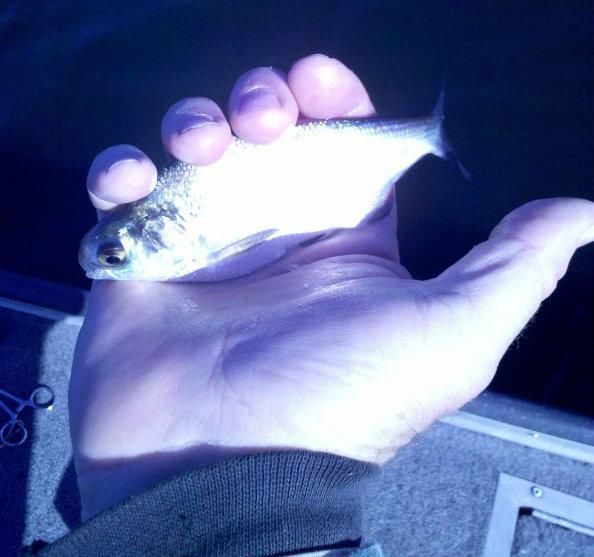
We actually accidentally snagged some of these baitfish yesterday with our crankbaits.  At first, I kept thinking that fish were bumping my lure, or perhaps I was ticking the tops of weeds or cover.  Well, I finally snagged one, and it turned out to be this little critter, a gizzard shad.  Bob and Howard also hooked a couple of them.  When you find these, predatory fish are close by.
So yesterday, we all made it to the ramp.  Temperatures were below freezing, with ice on the dock next to the ramp, and frost covering all of the cut soy bean and corn fields everywhere on the ride to the lake.  The surface water temperature was a chilly 44.3 degrees according to my depthfinder.

After an hour of trying the lily pads and woody cover with just a couple bites and no fish landed, we pondered crappie fishing again.  But wait, remember last year?  Howard and I made the change early and headed right for the deeper water where the wind once again piled up warmer water.  The water temperature there was 46 degrees, nearly two degrees warmer.  And, my depthfinder marked schools of baitfish everywhere.

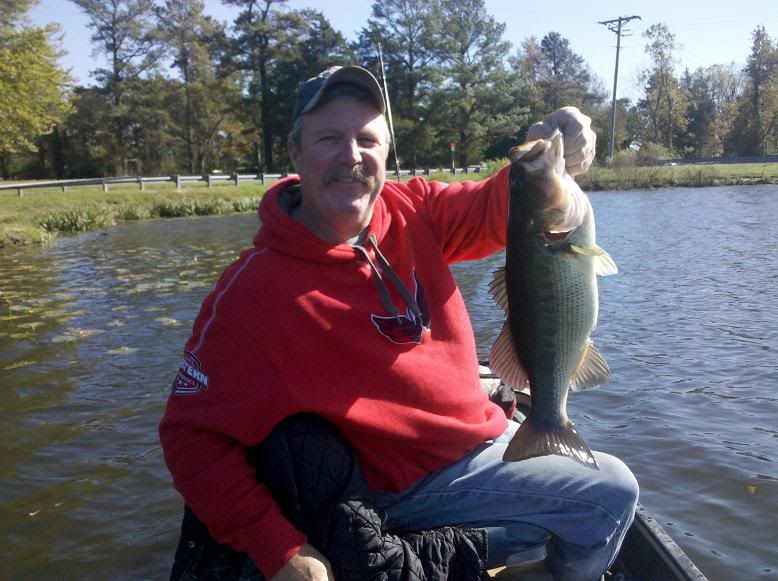
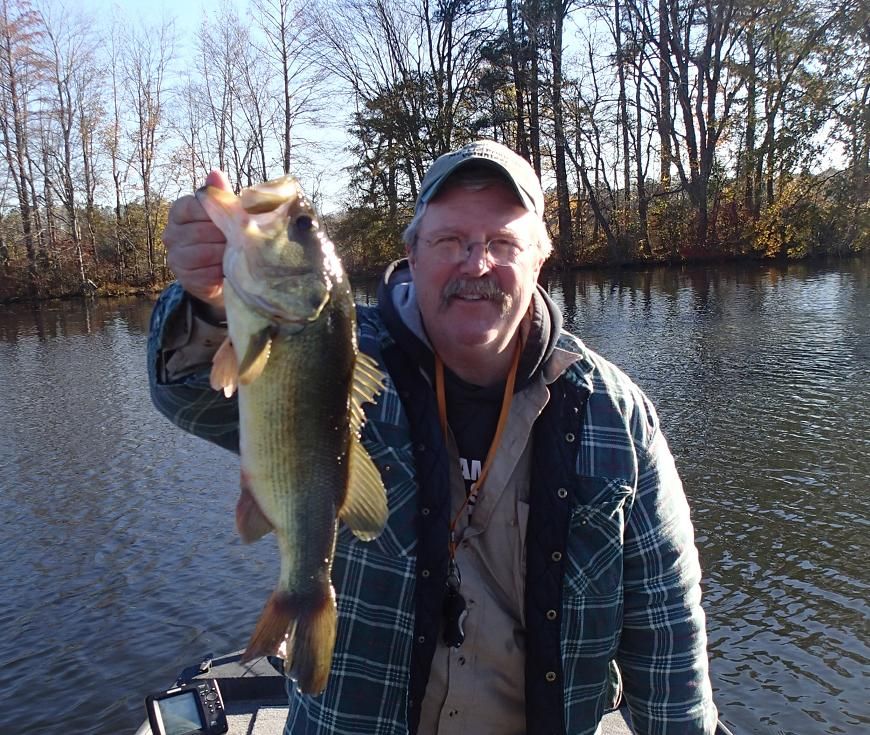
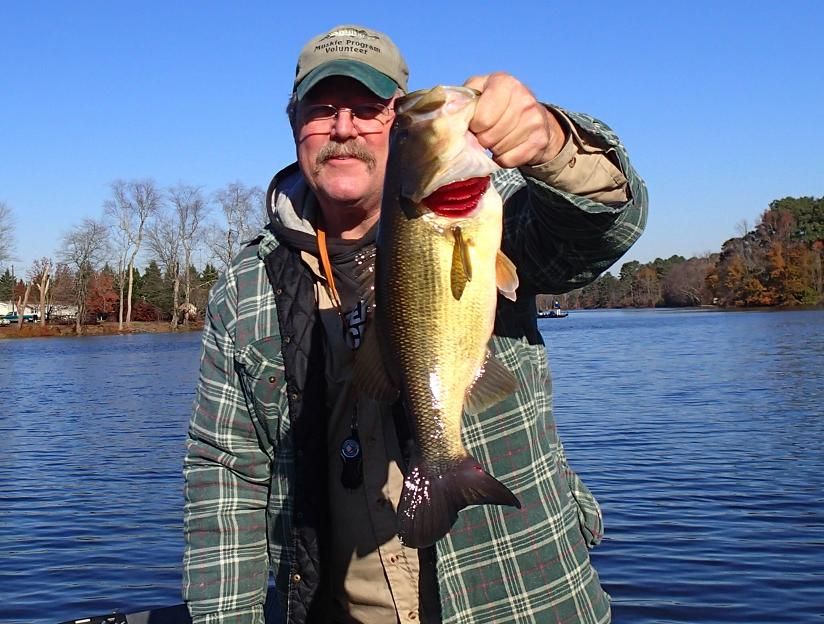
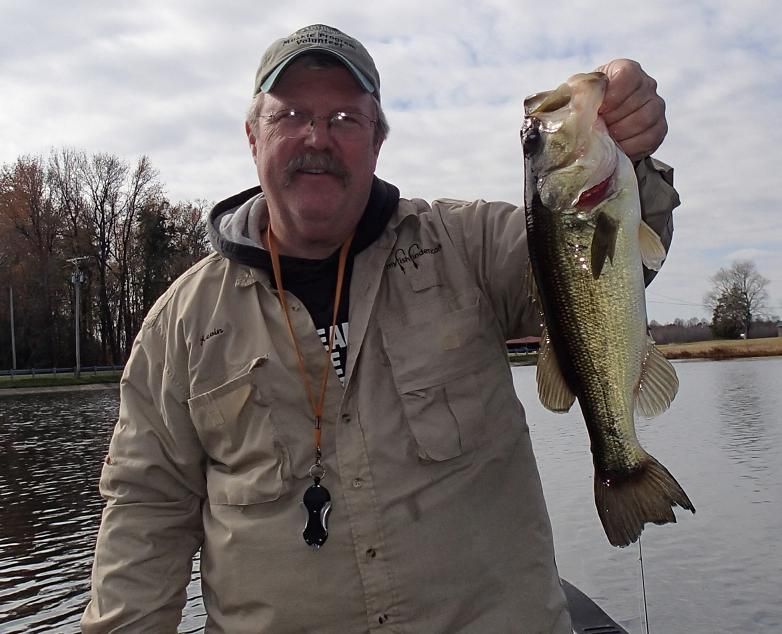
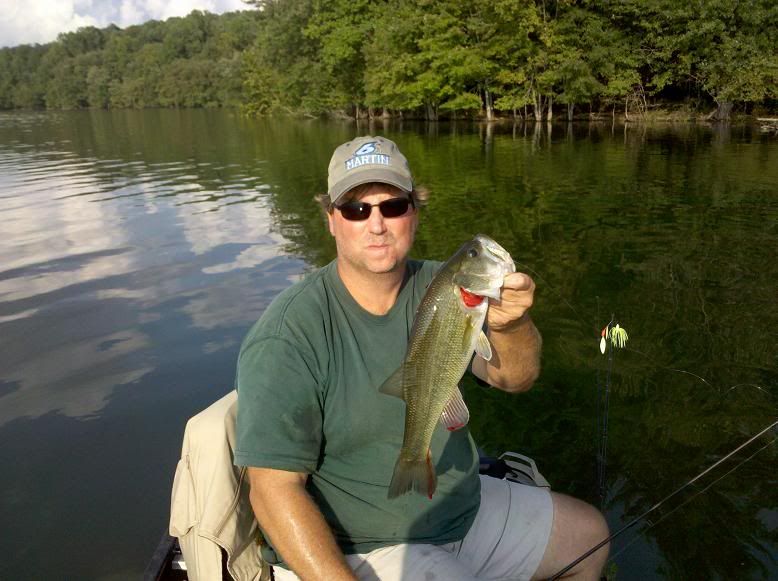
I had my gold Rat-L-Trap already tied on for just such an occasion.  My first cast was with the wind as the boat drifted in the same direction.  With the rod tip held high like last year to keep the snot grass off the hooks, I didn't crank five times when, wham, a nice hit.  I was pumped up as my first cast in that area resulted in a 19 1/2 inch largemouth with a big head and not much of a belly, but it was a good fish, and my first fish of the day.
My first cast with my gold lipless crankbait golden shiner imitation resulted in this long probably older bass.  But it couldn't have been more beautiful to me after a tough start. 
Howard snapped a couple photos with my camera and my phone.  We then took some measurements and released the fish.  I quickly texted Bob about what we found with a picture of my new fish telling him to bring him and his boy down to our location.

After we drifted several yards , I picked up my rod and made my second cast, again, with the wind and the drift.  About eight cranks, rod tip high, and wham!  After another good fight.  This time I landed another chunky bass that measured a nice 17 inches.  More pics, the release, texting Bob again, and back to fishing.  Things seemed to be working in our favor, the tide had turned, and what seemed like a tough fall day was looking up.
My very next cast resulted in a much fatter but slightly shorter 17 inch largemouth bass.
Not long after that last fish, I landed this 18 inch largemouth.  What was a tough day for me was turning to a banner day quickly.
Like last year, the fall pattern was holding.  My gold Rat-L-Trap fished with the rod tip high in the deeper water was producing.  Bass were gobbling it up.  Even the pickerel where there, as Howard found out.  His Rat-L-Trap was bitten off and taken from him.  That had to be a huge chainside.

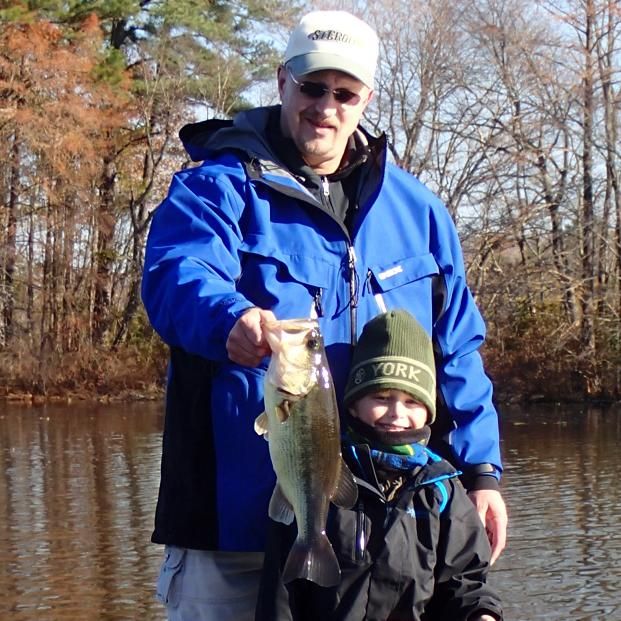
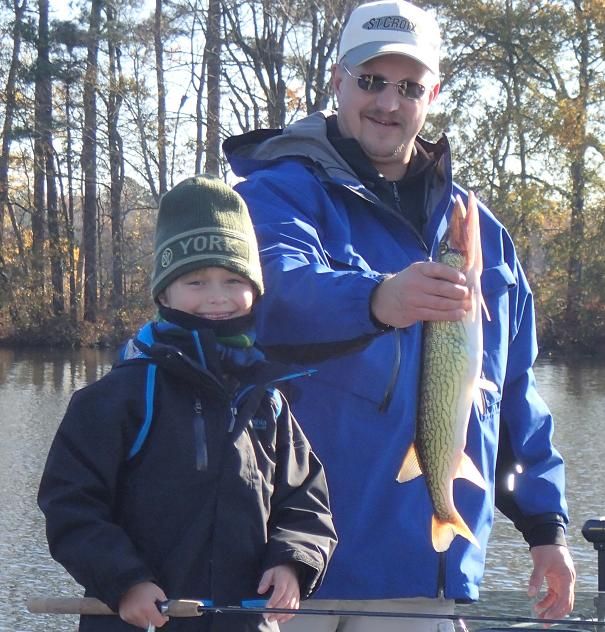
Soon, Bob and Carson made their way to our spot.  I told them of the pattern, and soon they were both working the deeper water with the rattling crankbaits.  It didn't take long for Carson, an eight year old quick learning heck of an angler (watch out KVD), to hook up and expertly fight and, with some help of his Dad, land the biggest chain pickerel of his life.
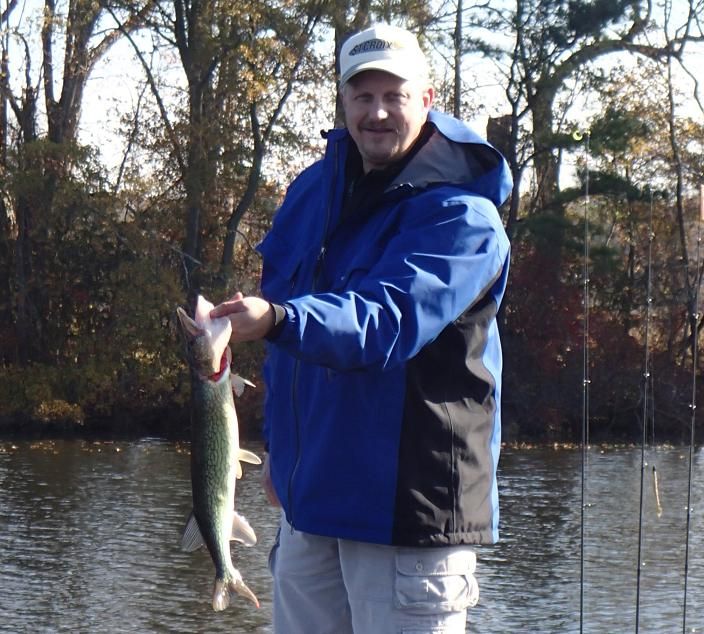
Bob holding Carson's chain pickerel, his personal best.  Watch out KVD, here comes Carson on the angling scene!  Don't worry Mr. Van Dam, Carson still is a bit nervous about holding his fish, so you have some time.
About ten minutes later, Carson proceeded to land his personal best largemouth, a fat 19 incher!  Bob joked about how his fishing karma had rubbed off on Carson, leaving him to start over again.  We also pointed out how his six year old boy had been putting a thumpin' on his Dad!  But Dad didn't take long to show his stuff, landing a nice chainside too.
Carson smiling proudly over his catch, a personal best 19 inch nearly four pound largemouth as his Dad proudly displays if for him.
Bob with a nice chain pickerel caught on a chrome Rat-L-Trap.
We had a very early start, and although Carson was excited to fish and about as happy as he could be over his catches, he ran out of gas around two in the afternoon.  Bob and his tuckered out child angling prodigy headed home, leaving the rest of the pickerel and bass for us.

Howard and I continued to work the area hard.  Fishing wasn't easy, but it was consistently giving up quality fish.  Not only did the rattling lipless crankbait work, but I also did well on a shallow diving shad like chrome crankbait, the Luhr-Jensen Speed Trap.  I also managed to catch four keepers, but also my smallest fish on my trusty plastic worm after finding some deeper water cover.

Like the past year, as the day neared the end, we fished our way back to the ramp hitting the woody cover that was fishless just hours earlier.  By this time, the water temperature had warmed to nearly 50 degrees.  I suspected that once the water warmed enough, some predators would move back into the woody cover.  I fished my Rat-L-Trap again, like a spinnerbait, and hooked and lost two nice chain pickerel, but landed one smaller pickerel and a few more fat bass, including a 17 3/4 inch and 18 inch largemouth.
Another fat crankbait bass, this one on a Luhr-Jensen chrome Speed Trap, again, fished with the rod tip high.
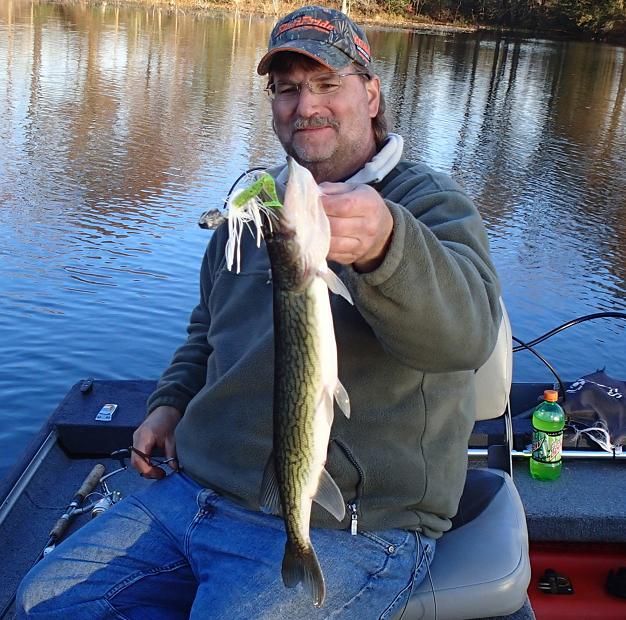
Howard connecting with a quality toothy predator, Esox niger, the chain pickerel.  This beauty inhaled a white chatterbait.
Luck... Experience plays a huge role, but when fishing open water, making that right cast is a combination of luck and experience.  But confidence in what you are doing, based on experience, improves your odds and brings you luck.  You caught fish there last year, doing the same thing, consistently.  Chances are, under the same conditions, your odds are pretty good that it will happen again.  Why one guy catches bass under these conditions and another angler doesn't, seemingly doing the exact same thing with identical lures, well more than likely it's luck.  Or, it could be subtle differences in tackle or technique.

Good Fall Bassin'...Now, another key component with finding bass in the fall is to use lures that can cover a lot of water quickly.  These search baits, like spinnerbaits, crankbaits, and chatterbaits, can really rack up the numbers for you, but may take a lot of casts when bass are in open water.  Rattling lipless crankbaits and diving crankbaits are good choices for locating schools of fish that feed on shad.

My day seemed tough at first, but turned out to be a great fall bassing day.  I finished with eighteen fat largemouth bass, with my biggest seven bass ranging from 17 inches to 19 3/4 inches.  The other ten fish were between 13 and 15 inches.  I managed a nice pickerel too, along with a crappie that inhaled a plastic worm.  Apparently, the crappie thought he was a largemouth.  Eight bass were on the Rat-L-Trap, four fell for the plastic worm, and six quality bass engulfed my Luhr-Jensen Speed Trap.

So there you have it folks.  Experience combined with a little luck, could turn a chilly fall day into one of your best bassin' days of the year.
______________________________________________________________________________

By the way, I want to thank everyone who keeps checking my blog for updates, and at the same time apologize for keeping you waiting for my next post.  I'll do a much better job in the future with updates.  Stay tuned with more fishing, hunting, and shark toothing articles.  I have a special shark tooth article nearly completed, highlighting some adventures of some internet friends from South Carolina.  Have a happy Thanksgiving!


Saturday, October 8, 2011

Cooling Fall Temperatures = Hot Fall Bass Bite

A crisp fifty degree temperature and light fog greeted us as we arrived at our fishing destination on this cool fall morning.  The leaves on the trees are just now starting to change.  A whitetail doe crossed the path on the way to our fishing hole, nervously looking back at us.  A great blue heron sat high in a blow down with it's head tucked between it's shoulders as if trying to stay warm in the chilly morning foggy air.  Nearby, a majestic bald eagle soared over a popular smallmouth river in search of a fishy breakfast.  Nasty double breasted cormorants, not native to Maryland after arriving and nesting in 1991, also cruised the river in search of fish.  Today's quarry, Micropterus salmoides, the largemouth bass, awaited us.  The water, slightly stained from recent rains, was just the way we like it, and based on past experience seemed just the ticket for a great reaction bite. 

I had a white Z-Man Chatterbait with gold blades tied on from my last trip.  Yeah, I'm lazy, because if a lure is tied on from the last trip it will more than likely see my first cast of the day.  And it just happened to be a hot lure last time, so why not?  On my other rod, I had Nanofil spooled on my series 400 Shimano Symetry reel on a medium power fast action St. Croix Avid spinning rod, and tied to that was a four inch green pumpkin plastic worm with a light wire Gamakatsu offset shank worm hook and a small bullet sinker.  We fished from the bank today at one of our shoreline hot spots, which is a tradition for us and usually makes for some fine fall fishing.  I carry two rods while doing this, one clipped to the back of my vest while I fish the other, keeping my hands free.  I carry much of my tackle in a fishing vest, with my spinnerbaits hanging over my shoulder in a Cabelas spinnerbait bag.  My vest holds several styles and colors of plastic worms, sinking soft stickbaits, and tubes along with the nece

ssary hardware to fish them.  Also, pockets hold extra spools of line, lure dye, a wacky rig tool, line clippers, forceps, sunscreen, water bottles,and a few other items of personal need.  My spinnerbait bag holds several varieties of spinnerbaits and chatterbaits in several colors along with trailers, trailer hooks, extra skirts and spinnerbait blades.  The bag is supported over my shoulder by a lap top shoulder strap that I pirated for fishing purposes (it's my wife's lap top bag...shhhh...don't tell her).  That's all I need for this spot today, spinnerbaits and chatterbaits for my reaction bite, and plenty of soft plastics to follow and work hot spots more carefully and thoroughly.

We had a short ten minute walk before reaching the first good hole.  My buddy Howard and I exchanged stories about fishing this spot over the years, bringing up fond memories of past fall bites.  We reminisced about a fall day twenty years ago when we both tossed tandem white spinnerbaits and caught good numbers of three to five pound largemouth that were holding tight to woody cover, but would shoot out from as much as five feet away to nail our shiny offering.  Howard and I have fished together since we met at my brother and sister's swim meet nearly thirty years ago. 

My friend Howard and I have been through a lot together.
He's not just an excellent angler, and a fishing buddy,
but also one of my best friends.  Here he is with a nice bass.
Wow, was it that long ago?  It seems like yesterday.  We both learned to fish baitcasting gear together.  Back then, the only reels available were left handed models for some reason.  So, even though we reeled with our left hands with spinning tackle, we had to learn to cast right handed and switch the rod and reel to our left hand and reel right handed when using baitcasting tackle. 

Howard and I cracked up, resurrecting a story about, while fishing this very body of water, me learning to use a baitcaster for the very first time.  I was pitching a large buzzbait in late summer, and found a nice log along side the near shoreline.  I brought the lure back past the log and was just about to lift it out for another cast when all of a sudden the water erupted at my feet.  The fish hit so hard that my glasses got soaked and I could hardly see.  Howard nearby observed my struggle as I held on to the monster bass for dear life.  I wasn't used to cranking the fish in and fighting the fish with a rod in my left hand, and in an embarassingly loud panic reaction blurted out, "How do I fight this thing?"  Eventually I calmed down and figured it out as I finally landed a twenty two inch smallmouth bass.  It was my biggest smallmouth landed for nearly eight more years, but it's an embarassingly funny moment that lives in both Howard's and my minds to this day. 

Since then, the baitcaster has been my favorite tool for tossing larger sized bass baits, and eventually I'd own several different styles of baitcasting combos including ones for specialty techniques like pitching and flipping.  I'm not sure that I'd have learned all that if it wasn't for my good friend Howard.  Together, we learned stuff like that over the years, learned to expertly fish this body of water, learned to fish other bodies of water together all around our state and our neighboring states.  We learned to ice fish together, to crappie fish, fly fish, to bow hunt, gun hunt, and we both bought our first boats within a few weeks of each other, Bass Tracker TX 17s with 70 horsepower two stroke motors.  I stood up for him at his wedding, and he was an usher at my wedding. 

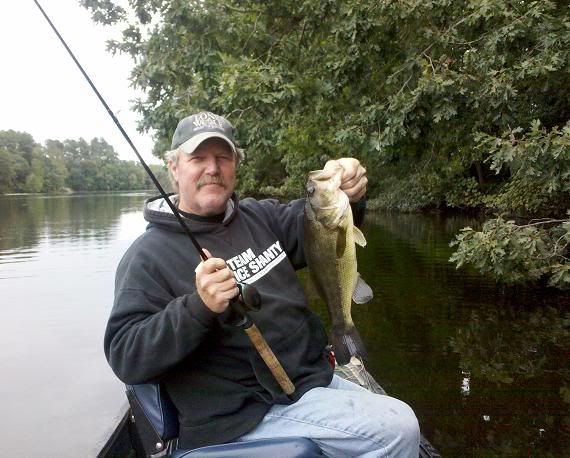
My first bass of the day.  It may have been chilly in the morning, but this fall bass fishing was hot all day long.
After laughing and joking about that for a few minutes, we arrived at our first destination.  The bank was pretty steep, but you could cast to this particular log jam that looked so bassy.  But if you hooked a bass here, you'd never get it out over all that brush, so you'd have to climb down and get it.  I tossed my chatterbait along side the biggest log just inches away, and brought the lure back along the tree trunk when a bass shot out and nailed it.  As I saw the bait disappear, I set the hook. 

The bass tried to bury itself in the log jam, but my medium heavy power fast action St. Croix Avid baitcasting rod powered him out and over the timber.  The bass fought back and headed down again, but I was able to turn him one more time.  After that, it was clear of danger and I took my time to land it.  I had to climb down the bank, through Rosa multifora, or wild rose bushes, drawing blood on the back of both hands as I bulled my way through the thicket to get to my prize bass.  My heavy lug sole boot gave way to the muddy bank as I nearly went feet first into the water, but was able to gain a little traction with my other foot.  While on my knees, contorted as if playing the family game twister, I was able to reach down and lip the chunky largemouth bass.  I climbed back up the bank and Howard took my picture.  The bass wasn't huge, but it was a nice start for the day, setting the stage for one of the best fall fishing days that I can remember.

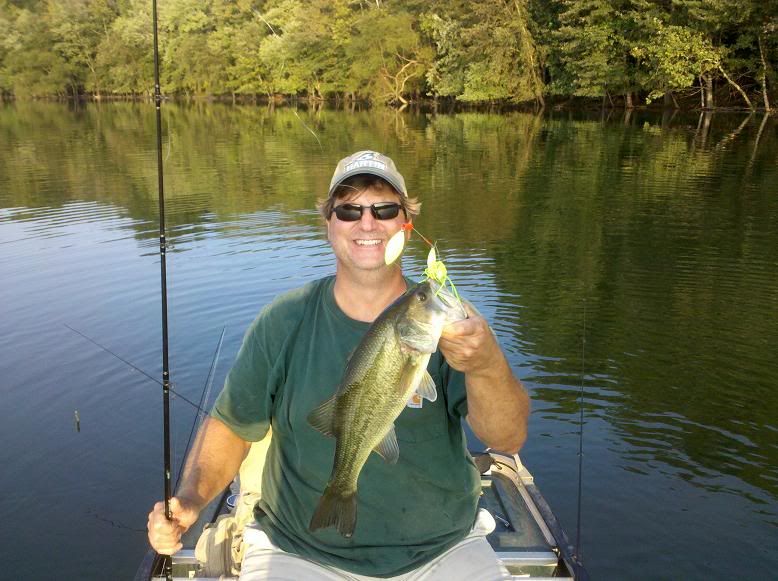
This bass, caught on a recent trip,  hit a white chatterbait with
 a bright white grub trailer.  Reaction baits like this in the
 fall can produce nice bass catches.
Recently I posted the power of the color white in the fall.  When fishing reaction baits like spinnerbaits or chatterbaits, I'm convinced that either lure would have worked equally well today, with the flash and movement drawing violent speedy largemouth predatory strikes.  But the visibility of the bright white color on such a nice bright and sunny fall day really allows bucketmouths to hone in for the attack.

Chartreuse is also a great color for this, but I prefer it for the warmer months, and white for cooler temperatures.  Maybe it's just me, but it's worked for nearly thirty years each and every year.  The bass aren't picky now, and the white bait is easy to see when worked a foot or three beneath the surface.  When it disappears, it's probably a fish, so set the hook and hang on.

Since I had worked so hard to get down that bank, I had a little bit of casting room, so I thought that I'd try a few more casts.  On my next cast, I worked the lure past the end of the log and wham, a chunky two pound largemouth attacked my chatterbait after letting it fall a foot or so.  I landed that fish and quicky unhooked it.  Howard stood at the top of the bank tying on his chatterbait after seeing my early success. 

I placed my next cast to the same spot, hoping they were stacked in there, and sure enough another nice bass launched from the cover and attempted to mutilate my chatterbait, but missed, pulling the skirt and trailer down the hook shank.  I quicky reeled up and fixed the bait, then tossed it back again and the fish took the lure this time.  This bass wasn't as big, but I'd take a pound and a half fish to make it three quick fish any day.  I tried a couple more casts without any further action and decided to climb back up the bank.  Not a bad start for the day, three fish in the first four casts.  Howard assisted me out of the thicket and after a high five, we continued to the next spot.  It was his turn, to work the next set of timber, and he would make the most of it.

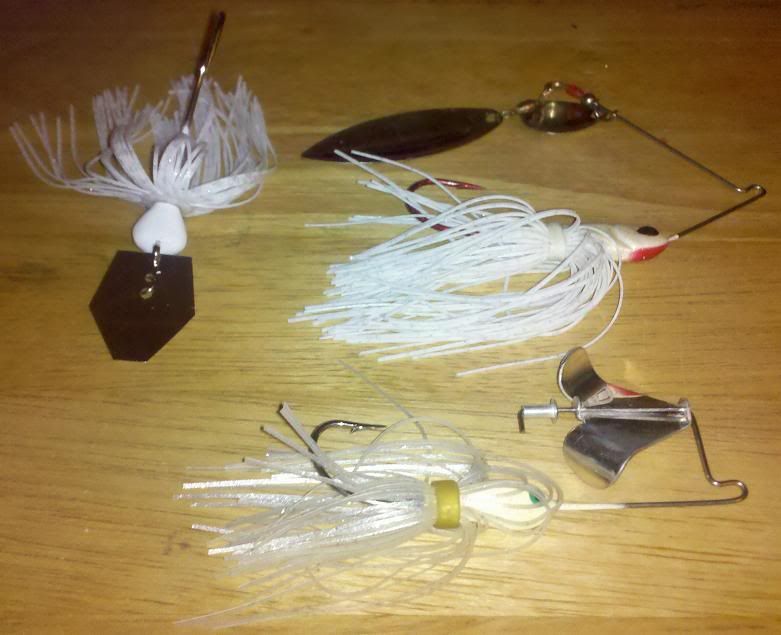
The Z-Man Chatterbait, upper left, has been hot lately on my
home waters for largemouth bass and chain pickerel.
Chatterbaits are basically skirted jigs with a piece of metal attached to the eye, with a snap poking through the metal blade for a line tie.  It's a simple concept, but provides a bit of flash, plenty of action, and vibration that is an alternative to fishing a spinnerbait, and perfect for fall reaction bass bites. 

Fish hammer them, what can I say?  You can fish them on a straight retrieve, or jig them and let them fall (yo yo style retrieve), crank 'em over cover and let them drop, or burn them just under the surface.  I used a fat four inch white grub as a trailer today, giving it a nice large profile. 

Gene Mueller also loves chatterbaits when fishing the weedy and woody shorelines of the Upper Tidal Potomac River, a hot spot famous for it's tremendous largemouth bass fishery, but recently infamous for it's unwanted population of the Chinese northern snakehead.  Gene wrote to me about the chatterbait, lauding it's ability to be weedless in just about any cover.  He likes to add three or four inch soft plastics as trailers, like sassy shad style baits, to give them bulk.  He feels that this bulk attracts big bass bites, and I agree wholeheartedly. 

Although I've had success on other bodies of water using this lure in the past, including the Upper Tidal Potomac, I had yet to try it in my local hot spot.  Why?  I don't know really, I guess I've tossed so many spinnerbaits with great success here in the past that I never felt the need to try much else.  But today, I'm glad that I did. 

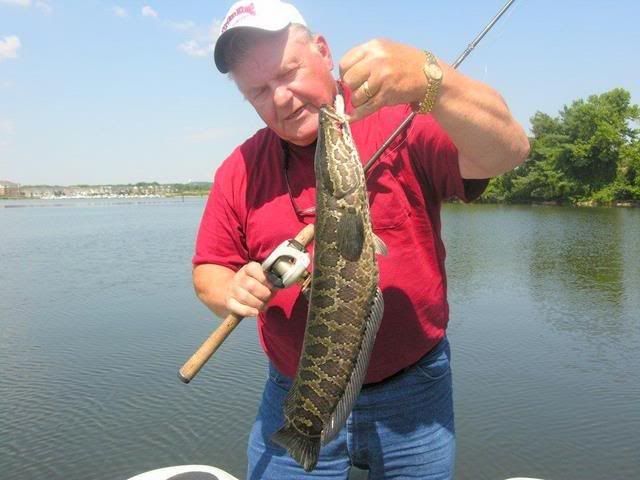
Gene Mueller with a huge Chinese snakehead from the Upper Tidal Potomac River that he subsequently killed properly as instructed by the Marland Department of Natural Resources.  Make sure that you check out his blog, linked on this web page. 
Gene posts fishing reports in the Washington Times each week, along with some great narrative about fishing and outdoors news (http://www.washingtontimes.com/sports/outdoors/), often touting chatterbaits as a hot lure in our area.  So, it finally sunk in that I'd better make more use out of them than I had in the past.  Thanks Gene!  By the way, his blog is fantastic, and is great for folks local to the Washington D.C. area, but often his posts offer angling tips and stories that are not only appealing to anyone, but may give you a tip that might work well in your fishing area.  In addition, he posts informative articles about hunting and political activities related to the future of our favorite sports.  You can find his blog here at http://www.genemuellerfishing.com/

Howard nailed this well fed healthy bass on a 1/2 oz. white chatterbait.
It wasn't long before Howard got into the action while landing a fat well fed largemouth bass on his chatterbait.  He pitched his chatterbait past a clump of weeds in about four feet of water that clung to a pair of sunken logs about fifteen feet from shore, and his bass shot out, and the strike nearly ripped the rod from his hands.  Howard put the boots to the fish and hoisted it out of the water and lipped in one quick move.  He stopped to allow a picture, but I could tell he wanted to get that lure right back in.  So, I quickly snapped a picture and he was back in business.

We were far from done.  Each piece of woody cover seemed to hold a willing bass as long as there was some depth around the cover.  The weeds normally hold fish in the warmer months, but they're dying off now.  Baitfish still hold amongst the weeds, but the colder temperatures seemed to keep the bass from holding there.  Later in the day, the temperatures warmed, and we were able to find a few bass cruising the weed edges with chatterbaits and the four inch plastic worms.

Green pumpkin plastic worms, Texas rigged with light
weight on light line, like this Zoom Dead Ringer, proved
extremely effective today.
We managed to find a downed tree, probably left in that state from Hurricane Irene a month ago.  Leaves still grew green on the tree, indicating it's a recent fall, but there was plenty of algae, weed clumps and duckweed clinging to the branches and trunk of the tree where it met the water.  To me, that was a sign that this was fish holding cover, being there long enough for largemouth and baitfish to find sanctary and ambush points. 

And, man, did that tree hold fish. Howard first proved it by nailing several bass from that tree using a plastic worm while I continued with the chatterbait.  After I switched to my plastic worm set up, Howard and I pulled out bass after bass, most of them averaging twelve to thirteen inches, but we both landed a few between two and three pounds. 

With limited fishing time because both of us had family duties late in the afternoon, cover like this with it's fish holding ability was the ticket to a great afternoon.  I lost two fish in the thick cover, but other than that, landed twenty two well fed largemouth between ten and eighteen inches long.  Howard had similar results.  We pitched to pocket after pocket along that tree, with each one holding several fish.  After removing a few fish from each pocket, it wasn't long that others moved in.  It was almost as if Howard and I were serving fast food, and it was lunch time for the bass, and they were waiting in line for their happy meals.  Four inch plastic worms on light line using light weight was the ticket at this spot, and green pumpkin was all you needed to keep them happy. 

Could you have pitched heavier stuff and nailed some bass here?  Absolutely, but my flipping rod was at home.  We were working from shore, and to stay mobile, you can't carry too many rods and fish effectively.  The tree branches were too numerous and thick to work a spinnerbait or chatterbait effectively here, but that worm slid through the branches with ease, and when pitched in with little splash kept the bass on the feed for a couple hours.  We both giggled like kids after landing bass after bass at this spot.  The only thing that kept us from doing more sore mouth damage to that fish population was time, our deadline to meet our family obligations.  So, we wrapped it up and decided to work our way back to our vehicles.

I decided to work the chatterbait while fishing our way back, and with little fishing time left, the best option now was to cover some water quickly looking for aggressive bass.  I picked up a few bass with the chatterbait fished parallel to shore along the dying weedbeds with some success.  These fish weren't big, but they were nice and fat, and a lot of fun.  Howard followed with his plastic worm when I'd have a hit and miss, landing several decent sized fish that way.  We worked our way back to our starting spot.  Howard first worked it with the plastic worm without any bites. 

I decided to give the chatterbait a go, and sure enough, a chunky two pound largemouth rocketed from the cover to munch on the chattering lure.  It took the lure down into the cover, but I was able to turn it and move it out.  I climbed down through the thicket again to land that fish, spilling more blood on my elbows, forearms and hands to the thorn bushes lining the bank. 

While down there, I decided to once again toss my chatterbait along that cover.  Why not?  I was down there, the cast was relatively easy, and if I hooked one I was in a position to land it easily if it was big.  But what were the chances that another bass was there, especially since I took four fish out of there already on the day?  Well, my next cast proved that there was a willing bass there, and it was a biggun.  It shot out from under the log to inhale my lure, but before I could set the hook it let go, leaving me with a chatterbait with the skirt and trailer hanging down by the hook gap and me with a dang it look on my face.  I tried several casts with both the chatterbait and the worm to no avail.  It was time to go anyway.  I know where this fish lives, so I'll be back to get her another day.

What a day.  In summary, I landed thirty nine bass between ten and nineteen inches on the day, and one fat crappie on a plastic worm.  Fifteen of the bass came via the chatterbait, the rest on plastic worms.  Howard had similar numbers.  He lost count when he ran out of all twelve fingers and toes (just kidding Howard)!  Anyway, I love the bowhunting opportunities that October presents, but when it cools down and your buddies are in the woods after those deer, don't overlook the hot fall largemouth bass bite.  Even though it's cool outside, it's hot under water.

Thursday, September 15, 2011

To Fish or Hunt? That is the question...

It's a tough choice for me in the fall, to choose
to bass fish or bowhunt for whitetail deer.
In my home state of Maryland, today marked the opening day of whitetail deer bow season.  For years, I'd burn a couple days of leave and head to the Western part of the state for some camping and early season bowhunting along with some of my local friends, and some that came down from Pennsylvania.  I had some great times and some fun hunts for several years.  Over time, some of those friends have grown apart due to family and work demands, and the annual camping trips became less annual, and eventually stopped.  I miss those days.  But, my urge to get in the woods still lingers.  These days, I'm a bit of a loner now when I hunt, making short trips to local spots.  Every now and then I'll hunt with a buddy, but they have teenage kids that occupy their time with high school sports, much like the experiences I had the past several years.  My daughter's grown now, in college, and is playing for her college softball team, so I'll be busy watching her a few times this fall.  But the most problematic influence on me NOT getting in the woods during early bow season has nothing to do with any of that any more, it's my drive to catch fall bass.  In other words, I'm torn between two of my favorite things to do.

I used to balance my problem by taking a few days off to hunt on the camping trip, and fish the Sunday of that opening weekend.  For me now, taking a few days off this time of year is out of the question, as it's one of the most busy times of year for me at work.  Growing up and being responsible has it's drawbacks!  So, I'm limited to weekends, and with family demands, that means choosing a day to either hunt or fish.  In recent years, I'd play it by ear, see who wants to fish and where, look at the weather forecast, and make a decision on which way to go.  This year, they're calling for cool temperatures this weekend, yet, I have a buddy that would like to fish, setting the stage for a tough decision on my part, and I've still got a huge urge to catch bass.

I guess it's fall now, I'm not sure, I can't ever remember when the season officially changes.  But the days are getting shorter, and the weather is changing.  I hate hunting in hot weather, but even when it's somewhat cooler, early season, I prefer to bowhunt without using a headnet and full body armor protection from those pesky annoying mosquitos.  They have deet products now that are supposedly scent free, but I don't believe it.  And, when it's hot, I sweat like a pig, and even if I may or may not smell like one, I certainly have this feeling that no matter how much I try to stay scent free, I have this feeling that every deer in the area can smell me.

Still, some of my most successful bowhunts have been early season ones.  Typically, I'd take a doe early on to put some tasty venison in my freezer.  At some of my favorite early season spots, on public and private land, I have some favorite trees that I like to climb using my portable tree stand.  By the way, I really like my Lone Wolf climber, they are light and don't creak, and pack very flat.  The only thing you need to bring is a nice cushion to sit on, because that's one thing that they lack.  And with my tailbone becoming more exposed as a result of the atrophy of my butt muscles due to my increasing age, the importance of the cushion each year has become the utmost importance.  These favorite trees are my favorites for various reasons.  I choose trees that I can have decent shooting lanes and visibility, but still have enough cover that deer can't spot me in the tree.  Unfortunately, visibility in early season isn't like after the leaves fall, and the deer can sneak up on you quickly and quietly.  Therefore, being alert is of utmost importance, because your window of time to get that good shot is a bit shorter.  Pre-season shooting practice, even better if you've done it all year long, really can make the difference this time of year in having the confidence to get that good shot.  And there aren't many experiences than bagging a deer with a bow during early season.  My special seasoned grilled tenderloin venison is proof enough of that...ask anyone who has tried it, especially mine!

Most bowhunters exclusively bowhunt during hunting season, and fish very little, but frequent the fishing holes during spring and summer.  When they vacate, they're leaving more room for anglers like me to take advantage of the feeding binge that occurs beneath the surface.  Bass, like many other warm water fish, sense the change in the seasons and they shorter days, and begin to fatten up on their favorite prey items, often wtih gluttonous abandon.  That translates to some of the best fishing of the year in my book.  I've been part of some awesome bass fishing bites this time of year, catching both size and numbers. 

So, while the waters we fish are less populated by anglers due to the start of hunting season, anglers could be missing out on some of the best bowhunting of the season.  Deer are a bit off guard this time of year, after having most of their woodland home pretty much free from human intervention.  They aren't expecting us, unlike late season, when deer have learned to search the trees for humans.  Some people don't believe that whitetail deer are capable of that, and I was one of those people, but I've witnessed it.  Anyone that bowhunts on public land has witnessed it too, and if they haven't, they will soon.  During early season, rut hunting tricks are ineffective for the most part, so leave your hormone type scents at home, and your rattling antlers too.  The only tools that I've found to work during early season are grunts and bleats, and if overused, you'll chase the deer away.  One bleat or grunt might help bring a deer in range, maybe two at the most.  Deer routinely vocalize to each other, but not often, so if you are any different than what they normally hear this time of year, your efforts can backfire and all you'll see are white fluffy tails waving at you and snort calls in return warning all other deer in the area of your presence. How exactly has using a call worked for me in the past?  It worked twice, that's it.  Twice.  During both times, I had deer within range and couldn't get a shot.  As they moved away from me, I grunted once, and they stopped and hung out longer, and eventually I was able to shoot a doe that may have walked away otherwise.  The year before that, a bleat did the trick.  That time, I had two does around me, and they stopped and reversed direction on the bleat, and nearly came right to my tree.  I saw a buck appear a few minutes later, so I thought that I'd try a grunt to keep him from moving away, only to have all three deer run and snort away.  The message is that it may work, but it could work against you.  I've come to think that I'm better off being scent free, blend in, and be unnoticed.

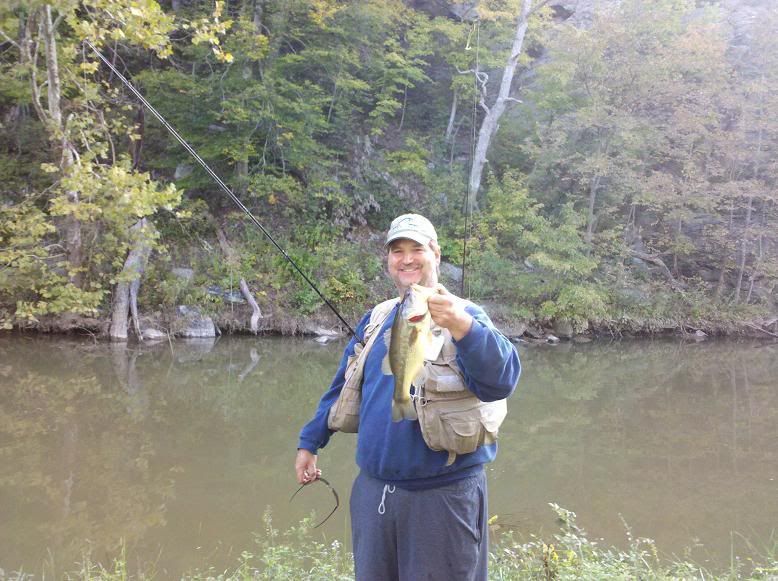
My buddy Howard boated this nice largemouth last weekend
while tossing a spinnerbait across an underwater hump.
Meanwhile, while folks like me are sitting in trees, anglers are pounding the banks in search of active largemouth or smallmouth bass.  Bass probe lake shallows along ambush points like points and underwater humps, islands or bars, or hold along woody cover if you can find it.  Reaction lures, like spinnerbaits, tempt good sized bass and allow you to cover a lot of water quickly.  Crankbaits, both lipped and lipless, are extremely effective search baits.  In reservoirs with a shad population, schooling bass can hardly resist a shad imitation crankbait.  Crankbaits are very versatile, allowing you to cover multiple depths, speeds, and by varying retrieve cadences by stopping and starting the lure, you can draw some pretty violent hits and land quality sized bass.  Suspending crankbaits are also very effective, allowing you to stop your retrieve leaving the lure holding at a desired depth, and bass often strike when the lure is at rest or on the very next little bit of movement.  Rapala Flat DT crankbaits are very good for this presentation, and come in a versions that dive to three, seven and nine feet.  Lipless sinking crankbaits are also great search baits, and are very versatile as well.  You can cast them out, let them sink while counting down to a specific depth, and crank them back.  You can cast them out and work them back right away near the surface.  Or, you can allow them to sink completely to the lake bottom, then jig them back in a yo-yo fashion.  Bass often strike when the lure is on the fall, so watch your line closely while doing this.

Howard found that this chunky largemouth bass fell for a
Texas rigged plastic worm fished over a reservoir hump.
Soft plastics also work well in the fall, especially on days when the search lures aren't drawing strikes.  Shaky head rigs, and Texas or Carolina rigged plastic worms will allow you to effectively work the bottom, while drop shot rigs will allow you to catch bass that are suspended just off the bottom.  Skirted jigs, jigheads teamed with twister tails, tube jigs, and jigging spoons can also help you locate fish on deep water structure.  Twister tails, or grubs, also make great search baits allowing you to cast, jig, or retrieve them and cover a lot of water.  Sometimes you can simply swim them straight back and find a few schooled bass in search of shad.  You can also attach jig spinners and turn them into a spinnerbait.  Jig spinners are spinner blades on wire arms that clip to the jighead, creating a spinnerbait.  In line spinners also work quite well as search baits for bass and other species in reservoirs.  These often overlooked lures can be worked at various depths and speeds, and readily put fish in the boat.  You can catch quite a mixed bag of fish using them, and when bass aren't biting, other species can make your day.  I've caught trout, bass, sunfish, perch, pickerel, crappie, pike, rock bass, walleye, and even catfish on in-line spinners in the fall.

What about lure colors in the fall?  Of course, chartreuse works all year round.  A guide local to our area, Glenn Peacock, used to have a saying, "If it ain't chartreuse, it ain't no use".  I always loved that saying.  I only fished with him one time, and we had a great time.  He put us on fish too, and some big ones, along the Upper Tidal Potomac.  Anyway, that saying always stuck with me, and there is some truth to it for sure.  Colors that match the natural forage of your lake will tempt bass, but one color seems to always rise to the occasion in the fall for me, especially when fishing spinnerbaits and twister tails, and that is white.  Why?  I don't know.  Perhaps the visiblity, drawing strikes when bass are the most active and can see it from a good distance away in clear water?  Perhaps it's because it's the most visible color when waters are murky? And, for bottom soft plastics, black or chartruese when the water is murky, or green pumpkin or watermelon work well during clear water.  Any natural color will work, and others include smoke, pumpkinseed, motor oil, or root beer can be effective in clear water.

During the fall, fat smallmouth bass might show up as
"doubles" as my buddy Bob and I found out on the Susquehanna
River not long ago.  These fish fell for spinnerbaits.
In addition, smallmouth bass in rivers become extremely active, and can give you some of the best fishing days all year long.  They are also fattening up for the upcoming winter, binging on minnows, crayfish, insects, and anything else that the river currents deliver to them.  Just about any lure will take smallies this time of year, but when they are super active, nothing is more fun for me than tossing the white tandem spinnerbait. They hit them so hard that the bigger ones bend them out of shape, leaving you with a twisted heap of wire, lead and metal sometimes.  Ah, I love it!

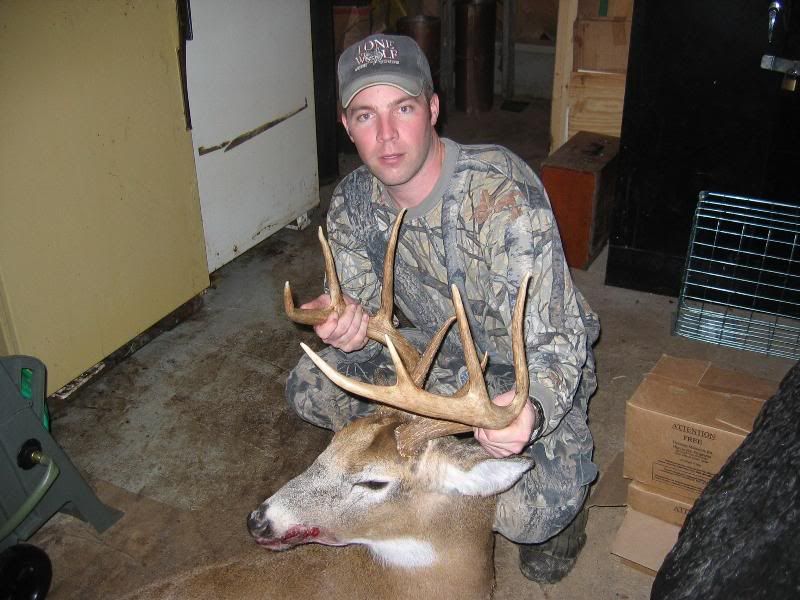
Bucks like this one that my brother shot in 2005 with his bow
might walk by your early season stand unaware of humans
invading their woods in a new hunting season.
OK, so what will keep me off the water, away from my fishing addiction?  Not much really, except perhaps a great bowhunt when the weather is right.  Cool crisp fall mornings, nice sunny post cold front days when the fishing might not be as good tend to result in great days in the woods.  Let's face it, I'm an angler and a hunter, it's friggin' hard to choose folks, and often my choice rides on just a whim of what I'm thinking about the most on any given day.  In the past, I had planned to hunt an upcoming early season day, even having all my scent free pre-hunt preparations done (see my hunting stories to read about my nearly anal anxiety about scent free preparation), only to have a friend offer me a spot on his boat to a location that I'd never pass up.  Such problems for an outdoorsman to have, eh?