I took a visit to Myrtle Beach this past week and for the first time in many years, my vacation wasn't attached to a fastpitch softball tournament. It was kinda nice! Anyway, I didn't get any fishing in, but managed to log in a few hours walking the beach each morning and a few evenings to enjoy the beach and look for some sharks teeth. I wound up giving about half of the sharks teeth that I found that weren't broken away to kids and families that were interested in learning how to find them.
As I wrote in my earlier post, while I was out in search of prehistoric sharks, Tommy Fox was catching modern day versions on the beach, including a 3 1/2 foot cousin of the hammerhead shark. While he and his girlfriend, Hannah, were reeling in sharks from the surf, I was finding fossilized teeth that ranged in age from two to 100 million years old. The sharks teeth and other fossils found along Myrtle Beach are dredged up off shore from various formations and deposits as a result of the replenishment of the beach sand each spring. Most likely, the formations include the Yorktown from the Pliocene Epoch, and perhaps the Black Creek Formation from the Cretaceous Period (when dinosaurs roamed the Earth).
 |
These are fossilized teeth from the Great White Shark,
Carcharodon carcharias, found at Myrtle Beach. Teeth like
these are not common, but with some diligence, a keen eye
and a bit of luck, you may find one amongst the shells. |
With about 14 hours of roaming the beaches, I managed to take home about fifty or so sharks teeth and other fossils. I found about twice that many, but gave a bunch away, keeping some of the better ones to show everyone here. Included in those finds were three great white shark teeth
Carcharodon carcharias, two of them broken, and one complete with just a tiny bit of damage to the tip of the blade (left most tooth pictured to the left). This type of damage to the tip was most likely caused while the animal fed on marine vertebrates. The right most tooth pictured to the left shows a broken blade, most likely caused after the tooth fell out of the sharks mouth and probably after it was fossilized. Most of the sharks teeth that you'll find along Myrtle Beach are broken, so finding one that is in relatively good shape is quite a treat, especially a particularly rare species like the great white shark. One family that I helped was from Missouri. Laurie told me that she and her daughters were teaching her husband what to look for, when he looked down and found an entire great white shark tooth. For most people, they may search for years without finding one, and some people have that kind of luck along with a good eye.
 |
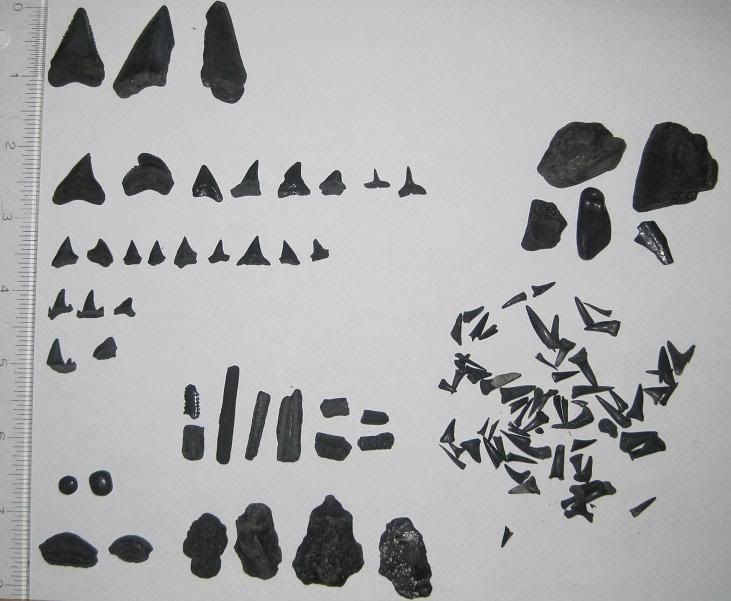
My fossil finds from Myrtle Beach that I managed to keep.
Top row, great white shark teeth, second frow from left -
bull shark, tiger shark, requiem sharks, and lemon sharks,
third row are sand bar sharks, next row are sand tiger sharks
and the next row are teeth from the Cretaceous Period
including an extinct mako and a crow shark. Below that are
drum fish teeth, sting ray spines, porcupine fish mouth plates,
and fossilized fish skull fragments, probably from sea robins. |
This particular year was a bit tough to find teeth. They didn't seem to come easily for me as in years past, and I'm not sure why. Basically, you have to "find the eye" as my daughter and I call it. She has better eyesight than I do, and has a knack for finding these cool fossils. Finding teeth with the roots and other characteristics intact is a challenge.
How do you find teeth along Myrtle Beach? The best took that you can use is your eyes. Get "the eye" by focusing on shark tooth shapes and ignore the shells. That's right, at least for me, ignore the shells and focus on teeth if you want to find them. They blend in with the shells, and if you don't focus on them you just won't see them. In Myrtle Beach, most of the teeth are black or dark gray, but don't focus only on those colors, because some of them can be light tan or cream color, although at Myrtle Beach those are rare. They can also be a dark greenish olive color. One guy walked up and showed me a nice inch and a quarter long great white tooth that was cream and tan. It was very nice. If you only focus on one color, then you may miss teeth like that. If you're having trouble finding any teeth, focus on the black ones first because they're the easiest to find. Once you learn the shapes and can recognize them, then you can check other colored material. Another clue is that shark teeth are quite a bit shinier than shells. The confusing part is that there are so many broken shells that look like shark teeth at first glance, so you'll pick up a lot of "fake" teeth, or broken shells. Even after your eyes are trained, you'll still pick up shells thinking that they're teeth at first. Shark teeth characteristically have smooth sharp blades with sharp cutting edges, while broken shells have a squared off edges, like broken glass. Also, the surface of shells are very irregular, not completely smooth like shark teeth are. You can put a shell in one hand and a tooth in another, and you can feel which one is a tooth and the other the shell without even looking at them once you become proficient at finding these little treasures.
 |
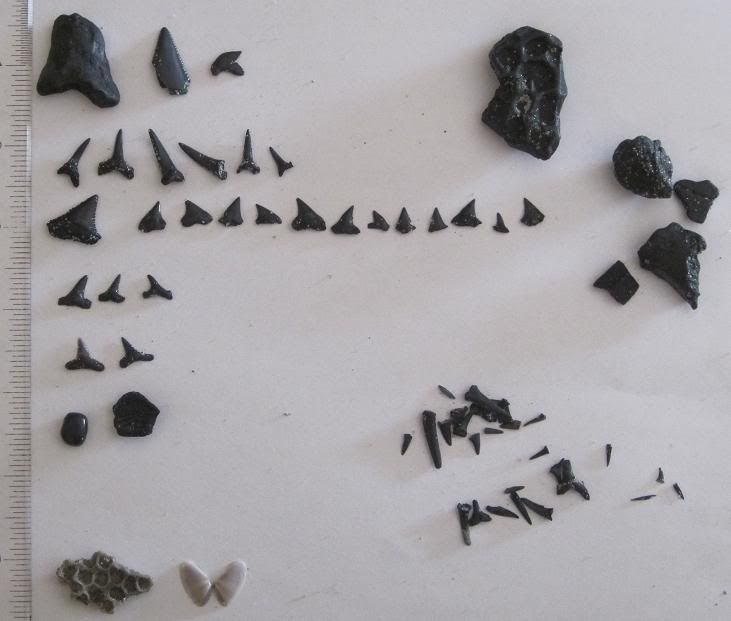
These are my daughter's finds. She has better eyesight than
I do, and with less hours collecting than I had, she still nearly
found as many fossils as I did. Top left, a worn broken "meg",
or megalodon, and a broken great white shark tooth. Also
she found a crocodile scute, top right. |
Another common question that people ask me about on the beach, is why are the teeth mostly black, and is color an age indicator? The only indicator of age that is due to the color is the fact that they are fossilized. The extent or amount of color does not correlate to the age of the fossils. The teeth are buried for millions of years in marine sedimentary deposits. The minerals leach into the teeth and change the color, so the color that the teeth exhibit depend on what minerals they are buried with. Phosphate tends to turn the teeth black, while iron tends to give them a red tint. Modern day teeth that fall out of the sharks mouth are almost pure white. You can see modern day shark teeth at the Ripley's Aquarium in Myrtle Beach at Broadway at the Beach. The shark tank, also known as "Dangerous Reef", is home to several species of sharks, including sand tiger sharks, lemon sharks, nurse sharks, sandbar sharks, saw sharks and stingrays. Many of these sharks lose thousands of teeth every year. We visit this aquarium every time we vacation in Myrtle Beach, and each time I've seen pure white sand tiger shark teeth laying on the rocks of this exhibit.
What time is the best time to collect? For me, any time, but, the real answer is, it depends. Huh? Well, most years moving tides or low tides have been the most productive. Low tides expose more shell material on the beach, while high tides tend to hide shell material. But this year, there seemed to be more teeth showing up at high tide than years past. Moving tides seem to be the best, because the ocean waves are like one big sorting machine, moving sand and shells around, exposing teeth and other fossils. The trick is to pick up the tooth that a wave exposed before the next wave sweeps it away or covers it with sand. I guess the best time is any time that the tides are moving. However, like most people on vacation, you have to think about what your family wants to do. So, the best time to collect is really when you can get out there. Also, I really like to collect during the early mornings before the crowds arrive on the beach simply because the teeth are easier to see when there are less footprints on the beach.
Where on the beach are the best places to look for shark teeth? Anywhere there are shells deposited on the beach, you'll probably find shark teeth. At Myrtle Beach, some of the best spots are where beach erosion occurs that expose shells. There are several creeks that empty directly into the ocean and those tend to wash the sand away, exposing shells and other fossils. Storms tend to erode more sand than other times, exposing more shells and fossils along the beach.
 |
The fish fossils above include drum fish teeth (top row) and
porcupine fish mouth plates (bottom row). |
In addition to shark teeth, you can find other fossils as well. You can find fish teeth, like barracuda teeth, porcupine fish mouth plates, and drum fish teeth. Also, you may find stingray dental plate fragments, stingray spines, and stingray scutes. Stingrays feed with teeth fused into a crushing mouth plate, and these plate fragments can be found along the beach. It's rare to find an intact plate at Myrtle Beach, but if you're lucky you may come across one. Most of the spines are broken fragments, but you can recognize them by the serrated edges of the spines. Stingray scutes are the bony protective scale like plates that run along the back of the stingray. Also, you may find fossilized fragments of fish skulls.
 |
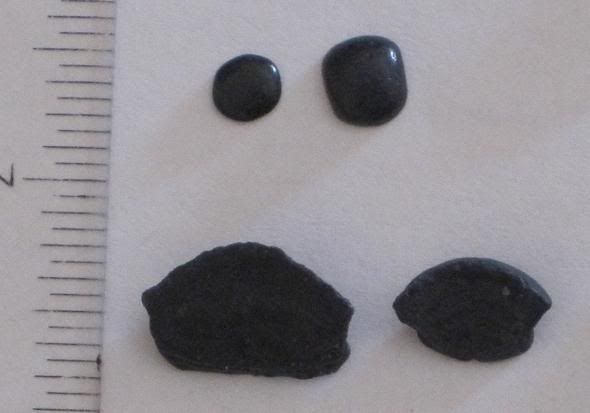
| My daughter found this crocodile scute |
You may find fossils from various marine vertebrates including fragments of whale and porpoise bones, manatee bone fragments, turtle shell fragments, and crocodile bone fragments and scutes. Crocodiles have protective armor, or scutes, along the length of their back and down the tail. In addition to the pounding of the surf, the process of replenishing the beach decreases the chance of finding complete bones and skulls of these marine vertebrates, so most of these fossils are merely fragments of the animal.
There are other places to find fossils if you're willing to spend money on them. There are many beach and gift shops at Myrtle Beach that sell shark tooth necklaces and shark teeth. Some of these resemble the teeth that you'll find along the beach, being gray or black, but those are from Florida for the most part (the Venice Beach area I'd imagine). But most of the teeth that you'll find at the stores are from Morocco. You can find teeth from extinct sand tiger sharks and the extinct white shark or
Otodus obliquus from the Eocene, about 37 to 55 million years ago. You can also find crow sharks and extinct makeral sharks from the Cretaceous period that are about 67 million years old or older. Most of these teeth are priced a bit more than you can find while shopping on-line, but every now and then you may find a species or tooth that is well worth the price. I'm always looking for a good deal, or a species that I haven't collected or own. Plus, you don't have to pay shipping if you do find a good deal.
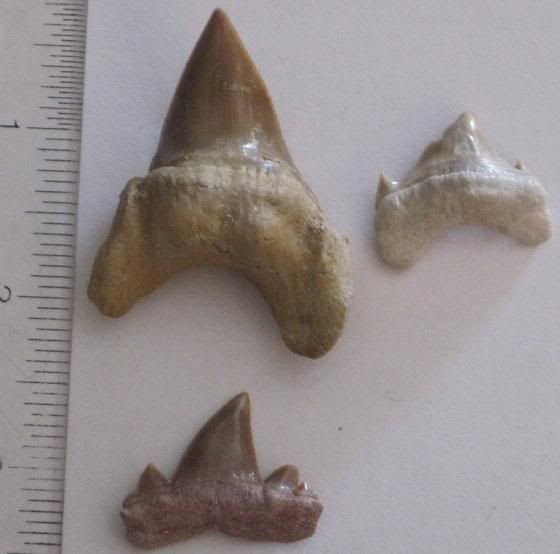
For example, the teeth pictured to the right are all from Morocco. The top two teeth are from the extinct white shark,
Otodus obliquus, and are quite common in Morocco. Now, I can find Otodus teeth in my home state. So why buy them? In this case, the two pictured are known as pathological teeth. These teeth have "defects" that simply make for interesting fossils. These teeth may have been damaged during development or caused by some sort of other problem duirng development. I have yet to find pathological Otodus teeth in my home state when collecting. Also, these two teeth were inexpensive. And, the bottom tooth is a species that I have yet to collect,
Cretalamna moroccana (formerly known as
Cretalamna biauriculata), from the Eocene. Be careful when purchasing these teeth. Many teeth found in gift shops are repaired or restored, which is OK, but not worth the price that they may be charging. So, when purchasing a megalodon, for example, for hundreds of dollars, make sure the tooth is not restored or repaired. If it is, make sure you know what it's worth so you can make an informed decision to purchase or not. If the tooth is inexpensive to begin with, then it's up to you whether to purchase or not. I personally like the looks of teeth that aren't repaired or restored better than those that are restored (at least in gift shops). Some stores at Myrtle Beach that sell decent specimens are Shell World, Myrtle Beach Ripley's Aquarium Gift Shop, and the Gay Dolphin gift shop has a nice shark tooth section. Many of the more expensive teeth in these stores may be higher priced than on-line stores, but like I said earlier, you don't have to pay shipping. Furthermore, I prefer to find my own fossils. But, my collection will never include some specimens,and those that I add that I can't find would have to be from the result of a direct purchase or a trade with another fossil collector.
So, if you don't want to spend money on sharks teeth but would like to own your own collection, hit the beach and go find some of your own. You can make jewelry out of them if you like, but many people like me simply take their better specimens and put them in riker mounts (display cases) so that we can enjoy them later, and share our treasures with other people.
Why collect fossils at Myrtle Beach? Well, it's fun and another thing to do at the beach. Some people really like to beach comb and find shells and I, like many other people, like to beach comb for sharks teeth. And, every now and then you'll find something nice to add to your collection.