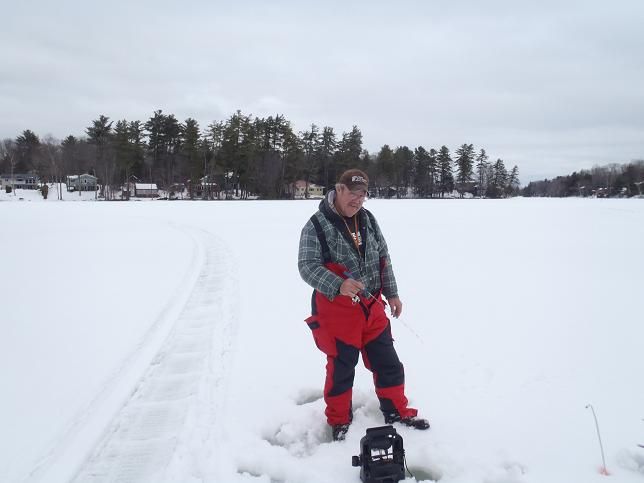
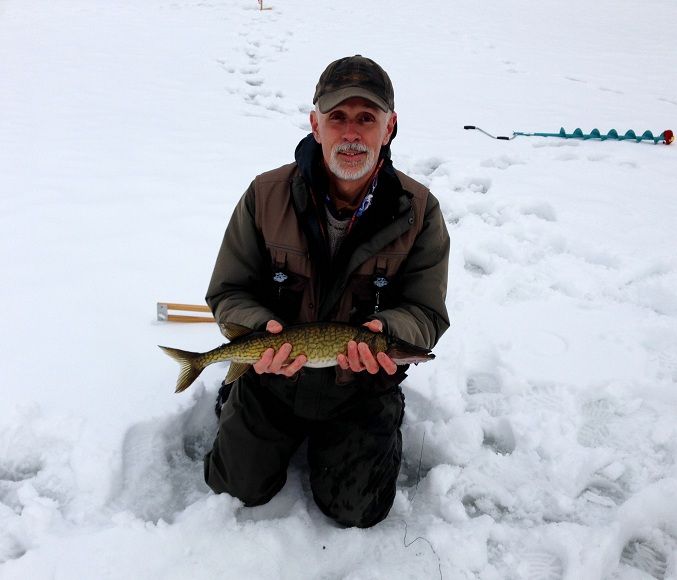
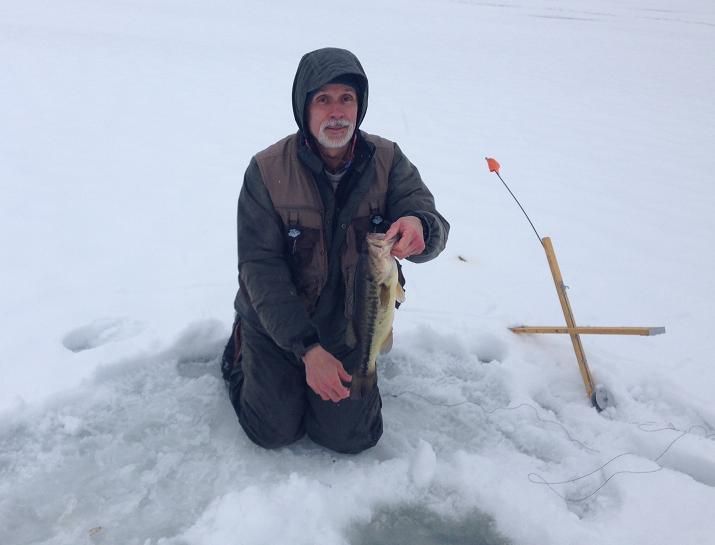
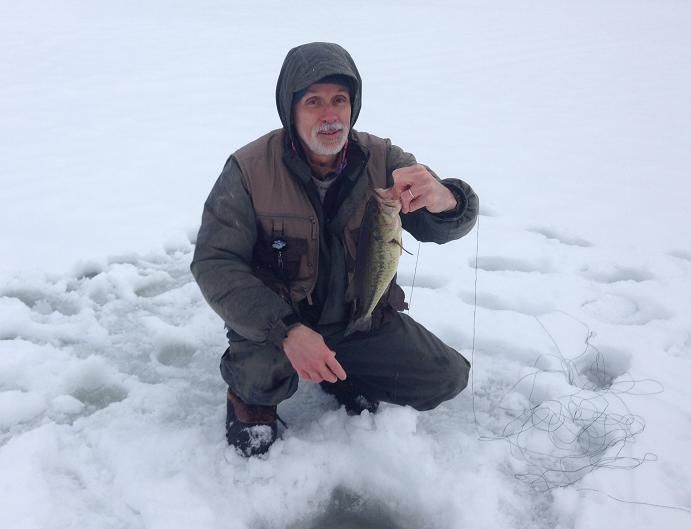
Showing posts with label ice fishing electronics. Show all posts

Tuesday, February 6, 2018

Introducing A Bud to the Hardwater


One thing that I've always enjoyed in any of my activities is to introduce someone that activity who has never done it before.  Even more rewarding is that if they have fun and want to go again.  Last weekend, I took a fishing buddy, Rodger, who swore a couple years ago that he'd never do it, out on the ice for an icefishing trip.  Well, never say never because I convinced him to give it a try, and I think we hooked him.  Now we have to reel him in...

When taking someone out for the first time on any outdoor activity, the best way to get them to go again is to make sure that they have fun the first time.  With icefishing, the first thing is to make sure that you pick a lake that has a bunch of willing fish, because catching is more fun than working hard to catch them.  The lake we picked has a reputation of that, with a mix of average sized panfish along with some jumbos, and they're usually very willing.  You can't beat jigging for panfish when the action is hot, a perfect recipe for a newbie to have fun at icefishing.

The next thing is to make sure that you teach them what you know, including how to use your electronics, what to look for, how to read the moods of the fish, and most importantly, to improve the odds that your newbie friend will have a better chance at icing some fish.  That means that you may have to sacrifice your fishing time to do the teaching, as well as the use of your electronics and other equipment.  The purpose of this trip wan't for my icefishing fulfillment, but for the fulfillment of doing something rewarding, putting my buddy on fish and introducing him to the sport.  Fortunately, I had a spare sonar unit so I wasn't fishing blind either.
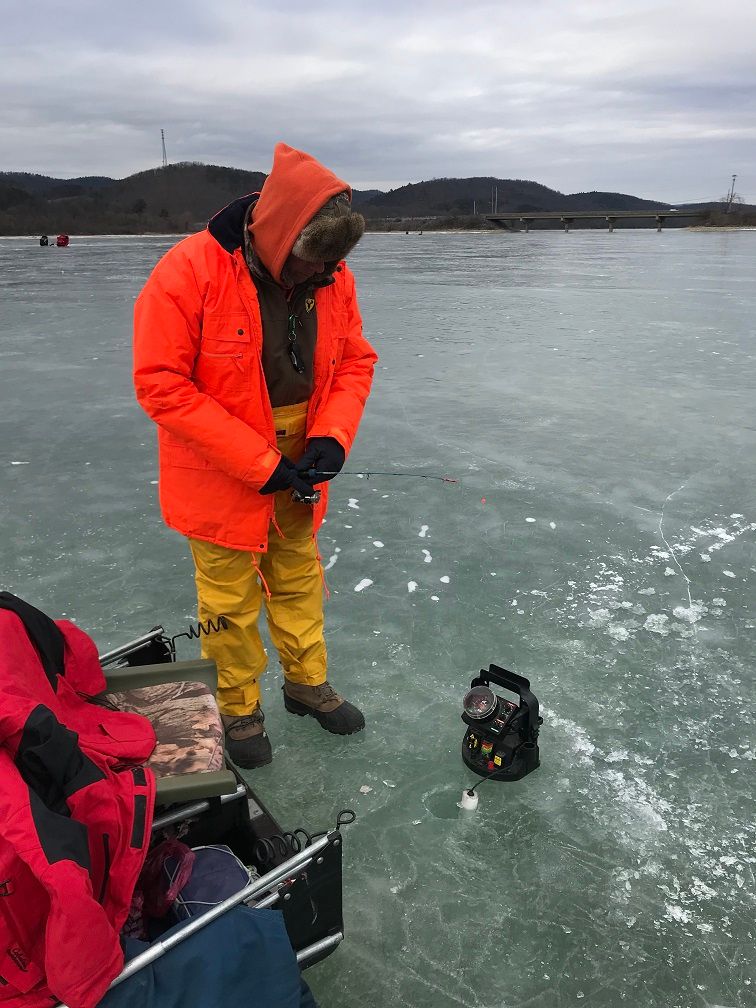
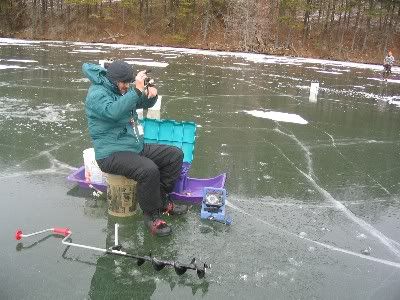
Rodger watching the fish react to his jig on my sonar unit while we were searching for active fish.  Eventually, we found active fish and Rodger caught a bunch, and had a good time.
Rodger is a little sensitive to the cold anyway, so picking a good day for comfort helps.  I was worried a bit that he'd be too cold to enjoy it, but as the day went along, everything worked out.  He dressed for the occasion, perhaps overdressed a bit, but at least he was pretty warm.  He also brought a bunch of hand warmers and used them as well to help.  I also let him use my Fish Trap pullover shanty for most of the afternoon once we found fish.  Again, that meant that I had to bear the elements like the good old days prior to me owning a Fish Trap.  But, that was OK, except that the wind was a bit annoying, and was a constant reminder of how much I love using my Fish Trap!  Remember about picking the right day?  It's about as much as for you as for your buddy.

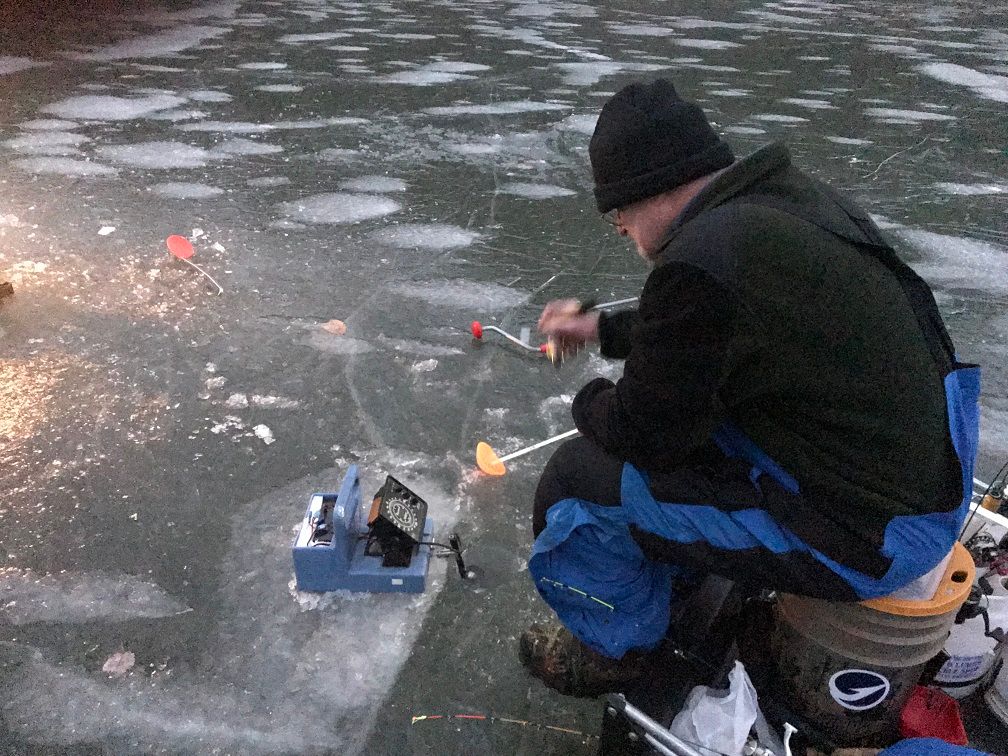
My other friend Glenn and I used our sonar to search for active fish.  We both took different directions and cut a bunch of holes and checked them with our sonar.  We were hoping to mark fish, and hopefully, a bunch of them suspended off the bottom.  To me, those are active catchable fish.  I don't mind finding fish on the bottom either, and they're worth checking out for sure.  A faint flicker of the bottom on the sonar could indicate fish holding tight to the bottom.  Those fish are usually a bit more finicky, but not always.  Definetly, they are worth dropping a lure down to.

And that is what we did.  We marked fish, dropped lures down to see how active they were, then either fished them a bit or moved on.  If you want to catch a bunch of fish, you need to be mobile.  It took a while to find fish, and we were looking for biters, not lookers.  There were a lot of lookers early on though.  But eventually, Glenn found a bunch of active fish on a point and gathered us up to join him.
Glenn was the first to find active suspended fish off a point at the channel edge.  After locating fish, he called us over to join him.  Thanks to Glenn, Rodger caught a bunch of fish shortly afterwards.  That may have been the difference if Rodger icefishes again or not.  It works to team up to find fish for everyone, and is a common practice among friends.
I had been cutting all of the holes up to this point (between Rodger and me), so as to teach, I had Rodger cut a few holes so he could learn how to use the hand auger.  He cut two holes and that was all he needed.  We marked a bunch of fish in the very first hole, suspended as much as five feet off the bottom to the bottom.

He used a jigging rod with a spring bobber that I set up with two jigs in tandem about nine inches apart, the top jig being a red glow Fat Boy (namesake of this blog) and the bottom a gold Fiskas jig, both tipped with a few maggots (aka spikes).  On the first drop, the fish hammered one of the jigs and Rodger had his first fish on the ice.

I quickly cut another hole set up my Aqua-vu camera in the same hole as my sonar transducer, so he could fish out of the second hole and reduce fish tangling in the camera and sonar.  Once we had the camera set up, I set up the pullover shanty and had him snug as a bug indoors and catching fish.  I could hear him giggling and laughing a few times, so he definitely had fun.
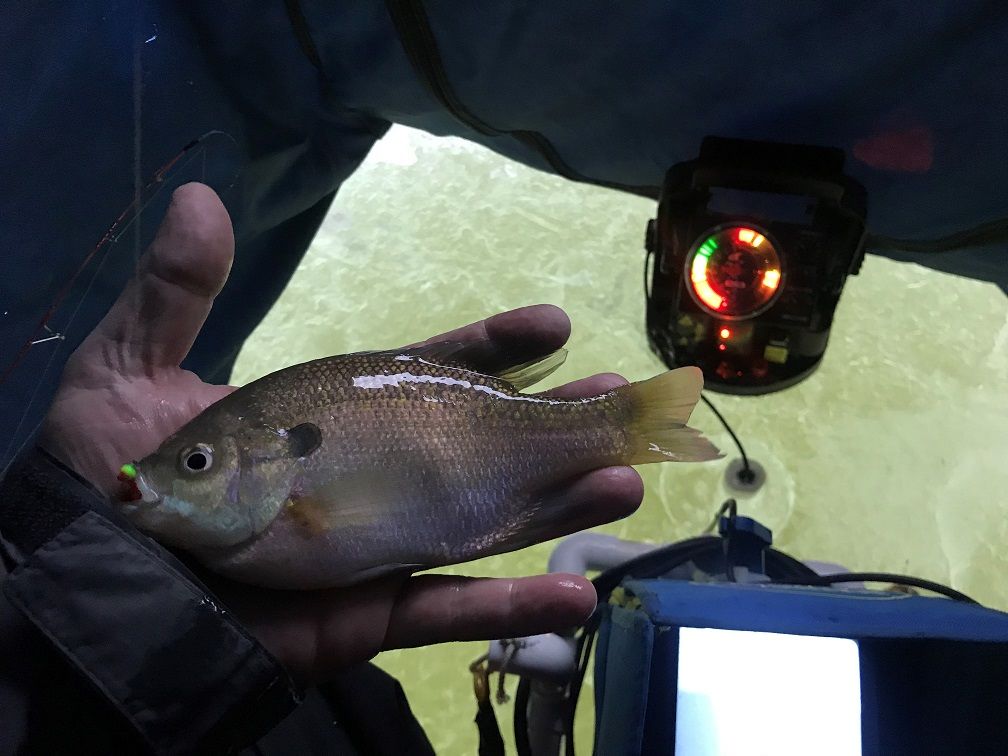
This is a pic from a prior trip of me holding a bluegill, but shows my setup inside my shanty with the sonar and camera in one hole, as I fish out of the other.  This is what I wanted Rodger to experience, catching a bunch of fish, seeing them on the camera and using the sonar.
Meanwhile, as I ran back and forth to check on him, I cut a few more holes and found some fish, but not as thick as the spot that he and Glenn were on.  At this point in time, they were caught fish about two to my one.  At my spot, the fish would show up suspended, and I could get them to bite, but then they'd leave.  The fish never left at Glenn and Rodger's holes.

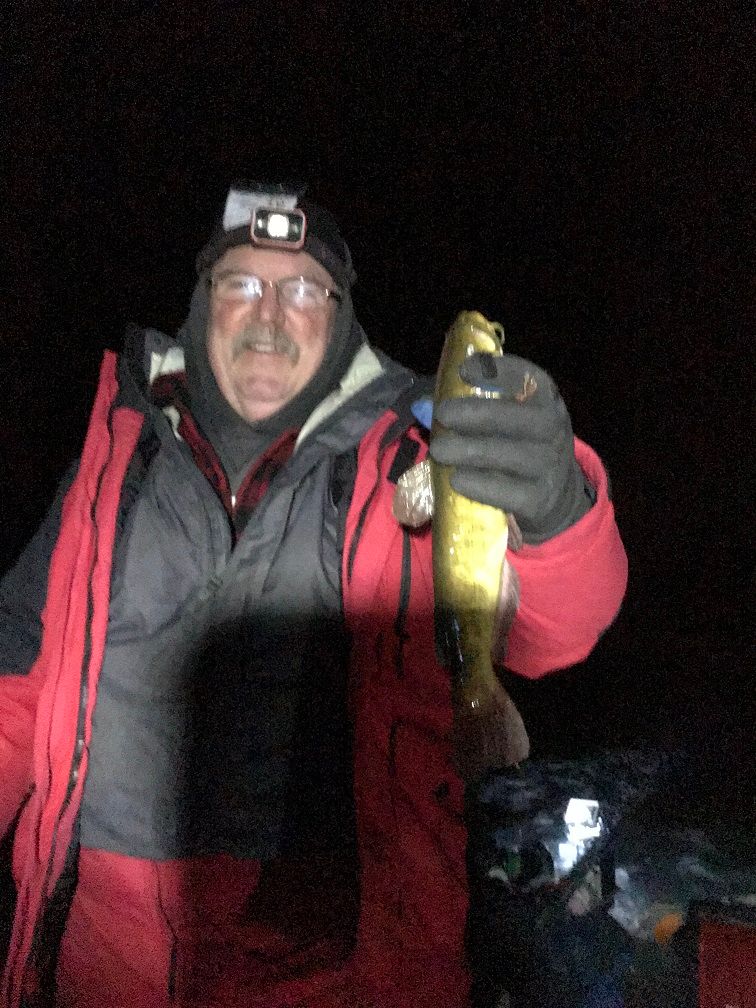
At my spot, I caught some medium sized crappie and some yellow perch, and then hooked into a big fish that went ballistic on me at the hole and popped off.  My initial thought was bass or walleye because it was a bronze color, but the fight didn't match, and the fish looked to be about 15-16 inches long or so.  I later found out that there are brown trout in there, so that is probably what I had on.  It was exciting, but it would have been nice to land that fish and get a picture.

As darkness approached, we set up for the night bite, hoping for crappie or anything else.  By that time, I'm sure that Glenn and Rodger caught twice as many fish as I did, and that made me happy, knowing that this trip was a success.  Now it was time to teach Rodger how to catch crappie at night.

I put the camera away, although it is fun and useful, it's not as helpful at night fishing for the suspended fish, at least in my opinion.  The model that I have tends to attract a ton of daphnia and other tiny aquatic life, making it difficult to see your jig or the fish after dark.  Plus, removing the camera reduces the risk of fish tangling on the camera cable.  Plus, fish can suspend at any depth, especially at night, sometimes right under the ice.

I cut a hole just North of Glenn, closer to where the point meets the channel and wow, when I checked it with my sonar, that hole was stacked from the bottom to about ten feet full of fish.  I couldn't fish there earlier because some other guys were close to that spot, and I didn't want to encroach on them.  I explained those ethics to Rodger as well, to not encroach on another angler's spot, whether it be jigging or a set of tip ups (which they also used).

After cutting that hole, I tore up the medium sized crappie until we had to leave.  At one point, I caught crappie on 16 consecutive drops as they were very aggressive.
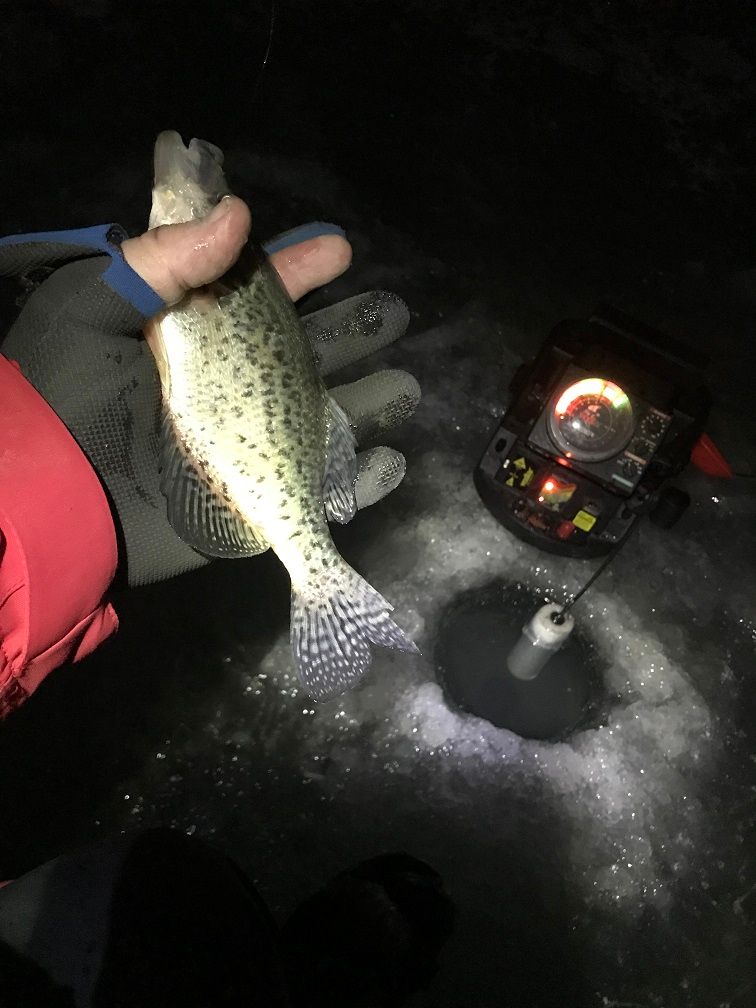
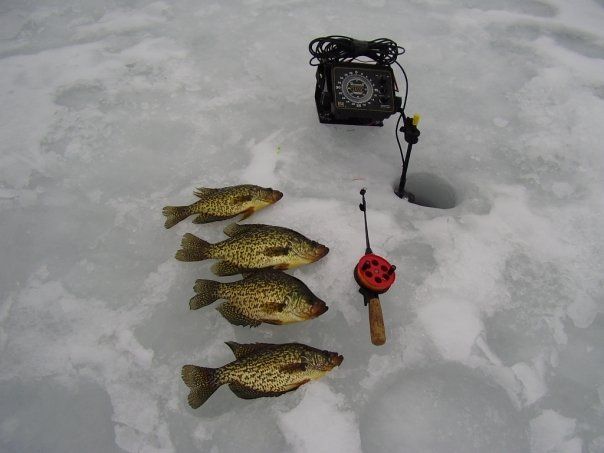
This crappie was a bit on the small side, but I caught several dozen crappie that averaged about 9 inches or so all night long.  The fish were stacked on a point near the creek channel.
Glenn and Rodger stayed at their holes and continued to catch fish.  Glenn eventually hooked into something huge, and fought it for twenty minutes before the two pound line finally gave out and broke off as the fish made a last charge before coming to the hole.  We never saw the fish.

About an hour and a half after dark, Rodger and Glenn were still catching a fish here and there, but I was slaying them, so I called them over.  I gave up my hot hole and gave it to Rodger, while Glenn fished an old hole that was nearby, and they both marked and caught fish right away.

I cut another hole about ten feet closer to the point and still marked a bunch of fish, and continued to catch crappie one after another.  At one point, about an hour before we stopped fishing, I counted thirty five crappie iced since dark, and then lost count.  I guess I landed a dozen more after that plus one bullhead.  On the day, I caught about 50-60 fish, so it started very slow for me but turned out to be a good numbers day for me.
This bullhead was suspended at ten feet off the bottom and slammed my soft plastic jigs.
Glenn and Rodger probably caught about the same number of fish that I did.  Between the three of us, we caught a total of six species, crappie, yellow perch, bluegills, pumpkinseeds, a creek chub, and a brown bullhead.

Of course, when you bring someone on the ice that is new to the experience, there is an element of fear.  I found it important to talk about ice safety several times, and I have more to teach him on future trips.  One thing that he discovered was that while ice forms, pressure builds up and forms cracks and makes booming noises.  I explained to him that was a good thing, but a couple times, pressure cracks shot past him at a very close range and prompted him to yell out some words that I can't type here!  I told him that was music to my ears, that the ice was building, and is always a good thing.

The fishing was still hot when we decided to leave, but I had a long drive home, and I was very tired.  I considered fishing all night, but was just too exhausted, and I wasn't sure if the other guys could do that or not, so we left the ice at 10 PM.  The fish were still biting.  It is tough to leave fish that are active.

The downside to this trip was that it was a good 3 hour plus of a drive one way for us.  We arrived late, so it was important to us that we caught an active bite, and we did.  But, I'd rather have had an earlier start, several events happened that delayed our fishing start time.  I won't get into that here though.  It was a good thing that we ended the day on a good strong evening bite, because it made that ride home a bit easier.  That is a problem every year for me though, finding good ice close enough to home.  I love icefishing so much that I'd drive further away to do it than I would otherwise to fish during open water.

The bigger story, however, is that I think that despite the long drive home and getting home late, that Rodger had a fun day on the ice, caught fish, and learned why we like icefishing so much.  Both Glenn and I taught him many things that day, and Rodger caught on, and joined the fun.  That's what it's all about.  That's how Glenn and my good friend and icefishing mentor, Jeff Redinger, got me hooked.  I was merely passing that on.  At this point, Rodger is now an ice angler!  Now that he's hooked, let's see if we can reel him in for another trip!
My ice fishing mentor and good friend, Jeff Redinger, posing with a huge sunfish that he caught through the ice.  Jeff introduced me to sonar, and taught me the importance of being mobile to catch fish through the ice on my first ice fishing trip 27 years ago.  


Tuesday, January 28, 2014

Remember Your First Ice Fishing Trip?

Remember your first ice fishing trip?  Leave a comment and tell me the story.  Here’s the scoop on my first time on the ice.  But first, some background…
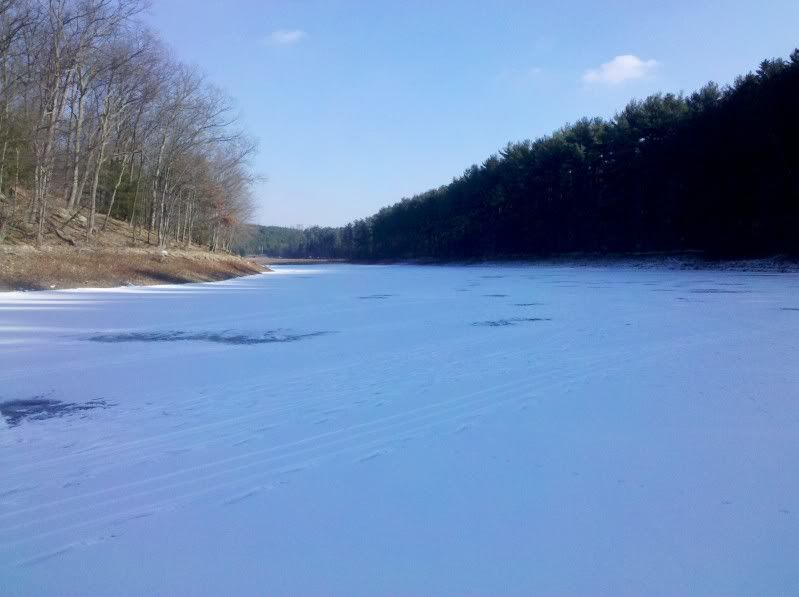
Wisconsin Ice.  Isn't it beautiful?  You can see some old holes cut and the trail of an angler checking holes for fish.  This photo is courtesy of Iceshanty.com.  Join that site if you like ice fishing if you already haven't.  It's free, and full of info, and has plenty of wallpaper pics like these.  I can't believe that I used to be afraid of something like this!
Many moons ago before I fished the hard water, I would hate this time of year.  Back then everything froze, the rivers, creeks, and even the Chesapeake Bay.  The only places you could find open water to fish were power plants with warm water discharges or below the dams of lakes.  I had heard of some people ice fishing the small local lakes, but never actually witnessed such an event.  Even still, I would have never set foot on the ice back then to check it out.  I held a huge level fear and respect for the ice.

Stories in the news about people falling through the ice and losing their lives, warnings from my parents about the dangers of ice, and my lack of understanding about ice safety in general kept those fears alive, leaving me to satisfy my fishing habits in other ways, like outdoors shows.

I’m really not a resident of ice fishing country.  People that live in the western part of our state ice fish often because of the higher elevations and colder temperatures.  But for the most part, you have to drive North to find safe ice in our neighboring friendly State of Pennsylvania.  People in my neck of the woods think pretty much the way that I did about getting on lake ice, much less ice fishing.

I recall a story from my Mother about someone in her high school that fell through the ice, and the unfortunate victim couldn’t find the hole where he fell through, leading him to his demise.  As a youngster, seeing that scene in the movie “The Omen,” where that kid fell through the river ice and people screamed in horror as they helplessly witnessed the current carry the child under the ice downstream impending doom, didn’t help matters either.

The local news always seemed to have stories unfortunate victims that ventured out onto the ice and fell through.  Every winter, these tragic deaths occurred, it seemed, leading one to believe that no ice is ever safe.  Well, there is some truth to that.  Having that wariness also makes us better ice anglers, or at least safer ones.  My respect for the dangers of thin ice always leads me to err on the side of caution.  I’ll address ice safety another day.

On top of the fears, my unwillingness to even think about ice fishing was compounded with some sort of notion that everyone just sits on one hole waiting for a fish to swim by and bite, while sitting outside freezing your you know what off.

Then, one day, I was talked into attending an ice fishing presentation and workshop by my friend Glenn Cumings, then a Park Naturalist for our regional parks system.   After the presentation, I was introduced by Glenn to the presenter, Jeff Redinger, who put on a very good presentation, enough to spark my interest in the subject.  The resulting discussion between Glenn, Jeff and I resulted in an invite to ice fish the following weekend.  I was terrified, but I agreed to go.

I’ll never forget that first trip…it was cold out but not uncomfortable.   It was an afternoon to evening trip to a small lake in Pennsylvania.  Jeff’s goal was to catch fish and at the same time, show us what it’s all about.  We had a chance to put into action what we learned during his presentation.  Our primary quarry, bluegills.  Jeff had plenty of gear.  All I had to have were some warm boots and clothes.  I brought a small box of my favorite open water panfish jigs with the idea that maybe I could catch a few on my stuff.  Yeah, I’m stubborn like that!!!!

The ice was crystal clear, was as slick as glass, and the water had about  six feet of visibility.  It was kind of spooky.   Jeff let me borrow a spare set of cleats for this trip.  The metal on ice sound on our cleats clicked and clacked as we walked across the frozen lake.  When you’d walk on it, sometimes pressure cracks would occur, sending fear up and down your spine, at least to a newbie like me already full of the fear of breaking through.
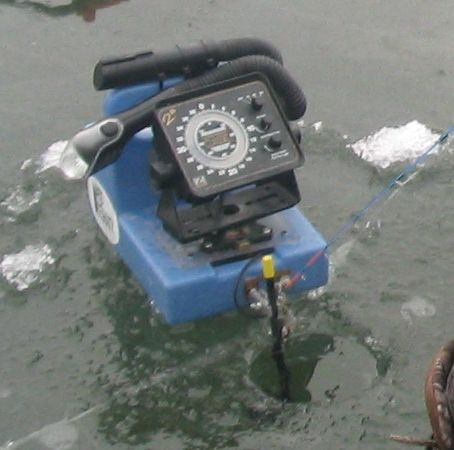
This picture was taken a couple years after Jeff showed us the ropes.  But, you can see Glenn fighting a fish that he watched using his sonar unit, a Zercom Clearwater Classic.  Glenn still uses this unit to this day.  The blue box is like the one Jeff  had with his Humminbird flasher style sonar.  Jeff eventually purchased a Clearwater Classic too, also my first sonar unit.  At the time, it was state of the art.  You can see how clear the ice was with the pressure cracks.  That's what it was like on my first trip, minus the snow.
During Jeff’s presentation, he talked about ice safety, where on a lake would be the safest place to get on, and places to avoid where there could be thin or weaker ice.  After a quick review of that short lesson, we were off to cut holes and look for fish.  He showed us how to use his hand auger as he discussed his methodology to find fish holding structure, and fish.

We moved out to the middle of the lake, and Jeff started cutting holes.  He cut about ten holes where he’d estimate the creek channel edge to be.  It didn’t hurt that he’d been out on this lake and had some experience catching fish prior to our trip.  After cutting the holes, he’d check each one with his sonar to see if he could mark a fish, or what might be a fish.  After checking a few holes without marking anything, he yelled out to us that he might have marked a fish.  The next step was to confirm that what he saw on his sonar was, indeed, a fish.  Then, he taught us his approach to catching them.

Jeff likes to fish for panfish, targeting bluegills, perch and crappie mainly, but gladly landing anything that would be willing to bite.  First, he’d drop an ice jig tipped with a waxworm or maggot (commonly known as a spike) down the hole, to test the reaction of the fish by watching his sonar, and to see if the fish would bite.  If the attempt produced a bite or at least have the fish seem interested, then he’d stay for a bit on that spot a bit longer.  If he caught a fish, then he’d stay even longer.  If he caught and marked multiple fish on his sonar and they were active, then he’d stay and fish it out until they stopped biting, then move to another hole.  That, my friends, is a hot spot…or a hot hole.
The spot that got me hooked!
When the fish stopped biting or became finicky, then he’d try downsizing his lure to tempt them.  If that didn’t work, then he’d move to find more active fish, checking the other holes that he cut or move on to cut more holes until he’d find another school of active fish and start the process over.

Jeff was using an old Rapala ice jigging rod with a spring bobber attached to the tip, spooled with either two or four pound test line.  A spring bobber is a form of strike indicator that is attached, usually, but not always, to the rod tip.  Often, it’s made of fine wire or a light spring.  When a fish inhales the tiny ice jig, the spring will bend enough for you to see the bite, where your next effort would be to set the hook.  With a traditional rod tip, you might not even see that bite.

The old Rapala jigging rod was made entirely of plastic.  It looked very cheap and simple, and was inexpensive..  Basically, it’s a rod and reel combination in a sense, but more of an instrument to hold the line, and doesn't really look like a fishing rod and reel.  If I had seen one prior to that day, I’d think that maybe it was some sort of kite flying reel.  With these rods, you don't reel in the fish.  You bring the fish up using a hand over hand method.  Where is the drag if you hook a big fish?  You hand over hand the line back in the hole!
Jeff has a few nice slabs iced, posing with a Rapala jigging rod and his trusty Zercom Clearwater Classic flasher style sonar.  When using this type of fishing rod, you don't reel them in, you hand line them.
Jeff gave us a quick lesson on how to use the sonar to not only find fish, but how to use it to determine fish behavior and actually be able to tell if a fish might bite, and when.  He used a flasher type of sonar back them made by Humminbird.  As he let his lure fall, he pointed out a bar of light on his round sonar display moving downward, saying that was his jig.  He also pointed out that the bright thick band at the calibrated twenty feet represented the bottom.

I asked, “What are all those marks in the middle?”  “Fish,” he said, as one of those fish marks moved vertically toward his falling lure.  Just when the jig was above the fish, he’d stop, wait, maybe twitch the rod tip a tiny bit causing the spring bobber to move ever so slightly.  As the fish moved closer to the lure, the sonar bands became one larger thick band.  He said, “Now is the time to take your eyes off the sonar and watch the spring bobber and look for a bite.  If the spring moves even the slightest amount, set the hook!”

The spring moved down a tiny bit.  Jeff set the hook lifting the palm rod way over his head, followed by fighting the fish by hand, pulling line up hand over fist, literally, giving some back to the fish during a short run.  Out through the hole appeared a fat yellow perch.  “I thought, wow, this stuff really works!”  I couldn’t wait to catch a fish now.  My next move was to cut a hole not too far from Jeff.  Not that I wanted to fish over the same fish that he was, but at least I could hear what he was doing and learn a thing or two.  And, he could relay info to me about what the fish were doing.  Were they on the bottom or suspended, and if suspended, how high?
My good friend and ice fishing mentor Jeff Redinger sporting some fine slabs for the dinner table.
The ice was building.  When it does that, it makes these booming noises, almost like thunder but not quite.  It really sounds more like someone bending a large piece of sheet metal.  When the pressure under the ice builds up, it would put pressure on the ice along the shorelines, and the result was usually a pressure crack to relieve that pressure, but also accompanied by that booming sound.  At least, that’s what I think is happening.  Perhaps someone familiar with the science could offer the exact explanation in a comment if I’m not on the mark here.  Jeff said, after one big boom and crack, “She’s making ice, and that’s music to my ears.”

Later, while sitting on a bucket fishing, a crack formed, heading straight toward me and right between my legs, scaring me nearly to death!  Pressure cracks aren’t really dangerous because the ice is pushed together into a near solid joint.  Although, Jeff recommended that when walking across the ice, try to avoid spots where multiple cracks cross, just to be a little extra safe.  Although, when snow covers the ice, you really can’t see the cracks, so you just go forward and trust that things are safe.  Again, I’ll address ice safety another day, but a good thing to do when conditions are iffy is to carry a spud bar and test the ice thickness as you proceed forward.  That day, I made sure to follow him, step by step!

Jeff, if I remember correctly, caught several fish out of that one hole while we were still trying to figure out how everything worked.  I tied on one of my favorite panfish jigs from my open water experience, a one inch Bass Pro Shops Squirmin’ Grub in pumpkinseed, color hooked on a 1/64 ounce orange ball headed jighead.  Jeff pretty much identified that the area held fish, and being without sonar, we had to figure out how deep to fish.  How do you do that?  Ask the guy with the sonar, over and over, “How deep are they?  Are you still marking them.”  Or, just go over and watch for yourself over his shoulder.  Those were valuable lessons actually.  It not only helps you to learn what is going on under the ice, but newbies like me can watch the more experienced ice angler work the fish!

After my lesson, I dropped my jig down the hole, using Jeff’s spare ice rod with my soft plastic jig.  I’d let it sink to the bottom, then when my line went slack, picked up the slack and wound up a little line so that the jig would be about a foot or two off the bottom.  I wasn’t going to see if the fish were finicky, so I jigged pretty aggressively, then let it sit, then repeat the process.  I’d work the bait slowly up a foot, then slowly all the way to the bottom, and repeat.

All of a sudden my spring snapped down.  A hit!  My first bite ice fishing!  I set the hook and pulled the fish up, hand over hand, and landed a nice fat yellow perch.  I guess the soft plastic grub was a winner after all!  Let me tell you that this was over 25 years ago, long before the popular ice fishing soft plastics of today.  Not long after that, I caught my second fish, a nice hand sized bluegill.  After that the fish became really active and I caught one after another, a mixed bag of species too.  When the bite slowed, I’d bounce to another hole and try again, while asking Jeff, the man with the eyes underneath, “Are you still marking fish?”  Sometimes he was too busy hauling in one bluegill after another to respond, but eventually he’d cough up that valuable info.

I was amazed.  I was hooked.  I thought that this ice fishing thing was cool!  It was like a whole new world opening up to me.  No more long cold icy no fishing weekends.  From then on, I prayed for frigid temperatures to build ice each winter.  And that sonar?  I had to have one.  It took me a couple years to save enough money but eventually purchased one, then later, another.
Eventually, I purchased a sonar unit too.  That's my Clearwater Classic, my first sonar unit, that now serves as my back up sonar.  It still works great!  My first purchases were rods, jigs, cleats and an ice auger.  After that, my arsenal exploded with gear.  Obviously I went from being hooked to addicted!
Jeff was hammering the bluegills, big bump headed bull bluegills too, one after another.  He was on such a good bite that he didn’t move from that one hole all afternoon and evening.  At times, his jig couldn’t get to the bottom because the school of gills was so thick.  He had a bunch of fish laid out on the ice that he was bringing home for the table, the best of the big bluegills and a few fat yellow perch.  Normally he’d bounce from hole to hole, and leaving those fish on the ice are a nice reminder what holes are hot and what aren’t.  Of course, that might not be such a good idea on a crowded lake for all to see!

I wasn’t on that type of bite, but I was steadily catching fish.  It was really cool watching the fish come up viewing through the ice from several feet down.  It kind of creeped me out at the time.  Now I love those types of days.

My Squirmin’ Grub caught big bluegills, fat yellow perch, a few slab crappie and some small foot long largemouth bass.  At the end of the day, I finished with almost thirty fish.  My buddy Glenn did nearly as well.  It was his second trip out on the ice.  Already he was hopelessly addicted.  He’d driven to Pennsylvania the previous weekend and raided the local tackle shops for ice gear and lures.

We didn’t have the internet to place orders back then.  Shopping for fishing gear was all done through a catalogue via the mail, or by shopping at the once numerous Mom and Pop tackle shops in the area.  Waxworms and spikes back then were hard to come by in Maryland, but some of those Pennsylvania stores supplied us throughout the ice season.

But man was I hooked.  I thought about all those years that I’d visit a lake and turn away, wondering if the ice was good enough to get out on and fish.  And for many years, ice fishing was legal on those lakes.  Remember the drownings that I’d heard about?  There were the reason the lakes were closed off to ice fishing after them.  Knowing what I know now, those people ventured out onto ice that wasn’t thick enough.  They didn’t know what they were doing, or what ice was “safe” or not “safe”.  They didn’t know Jeff’s lessons on what to look for.  Why?  Nobody in our area ice fished, or very few did that knew what they were doing.
Not only did I have a blast on my first trip, but I brought some home for a tasty fish fry.  This photo was a few years later, but caught from the same lake that gave me my first start.
But Jeff knew what he was doing.  He was, and still is, a student of the sport, and a pretty darned good teacher too.  He learned much from reading articles about Dave Genz and his methods, and applied those tactics in his home state before moving East.  Dave Genz basically preached the use of electronics (sonar), to stay mobile and go find fish.  Don’t just go out and cut a hole, hope that they are there, and wait for a bite.  Go find them!  It’s more like fish hunting than just fishing.  After all, when fishing out of a boat, most anglers don’t sit in one spot all day.  They move until they catch something, right?  It’s the same thing on the ice.

Since that fateful ice fishing presentation, Jeff has become a dear friend of mine.  I’m forever grateful for my friends Jeff and Glenn, what Jeff taught us, what Glenn and I learned together.  I eventually introduced other friends to ice fishing.  And, eventually, I helped others like Jeff helped me, showing other anglers throughout Maryland and Pennsylvania how to use sonar and the benefits to catching more fish.

Most of the time they’d approach me and ask what that funny looking blue box was for.  After showing them, even letting them fish using it, they were hooked.  Some of those people eventually met me again on the ice and thanked me for helping them, even years later!  I didn’t recognize them at all first, but after that, some became my friends that I still fish with to this day.
Pictured here are my buddies Bill and Mark.  Bill's sporting a nice crappie.  By this time, all my buddies had sonar and we were veterans on the ice.  No more fear for me of the ice, but I still respect it and am careful.
Over time, more and more people started showing up with portable sonar units on the ice.  But back then, I may have seen one or two people at the most over the course of several years using sonar.  And those were the LCD type, not flasher style sonar.  Now, it’s mainstream and just about everyone uses them.  Now there are several brands and also underwater cameras (which I also have and love to fish with).
Here's my first sonar unit, a Zercom Clearwater Classic.  The transducer arm has a level on it.  The battery powered snake light that I rigged to the handle of my Dave Genz Blue Ice Box served as a temporary light so I could fish in the dark until my lantern would be fired up.
This is my current sonar unit, the Vexilar FL-18.  Notice the green and orange bars at about three o'clock.  Those are fish marks, and thick orange bar at about five o'clock is the bottom.  When you drop a jig down the hole, it will show up as a mark like the ones above.  Watch your jig mark and the fish marks and when they come together, watch your rod tip for the bite!  Also, notice the float supporting the transducer in this model.  
Not long after that, I discovered a website for ice fishing and met some more guys to fish with, many from Pennsylvania.  But that website died out, but a new one showed up.  The new website was great, and grew in popularity by leaps and bounds.  Today, it is undoubtedly the most popular ice fishing forum on the web, www.iceshanty.com.  If you haven’t had a chance to check it out, and you’re interested in ice fishing, please do so.  If you are interested in maybe giving ice fishing a try, like I did, or are an ice fishing newbie, then definitely check out Iceshanty, because there is a wealth of information on the site and plenty of knowledgeable helpful anglers to give you a hand.
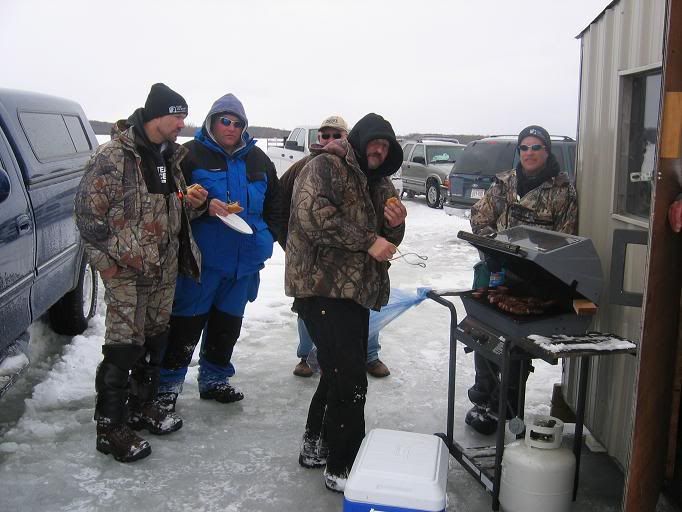
Fun and eats on Wisconsin ice!  Iceshanty allowed me to meet some really cool friends, thanks go way back to Jeff and Glenn introducing me to this fun filled sport.

Friday, March 8, 2013

On the Hardwater - A Short 2013 Season

Now that I’m an old man, one of the things on my bucket list was to visit my buddy, Jim Cumming, for some ice fishing.  So, on Friday, I made the trip North after stopping and paying a visit to my friend, Geoff Cerrelli in Pennsylvania, who graciously gave me some maggots.  I added that period for humor’s sake, maggots are also commonly known in the ice fishing world as spikes, which make for a very effective bait to tip lures, spoons, and ice jigs with to catch hungry panfish through the ice.  Since then, I’ve passed on the maggots to their new owner who will get some use out of them, my Maine host on the trip, Jim Cumming.

The ice conditions were sloppy to say the least.  It snowed every day, not much, but enough to be annoying, especially when I left my tennis shoes at home and wore Crocs during my leisure non-fishing time up there.  Temperatures ranged from the upper twenties during darkness, to mid thirties throughout the day with periodic snow squalls and light winds.  Fifteen miles per hour plus winds in Maine is considered light apparently, and about the only thing good about slush and snow on the ice is that your portable shanty won't blow away.  On the ice, we found a good five inches of snow on top of about four inches of slush, on top of about twenty inches plus of mixed white and clear ice, all of which made mobility very limited.

Mobility is the key to my ice fishing strategy.  Meaning, if you aren’t on fish, you move to find them.  First, you have to get to the area that you’d like to fish, then, in theory, you cut a bunch of holes until you find the fish.  Then, when they stop biting, you repeat the process.  Usually, productive holes when the bite stops will once again be productive after a short while, especially with yellow perch as their schools move around quite a bit.  You can bounce from hole to hole and keep on the school that way.
 
However, the conditions described above really do limit your ability to do much of that.  This is especially true when you’re old, fat and out of shape like me.  First of all, to get to Jim’s prime spots, we had to trudge through all that slush and snow while dragging our sleds that were heaped full of ice fishing gear gear nearly half a mile or more.  Needless to say, I had to stop and rest several times, even taking a seat to catch my breath and the scenery at the same time.  I guess you could say that I found the scenery breathtaking

Jim, on the other hand, is like the energizer bunny, and scampered out to his spot in no time.  All I could do is watch him pull away, and try to stop, rest, and regain my ability to breath before gathering up enough energy and will to trudge forward.
That's Jim off in the distance.  As you can see, you'd think that I couldjust follow his footprints for easier walking, but Jim apparently doesn't believe in walking a straight path!  Actually, sometimes you have to improve your own mobility by finding less sloppy stuff to walk through, and that's what he was doing.
Like many guys, Jim’s approach is a varied and effective one common to many ice anglers, to set tip ups, or “traps” (as they are referred to by Mainahs), to catch larger predatory fish, and when time permits, use a jigging rod to catch smaller panfish or anything else that wants to bite while waiting for “flags”.  Although this limits mobility in some cases, it does allow the ice angler to fish the best of both worlds. 

For those of you that aren't familiar with them, tip ups basically wooden or plastic stand fitted with a line filled spool that fits across the hole in the ice, with the line having a leader, perhaps a weight, and a baited hook dangling to tantalize potentially hungry fish.  The tip up has a spring loaded mechanism that, when a bite occurs, allows a flag to shoot up and alert you that a fish has taken your bait.  The videos below show Jim in action working tip ups to catch some nice predatory fish, filmed on our first day this past Saturday.


My approach is a bit different, I prefer to jig.  Although I lack experience in using them, I’m open to using tip ups.  In fact, I actually did try them on our second day at a trout lake.  Jim showed me how to use some and I promptly caught nothing on mine.  In fact, that day, we both got skunked, so not much detail will be provided except that the sloppy conditions were a bit better, only we trudged twice as far to get to the spot where we were skunked, and I was twice as worn out at the end of the day.  Jim summed up that second day quite nicely, the fishing stunk, but the company was awesome.  The cool thing about tip ups is that you really never know what you’re going to catch.  Any predator that lives in the lake could be on the other end of your line, in that lake, it could have been pike, brown trout, brookies, splake, lake trout or big bass.

On that first day, I think Jim caught fifteen warm water predators (chain pickerel, largemouth bass, and smallmouth bass) on his “traps” and jigged up about as many other fish in between flags.  Those other fish included yellow and white perch.  I caught about half as many fish jigging, a mixed bag between yellow perch and white perch, and one other species that I’d never caught before, a smelt.  It was my first fish of the trip.

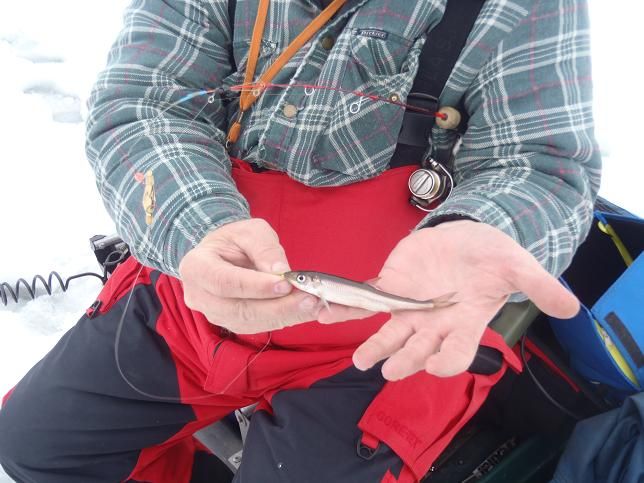
My first Maine fish through the ice...a minnow!  As it turns out, this baitfish is also a highly coveted delicacy, the smelt.  People try to catch these guys by the bucket full, bring them home, smoke or fry them, and feast.

Here's Jim working a tip up.


While Jim kept watch of his tip ups, I jigged.
The tip ups do catch big fish, the pictures below are evidence of their effectiveness.
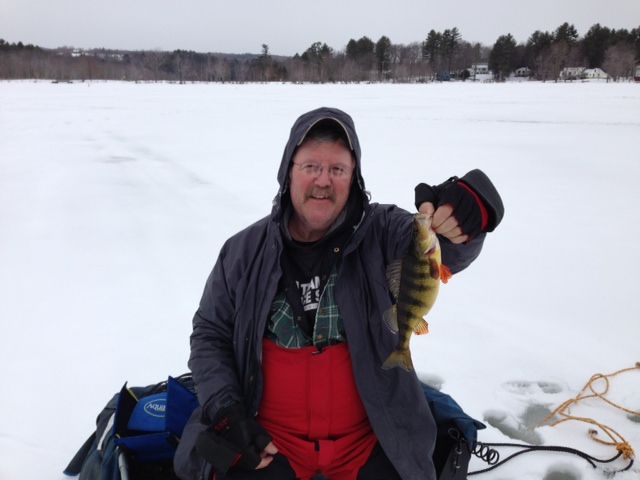
Jim sports a fat Maine chain pickerel.

Jim with a chunky iced largemouth bass caught on a "trap", released to fight another day.  Jim uses circle hooks that greatly reduce deeply hooked fish and allow for clean healthy releases.  They nearly always are hooked in the corner of the mouth.  Don't "set" the hook in the traditional way.  Instead, apply steady pressure on the fish as you hand line them up, which moves the hook to the corner of the fishes mouth.

Jim's tip ups brought many fat bass like this to the icy surface on our first day.
Day three, March 4th, measured up to what I had hoped, and basically turned out to be my ice fishing season.  Honestly, I'm not picky about what I catch through the ice, as long as I can get on a good jigging bite and the fish put up a decent fight on my light tackle.  As it turned out, I couldn't ask for a better day, with a great bite, on the same lake as day one, but with a much closer hike to his spot.  The bad news was that the sloppy conditions on the ice were even worse. 

Snow insulates the slush and water between it and the ice, and the weight of the snow pushes down on the ice, allowing water to seep up through holes cut in the ice throughout the lake, making it even worse.  Despite the sloppy conditions, higher winds, constant snow, rain or drizzle all day long, the fish didn’t care and bit all day long. 

Jim, early on, stepped into and old eight inch hole that someone had cut perhaps a few days prior, and had a wet foot which could have ruined his day had temperatures been a bit colder.  There's nothing more miserable while ice fishing than cold wet feet.  Warm insulated boots and wool socks that even insulate when wet helped Jim remain somewhat comfortable.  But, even after that, and also having to battle a stomach ache, he hung in there and stuck the day out.  Good fishing can put some of that at ease, and that was the case.  This was our two hundred fish combined day, a mixed bag of bass, pickerel, perch, sunfish, and fallfish. 

It was my kind of day though.  We found fish quickly, and I think that I cut three holes all day long, and it was all that was needed.  In addition to trudging through all that slop, cutting a hole with a hand auger through twenty plus inches of ice can wear and old fat guy like me out quickly.  Well, I actually cut seven holes, because once I was on fish, I had to cut holes for my electronics too.  I do this to keep the fish from tangling in the camera cable or transducer cable of my sonar. 

I was able to handle the elements easily, tucking myself inside my cozy Fish Trap portable ice fishing shanty.  Not only does it protect me from the elements, it also allows me to view my camera monitor much easier, providing a dark house of sorts, with just enough light inside to see what was going on.  My Fish Trap also has windows where I can view what is going on outside.
Shown here is my hiding spot, out of the wind, comfy, and able to easily view my underwater camera screen.
I offered as often as I could to invite Jim to either join me or take my place inside to warm up now and then, and to try out my electronics (which he did for a bit) especially since he wasn’t feeling well.  But, Jim’s a tough guy and put up with what Mother Nature dealt him, and having good fish bite all day long helped him cope, I’m quite sure.  He seemed to be more focused on me having a good time than his personal well being.  What a great host and a great friend!

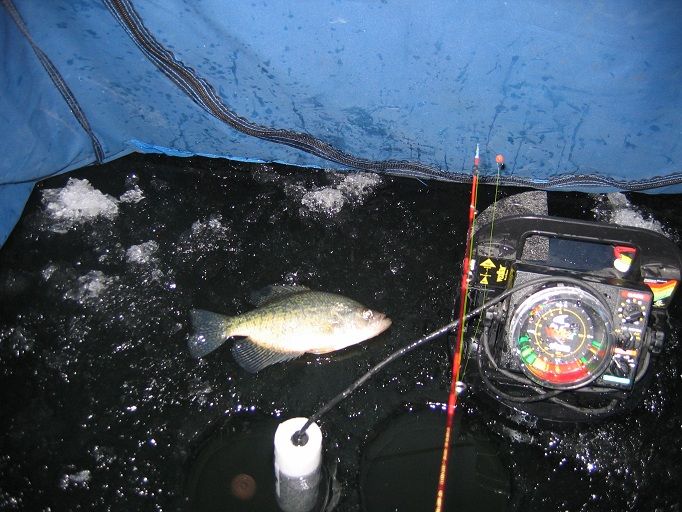
This is the view of my set up while inside my comfy portable ice fishing haven.  The hole on the right was for my electonics.  In this picture, my sonar wasn't being used to conserve the battery as fish were moving into camera view for a long period of time.  This hole was home to my camera cable, with the actual camera down the hole positioned to look down on the fish toward the bottom, where you can see weeds scattered alogn the bottom.  In the center of the screen is my jig.  Where you find weeds while ice fishing, fish are usually nearby.
I typically use my sonar to locate the fish, checking hole after hole until they are located.  Then, I’ll drop a jig down the hole to check if the fish are active and will bite.  On the sonar screen, you can actually see your lure sink toward the bottom, and see the fish rise off the bottom to your bait (or move in from the side).  Once the bar on the sonar (flasher) representing a fish moves even with the one representing your lure, you take your eye off the sonar unit and focus on your rod tip and watch for any movement of that rod tip.  If it twitches, set the hook and you most of the time will catch a fish.  Sometimes the bites are very subtle, and all that might move is your line.  If anything weird like that happens, set the hook.  Crappie are notorious for doing that.

Actually, to be effective on the ice, sonar is really all you need.  You can most certainly use the sonar all day long to put you on fish, watch your lure and the fish, and get a sense of how they are reacting your entire day.  Sonar can give you enough information, but it can't tell you everything.  What you don’t know is what kind of fish they are or how big those fish are.  You can read the sonar to determine the type of bottom, hard or soft, and even read weeds or other cover.  If you are on a good fish bite, this is where the camera comes in handy.  You can see what the bottom is like, even what kind of weeds are present.

Personally, I view the sonar and the camera as separate tools with different purposes.  The sonar puts me on fish, the camera refines and improves my ability to catch them.  They are simply effective tools to fish.  Do you need them both?  No, but they both really do improve your odds.  In addition, I find it extremely fun.  You can drop the camera down, see the fish, how big they are, what the bottom is like, what kind of weeds are there, stumps, branches, whatever.  And, you can watch the fish actually inhale or bite your lure.  Not only that, you can see the fish that aren’t after your lure at the time too. 

It’s so much fun, like watching an interactive TV show with you and the fish as stars.  I'll sit there and watch the fish inhale my lure and then set the hook and the fight is on, all day long, with me giggling like a kid the entire time.  The advantage the camera gives you is that you know exactly when to set the hook.  There is no doubt when you have a bite, and even the most subtle bites aren’t missed unless you’re too slow to react.  The result is that the hookup percentage is higher.

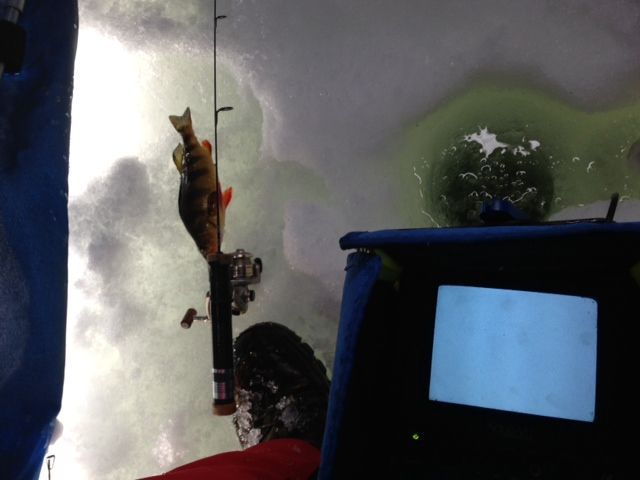
Pictured here is a medium sized yellow perch that fell victim to my set up.  The fish was released unharmed after his photo op.  This was my last spot, my third set of holes on the day, that proved to be the most productive spot.  You can see on the camera that this spot showed less weeds than that other spot in the previous picture, and it was a mere fifteen feet away.  You can't see the fish in this picture, but they were moving through often, like a highway following the weed edge.
I landed sixty nine yellow perch, and at least fifty of them were between ten and thirteen inches long.  In addition, the sunfish were active.  Jim caught a ton of them, and I finished with twenty one of chunky sunnies, a mix of pumpkinseed and red ear sunfish.
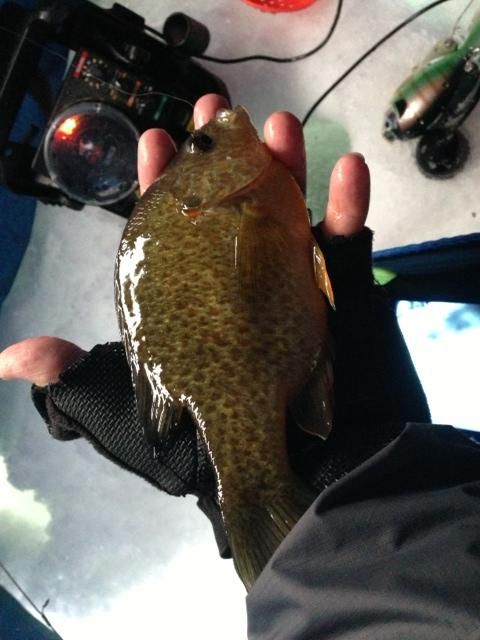
Here was my biggest sunfish of the day.  All of them were nice, but this one was a brute. 
In the picture above, you can see the camera on the ice.  I had to pull it, my line, and the fish out all together because this guy wrapped himself around my camera cable.  You can also see the sonar or flasher at work here.  Sometimes it helps to use both, to use the flasher to see what’s outside of the range of your camera, to gain a clue that fish are approaching.

Jim didn’t have much tip up action that last day, but did manage to land a dandy fat largemouth bass.  It took a lot of line too, as you can see it strewn across the ice in the picture below.
Nice bass Jim!

While Jim jigged away catching sunnie after sunnie, I hammered perch like this one all day long.  I'm sitting on a modified bass boat seat installed in my Fish Trap, pictured here with the shanty in the open position.
Of course, jigging is an effective way to put panfish on the ice.  But, you can also jig up predators.  I also landed two small chain pickerel and three largemouth.  At one point when the perch action slowed, I was watching my Berkley one and a half inch Gulp Smelt Minnow on my 1/32 ounce Ratso glow jighead, putting myself in a trance while jigging.   I set my rod down to take a drink of my Pepsi Max, when, what looked like a submarine appeared on my camera moving right up to my jig.  I picked up the rod and gave it a twitch, and the submarine opened its mouth and sucked in my jig.  It was a massive largemouth, at least for ice fishing in my world, and probably was in the four pound range.  It took off, taking drag while I was backreeling.  I fought this fish for quite a while as I didn’t want to break this fish off.  I had to be careful because my perch jigging rod was set up with only one pound test.  Things were going well but I took one hand to pull the camera and cable up and out of the hole to keep the fish from wrapping around the cable, while the bass took drag, and it broke me off.  Well, that explains why the panfish dissappeared!

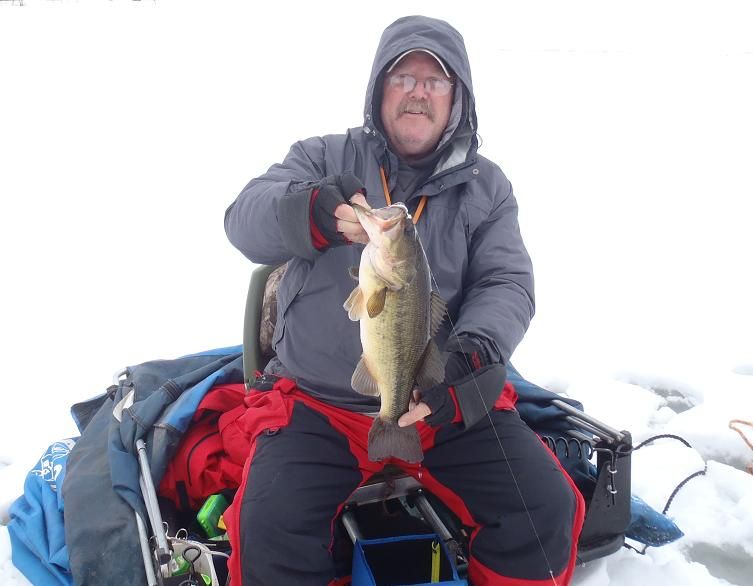
Not too long after that, I had a repeat performance, only this time I successfully landed the fish, a largemouth bass, not quite as large as the first one, but a healthy fish that was eighteen inches on my measuring tape.After a quick photo shoot, I released it back to the depths under the ice.
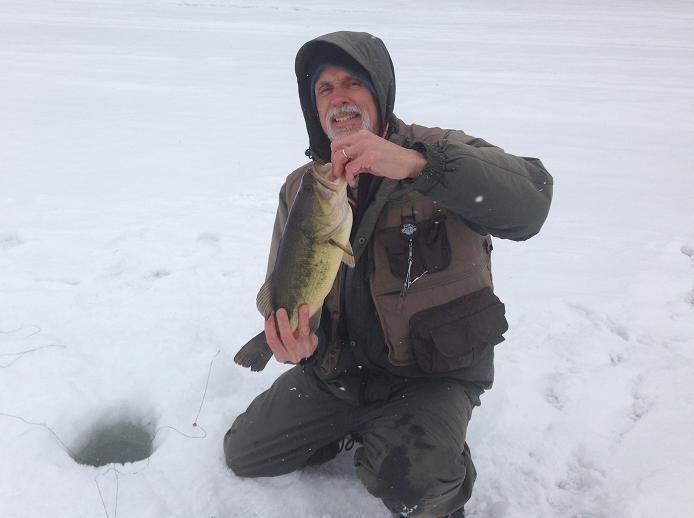
Here was my biggest fish of my trip, a nice eighteen inche largemouth bass.  Not bad for using a perch rod and reel combo spooled with one pound test!
So, that was my last day on the ice, and it made my ice fishing season.  I’d say, in fact, it was my ice fishing season.  Jim and I had hoped to get out on Tuesday for one more go at these fish, but the approaching storm caused me to reevaluate my plans and cut my trip short one day.  I just couldn’t risk leaving my wife stranded at home without power.  I considered staying an extra day to wait it out, but the storm was due to hit New England the next day, so that option was out.  Nevertheless, my first ever visit to Maine to visit my good friend Jim proved to be very memorable.  It wasn't much of a season, but it was one that I'll never forget.  Now I want more!  I will be back.  And, in addition, next time I hope to meet up with some of my other Maine Iceshanty friends.

I can’t wait to get back up there again on the ice or open water.  I purchased a yearly Maine license, so more than likely it will happen.  I owe a huge thank you to Jim Cumming for being such a gracious host, fantastic guide, and most of all a great friend.  Also, a big thanks go out to Geoff Cerrelli for helping me out with some last second bait.  It was great to meet up and talk with him again, and we will hit the softwater together before long.  Perhaps that adventure will result in a future blog post!