Showing posts with label jigging. Show all posts

Wednesday, December 23, 2020

"The Sickness"

The call of the wild drives our passion for the outdoors.  That's what drives us to get outdoors as often as we do.  It's primeval.  Every now and then, as one season ends prior to another one beginning, I explain to my wife, when bargaining for fishing time, that maybe this is the last best chance that I'll have for the season to get out and catch or bag whatever it is that I'm after.  Her response is that it's all one big season, that they all run together, and they never end... "So, just go, if that will make you happy.".  

Each season ends and butts up against another one.  It's so true.  And each season can be as addicting as the last, whether it's hunting or some aspect of fishing.  But, my friend Steve and I have one major addiction that crosses all seasons and overrides all other addictions.  That addiction is fishing for rockfish, and it's an all year long affliction.  My friend, Captain Steve Kelley calls it, "The Sickness".

Fishing for rockfish is an addiction.  We call it, "The Sickness".  If you catch a bunch of these, you'll understand.

It's not just an addiction, it's an obsession.  It's grown into this monster that pushes us to get out in extreme (not unsafe) conditions to fill the need to feel that bite, set the hook, and fight fish that just don't quit, even after they've been landed.  

Let's face it, the striped bass (Morone Saxitilis) is one tough hombre.  In 1881, Dr. James Henshall wrote a book titled, "Book of the Black Bass".  Within that book is an oft-quoted passage, that smallmouth bass are "inch for inch, pound for pound, the gamest fish that swims".  Although I agree with the premise that smallies are among the strongest fighters for their size, I have to wonder if Dr. Henshall ever hooked into a striped bass.  If he had, then perhaps he might have revised that statement to "one of the gamest fish that swims". 
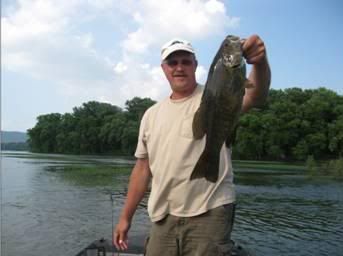
"Inch for inch, pound for pound, the gamest fish that swims."  -Dr. James Henshall from his 1881 book, "Book of the Black Bass".  Although I love smallies and understand his passion, it's obvious to me, Dr. Henshall had never hooked into a big rockfish. Pictured:  Bob Barber with a nice Susquehanna smallmouth.

In a nutshell, that's why they are addicting.  Rockfish are so strong that I often hook a decent one and claim that it's a better fish than it is, often shouting to my fishing pals, "This is a good one!" as a little drag peels off, and then realize later in the fight that it's the same size that I've been catching all along.  I'll follow up with a statement like, "well it's a future forty incher!"  

However, when you actually hook into a jumbo rockfish, you can tell it's an entirely different class of fish.  Let me tell you, the big ones can really test your light tackle skills.  No big rockfish is caught until you've either got a hold of it or it's in the net, because they simply have no quit.  

On my last trip out, I hooked a fish on a topwater plug, and it turned out to be a jumbo rockfish.  I hooked it on a medium spinning rod with ten pound braid, and that fish took me around the boat.  My fishing pals were all fighting fish too, so I had no help.  I was on my own to land this fish.  No biggie, right?  I've done it hundreds of times.  This fish was just a little bigger.  With my rod in my left hand raised as high as I could, I eased the lunker rockfish toward my hand.  The huge mouth that could have almost enfulfed my head had my large Stillwater Smack-it all the way inside it's mouth.  We didn't have a net large enough for a fish like this, so I tried to grab it's lower jaw, as it seemed that the fight was over.  

The fish had other ideas.  It took off straight down under the boat like a shot, and my 20 pound Seaguar Fluorocarbon leader snapped.  The fish escaped with my favorite topwater lure, leaving me with an empty line and leader blowing in the wind.  I almost cried.  What an amazing species.  It showed me who's boss!

Fishing for rockfish isn't new to my circle of fishing buddies.  We've fished the tidal catch and release areas for brute migratory rockfish for years.  The exception was this past spring, because our local laws changed to prohibit catch and release fishing in the major tributaries of the Bay.  That was painful.  Prior to last year, it's been an annual April tradition.  

Over the years, those spring runs have produced some tremendous days, with catches yielding rockfish over 40 inches numerous times.  Casting crankbaits has been our pattern of choice for targeting big spring rockfish.  The crankbait bite is truly an addiction within this addiction.  There's nothing like the vicious hit of a rockfish on a crankbait.  It's pretty amazing when a big one smashes it and nearly dislocates your shoulder on the strike.  You work the crankbait fast and erratically, and then all of a sudden, one crushes it.  It feels like you've hooked a bucking bronco.  That feeds the addiction alone, nevermind the ten or twenty minute fight that you have coming.

Crankbaits rock when it comes to catching big spring rockfish.

The truth is that we stumbled on the tidal crankbait pattern.  One day, many years ago, my friends, Bill Dowd, Bill May and I were bass fishing out of his bass boat.  It was a frosty early April morning.  Bill May caught a nice chunky three pound largemouth that hammered a spinnerbait from under a partially floating log, but, other than that, the bass fishing was very slow.  We used the trolling motor to venture out from shore in an effort to mark fish along a drop off or in a channel.  It seemed like it took forever to move from three feet of water to six.  Then, it went rather quickly down to twelve feet of water, and lo and behold, we marked fish.  

Bill May, dropped a green pumpkin bass tube jig down to the bottom and had a nice fish hit it immediately.  That fish came unbuttoned just out of sight under the boat.  We all thought it was a big largemouth.  Then, I hooked up and fought a nice fish as well, and it turned out to be about a six pound fish, but...it was a striped bass!  We repeated the drift and observed the sonar, and noticed them holding in a twelve foot trough for about a mile mile long.  

After repeated drifts down the trough, we caught numerous stripers all day long.  We caught fish on bass lures, mostly four inch tube jigs, Rat-L-Traps, spinnerbaits, small crankbaits, and jigging spoons.  My friend Bill Dowd caught one that went just over 30 inches, and I managed to boat a 34 incher that hit a jigging spoon, which was my personal best at the time.  

After hearing about our trip, my good friend Bob Barber invited Steve and I to fish out of his boat and we found them again in the same "trough".  We caught lots of 18 to 30 inch rockfish by jigging or trolling sassy shads and Rat-L-Traps.  Steve and Bob pounded them all day on the jigs.  

Stubborn me, on the other hand, wanted to fish crankbaits.  I caught a few fish on a Rat-L-Trap, but the action was a little slow on that lure.  The crankbait action was hot the prior trip at the end of the day, and I wanted to duplicate that with more time.  I was frustrated as Bob and Steve landed fish after fish, about three or four to my one.

During the late afternoon, the tide changed and the action picked up, and things started to change for me as well.  Bob fought a nice mid-twenty inch fish to the boat, and, right at boatside, a monster striper rose from the depths and tried to eat the smaller rockfish, and nearly knocked it off of Bob's hook.  We all stood there with our mouths agape.  In the movies, one might say something like, "We're gonna need a bigger boat..."

I immediately dug into my tackle box looking for the biggest crankbait that I could find, and pulled out a seven inch Bomber Long A.  If I remember correctly, it was about the third cast, just as Bob swung the boat around with his trolling motor, a fish hammered my Long A.

I fought that fish for a long time.  It seemed like forever.  In my mind, it seemed like maybe forty minutes, but, in reality, it was probably only ten or fifteen minutes.  I'd have to have Bob or Steve chime in on that.

We were using light tackle, and this big fish fought extremely hard against the spinning rod that I typically used for fishing plastic worms for largemouth bass.  I was using twelve pound Fireline that day.  It took me quite a while to get that fish to the boat after several runs.  It was a monster, a 45 1/2 inch striper and weighed 38.1 pounds!  That fish remains my personal best to this day.  I'm glad that I stuck with fishing crankbaits!  After an excellent job putting that fish into Bob's undersized net, we admired the fish and set her free.  Bob and Steve both tied on big cranks and caught good fish for the rest of the day.

The Long A really turned my day around, as my biggest four fish went 45 ½ inches and 38.1 pounds., 37 inches and 21 pounds, 34 inches and 15.2 pounds, 31 inches and 11 pounds, and I caught several between eight and ten pounds.  It was nice to have a scale to record the weights of the fish.  Because of that day, I have a good idea of how much the fish we catch today weigh.  

I'd love to share pics with you of any of those fish.  But, I can't.  You see, this was way before any of us owned a digital camera or a phone with a camera, and, earlier in the day, we used up all of our film on the smaller fish.  We had no idea monster rockfish were in the area.  The only proof that I have are the eye witness accounts of my friends, Bob and Steve.

What a day!  That changed everything.  That's when the striper addiction started for us, way back in 2002.  From then on, we went back to that area in an attempt to repeat our previous success.  Conditions vary during the spring there, and you have to hit the conditions just right to fish crankbaits for stripers.  The right conditions need to be the right water temperature, good water clarity, light winds, and the fish have to be there.
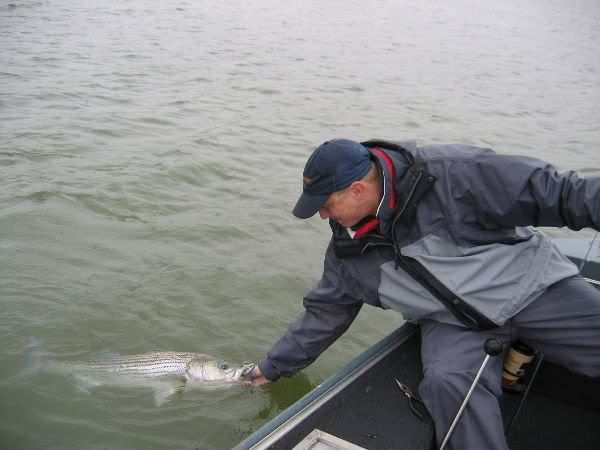
My friend Bob Barber, Steve and I had a great day back in 2002.  Here, a few years later, Bob lands a really nice rockfish that he caught on a crankbait during a past April catch and release season.

We've had some successful days since then, but, you had to time it right.  Finding suitable fishing or boating conditions doesn't always coincide with when the fish are there.  The weather in April is usually not the most stable.  Wind is the enemy, because, not only does it result in small craft advisories, it muddies up the water.  Dirty water is not a good condition for fishing crankbaits for striped bass.  You need some visibility.  It doesn't have to be gin clear, but clear enough for the fish to see your lures.  

A few years ago, out of Steve's boat, I was nearly able to match that 45 1/2 inch rockfish, with a really fat 44 and 3/4 inch fish.  It may have been heavier than the one that I caught in 2002, but, we never weighed it.  I'll post the details of that memorable day in a future post.

This 44 3/4 inch beast hammered an 8 inch Bomber Long A.  You can see why, when you catch a trophy like this, you're addicted for life and crave ever so more...

After that, we were all obsessed with the catch and release spring striper fishing, so much so, that we'd forget all of those other good fishing opportunities available to us for other species.  I mean, I was a largemouth bass fanatic from way back.  I never thought that I'd pass up fishing for largemouth bass in April for anything.  For the month of April, fishing is good just about everywhere for any species.

Don't get me wrong, the good Lord knows that I love catching three to five pound largemouth or smallmouth bass, or slab crappies, or big white perch.  But, put each of those fish up against a trophy rockfish, and the choice is clear, at least for me, what I'd rather target.

I caught this big largemouth on a Rat-L-Trap off of Captain Steve Kelley's boat also.  We both love fishing for largemouth bass in the spring.  But, our first choice is to target rockfish in April.

When the spring crankbait bite is on, you can't beat the thrill or the action, especially when you have the chance at the fish of a lifetime.  But, the spring trophy catch and release "season" is short lived, as the bigger fish leave the tributaries and head out to the Bay and into the Ocean in a matter of weeks.  In other words, our addiction pretty much ended when that "bite" was over.  It was truly a short term sickness.

Summer traditionally for me was the time to wade fish for smallmouth bass.  I love small stream fishing.  But anytime Steve invited me out to the Bay, the chance of catching a big rockfish trumped stream fishing for bass.  No offense to my stream fishing buddies, but I like variety, and getting out on the Bay was a welcome change.

When Steve invited me to fish the Bay with him in the summer, we always had the goal of getting a few keeper fish and simply have fun.  We'd drift bait back to the bridge pilings and catch a few keeper rockfish mixed with white perch.  It was fun, because you never really knew what you were going to catch.  Rockfish, toadfish, drum, trout, flounder, perch, bluefish, and sea bass catches always kept you guessing.

We were convinced that bait was the way to go to catch big fish, and, although we knew that anglers regularly jigged for rockfish successfully, we clung to the notion that bait was the best way to go.  It's no secret that live or fresh bait will tempt big fish of all species.

Steve with a nice rockfish caught by drifting bait to bridge pilings.  Bait will catch fish, big fish, consistently.  However, learning to catch big fish on jigs really stoked our addiction for striped bass fishing.

After we'd run out of bait, we'd head out and look for breaking fish under birds or find spots with good current and structure that held rockfish.  Once we found such places, we'd toss paddle tail swimbait jigs to catch lots of schoolie sized rockfish.  It was fun, and, although we both heard that big fish may be under the smaller fish, we didn't know how to find them or fish for them.  Still, we had fun fishing the Bay that way.  Every now and then, we'd catch a smaller sized "keeper" fish.  Even though we had fun, we didn't really feel the rockfish addiction as we did during the spring catch and release bite.

We both wanted more.  We tried jigging with limited success around the Bay Bridge pilings, but still were convinced that bait was the ticket for bigger fish.  Steve and I researched the internet to learn more.  We watched YouTube videos about fishing the Chesapeake Bay, read blogs, and fishing forum posts.  

I purchased Shawn Kimbro's books after we watched every single one of his videos.  The books and videos were not only very informative, they were also inspiring.  We did everything that we could do, purchased the right tackle, practiced the right techniques, and did everything that he recommended.  That was the start of "The Striper Jigging Revelation".  

You can read all about that by clicking on the blog post link above, or simply scroll down the page to post below this one.  That article contains information about jigging techniques and recommended tackle.  Each trip out, Steve and I learn something new.  Every time we successfully found and jigged up nice rockfish, it was like  putting the bigger puzzle together, one piece at a time.  

However, it's more than that.  Our growing rockfish success caused us to give up other outdoor activities.  Steve and I both bow hunt.  Since my Brother, Kyle, passed away, Steve's been the only person that I've hunted with on a regular basis.  We each have our own spots too.  Neither of us missed hunting season for anything.  It was another seasonal addiction.

But, last winter, we wanted to catch stripers so bad, that neither of us purchased a hunting license.  Steve typically winterized his boat each year around late October or November or so.  Last year was the first year that he didn't do that.  We kept fishing, and never sat in a tree stand.  We gave up one addiction for another.  That's sick!!!

October though mid-November used to be reserved for bow hunting during the rut.  Now, those months have become addictive striper fishing months.  Now, we fully understand the Maryland term for that time of year, "Rocktober".  Our bow hunting time has been relegated to a late season phenomenon.

Dan Ricker knows the sickness too as he sports a fat slob of a rockfish caught on a Coach Jig Head rigged with a Bust'em Baits Fat Boy.  Dan constantly barks out how he'd rather be walleye or crappie fishing, but you can tell that he's as addicted as we are.

So, for those of you that know this disease and suffer the same affliction as we do, then you recognize the symptoms.  That's when you know you have it bad.  All you think about is the jig, topwater or crankbait bite, and the fight of a big rockfish that peels drag off and fights so hard.  All you think about is how you can find more pieces of the rockfish puzzle to achieve further fishing success.  Instead of watching television with your family, your mind drifts off to another world as you scan the Navionics app on your phone, looking for good structure that might attract rockfish via current breaks and ripping tides.

You can't put down Shawn's books.  You've read them until you've almost memorized them.  You scour the internet and read every local fishing report that you can find, or any web forum post about striper fishing, for that matter.  You can't stop scrolling through the Facebook posts of your fishing groups to read rockfish reports for the days that you couldn't fish.  

Catching fish like this just aggravated Steve's symptoms.  After a fish like this, you'll get "the sickness".  

You go through and organize your tackle and repair the rigs on your striper rods even though you may not have a trip planned yet.  You order tackle on-line, or visit the local tackle shops to get more of what worked for you.  If you're broke like me this time of year, you visit on-line tackle stores and add items to your cart or wishlist, knowing that you can't afford to pay for them yet.  You may visit a local tackle shop to buy some tackle for a fishing friend as a holiday gift, but, of course, you can't help picking up some tackle for yourself.

You find that, while doing other things, whether it's shopping at the local hardware or grocery store, doing errands around the house, sitting in a tree stand, or even other types of fishing, you dream of jigging for rockfish.  You find yourself always checking the weather...not at home.  No.  You check, at multiple locations around the Bay using various weather apps to find out wind and wave conditions for the next ten days.

Check out our buddy Rodger Moran's expression after catching this rockfish.  Think he's got "The Sickness" or what?  

You also call your fishing friend network to find out the latest intel.  When your fishing pals are out there on days that you can't go, you text them constantly for updates, knowing full well that if you were out there and the bite was on, that you would focus on fishing and ignore your phone.

You dream about jigging for rockfish, and you set the hook in your sleep and accidentally knock your spouse in the arm.  Or, perhaps you have a dream where, on every cast, big rockfish are knocking your topwater plug out of the water or crushing it so hard that they set the hooks themselves.  These are recurring dreams, by the way.  

You've got it bad.  There is no cure.  Your only hope is to treat the symptoms.  How?  By going out fishing for rockfish.  

You've got "The Sickness"! 


Friday, February 21, 2014

On the Hardwater - Attacking a Small Lake for Panfish

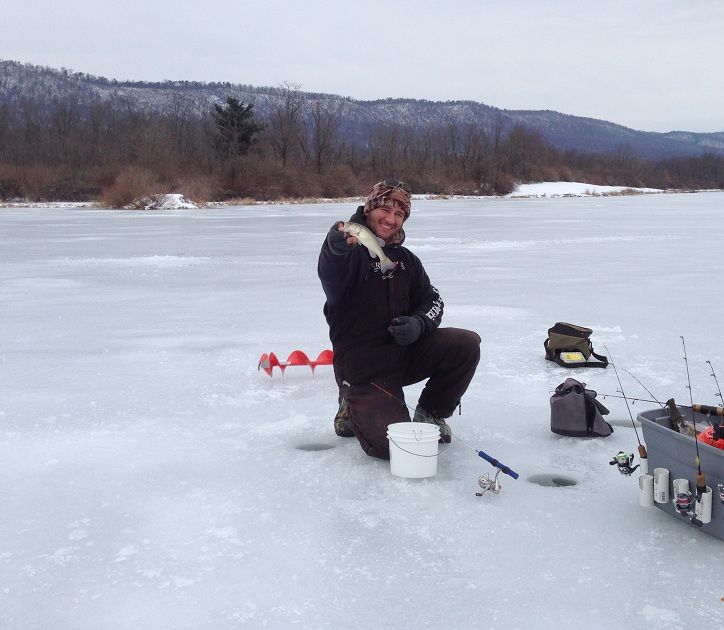
Why people ice fish means many things to many people.  Some like the outdoors experience, just being out there, opting to not sit on the couch watching outdoors shows on the television.  Others like the social aspect of ice fishing, even bringing cooking devices out on the ice to have a big party while catching a few fish.  It's all good!  But my goal is to catch as many fish jigging as I can...that's how I have fun on the ice.  Smaller lakes often give you that opportunity.  I like to improve my chances by hitting the hardwater on the smaller lakes.  So, how do I approach my goal?
Small lakes offer an easy advantage to finding active panfish because you can cover a ton of ice in a single day.  During mid winter, I like to start deep near dams or creek channels, then work towards more shallow types of structure, or cover like weed beds or tree blowdowns.
I like solving the puzzle, not only finding where the fish are, but where I can find the ones that are willing to bite.  Sometimes it takes a little work, and at other times it could be a lot of work.  Rarely, you might cut only one hole!  But the most fun is catching them, one after another.  It takes some knowledge, either learned via experience or from various media, such as videos, magazines, books, television shows, fishing forums and even from other ice anglers.  And a little luck doesn't hurt.

The first step is to pick a lake that has a good panfish population.  When I'm talking about a small lake, I'm thinking about a two hundred or so acres or less.  The vast majority of the lakes in my region are man made, featuring a dam, flooded creek channels, points, islands, and other structure.

An advantage of finding a gem of a small lake is that you can cover most of if not then entire lake to find fish. You can still make that major change if the bite is off by fishing a totally different area on your lake or by having another nearby small lake as a back up plan.  Sometimes, that major change will put you on active fish.

My favorite fish to target through the ice are crappie, but I also love a good bluegill or yellow perch bite.  So I tend to prefer lakes with historically good crappie populations and size.  
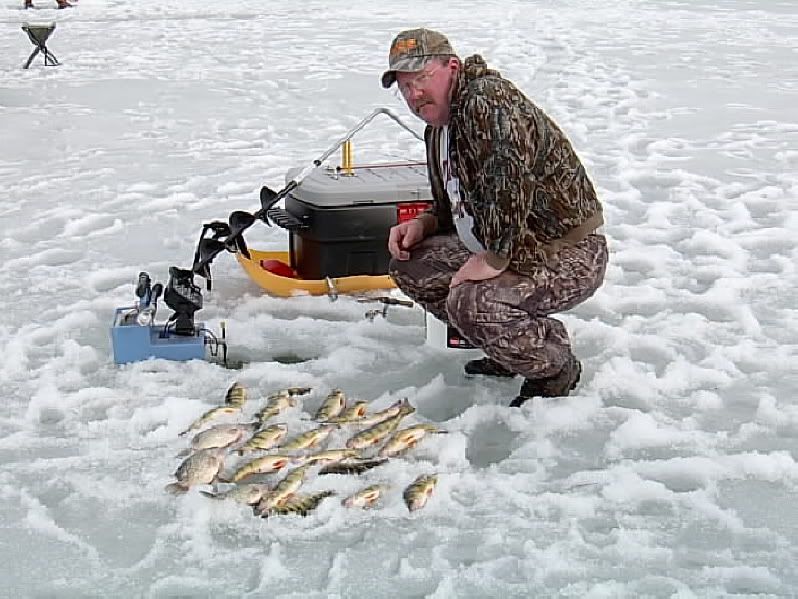
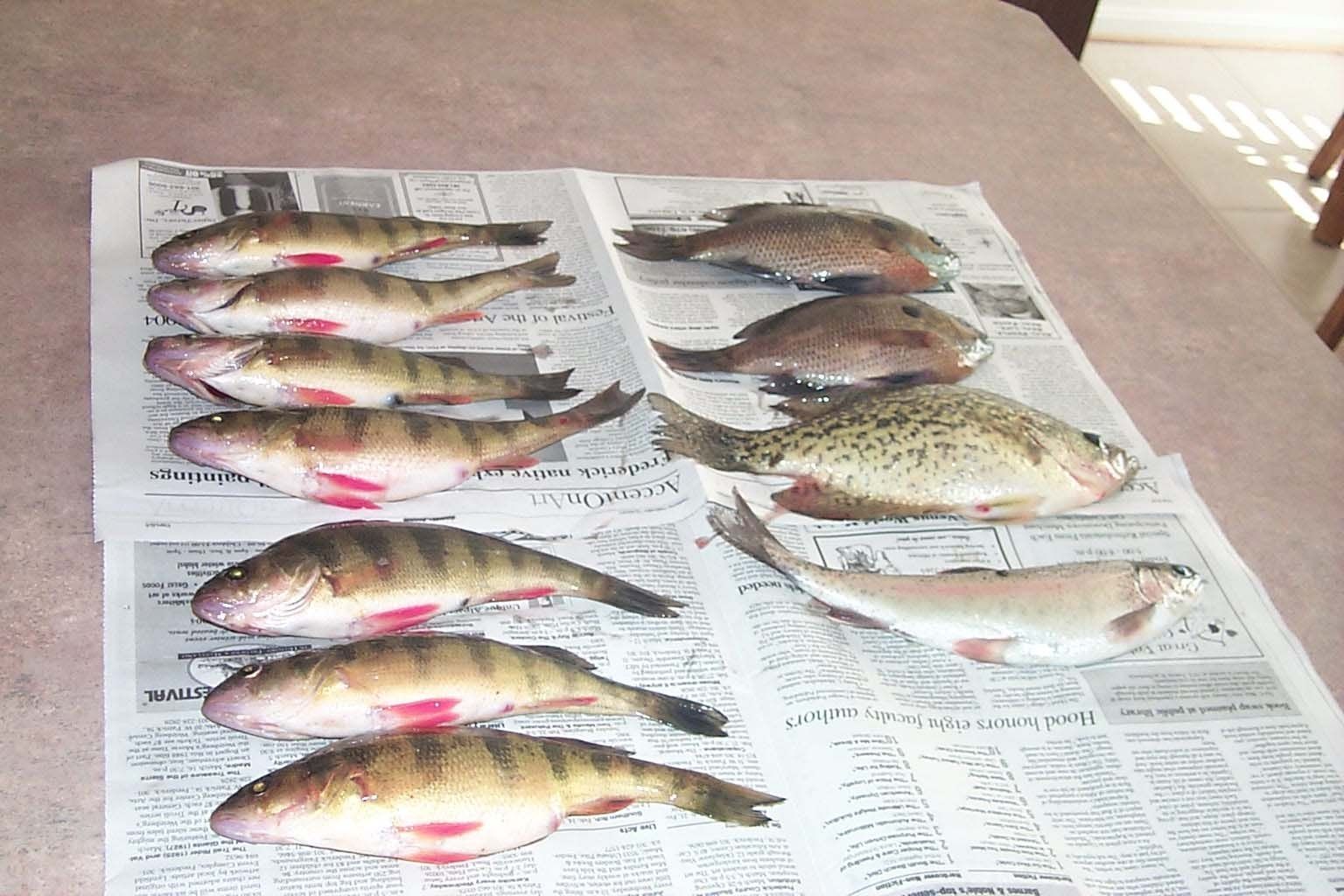
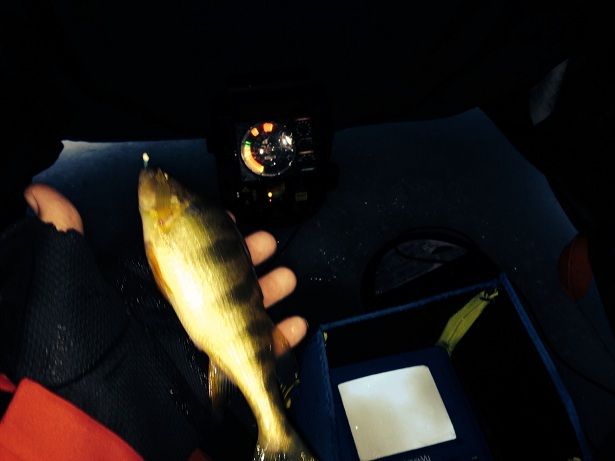
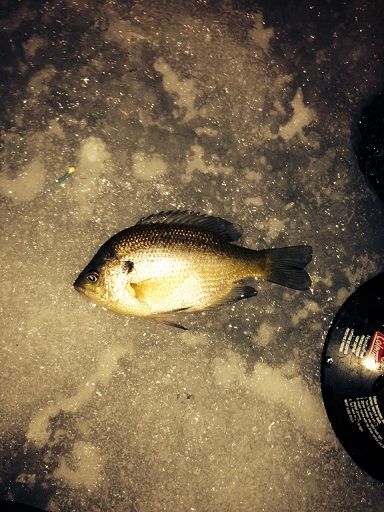
Mixed bags of slab crappie, yellow perch, and bluegills are a real fun time.  These fish were all caught in thirty feet of water over a creek channel not far from the dam.  Smaller lakes give you the opportunity to catch a bunch.
Small lakes offer an advantage over larger ones with respect to finding fish simply because you have less water to search to find them.  But panfish size vary from year to year, especially with crappie populations where sizes often vary.  Some years yield those fat slab crappie, others give up the medium sized ones.  The same holds true for perch and bluegills.

Other lakes may have large populations of "dinks" and but sometimes give up the larger ones.  Those bigger fish are harder to find.  But if you're into dinks, move to another location on the lake and hunt for the bigger ones if you know that lake supports them.  This frequently occurs with bluegills and perch one some of the lakes that I frequent.

If' I'm marking a lot of fish, it's tough to leave them.  But if they are four to six inch perch, or tiny bluegills or crappie, it's best to move from my experience.  Usually, I'll move to a different structure or area of the lake.  If the dinks are deep, then I move to weedy break lines, for example.  Often that change results in bigger fish.
My brother Kyle poses with a dink perch.  If you're catching dink perch like this, move and go find bigger panfish.  Tiny perch like this often group in large schools like this as a defense against predators.   Later, we'd find a nice mixed bag of  bigger panfish to bring home for a fish fry.
Finding good sized panfish on larger lakes (near 200 acres) could prove to be tougher.  Basically, you have to break the lake down into more manageable water size to cover.  Use lake contour structure maps to locate an area where the structure is more suitable for panfish and work that area.  Have a back up location if you have to make a spot change to get on fish if your first spot doesn't pan out.

It helps to have experience on a particular lake.  I have a few favorites, and patterns from one year to the next tend to hold true depending on how late you are in the ice season.  Sometimes that past experience pays off by cutting down on the time spend searching for fish..

During early and late ice, I look for mid depth fish first, fifteen feet or less, then adjust accordingly.  But it depends on what species your targeting.  Weed lines or flats near structure, points or a creek channel, are good places to find perch.  The creek channels tend to be good crappie spots, or any cover, such as a sunken tree or brushpile, or man made fish structure.
After cutting a bunch of holes, we finally found some bigger panfish and a bonus stocked trout.  These were stacked up near a creek channel off the end of a long sloping point on one of my favorite small lakes.
During mid winter, my approach is to start deep, then work shallower.  The Eastern waters that I fish are usually small reservoirs, with maximum depths of twenty to forty feet.  I typically look for fish in the twenty to thirty foot range first, them move deeper in my search.  If that doesn't pan out, then I move shallower.

I've found that schools of crappie during mid ice tend to hold over the deeper basins of lakes that I fish, or off creek channels near dams.  Often, you'll find yellow perch and bluegills with them this time of year.  Our lakes are man made, so most of the time there are creek channels, flats, points, primary and secondary drop offs to check.  I like to search the channel edges first.  As you move shallow, search for weeds because they could be the key when the deeper waters seem like a dead sea.
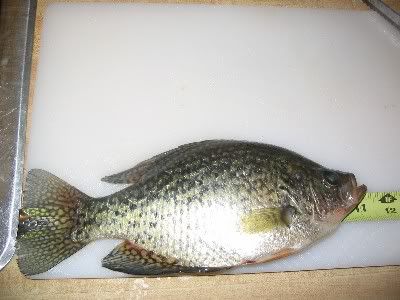
To me, crappie like this slab are what I look for and expect on the smaller lakes that I fish.  I am in seventh heaven catching crappie like these through the ice all day long!
Start by using either your own past experience on the lake, where you've caught crappie during mid ice, or locate the type of structure that you'd like to fish on a lake contour map.  Start by cutting a series of holes over the location of the structure, or where you think it may be.  I use a hand auger because, in my neck of the woods, the ice rarely gets thicker than a foot.  So, cutting a good number of holes becomes an obvious workout the thicker the ice gets.  That's when a power auger becomes effective.
I use my Clam Fish Trap Pro as my home base, then start cutting and checking holes.  Don't waste time on inactive fish.  Move and find fish.  Small changes at first might work.  If not, think bigger changes.
I usually cut a half dozen holes to start, then check them with my sonar.  I search for either suspended fish, or fish marked on the bottom.  For those fish on the bottom, the sonar shows the bottom jumping.  When the fish moves, the mark flickers, and if that mark is close to the bottom, it appears as if the bottom is flickering.   If the bottom doesn't jump or move, most likely you're not marking fish.  If your sonar transducer hangs or is supported by a float, make sure that it's stabilized and not moving, which could give you a false reading of marked bottom fish.

If I mark fish, then I'll drop a lure down and see how they react.  I can see my jig fall as a bar on my sonar toward the bottom.  If another bar moves off the bottom toward it, then I know the fish are active, and that means a fish is either moving toward my lure or interested in it.  When the bar representing the fish meets the bar representing my jig, I take my eyes off the flasher (sonar) and watch my rod tip.  If there is any movement of the rod tip or line, set the hook.

Now, marking fish is one thing, even ones that appear interested, catching active fish is another.  Just because a fish moves in to inspect your lure doesn't guarantee a bite.  Fish sometimes are curious, but finicky, and it either takes extra effort to tease them to bite or they just aren't interested.  We call those "sniffers."  If you routinely mark sniffers, move.  If they are in every hole that you cut, move and cut more holes.

Later in the day though, it might be wise to remember where those sniffers are, especially if you catch one and it's a good sized fish.  Because, often low light conditions, commonly thought of at the magic hour, that last hour of daylight, finicky fish might become more active later.  If you get into a good bite and it dies off, it may pay to go back and recheck the sniffer holes again.

Some anglers may try a variety of jigs to tempt the sniffers into biting, hoping that the magic jig will turn on the bite swtich.  At times, making changes in your offering, either tipping with bait or downsizing, will work.  But more times than not, moving is the key.  While those guys are trying to get that one fish to bite, I'm looking for multiple biting fish.  You can pad your numbers in a hurry by finding those biters.

Another thing about sniffers.  They may not be big finicky fish, but rather could be dinks.  Dinks often will sniff because, quite frankly, your jig might be too big for them.  If you mark a fish that charges up to your lure but then gets spooked the second that you give it a jig, most likely it's a small fish.  Move!

Since I really love crappie fishing, I tend to search for suspended fish.  I have very little patience when dealing with sniffers and fish that won't rise off the bottom much.  I search for suspended fish when I can.  There are times when you won't find them, but sometimes you do.  When you do, the reward usually means more bites and active fish.  Perch really like to feed off the bottom, so that might explain why my crappie and bluegill numbers when catching a mixed panfish bag are higher than my perch numbers.
This is what I'm looking for when searching for big schools of panfish.  When reading this sonar, the bottom was nineteen feet, shown at about eight o'clock.  The surface of the sonar is at twelve o'clock.  All of the marks in between are suspended fish.  Fish also were on the bottom.  We call this, "sonar lit up like a Christmas tree!"
When I finally find the crappie, I will fish that hole out because they usually hold in big schools.  If they are suspended, often you'll catch perch and sunfish that suspend with them.  That situation may result in that nice hundred fish day!  If you plan on fishing for crappie after dark, remember what holes you caught them in because it's likely those holes may produce near or after dark. I'll provide some night fishing secrets in a future post.

The key to being successful to this type of fishing is to move when things aren't going well, and find those active fish.  It may mean cutting a ton of holes or making major spot changes, but the reward could be worth it.  This isn't a new concept.  I learned it many years ago from my ice fishing mentor, Jeff Redinger, who taught me the Dave Genz approach, using sonar to find fish and a comfortable portable shanty that allows you to easily make those important spot changes.  I'm sure that there are other pioneers out there, but that's how I learned.
My ice fishing mentor and friend, Jeff Redinger, posing with a massive redear sunnie.  Jeff has caught countless slob sunfish like this over the years using the techniques that he taught me, techniques made popular by ice fishing legend Dave Genz.
Many of you may apply these tactics already and have experienced that success.  But some of you may not have learned this yet, and my hope is that this helps you.  Just because you have a sonar unit and are marking fish, doesn't mean that those are the fish that you should be targeting.  Move away from sniffers and go find some biters!  Move away from dinks and go find bigger panfish!

My best of luck wishes go out to all of you hardwater anglers, and please be safe during these next few weeks of late ice!

Sunday, February 16, 2014

The Century Mark on the Ice!

Last week I met up with a musky fishing friend of mine, Mike Carrigan, and a couple of his buddies on small local lake.  My buddy Wayne also met me there.  The plan was to find some willing crappie at first light, and for me to make a day of it.  Wayne planned to stick it out with me, while Mike and his buddies were only fishing a partial day.
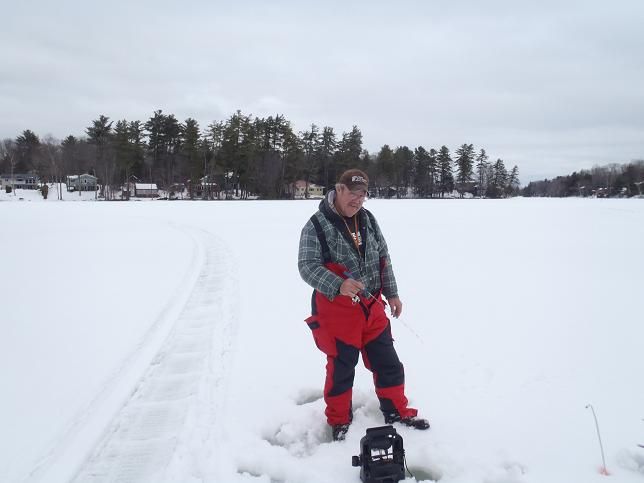
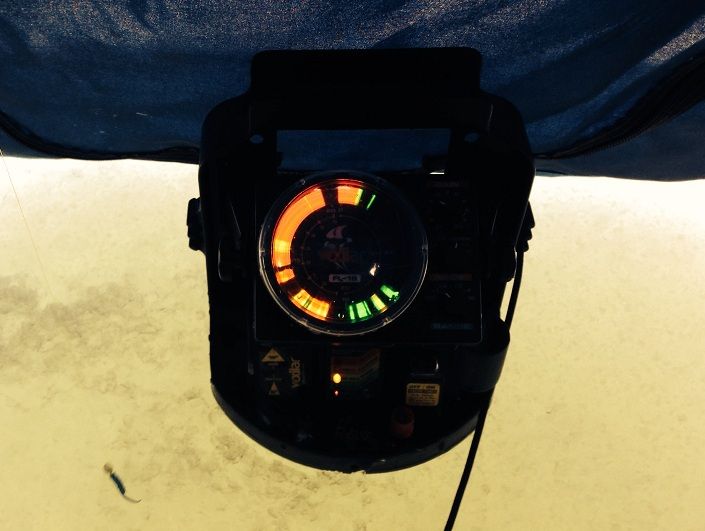
My friend Mike Carrigan fishing out of a Clam Fish Trap and using a Vexilar FL-18 flasher.  Mike caught some decent trout and crappie throughout the morning.  He found some active fish out of this particular hole.
Most of the snow from the previous week had melted and refroze, forming a nice white layer of slick ice on top of a good nine inches of clear ice.  The weather was cloudy but pleasant, not much wind, right below the freezing mark all day.

I arrived after sunrise, getting a later start than I had wanted.  Wayne, Mike and his buddies were all on the ice already.  As I was getting ready, first Wayne showed up to greet me, then went back out and fished, followed by Mike a short time later.  It took me a while to get my stuff organized and ready to roll.

Mike and his buddies were about a hundred yards away from Wayne.  They were fishing the deeper water near the dam, while Wayne was working the deeper drop off out from a main point not too far from the dam.  I decided to cut holes in between all of them, to connect the dots, if you will!
Wayne had already located a school of active bluegills and a few crappie, out in the channel closest to the main lake point.  Here's he is using his sonar to watch the reaction of the fish as he teases them into biting.
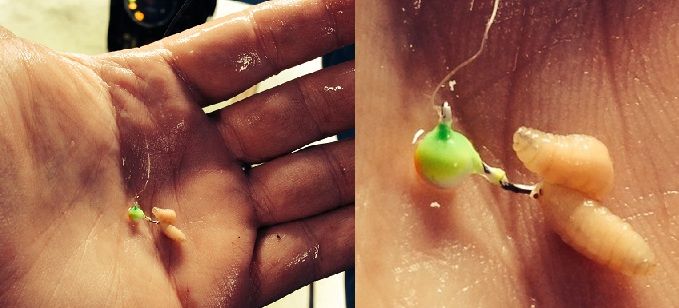
I proceeded to cut half a dozen holes, scooped out the ice chips, and dropped my sonar down to see if I could mark fish.  I marked fish in every hole.  They weren't suspended, but were holding tight to the bottom.  I dropped my twin Ratso soft plastic rig down and drew the fish off the bottom  in each hole, but they either bit really lightly or lost interest quickly.  I went back and covered each hole with a smaller jig rigged with two maggots to see if I could get those finicky "sniffers" to bite something tipped with bait.
Starting near my sled,  I cut holes between Mike and his buddies and my friend Wayne, hoping to mark and find some active fish.
Spikes or waxworms as bait act as a nice tasty treat to the fish and provide a little bit of scent to trigger their feeding instinct.  When the fish are active, I prefer to use the soft plastics and not mess with constantly replacing bait when the fish pick the maggots or waxworms off the lure.  But, sometimes, they only thing they will bite are the baited jigs.

Mike was catching medium and small sized crappie now and then, while Wayne, over by the point was getting a pretty good bluegill bite going with an occasional crappie.  Meanwhile, I was having a hard time getting solid hits.  So, I kept cutting holes.

I walked over to see how Mike was doing, and he found a hole that held a few pretty aggressive fish.  I watched him fish for a bit while chatting about the fishing on this lake, and took a nice little video of him in action, showing us how it's done.  Please note that this fish is one of the small finicky crappie, not one of the bigger ones that he caught throughout the morning.  The fact that this catch is on video is merely because I spent way more time fishing than walking around taking videos.  Yet, it does illustrate how to use a flasher to catch fish.

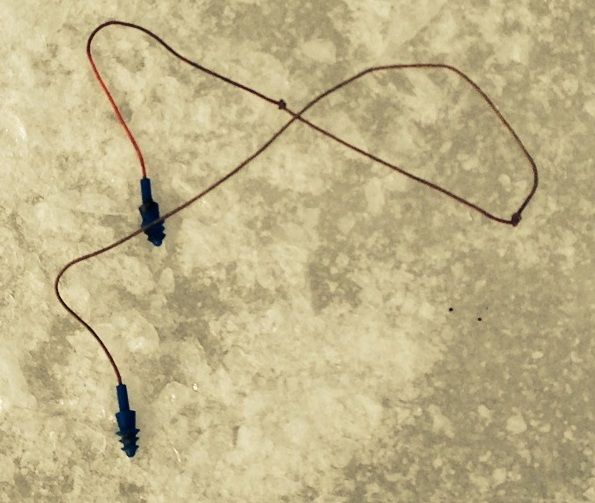
Mikes buddies were catching some stocked rainbow trout on tip ups, and Wayne was jigging a few up too.  But one of the small trout had something sticking out of its gullet, a set of shooting ear plugs!  At least five inches were down it's throat.  We all got a laugh out of that!
These were the earplugs that were found in a trouts gullet that Mike's buddy Phil caught on a tip up.  We cracked up, saying that maybe he should put this back on a tip up and try for another!
I wasn't satisfied with the holes that I had cut so far.  I wanted active fish, not sniffers.  So, I cut another half dozen holes along the basin of a cove not far away where I'd found a good crappie bite in the past with similar results.  I caught a couple small bluegills and crappie, about one fish caught out of every four holes, with lot's of sniffers in each hole.  And the sniffers that bit seemed to prefer the tiny jig/maggot combination.
Every hole marked fish, but when I caught them, they were on the small side.  These were the finicky fish, the sniffers.  When you get this type of inactivity or finicky fish, move and find bigger more active fish.
My next move was back near where I started.  In one of the holes that I cut, I marked what I thought at first was a fish, but it was some sort of structure.  Perhaps it was a tree limb or something.  This particular spot didn't mark any fish, or at best, a sniffer or two.  It was almost what I was looking for, structure, but lacked the fish that I'd expect there.

So, I decided to cut a half dozen more holes around that area.  The first hole that I checked was loaded with fish, suspended off the bottom over nineteen feet of water from the bottom ten feet.  This was late morning, and the fish were stacked like cord wood.

I remember saying to myself, "This is the spot!"
My flasher lit up like a Christmas tree!  The bottom of the lake is at about 8:40, which was nineteen feet deep, and there was a tree branch at about 7:35, about four feet off the bottom.  The rest of the marks were fish, showing all the way up to ten feet off the bottom (about  3:20 on a clock).  The surface is at high noon, with a couple marks that are noise from the ice surface.  You can see the fish were stacked like cord wood here!  This was the spot!
As I've described in recent posts, my tactic when finding fish stacked like this is to set up and fish over them for a while.  Most of the time, you'll catch a good number then the bite dies off and you're off on the search again for more active fish.  However, this spot seemed different.  This was late morning, and the fish were suspended.  My graph was lit up like a Christmas tree (a popular saying among ice anglers when they mark a bunch of suspended seemingly active fish).  This is the type of spot that can make your day.

My way of setting up is to cut a couple holes, one for my electronics, and one to fish out of.  Since there were a bunch of fish showing up, I decided to set up my underwater camera.  It took me a couple minutes to set up my shanty and the underwater camera so that I could see my jigs, but it took even less time for me to start hooking up.  I can't see much on the camera out in the open because of the glare, so I need to close up Clam Fish Trap Pro (my portable flip over shelter ), so I could see the camera.  Please note that I don't waste the time or energy to set up this way unless I know for a fact that I'm on a hot spot.
When I find a good spot with lot's of fish marked, I'll cut one hole for my electronics, and one to fish out of.  I took this picture shortly after marking tons of fish.
I lowered my camera to about ten feet off the bottom, the upper range of the suspended fish.  The water clarity was a bit cloudy, not as clear as I'd like for this type of set up, but it would have to do.  I could see only about two feet at the most below the camera, which is set to look down on the fish.  As soon as I picked up my rod and jigged, I saw a crappie swim in very quickly and miss my lure.  The next attempt from a different fish resulted in the fish sucking my jig in.

When I set the camera up, I dropped down my tandem Ratso rig down there because they're easier to find. The top Ratso was the one that the crappie inhaled, so I set the hook.  These weren't the dink crappie that I was getting earlier, these were decent for this lake.  They weren't big, but they were fat mediums, most good enough for a nice filet at nine to ten inches long.

The fish were ferocious.  As soon as I dropped the Ratso's into camera view, a crappie would swoop in to inhale it, aggressively.  And my sonar was showing a lot of fish down there.  I was catching them one after another, giggling like a little kid.  So, before the school left, I decided to coax Mike over to give the camera a try.

Mike spent about fifteen minutes in there playing with the camera and catching a few.  I heard him laughing as he was getting used to fishing versus what he was seeing on the camera.  It takes getting used to for sure, but he was having fun.  He didn't want to take up my fishing time, so he turned my shanty back over to me.

For the next two hours, the crappie kept showing up, actively attacking my soft plastic jigs.  I lost a couple nice crappie at the hole but for the most part, I landed about eighty percent of the fish that decided to bite.  I lost some time when crappie or bluegills decided to wrap themselves around my camera cable during the fight, but landed those fish.  The time lost was setting it up again so I could see my jigs.

By now it was snowing lightly.  I've always seemed to have good luck with the crappie while it was snowing, so this seemed to be the case again.

Over the next two hours, I managed to ice thirty four crappie and seven bluegills.  Then, they seemed to disappear.  But, one solid mark remained about four feet off the bottom and didn't more or react to any of my lures.  I couldn't see it on my camera, but I was pretty sure it was a larger branch of that tree that I found earlier.  I felt that the fish would return, so I decided to stick it out.

During the following few hours, I picked up crappie and bluegills now and then.  But, the fish became a bit finicky.  I could see them on the camera at times, and they'd move in and check out my lure and either bite or swim off.  I also was able to fish off the bottom and coax a decent bluegill into biting every now and then, below the tree mark.
Sometimes finicky fish, especially bluegills, will prefer a smaller jig tipped with a couple spikes.  This tiny Northland Tungsten Fireball jig fishes heavy and shows a nice mark on my sonar.
I took a break and socialized a little bit, and during the meantime checked some of the other holes out without electronics while jigging a Salmo Chubby Darter, a jigging lure that resembles a lipless crankbait and an effective technique for catching bass, trout and jumbo crappie.  I didn't get any hits, but Mike and his buddies, Phil and Nick, were pretty much calling it a day during early afternoon.

Meanwhile, Wayne was consistently catching bluegills and the occasional crappie out of his spot.  I went back to my hole and noticed that the suspended fish had returned, with more and more of them appearing on my flasher.  They snubbed my tandem plastics for the most part, but willingly hit the tiny jig/maggot combination.  They were bluegills.  Not the sniffing dinks from the morning, but decent sized ones.  I wouldn't say they were big, but they were decent, averaging seven to eight inches long.
Wayne with a small crappie caught earlier in the morning.  Later, we both caught quite nicer ones.  Like I said earlier in the post, when the bigger fish are really biting well, it's tough to be a camera man!
Bluegills fight like crazy and easily wrap around the camera cable, so I quickly pulled the camera out.  They were so active that using the sonar was highly effective.

These fish became very active and aggressive toward my smaller offering.  Every now and then, I'd hook a crappie.  By late afternoon, the bite was frantic again. The bluegills were all around the tree, both above it and below it, and sometimes suspending ten feet off the bottom, and extremely aggressive.  The crappie bite earlier in the day was quite impressive, but this bluegill bite was something else!
The bluegills preferred this small round ball jig tipped with a couple spikes.
Our hope was to fish into the dark for the crappie, that since we found them during the day here in decent numbers, that they'd return.  Usually, that's a good plan for setting up for a night time crappie bite.  But, I didn't want to leave this great bluegill bite to go back to my truck and get my lantern!

Wayne had moved closer so we could share the lantern light once the night bite began, and also was getting into the bluegills at a rapid rate.  He also had a knack for catching several trout on the day while jigging, and also a couple largemouth bass as well.
In between catching crappie and bluegills, Wayne caught trout and a few small largemouth bass, which are fun on the light ice panfish set ups.
I finally decided to quickly go get my lantern and return before it was too late.  But the bluegills didn't let me down, they kept on biting.  It was a great evening bite.  I managed to also catch a small bass.  Then, the sun dropped as well as the temperatures.
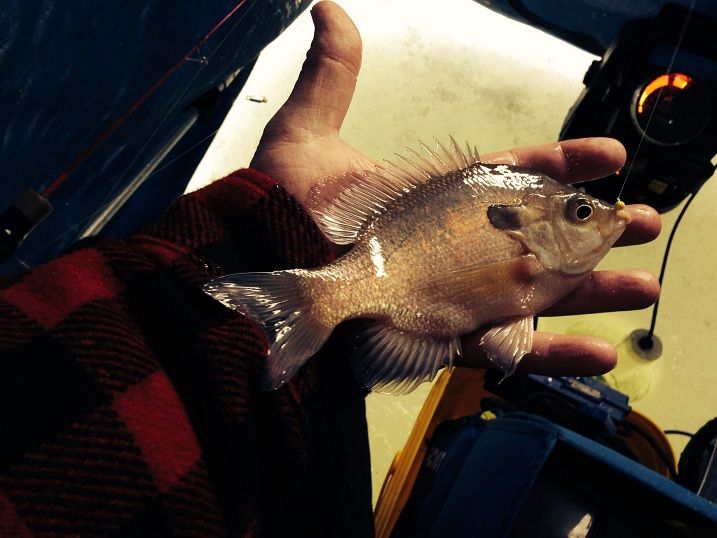
This hand sized bluegill liked that Northland Tungsten Fireball jig!
Wayne and I caught a few bluegills and crappie after dark, but the bite wasn't what we'd hoped for.  The fish became finicky but we marked them regularly.  I've noticed this before when fishing murky water, that those lakes don't make for great night bites for crappie.  So, we called it quits.

My numbers were my best trip of the year, and the size of the fish, although not large, was decent.  At least it was from the standpoint of having a good time.  I finished with forty two crappie, sixty three bluegills, and a largemouth bass.  That one hot hole produced 101 fish!  That is a great day on the ice, for me, a total of 106 fish on the day.  I'm sure Wayne had similar numbers.

Any time you hit the century mark with numbers of fish, on or off the ice, it's a trip to remember.  Hence, I thought that I'd share it with you!

What a fun day on the ice!

Monday, February 3, 2014

Hot Start to a Cold Winter...Hardwater Heaven!

Call it Polar Vortex, call it unusual, call it whatever you wish.  I call it winter, a normal winter that reminded me of winters past, where our local ice fishing opportunities lasted two to three months.  No matter what it's called, I'm thankful for it.  The mild winters of the past few years were painful to ice anglers like me, who had to travel further to find ice.  Now, my inner conflict, the open water musky angler in me, yearns for flowing rivers free of ice, but part of me is happy now!

As an ice angler, I couldn't have been much more happy about my first four trips on the ice.  I had the opportunity to meet new friends and fish with old friends.  And the icing on the cake, or on the lake, was that we caught a bunch of fish in the process.

My first three trips took place at the lake where it all started for me too many years ago to mention.  Yeah, I'm the guy that I used to call "old".  This lake was home to my first ice fishing adventure of my life, as detailed in my previous post, "Remember Your First Ice Fishing Trip?"  Jeff Redinger turned me on to this gem of a lake along with the sport of ice fishing.

My old friend Glenn Cumings met me up there, the same guy that hosted Jeff's ice fishing workshop that got me addicted to this past time.  Glenn is as equally responsible for my ice fishing exposure as Jeff is.  The ice was anywhere from four to eight inches thick where it looked “safe” that first afternoon.  The lake was drawn down about ten feet for the past few years because the dam needs
to be repaired.  The usual twenty something foot deep hot spots were now ten feet shallower.  But, the fish were there.

My first trip always seems like an orientation for me, not only to find the fish, but also to get the rustiness of not being on the ice a while out of me.  My hook setting reaction time seems to get slower each year, yet improves daily the more that I get out and fish.

I fished near an old spot where twenty foot depths were ten, hoping the fish wouldn't care about depth and remain on the structure.  I picked up a few fish here and there, but it wasn't a banner day for me. I finished with eleven medium sized crappie, seven nice bluegills, and five decent sized yellow perch.  I was only on the ice for just a few hours, so it wasn't all that bad.  In fact, it wasn't the fish, it was me.

One of my favorite rod and reel rigs for fishing soft plastics is my tandem Ratso rig.  I rig two Ratso's in tandem, one about eight inches higher than the bottom one.  The rod is an ultralight inexpensive fiberglass rod with a broken rod tip.  Being the cheap person that I am, I converted this to my ultralight jigging rod for these baits by adding a homemade “spring bobber” as a replacement tip top.  If you've read my other ice fishing posts, you know how much I rely on this rig.  It's my bread and butter panfish catching set up!

This rig really shines during that night time crappie bite.  Usually, when a fish bites, you see the spring move down with the fish pulling on the line.  Sometimes crappie will hit and the spring, normally loaded by the weight of the jig, actually rises and the line goes slack.  When fish hit like that, they’re pushing the bait up.  Crappie are notorious for that behavior.

Glenn introduced me to one of the guys on the ice, Tanner, who also frequents Iceshanty.  He fished with two of his buddies that had never ice fished before.  He let his buddies use his flip over shanty, tackle, and sonar units.  That's a true friend right there, hauling all that extra gear out just for them.

Since I didn’t arrive at the lake until about four in the afternoon, I didn’t bring my underwater camera onto the ice simply because of the lack of daylight.  I relied on the sonar to detect the fish and observe their behavior.  I may have missed some fish during the night bite because my lantern wasn’t working properly, and I didn't have the right tools to fix it on the lake.  Glenn and the other guys did well, maybe slightly better than I did, possible because of that.  I thought at the time it was because they were using bait, but that wasn’t the case.  I wouldn’t discover why my limited success until the next day.

All of my fish were caught on glow Ratso 1/64 jigs with blue glow 3/4 inch Ratso soft plastic finesse tails (stinger style) made by Custom Jigs and Spins.  On this lake, glow blue or glow pink are hot colors for some reason.  That day, blue worked much better than the pink.  As far as color goes, I'm not convinced that it makes a difference as it's more of a confidence thing, but the glow does make a difference in my humble opinion.  I think that how you work the lure and the lure size are far more important factors.  But it was a fun start for my ice season.  The fish weren’t big, but not quite dinks either…mediums I’d say.
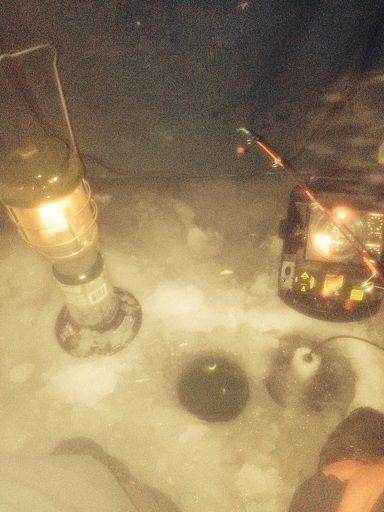
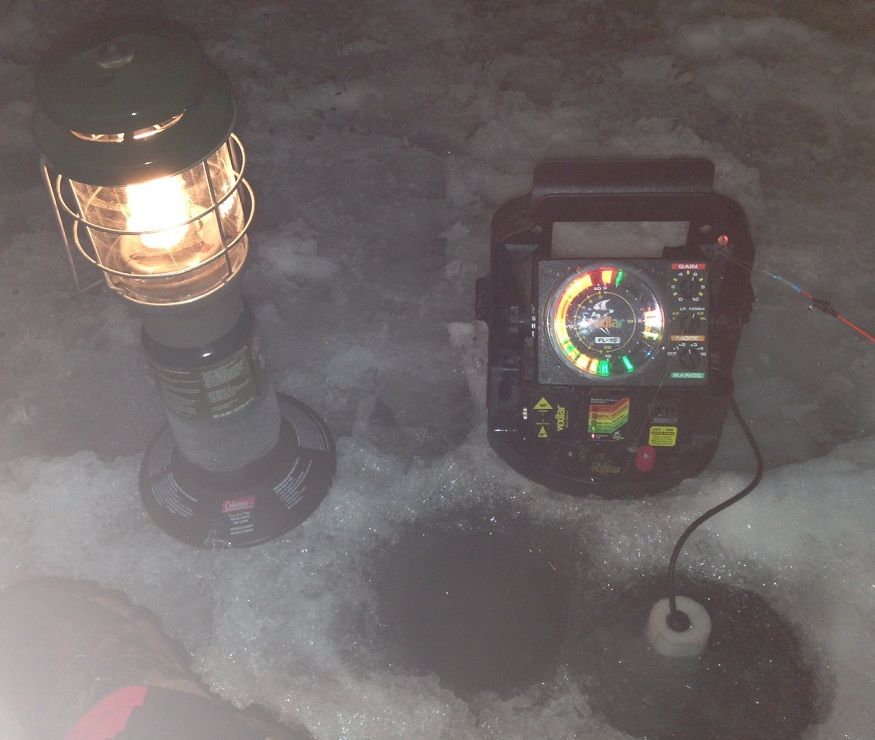
It looks cold, but it was actually pretty toasty inside my shanty.  I had to peel off a couple layers of clothing to keep from sweating inside there.  The lantern provides both light and heat inside, even in frigid temperatures.
I fished the same lake the next day, starting around mid-afternoon.   The bite was slow at first.  I only caught one bluegill for the first hour.  I spent quite a bit of time searching for active fish, cutting holes and checking them with the sonar.  Every hole I cut seemed to be the same, eleven feet and featureless, and not marking many fish.

I dropped my camera down for a horizontal look around, and saw nothing but mud and a clump of algae here and there, with no fish in site.  I checked four separate holes where I caught fish the previous night and found nothing.  Then, I found one spot that was about two feet deeper and marked a fish.  I didn’t catch it, but did mark it.  I figured this spot was different.  Later, that hunch would prove to be the reason that the fish were there.

I dropped down the camera for a quick 360 degree scan, and saw several bluegills.  This was a good spot to set up.  I cut one hole for my flasher, one for my camera, and one to fish out of.  Within a half hour, I had a few nice bluegills iced, not great, but a start.  I set my camera to look down on the fish at about six feet from the bottom.  This way, I could see them approach from any angle.  I could see my jigs and the bottom pretty clearly.

I spent most of the afternoon fishing inside my shanty.  It’s easier to see the camera in a dark house.  Of course, inside the shanty, you're also comfortable and out of the elements.  Every now and then I'd flip my shack open to chat and not be an unsociable hermit.  Tanner had arrived with his buddies, Ricky and Chris.  They also began to take advantage of the late afternoon bite.
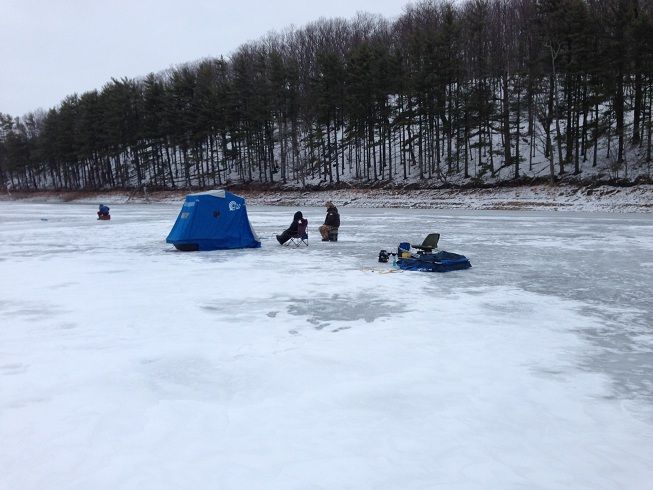
Pictured here are Tanner to the right, his buddy Chris in the chair, and Ricky inside the other shanty.  The guy furthest away is named Rich.  I met Rich the day before.  He’s a nice guy and really tore up the bluegills both days.  As you can see, not only can you catch a lot of fish, but it’s pretty sociable out there too!
While using the camera, when the fish moved in, I could see them inhale my lure, and I’d set the hook. That extra time made up for my slow old age hook sets and allowed me to land the light biters that gave me fits the day before.  Bluegills are notorious for being finicky light biters.  The camera helps to see them bite.

Later, even more fish showed up, and showed up in bigger numbers.  The fish chased down my jigs as quick as I could get them down there.  They competed with each other to get to them.  At one point, the bluegills pecked at my camera!  Then the crappie moved in.  They used my camera as structure!  I’d jig right up to the camera and a crappie would appear right there and inhale it.  They looked huge right in front of the camera like that.  They were extremely aggressive.  You can't see stuff like that on a flasher, which makes ice fishing with an underwater camera that much more fun.
I watched this yellow perch show up suspend right below the camera and engulf my offering.  You can see the Ratso firmly embedded in its upper lip.  Also, you can see my set up, the flasher and camera both in use.  During daylight, the camera was effective.  Deeper fish that were out of view had to be watched on the sonar until the camera could pick them up.  As daylight diminished, the camera's effectiveness did as well.
As we lost daylight, the camera became less effective.  My camera doesn’t work well at night.  The zooplankton are attracted to the camera lighting and they show up in huge clouds after dark.  Plus, it's an old undewater camera and the lighting isn't really all that great.  I've heard that the modern cameras work much better at night.  So, as it became dark, I had to focus on the sonar.  It didn't matter, as the bluegills and crappie stayed aggressive most of the evening.

This particular lake isn't open all night.  In fact, they will ticket you after a certain time.  There was a slow spell about an hour and a half after dark, but wouldn’t you know it, when it was time to get off the lake, the crappie showed up again, more aggressive than ever.  We managed a few bigger ones to close out the evening with some over ten inches long.  But most were mediums like the previous day.
Here’s a typical bluegill from that trip, measuring about six inches (average was 6-8”), with the Ratso in the upper lip.
That night, I finished with 44 crappie, 31 bluegills, and 5 yellow perch.  I caught my last crappie to round out eighty fish just in time to pack up and get out before getting ticketed.  Tanner was using maggots on a small moon glow jig and easily did as well as I did, and better than I did the previous night.  The difference for me between the two nights was that slightly deeper depression in the bottom that seemed to hold the fish.
The last crappie of the night, a small one.
Of course, after those two afternoons, visions of ice fishing danced through my brain all week at work.  I had the day off this past Friday, and went back to the same lake, this time toting Glenn with me.  We hit a local tackle shop for bait to pick up some spikes, just in case the fish were finicky.

We arrived at the lake and were fishing by about one in the afternoon.  A week after my first outing, the ice had more than doubled, now over ten inches thick.

Glenn heard about a spot that had a hot bite of bigger fish from a buddy of his, so we cut holes in that area and searched for fish.  I marked fish in every hole that I cut.  This area of the lake was nearly the deepest at fifteen to eighteen feet.  The fish actively checked the baits and nipped at then.  This behavior is typical of smaller fish, or very finicky larger fish.  You won't know for sure until you catch one.

After cutting a few more holes and having the same thing happen, I downsized to a tiny ice jig tipped with one maggot.  I had to catch one to see if they were worth fishing for or not, just to be sure.  I caught one fish after another on that rig, but they were literally three inch bluegills and four inch yellow perch, confirming my suspicion.  So much for the magic hole.

I didn’t want to waste time feeding baitfish, and moved further up the lake to the more shallow thirteen foot depth that had been productive the week before.  Again, every hole marked fish, so I had to fish them to see what those fish were.  I wasn't satisfied with my catch, so I kept moving, cutting and checking holes. Up until then, I had a dozen fish under my belt that wouldn’t have weighed half a pound collectively!

I moved toward the creek channel, out of the thirteen feet and and back to fifteen, but further up the lake.  My first drop resulted in good hit on my tandem Ratso soft plastic rig.  The bite resonated up to my elbow!  I set the hook and immediately pulled my flasher transducer out of the way.  I back reeled and the fish took drag, and I didn’t want to lose whatever it was, even if I was using one pound test.  Finally, I brought it to the hole, head first and lipped it, yanking it onto the ice.  It turned out to not be a monster, but a nice bass at fourteen and one half inches long!
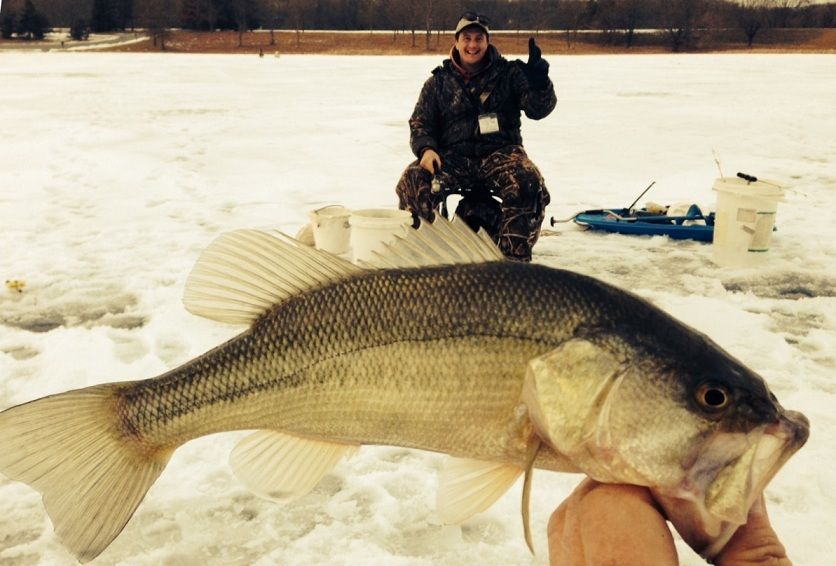
This chunky fourteen and a half inch largemouth fell for my Ratso tandem rig.  Here you can see my modified broken inexpensive rod with my home made spring tip top.  Not bad for one pound test, huh?
Well, I figured that was the hot hole.  But, maybe there were more like him down there.  My flasher marked a lot of fish, so I dropped something that usually tempts the bigger fish like this one, a Salmo Chubby Darter, which looks like a lipless crankbait but is a vertical jigging lure.  You lower them to the bottom, then rip them up about three feet or so, then let them drop, keeping your light tight as it falls with the fluttering lure, but not so tight that it kills the action.

After jigging the Chubby Darter three times, my sonar showed the marks moving up for the bite, then, a big hit!  Fish on!  "Whoooo hooo", I’m thinking, "I figured out the bass here!"  But, only to my disappointment, it was a bluegill, albeit nice one. That gill thought he was a largemouth!
This bluegill thought he was a largemouth, jumping all over my Salmo Chubby Darter!
After that, the fish vanished and I stopped marking fish.  By now, it was the magic hour, four in the afternoon, and too late to pull out the camera and set up.  The week prior, this was the hot bite time, and it wasn't happening for me now, especially since the fish had vacated.  It was time to go in search mode again.  I thought, “What a difference from last week when they were so active.”

So, I moved up the channel a little ways, cut another hole.  This time, I marked fish from literally the bottom to about three feet under the ice, and it remained like that the rest of the afternoon and evening.  I dropped my Ratsos down there, and the fish were shooting off the bottom to hit them.  At first, it was bluegills, not big but bigger than before, maybe a six inch average, and some decent yellow perch, males mostly.  Mixed in were some medium crappies.

But the bite never stopped.  In fact, it intensified.  I hit the thirty fish count and pulled out my golf counter so I wouldn’t lose track.  I could remember in my head the perch and bass count, since they were less numerous.  All I had to do is let the golf counter count the total, and remember the crappie count, and deduct that to calculate the bluegills.

My jigs wouldn’t make it to the bottom without fish inhaling them.  They literally hooked themselves.  If I missed on a hookset, another would shoot up to bite before I could lower the bait down.  I caught two at a time on a few drops.  This action, out of one hole, took place from four until about seven in the evening when my lantern ran out of propane.  During that time, my fish count went from a dozen fish to seventy one in total!

My lantern ran out of propane during the hot bite.  On my way back to my truck for more fuel, I ran into Tanner, who introduced me to his Father and Uncle.  They offered me a can of propane to get my lantern working again, so I could get back on the bite.  Thanks guys!  But, by the time I had the lantern fired up, the bite had slowed drastically.  For the next hour and a half, I caught only five medium crappie, but did miss a few bites.  All of the crappie were seven or eight inches long with a  few nine inchers mixed in.

Of course, we had to be off the lake their closing time.  With a half hour to go, talked about packing it in.  Then, like clockwork, they turned on again.  Those fish knew that we had to get off the ice!  All of a sudden, they chased my Ratso’s again.  But now, the crappie were bigger, averaging nine inches, with two fat ones that were over ten inches long.  It was really hard to quit fishing and avoid getting fined, but we did.  I finished with 86 fish, 35 of them were crappie, the one bass, five fat yellow perch, and the rest bluegills.

It was one of the hottest bites in such a short time frame that I can ever recall, even better than the week before.

The next day, I set my sights on another Central Pennsylvania lake further North, to fish the hardwater with one of the best musky anglers, check that, anglers, that I know, the founder of Keystone Outdoor Addiction, Jeremy Tyson.  Jeremy has been ice fishing most of his life, but never really gave using electronics a try, so he wanted to check out my system and see what it's all about.  My friend, fellow angler Wayne Chmielewski, also met us there.  Jeremy's friend Jay was also to meet up with us.  I hadn't met him yet.

When I was setting up, this guy walked out on the ice straight toward us.  He wore a green jacket and black hat, sunglasses over the hat logo, with a backpack and no fishing stuff.  I'm thinking, "Well, here's the game warden checking licenses, starting out with us, the furthest out first."  I figured I'd get it over with so that I could set up and begin fishing.  I walk over to him and showed him my license.  He said that everything looked in good order and asked how the fishing was.  As I was telling him about the fishing, Jeremy yelled out, "Hey Jay, you didn't just check his fishing license, did ya?"

It was Jeremy’s friend, Jay, who was coming out to fish with us…If I was an ostrich, I would have stuck my head down one of the hole in the ice to hide!

Usually, the panfish at this lake are on the larger side but more difficult to find and catch.  The trick is to find fish.  When you do, the size will come.  At least that's been the M.O. of this lake for many years that I've fished it.   We found fish, but nothing big, and they would turn out to be very picky all day.

We were fishing thirty four feet of water.  I gave Jeremy and Jay a tutorial on how to use the sonar as neither had used them through the ice before.  The fish were active enough to effectively teach them about the electronics, but the bluegills and crappie were much smaller than what I’d caught during my previous trips.  We did manage a few nice fat yellow perch though.

I also showed the camera set up to Jeremy and Jay, gave then each turns at attempting to catch fish with it.  They had fun with the system, but I think that they didn't want to infringe on my fishing.  I didn't mind, I was out to have fun.  Them having fun was rewarding to me.  But I admit, it's very easy to close the shanty and sit there and watch the camera and fish. It's mesmerizing, and time goes by.

At one point in the late afternoon, the fish showed up on the sonar in big suspended schools.  I then saw them on my camera.  They were crappie.  I'd watch them zoom in and miss my lures and aggressively attempt to eat them.  They’d surge to attack and miss, often, like they were blind!  But, it was deep, probably nearly thirty feet down down over thirty four feet of water, right under my camera, and there was snow on the ice.  It was dark down there.  I think that they had a hard time seeing the bait.  That does explain why at night they will follow and not always bite.  They may be trying to eat the lure all along and simply miss.

Later, I watched my jig while trying to entice a crappie below, when a big flash of a fish swooped in and engulfed my jig.  I set the hook and the fight was on.  It wasn’t as strong as the bass from the day before, but the fish was much bigger than I had been catching all day and I didn’t want to lose it.  Fortunately, it didn’t wrap around my camera cable, and I was able to get it though the hole.  As it turns out, rather than the big fat perch that I had hoped it was, it was another bass, but it was significantly smaller than the bass from Friday at about ten inches long.
Here's the little bass that attacked my Ratso rig, with Jeremy Tyson in the background.
Here's a picture of Wayne, searching for fish down by the dam.
Jeremy called it quits before dark. It was a good call, because his arrival at home earlier saves him brownie points with his wife for future trips, and these dinky fish weren't worth it.  We stayed in hopes that the bigger crappie would appear.

After dark, my flasher lit up like a Christmas tree with fish.  Looking at the round shape of the sonar in the picture below, the bottom is at about 8 o'clock.  All those marks to the right going counter clockwise are fish.  The bottom group were mostly tiny bluegills.  The ones the the right, at about ten to fifteen feet were small  to medium crappie, the biggest that we caught were nine inches, but most were only six inches long.  The fish about ten feet down over thirty four feet of water were the more active fish, suspended like that.  The ones toward the bottom were suspended and active too, but were too small to get even the tiny jig hook in their mouths
My sonar was lit up like a Christmas Tree!
I hoped the lake would have produced a hot bite with bigger fish.  There was enough action to keep us interested, but fish fish were very picky during the day and, other than the perch, were on the small side.  I finished with a six bluegills, two yellow perch, a largemouth, and twenty two crappie.  Not bad, but not great, and the size was a real disappointment, especially for this lake.  We could have stayed and caught more, but Wayne and I had a long drive home.  So, we made a pact that we'd each get one more and then call it quits.  It took about fifteen minutes, and we succeeded in fulfilling our pact, and packed it up.

My first four trips were a huge success though, because I fished with Jeremy and Wayne for the first time on the ice, and met some new anglers (Tanner, Jay and Rich), and spent some time with an old friend who is partly responsible for my ice fishing addiction, Glenn Cumings.  And, two of the four trips had some of the hottest action that I'd ever experienced in such a short amount of time!

I'd say that was a hot start to a cold winter, wouldn't you?