Showing posts with label largemouth bass. Show all posts

Thursday, April 18, 2019

Remembering Some of My Biggest Bass

Last night, I was reflecting on some of the biggest bass that I've caught in my home state over the years, and thought that maybe it would be a good time to share some of these stories with you.  Since some of the stories may be long winded, so I'll do this over the course of several blog posts.  Some of the stories might not have been my biggest fish, but, they were big fish, and the stories are worth telling.  I hope that you enjoy them and, even better, learn something that may help you catch your personal best bass.

Unfortunately, some of these stories happened prior to the digital age, and I have no idea what I did with the pictures that I had, so you'll have to take it on good faith that the stories are true.  Yeah, I know what they say about fishing stories.  I do have witnesses though!!!   So, if I don't have a pic to share of that actual fish, I'll post a substitute picture of a nice fish, or pics related to how I caught the big one.

One day, if I'm lucky enough to find any of those prints, I'll make a copy of them and share them with you.  I had a major septic flood in my basement in 2012, and lost a bunch of stuff, so it's possible that many of the pics are gone forever.  I also have rolls of film that I've never developed, so maybe there are some pics on those rolls.  Some of you may ask, what is "film"?  Ha ha.  Some of these big bass were caught prior to the invention of affordable waterproof or digital cameras.  What can I say, I'm an old fart!

How do I...???
One hot summer evening, I was bank fishing with my buddy, Howard, his girlfriend at the time, and his black Labrador, Max, along a body of water next to a local river, and decided to drop down to fish the river.  The bank was steep and it was a struggle to climb down there.  

The river was deep, and the water was, what some of my friends today call, "big fish green".  "Big fish green" means that there is a slight amount of color in the water, enough sediment to make fish feel comfortable to be active, yet not too much that they can't see your lures, leaving the river with a greenish tint.  

There was a huge log that ran parallel to the river bank right in front of me.  In fact, I had to fish over this log, and, it sat at about waist high to me, so it wasn't easy.  There wasn't a lot of room to stand along the bank there, and just barely enough room to effectively cast.  Just a bit upriver from me, about twenty feet or so, was a rock ledge that stuck out from the river bank about twenty five yards and created a nice eddy where I figured that fish would lay in ambush of their prey.

Just a few days prior, I purchased my first baitcasting outfit.  I'm not really sure, but it may have been my first time fishing with it.  Back them, stores pretty much only sold affordable baitcasting reels that cranked on the left side, and being right handed, and growing up fishing with spinning tackle, I was used to cranking with my right hand.  So, I had to learn to switch hands after each cast, and learn to crank with my left hand.  Learning to cast and not backlash was difficult enough back then, prior to the invention of fancy magnets in reels that prevent the spool from spinning too fast, but, switching hands too?  Still, I started to get the hang of it.

I remember that I had a large chartreuse buzzbait tied on, a perfect choice for targeting big, aggressive largemouth bass in the slower waters during the hot summer, but not really a lure meant for tempting smallmouth bass the fast river water.  Also, most people generally pursued river smallies with smaller morsel sized baits over the bigger lures commonly used to chase largemouth bass.  But, being lazy, I didn't want to tie on a new lure.  And, I only intended to toss a couple casts.  Honestly, I didn't really think that I'd catch anything on it in the river, but, what the heck?

My buddy, Howard, and his girlfriend, happened to walk by and watch me cast from the path above me.  I think that Howard, already a baitcasting veteran, enjoyed watching me struggle to learn the ropes.  It must have been somewhat amusing and entertaining throughout the day, watching me learn the hard way, as I cursed while I picked out the many birds nests.  I forced myself to learn the hard way by leaving my spinning rigs at home.  So, even if I wanted to toss smaller smallmouth sized lures, I wouldn't for fear of getting more backlashes.

On the first cast, I lobbed the buzzbait upstream and across, and retrieved it past the tip of the rocks and through the eddy.  Just as the lure reached the bank right in front of me and the tree, the water erupted.  Water went everywhere, on my sunglasses, on my face, and on my shirt as the fish thrashed about in front of me.  It suprised the heck out of me!

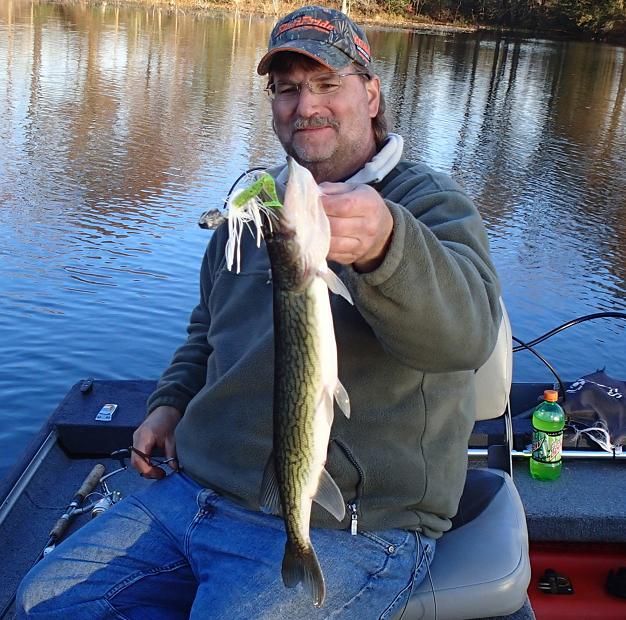
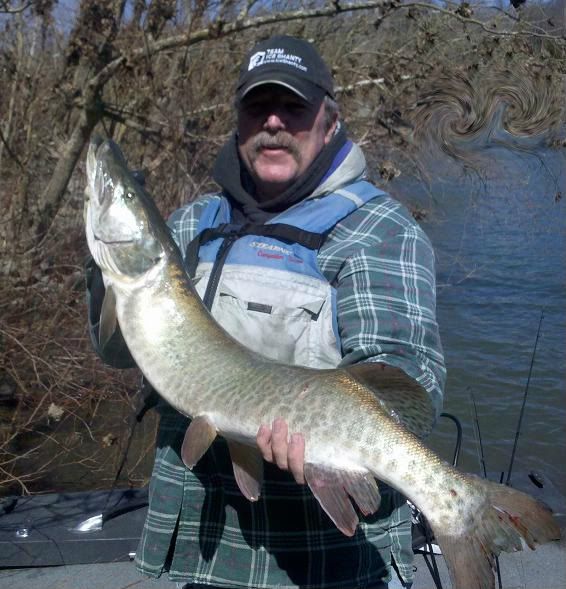
I don't have any pictorial examples of big buzzbait smallmouth, but, this picture shows that big smallmouth will hit big baits, and big baits don't get much bigger than this musky sized bucktail.
Of course, I was extremely surprised and excited, and nearly forgot what I was supposed to do.  In situations like that, sometimes people say the silliest things.  I fought this fish as it went ballistic on me just over the stupid log, I yelled out a couple expletives that are too vulgar for this blog, followed by "How do I fight this thing?"  Howard, his girlfriend, and probably the dog too, were laughing hysterically at me.   I really did get confused, not used to reeling with my left hand, and fighting a fish with the rod in my right hand.
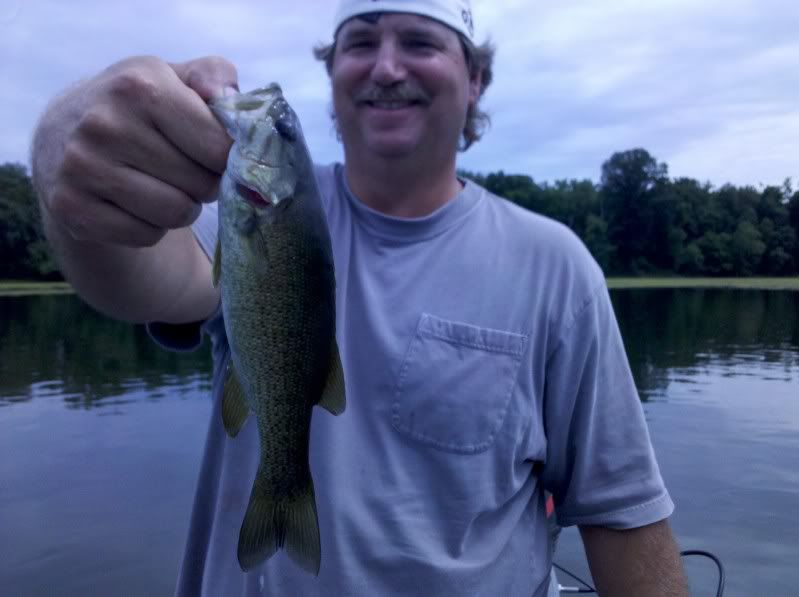
These days, I routinely toss small 1/8 oz. buzzbaits while targeting smallmouth bass like this decent fish.  The truth is that you definitely will get better summer time numbers of fish on these smaller buzzbaits.  But, big baits catch big fish, as the story told explains.  
To this day, Howard teases me about that fish.  Eventually, I figured it out, got the fish in, and hoisted it over the log.  It wasn't the biggest smallmouth bass that I've ever caught, but it was a nice one for our area, and was my biggest to date at that time.  I didn't have a tape measure or scale with me, but I'd guess that fish was a fat twenty inch smallie.  And, it was the first fish that I ever caught using a baitcasting outfit! 

The hanging down to my ankles fish...
It was a hot, muggy, dog day of a summer evening as Howard and I met each other in the parking lot after work.  Typically, back then, we'd scurry to our fishing spot after work and get as much time as possible in to fish.  But, on these hot, steamy nights, there was no hurry.  We arrived at our spot about an hour before dark so that we could fish the magic hour, and then fish well into the dark.  Usually, our timing was about right, and we'd catch fish right away.  During the dog days of a hot summer, the best bite is often at night as bass are mostly inactive during the heat of the day.

Frogs sang and chirped loudly.  They'd jump from our footsteps and into the water as we walked along the path along the bank.  Bugs were everywhere, and mosquitos constantly buzzed us as they searched for a chink in our bug spray armor.  To me, all these things meant is that it was buzzer time.  

Using baitcasting outfits were so productive for me throughout the years, whether they were specialized rigs for flipping, pitching or just plain chunkin' and windin'.  I found them to be very effective for using larger lures, the spinnerbaits and buzzbaits, for example, that produced so many big bass for me.  These lures are perfect for fishing around sunken timber, weeds, lily pads and logs.  

We bank fished most often at one of our favorite bodies of water.  Baitcasting rods teamed with heavier line not only allowed us to toss larger lures, but also improved our chances of retrieving lures that we snagged in the timber.  After all, if your not snagging now and then, you're not fishing in the right places.  But, we were young and lived on a tight budget, so, every lure that we could get back was a bonus.
As Howard shows you, summer night fishing with buzzbaits can be the ticket for big largemouth bass.
Both Howard and I worked our way down the bank, and picked up some nice fish here and there.  On this particular night, the fish were bigger on average than what we normally caught.  Howard already caught a pair of twenty inch largemouth that probably weighed about four pounds at their summer weight.  I had a pretty good evening as well, landing a few eighteen inch fish and several fifteen inchers.  Howard and I eventually drifted away from each other, out of sight in the dark, as we each tried to figure out where the next big bass lurked.  I lagged behind as he moved on, because I knew that I was at a really good spot.  

I had a good feeling about this one particular spot, so I worked it thoroughly.  There were several blowdowns, and I wanted to make sure that I covered every angle fishing them.  I just knew that there had to be a lunker there.  This spot was about forty yards long, so I worked each tree from many angles to optimize my chances that a big fish would find my lure.  I picked up a couple smaller fish, and it was late, about midnight, so I figured that I'd work my way back toward Howard, meet up with him, and we'd head home.  After all, we had to work the next day.
Oh, how I love fishing buzzers at night during the dog days of summer!
On the way back over that same forty yard stretch, I fished the one spot that I hadn't really covered, where there weren't any trees, but, rather, had tons of frogs.  That spot was simply casting parallel to the bank.  On my second cast, I worked the lure all the way to me, covering as much water as I could.  I couldn't see anything except for where the weeds and water met, because it was so dark.  I couldn't even see my lure from the end of the cast to but to only about ten feet away.  But, I could hear the buzzbait, making a squeaky sounding plopping sound as it chugged along.  I worked the lure as slow as possible, just fast enough to keep the lure at the surface.

As I fished with the rod tip low to the water, and about four feet of line left from the tip of my rod, the water exploded just feet away.  Honestly, it scared the poop out of me!  I literally jumped when it hit.  I could tell immediately that this was a special fish.  On my baitcasting rigs, I set the drag pretty tight so as to get the maximum hook set, and typically, I'd horse the fish in.  There was no horsing this one in.  It took line, even with my drag set as to not allow that to happen.  Finally, I got it near shore, and I climbed down the bank and grabbed the behemoth by the lower jaw.
In the evening and at night during the dog days of summer, large buzzbaits, like this one, call in the hawgs.
As of that day, it was my biggest largemouth that I'd ever caught, for sure, and prior to that fish, I had caught dozens of five pound fish in my life.  This fish was bigger...unforgettable.  I was about two hundred yards away from Howard, and I wanted to show him this fish.  If this fish was so much bigger than most of the big fish that we catch there, that it was worth walking two hundred yards away to show my friend, and stop fishing, then you know it had to be a special fish! And that's what I did.  I walked down the path along the bank directly to him, carrying the fish at my side by the lower jaw.

When I reached Howard, he couldn't believe what he saw.  He said that, as I walked toward him, that he could see me holding the fish at my side, and the tail of the fish reached my ankle.  I'm 5'11" tall, as a reference for you, so it was a long bass.  He marveled at the fish as he proceeded to fit both of his fists into its massive mouth.  That amazed me!  The belly bulged on this fish, similar to the way my belly does now.  I was still shaking from the experience.  Neither of us had a camera, so, after a couple minutes of admiring the fish, I released it.
This was the buzzbait that I used to catch that huge fish, and many others since then.  I made this in-line buzzer by taking parts from other buzzbaits, bending my own wire shafts using a wire bending tool, and assembling the three components together with split rings.  This bait has caught me so many big fish.  The whole thing is about eight inches long.
Howard estimated that this bass would have been about twenty four inches long and weighed about seven pounds, give or take an inch or a few ounces.  It was truly one of the biggest largemouth bass that I've ever caught.  It would be a few years before I was able to equal that fish, but those are different stories for future blog posts.

OK, so that's all for today.  I'll post a few more on my next post.  Until then, I wish your all good fishing!


Thursday, March 28, 2019

Spring is Here: Time to Break Out the Lipless Crankbaits

Ah, spring is here in the D.C. area.  The cherry blossoms are about to bloom, the forcythias are in bloom, the buds on our trees are about to pop, the robins returned, blue birds are flirting with each other, fish of all species are on the feed, and my lipless crankbaits are screaming out to me.  Not too many fishing patterns get my blood pumping more than when big fish munch on lipless crankbaits.
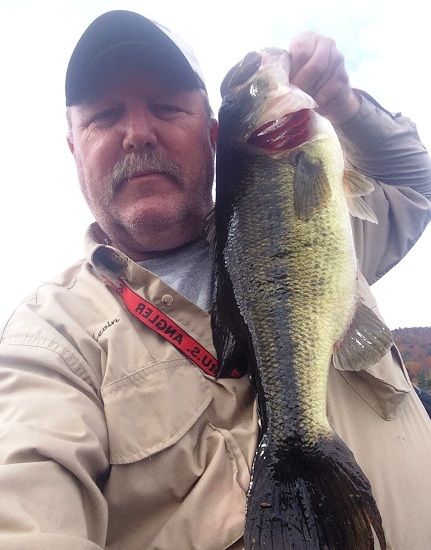
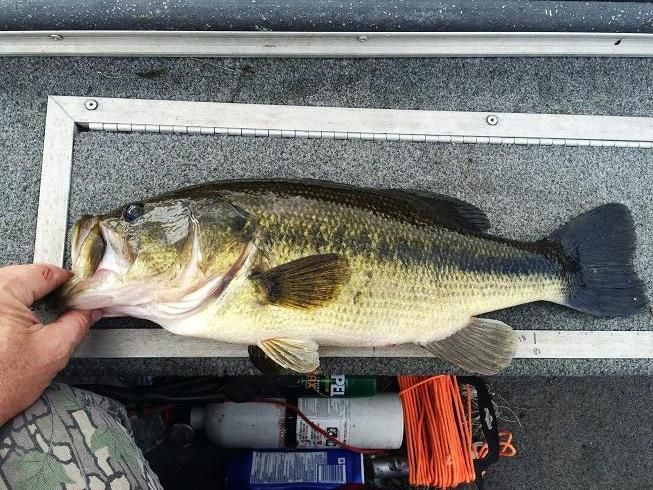
Not only can you catch good numbers of fish on lipless crankbaits, but big ones too.  This one fell for a Bill Lewis Rat-L-Trap in the Chrome Blue Back color.
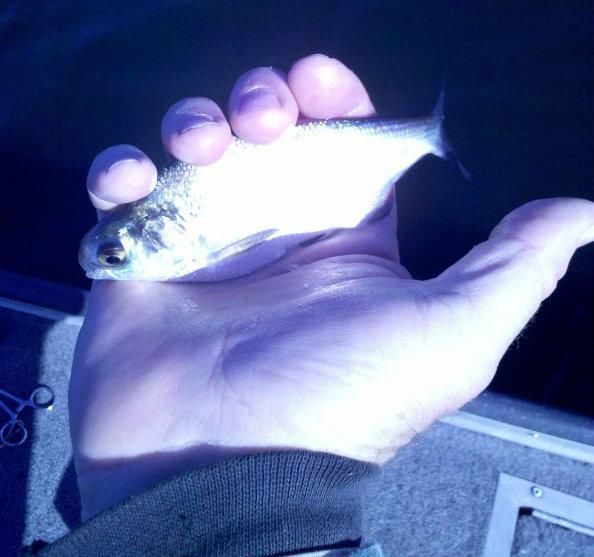
In our tidal rivers, blueback herring run into the skinny waters while largemouth bass, chain pickerel, and striped bass wait in ambush.  Upriver, our smallmouth bass are on the feed.  And, in local lakes and ponds, golden shiners swarm in the shallows, with predatory bass and pickerel ready to attack them for a tasty meal.
My friend Brad with a nice tidal largemouth bass that fell for a lipless crankbait.
One of the best types of lure to offer these predatory fish are lipless crankbaits.  I don't know if it's the vibration, rattling sound, or flash that drive these fish nuts enough to attack, or if it appeals to their extreme urge to feed prior to a rigorous spawn.  I've heard arguments about both.  But, seriously, when they're attacking these crankbaits, it doesn't matter why, just that they're hitting.
Largemouth bass love lipless crankbaits, or hate them, depending on your view of why they attack them so violently.
It's true, that I've seen fish come from a long way to hit these lures.  Stripers are notorious for chasing down baitfish at high speeds.  Largemouth bass are known to have extremely quick ambush attack speeds, but can also chase down a quickly retrieved lipless crank.  Why?  Like I said, who cares?  Just that they do it, but honestly, it could be a combination of reasons.

Lipless crankbaits provide plenty of vibration that can be detected by an extremely sensitive organ in fish called the lateral line.  When predatory fish sense these vibrations, the vibrations could provoke them into striking whatever is making them.  Also, this extra sensitive organ allows fish to hone in on these lures from long distances away.  The rattles in these lures could appeal to a feeding response, or just tick them off.  At any rate, most of these lures have a loud rattling sound, teamed with their tight vibration, designed to trigger strikes.  And, they most certainly do that well.
Gotta love what I call "trappin'" bass.  Mark fooled this nice bass on a lipless crankbait.
Whether you're fishing various colors or metallic finishes, most of these lures provide a measure of flash that could trigger strikes.  I love the metallic finishes when skies are bright or if I'm fishing clearer water.  Bright colors, like chartreuse, are great for fishing dingy water or dark days.  In fact, dark colors also work well in those conditions.  The action of the crankbait is key though, as the tight vibrating wiggle provides a flash that mimics their prey.  This feature could also trigger reaction strikes or appeal to their feeding urges.

For anglers, these baits are attractive because you can fish them so many ways.  You can just toss them out and crank them in.  You can cast them out and jig them back, or fish directly below the boat in deep water and vertical jig.  You can cast them out, let them sink, count them down, and fish them at any depth you desire.  Or you can fish them slowly across the tops of weed beds and rip them off the weeds (more on that later).  How much more versatile of a lure is there than that?
There are many ways to fish these crankbaits.   This pre-spawn Great Lakes smallmouth bass slammed a deep, slowly cranked lipless crankbait.
One huge advantage to fishing this type of lure is that they cover a lot of water quickly.  They're great search lures, especially when fishing new lakes.  They're perfectly designed for finding for schooling predatory fish, or perhaps fish ambushing baitfish on a windy point.  When the fish are on, you can catch good numbers of them on these lures for this reason, and not only that, potentially big fish.  They're big fish baits!
You cover water with lipless crankbaits to find chunky largemouth bass like this.
So, for those out there who don't know what a lipless crankbait is, they're basically a type of plug that is about a half inch or less in width, laterally compressed (almost flat), that sink on the fall, and don't have a lip like other crankbaits do.  Most of them have some sort of rattling system inside them.  The line tie is at the top of the "head" of the lure.  All of these features make them unique.

There are many brands out there, most of them produce well.  We all have our favorites.  I fish several different brands, because each one has a slightly different presentation, but they all have similar traits mentioned above.  I like the Bill Lewis Rat-L-Trap, Rapala Rattlin' Rap, Strike King Red Eyed Shad, and Yo-Zuri Rattl'n Vibe.  Each has their place in my box.  I carry four different sizes, depending on what I'm fishing for, being 1 oz., 3/4 oz., 1/2 oz. and 1/4 oz.  There are other brands that probably work just as well, but it's up to you to find your favorites.

If I had to say that I have a favorite or "go to" version, the first one that I tie on, one that catches just about any predatory fish, it's a 1/2 ounce Bill Lewis Rat-L-Trap.  I love the Chrome Blue Back color when fishing our tidal waters, as I feel it resembles the blue back herring.  Maybe it does, or maybe it doesn't, but that thought gives me confidence that this will work, and it usually does.
Shad and blueback herring run up river to spawn in the spring.  Lipless crankbaits are great imitators of these baitfish.  I like the Chrome Blue Back Rat-L-Trap for this purpose.  Nice largemouth, like this one, stripers and other predatory fish feast on them, and will do the same on your lipless crankbait.
For lakes and ponds, I love the Gold Black Back color this time of year.  I think that they resemble golden shiners, and in tannic acid stained waters, maybe resemble shad as well.  That said, there are other colors that could be effective in other situations or water conditions.  The colors mentioned above work best for me if there is about two feet or more visibility.  Truthfully, I think that color is the least important feature, except perhaps the metallic finishes, because they provide a lot of flash, as do baitfish.
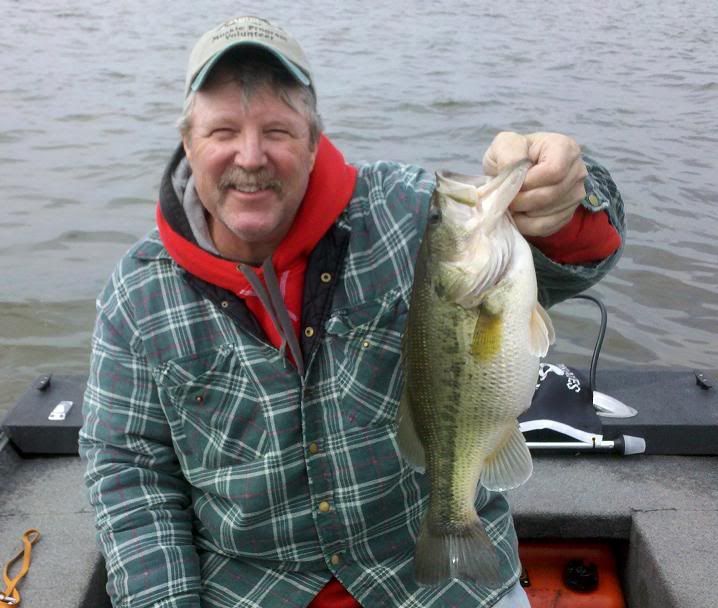
This chunky largemouth fell for a Gold Black Back 1/2 ounce Rat-L-Trap.  There are plenty of golden shiners in our lakes, so if your lakes have a good population of them, try the gold "trap".
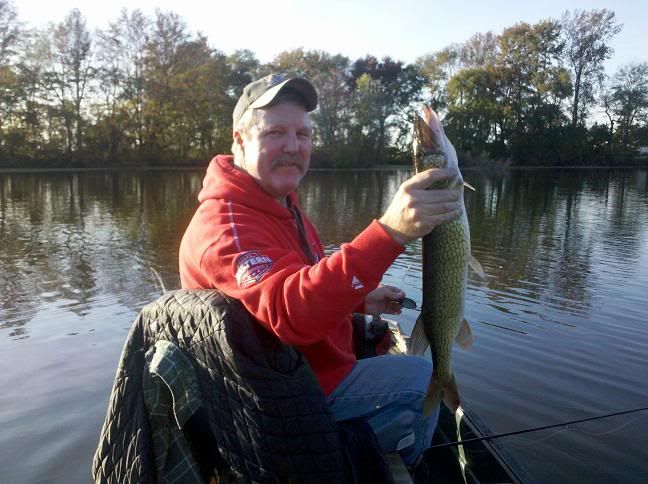
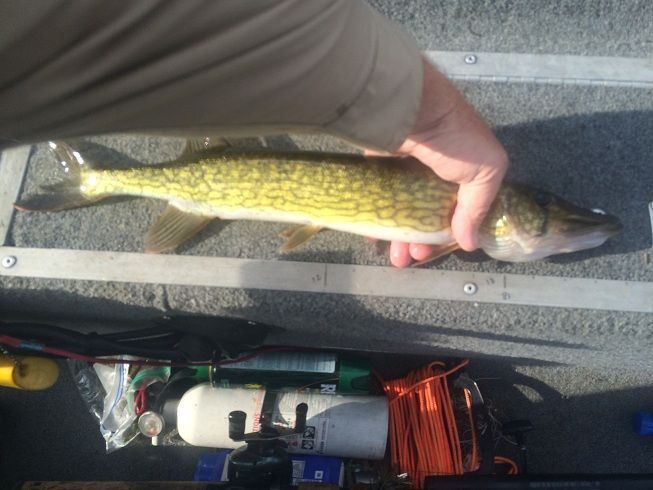
Chain pickerel love the golden shiner imitation as well.
So, how do you fish them?  Like I said above, there are many ways to fish lipless cranks.  But, in spring time, which is the focus of this article, I'll mention my favorite pattern for largemouth.  During spring, some weeds are beginning to grow, while others have already been growing and are now filling in, and these weeds attract baitfish.  Equally important, is that weeds provide ambush cover and break up the silhouette of predatory fish on the bottom.  Most predatory fish, like bass, are dark on the top, and light underneath.  So, when they sit on the bottom in wait, they blend in with the weeds very well.  When cover like this attracts both predators and prey, it's a fishing hot spot.

In this situation, I try to fish just over the top of the weeds and let the treble hooks tick the tops of the weeds.  When the lure gets to the edge of the weed bed, I let it drop and flutter down, then rip it up and crank it back.  Often, when bass fishing, ripping a lure like this off the bottom will trigger strikes.  Also, lures that flutter down over weed bed edges could provoke a predatory fish hiding below.  As the crank flutters down, the fish think it is an easy meal, and attack it on the fall.
Steve will tell you that fishing over the top of weed beds with lipless crankbaits will catch big bass, and here's the proof!
When fishing over top of the weeds, your lure will hang up on weeds occasionally.  Don't just reel your lure in and clean it off.  When that happens, as long as it isn't a thick mat, rip the lure from the weeds with the rod tip and continue fishing the lure.  As with ripping a lure off the bottom, ripping one off weeds may also provoke vicious strikes from largemouth.  Again, the flash, vibration, and darting action of the lure when ripped off the weed is key, I believe, to provoking bass into striking.  This is the pattern, really.

How do I keep a sinking lure above the weeds?  I keep my rod tip up when reeling, and if the weeds are a foot under the surface, keep it higher.  This also allows you to reel in the lure a little slower, and I feel, making the lure more attractive to bass.  If you do this while keeping your rod tip down, you will have to fish the lure much faster to keep the lure up enough, or you will bury your lure in the weeds, leading to frustration and less productive casts.

I prefer using a long, fast action baitcasting bass rig for this, with braided line.  I used to use fluorocarbon line, and that worked well too.  The low stretch lines and long, fast action rods enable you to keep the lure above the weeds, and to rip the lure off of the weeds and clear it, while also provoking fish to strike.  My pitching rod and reel work great for this technique.
This largemouth, and countless others like this, were caught on the weed pattern described above.
Striped bass, or stripers or rockfish, as they call them in my neck of the woods, love lipless cranks too.  You can fish them any number of ways, but if I had to say one thing about them for stripers is that they like them fast, and they like erratic.  So, crank it in, let it stop, rip it, then crank as fast as you can, then rinse, repeat.  Stripers can out swim your lure no matter how fast you reel, if they want it.  That said, if they're deep, you have to let it sink down there so they can see it first.  That's the beauty of these lures, really, their versatility, and that they simply catch fish.
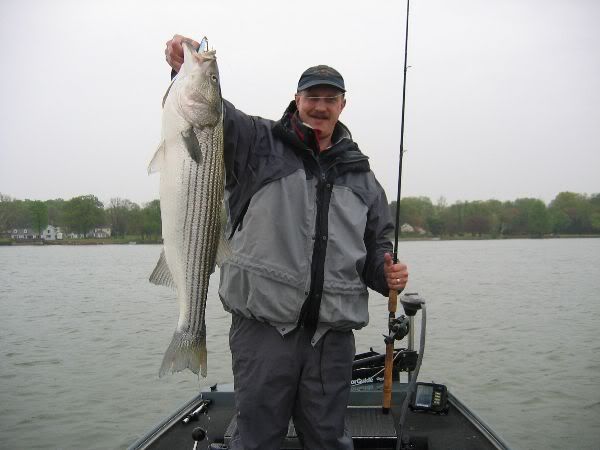
My buddy Bob with a nice striper that he caught on a 1 ounce Rat-L-Trap.

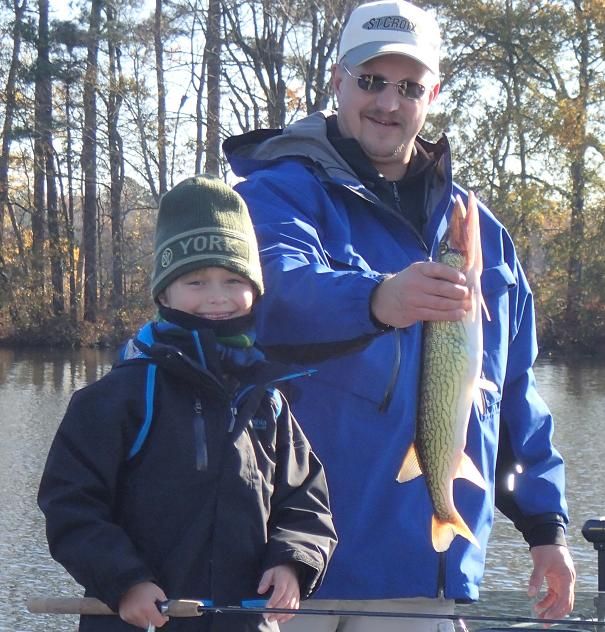
Carson (left) and his Dad, Bob, with a nice chainside caught on a lipless crankbait.  This time, the fish fell for a 1/4 oz. Rat-L-Trap in the Chrome Blue Back color.
The lure shape resembles a shad remarkably well.  When you think about it, they could resemble just about any form of baitfish as long as the predators don't have much time to examine the lure.  Perhaps that is why these lures are so effective?
Shad, like this one, are abundant in our rivers, and in some of our lakes and ponds.  Lipless crankbaits are great lures that mimic these baitfish.   Lipless crankbaits match them in size, shape, flash, and even action.
I fish the larger sizes for larger predators, like stripers, pike, and even musky.  I prefer the half once size for bass, but there are times when the 1/4 ounce size is necessary.  The 1/4 ounce size will also catch perch, crappie, trout and other panfish.

The coolest thing about lipless crankbaits is that they can catch just about any predatory fish out there.  I caught my biggest king salmon on a black Cotton Cordell Hot Spot, and another huge one on a chartreuse Rat-L-Trap.  I've caught northern pike, walleye, lake trout, steelhead, large brown trout, and even catfish on them.  These lures work well on many saltwater species as well, especially bluefish and sea trout.  Talk about a versatile lure, eh?
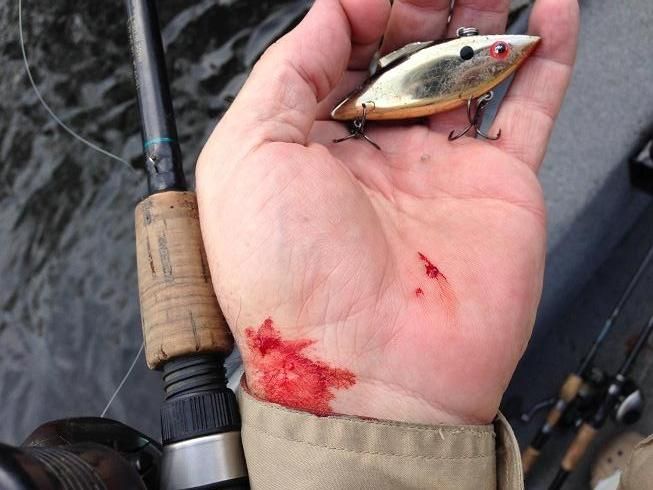
Oh yeah, a warning, as with any treble hooked lure, when unhooking fish, be careful.  I reached to unhook a chain pickerel, and the slimy fish slid down and the hooks both lodged into my hand, still attached to the fish while it thrashed about.  Talk about painful!  Luckily, this time, I was able to grab the fish while my buddy got the hooks out of it.  The hook that went into the middle of my palm popped right out, but the hook mark on the left took some handy plier work.  Fortunately, it came out quickly.  After all, I'm not a surgeon, but I did stay at a Holiday Inn a few times!
So, when the early signs of spring reach your area, if you haven't already, give lipless crankbaits a try.  By the way, they work well all year.  However, they're my "go to" lure during spring and early fall.  So get out there and give them a try!  If this helps you catch a big fish, please leave me a comment and tell me the story!


Thursday, July 21, 2016

Want Your Largemouth Big? Fish a Jig!


It was a cool fall day. We had a really good morning plastic worm bite catching big fish consistently.  Around mid-morning, the action died.  Did the fish move?  Did we catch them all?  I didn't think so, it was a classic fall spot.  It had plenty of structure with weeds, next to deep water.  The sonar lit up like a Christmas tree all around the area especially in deep water, so there was plenty of bait nearby.  Yeah, the fish were there.  They had to be.

I tied on a black and blue jig, leaving a chewed up plastic worm as the trailer, and tossed it out, let it sink, keeping a tight line as the jig fell.  All of a sudden, the line went slack as I felt a tap, so I set the hook hard and my rod stopped as if I'd set into a rock, but all of a sudden there were head shakes.  The fat largemouth lept out of the water trying to throw the hook as I plunged my rod down into the water to prevent it.  It failed in it's next attempt to dislodge the hook after rocketing under my boat hull, and I finally brought it to the surface and netted it.  That first fish went 19 inches long.

After that, the action continued all morning as I caught 17 more fat bellied largemouth bass, all over 18 inches and my 5 biggest over 20 inches long, with the largest one being 22.5 inches long!  Man, did they ever love that jig that day.  My love for skirted jigs and efforts to reincorporate them into my daily bass fishing arsenal finally paid off.  What a day!

This was one of five fat largemouth over 20 inches that fall day that fell for my jig and eel combo.

My jig and eel combo from that day that caught a bunch of bass like the one pictured above, and in the basses mouth in the picture below.  Plastic worms make great trailers, by the way.
A few years ago, one of my goals was to become proficient in flipping and pitching skirted jigs because they catch big bass.  There is no questioning that.  Denny Brauer became famous on the B.A.S.S. circuit catching massive limits, winning tournaments and tons of money using them, as have others over the years.  They aren't new by any means, but one thing is for certain, when that jig bite is on, it's big bass time.
This largemouth bass hammered this jig and eel combination.
Now let me just say right now that I've always been a believer in these lures.  Many years ago, I fished them from shore and from my boat and landed quite a number of good sized largemouth bass.  But, for some reason, given the effectiveness of soft plastics, I sort of got away from using them.  A few years ago, upon remembering those good times, I was determined to make it part of my arsenal again.

My first step to meet that goal a few years ago was to replace my old flipping rod.  I purchased a Powell Max medium heavy pitching rod and an Ardent flipping reel.  I didn't care for the reel, so it has since been shelved.  Instead, I use my old Shimano Castaic, which to this day I feel is the best pitching reel that I've ever owned.  I spooled up some Power Pro braid, and I was in business.  By the way, I don't believe that the fish care about seeing the line, so I tie directly to the lure.  I set the hook very hard and found myself snapping off fluorocarbon leaders, so heck with that.  So far, so good without the leader.
My current pitching/flipping rig consists of the Powell MH pitching rod teamed with a Shimano Castaic Reel.  I love this combo.
The next step was to practice.  I stood on a stool in my back yard every night and pitched jigs of different sizes into a coffee cup.  At first, I started close in, about 15 feet away, and missed often.  Then, I got the hang of it.  I practiced every night, moving the cup further away, and eventually was able to put it in the cup most of the time, or at least hit it at distances out to 30 feet.  After that, I used multiple cups and pitched or flipped to all of them.  It was fun to practice too.  One evening, a mockingbird chased my jig a few times making it more interesting.  I had to reel it in quickly to keep the bird from getting hooked.  I couldn't wait to put my skills into action, and it didn't take long for the fish to cooperate.

Jigs are awesome.  They come in plenty of colors, sizes, head shapes, and they can be teamed with many different types of trailers, ranging from pork to soft plastic ones in a zillion shapes and sizes.
My last outing had this box with a decent selection of jigs and trailers, along with some Carolina rig supplies and a few odds and ends.  I carry a box of jigs every time I go largemouth fishing now.  


This green pumpkin jig and plastic craw combo not long ago caught a nice bass and chain pickerel on back to back pitches.  I may have caught more on it that day, but I didn't pull it out until the end of the day.  Prior to that, we were on a good chatterbait bite.
Chain pickerel and other predatory fish love skirted jigs too!   This medium sized chainside inhaled my jig and eel.
So here's the deal, everyone knows jigs work.  They catch plenty of fish and more often than not, they'll be big.   Don't take my word for it, read up on other successes or check out the countless articles in fishing magazines and on-line forums.  Better yet, if you haven't tried them, give them a try, and don't give up!  Some day, they'll pay off for you.

Wednesday, December 12, 2012

It's a Small World to Fish In, Isn't It?


Last week I put my boat into the Upper Tidal Potomac and took my buddy to a spot that has been producing for me.  Now, I could give you a fishing report, but really something more interesting to me happened, although the fishing was also pretty doggone good.  We ran into Gene Mueller’s long time buddies, Andy Andrzejewski and Marty Magone as they were also targeting any fish that was willing to bite that day.
Pictured are Gene Mueller's buddies,  Andy Andrzejewski (left) and Marty Magone that we met for the first time on the water.
I had never met either of them before, but because of Gene’s blog titled, “Gene Mueller’s World of Fishing & Hunting”, I felt as if I’ve known them for some time.  That said, when I recognized them, I was a bit apprehensive about introducing myself at first.  But, being the fishing social butterfly that I am, I blurted out a less than subtle, “Are you Andy?”

Andy’s reply was, “Yeah”.  The tone sort of sounded kind of like a, "what about it?", or  "who the hell are you?", or "what’s it to ya?" type of thing.  For the record, he didn’t say any of those things, and he probably wasn’t thinking any of them either.  That was my own insecure alter ego speaking to me.  But he asked if the reason that I knew of him was because of Gene’s blog.  I replied, “Yes, and also because I’m a fellow outdoors blogger and internet friend of Gene's… Fat Boy’s Outdoors?”

I was hoping that would break the ice, and that they’d recognize my blog name since Gene graciously added my link to his site, and often points folks to my blog.  But it dawned on me that maybe they didn’t know of it, or if they did, what if they didn’t like it?  I think that if that was true, then I’d have fired up the motor and scooted on outta there faster than leaving the house on a fishing trip with chores to be done!

Fortunately, after a pause, Andy blurted out, “Oh yeah!  I’ve heard of you and your blog!”  And Marty added something to the effect of, “ Funny, you’re not as fat as I thought you’d be!”  (although that wasn’t exactly what he said, it was the gist of it).

All I could do is laugh at that point.  The ice was broken, and all of a sudden, it was obvious that I wasn’t a fishing threat to them.  You know, the kind of threat like, why the heck are you moving in on my honey hole?  Still, we kept our distance so as to not disturb their fishing and give them appropriate elbow room, fishing the outskirts of the hole.

Andy then opened up and told us that the crappie bite up to that point hadn’t been all that hot, but they had boated over a dozen bass already.  But it didn’t take long for both Andy and Marty to start nailing the slab crappie, one after another.  Meanwhile, Rodger and I were getting a few hits and misses every now and then, and finally started catching a few.

Rodger had never fished there before, and in fact, had never fished for crappie before.  He may have been getting bites and not recognizing them.  We were jigging for them, and the bites were subtle.  Just a twitch of your line could be a fish, and you may or may not feel the tap of the bite.  Sometimes, you saw or felt nothing other than perhaps a little weight at the end of your line, like a spongy feeling like when you have a large leaf stuck to your lure.  I told Rodg to set the hook on anything.  He still struggled.

Finally, I pulled out the secret weapon…Smelly Jelly.  I smeared his lure with it and the very next cast he caught his first slab crappie.  Then, it was one after another.
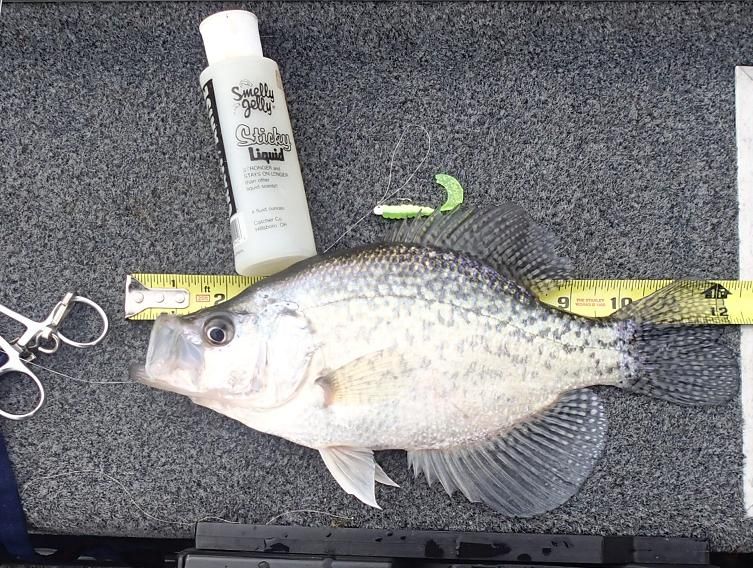
Smelly Jelly was the ticket to get Rodger into slab crappie like this one.  Later, the Kalin's grub pictured above took one crappie after another all day long.
Andy wanted to get a picture of each of us holding one, but the problem was that we weren’t getting doubles.  He said to put one in the livewell, but my boat doesn’t have a live well, so we had to hope for a double.  Eventually, we gave up on that because, even when we caught doubles, one of the fish wouldn’t be large enough for a good photo.

We chatted about various things, from fishing, about Gene, about boats, about musky fishing.  In fact, my mouth ran so much that maybe I was distracting their fishing!  But, it was fun and cool for me, adding to my good time.
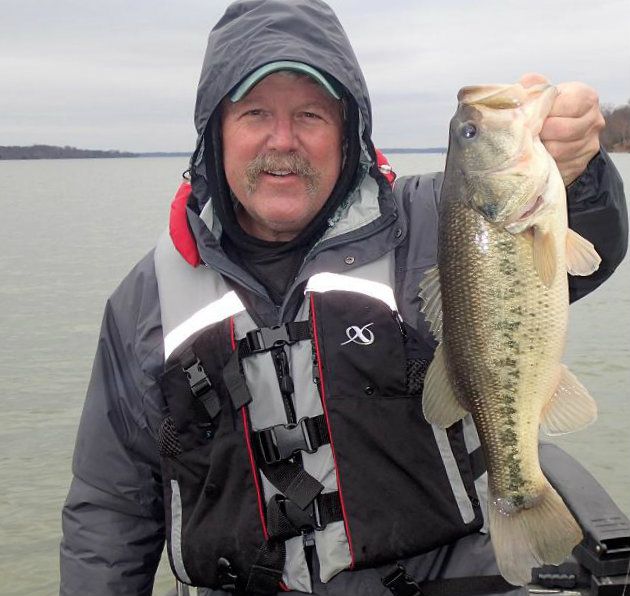
But Rodger and I wanted to improve our bite, so we moved to another area of the hole out of view of those guys.  We immediately got into some good fish, and some good sized ones.  I found out that the crappie were a bit finickier than the last time we were out, preferring a down sized lure.  The Kalin’s two inch Triple Threat Grub in the lemon meringue color was the ticket.  I was dropping it over the side of the boat and they were nailing it.  Later, using it under a float caught crappie every cast.  Rodger was catching them also using a three inch Bass Pro Shops Tripple Ripple Grub in the pumpkin/chartreuse color.
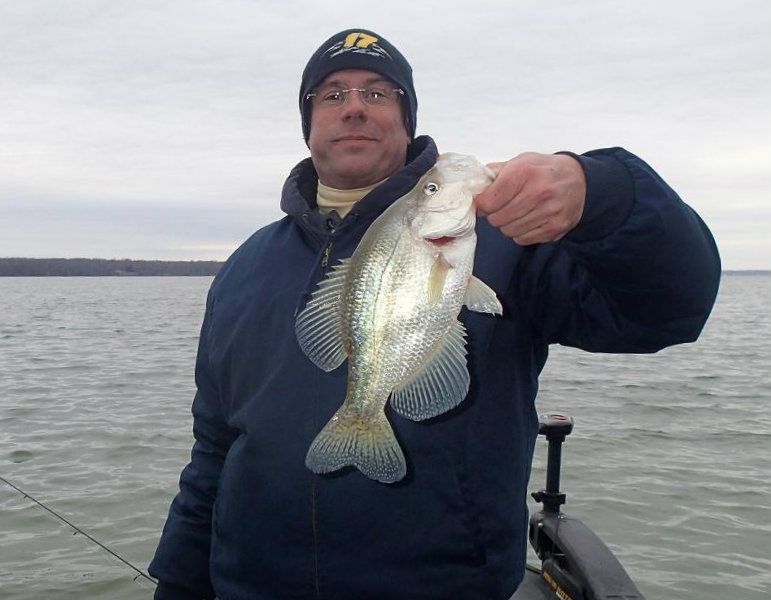
Rodger showing off a slab crappie that fell for a Bass Pro Shops Tripple Ripple Grub smeared with Smelly Jelly.
Andy and Marty moved over to us and mentioned that they were heading out to try some other spots in search of bigger bass.  Before leaving they tried again to get some better pictures, but we couldn’t seem to produce a double with two quality crappie.  By quality, the smaller ones that we were catching were a mere twelve inches long, big by most standards in lakes in our area, but not ones fit for this fishing hole.

While we fished and talked, they took a lunch break before leaving.  Marty pulled out one of his famous egg splatter sandwiches and asked if I had heard of them.  I told him that I’ve read it about it in Gene’s blog many times, but this had been the first time I had seen one.  It was a Dagwood sandwich if I had ever seen one.  It looks like you almost need a tire jack to open your jaw wide enough to take that first bite!  Andy also noted that Gene makes a mighty three meat sandwich too.  They asked what we had to eat.  I, in an embarrassing tone, replied, “Seven Eleven hot dogs with no bun”.

Andy replied, “Cold Seven Eleven hot dogs???”  I know, it doesn’t sound very appetizing.  And once again, I’m doing the low carb thing, trying to get my weight down.  I explained to them it was so I could keep the boat on a plane in the upper river and allow me to tote along more tackle.  Andy said that I might have to change my blog name to Skinny Boy’s Outdoors if I lost as much weight as I wanted to!

After chatting/fishing a little while longer, those guys left to find that lunker.  Wouldn’t you know it?  Right after leaving we started picking up doubles of lunker sized crappie?  That’s how it goes sometimes.
After those guys left, we nailed crappie like this all day long!
After they left, the fishing improved as the tide changed, as it always seems to do on tidal water.  Slack tide is always tougher fishing, but when the water moves, so does the bait, and so do the predators.  Find ambush points on the edges of the current and you’ll find the predators.  It’s not different in the late fall or winter, except the deeper holes tend to concentrate the fish a little bit.  As Gene noted in his blog post, Rodger and I caught a lot of crappie and bass.  The slabs had shoulders, and even a few of the bass were decent sized.  My biggest largemouth bass was a respectable 18 ½ inches long.
I did catch a bunch of bass that day, with this one being the biggest at 18 1/2 inches long.  Most were on the small side, but I'd say that about a dozen and a half of them were "keeper" sized.
I really had a great time fishing with my buddy Rodger that day, and meeting Andy and Marty made it even better.   They both have a great sense of humor, and it’s always a special treat to talk fishing with people that have that vast fishing knowledge that they do.  I can certainly see why Gene enjoys fishing with those two good friends of his.

If you ever want to read more about them along with Gene’s fishing adventures, make sure that you visit Gene Mueller’s blog, “Gene Mueller’s World of Fishing & Hunting”.  Not only will you enjoy the many fishing and hunting stories that he shares with his readers, you’ll also learn a thing or two.  Throughout his posts are some great fishing tips that I’m sure would apply to many parts of the country, not just our corner of the world.
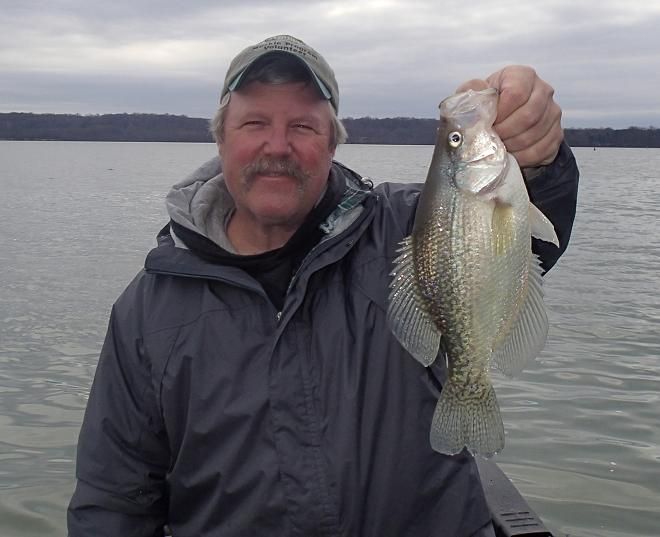
Gene Mueller with a slab Tidal Potomac crappie caught on a bobber and jig.   Gene provides some great fishing tips on his website, "Gene Mueller's World of Fishing & Hunting".
You can also read an interesting interview that I had with Gene a while back on this blog on a post titled, "Interview with Gene Mueller, Outdoor Writer Celebrity".

And finally, after meeting Andy, a licensed fishing guide that works the Upper Tidal Potomac River, I’m convinced that anyone hiring him would have a great time with him and also catch a boat load of fish.  You can book a trip by calling (301) 932-1509.

Sunday, November 18, 2012

Experience+Luck=Good Fall Bassin'

My wife loves those crisp cool sunny fall days, but bass anglers either love 'em or hate 'em.  Why? Bass anglers love those days when the feeding bell seems to ring all day long as bass binge on any active bait that they can find, or hate those same kind of fall weather days where cold front bluebird skies can cause bass to hunker down and not bite, appearing to have lock jaw.
Windy sunny days with bluebird skies can be hot or tough, who knows why or when.  Either way, they make for beautiful scenic photographs.
Yesterday, my buddy Howard and I hit one of our favorite small lakes in search of a mixed bag of bass, chain pickerel and crappie.  My buddy Bob, who I purchased my boat from, wanted to tag along with his boat, and bring a special guest, his eight year old Son, Carson.  Howard and I have a history of hitting lakes like this in the fall, and every year we seem to learn something new.
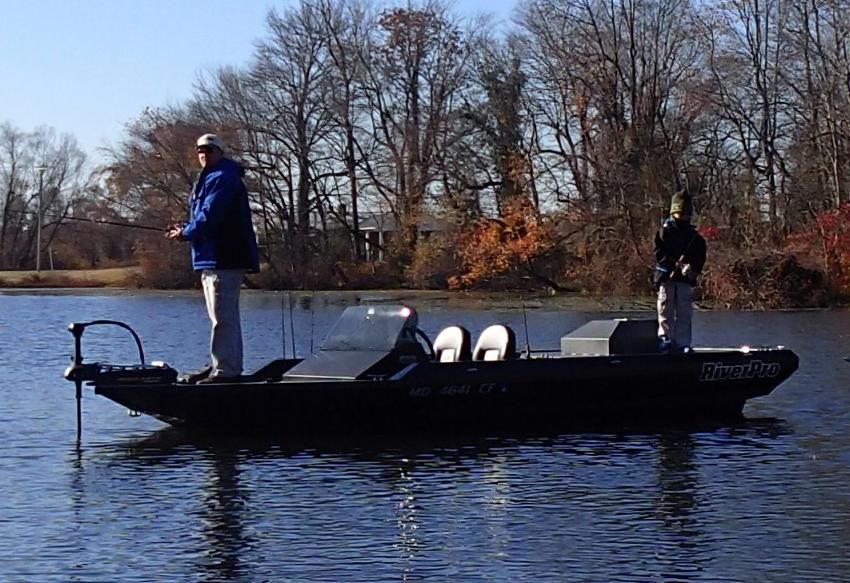
Bob and Carson fishing out of Bob's new dream boat, the Riverpro LoPro.
Experience... One of the elements in my equation titling this post.  Last year we hit this spot and had a really tough day most of the day.  We had an early morning start and by noon, not even a bite, fishing for bass or pickerel.  We hit all of the woody and weedy cover and nothing.

Not two weeks earlier did we have a banner day, all day, boating many chainsides and chunky bass that were hammering our chatterbaits and soft plastics.  The upper end of the lake that week was loaded with predators, and massive schools of bait to keep predatory fish happy.  Golden shiners and schools of shad were on the upper lake menu that day.
Last year, prior to the cool down, we caught bass like this and chain pickerel all day long on woody and weedy cover.  They were chasing baitfish in the upper end of the lake.
So where were the predators?  Where they just suffering from lockjaw due to the weather and cold temperatures?  Or did they move?  Not only did we not catch anything in the upper end of the lake or on any of the cover, but we didn't see any baitfish either.

It was so tough we resorted to fishing for crappie and bluegills.  Not that panfishing is bad.  Not at all, they can save a trip and turn a bad day into a good one.  In fact, when the crappie bite is on, fishing days are far from crappy.  They can be as fun as any fishing day of the year.  But, we were spoiled.  Chunky bass and big toothy pickerel were still on our minds.

On that day last November, we had Northeast winds blowing down the lake all day.  The forecast called for wind speeds in the five to ten miles per hour range, but they turned out to be more like ten to twenty.  It made for tough fishing and tough boat control.

While we were drifting from one crappie spot to the next, we remarked how the wind was piling up on the Southern shore.  Of course, warmer temps would be there, it was the deepest part of the lake, and that might be where the bait went.  So, we opted to try for predators once again.

My mind couldn't shake the sight of bass and chain pickerel chasing baitfish two weeks earlier, so I opted to tie on a gold half ounce Rat-L-Trap to imitate the golden shiners that are prevalent in this lake.  Neither Howard nor I had ever fished rattling lipless crankbaits in this lake.  Normally, these lures are hot during the spring, so it wouldn't previously have been my top choice in the fall.  But they do cover water quickly, and do resemble the forage for this lake.

My first cast toward the deep end resulted in too deep of a retrieve and hooks full of snot grass (bottom scum like algae). So, I tried another cast keeping my rod tip up and cranking medium speed, and wham, nice fish on.  After a nice fight, I landed a chunky four and a half pound bass (weighed four pounds seven ounces and went twenty inches long).
Matching the hatch, a gold Rat-L-Trap imitating a golden shiner, proved the ticket to land this fat bass, combined with finding the right location.
The pattern held all afternoon after that.  The rattling lipless crankbait boated several nice fat bass in the three pound range the rest of the day.  In addition, we landed some large chain pickerel in the same area.  As evening approached, we fished the crankbaits on the way back to the ramp around wood, like you might do with a chatterbait or spinnerbait, and that too produced some fine bass and pickerel.

Matching the hatch along with figuring out where the predatory fish liked to be this time of year were keys to our success.  The Northeast winds piled up warm water along the deeper section of the lake.  The baitfish were there, and so where the predators.  As the temperatures warmed during the day, some of the bass and pickerel moved into the cover that seemed devoid of life just hours earlier.
We actually accidentally snagged some of these baitfish yesterday with our crankbaits.  At first, I kept thinking that fish were bumping my lure, or perhaps I was ticking the tops of weeds or cover.  Well, I finally snagged one, and it turned out to be this little critter, a gizzard shad.  Bob and Howard also hooked a couple of them.  When you find these, predatory fish are close by.
So yesterday, we all made it to the ramp.  Temperatures were below freezing, with ice on the dock next to the ramp, and frost covering all of the cut soy bean and corn fields everywhere on the ride to the lake.  The surface water temperature was a chilly 44.3 degrees according to my depthfinder.

After an hour of trying the lily pads and woody cover with just a couple bites and no fish landed, we pondered crappie fishing again.  But wait, remember last year?  Howard and I made the change early and headed right for the deeper water where the wind once again piled up warmer water.  The water temperature there was 46 degrees, nearly two degrees warmer.  And, my depthfinder marked schools of baitfish everywhere.

I had my gold Rat-L-Trap already tied on for just such an occasion.  My first cast was with the wind as the boat drifted in the same direction.  With the rod tip held high like last year to keep the snot grass off the hooks, I didn't crank five times when, wham, a nice hit.  I was pumped up as my first cast in that area resulted in a 19 1/2 inch largemouth with a big head and not much of a belly, but it was a good fish, and my first fish of the day.
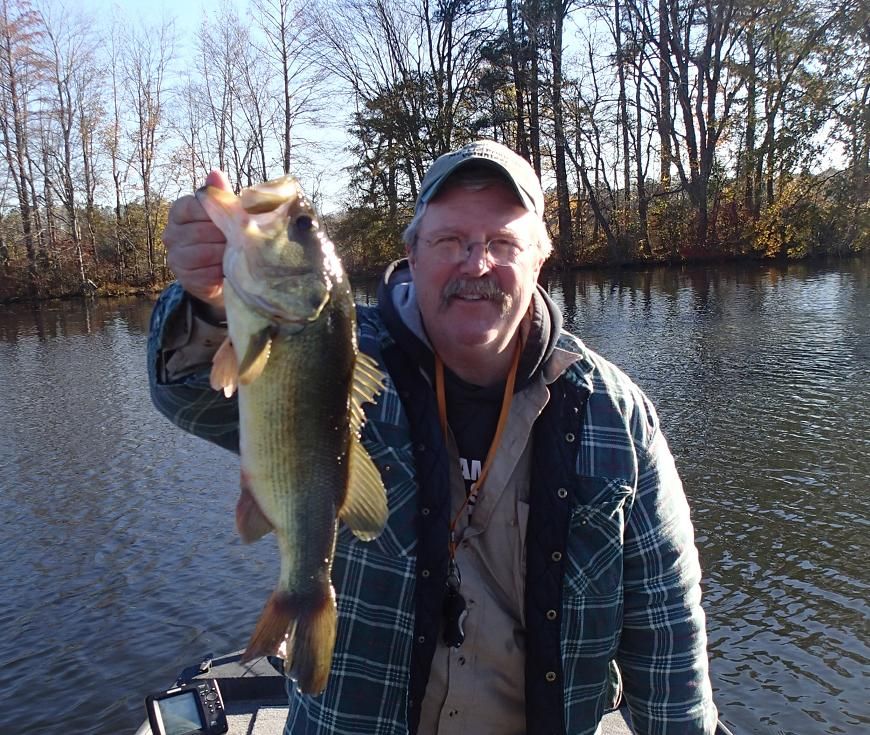
My first cast with my gold lipless crankbait golden shiner imitation resulted in this long probably older bass.  But it couldn't have been more beautiful to me after a tough start. 
Howard snapped a couple photos with my camera and my phone.  We then took some measurements and released the fish.  I quickly texted Bob about what we found with a picture of my new fish telling him to bring him and his boy down to our location.

After we drifted several yards , I picked up my rod and made my second cast, again, with the wind and the drift.  About eight cranks, rod tip high, and wham!  After another good fight.  This time I landed another chunky bass that measured a nice 17 inches.  More pics, the release, texting Bob again, and back to fishing.  Things seemed to be working in our favor, the tide had turned, and what seemed like a tough fall day was looking up.
My very next cast resulted in a much fatter but slightly shorter 17 inch largemouth bass.
Not long after that last fish, I landed this 18 inch largemouth.  What was a tough day for me was turning to a banner day quickly.
Like last year, the fall pattern was holding.  My gold Rat-L-Trap fished with the rod tip high in the deeper water was producing.  Bass were gobbling it up.  Even the pickerel where there, as Howard found out.  His Rat-L-Trap was bitten off and taken from him.  That had to be a huge chainside.

Soon, Bob and Carson made their way to our spot.  I told them of the pattern, and soon they were both working the deeper water with the rattling crankbaits.  It didn't take long for Carson, an eight year old quick learning heck of an angler (watch out KVD), to hook up and expertly fight and, with some help of his Dad, land the biggest chain pickerel of his life.
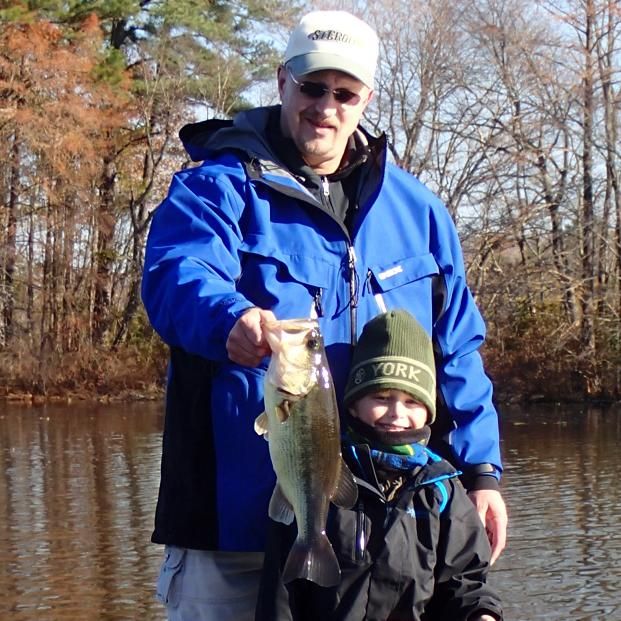
Bob holding Carson's chain pickerel, his personal best.  Watch out KVD, here comes Carson on the angling scene!  Don't worry Mr. Van Dam, Carson still is a bit nervous about holding his fish, so you have some time.
About ten minutes later, Carson proceeded to land his personal best largemouth, a fat 19 incher!  Bob joked about how his fishing karma had rubbed off on Carson, leaving him to start over again.  We also pointed out how his six year old boy had been putting a thumpin' on his Dad!  But Dad didn't take long to show his stuff, landing a nice chainside too.
Carson smiling proudly over his catch, a personal best 19 inch nearly four pound largemouth as his Dad proudly displays if for him.
Bob with a nice chain pickerel caught on a chrome Rat-L-Trap.
We had a very early start, and although Carson was excited to fish and about as happy as he could be over his catches, he ran out of gas around two in the afternoon.  Bob and his tuckered out child angling prodigy headed home, leaving the rest of the pickerel and bass for us.

Howard and I continued to work the area hard.  Fishing wasn't easy, but it was consistently giving up quality fish.  Not only did the rattling lipless crankbait work, but I also did well on a shallow diving shad like chrome crankbait, the Luhr-Jensen Speed Trap.  I also managed to catch four keepers, but also my smallest fish on my trusty plastic worm after finding some deeper water cover.

Like the past year, as the day neared the end, we fished our way back to the ramp hitting the woody cover that was fishless just hours earlier.  By this time, the water temperature had warmed to nearly 50 degrees.  I suspected that once the water warmed enough, some predators would move back into the woody cover.  I fished my Rat-L-Trap again, like a spinnerbait, and hooked and lost two nice chain pickerel, but landed one smaller pickerel and a few more fat bass, including a 17 3/4 inch and 18 inch largemouth.
Another fat crankbait bass, this one on a Luhr-Jensen chrome Speed Trap, again, fished with the rod tip high.
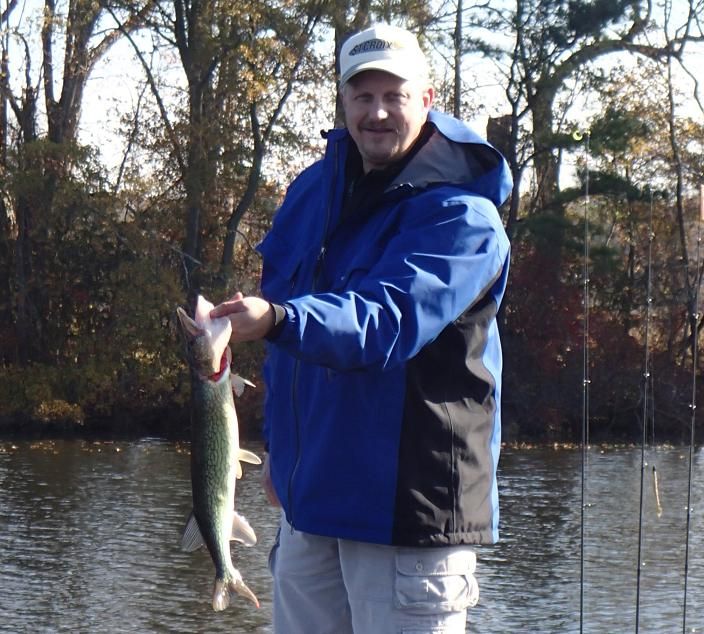
Howard connecting with a quality toothy predator, Esox niger, the chain pickerel.  This beauty inhaled a white chatterbait.
Luck... Experience plays a huge role, but when fishing open water, making that right cast is a combination of luck and experience.  But confidence in what you are doing, based on experience, improves your odds and brings you luck.  You caught fish there last year, doing the same thing, consistently.  Chances are, under the same conditions, your odds are pretty good that it will happen again.  Why one guy catches bass under these conditions and another angler doesn't, seemingly doing the exact same thing with identical lures, well more than likely it's luck.  Or, it could be subtle differences in tackle or technique.

Good Fall Bassin'...Now, another key component with finding bass in the fall is to use lures that can cover a lot of water quickly.  These search baits, like spinnerbaits, crankbaits, and chatterbaits, can really rack up the numbers for you, but may take a lot of casts when bass are in open water.  Rattling lipless crankbaits and diving crankbaits are good choices for locating schools of fish that feed on shad.

My day seemed tough at first, but turned out to be a great fall bassing day.  I finished with eighteen fat largemouth bass, with my biggest seven bass ranging from 17 inches to 19 3/4 inches.  The other ten fish were between 13 and 15 inches.  I managed a nice pickerel too, along with a crappie that inhaled a plastic worm.  Apparently, the crappie thought he was a largemouth.  Eight bass were on the Rat-L-Trap, four fell for the plastic worm, and six quality bass engulfed my Luhr-Jensen Speed Trap.

So there you have it folks.  Experience combined with a little luck, could turn a chilly fall day into one of your best bassin' days of the year.
______________________________________________________________________________

By the way, I want to thank everyone who keeps checking my blog for updates, and at the same time apologize for keeping you waiting for my next post.  I'll do a much better job in the future with updates.  Stay tuned with more fishing, hunting, and shark toothing articles.  I have a special shark tooth article nearly completed, highlighting some adventures of some internet friends from South Carolina.  Have a happy Thanksgiving!


Tuesday, July 24, 2012

My New Family Member

Well, before everyone congratulates me for having a baby, let me come clean by admitting that it’s not human, it’s a boat.  I recently purchased a used sixteen foot Alumaweld aluminum panfish style boat with stick steering powered by a 60/40 horsepower jet outboard drive motor.  This boat is teamed with an eighty pound thrust Minn Kota Maxxum trolling motor.  The set up of this rig is designed to navigate and fish the shallow rocky rivers of the Mid-Atlantic for smallmouth bass, largemouth bass, walleye, musky, and panfish.  Basically, the idea is to navigate where prop boats can’t go without damaging their lower units.
My new son!
After purchasing the boat, I brought it home and ran into my first two challenges.  The first was navigating the sharp ninety degree turn into my driveway, and meanwhile, stressing the transmission trying to push the boat up the steep hill of my driveway in reverse which proved challenging enough.  To make things tougher, I recently had to do it in pitch dark with no lighting on the driveway. 


Even more challenging was the acceptance of a new family member by the rest of my family.  After parking the boat, I entered my house and asked my soon to be twenty year old daughter, who was laying on the couch, why she wasn’t excited to meet her new brother.  Her response was something to the effect of, “It’s not my brother and if you say that again, I’ll slash the trailer tires.”  My reply shot out, “That’s no way to treat your new brother, go to your room!”  I then walked down to the hall to the master bedroom, and made my second mistake, opening the door and waking my wife from her beauty sleep of an afternoon nap, and asked her if she wanted to come out and see her new son.  Needless to say, that didn’t go over very well.  My fishing time was instantly reduced while more tasks were added to my honeydo list.
Sitting in my carport with the jet drive partially visible, waiting to meet his new Sister and Mom!
Why would I pick such a craft to fish from?  There are several ramps on a nearby river within a half hour of where I live, and a dozen more within an hour and a half.  In addition, there are several more similar rivers with excellent fishing within a couple hour drive.  My new jet boat will put me on some of the most famous smallmouth streams in the United States, the Potomac, Susquehanna, Delaware, Juniata, Shenandoah, Rappahannock, New and James are all within my fishing domain now. 

Also, there is an outstanding electric only lake only ten minutes from my house, and a bunch more within an hour drive where that Minn Kota will move me quite nicely from one fishing hole to another.  I can also easily put in some of the many ponds on Maryland’s Eastern Shore, or easily fish the Upper Tidal Potomac or larger lakes in Maryland, Virginia, or Pennsylvania like Deep Creek, Raystown, Anna, or Smith Mountain Lake.  It’s not a boat that can do everything, but it’s one that gives me the most options.
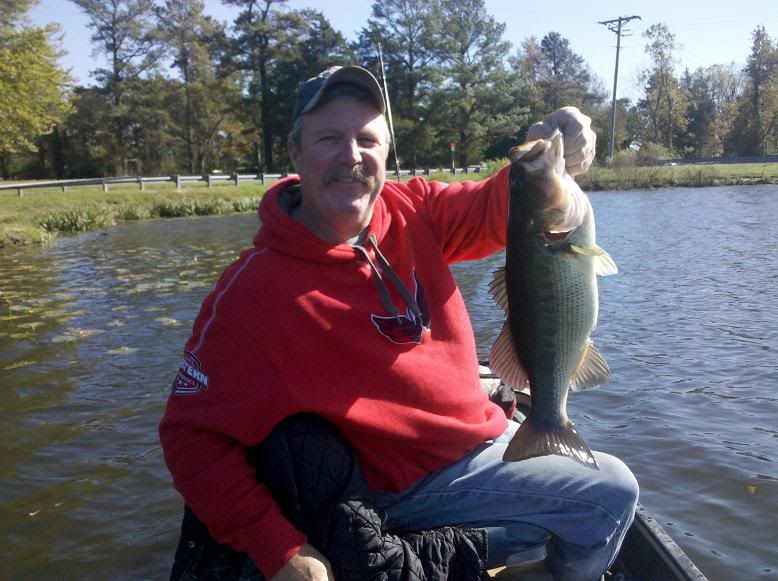
My fishing pal Howard achieves the honor of catching the first fish out of this boat under the new ownership, a dink smallie photographed magazine style!
The jet drive loses thirty percent of the motor's horsepower when drawing water through the intake and shooting it out the back, hence the 60/40 horsepower rating, but the loss of power is offset by the ability of the craft to go places that would tear a prop and/or lower unit instantly into scrap metal.  It’s akin to a four wheel drive truck designed for mud bogging compared to a BMW doing the same job.  Plus, the boat is small and light, and that much horsepower gives it plenty of speed for me, about 26 mph boating against the current, and 28 to 30 mph motoring with the current.
My first fish out of the boat was a dink smallie also, but this was my second fish which reached the fine honor of being the first keeper sized bass caught out of the "new" boat.
Howard with the honor of catching the first keeper largemouth out of my new boat.
Why the panfish style with stick steering?  The seating arrangement places me up to the front, providing a great view ahead allowing me to spot rocks and current seams while the stick steering provides improved ability to maneuver around such aluminum crushing obstacles as boulders and rocky ledges beneath the surface.  Also, the weight is more evenly distributed, maximizing speed while allowing the rig to get on a plane much more easily.
The seating arrangement allows the driver to easily see obstructions while navigating on plane while evenly distributing weight to maximize speed and enable optimal drafting while drift fishing rocky shallow Mid-Atlantic rivers.
I have quite a history with this particular boat.  I purchased it from a buddy of mine, Bob.  I’ve actually fished out of the back of the boat for years while catching many big fish, some of which were personal bests for me during those times and remain so today.  Bob and I had some awesome times and I have many fine memories those trips over the years.  Thanks Bob!
My personal best musky was caught out of the back of "Bob's" boat...now my boat.  I'll break that PB  some day soon I hope.
I’ve made many trips, some long distance vacation type fishing trips and fished out of the back of this boat, including trips to Canada and the Adirondacks in New York, along with countless local trips. 
I caught this nice catfish on a trip to Canada chasing muskies out of the back of  this boat!  Notice the similarities of the characters here...shape of the belly, whiskers.
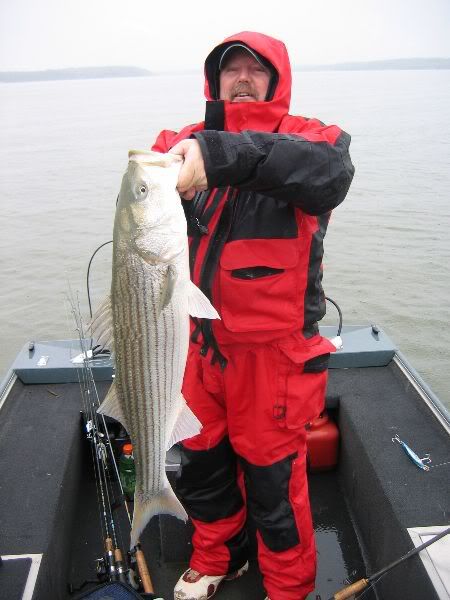
I’ve caught some of the biggest freshwater or brackish water fish of my life out of this boat.  Several years ago, I was able to boat a forty five and a half inch striper that weighed a tad over thirty eight pounds that remains my personal best striped bass catch.  Unfortunately, I didn’t snap a picture of that massive fish because we used up all of our film earlier on smaller fish.  We also didn’t realize that they reached that size where we were fishing, only discovering the “fishery” a few days earlier.  This was before any of us had digital cameras, which were just out on the market at the time and very expensive.  
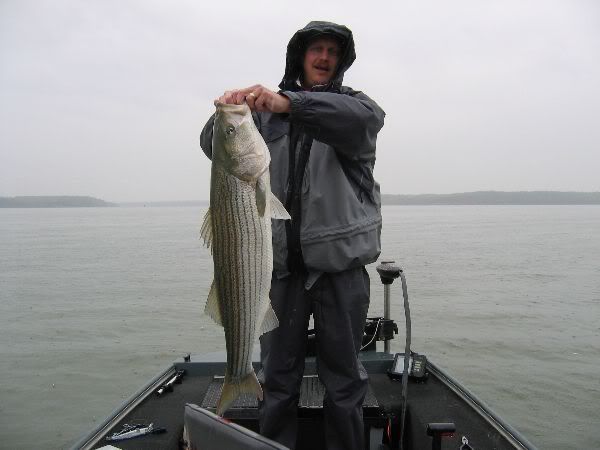
Although this striper is quite a bit smaller than my personal best, it's another nice one caught off the back of my new boat, another moment in it's history.
A thirty inch fish at that time seemed huge to us, but a 38 pounder?  It was unthinkable until it happened.  I caught it casting a Bomber Magnum Long A minnow style crankbait after seeing a huge striper try and eat an eighteen inch small striper that my buddy caught at boat side.  When I saw that, I dug into my tackle box for the biggest lure that I could find, and it paid off big time.  My biggest four stripers that day went 45 ½” and 38.1 lbs., 37” and 21 lbs., 34” and 15.2 lbs., 31” and 11 lbs, and I caught several more in the eight to ten pound range that evening.
Bob with a beauty of a striper, a.k.a. rockfish in Maryland, caught at the helm of the boat under his ownership.
I’ve also caught, photographed and released my largest musky, my personal best walleye, and countless big smallmouth and largemouth bass.  Oh yeah, there’s a lot of history and memories on this boat, not to mention solidifying a great friendship with Bob, and making other fishing friends through him.  Now instead of fishing out of the back, I’ll be at the helm and hopefully, there will be more personal bests for me and my fishing pals.
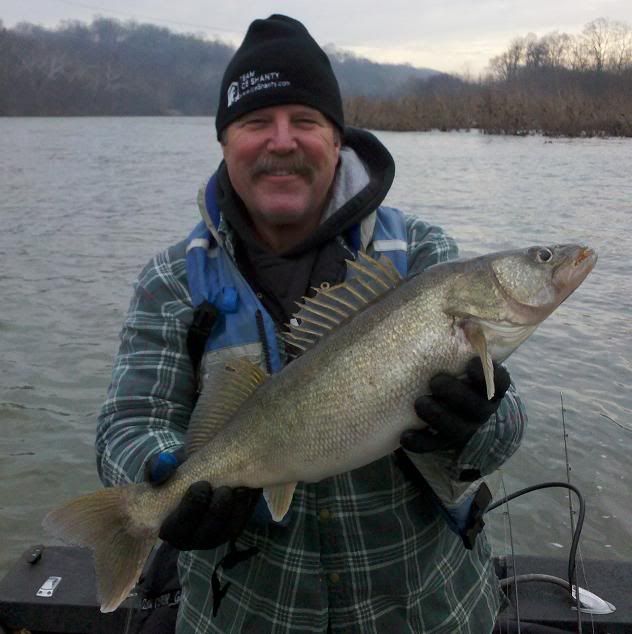
Thanks to Bob taking me fishing out of his boat, I've been able to get some personal best on several species including this fine walleye taken on the last day of 2011.


A double on the Susky, Bob with his smallie and me holding mine near to the camera a couple years ago.  We spent a lot of time chasing smallies together on the Susquehanna over the years out of this boat.
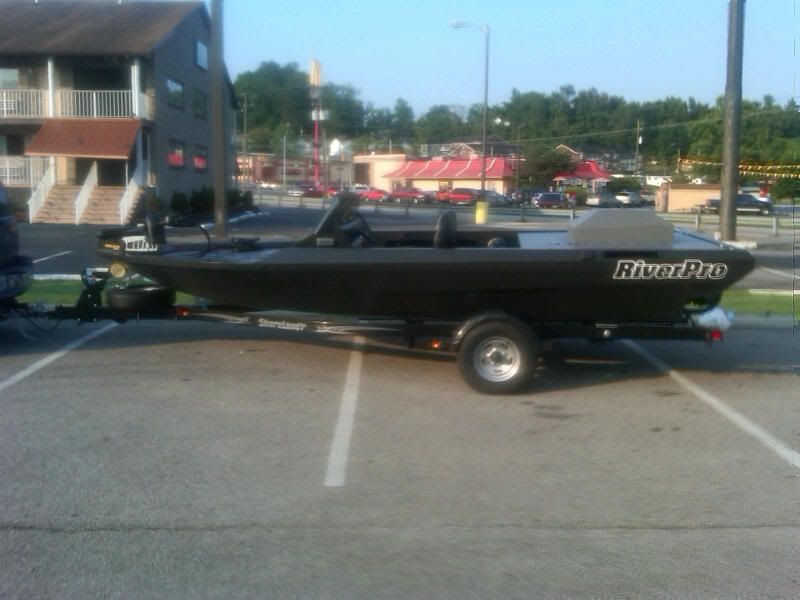
Meanwhile, what about Bob?  He's a bit sentimental and emotional about transferring ownership to me, but at the same time, he's excited.  He would only part with such a boat if he had a suitable replacement.  "Suitable" hardly describes his replacement though.  He just brought home his new RiverPro 186 LoPro built by Kevin Turner in Missouri.  This, my friends, is my dream boat.  But alas, I can't afford one as yet.  Congratulations to Bob for his magnificent purchase.  I'll save the details on this boat for a future post after I ride and fish from the back of this fine machine.  Bob will have a ton of fun on his new ride, and will soon forget about his old boat before long.
Bob's sleek new RiverPro 186 LoPro with the 200 hp Mercury SportJet will pictured here on it's way home, soon allow Bob to be less sentimental about the sale of his old boat to me!
Actually, my new purchase is my dream boat.  Hey, it puts me on the water and I can fish just about anywhere I want to go.  What more could I ask for?  At least until I hit the lotto!!!!


Only one question remains…  


What should I name my new boat?  Any suggestions?