Showing posts with label plastic worms. Show all posts

Thursday, May 2, 2019

How About a Little Bait, Big Bass Story?

Here's another campfire type story that brings back fond bass fishing memories for me, one of a big bass caught while finesse fishing on a rather small lure.  Only this big bass wasn't caught by me, rather, it was caught by my fishing pal, Captain Steve Kelley.

It was early spring, near the end of March.  Cloudy skies, light winds, air temperatures in the upper fifties, and water temperatures in the low fifties were ideal conditions to catch pre-spawn big bass.  Water visibility was about two feet, which was really good for such a windy month.  We started out fishing with a moving incoming tide in our favor.

Recently, in previous trips, we'd done well casting lipless crankbaits, and we expected similar results on this trip.  Basically, the hot pattern at the time was to find emerging weedbeds, cast out a crankback, and as you reeled it in, tick the tops of the weeds with it.  Often, if you lighly snagged a weed during the retrieve and jerked the crankbait off it, you'd provoke a bass to strike.   Lipless crankbaits work great with this method. 

Click Here for more info on fishing lipless crankbaits and fishing this weed pattern.

We reached our first location of the day around mid morning, a cove at the mouth of a creek that had a fair amount of sunken wood and plenty of fallen timber along the bank.  The bottom consisted of pea gravel along the bank, and a muddy bottom out toward the middle of the cove.  Bass consistently spawn in this cove, so we felt that was a great reason to start there for the day.  This cove usually had a fair amount of weeds, so we thought that the crankbait pattern be the perfect method.

However, the fish had other plans for us, at least at this spot, at that particular time.  Steve finally hooked up on his first largemouth, an eighteen incher, after about a half hour cruising the cove on a crankbait.  I picked up a couple of punk fish, but the bite wasn't as fast and furious as it had been during previous trips.  For some reason, the weeds hadn't grown as they had in the past at this spot.

Sometimes, when things are slow in the cove, it often winds up being better fishing inside the creek.  We fished our way into the creek.  As we entered the creek, Steve commented that he often caught fish on plastic worms off one of the points.  At the tip of this point, there was a log that created a small current break during an incoming tide.  Steve picked up his rod, rigged with light weight, a light wire hook, and four inch green pumpkin ringworm, and pitched his worm perfectly into the eddy created by the log.  Almost immediately, he yelled, "Fish!  It's a good one!"

After hearing that, I reeled in my lure and grabbed the net.  The current swept us further into the creek as Steve battled the fish on eight pound fluorocarbon line spooled on a medium light action spinning rod and reel combo.  As the fish neared the boat, I had the net in the water at the ready, but the fish saw the net, and took off for a run.  At this point, neither of us got a good look at her.

It peeled off a little line, and then Steve worked her back in.  After a few head shakes under the boat, Steve brought the fish out from under the boat and I eased the net underneath her.  This fish was a fat girl for sure.  After I netted her and took pictures, Steve placed her on the measuring board and she went twenty one and a half inches long.  We didn't have a scale, but I'd guess, based on her girth, that she weighed about six pounds, perhaps a little more.  At the time, this was Steve's personal best tidal river bass.  What a beast!
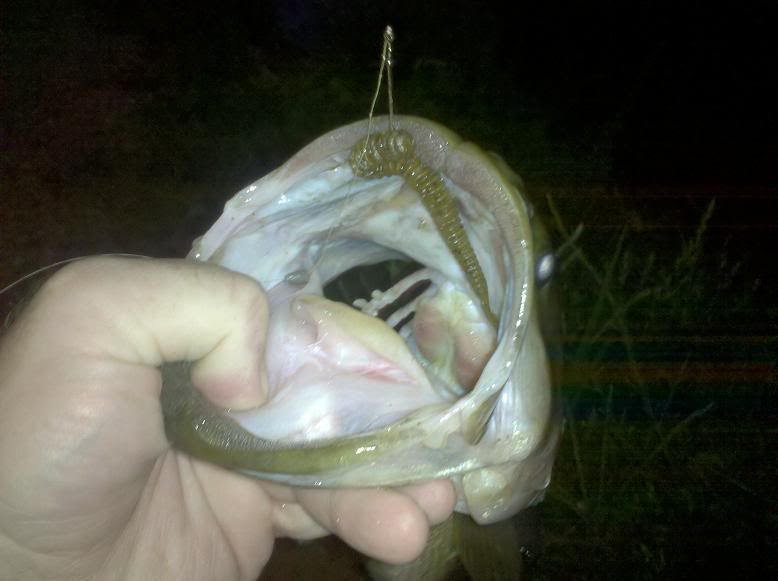
Steve's twenty and a half inch personal best tidal river largemouth bass inhaled a four inch finesse worm!
In recent blog posts, I posted stories about big bass caught on big lures, and that is such a true saying worth repeating.  But, this bass was caught on a finesse style worm, texas rigged fished with a light bullet sinker on light line.  It wasn't a new pattern for either of us, as this rig has caught lots of fish, for both of us.  And, I personally have caught several five pound or better fish on this rig.  It's productive.  During a tough bite, you can't beat it.  But, this fish was caught finessing on a day when the crankbait bite should have been king, and at the end of the day, it was. 
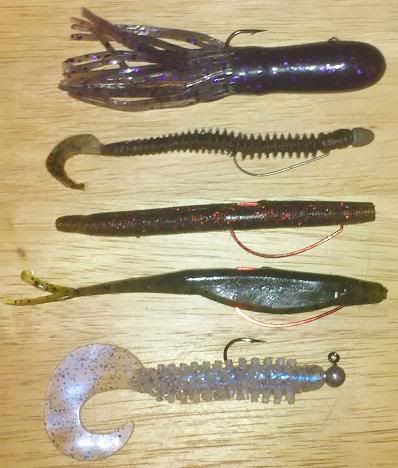
Pictured here are a few productive finesse soft plastic lures.  The second lure from the top, a four inch green pumpkin ringworm, fished with a light wire hook, and a light 1/16 ounce bullet sinker on eight pound line caught Steve's lunker fish.
After that fish, we moved to another spot with a good weedbed, where the fish really turned on to the lipless crankbait pattern.  I don't remember if he caught any more on a worm, but, it's tough to finesse fish when your boat partner is cranking in big fish and covering water.  In other words, when the crankbait bite is on, it's a tough choice to put that lure down.  Let's face it, lures like that cover a lot of water, and when they're hot, you can really rack up the numbers of good fish in a hurry.

We fished into the early afternoon and then he had to be off the water for a family function.  Steve finished with fifteen bass, all of the over three pounds, including his personal best fish.  I had a great day as well, finishing with sixteen bass, including nineteen incher and several in the seventeen to eighteen inch range, along with a couple fifteen inch fish.
I had a good day as well, as I caught good numbers of bass, including this nineteen incher.
What made this day memorable, other than fishing with a good friend, and other than the fact that we caught good numbers of nice sized bass in a short amount of time, was that I got to experience my fishing pal catch his personal best tidal river largemouth bass.  It was my honor to net and photograph this fish.  I can't wait to do the same when he catches his next personal best bass, if I'm lucky enough to be there when he does!

Tuesday, August 30, 2016

In, Under, and on Top of the River

After my last two blog posts about underwater photography and fishing buzzbaits, I couldn't wait to get out and try it all again in one trip.  What better a place to do that than our favorite summer wading spot?  My friend Rodger and I put in a full day of fishing and had a blast.  For me, it was all about the experience, not just numbers or the size of the fish (although bigger fish would have been more than welcome).
I love wade fishing the river in the summer.  We had gin clear water and bluebird skies to deal with, but the fish cooperated for us.  I had a great time.
The weather conditions weren't optimal for fishing, and as I later found out, not optimal for viewing certain species underwater either.  A cold front moved through the night before, and we had bluebird skies with a slight breeze, with air temperatures in the upper 80's.  That isn't a problem for wade fishing for smallmouth bass, but combine that with very low gin clear water, and it seemed that all of the fish were very spooky, including those that I wanted for my photo op.

I started off in the morning with a Heddon Baby Torpedo and after about thirty casts or so, decided to switch to a more finesse approach.  My buddy Rodger started out finesse fishing by tossing a small plastic worm and already had several fish under his belt by the time that I adapted.  Following his lead, I opted for the finesse approach and offered them the same four inch plastic worm, a lure that even skittish smallies will bite in our local river with such tough conditions.

My first spot fishing the worm was stacked with bass, so it didn't take long for my numbers to catch up.  At one point, I was able to catch them within a rods length of me and actually watch my worm bounce along the bottom and see the bass swim up and gobble it up.  The water was so clear that the fish would close in from about ten feet away on my lure!

It is amazing at how good their senses are.  As soon as the lure made the splash, their lateral line combined with keen eyesight allowed them to hone in for the attack from quite a distance away.

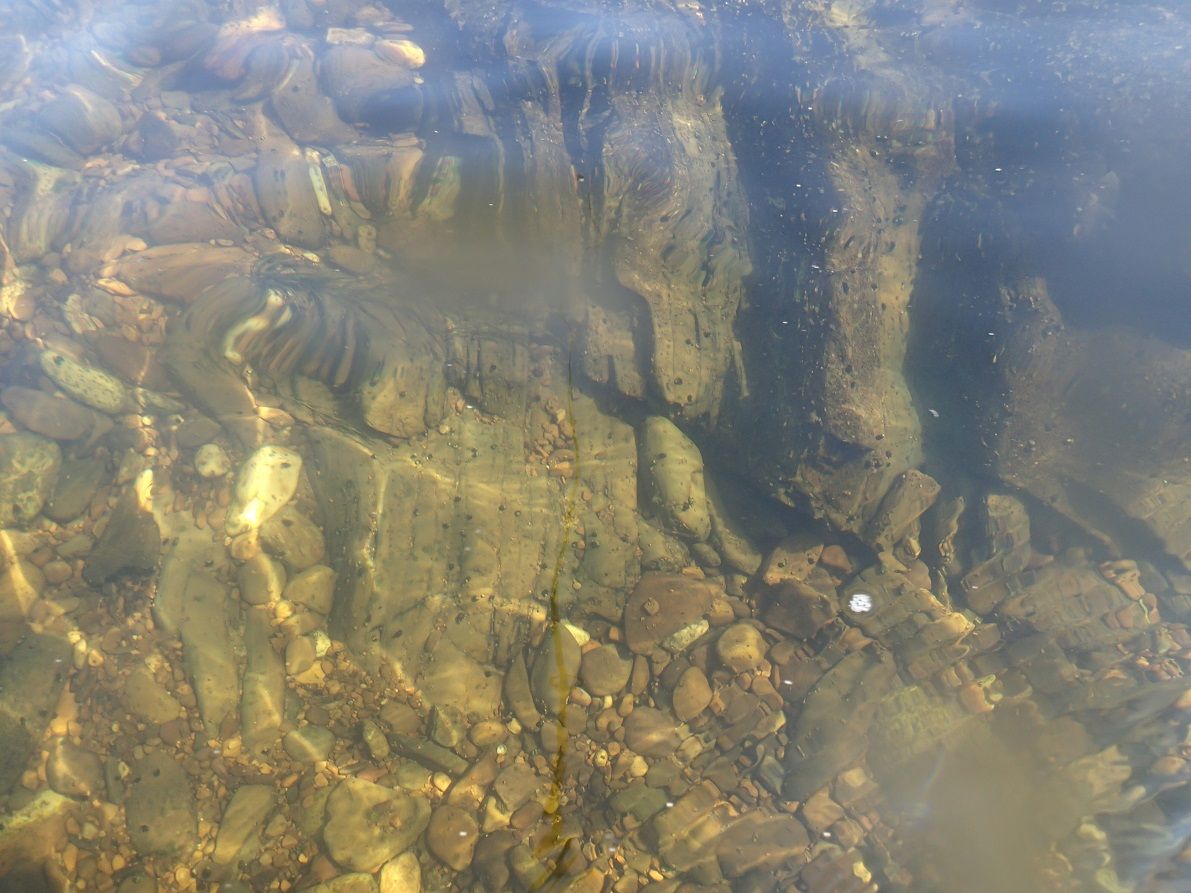
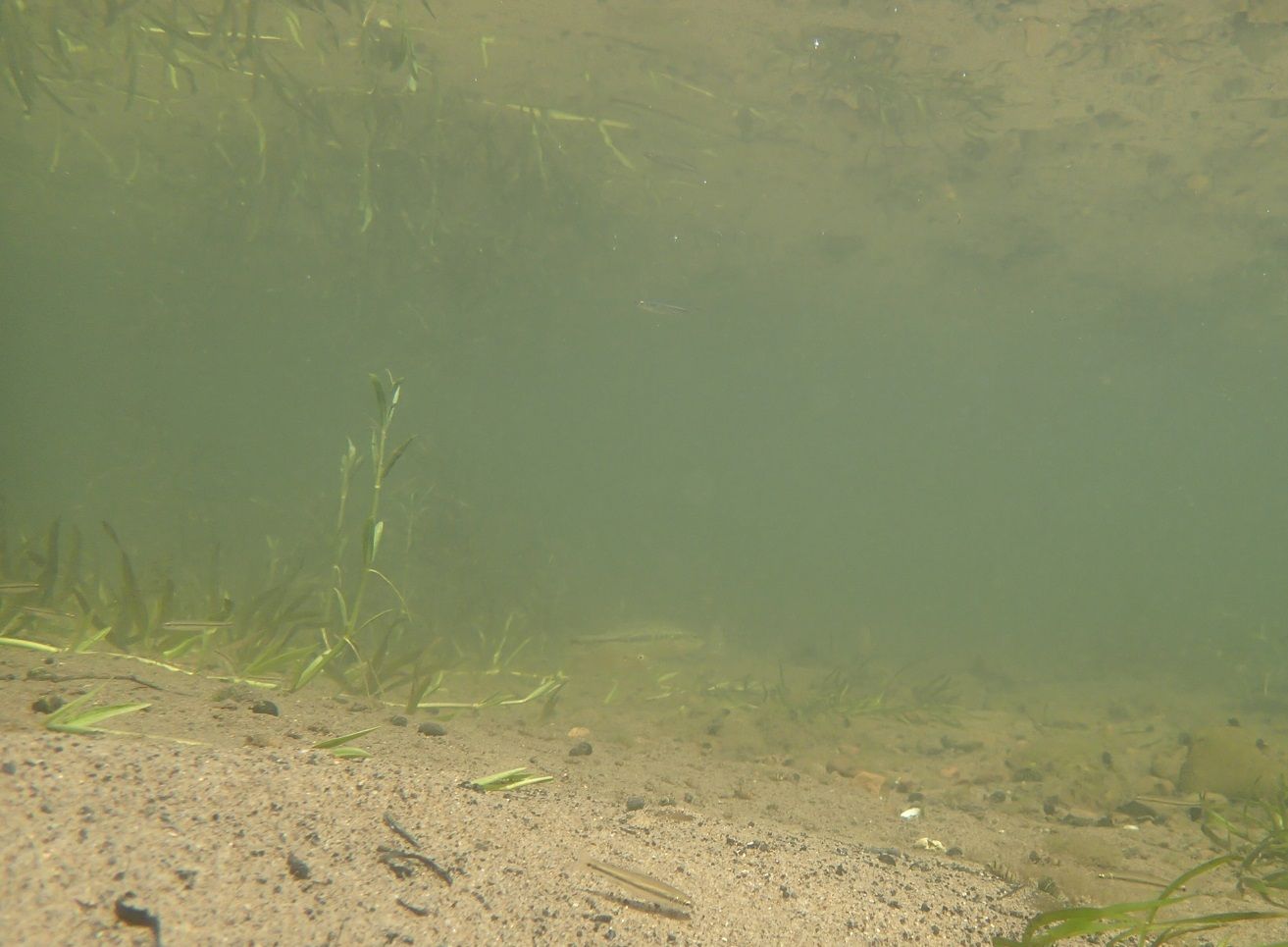
The river bottom, picture taken underwater from about waist deep.  The water was gin clear.
Here is the same spot with the picture taken above my waist with the camera out of the water.  Notice how clear the water is.  The only blur coming from water drops on my camera lens.
After catching a dozen or so bass, I started my underwater explorations, searching for good pictures of darters, minnows and anything else of interest.  However, even the little fish were spooky, and it was difficult getting close to the ones that I could find much less getting a good picture without scaring them away.  I did manage to get some pretty cool photos though.

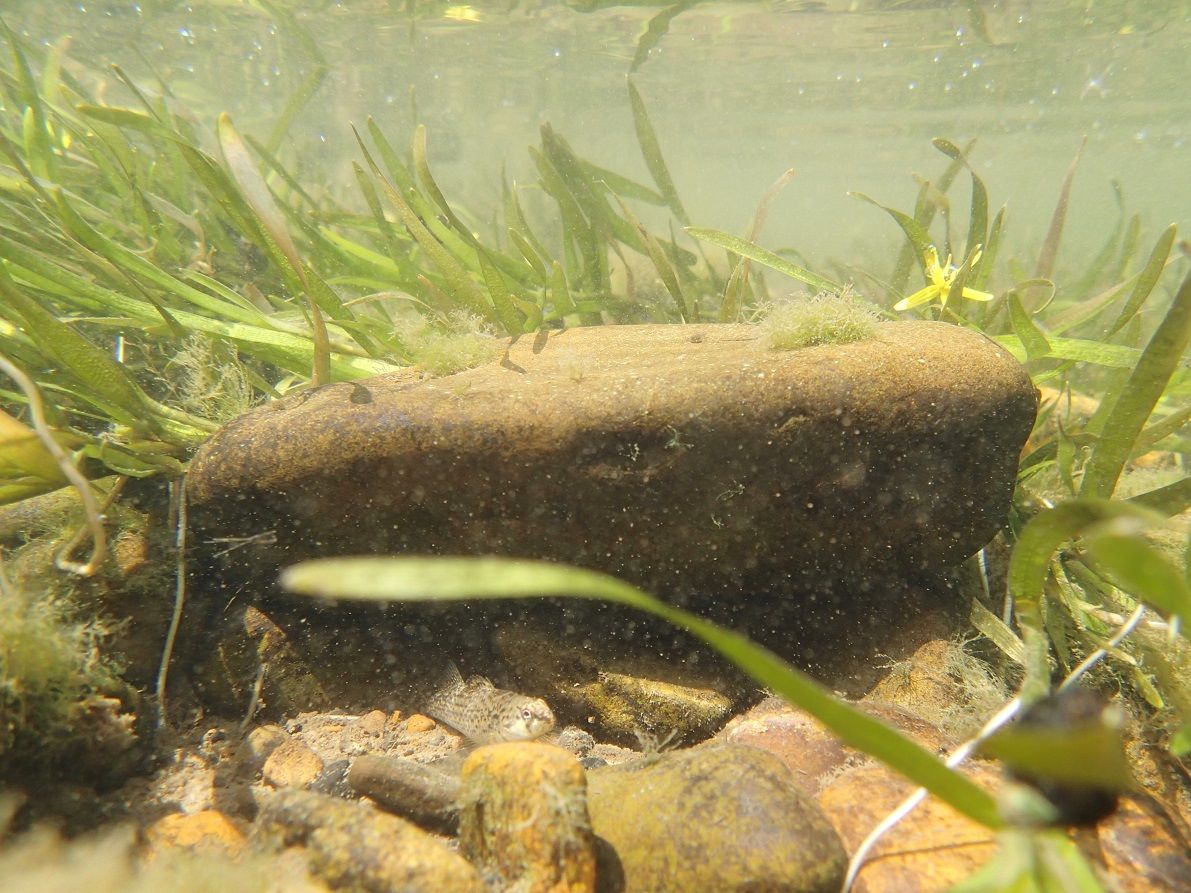
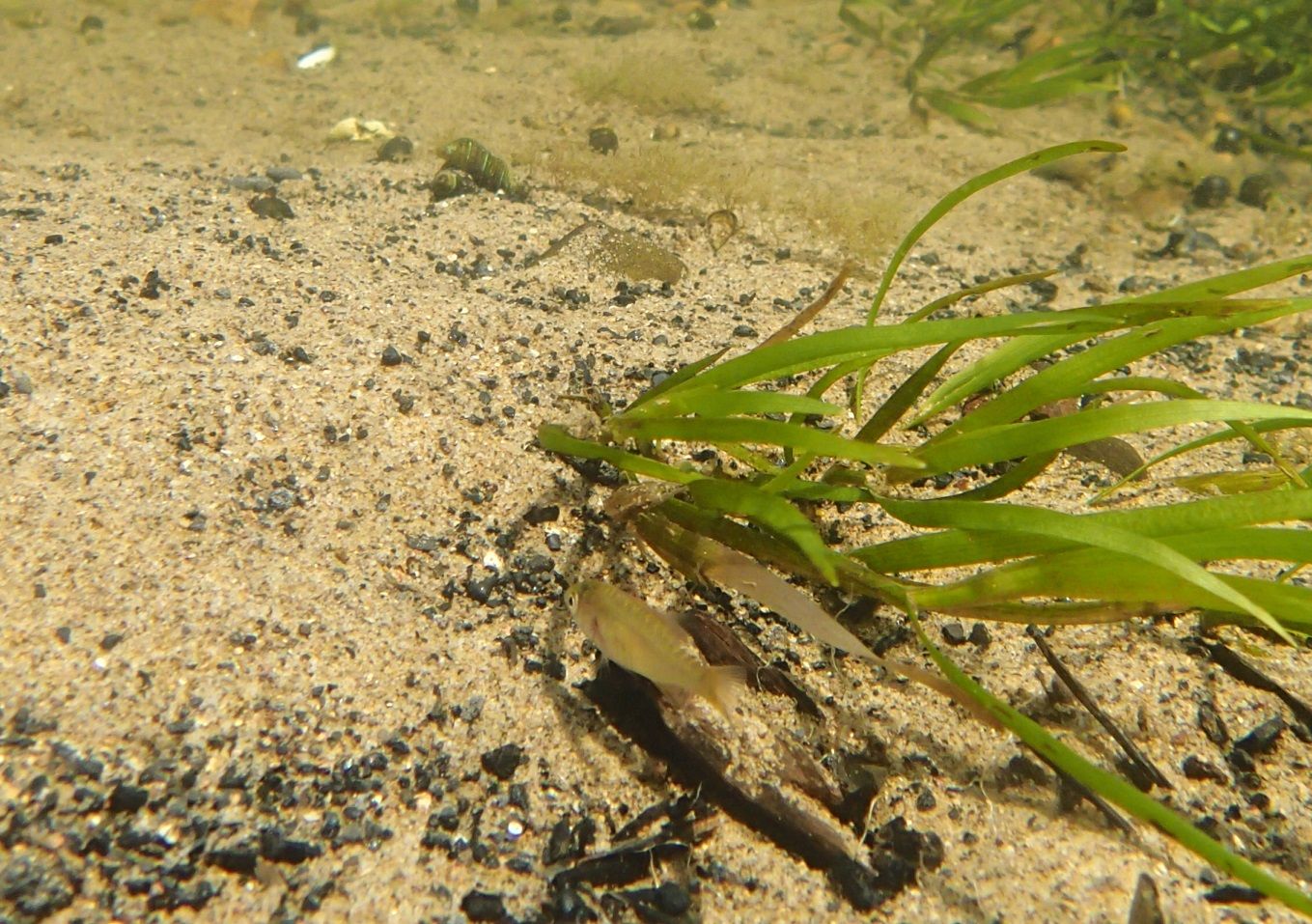
This darter posed for me briefly before I spooked it.  I'm not sure what kind of darter this is.
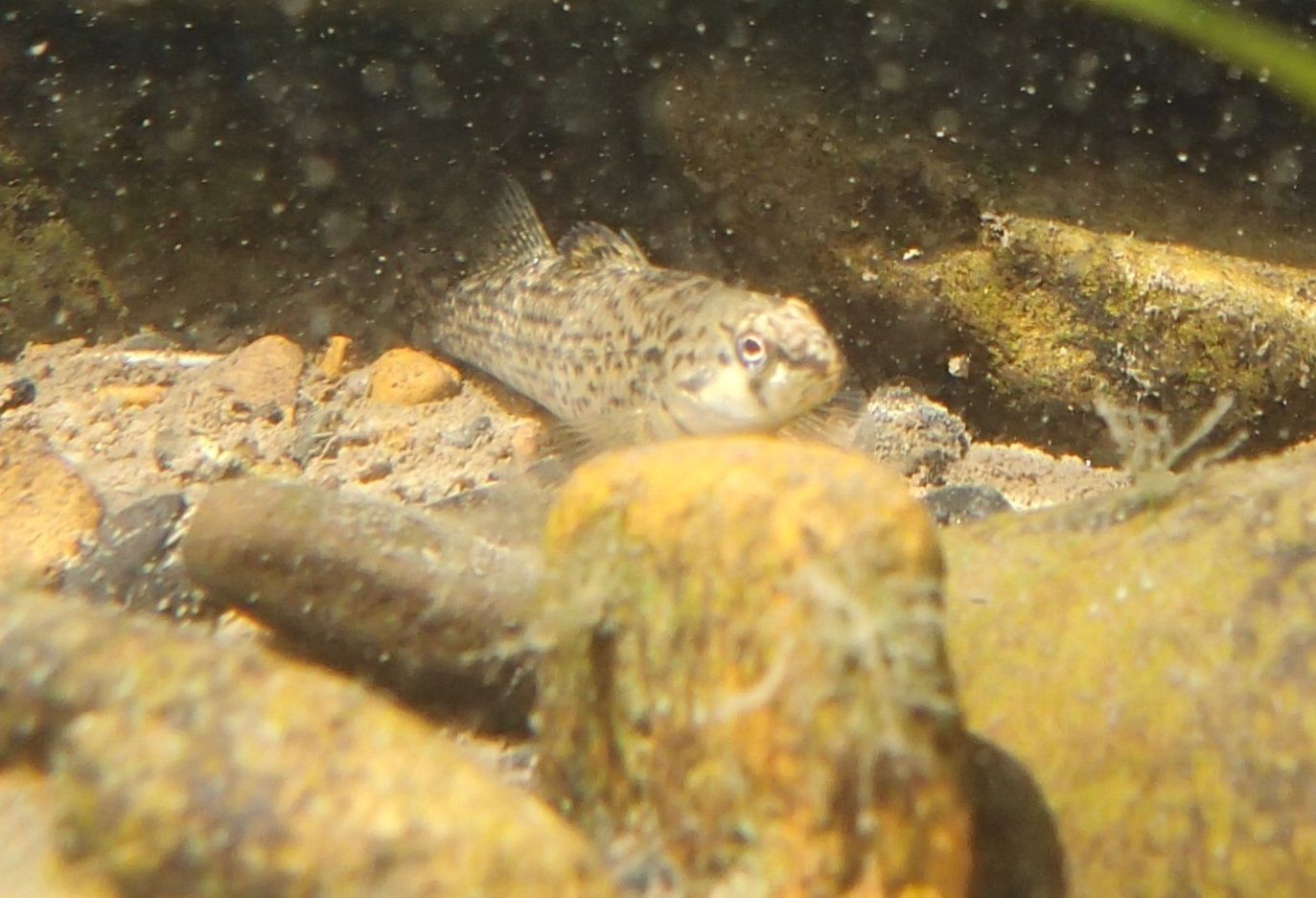
Edit:  This is a female rainbow darter, Etheostoma caeruleum.
Here's a closer look at the darter from above.  I can't identify it from this picture.  Greenside, tessellated, and rainbow darters live in this watershed.  What do you think?  Edit:  Since identified as a female rainbow darter, Etheostoma caeruleum.
Here's a closeup of a greenside darter from yesterday's trip.
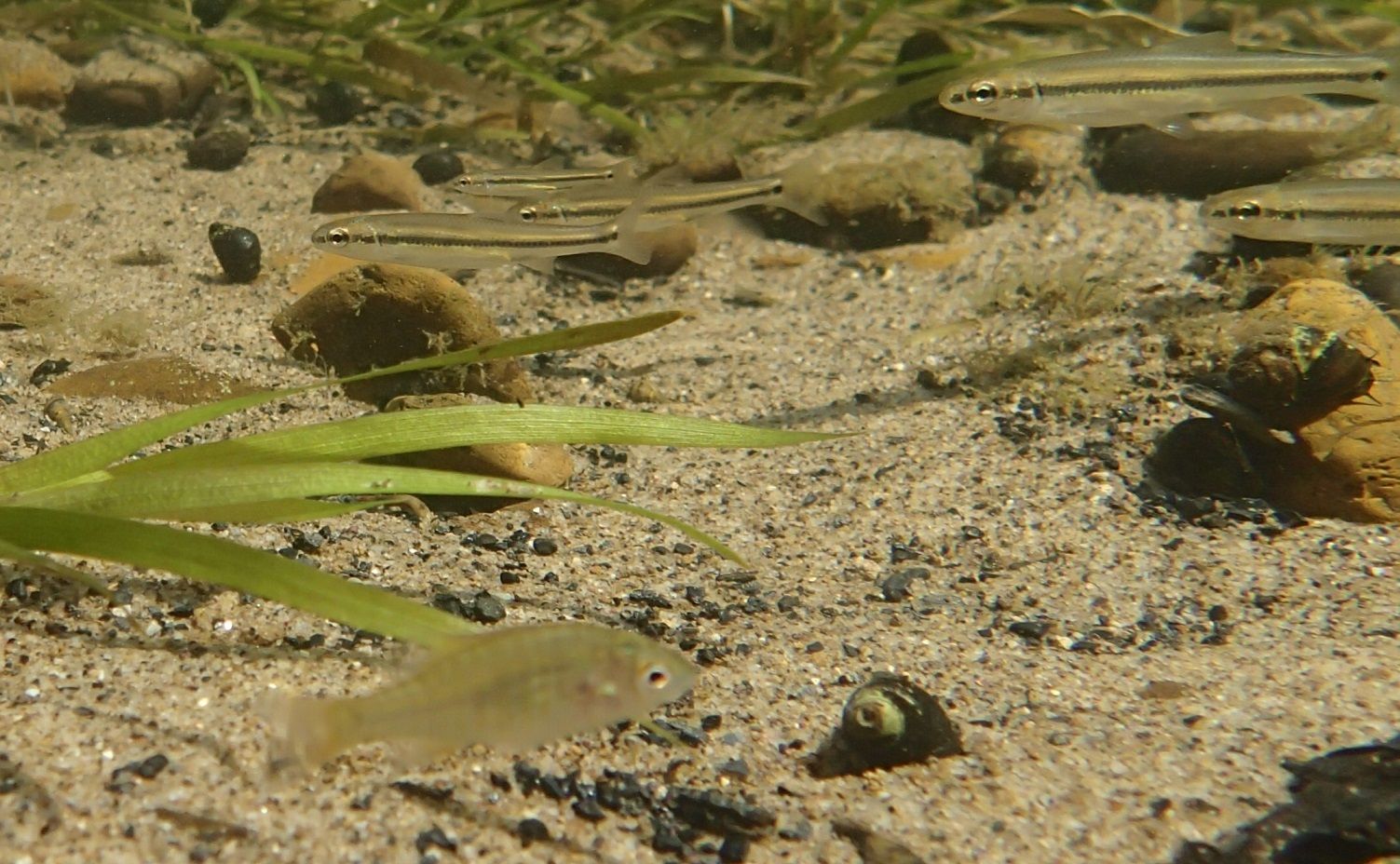
I think this picture is cool in many ways.  I love the surface reflection of the bottom on the waters surface.  the minnows feeding in the foreground are cool, but notice the predator in the background?  This 7 inch largemouth bass would dart in to attack the minnows every now and then.  There were a couple redbreast sunfish hanging out with it waiting to gobble up any morsels leftover from a successful attack.
I was able to snap a picture of this juvenile redbreast sunnie holding in the current, waiting for the current to deliver a tasty meal.
As the same sunfish turned down river, a school of minnows moved in to feed.  I'm not sure of the ID of these minnows.  Anyone know?
OK, changing gears again back to fishing - both Rodger and I caught a bunch of average sized smallies and took a lunch break at a local Mom and Pop joint, where we ate delicious but inexpensive food washed down with some cold beverages.  The atmosphere sports game mounts of all kinds, sporting memorabilia, and other things local to the area.  After eating and relaxing, it was tempting just to stay and watch football or racing, but we persevered through that laziness, mustered up some energy and headed back to our spot for the evening bite.

While the sun was still up high, Rodger and I found some worthy holes down river and let the plastic worm do its thing, tempting bass to bite consistently.  The problem was that the river was so low, that finding spots deep enough to hold fish was tough.  They weren't normally where you'd find them.  But, when you found a good hole, the fish were stacked in there.  When wading, it takes time to find those holes, not like in a boat when you can run and gun to them.  It takes time for old farts like us to wade from one spot to another.  I tried topwater off and on with only a couple slurping hits, but no fish hanging on.  While the sun was high, the plastic worm was the ticket for the majority of the time.
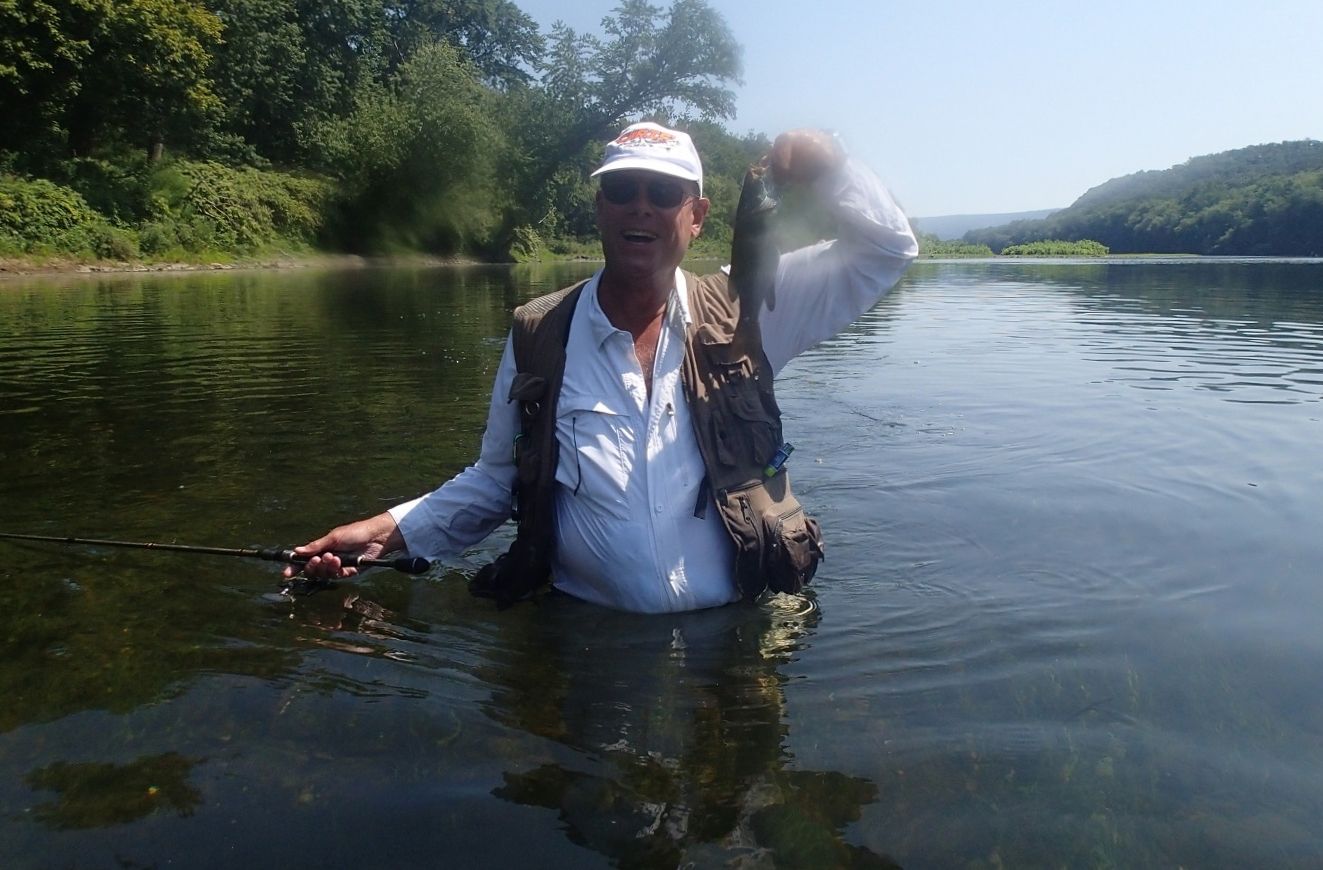
Here's Rodger with a willing smallmouth that inhaled his plastic worm.  Underwater photography is great, but remember to do what I didn't do, wipe off the water from the lens before taking a picture of your friend with a fish!
After searching for those productive holes while wading down river, we realized that we'd better start heading back as the sun edged over the adjacent Western hill so we could find our way back.  Of course, when you head back, you have to wade and fish your way back, stopping when the fish dictate.

Wading up against the current takes time, and on that day, it proved to be taxing on my old aching legs.  For some reason, the fish stopped biting my plastic worm.  Either Rodger and I sore-mouthed the fish in those productive holes or the fish wanted something else.  I decided to make things easier on my bones by wading to the other side of the river to very shallow ankle deep water and wade back.  I tied on a buzzbait to cover more water and maybe catch a few fish along the way.

While working that ankle deep water with the buzzer, I had a hit and a fish on briefly, but it spit the hook.  I thought that was encourage, so I kept casting.  A few casts later, as the lure hit the water, I saw a wake heading from about twenty feet away toward my bait and became very excited.  The fish nailed my buzzbait and took off.  I thought it might be a big fish, but after I turned it, I realized that the fish was a little bigger than the average for the day, but not by much.  It wasn't the size of the fish that got me fired up, but how far it came to hit my lure.  Prior to that, I can't recall a bass charging in from that far away!  It was an exciting moment though and I realized that the topwater bite was on, finally.
Here's a picture of the bass that made the wake in shallow water, charging from about twenty feet away to attack the buzzbait.
I managed to catch seven more bass on the buzzbait as we headed back to our take out spot, finishing with 41 bass for the day.  I fished about 70 percent of the time, with the rest of the time spent trying to get some decent underwater photos.  But, that's pretty productive anyway!  Rodger finished with 50 plus bass along with a few big sunfish.

All in all, we had a really fun day.  Even though it wasn't the topwater bite that I've been craving, I was able to accomplish two things with this trip, some topwater action and getting a few good underwater photographs.  I can't wait to do it again.  Good fishing, cool underwater wildlife to observe, good cheap food and drink, and sharing it with a good friend.  That makes for a memorable day!

Saturday, May 5, 2012

The Bite

You know where the bass are there because you've fished your spot countless times over the years.  The water is crystal clear, leaving you with the first impression that the bass might be spooky.  It doesn't matter what time of year it is at this spot, because the bass always seem to hang out in this area all year long.  It's the perfect spot for bass to ambush unsuspecting prey with plenty of cover, a drop off to deeper water, and during this time of year, vegetation.  On this day, you're facing typical cold front conditions with Northwest winds at ten to fifteen miles per hour and bluebird skies, not exactly ideal bassin' weather.  You normally work these areas with crankbaits, spinnerbaits or buzzbaits, looking for that big fish reaction bite.  But today, you're finesse fishing, because you know that under tough conditions, this is your go to technique.  You aren't worried, because you know that you'll get "the bite".  Maybe a big fish, or maybe a lot of bites, or maybe both.
One of my favorite things in fishing, catching bass on a plastic worm, and getting "the bite".
Most people don't like fishing these conditions; bluebird skies, annoying relentless winds creating a bow in your line, and crystal clear water.  Yet, you know that with these conditions, the wind piles up warmer water along the woody shoreline, also breaking up the surface and decreasing the ability of prey to see predators that lurk in the heavy, until it's too late.  Today, the bass should relate tightly to the wood or hide under the mats of weeds.  Reaction baits may work, but your past experience has shown the fish to be picky under these conditions at your honey hole.

You pitch your plastic worm right into a hole through  a tangle of branches in a huge blowdown.  Your offering falls slowly as you watch your line intensely for the slightest movement that should indicate a strike.  You're using a superline, where the lack of stretch gives you confidence that when a bass bites, you can easily drive that hook home on your hook set.  You position your rod to minimize the bow in the line as much as possible for two reasons, to allow your lure to fall naturally through the cover, and to feel the bite as easily as possible.

And then, you feel it.  "The bite".  It's not a bone jarring strike, nor does it rip the rod from your hands.  Rather, it's a suble tap, as if someone gently flicked their fingernail against the blank of your rod.  Immediately, you sense the weight of the fish beginning to move away with what it assumes is an easy meal.  You drop your rod tip and crank up a little slack line, and with a quick short snap of your wrist, drive the hook home.
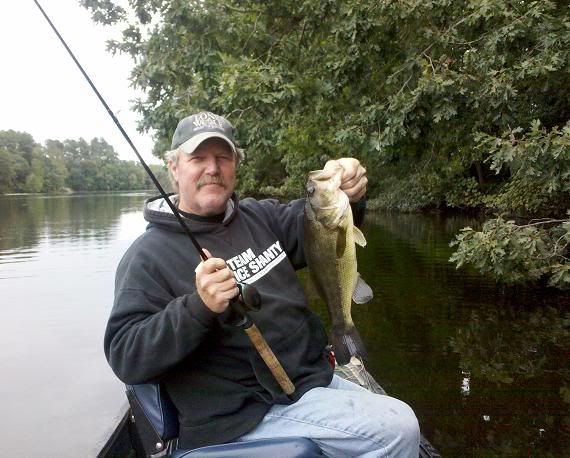
Long time fishing bud Howard Boltz knows "the bite" as well, recognizing it early enough to set the hook into this fine largemouth bass.
Then the bass goes ballistic, diving deep into the cover against the force of your rod.  You put pressure on the fish to oppose it's will to escape, and turn the fish successfully.  The fish tries to dive once again, but your drag is tight, and there's nowhere for it to go.  Your superline is much stronger than the rated pound test, and soon you move the fish out of it's woody lair.  You reach down and grab the bass by the lower jaw and hoist your trophy out of the water.
My friend Steve felt "the bite", nailing this hawg on a plastic worm.
In my opinion, I live for that bite.  That's when I know when I'm doing everything right, the way that I need to perform.  I know that I'm on the verge of bassin' success for that day.  I know that when I can get that first bite, I can get more.  And after catching that first bass, I'm greedy...I want more bites.  And when you're in a zone, worm fishing can do that for you.

There are other exciting bites in fishing.  Many are very exciting, like a bass slamming a buzzbait at boat side, or a musky attacking a blade bait at boatside after a figure eight finishing retrieve, or a massive striper crushing a crankbait at the end of your cast.  Some bites are so explosive at the boat side that you may feel the need to change your drawers!  Even in bassing, the spinnerbait or crankbite bite is a very addictive, adrenaline generating event.
Crash Mullin's demonstrates "the bite" in this awesome and humerous video.  It can't get much more exciting when a musky follows your cast and you draw a strike after going into a figure eight.  He has a great fishing show, by the way.  "The Bite" gets your adrenaline going for sure!!!!

It's not the braggin' style photos posing for fish that I live for, nor is it the numbers, and it's certainly not just the activity outdoors that many say, "a bad day of fishing is better than a good day at work".  On the contrary, I live for "the bite".  And I live for lots of them!!!!!!

Saturday, October 8, 2011

Cooling Fall Temperatures = Hot Fall Bass Bite

A crisp fifty degree temperature and light fog greeted us as we arrived at our fishing destination on this cool fall morning.  The leaves on the trees are just now starting to change.  A whitetail doe crossed the path on the way to our fishing hole, nervously looking back at us.  A great blue heron sat high in a blow down with it's head tucked between it's shoulders as if trying to stay warm in the chilly morning foggy air.  Nearby, a majestic bald eagle soared over a popular smallmouth river in search of a fishy breakfast.  Nasty double breasted cormorants, not native to Maryland after arriving and nesting in 1991, also cruised the river in search of fish.  Today's quarry, Micropterus salmoides, the largemouth bass, awaited us.  The water, slightly stained from recent rains, was just the way we like it, and based on past experience seemed just the ticket for a great reaction bite. 

I had a white Z-Man Chatterbait with gold blades tied on from my last trip.  Yeah, I'm lazy, because if a lure is tied on from the last trip it will more than likely see my first cast of the day.  And it just happened to be a hot lure last time, so why not?  On my other rod, I had Nanofil spooled on my series 400 Shimano Symetry reel on a medium power fast action St. Croix Avid spinning rod, and tied to that was a four inch green pumpkin plastic worm with a light wire Gamakatsu offset shank worm hook and a small bullet sinker.  We fished from the bank today at one of our shoreline hot spots, which is a tradition for us and usually makes for some fine fall fishing.  I carry two rods while doing this, one clipped to the back of my vest while I fish the other, keeping my hands free.  I carry much of my tackle in a fishing vest, with my spinnerbaits hanging over my shoulder in a Cabelas spinnerbait bag.  My vest holds several styles and colors of plastic worms, sinking soft stickbaits, and tubes along with the nece

ssary hardware to fish them.  Also, pockets hold extra spools of line, lure dye, a wacky rig tool, line clippers, forceps, sunscreen, water bottles,and a few other items of personal need.  My spinnerbait bag holds several varieties of spinnerbaits and chatterbaits in several colors along with trailers, trailer hooks, extra skirts and spinnerbait blades.  The bag is supported over my shoulder by a lap top shoulder strap that I pirated for fishing purposes (it's my wife's lap top bag...shhhh...don't tell her).  That's all I need for this spot today, spinnerbaits and chatterbaits for my reaction bite, and plenty of soft plastics to follow and work hot spots more carefully and thoroughly.

We had a short ten minute walk before reaching the first good hole.  My buddy Howard and I exchanged stories about fishing this spot over the years, bringing up fond memories of past fall bites.  We reminisced about a fall day twenty years ago when we both tossed tandem white spinnerbaits and caught good numbers of three to five pound largemouth that were holding tight to woody cover, but would shoot out from as much as five feet away to nail our shiny offering.  Howard and I have fished together since we met at my brother and sister's swim meet nearly thirty years ago. 

My friend Howard and I have been through a lot together.
He's not just an excellent angler, and a fishing buddy,
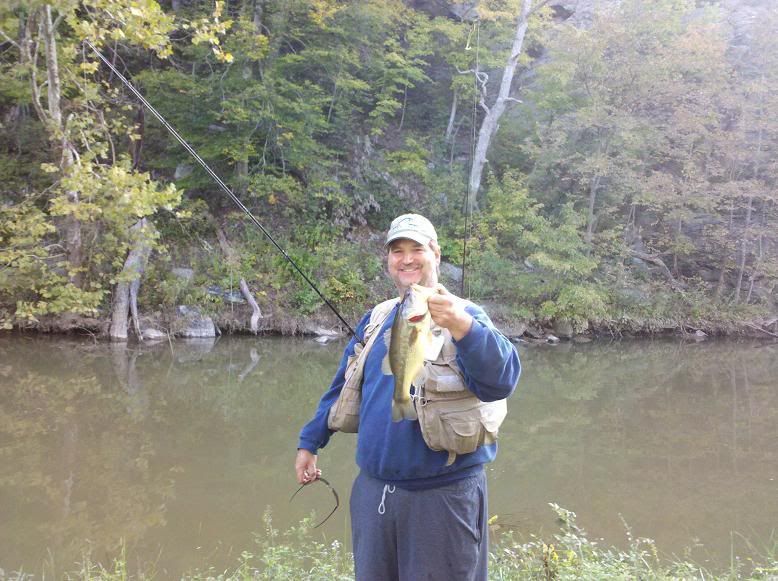
but also one of my best friends.  Here he is with a nice bass.
Wow, was it that long ago?  It seems like yesterday.  We both learned to fish baitcasting gear together.  Back then, the only reels available were left handed models for some reason.  So, even though we reeled with our left hands with spinning tackle, we had to learn to cast right handed and switch the rod and reel to our left hand and reel right handed when using baitcasting tackle. 

Howard and I cracked up, resurrecting a story about, while fishing this very body of water, me learning to use a baitcaster for the very first time.  I was pitching a large buzzbait in late summer, and found a nice log along side the near shoreline.  I brought the lure back past the log and was just about to lift it out for another cast when all of a sudden the water erupted at my feet.  The fish hit so hard that my glasses got soaked and I could hardly see.  Howard nearby observed my struggle as I held on to the monster bass for dear life.  I wasn't used to cranking the fish in and fighting the fish with a rod in my left hand, and in an embarassingly loud panic reaction blurted out, "How do I fight this thing?"  Eventually I calmed down and figured it out as I finally landed a twenty two inch smallmouth bass.  It was my biggest smallmouth landed for nearly eight more years, but it's an embarassingly funny moment that lives in both Howard's and my minds to this day. 

Since then, the baitcaster has been my favorite tool for tossing larger sized bass baits, and eventually I'd own several different styles of baitcasting combos including ones for specialty techniques like pitching and flipping.  I'm not sure that I'd have learned all that if it wasn't for my good friend Howard.  Together, we learned stuff like that over the years, learned to expertly fish this body of water, learned to fish other bodies of water together all around our state and our neighboring states.  We learned to ice fish together, to crappie fish, fly fish, to bow hunt, gun hunt, and we both bought our first boats within a few weeks of each other, Bass Tracker TX 17s with 70 horsepower two stroke motors.  I stood up for him at his wedding, and he was an usher at my wedding. 

My first bass of the day.  It may have been chilly in the morning, but this fall bass fishing was hot all day long.
After laughing and joking about that for a few minutes, we arrived at our first destination.  The bank was pretty steep, but you could cast to this particular log jam that looked so bassy.  But if you hooked a bass here, you'd never get it out over all that brush, so you'd have to climb down and get it.  I tossed my chatterbait along side the biggest log just inches away, and brought the lure back along the tree trunk when a bass shot out and nailed it.  As I saw the bait disappear, I set the hook. 

The bass tried to bury itself in the log jam, but my medium heavy power fast action St. Croix Avid baitcasting rod powered him out and over the timber.  The bass fought back and headed down again, but I was able to turn him one more time.  After that, it was clear of danger and I took my time to land it.  I had to climb down the bank, through Rosa multifora, or wild rose bushes, drawing blood on the back of both hands as I bulled my way through the thicket to get to my prize bass.  My heavy lug sole boot gave way to the muddy bank as I nearly went feet first into the water, but was able to gain a little traction with my other foot.  While on my knees, contorted as if playing the family game twister, I was able to reach down and lip the chunky largemouth bass.  I climbed back up the bank and Howard took my picture.  The bass wasn't huge, but it was a nice start for the day, setting the stage for one of the best fall fishing days that I can remember.

This bass, caught on a recent trip,  hit a white chatterbait with
 a bright white grub trailer.  Reaction baits like this in the
 fall can produce nice bass catches.
Recently I posted the power of the color white in the fall.  When fishing reaction baits like spinnerbaits or chatterbaits, I'm convinced that either lure would have worked equally well today, with the flash and movement drawing violent speedy largemouth predatory strikes.  But the visibility of the bright white color on such a nice bright and sunny fall day really allows bucketmouths to hone in for the attack.

Chartreuse is also a great color for this, but I prefer it for the warmer months, and white for cooler temperatures.  Maybe it's just me, but it's worked for nearly thirty years each and every year.  The bass aren't picky now, and the white bait is easy to see when worked a foot or three beneath the surface.  When it disappears, it's probably a fish, so set the hook and hang on.

Since I had worked so hard to get down that bank, I had a little bit of casting room, so I thought that I'd try a few more casts.  On my next cast, I worked the lure past the end of the log and wham, a chunky two pound largemouth attacked my chatterbait after letting it fall a foot or so.  I landed that fish and quicky unhooked it.  Howard stood at the top of the bank tying on his chatterbait after seeing my early success. 

I placed my next cast to the same spot, hoping they were stacked in there, and sure enough another nice bass launched from the cover and attempted to mutilate my chatterbait, but missed, pulling the skirt and trailer down the hook shank.  I quicky reeled up and fixed the bait, then tossed it back again and the fish took the lure this time.  This bass wasn't as big, but I'd take a pound and a half fish to make it three quick fish any day.  I tried a couple more casts without any further action and decided to climb back up the bank.  Not a bad start for the day, three fish in the first four casts.  Howard assisted me out of the thicket and after a high five, we continued to the next spot.  It was his turn, to work the next set of timber, and he would make the most of it.

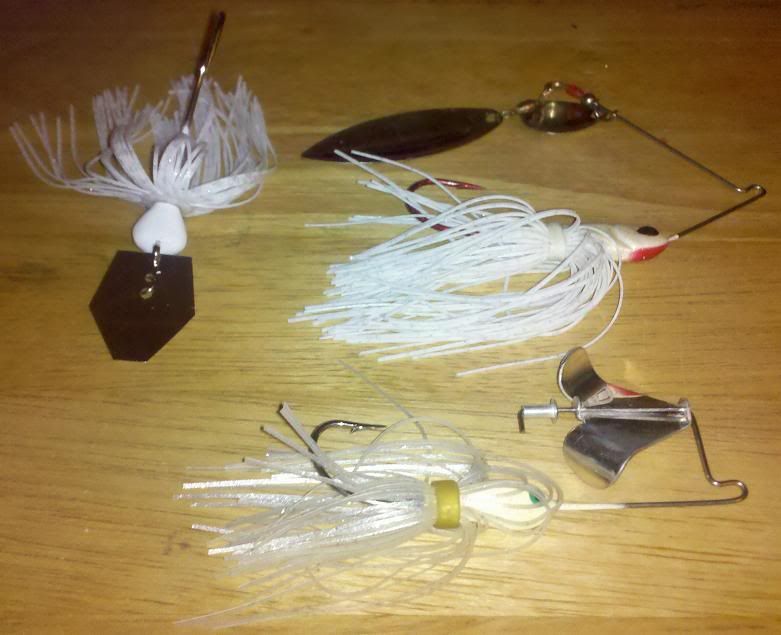
The Z-Man Chatterbait, upper left, has been hot lately on my
home waters for largemouth bass and chain pickerel.
Chatterbaits are basically skirted jigs with a piece of metal attached to the eye, with a snap poking through the metal blade for a line tie.  It's a simple concept, but provides a bit of flash, plenty of action, and vibration that is an alternative to fishing a spinnerbait, and perfect for fall reaction bass bites. 

Fish hammer them, what can I say?  You can fish them on a straight retrieve, or jig them and let them fall (yo yo style retrieve), crank 'em over cover and let them drop, or burn them just under the surface.  I used a fat four inch white grub as a trailer today, giving it a nice large profile. 

Gene Mueller also loves chatterbaits when fishing the weedy and woody shorelines of the Upper Tidal Potomac River, a hot spot famous for it's tremendous largemouth bass fishery, but recently infamous for it's unwanted population of the Chinese northern snakehead.  Gene wrote to me about the chatterbait, lauding it's ability to be weedless in just about any cover.  He likes to add three or four inch soft plastics as trailers, like sassy shad style baits, to give them bulk.  He feels that this bulk attracts big bass bites, and I agree wholeheartedly. 

Although I've had success on other bodies of water using this lure in the past, including the Upper Tidal Potomac, I had yet to try it in my local hot spot.  Why?  I don't know really, I guess I've tossed so many spinnerbaits with great success here in the past that I never felt the need to try much else.  But today, I'm glad that I did. 

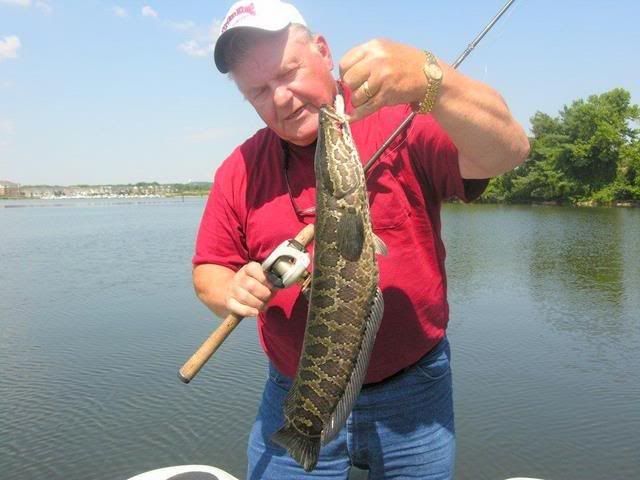
Gene Mueller with a huge Chinese snakehead from the Upper Tidal Potomac River that he subsequently killed properly as instructed by the Marland Department of Natural Resources.  Make sure that you check out his blog, linked on this web page. 
Gene posts fishing reports in the Washington Times each week, along with some great narrative about fishing and outdoors news (http://www.washingtontimes.com/sports/outdoors/), often touting chatterbaits as a hot lure in our area.  So, it finally sunk in that I'd better make more use out of them than I had in the past.  Thanks Gene!  By the way, his blog is fantastic, and is great for folks local to the Washington D.C. area, but often his posts offer angling tips and stories that are not only appealing to anyone, but may give you a tip that might work well in your fishing area.  In addition, he posts informative articles about hunting and political activities related to the future of our favorite sports.  You can find his blog here at http://www.genemuellerfishing.com/

Howard nailed this well fed healthy bass on a 1/2 oz. white chatterbait.
It wasn't long before Howard got into the action while landing a fat well fed largemouth bass on his chatterbait.  He pitched his chatterbait past a clump of weeds in about four feet of water that clung to a pair of sunken logs about fifteen feet from shore, and his bass shot out, and the strike nearly ripped the rod from his hands.  Howard put the boots to the fish and hoisted it out of the water and lipped in one quick move.  He stopped to allow a picture, but I could tell he wanted to get that lure right back in.  So, I quickly snapped a picture and he was back in business.

We were far from done.  Each piece of woody cover seemed to hold a willing bass as long as there was some depth around the cover.  The weeds normally hold fish in the warmer months, but they're dying off now.  Baitfish still hold amongst the weeds, but the colder temperatures seemed to keep the bass from holding there.  Later in the day, the temperatures warmed, and we were able to find a few bass cruising the weed edges with chatterbaits and the four inch plastic worms.

Green pumpkin plastic worms, Texas rigged with light
weight on light line, like this Zoom Dead Ringer, proved
extremely effective today.
We managed to find a downed tree, probably left in that state from Hurricane Irene a month ago.  Leaves still grew green on the tree, indicating it's a recent fall, but there was plenty of algae, weed clumps and duckweed clinging to the branches and trunk of the tree where it met the water.  To me, that was a sign that this was fish holding cover, being there long enough for largemouth and baitfish to find sanctary and ambush points. 

And, man, did that tree hold fish. Howard first proved it by nailing several bass from that tree using a plastic worm while I continued with the chatterbait.  After I switched to my plastic worm set up, Howard and I pulled out bass after bass, most of them averaging twelve to thirteen inches, but we both landed a few between two and three pounds. 

With limited fishing time because both of us had family duties late in the afternoon, cover like this with it's fish holding ability was the ticket to a great afternoon.  I lost two fish in the thick cover, but other than that, landed twenty two well fed largemouth between ten and eighteen inches long.  Howard had similar results.  We pitched to pocket after pocket along that tree, with each one holding several fish.  After removing a few fish from each pocket, it wasn't long that others moved in.  It was almost as if Howard and I were serving fast food, and it was lunch time for the bass, and they were waiting in line for their happy meals.  Four inch plastic worms on light line using light weight was the ticket at this spot, and green pumpkin was all you needed to keep them happy. 

Could you have pitched heavier stuff and nailed some bass here?  Absolutely, but my flipping rod was at home.  We were working from shore, and to stay mobile, you can't carry too many rods and fish effectively.  The tree branches were too numerous and thick to work a spinnerbait or chatterbait effectively here, but that worm slid through the branches with ease, and when pitched in with little splash kept the bass on the feed for a couple hours.  We both giggled like kids after landing bass after bass at this spot.  The only thing that kept us from doing more sore mouth damage to that fish population was time, our deadline to meet our family obligations.  So, we wrapped it up and decided to work our way back to our vehicles.

I decided to work the chatterbait while fishing our way back, and with little fishing time left, the best option now was to cover some water quickly looking for aggressive bass.  I picked up a few bass with the chatterbait fished parallel to shore along the dying weedbeds with some success.  These fish weren't big, but they were nice and fat, and a lot of fun.  Howard followed with his plastic worm when I'd have a hit and miss, landing several decent sized fish that way.  We worked our way back to our starting spot.  Howard first worked it with the plastic worm without any bites. 

I decided to give the chatterbait a go, and sure enough, a chunky two pound largemouth rocketed from the cover to munch on the chattering lure.  It took the lure down into the cover, but I was able to turn it and move it out.  I climbed down through the thicket again to land that fish, spilling more blood on my elbows, forearms and hands to the thorn bushes lining the bank. 

While down there, I decided to once again toss my chatterbait along that cover.  Why not?  I was down there, the cast was relatively easy, and if I hooked one I was in a position to land it easily if it was big.  But what were the chances that another bass was there, especially since I took four fish out of there already on the day?  Well, my next cast proved that there was a willing bass there, and it was a biggun.  It shot out from under the log to inhale my lure, but before I could set the hook it let go, leaving me with a chatterbait with the skirt and trailer hanging down by the hook gap and me with a dang it look on my face.  I tried several casts with both the chatterbait and the worm to no avail.  It was time to go anyway.  I know where this fish lives, so I'll be back to get her another day.

What a day.  In summary, I landed thirty nine bass between ten and nineteen inches on the day, and one fat crappie on a plastic worm.  Fifteen of the bass came via the chatterbait, the rest on plastic worms.  Howard had similar numbers.  He lost count when he ran out of all twelve fingers and toes (just kidding Howard)!  Anyway, I love the bowhunting opportunities that October presents, but when it cools down and your buddies are in the woods after those deer, don't overlook the hot fall largemouth bass bite.  Even though it's cool outside, it's hot under water.