Showing posts with label bluegills. Show all posts

Sunday, February 16, 2014

The Century Mark on the Ice!

Last week I met up with a musky fishing friend of mine, Mike Carrigan, and a couple of his buddies on small local lake.  My buddy Wayne also met me there.  The plan was to find some willing crappie at first light, and for me to make a day of it.  Wayne planned to stick it out with me, while Mike and his buddies were only fishing a partial day.
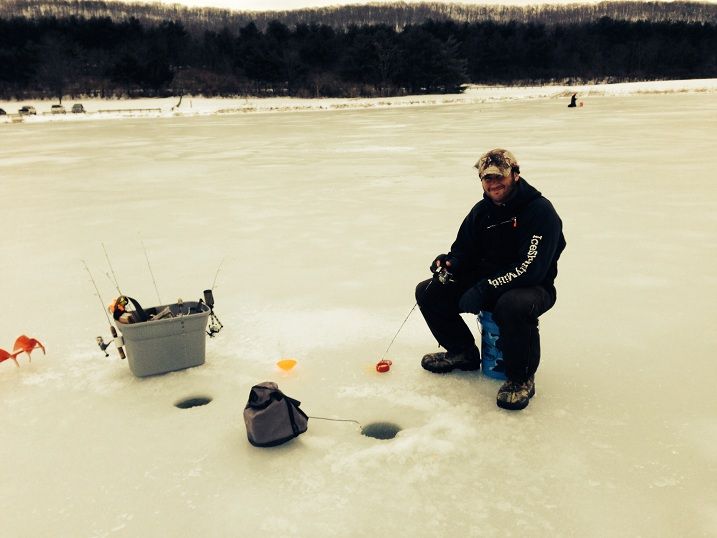
My friend Mike Carrigan fishing out of a Clam Fish Trap and using a Vexilar FL-18 flasher.  Mike caught some decent trout and crappie throughout the morning.  He found some active fish out of this particular hole.
Most of the snow from the previous week had melted and refroze, forming a nice white layer of slick ice on top of a good nine inches of clear ice.  The weather was cloudy but pleasant, not much wind, right below the freezing mark all day.

I arrived after sunrise, getting a later start than I had wanted.  Wayne, Mike and his buddies were all on the ice already.  As I was getting ready, first Wayne showed up to greet me, then went back out and fished, followed by Mike a short time later.  It took me a while to get my stuff organized and ready to roll.

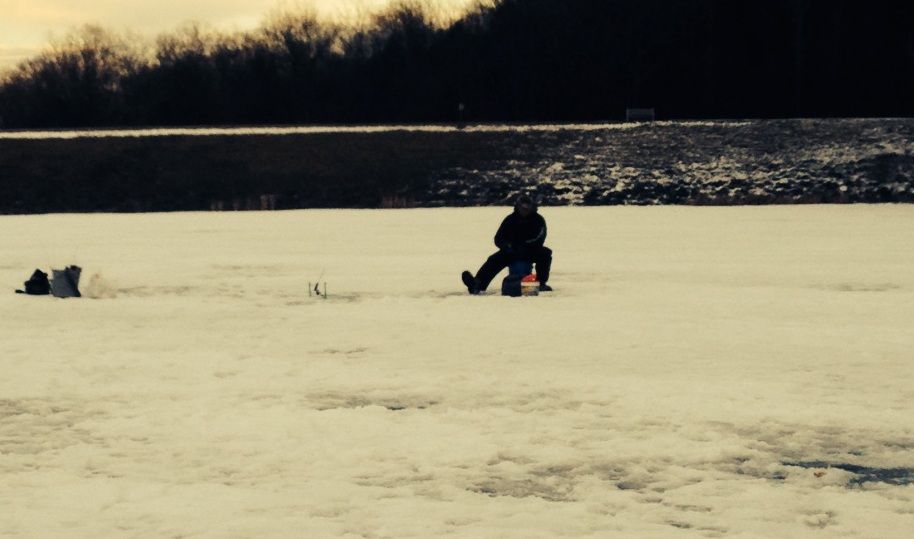
Mike and his buddies were about a hundred yards away from Wayne.  They were fishing the deeper water near the dam, while Wayne was working the deeper drop off out from a main point not too far from the dam.  I decided to cut holes in between all of them, to connect the dots, if you will!
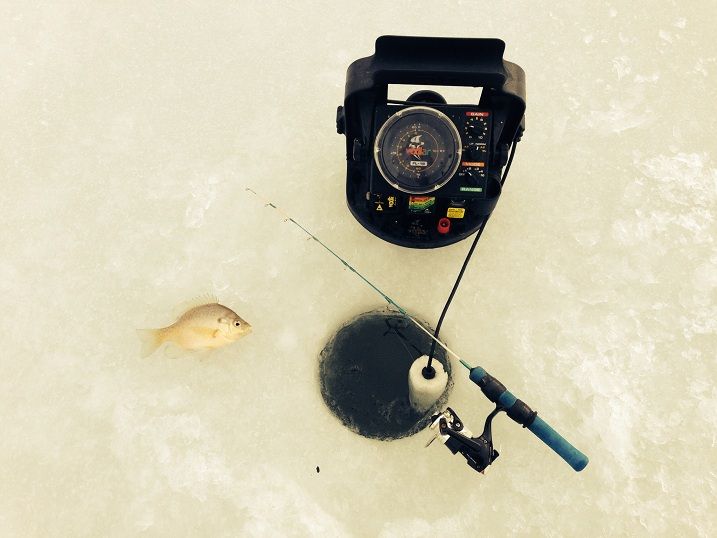
Wayne had already located a school of active bluegills and a few crappie, out in the channel closest to the main lake point.  Here's he is using his sonar to watch the reaction of the fish as he teases them into biting.
I proceeded to cut half a dozen holes, scooped out the ice chips, and dropped my sonar down to see if I could mark fish.  I marked fish in every hole.  They weren't suspended, but were holding tight to the bottom.  I dropped my twin Ratso soft plastic rig down and drew the fish off the bottom  in each hole, but they either bit really lightly or lost interest quickly.  I went back and covered each hole with a smaller jig rigged with two maggots to see if I could get those finicky "sniffers" to bite something tipped with bait.
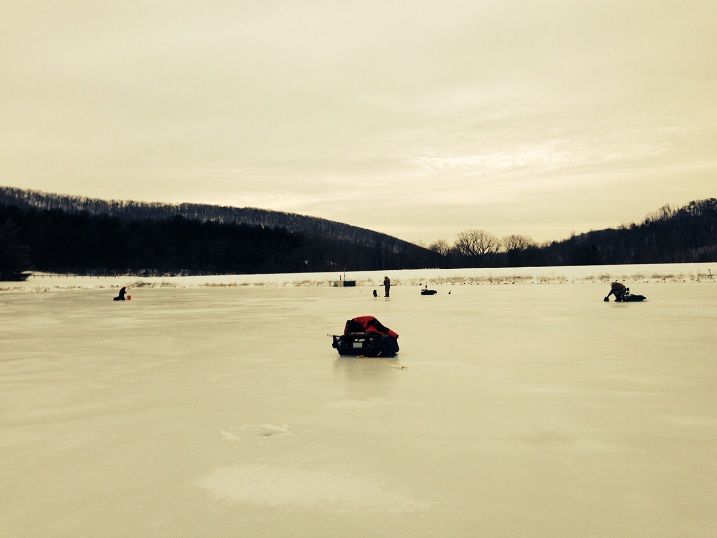
Starting near my sled,  I cut holes between Mike and his buddies and my friend Wayne, hoping to mark and find some active fish.
Spikes or waxworms as bait act as a nice tasty treat to the fish and provide a little bit of scent to trigger their feeding instinct.  When the fish are active, I prefer to use the soft plastics and not mess with constantly replacing bait when the fish pick the maggots or waxworms off the lure.  But, sometimes, they only thing they will bite are the baited jigs.

Mike was catching medium and small sized crappie now and then, while Wayne, over by the point was getting a pretty good bluegill bite going with an occasional crappie.  Meanwhile, I was having a hard time getting solid hits.  So, I kept cutting holes.

I walked over to see how Mike was doing, and he found a hole that held a few pretty aggressive fish.  I watched him fish for a bit while chatting about the fishing on this lake, and took a nice little video of him in action, showing us how it's done.  Please note that this fish is one of the small finicky crappie, not one of the bigger ones that he caught throughout the morning.  The fact that this catch is on video is merely because I spent way more time fishing than walking around taking videos.  Yet, it does illustrate how to use a flasher to catch fish.

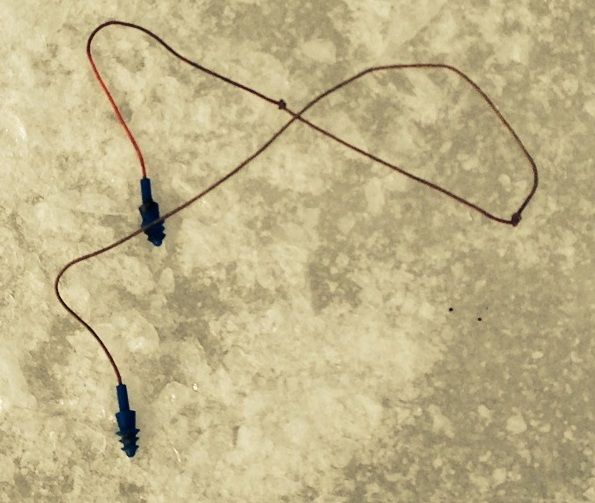
Mikes buddies were catching some stocked rainbow trout on tip ups, and Wayne was jigging a few up too.  But one of the small trout had something sticking out of its gullet, a set of shooting ear plugs!  At least five inches were down it's throat.  We all got a laugh out of that!
These were the earplugs that were found in a trouts gullet that Mike's buddy Phil caught on a tip up.  We cracked up, saying that maybe he should put this back on a tip up and try for another!
I wasn't satisfied with the holes that I had cut so far.  I wanted active fish, not sniffers.  So, I cut another half dozen holes along the basin of a cove not far away where I'd found a good crappie bite in the past with similar results.  I caught a couple small bluegills and crappie, about one fish caught out of every four holes, with lot's of sniffers in each hole.  And the sniffers that bit seemed to prefer the tiny jig/maggot combination.
Every hole marked fish, but when I caught them, they were on the small side.  These were the finicky fish, the sniffers.  When you get this type of inactivity or finicky fish, move and find bigger more active fish.
My next move was back near where I started.  In one of the holes that I cut, I marked what I thought at first was a fish, but it was some sort of structure.  Perhaps it was a tree limb or something.  This particular spot didn't mark any fish, or at best, a sniffer or two.  It was almost what I was looking for, structure, but lacked the fish that I'd expect there.

So, I decided to cut a half dozen more holes around that area.  The first hole that I checked was loaded with fish, suspended off the bottom over nineteen feet of water from the bottom ten feet.  This was late morning, and the fish were stacked like cord wood.

I remember saying to myself, "This is the spot!"
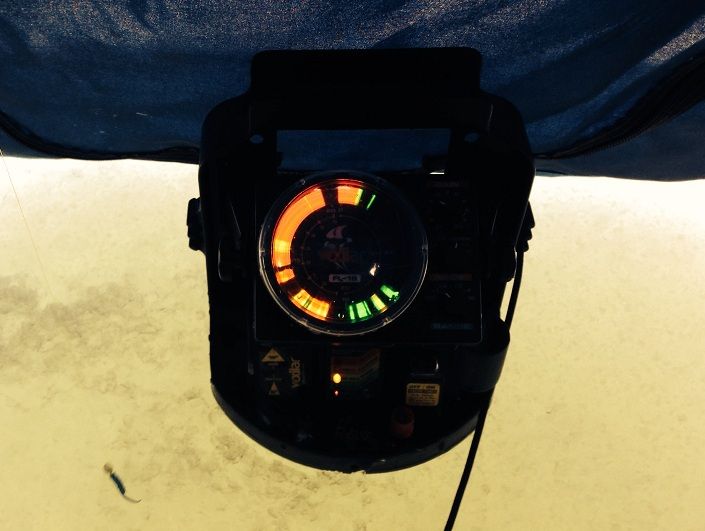
My flasher lit up like a Christmas tree!  The bottom of the lake is at about 8:40, which was nineteen feet deep, and there was a tree branch at about 7:35, about four feet off the bottom.  The rest of the marks were fish, showing all the way up to ten feet off the bottom (about  3:20 on a clock).  The surface is at high noon, with a couple marks that are noise from the ice surface.  You can see the fish were stacked like cord wood here!  This was the spot!
As I've described in recent posts, my tactic when finding fish stacked like this is to set up and fish over them for a while.  Most of the time, you'll catch a good number then the bite dies off and you're off on the search again for more active fish.  However, this spot seemed different.  This was late morning, and the fish were suspended.  My graph was lit up like a Christmas tree (a popular saying among ice anglers when they mark a bunch of suspended seemingly active fish).  This is the type of spot that can make your day.

My way of setting up is to cut a couple holes, one for my electronics, and one to fish out of.  Since there were a bunch of fish showing up, I decided to set up my underwater camera.  It took me a couple minutes to set up my shanty and the underwater camera so that I could see my jigs, but it took even less time for me to start hooking up.  I can't see much on the camera out in the open because of the glare, so I need to close up Clam Fish Trap Pro (my portable flip over shelter ), so I could see the camera.  Please note that I don't waste the time or energy to set up this way unless I know for a fact that I'm on a hot spot.
When I find a good spot with lot's of fish marked, I'll cut one hole for my electronics, and one to fish out of.  I took this picture shortly after marking tons of fish.
I lowered my camera to about ten feet off the bottom, the upper range of the suspended fish.  The water clarity was a bit cloudy, not as clear as I'd like for this type of set up, but it would have to do.  I could see only about two feet at the most below the camera, which is set to look down on the fish.  As soon as I picked up my rod and jigged, I saw a crappie swim in very quickly and miss my lure.  The next attempt from a different fish resulted in the fish sucking my jig in.

When I set the camera up, I dropped down my tandem Ratso rig down there because they're easier to find. The top Ratso was the one that the crappie inhaled, so I set the hook.  These weren't the dink crappie that I was getting earlier, these were decent for this lake.  They weren't big, but they were fat mediums, most good enough for a nice filet at nine to ten inches long.

The fish were ferocious.  As soon as I dropped the Ratso's into camera view, a crappie would swoop in to inhale it, aggressively.  And my sonar was showing a lot of fish down there.  I was catching them one after another, giggling like a little kid.  So, before the school left, I decided to coax Mike over to give the camera a try.

Mike spent about fifteen minutes in there playing with the camera and catching a few.  I heard him laughing as he was getting used to fishing versus what he was seeing on the camera.  It takes getting used to for sure, but he was having fun.  He didn't want to take up my fishing time, so he turned my shanty back over to me.

For the next two hours, the crappie kept showing up, actively attacking my soft plastic jigs.  I lost a couple nice crappie at the hole but for the most part, I landed about eighty percent of the fish that decided to bite.  I lost some time when crappie or bluegills decided to wrap themselves around my camera cable during the fight, but landed those fish.  The time lost was setting it up again so I could see my jigs.

By now it was snowing lightly.  I've always seemed to have good luck with the crappie while it was snowing, so this seemed to be the case again.

Over the next two hours, I managed to ice thirty four crappie and seven bluegills.  Then, they seemed to disappear.  But, one solid mark remained about four feet off the bottom and didn't more or react to any of my lures.  I couldn't see it on my camera, but I was pretty sure it was a larger branch of that tree that I found earlier.  I felt that the fish would return, so I decided to stick it out.

During the following few hours, I picked up crappie and bluegills now and then.  But, the fish became a bit finicky.  I could see them on the camera at times, and they'd move in and check out my lure and either bite or swim off.  I also was able to fish off the bottom and coax a decent bluegill into biting every now and then, below the tree mark.
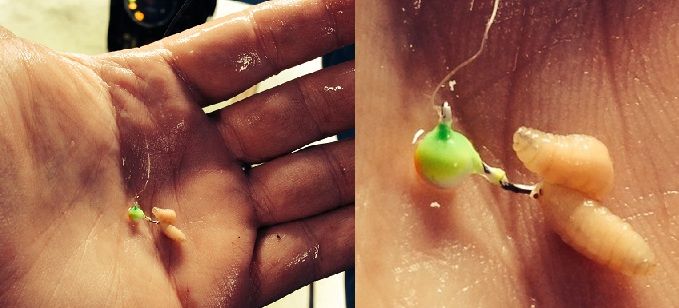
Sometimes finicky fish, especially bluegills, will prefer a smaller jig tipped with a couple spikes.  This tiny Northland Tungsten Fireball jig fishes heavy and shows a nice mark on my sonar.
I took a break and socialized a little bit, and during the meantime checked some of the other holes out without electronics while jigging a Salmo Chubby Darter, a jigging lure that resembles a lipless crankbait and an effective technique for catching bass, trout and jumbo crappie.  I didn't get any hits, but Mike and his buddies, Phil and Nick, were pretty much calling it a day during early afternoon.

Meanwhile, Wayne was consistently catching bluegills and the occasional crappie out of his spot.  I went back to my hole and noticed that the suspended fish had returned, with more and more of them appearing on my flasher.  They snubbed my tandem plastics for the most part, but willingly hit the tiny jig/maggot combination.  They were bluegills.  Not the sniffing dinks from the morning, but decent sized ones.  I wouldn't say they were big, but they were decent, averaging seven to eight inches long.
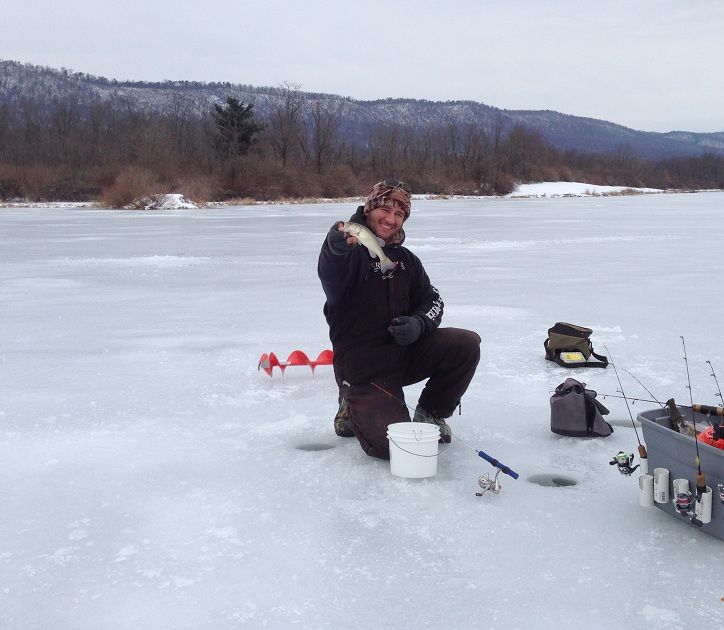
Wayne with a small crappie caught earlier in the morning.  Later, we both caught quite nicer ones.  Like I said earlier in the post, when the bigger fish are really biting well, it's tough to be a camera man!
Bluegills fight like crazy and easily wrap around the camera cable, so I quickly pulled the camera out.  They were so active that using the sonar was highly effective.

These fish became very active and aggressive toward my smaller offering.  Every now and then, I'd hook a crappie.  By late afternoon, the bite was frantic again. The bluegills were all around the tree, both above it and below it, and sometimes suspending ten feet off the bottom, and extremely aggressive.  The crappie bite earlier in the day was quite impressive, but this bluegill bite was something else!
The bluegills preferred this small round ball jig tipped with a couple spikes.
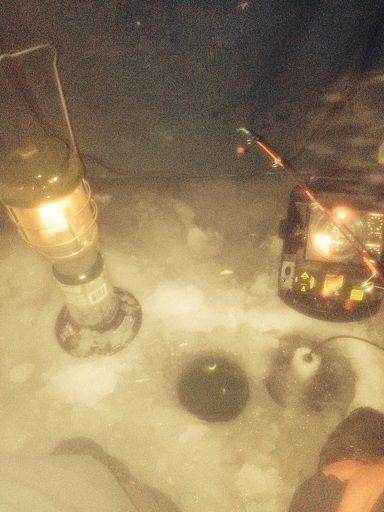
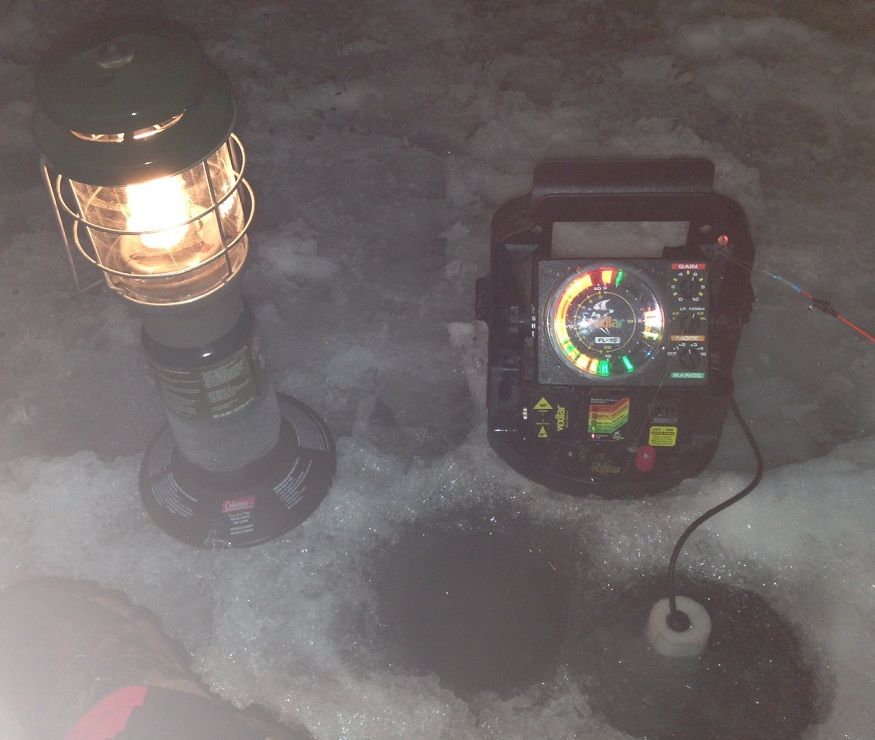
Our hope was to fish into the dark for the crappie, that since we found them during the day here in decent numbers, that they'd return.  Usually, that's a good plan for setting up for a night time crappie bite.  But, I didn't want to leave this great bluegill bite to go back to my truck and get my lantern!

Wayne had moved closer so we could share the lantern light once the night bite began, and also was getting into the bluegills at a rapid rate.  He also had a knack for catching several trout on the day while jigging, and also a couple largemouth bass as well.
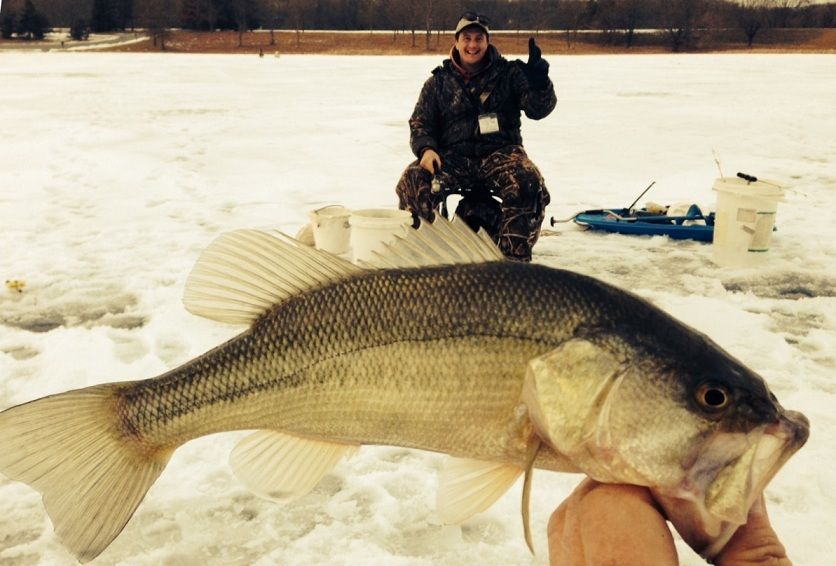
In between catching crappie and bluegills, Wayne caught trout and a few small largemouth bass, which are fun on the light ice panfish set ups.
I finally decided to quickly go get my lantern and return before it was too late.  But the bluegills didn't let me down, they kept on biting.  It was a great evening bite.  I managed to also catch a small bass.  Then, the sun dropped as well as the temperatures.
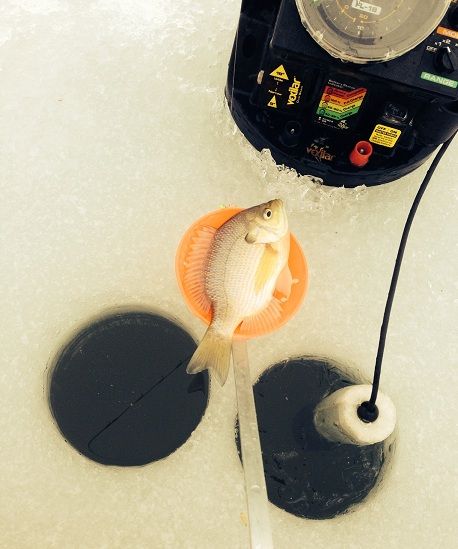
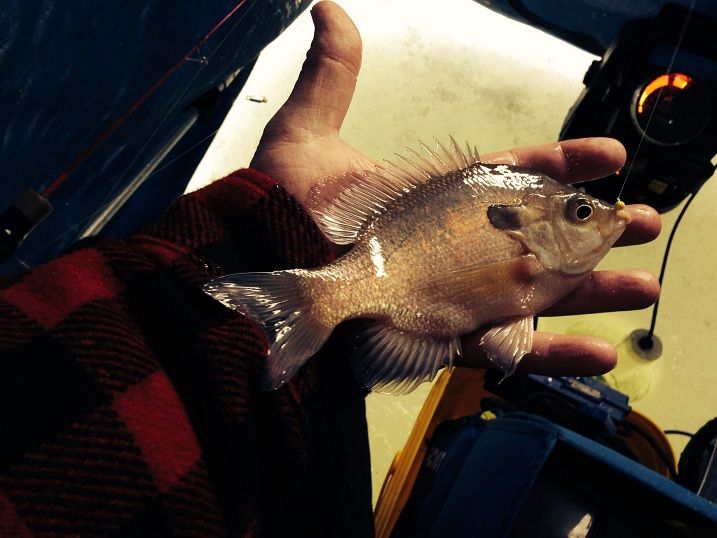
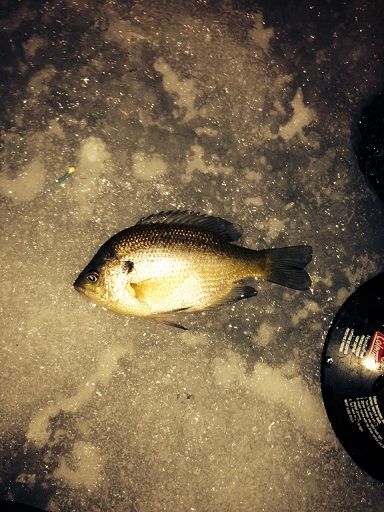
This hand sized bluegill liked that Northland Tungsten Fireball jig!
Wayne and I caught a few bluegills and crappie after dark, but the bite wasn't what we'd hoped for.  The fish became finicky but we marked them regularly.  I've noticed this before when fishing murky water, that those lakes don't make for great night bites for crappie.  So, we called it quits.

My numbers were my best trip of the year, and the size of the fish, although not large, was decent.  At least it was from the standpoint of having a good time.  I finished with forty two crappie, sixty three bluegills, and a largemouth bass.  That one hot hole produced 101 fish!  That is a great day on the ice, for me, a total of 106 fish on the day.  I'm sure Wayne had similar numbers.

Any time you hit the century mark with numbers of fish, on or off the ice, it's a trip to remember.  Hence, I thought that I'd share it with you!

What a fun day on the ice!

Monday, February 3, 2014

Hot Start to a Cold Winter...Hardwater Heaven!

Call it Polar Vortex, call it unusual, call it whatever you wish.  I call it winter, a normal winter that reminded me of winters past, where our local ice fishing opportunities lasted two to three months.  No matter what it's called, I'm thankful for it.  The mild winters of the past few years were painful to ice anglers like me, who had to travel further to find ice.  Now, my inner conflict, the open water musky angler in me, yearns for flowing rivers free of ice, but part of me is happy now!

As an ice angler, I couldn't have been much more happy about my first four trips on the ice.  I had the opportunity to meet new friends and fish with old friends.  And the icing on the cake, or on the lake, was that we caught a bunch of fish in the process.

My first three trips took place at the lake where it all started for me too many years ago to mention.  Yeah, I'm the guy that I used to call "old".  This lake was home to my first ice fishing adventure of my life, as detailed in my previous post, "Remember Your First Ice Fishing Trip?"  Jeff Redinger turned me on to this gem of a lake along with the sport of ice fishing.

My old friend Glenn Cumings met me up there, the same guy that hosted Jeff's ice fishing workshop that got me addicted to this past time.  Glenn is as equally responsible for my ice fishing exposure as Jeff is.  The ice was anywhere from four to eight inches thick where it looked “safe” that first afternoon.  The lake was drawn down about ten feet for the past few years because the dam needs
to be repaired.  The usual twenty something foot deep hot spots were now ten feet shallower.  But, the fish were there.

My first trip always seems like an orientation for me, not only to find the fish, but also to get the rustiness of not being on the ice a while out of me.  My hook setting reaction time seems to get slower each year, yet improves daily the more that I get out and fish.

I fished near an old spot where twenty foot depths were ten, hoping the fish wouldn't care about depth and remain on the structure.  I picked up a few fish here and there, but it wasn't a banner day for me. I finished with eleven medium sized crappie, seven nice bluegills, and five decent sized yellow perch.  I was only on the ice for just a few hours, so it wasn't all that bad.  In fact, it wasn't the fish, it was me.

One of my favorite rod and reel rigs for fishing soft plastics is my tandem Ratso rig.  I rig two Ratso's in tandem, one about eight inches higher than the bottom one.  The rod is an ultralight inexpensive fiberglass rod with a broken rod tip.  Being the cheap person that I am, I converted this to my ultralight jigging rod for these baits by adding a homemade “spring bobber” as a replacement tip top.  If you've read my other ice fishing posts, you know how much I rely on this rig.  It's my bread and butter panfish catching set up!

This rig really shines during that night time crappie bite.  Usually, when a fish bites, you see the spring move down with the fish pulling on the line.  Sometimes crappie will hit and the spring, normally loaded by the weight of the jig, actually rises and the line goes slack.  When fish hit like that, they’re pushing the bait up.  Crappie are notorious for that behavior.

Glenn introduced me to one of the guys on the ice, Tanner, who also frequents Iceshanty.  He fished with two of his buddies that had never ice fished before.  He let his buddies use his flip over shanty, tackle, and sonar units.  That's a true friend right there, hauling all that extra gear out just for them.

Since I didn’t arrive at the lake until about four in the afternoon, I didn’t bring my underwater camera onto the ice simply because of the lack of daylight.  I relied on the sonar to detect the fish and observe their behavior.  I may have missed some fish during the night bite because my lantern wasn’t working properly, and I didn't have the right tools to fix it on the lake.  Glenn and the other guys did well, maybe slightly better than I did, possible because of that.  I thought at the time it was because they were using bait, but that wasn’t the case.  I wouldn’t discover why my limited success until the next day.

All of my fish were caught on glow Ratso 1/64 jigs with blue glow 3/4 inch Ratso soft plastic finesse tails (stinger style) made by Custom Jigs and Spins.  On this lake, glow blue or glow pink are hot colors for some reason.  That day, blue worked much better than the pink.  As far as color goes, I'm not convinced that it makes a difference as it's more of a confidence thing, but the glow does make a difference in my humble opinion.  I think that how you work the lure and the lure size are far more important factors.  But it was a fun start for my ice season.  The fish weren’t big, but not quite dinks either…mediums I’d say.
It looks cold, but it was actually pretty toasty inside my shanty.  I had to peel off a couple layers of clothing to keep from sweating inside there.  The lantern provides both light and heat inside, even in frigid temperatures.
I fished the same lake the next day, starting around mid-afternoon.   The bite was slow at first.  I only caught one bluegill for the first hour.  I spent quite a bit of time searching for active fish, cutting holes and checking them with the sonar.  Every hole I cut seemed to be the same, eleven feet and featureless, and not marking many fish.

I dropped my camera down for a horizontal look around, and saw nothing but mud and a clump of algae here and there, with no fish in site.  I checked four separate holes where I caught fish the previous night and found nothing.  Then, I found one spot that was about two feet deeper and marked a fish.  I didn’t catch it, but did mark it.  I figured this spot was different.  Later, that hunch would prove to be the reason that the fish were there.

I dropped down the camera for a quick 360 degree scan, and saw several bluegills.  This was a good spot to set up.  I cut one hole for my flasher, one for my camera, and one to fish out of.  Within a half hour, I had a few nice bluegills iced, not great, but a start.  I set my camera to look down on the fish at about six feet from the bottom.  This way, I could see them approach from any angle.  I could see my jigs and the bottom pretty clearly.

I spent most of the afternoon fishing inside my shanty.  It’s easier to see the camera in a dark house.  Of course, inside the shanty, you're also comfortable and out of the elements.  Every now and then I'd flip my shack open to chat and not be an unsociable hermit.  Tanner had arrived with his buddies, Ricky and Chris.  They also began to take advantage of the late afternoon bite.
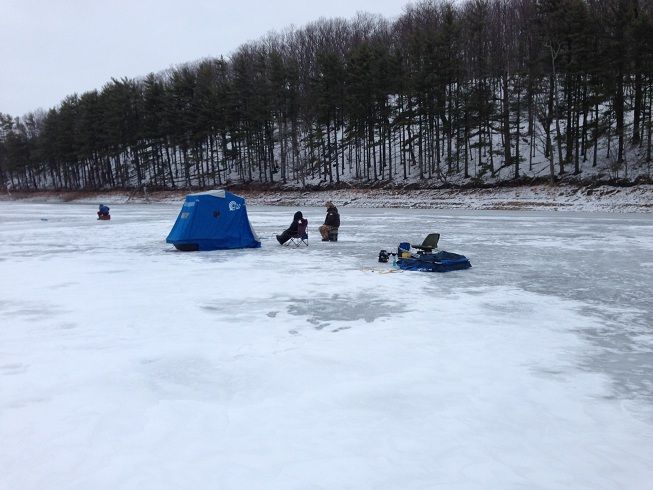
Pictured here are Tanner to the right, his buddy Chris in the chair, and Ricky inside the other shanty.  The guy furthest away is named Rich.  I met Rich the day before.  He’s a nice guy and really tore up the bluegills both days.  As you can see, not only can you catch a lot of fish, but it’s pretty sociable out there too!
While using the camera, when the fish moved in, I could see them inhale my lure, and I’d set the hook. That extra time made up for my slow old age hook sets and allowed me to land the light biters that gave me fits the day before.  Bluegills are notorious for being finicky light biters.  The camera helps to see them bite.

Later, even more fish showed up, and showed up in bigger numbers.  The fish chased down my jigs as quick as I could get them down there.  They competed with each other to get to them.  At one point, the bluegills pecked at my camera!  Then the crappie moved in.  They used my camera as structure!  I’d jig right up to the camera and a crappie would appear right there and inhale it.  They looked huge right in front of the camera like that.  They were extremely aggressive.  You can't see stuff like that on a flasher, which makes ice fishing with an underwater camera that much more fun.
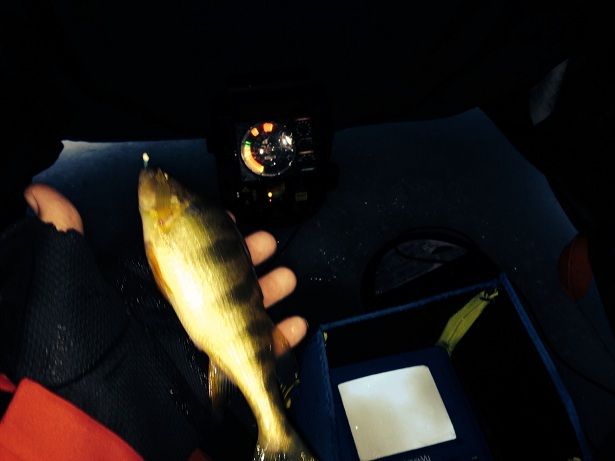
I watched this yellow perch show up suspend right below the camera and engulf my offering.  You can see the Ratso firmly embedded in its upper lip.  Also, you can see my set up, the flasher and camera both in use.  During daylight, the camera was effective.  Deeper fish that were out of view had to be watched on the sonar until the camera could pick them up.  As daylight diminished, the camera's effectiveness did as well.
As we lost daylight, the camera became less effective.  My camera doesn’t work well at night.  The zooplankton are attracted to the camera lighting and they show up in huge clouds after dark.  Plus, it's an old undewater camera and the lighting isn't really all that great.  I've heard that the modern cameras work much better at night.  So, as it became dark, I had to focus on the sonar.  It didn't matter, as the bluegills and crappie stayed aggressive most of the evening.

This particular lake isn't open all night.  In fact, they will ticket you after a certain time.  There was a slow spell about an hour and a half after dark, but wouldn’t you know it, when it was time to get off the lake, the crappie showed up again, more aggressive than ever.  We managed a few bigger ones to close out the evening with some over ten inches long.  But most were mediums like the previous day.
Here’s a typical bluegill from that trip, measuring about six inches (average was 6-8”), with the Ratso in the upper lip.
That night, I finished with 44 crappie, 31 bluegills, and 5 yellow perch.  I caught my last crappie to round out eighty fish just in time to pack up and get out before getting ticketed.  Tanner was using maggots on a small moon glow jig and easily did as well as I did, and better than I did the previous night.  The difference for me between the two nights was that slightly deeper depression in the bottom that seemed to hold the fish.
The last crappie of the night, a small one.
Of course, after those two afternoons, visions of ice fishing danced through my brain all week at work.  I had the day off this past Friday, and went back to the same lake, this time toting Glenn with me.  We hit a local tackle shop for bait to pick up some spikes, just in case the fish were finicky.

We arrived at the lake and were fishing by about one in the afternoon.  A week after my first outing, the ice had more than doubled, now over ten inches thick.

Glenn heard about a spot that had a hot bite of bigger fish from a buddy of his, so we cut holes in that area and searched for fish.  I marked fish in every hole that I cut.  This area of the lake was nearly the deepest at fifteen to eighteen feet.  The fish actively checked the baits and nipped at then.  This behavior is typical of smaller fish, or very finicky larger fish.  You won't know for sure until you catch one.

After cutting a few more holes and having the same thing happen, I downsized to a tiny ice jig tipped with one maggot.  I had to catch one to see if they were worth fishing for or not, just to be sure.  I caught one fish after another on that rig, but they were literally three inch bluegills and four inch yellow perch, confirming my suspicion.  So much for the magic hole.

I didn’t want to waste time feeding baitfish, and moved further up the lake to the more shallow thirteen foot depth that had been productive the week before.  Again, every hole marked fish, so I had to fish them to see what those fish were.  I wasn't satisfied with my catch, so I kept moving, cutting and checking holes. Up until then, I had a dozen fish under my belt that wouldn’t have weighed half a pound collectively!

I moved toward the creek channel, out of the thirteen feet and and back to fifteen, but further up the lake.  My first drop resulted in good hit on my tandem Ratso soft plastic rig.  The bite resonated up to my elbow!  I set the hook and immediately pulled my flasher transducer out of the way.  I back reeled and the fish took drag, and I didn’t want to lose whatever it was, even if I was using one pound test.  Finally, I brought it to the hole, head first and lipped it, yanking it onto the ice.  It turned out to not be a monster, but a nice bass at fourteen and one half inches long!
This chunky fourteen and a half inch largemouth fell for my Ratso tandem rig.  Here you can see my modified broken inexpensive rod with my home made spring tip top.  Not bad for one pound test, huh?
Well, I figured that was the hot hole.  But, maybe there were more like him down there.  My flasher marked a lot of fish, so I dropped something that usually tempts the bigger fish like this one, a Salmo Chubby Darter, which looks like a lipless crankbait but is a vertical jigging lure.  You lower them to the bottom, then rip them up about three feet or so, then let them drop, keeping your light tight as it falls with the fluttering lure, but not so tight that it kills the action.

After jigging the Chubby Darter three times, my sonar showed the marks moving up for the bite, then, a big hit!  Fish on!  "Whoooo hooo", I’m thinking, "I figured out the bass here!"  But, only to my disappointment, it was a bluegill, albeit nice one. That gill thought he was a largemouth!
This bluegill thought he was a largemouth, jumping all over my Salmo Chubby Darter!
After that, the fish vanished and I stopped marking fish.  By now, it was the magic hour, four in the afternoon, and too late to pull out the camera and set up.  The week prior, this was the hot bite time, and it wasn't happening for me now, especially since the fish had vacated.  It was time to go in search mode again.  I thought, “What a difference from last week when they were so active.”

So, I moved up the channel a little ways, cut another hole.  This time, I marked fish from literally the bottom to about three feet under the ice, and it remained like that the rest of the afternoon and evening.  I dropped my Ratsos down there, and the fish were shooting off the bottom to hit them.  At first, it was bluegills, not big but bigger than before, maybe a six inch average, and some decent yellow perch, males mostly.  Mixed in were some medium crappies.

But the bite never stopped.  In fact, it intensified.  I hit the thirty fish count and pulled out my golf counter so I wouldn’t lose track.  I could remember in my head the perch and bass count, since they were less numerous.  All I had to do is let the golf counter count the total, and remember the crappie count, and deduct that to calculate the bluegills.

My jigs wouldn’t make it to the bottom without fish inhaling them.  They literally hooked themselves.  If I missed on a hookset, another would shoot up to bite before I could lower the bait down.  I caught two at a time on a few drops.  This action, out of one hole, took place from four until about seven in the evening when my lantern ran out of propane.  During that time, my fish count went from a dozen fish to seventy one in total!

My lantern ran out of propane during the hot bite.  On my way back to my truck for more fuel, I ran into Tanner, who introduced me to his Father and Uncle.  They offered me a can of propane to get my lantern working again, so I could get back on the bite.  Thanks guys!  But, by the time I had the lantern fired up, the bite had slowed drastically.  For the next hour and a half, I caught only five medium crappie, but did miss a few bites.  All of the crappie were seven or eight inches long with a  few nine inchers mixed in.

Of course, we had to be off the lake their closing time.  With a half hour to go, talked about packing it in.  Then, like clockwork, they turned on again.  Those fish knew that we had to get off the ice!  All of a sudden, they chased my Ratso’s again.  But now, the crappie were bigger, averaging nine inches, with two fat ones that were over ten inches long.  It was really hard to quit fishing and avoid getting fined, but we did.  I finished with 86 fish, 35 of them were crappie, the one bass, five fat yellow perch, and the rest bluegills.

It was one of the hottest bites in such a short time frame that I can ever recall, even better than the week before.

The next day, I set my sights on another Central Pennsylvania lake further North, to fish the hardwater with one of the best musky anglers, check that, anglers, that I know, the founder of Keystone Outdoor Addiction, Jeremy Tyson.  Jeremy has been ice fishing most of his life, but never really gave using electronics a try, so he wanted to check out my system and see what it's all about.  My friend, fellow angler Wayne Chmielewski, also met us there.  Jeremy's friend Jay was also to meet up with us.  I hadn't met him yet.

When I was setting up, this guy walked out on the ice straight toward us.  He wore a green jacket and black hat, sunglasses over the hat logo, with a backpack and no fishing stuff.  I'm thinking, "Well, here's the game warden checking licenses, starting out with us, the furthest out first."  I figured I'd get it over with so that I could set up and begin fishing.  I walk over to him and showed him my license.  He said that everything looked in good order and asked how the fishing was.  As I was telling him about the fishing, Jeremy yelled out, "Hey Jay, you didn't just check his fishing license, did ya?"

It was Jeremy’s friend, Jay, who was coming out to fish with us…If I was an ostrich, I would have stuck my head down one of the hole in the ice to hide!

Usually, the panfish at this lake are on the larger side but more difficult to find and catch.  The trick is to find fish.  When you do, the size will come.  At least that's been the M.O. of this lake for many years that I've fished it.   We found fish, but nothing big, and they would turn out to be very picky all day.

We were fishing thirty four feet of water.  I gave Jeremy and Jay a tutorial on how to use the sonar as neither had used them through the ice before.  The fish were active enough to effectively teach them about the electronics, but the bluegills and crappie were much smaller than what I’d caught during my previous trips.  We did manage a few nice fat yellow perch though.

I also showed the camera set up to Jeremy and Jay, gave then each turns at attempting to catch fish with it.  They had fun with the system, but I think that they didn't want to infringe on my fishing.  I didn't mind, I was out to have fun.  Them having fun was rewarding to me.  But I admit, it's very easy to close the shanty and sit there and watch the camera and fish. It's mesmerizing, and time goes by.

At one point in the late afternoon, the fish showed up on the sonar in big suspended schools.  I then saw them on my camera.  They were crappie.  I'd watch them zoom in and miss my lures and aggressively attempt to eat them.  They’d surge to attack and miss, often, like they were blind!  But, it was deep, probably nearly thirty feet down down over thirty four feet of water, right under my camera, and there was snow on the ice.  It was dark down there.  I think that they had a hard time seeing the bait.  That does explain why at night they will follow and not always bite.  They may be trying to eat the lure all along and simply miss.

Later, I watched my jig while trying to entice a crappie below, when a big flash of a fish swooped in and engulfed my jig.  I set the hook and the fight was on.  It wasn’t as strong as the bass from the day before, but the fish was much bigger than I had been catching all day and I didn’t want to lose it.  Fortunately, it didn’t wrap around my camera cable, and I was able to get it though the hole.  As it turns out, rather than the big fat perch that I had hoped it was, it was another bass, but it was significantly smaller than the bass from Friday at about ten inches long.
Here's the little bass that attacked my Ratso rig, with Jeremy Tyson in the background.
Here's a picture of Wayne, searching for fish down by the dam.
Jeremy called it quits before dark. It was a good call, because his arrival at home earlier saves him brownie points with his wife for future trips, and these dinky fish weren't worth it.  We stayed in hopes that the bigger crappie would appear.

After dark, my flasher lit up like a Christmas tree with fish.  Looking at the round shape of the sonar in the picture below, the bottom is at about 8 o'clock.  All those marks to the right going counter clockwise are fish.  The bottom group were mostly tiny bluegills.  The ones the the right, at about ten to fifteen feet were small  to medium crappie, the biggest that we caught were nine inches, but most were only six inches long.  The fish about ten feet down over thirty four feet of water were the more active fish, suspended like that.  The ones toward the bottom were suspended and active too, but were too small to get even the tiny jig hook in their mouths
My sonar was lit up like a Christmas Tree!
I hoped the lake would have produced a hot bite with bigger fish.  There was enough action to keep us interested, but fish fish were very picky during the day and, other than the perch, were on the small side.  I finished with a six bluegills, two yellow perch, a largemouth, and twenty two crappie.  Not bad, but not great, and the size was a real disappointment, especially for this lake.  We could have stayed and caught more, but Wayne and I had a long drive home.  So, we made a pact that we'd each get one more and then call it quits.  It took about fifteen minutes, and we succeeded in fulfilling our pact, and packed it up.

My first four trips were a huge success though, because I fished with Jeremy and Wayne for the first time on the ice, and met some new anglers (Tanner, Jay and Rich), and spent some time with an old friend who is partly responsible for my ice fishing addiction, Glenn Cumings.  And, two of the four trips had some of the hottest action that I'd ever experienced in such a short amount of time!

I'd say that was a hot start to a cold winter, wouldn't you?


Sunday, February 5, 2012

On the Hardwater - Jigging Spoons and Blade Baits

A basic staple of cold water fishing is to toss chunks of metal into deep water where flash, vibration and flutter draw a reaction strike from some sort of predatory fish.  Many years ago, a resourceful angler, Julio T. Buel invented a fishing lure called a spoon, somewhere around 1821 and finally became the first to commercially manufacture them in 1848 (see footnote 1).  It's believed that he fashioned his first spoon lure from an ordinary tea spoon, possibly by severing the handle and attached a hook to it.  Spoons have been catching predatory fish even since, especially through the ice.  For the most part in ice fishing, we use two types of spoons, slab style spoons that wobble and flutter, or blade baits that vibrate in a similar manner to a lipless crankbait.  Both are affective through the ice.

Of course, spoons come in a wide variety of shapes, sizes, colors and styles.  I'm going to touch on some of my favorites simply because I can show you physical examples of them.  By all means, there are many brands out there that are equally effective.  Of course, the spoons that will work for you depend on the species that you target.  In this post, I'm going to cover spoons that work on lunker panfish as well as larger predatory species like bass, walleye, pickerel and pike.  I'll also cover some tactics and tips that work with these lures.

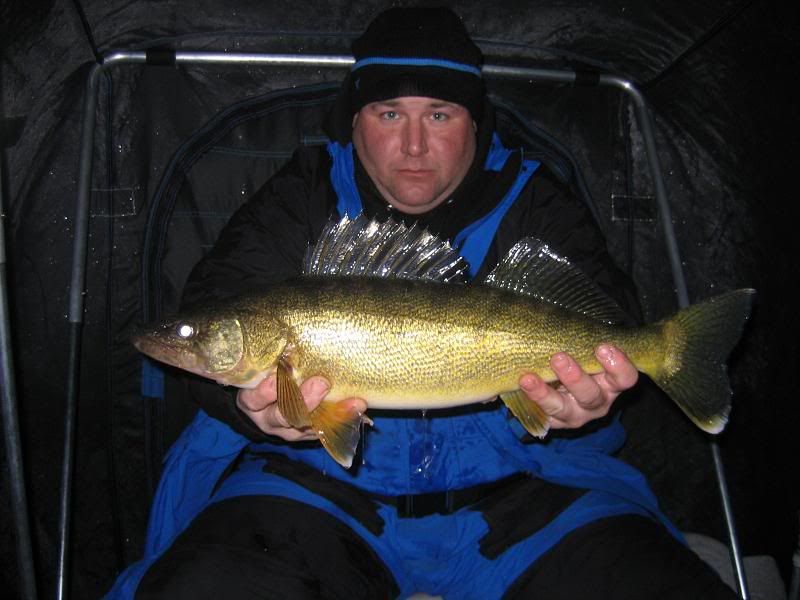
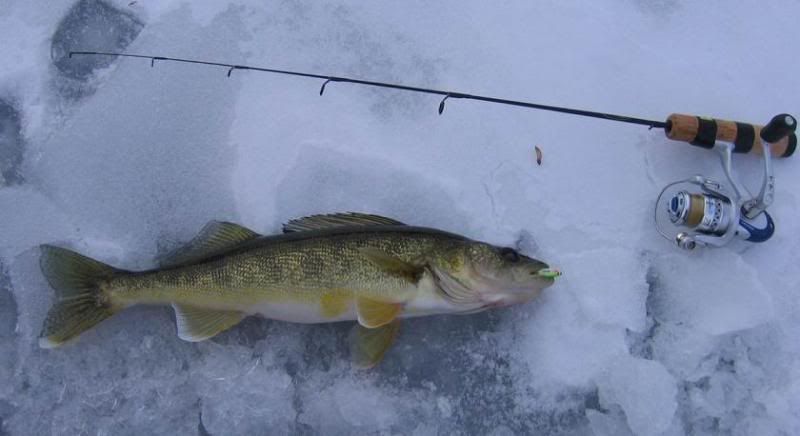
Ken Askins, a.k.a Bean on  Iceshanty , sports a nice walleye that was fooled on a Northland Buck-shot Rattle Spoon.  Photo courtesy of Ken Askins.
Jigging Spoons
The most popular spoons used through the ice are collectively known as jigging spoons, and as the name suggests, are designed for vertical jigging.  Jigging spoons are equally effective  when fished in open water by fishing vertically or cast and jigged on the retrieve.  In this post, the focus will be on techniques used with these lures that are effective though the ice.

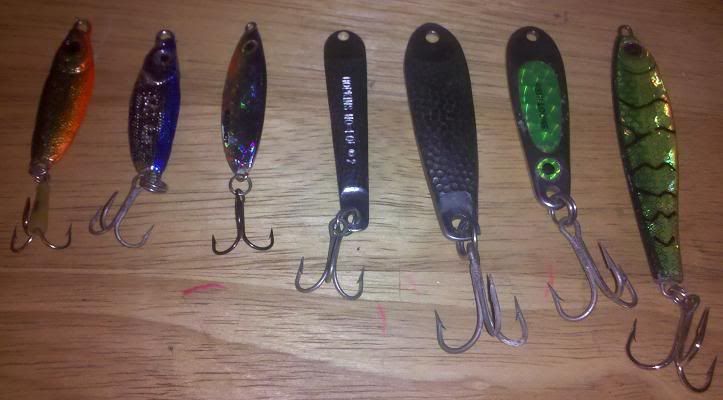
Larger spoons like these will take big fish through the ice.  From left, two Luhr Jensen Crippled Herring, Northland Buck-Shot Rattle Spoon, Hopkins Spoon, Hopkins Shorty, Hopkins Smoothie, and a Bass Pro Shops XPS jigging spoon.  Use these to bounce from hole to hole and cover water.  Big spoons catch big fish.

The results speak for themselves, just look at this fat walleye caught by my good friend Mark Sirko of Pennsylvania that fell for a large jigging spoon.  Photo courtesy of Ken Askins.

Mark displays a pike that fell for a large jigging spoon.  Catching pike while jigging spoons through the ice is a real thrill.  Nice fish Mark!  Photo courtesy of Ken Askins.
The spoons pictured above are similar in design to the original one invented by Mr. Buel in 1848.  They are, in simplest design, a slab of metal with a treble hook on one end, and a line tie on the other, then painted or finished in such a way as to attract strikes when jigged.  Some are concave, others are thin, others thick, and each type will have a different action.  They come in many shapes that also affect the action.  It's up to you to determine which shape or style will work for you.

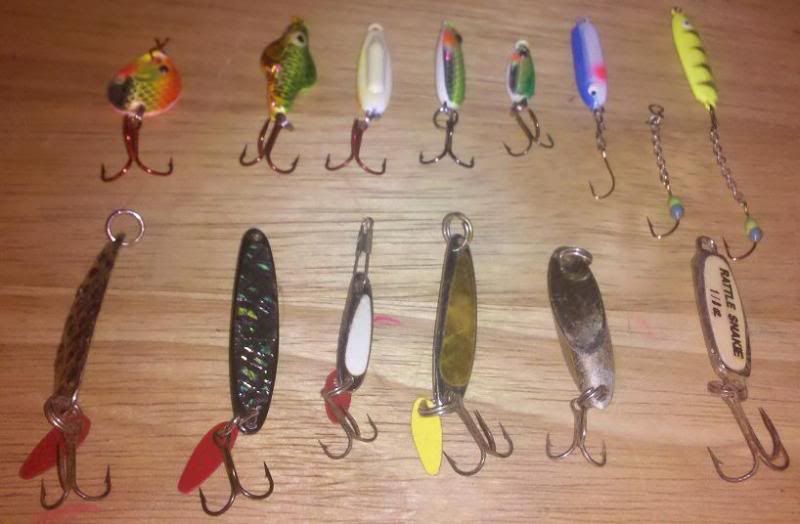
These smaller jigging spoons are popular with ice anglers as they catch both panfish and predators.  When searching for big crappie, jumbo yellow perch, and plate sized bluegills, try one of these.  Top row from left, Northland Eye-Dropper Spoon, Lindy Techni-Glo Rattl'n Flyer, two Northland Buck-Shot Rattle Spoons (showing rattling chamber), Northland Forage Minnow, Hali Sukkula Jigs (showing different chain droppers).  Bottom row, Bay de Noc Swedish Pimples, Acme Kastmaster, and Bass N Bait Rattle Snakie spoon.

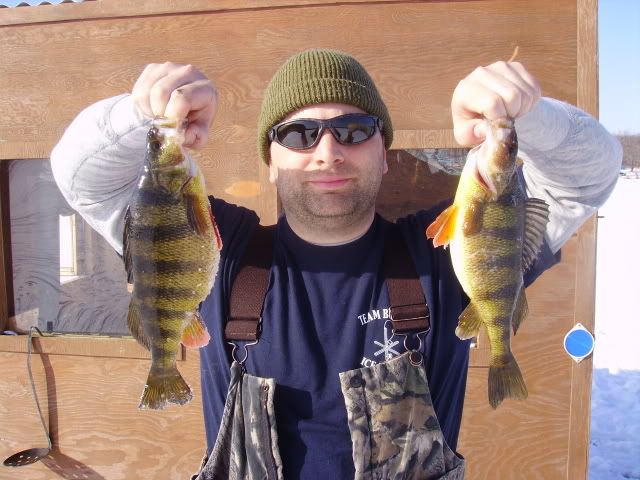
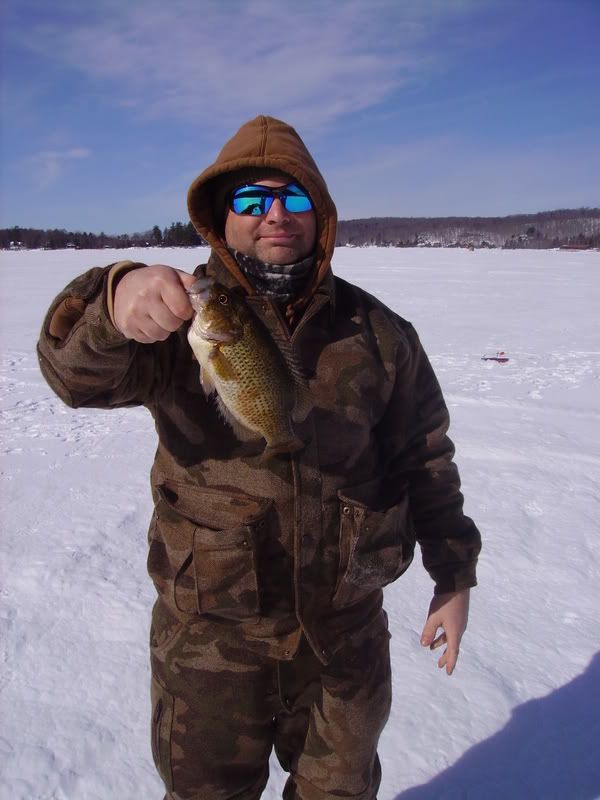
Mike Bushey, a.k.a. adkRoy on Iceshanty from New York poses with some fat jumbo perch that took a Hali Sukkula Jig.  These jigs are hot for panfish and predators alike.  Photo courtesy of Mike Bushey.
Jigging spoons work well because they give off vibrations, flash, and some sort of fluttering action on the fall, to provoke a reaction strikes from aggressive fish.  However, tipping them with bait will also draw strikes from fish already on the feed.  Some jigging spoons sport internal chambers that contain shot or beads that rattle, adding to the attraction that may provoke strikes.  Others are painted in bright colors or even extremely realistic fish imitating patterns.

My buddy Ken posing with a huge crappie that nailed a Northland Buck-Shot Rattle Spoon.  That is one slab crappie!  Photo courtesy of Ken Askins.
Blade Baits
These spoon type lures are designed for a horizontal presentation fished vertically, with the line tie on one side, and two or more hooks on the other.  Most of the time, the line tie is merely a snap inserted through a hole in the blade (spoon).  Some models have multiple holes that provide different action on the lure depending on which one you choose to use.

When you jig these lures up off the bottom, you'll feel the lure vibrate rapidly on the pull.  On the drop, these lures flutter or spiral down.  When sitting motionless, they resemble a fish or a minnow.
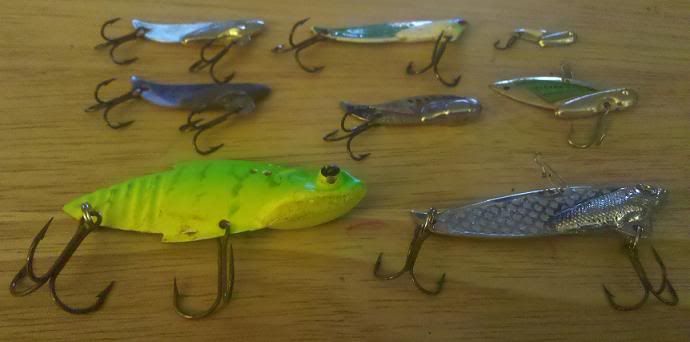
Blade baits are great for targeting big predatory fish through the ice, but also work well on jumbo panfish.  From top to bottom, left column, Silver Buddy, Luhr Jensen Rattlin' Ripple Tail; middle column, Heddon Sonars; right column, Reef Runner Cicadas, Bass Pro Shops XPS Lazer Eye.
Fishing Spoons and Blades
When on the ice, I carry a couple rods that are slightly beefier than my panfish rods to jig small spoons and blade baits.  I use four to six pound fluorocarbon line with a small snap tied to the end, or a No-knot Fast Snap, so that I can change spoons easily until I find one that the fish will hit when targeting panfish.  For bigger spoons, my set ups are on eight to twelve pound line depending on the lake, species that I'm targeting, and the weight of the spoon.  Typically, I'll have one that has a rattle rigged on one rod, and a totally different style rigged on the other rod, like a blade bait.  This way I can try different presentations until I can get some sort of response from fish, perhaps bites or reactions that I can see on my camera or sonar.

When fishing jigging spoons or blade baits, most anglers prefer graphite rods with some backbone so that they can easily feel the strikes, and also work these larger lures a good responsive action.  If the rod is too "whippy", the lure action, especially in deeper water, isn't responsive enough.  In other words, your rod tip may be moving and working much harder without the result you're expecting thirty feet under water.  If you want your spoon to travel a foot on your jig, you won't want to have to work your arms and shoulders three feet to get that result.  More importantly, when a fish hits, you want to have a good hook set and a whippy rod won't effectively do that.

Here's a jigging rod set up with a Northland Buck-Shot Rattle Spoon that allowed Ken to ice this fine walleye.  Photo courtesy of Ken Askins.
Another thing that ice anglers do to draw strikes from inactive fish is to tip their lures, or sweeten them, with some sort of bait.  You can use waxworms, spikes (maggots), minnows, and where legal, fish eyes, minnow heads or belly meat.  In addition to tipping them with bait, you can also use Berkley Gulp Minnows or Minnow Heads. 
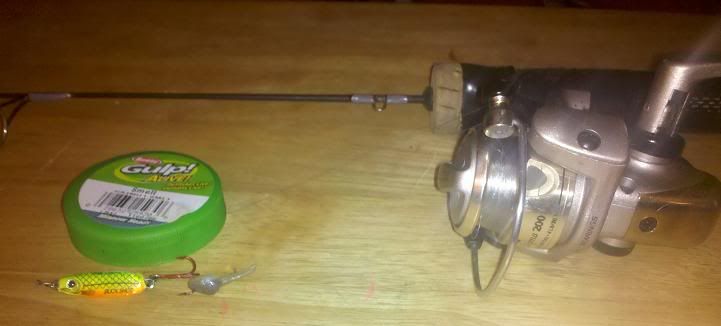
This jigging rod is rigged with a Buck-Shot Rattle Spoon tipped with a Berkley Gulp Minnow Head.
There are a couple ways to work a jigging spoon or a blade bait.  You can fish them aggressively or finesse them.

The Aggressive Presentation:
Drop the spoon until it hits the bottom, then reel up the slack until the line is tight.  Then, raise the rod tip to the eleven o'clock position quickly to draw the spoon off the bottom, then lower the rod tip slowly and let the spoon fall.  It's important to drop your rod tip at the same rate that your spoon falls to keep the line tight.  Watch the line closely because if it goes slack or twitches, set the hook.  Fish often hit these lures on the fall.  Sometimes, if fish are on the bottom, they'll hit as your lure reaches the bottom.  You may not see these hits, but you'll have a fish on when you raise your rod for the next jig.  By raising the rod, sometimes you actually set the hook on a biting fish. 

When you find the school and the fish are aggressive, spoons are good choices because, after catching a fish, you can get them back down quickly to target your next one.  When the schools move often, it's important to get that lure back down there before the school moves off.

Try first without tipping the lure with bait.  This gives the spoon it's best action which will draw reaction strikes from big panfish and predators alike.  Sometimes the strikes are quite violent!  When doing this, you can hit a bunch of holes and not really need your sonar or camera, assuming that you know the depth that the fish are holding.

If the fish aren't hitting the technique above, after a few jigging patterns, let the jig sit on the bottom of your jig for a second, maybe shake it a little bit.  Try different things until they strike.

When the fish are agressive, they'll hit a jigging spoon without bait.  Presumably, when finding your ice fishing spot, you've cut some holes and checked them with your sonar until you've located fish.  Then, you've opened up the area by cutting a series of holes, not just one.  Bouncing from hole to hole with a jigging spoon is a good way to get some quick bites on big fish and pick off the more active predators.  I've caught some of my biggest slab crappie this way along with walleyes, bass, chain pickerel and every now and then a pike.

I spend a lot of time jigging smaller baits and plastics for panfish, and sitting at one hole for any length of time tires out the old caboose and causes my feet to fall asleep.  So, every now and then I'll get up to stretch my legs and walk around.  You can either do this and not fish by visiting your fishing buddies on the ice to see how they're doing, or you can carry a jigging spoon rod with you on the way and hit a few holes.  You have to keep your lure in the water to catch fish.  So that's what I like to do when I need that type of break, to bounce around and hit some holes with my jigging rod, maybe catch a couple fish, and then visit my buds to see how they're doing.

Finesse Spoon Presentations
If your aggressive approach doesn't provoke strikes but you know that the fish are there, then it's time to try a more finesse spooning approach.  First, try adding a bunch of spikes or a minnow head to a treble hook and slow down your jigging.  Try shorter hops with an occasional larger jigging movement, then let the lure sit, maybe shake it a little.  Try different things to get them to hit.  This is when the camera or sonar comes in handy where you can see how the fish react and then adjust.
Mike teased his favorite fish, the rock bass, into hitting his Swedish Pimple.  Jigging spoons catch just about any willing fish through the ice.  Photo courtesy of Mike Bushey.
Even smelt will hammer jigging spoons!  Photo courtesy of Mike Bushey.
If you notice that fish are attracted to all of the jigging commotion but just won't bite, try changing the type of spoon, or color, or size, to see if that might draw a strike.

Sometimes aggressive jigging actually scares fish away.  You can see that on your camera or sonar.  When that happens, try a much more subtle jigging action.  If you've tipped your lure with bait, try jigging them as you would an ice jig with maggots.  On lakes that have larger panfish, jigging spoons worked this way might be worth starting out with, especially with perch and crappie when they're schooled up and moving around.  Often these larger baits will ice the biggest panfish in the school first, or at least the most aggressive ones.
Mike shows off a perch that he nailed on a Hali Sukkula Jig tipped with bait.  Perch just love these things and you can jig them aggressively or fish them like you would smaller ice jigs for finicky biters.  Photo courtesy of Mike Bushey.
Also, spoons are great for drawing the school in because of their visibility.  If the school moves off, jig your spoon aggressively to draw them back.  The flash, vibration and action in clear water under the ice often will attract schools of fish that are aggressively feeding.  If you don't attract the school in a reasonable amount of time, then maybe it's time to bounce around from hole to hole until you find them again.  Bring the sonar with you and your jigging spoon rod, check the hole for the school and if it's there, you can get that lure down quickly to hook up.
Mark shows that jigging spoons will catch a wide variety of fish through the ice.  He landed a jumbo yellow perch and a nice hybrid striper using a jigging spoon.  Photo courtesy of Ken Askins.
I can't tell you how important sonar is in this type of fishing too.  They aren't called "fish finders" for nothing, they will locate the schools for you.  Not only will they locate what hole to fish, but also they tell you the depth to lower your spoon to especially if the fish are suspended.

Mark shows that using jigging spoons will ice big fish like this fat walleye.  If you currently don't include jigging spoons in your ice fishing strategy, you may be missing out on your chance to ice some of the biggest fish in your lake.  Photo courtesy of Ken Askins.
If you don't have jigging spoons in your ice fishing arsenal, then you may be missing out on some terrific ice fishing action.  These lures can ice fish quickly when the fish are aggressive, even fish that seem finicky when fishing smaller jigging presentations.  In other words, sometimes bigger is better.  Try them!

I'd like to extend a special thanks to Ken Askins (Bean on http://www.iceshanty.com/) and Mike Bushey (adkRoy on http://www.iceshanty.com/) for their contribution to this blog post.  Both of them have also contributed some great info on Iceshanty, helping to make it the premier ice fishing web forum on the internet.

Footnotes
1.  Old Fishing Lures and Tackle:  Identification and Value Guide by Carl F. Luckey and Russell E. Lewis

Friday, January 27, 2012

On the Hardwater - Jigging Soft Plastics for Panfish

I started out typing up the second post in this series with the intention creating a follow up to the last one, "On the Hardwater - Ice Fishing Basics I".  It's currently a work in progress and I'll post it in a few days, but I decided instead to post something more detailed, a subject that is truly my passion when fishing for panfish, and that is fishing with artificials, specifically soft plastics.
This yellow perch fell for a Bass Pro Shops one inch pumpkinseed Squirmin' Grub.  Soft plastics can catch a lot of fish in a hurry, especially in early and late season. 
Years ago, my go to rig included a 1/80 ounce jighead, either chartreuse or orange, rigged with a one inch Bass Pro Shops pumpkinseed Squirmin Grub, fished on four pound monofilament line on an ultralight 24" fiberglass cheap fishing rod.  In fact, my first fish on the ice came on that jig.  I tore them up that day on them, and became hooked on ice fishing at the same time.  Since then, that jig has caught many a crappie, bluegill, yellow perch, trout and bass amongst other species through the ice.  Over the years, my soft plastic arsenal has grown, mostly as a carryover from fishing for panfish during open water season, then taken to the ice.

Why fish soft plastics?  There are times when fish of all species can't stop hitting them.  And, you don't have to worry about changing old bait, or replacing bait stolen by fish, and you can quickly get your lure back down to them.  And, there are even times when they won't hit anything else, for reasons I have yet to understand.  During a hot bite, I can catch an extra fish while my buddy is baiting a hook.

So, what kind of soft plastics work well on panfish?  In general, I think small and light, although there are times when bigger is actually better.  When it comes to color, I mostly use either natural colors when the water is gin clear and there is a lot of light penetration below, or bright or glow colors when it's dark or dingy down there.  But, there are times when they need to see something different, and a glow or bright color may work when the water is clear.  I'm also a fan of red and black, red when the water is clear, black any time but especially in dingy water.  As you might expect, glow colors work great at night.  Basically, try different combinations and let the fish tell you.  One way to do that is to fish two jigs in tandem, with different soft plastics on each one, and let the fish choose.
This rod is rigged with two Ratsos, about nine inches apart.  The color choice here includes glow pink and glow blue, both hot colors for crappie and bluegills on the lakes that I fish.  If they both work, I leave them both on.  If one works better than the other, then I try two of the hot color or try something different altogether.  These Ratso jigheads are glow color too.
One of my favorite rigs has two Custom Jigs and Spins size eight Ratsos rigged about eight to ten inches apart.  Preparing this rig involves a small swivel with a three foot leader.  Using your favorite fishing knot, tie a jig about ten inches from the end of the line, but do not cut the tag end.  Then, at the end of the line, tie on the second jig.  Then, add two different soft plastics and see which ones work the best.  Once you determine that, double up on that color, size, or style because you might hook up two fish at a time!  The swivel prevents line twist.  You can tie this rig without a swivel.  I'll go into the advantages and disadvantages of using a swivel later.
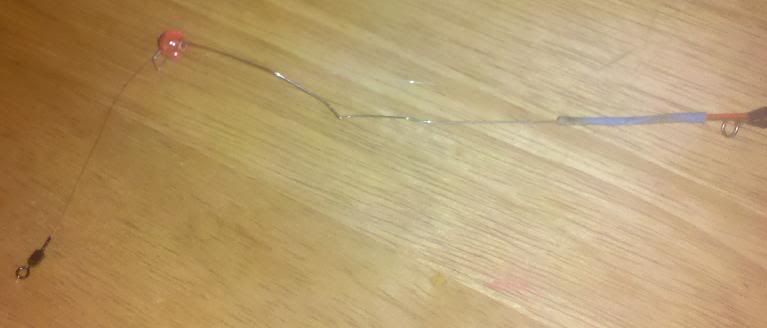
This is the rod tip of my broken South Bend fiberglass cheap jigging rod.  When it broke (slammed in the lid of my box), rather than tossing it in the trash, I made a spring bobber out of light spinner wire and a plastic bead, and used fishing line and shrink wrap to attach it to the end of the rod.  The spring helps me detect the lightest bites.  Notice the swivel that attaches to the leader and main line.
My plastics selection can be divided into two categories, scented and non-scented.  The non-scented plastics are the traditional types that you find that are effective when fishing open water for panfish.  The scented types are soft plastics that are biodegradable or have some sort of scent mixed in with the plastic that have really gained in popularity over the past several years.
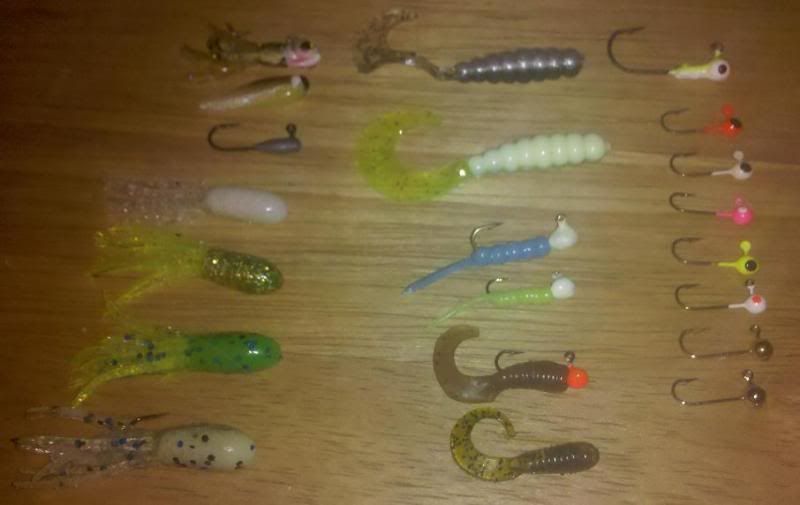
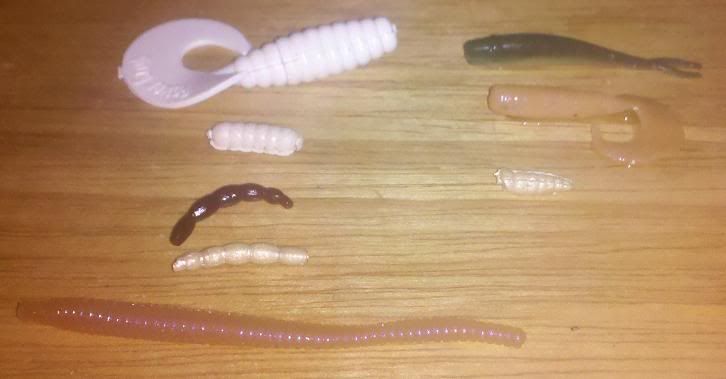
These non-scented soft plastic baits are among my favorites and have iced many a crappie, bluegill, or yellow perch.  The left column includes external tube jigs and insider head tubes.  The middle column includes twister tails or grubs, and Ratsos.  To the right are various colors and styles of jigheads used to rig these hot baits.
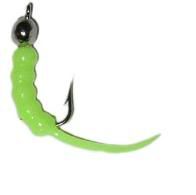
This lure is called the Shrimpo, basically,
it's a verticle version of the Ratso.
Make sure when rigging this lure that
you keep the tail rigged as shown, you'll
get more bites that way.
I usually carry tube jigs, grubs and Ratsos as my staple go to baits for non-scented plastics.  In addition to the Ratso, I carry Kalin's two inch grubs, Bass Pro Shops one inch Squirmin' Grubs and 1.5" Squirmin' Tubes.  These are very effective on the hardwater and in the soft water for virtually any panfish.

I also carry a box of various soft plastics designed for ice fishing that include such interesting critters as the Little Atom Wedgies, Nuggies, Duppies, Skimpies and Micro Noodles.  While you're ice fishing, if someone approaches you with the intent of giving you a Wedgie, don't run away, it may help you catch fish!  Another new group of soft plastics from the Reel Good Guide Store broke onto the scene and promise to fill ice anglers boxes with plastics and most likely their buckets with a limit of panfish.  These lures hail in the names of the Ice Mite, Paddle Bug, and GoJo.

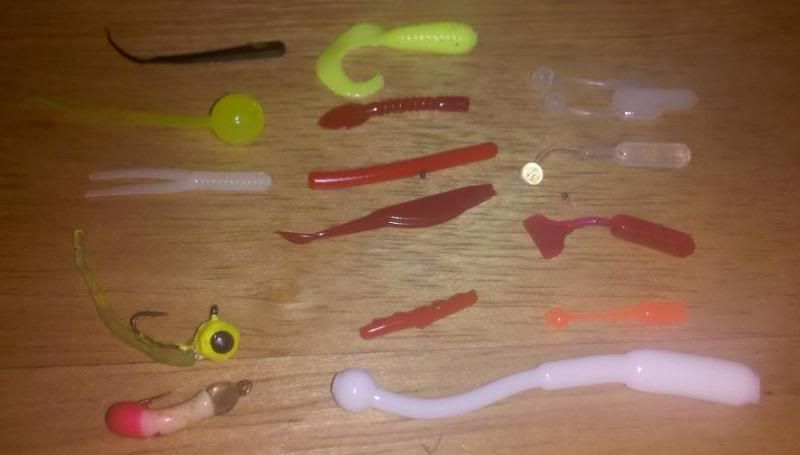
These plastics are carried in my "other" plastics box.  These are designed specifically for ice fishing, but can be used in open water with good success.  The top left and middle columns are soft plastics from the Little Atom company, while the column to the right are from Reel Good Guides.  The chartreuse jig to the left is made by a friend of mine, and the one below that is from Custom Jigs and Spins called the Purist.  The Purist is great in shallow water less than six feet.
There are other soft plastics out there designed for ice fishing or for open water panfishing, and the only thing that they need for them to work is for you to try them.  My advice is, that if you have confidence in a particular soft plastic when fishing for panfish during open water, chances are that they'd work under the ice as well.  I'm not loyal or biased toward any particular brand.  Rather, if I see something that I think will work, I'll try them.

So, what's another way to add some oomph to your non-scented soft plastic jig to further tempt finicky fish into biting?  Add scent.  There are many commercial brands of scent, including Fish Formula, Smelly Jelly, Bang and Berkeley Gulp juice to mention a few, and I'm sure that there are others.  Some people make their own using anise oil or cod liver oil as a base, then adding other flavors like garlic or other fish oils.  What works best?  I really don't know, but I use scent all of the time.  Scent, if anything, covers human scent and other things that might not appeal to the finicky taste buds of fish.  It's quite possible that fish might bite these scented lures because of the scent, but at a minimum seems to result in fish holding onto the bait longer.  That added time might be the difference between hooking up on a bite or the fish spitting the lure out.

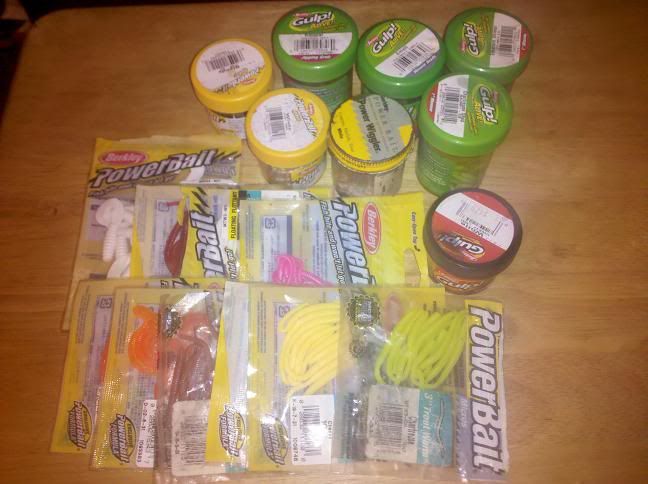
Scented Lures, which include biodegradable lures, are claimed by their makers to outfish live bait.  I can sometimes say that about any soft plastic, but there are times that these scented ones out perform anything else.  Probably the most popular ones are made by Berkley, but also Yum and Mr. Twister make versions that are very tempting to panfish.  I carry a good supply of Gulp and Powerbait products.
The column to the left are Berkley Powerbait products, and to the right are Gulp products.  The Powerbait products are as follows, Power Grub, Power Wiggler, Power Spikes, and Power Trout Worms.  The Gulp products are, top to bottom, Gulp Minnow, Gulp Grub, and Gulp Maggot.  These are awesome for finicky panfish.


Can you tell that I like Berkley scented products?  I carry these on every ice trip, and use them!
When fishing soft plastics, sometimes the bite can be easily detected, but most of the time the bites will be light.  Using a spring bobber or a very sensitive ultralight rod really helps to detect the bites.  The best way to detect bites is to see them.  During the daytime, in clear water, I use an Aqua-vu underwater camera when I'm over a good number of fish that I've marked with my sonar.  I can see them inhale the plastic lure and set the hook before they can spit it out.  Sometimes these fish bite so light that you can't detect movement on your rod tip or from your line, but with a camera, you can nail them. 
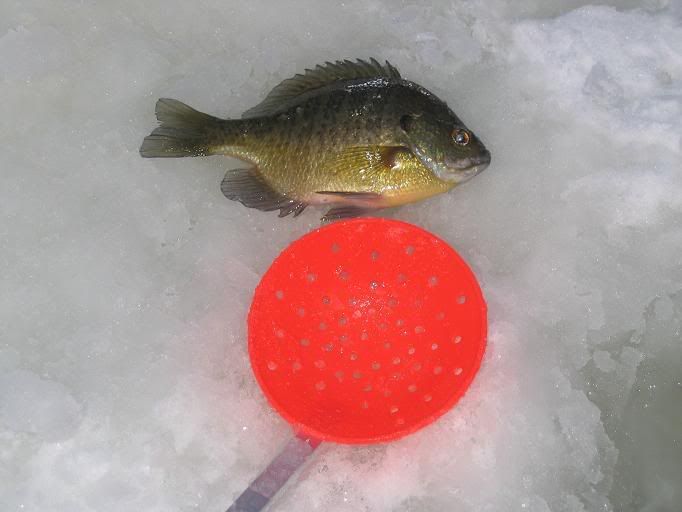
Bluegills like this one often bite so light that you can't see the bite on even a spring.  That's when a camera comes in handy, set the hook when you see the bite.  Some anglers when fishing shallow water, will "sight" fish by laying on the ice and peering down the hole.  This is the same principle as when using the camera.
Night Time Crappie
One of my favorite patterns of the Ratso tandem rig is the night time crappie bite.  The camera isn't much use at night, I've found, because there's so much zooplankton activity at night that are attracted to your camera light that it blocks out most of your visibility.  So, two things are key, your sonar and the spring bobber (or a very sensitive rod tip).

Before I go on, in my last post I gave a lot of credit to my buddy Jeff Redinger.  I have to give him credit here too, for turning me on to the Ratsos.  Since he pointed them out to me, I've caught a ton of fish on them.

OK, back to crappie.  The first thing to know is that, at least from my experience, crappie feed up.  What I mean by that is that they seem to respond to lures that are worked above them rather than on the bottom or below them.  That's not to say that they won't chase a lure down or hit them off the bottom, rather, they seem to be much more aggressive to lures presented above them.

Another trait of crappie, especially at night, is they almost always suspend.  If you're lure isn't where they can find it, then you won't get bites.  This is where a good sonar unit comes in handy.  As discussed in my last post, "On the Hardwater - Ice Fishing Basics I", you can see your jig or, in this case, both Ratsos, and you can see the fish.  With suspended fish, you know exactly what depth they are holding at because you can see them, so you can effectively drop that lure into your hole and jig it just above them.  Without sonar, you might drop the lure below them or fish too high, and the fish won't see it.

Crappie that bite "up" often push the lure up on their attack, creating slack in your line, resulting in your spring straightening out or moving up.  If you don't have a spring bobber, you need to really watch your line and make sure that any weird slack that all of a sudden appears is followed by a hook set, because that could be a fish!

When working the tandem Ratsos, most of the time the fish are focused on the bottom one.  When there's a thick school, you may see them surround both of them.  If you hook one, let it thrash a second or two and you'll often get a second bite, and you can catch two at a time that way.

 Using sonar, or a flasher, along with my tandem Ratso rig, allowed me to catch panfish for three hours non-stop on this trip.  I kept a few of them for a nice panfish dinner, the rest were released to catch another day.  My Ratsos have done this for me time and again.
How do I tempt them into striking?  First, the fish need to see the lures.  You've presented them because you're using sonar and you're keeping your lure slightly above them.  I also like glow colors at night, so I'm always using a light source to keep them "charged".  What I like to do is keep the jigs just above them, then lightly jig the lure and barely move it so that the Ratso tail is barely quivering.  As you do that, slowly raise, then stop, then raise, then stop and draw the fish up higher in the water column.  Eventually, they can't stand it and will hit before the lure escapes.  There are times when they may chase it all the way to the hole!  You really have to pay close attention to your sonar and watch their behavior.  When the fish finally are tempted to your lure and appear to be one with your lure on the sonar, take your eyes off the sonar and closely watch your rod tip for the bite.

Another thing to watch is when there's a thick school, after catching a fish, you may be in a hurry to get that lure back down.  So, you drop your jig in the hole and it's sinking then all of a sudden stops, and you may not see anything on your sonar.  That's usually due to one of two things.  Either it's hung on some ice frozen at your hole, or it's a fish swallowing your jig on the fall.  Set the hook.  Crappie are notorious for doing this.

What happens when the suspended school of crappie disappears?  They probably haven't gone far away.  The school is most likely nearby enough to see your jig but just outside of the cone of your sonar.  So, to get them back, jig your lure aggressively until they appear on your sonar, then go back to what you did earlier to get bites.

One more thing about using a spring with this Ratso rig, it really helps when it's windy to find shelter to fish.  For me, it's my flip over style Fish Trap, that allows me to fish out of the wind so I can easily see and detect the lightest of bites.

So, why do predators like crappie bite these micro sized plastics, especially at night when they feed so much on minnows?  These soft plastics, along with other ice jigs, are great for imitating small crustaceans.  Remember why I don't like the camera at night, because the zooplankton are attracted to the light?  Those are the critters that the crappie are feeding on at night.  Zooplankton become much more active at night, rising in the water column, and the crappie are right there with them.  See why crappie suspend now?  You can imitate them in your jigging technique, and it could trigger strikes.  What do they look like if you don't drop a camera down there, you might ask?  Well, just look into your hole.  The light from your lantern attracts them to your hole, and you can see copepods, amphipods, and daphnia flitting about in your hole.

One final piece of important equipment needed for a good night crappie bite is a lantern.  I bring out a propane fueled Coleman lantern.  In my shanty, it not only provides a great light source, but helps keep it warm in there.  It could be in the teens outside and windy, but in my shanty I could strip down to a flannel shirt and be toasty as can be.  Lanterns are great also for charging up your glow lures.  I really believe that the light generated by your lantern attracts zooplankton, and the crappie are drawn there as well.  Just don't let your line get too close to the lantern, or you'll be retying a new rig (speaking from experience there).  Also, don't let it near the canvas on your flip over shanty or you'll be patching a hole prior to your next trip.

Before I forget, let me mention the advantages and disadvantages of using a swivel, as promised earlier in this post.  The swivel prevents line twist, and also adds a slight bit of weight which helps to load your rod tip when using light lures.  Line twist causes lures to spin.  Huh?  Well, when watching your lure with an underwater camera, if you jig any lure with spinning tackle, you will twist your line.  When you stop jigging, the line unwinds, and your lure twirls or spins under the water.  Fish will approach the lure and look at it, but most of the time won't bite a spinning lure and will eventually swim off.  Sometimes, but rarely, they'll wait for it to stop spinning and then bite.  You can reduce this twist by using a swivel, or, keep jigging the lure.  The lure won't spin as much if you keep it moving.  But if you have fish that will only hit whne you dead stick your lure, if it spins, you'll lose a chance at that type of bite.

The disadvantage of using a swivel is that it's another thing to see on your sonar, and sometimes the fish will actually bite it.  I've been tempted to put a small jig on it, but have never done that.  I wonder if it will work?  Hmmm...  Another disadvantage is that you have to keep changing your leader as you retie your jigs or change lures.  That's not a problem at home, but on the ice in the elements it's kind of tricky, especially with my old age and poor eyesight.  Oh, you're laughing eh?  Well, just wait until your my age and have to tie up a new rig with one or two pound test in a shanty in icy weather!  Obviously, the advantages outweigh the disadvantages.

Another thing that you can do with plastics is to use them to tip any of your ice jigs or spoons.  I really like doing that with the Berkley Gulp products, adding a Gulp Minnow Head or Minnow to a spoon can tempt bigger panfish or even bass, pickerel or walleye!
This Northland Buck-Shot Rattle Spoon tipped with a Gulp Minnow Head will not only tempt jumbo perch, but may put a nice walleye or bass on the ice for you.
Which leads me to my next topic, bigger plastics.  Bigger baits catch bigger fish, right?  Well, that's sometimes true with panfish.  If the common forage of a lake is larger, and fish are feeding often on minnows or crayfish, bigger soft plastics might work even better than the micro ones mentioned above.  You can really clean up on slob bluegills, slab crappie, and jumbo yellow perch by giving them something a bit bigger and more tempting.  I've caught jumbo perch and crappie while jigging three inch soft plastics.  When the fish are aggressive, sometimes your best catches can result from going big.

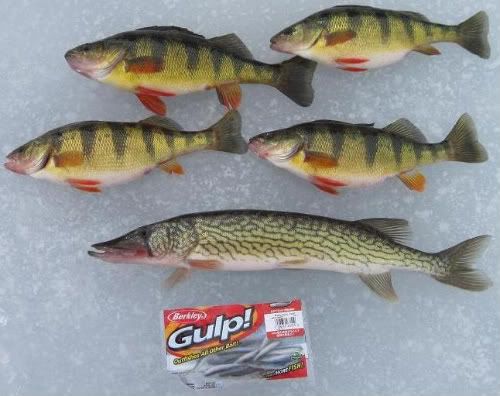
Bigger can be better.  These jumbo perch and a bonus pickerel fell for three inch Gulp minnows on a 1/16 ounce jighead.
So, next time you go out on the hardwater, have a rod rigged with your favorite soft plastic lure for panfish, and give it a try.  You may find that you may catch more than you ever imagined.  This isn't the only or always the best way to catch panfish, so make sure to bring what you're comfortable with out on the ice, but give these a try, you may be pleasantly surprised.  Think of soft plastics like you would any other time of year, as another tool to catch more fish, a tool that I never leave behind.

For more ice fishing tips, techniques, talk and fishing reports, please visit http://www.iceshanty.com/.