Showing posts with label Fossils. Show all posts

Monday, August 13, 2012

How to Find Shark Teeth at Myrtle Beach...

 ...or at least how I find them.  There may be other ways to find shark teeth on the beach, and I'll touch on those briefly, but I'll focus mostly on my methods.
Although Myrtle Beach isn't a premier collecting location, it sure is fun finding shark teeth there while you're on vacation.  This blog post hopefully will help you.
First of all, let me state that there are more productive fossil hunting locations along the U.S. Eastern Coastal Plain, so this isn't a recommendation to collect there if you plan specifically hope to find the megalodon or great white shark tooth of your dreams, although large nice teeth are possible.  However, if you are planning a vacation to Myrtle Beach, then finding shark teeth and other fossils are just another fun activity and well worth the effort.  Even though I go to Myrtle Beach to vacation, any time that I'm fossil collecting, I may take it a bit more seriously than others.

Let's start off with the right tools for the job.  The most important tool is... (drum roll inserted here) ...ready?  Your eyes.  That's right, your eyes.  You need to discern the shapes and characteristics of shark teeth from the gazillions shell fragments that you may encounter on the beach.  After that, additional tools are up to you.
The most important tool that you'll need are your peepers...learn what the teeth look like and their characteristics and you'll find them.  There are other useful tools, but these are the best.
OK, well some of us, like me, need a little help...
Other than my eyes, my other tools and things that I carry with me consist of a tool to assist me in collecting that I refer to as my "pick up tool", some sort of container to keep your finds in, a fanny pack to carry essentials (water, cell phone, room key, camera, etc.), and comfortable footwear.
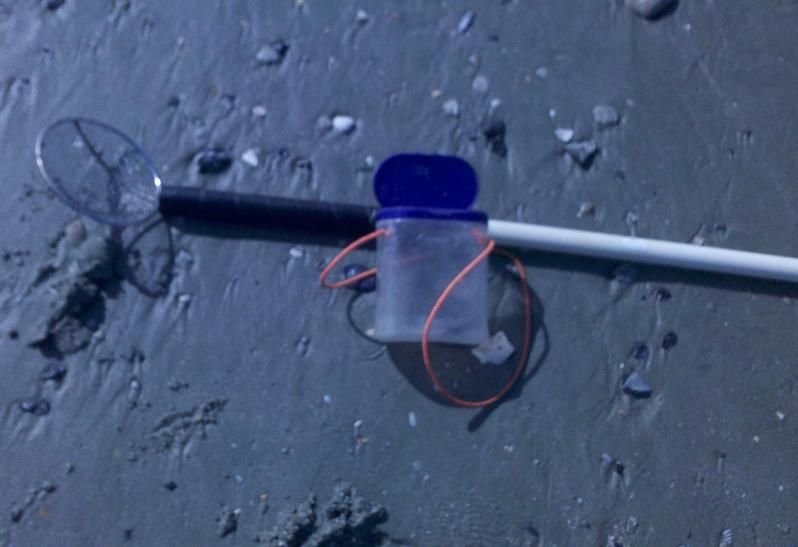
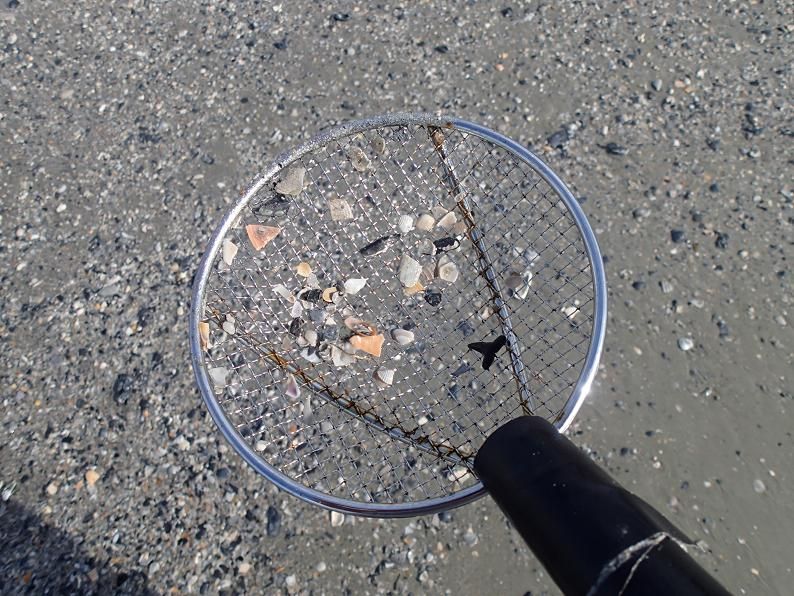
My "pick up tool" consists of a frying skimmer that I purchased at Gander Mountain, some Gorilla tape, and PVC pipe cut to an appropriate length.  My collecting container is an old mayo container with a large lid.  It will easily hold large and small shark teeth.
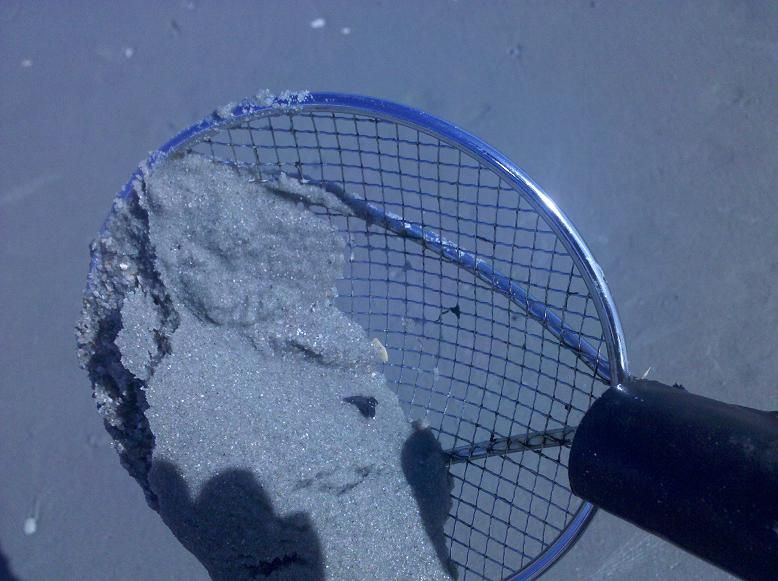
My "pick up tool" has one important function to me, to save my back.  Bending over a thousand times in a day can really give an old codger like me a week long back ache or worse.  This tool allows me to pick something up and bring it up to my eyes where I can see it.  If the item is small, I simply pick up it along with the sand surrounding it.  The tool allows me to also catch stuff in the surf much more quickly than if I had to launch after it with my hand because I carry the tool at beach level, like an extension of my arm and hand, at all times.  Waves may still steal something from my grasp, but my odds of collecting something are increased dramatically while using the "pick up tool".

Also, regarding my collecting tool, or collecting in general here.  I pick up just about anything that is different than a shell, or that I think is a fossil or shark tooth.  I'd say that about ninety percent of what I pick up is not a shark tooth.  Still, I keep checking.  Every now and then, I pick up something that I don't think is a shark tooth, and it turns out to be one!
When I see something that I think might be a shark tooth or something else of interest, I use my "pick up tool" to bring it closer to eye level and save my back from a future back ache.  If it's a small object, I grab everything around it too.
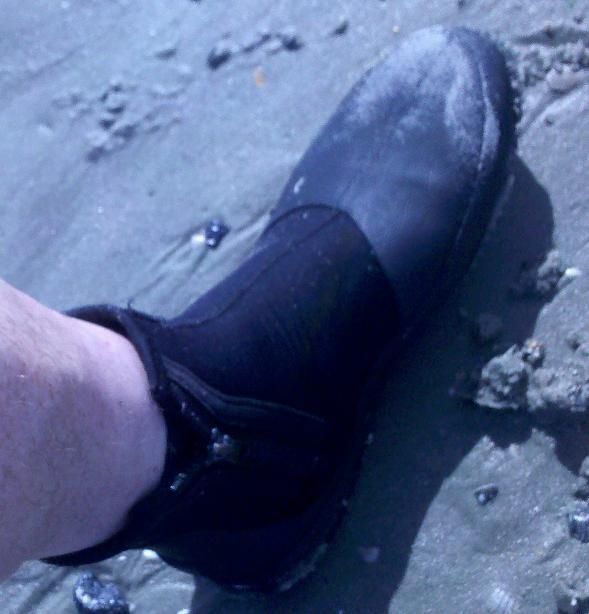
Well, you may ask, why not just go barefoot?  After all, you're on the beach, right?  My response would be, "True, and if you prefer that, go for it."  But, I personally find that if the bottoms of my feet are protected from shells and other debris, then I can focus on finding the teeth rather than the bottoms of my dawgs getting sore.  So, I either wear flats shoes (designed for fishing the flats) or Crocs.  Both types of shoes can be worn easily in the water.  The flats shoes keep sand and shells out, and allow me to walk on shells and rocks without cutting the bottoms of my feet, and also prevent blisters caused by sand. 
Flats shoes, like these from Bass Pro Shops, protect the bottoms of my feet from getting cut by shells and other beach material.  I may look goofy out there, but I'm comfortable, and when I'm comfortable, I can more easily focus on what I'm searching for.
Crocs are OK, but I also wear socks to prevent blisters.  The only problem with using them is that when collecting in the surf, shells find their way between your feet and the shoes, so you'll constantly be cleaning them out.
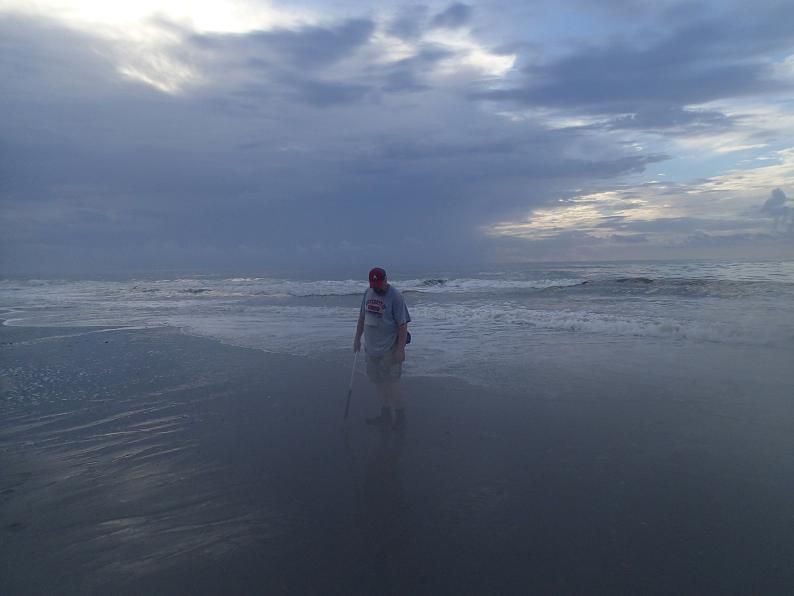
Well, here's a fossil nerd if I ever saw one!  I may look goofy, but my feet are comfortable and I have everything that I need to collect as long as my family permits me to do it.
In the summer, it's hot out there, so make sure that you bring plenty of water along and wear sun screen if your skin is as fair as mine.  I can't stress enough about how important having enough water available is while collecting.  If you stress from the heat and sun, your concentration goes down, and when that happens, not only does your collecting suffer, but your health most likely will too.  It can be dangerous out there if you aren't careful.

A few years ago, I left my resort hotel and walked quite a ways collecting.  I had two bottles of water and it had to be well over a hundred degrees out there with no wind at all.  I ran out of water half way on my return trip.  Fortunately, I ran into my soon to be friend Carl from Northeast Pennsylvania. 

Carl walked up to talk to me to ask about what I was up to, like so many people do each year.  After explaining what I was doing and showing him my finds, he offered me an ice cold beverage.  It was a Yuengling to be exact. 

Now I'm not a big beer drinker, although I love the taste of a good beer now and then, drinking water is far better for you health wise to prevent heat stroke, but, let me tell you friends...that Yuengling was like heaven!  Ice cold and hit the spot.  It cooled me down instantly.  And, fortunately, my walk back wasn't all that far.  So, not only will you have fun collecting and possibly gain some attention, you'll make friends along the way by nice folks like Carl.  I see him every year at the same spot during my vacation and he flags me down to say hi, offering me a Yuengling each time.  I'm forever thankful to Carl for that ice cold beverage.  Thanks Carl!!!!

As far as techniques go, I see other collectors sifting the shell beds or simply using their hands to sort through the beach material either by fanning the shell bed or digging a hole and allowing the sides to cave in exposing teeth.  You may find other tools successful as well, like trowels, rakes, shovels, etc.  They may all assist you in finding fossils on the beach as they might at other locations.  I prefer a lot less work while I'm on vacation, so surface collecting for me is the ticket.

So next, you may ask, where would I find shark teeth at Myrtle Beach?  My answer is, on the beach.  I'm not saying that to be smart, but they're there, and they can be anywhere.  I think that the odds of you finding shark teeth increase when you find shelly material on the beach as the teeth could be mixed in.  But really, any wave can uncover one in the sand or amongst the shells.  Or, the wind could expose a fossil well above the tide line, perhaps where someone sunbathed just hours earlier.  Or, perhaps someone built a sand castle and the waves are destroying the fortress, exposing teeth and other shells exposed from someone's sand castle building efforts.
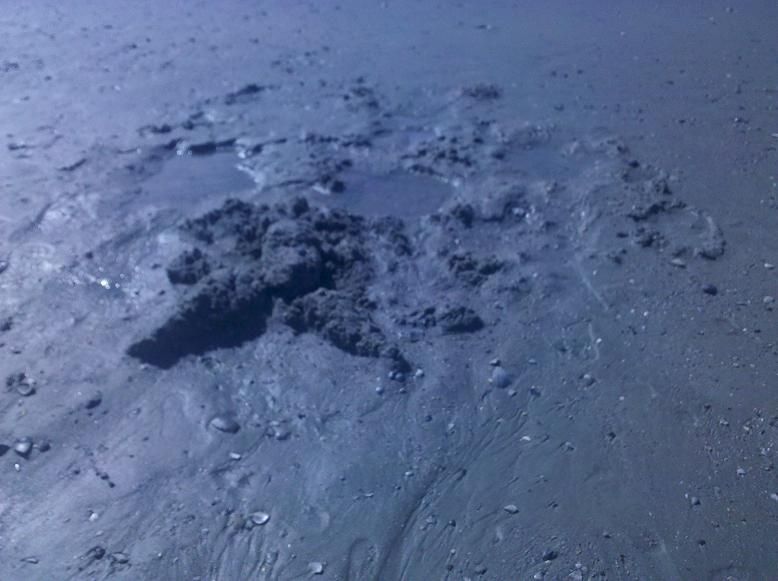
Sand castle ruins may cause tears from the young folks who build them once they are destroyed by the mighty ocean, but fossil collectors may find tears of joy if the exposed fossils result in a good find!
I guess what I'm saying is that, once you learn to identify teeth, you can find them just about anywhere on the beach.  You'll find your favorite spots, probably from where you find the most success.  But keep an open mind.  Any place that you notice fossil material, whether it's old fossilized shells, porpoise or whale bone fragments, or internal molds of gastropods, you have a chance at finding fossilized shark teeth.
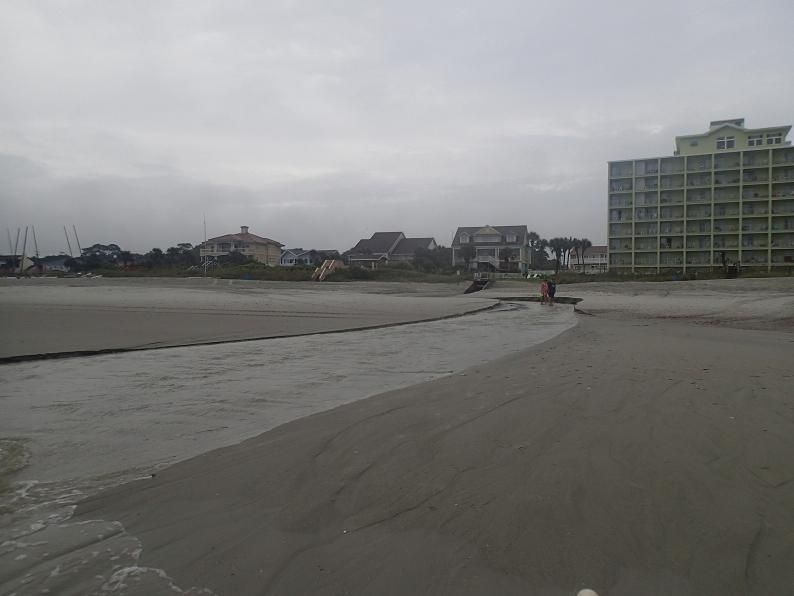
Creek mouths, like this one,  provide a constant source of erosion, moving sand and shells.   Sometimes you can see the shark teeth just tumbling down to you.  The trick is to catch them and not let them get buried or carried away by a wave (this is where my "pick up tool" comes in handy).  Some storm drains don't flow much, but are worth checking after a thunderstorm.
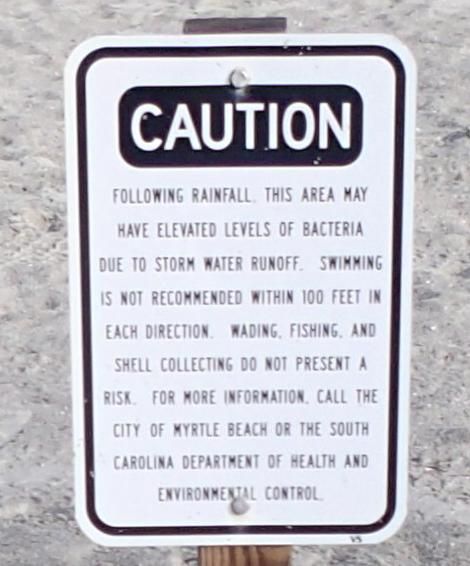
This sign says it all about the creek mouths along the beach.  It's OK to collect, but I wouldn't want any of this water in my eyes or mouth.  I'd be careful about subjecting exposed sores or open wounds to this water as well. 
One of the best places to find shark teeth is where the water meets the shoreline and washes shell material back and forth.  The waves act like a massive sorting maching, moving material around constantly.  Use it to your advantage, the waves can be your friend.  My collecting tool helps me keep from losing larger teeth in the surf, and getting them much more quickly than bending over.
A couple more tips about where to find shark teeth on the beach.  First, larger teeth are usually found with larger shell fragments and other beach material.  Tidal currents and waves can move large shark teeth, but they travel a bit less than lighter materials.  The same is true with shells.  So, it's more likely that larger shells and teeth would be found together.  Disclaimer:  not always though...it's not a golden rule.  It's just an observation that seems to be true most of the time.  That said, I've found larger teeth all by their lonesome laying right on the sand without even a shell fragment within yards of it.

Massive shell beds aren't easy to search, so take your time.  You may find it easier to search where the waves have washed the material down, where shark teeth stand out more against the sand, making them easier to see.  Once you become familiar with the shapes and other characteristics of shark teeth, you will be able to see them among the shells.

The shell beds always seem to be sorted with objects of similar size, and lay on the beach in zones.  At low tide, you may wish to search all of the zones or simply follow one down the beach.  How you approach this is simply up to you.  Keep in mind that there is no way that you can cover the entire beach and find every tooth.  It's just too massive.  So, pick a spot and focus on that area.

At low tide, if the water isn't moving shell material, my approach is to follow a likely zone traveling slowly parallel to the surf until I find a tooth or some sort of indication that fossils are there.  Once I find a tooth, I switch gears and move perpendicular to the surf, moving up toward the high tide line while searching with my eyes for teeth across zones.  After I reach the high tide line, I move a bit in one direction to my right or left, and travel back down toward the water, slowly moving and sweeping my eyes across the shell material keeping and eye out for teeth.  I basically work about a fifty or hundred yard stretch in a grid like manner this way.  If you have trouble finding teeth, slow down.
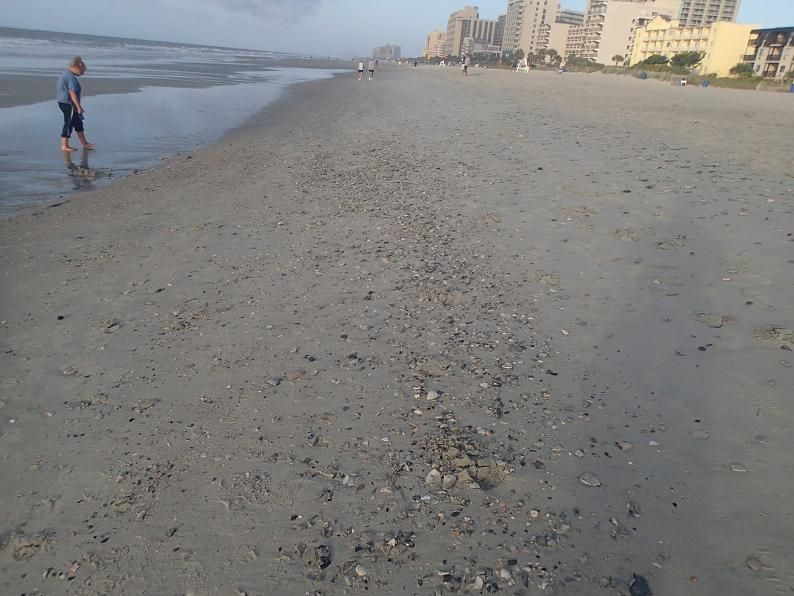
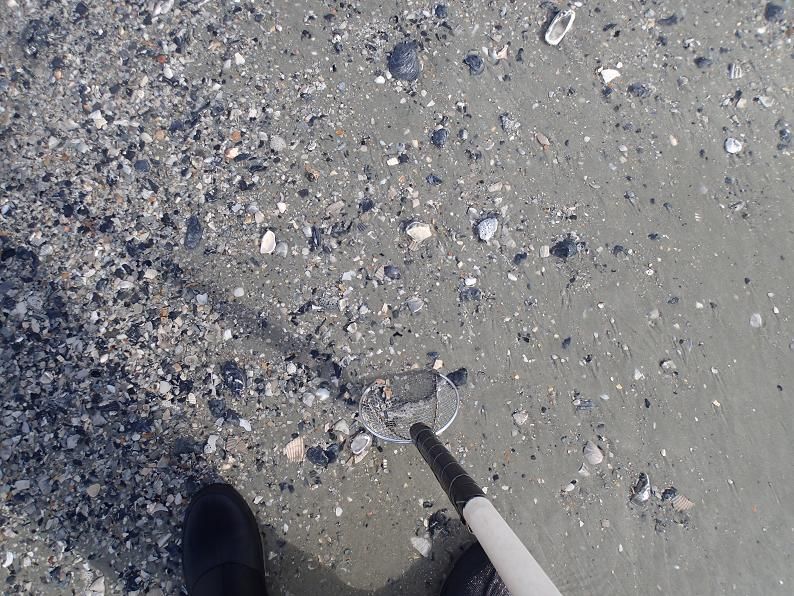
Looking parallel to shore, you can see the various tidal zones, or shell deposits, that you may find shark teeth mixed in with the shells.  Some people find a tooth, and search the zone in the same general path that they found the other tooth in.  Others move back and forth, mixing their search up.  I prefer to search across the zones (right to left, then left to right in this picture) and cover the entire section of beach that interests me.
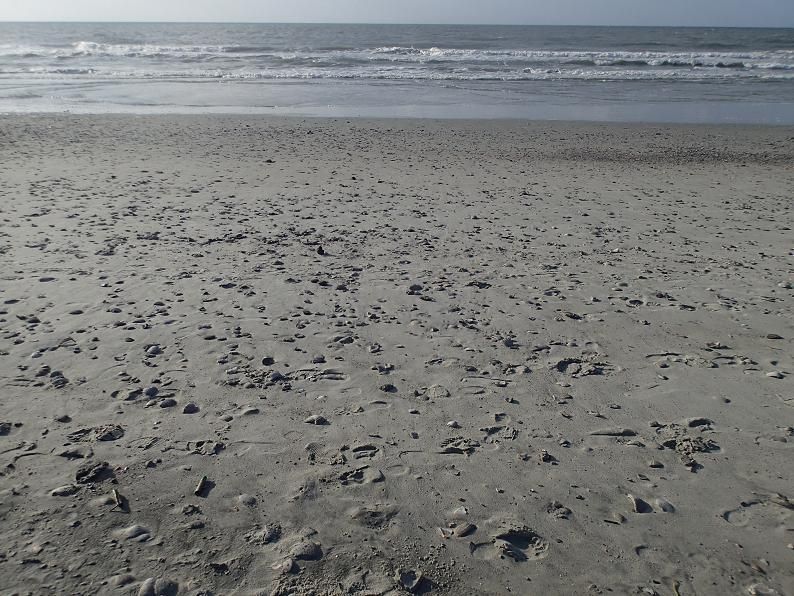
Standing at the high tide area while looking toward the surf, you can easily see the various tidal deposit zones.  I prefer to move across these zones, from the surf toward the high tide line, and then in the reverse direction.  Move slowly and search back and forth with your eyes for signs of teeth.
If the surf is washing shell material directly, I move slowly along the waters edge, watching intently as waves move beach material around, waiting for it to uncover my prize.  When you see a tooth, or what may be a tooth, grab it quickly before the next wave attempts to sweep it away or bury it with sand.

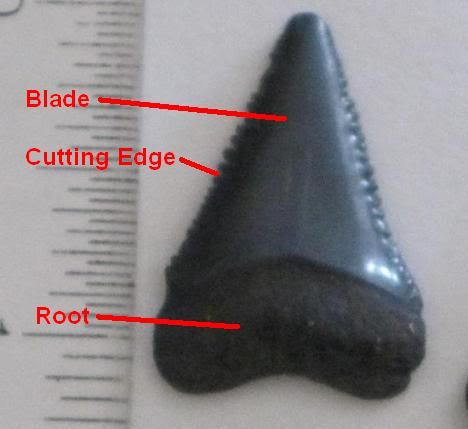
Now that we've discussed where you might find teeth, let's take a look at some very basic anatomy of a shark tooth and the characteristics of fossilized shark teeth that will help you discern the teeth from the scads of shell fragments on the beach.  I'm not going to post all of the different types or shapes in this post, but will do so in a future post.  Instead, I'll point out things that will help you find teeth in general.  First, all shark teeth that are whole and not broken have a root and a blade with a distinct cutting edge.
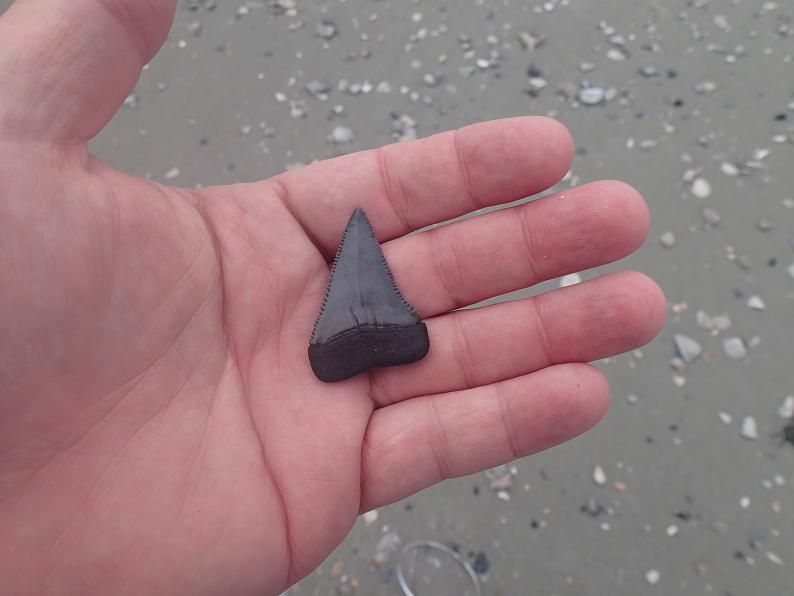
This great white shark tooth that I found a year ago demonstrates what all shark teeth have in common, no matter the shape.  Whole teeth all have roots, blades and cutting edges (along the entire length or only partially along the blade).
The shark teeth that you may find at Myrtle Beach will most likely be fossilized and have some sort of coloration.  Modern day teeth are pure white, and you can see them at the bottom of the shark tank at the Ripley's Aquarium.  The fossilized teeth colors vary from grays, greens, browns, to almost pitch black.  Some may be cream colored.  The coloration depends on the minerals that leached into the tooth during the fossilization process, which may have occurred over millions of years.  Most of the teeth at Myrtle Beach seem to be black, perhaps due to higher phosphate levels in the fossil layers.

Most of the teeth that you'll find will be broken, perhaps without the root, or only one lobe of the root.  Most will be small, about a half inch or less in size.  And most will be worn, although you may find a good many teeth that are in good shape.  My tip for you is to pick them all up until you learn what a tooth is or what a tooth is not.  If you can spot the small or broken teeth, then you'll be able to spot whole or large teeth, either buried or completely exposed.

Once you learn what is a tooth and what is not, you'll spot many more teeth.  You'll achieve what my daughter and I refer to as getting "the eye".  Just remember, teeth have cutting edges, shells do not.  Teeth, even broken ones, are almost perfectly designed as teeth, shells are irregular and imperfectly formed (no offense meant to shell collectors, but from a shark tooth hunting perspective being that teeth are perfectly designed to cut while shells are not).
This extremely worn great white tooth still exhibits the traits of a tooth.  Notice the distinct cutting edge and regularity of the blade.  Even broken teeth exhibit the near perfect "complexion" of a blade.
Shells, on the other hand, may be shaped like a tooth overall, but don't have the cutting edge or the regularity of a blade.  They, unlike shark teeth, are irregular or imperfect, often showing growth rings, wavy texture, or an irregular surface.  This is NOT a tooth.  Once you learn what a tooth is and what isn't, you'll have "the eye".
Here's another tip.  Forget about shells when tooth collecting.  Focus on finding only teeth, at least until you gain more toothin' experience.  If you try to find both simultaneously, you'll find less teeth and perhaps overlook a great find right under your eyes.  There's nothing at all wrong about shell collecting, and if you do that just realize that it's tough to do both.  At least, for me that's true.  I basically ignore shells and search for fossils.  So my advice is to do one, or the other.

Also, since the majority of teeth that you'll find will be black, focus on that color at first.  Then, once you find a few shark teeth and begin to get the hang of it, pay more attention to the shapes and other characteristics than just the color.  Shark teeth also tend to shine a bit more than shells, perhaps because the enamel on the teeth is so smooth, the reflective properties are a bit better than shells.  Teeth that are wet tend to be a bit easier to see also.

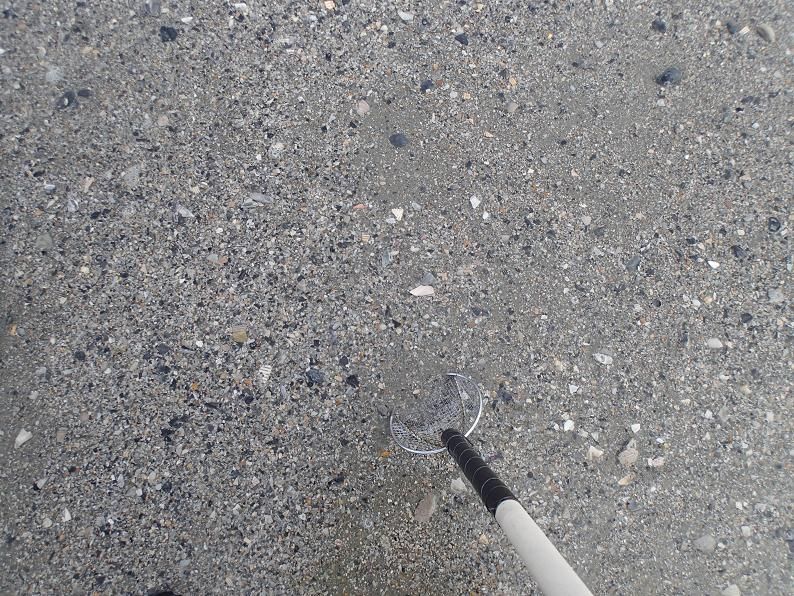
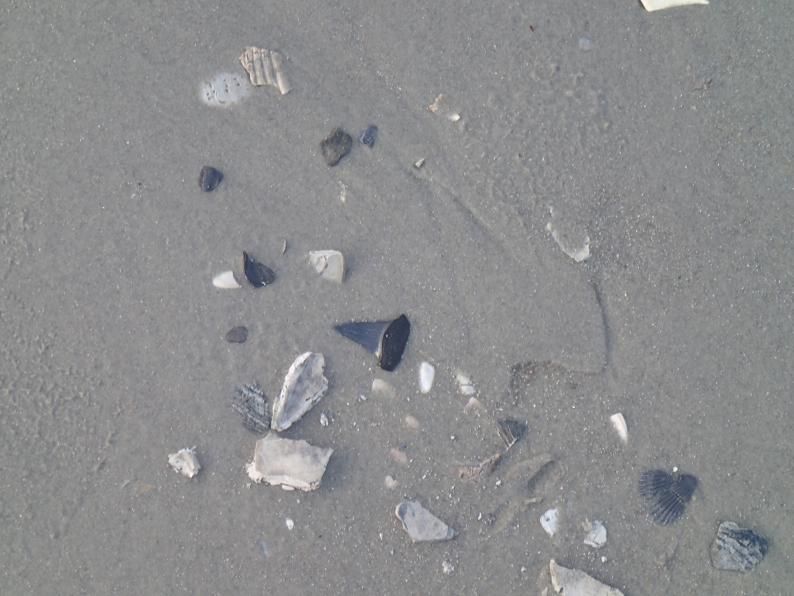
Here are some pics before and after the find, to give you an idea of what you may be looking at.
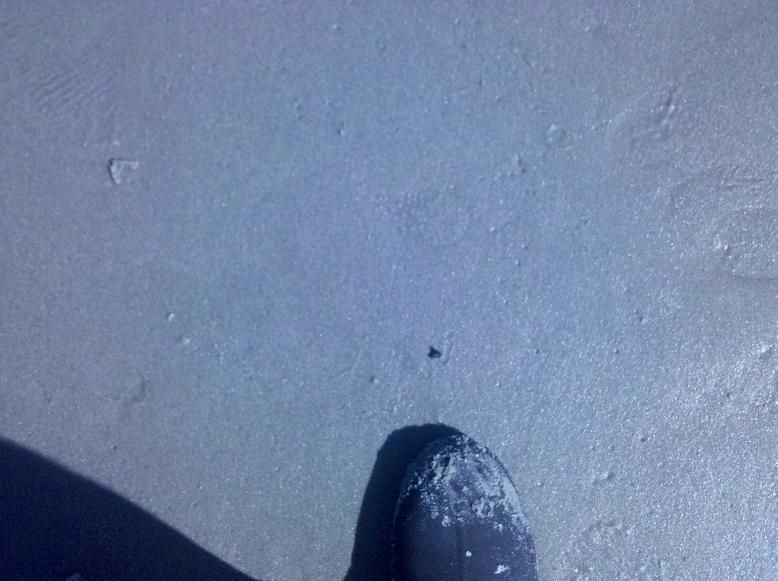
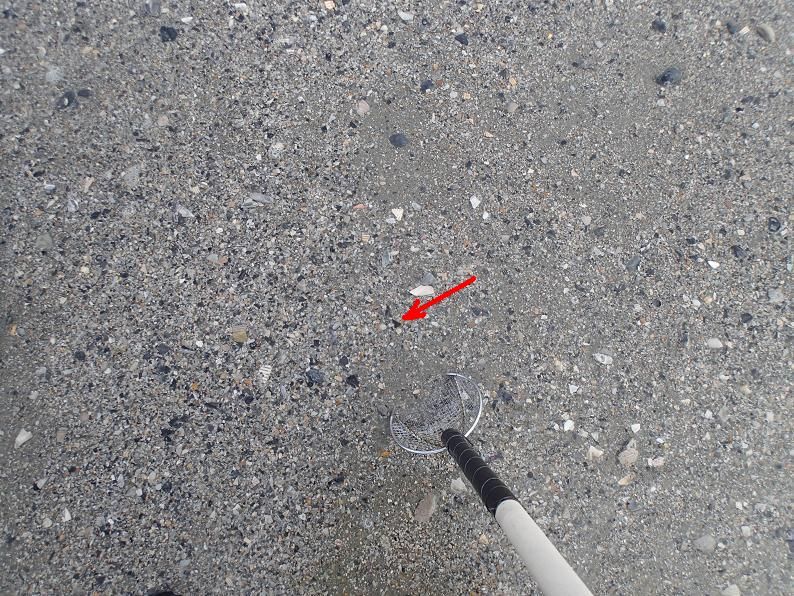
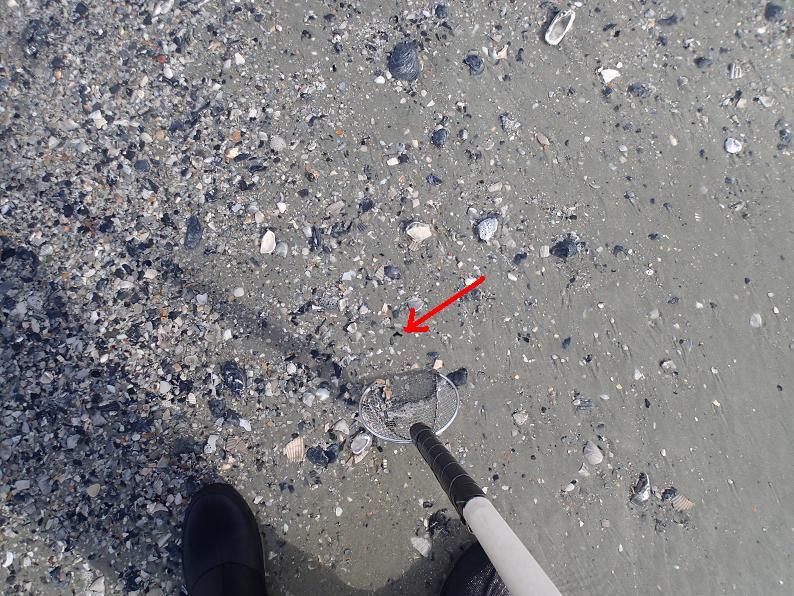
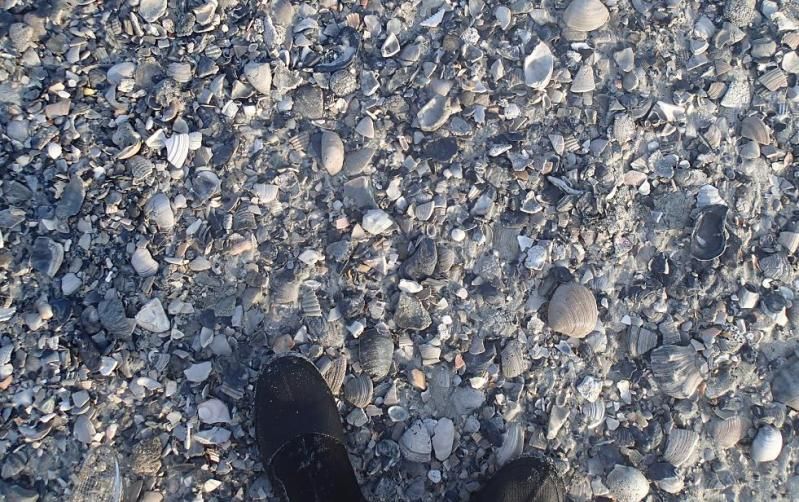
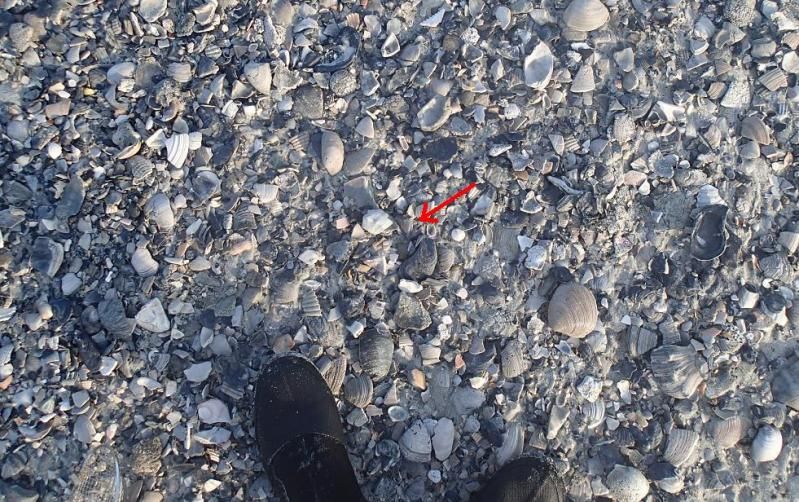
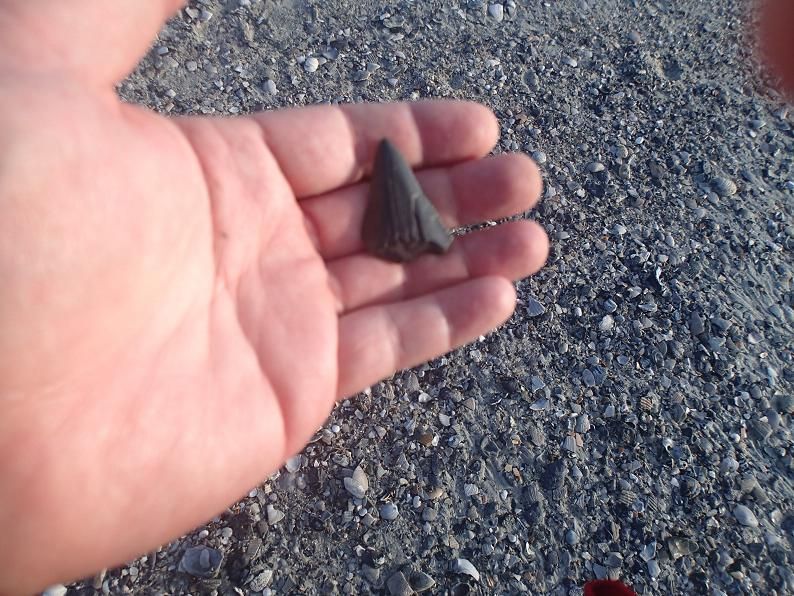
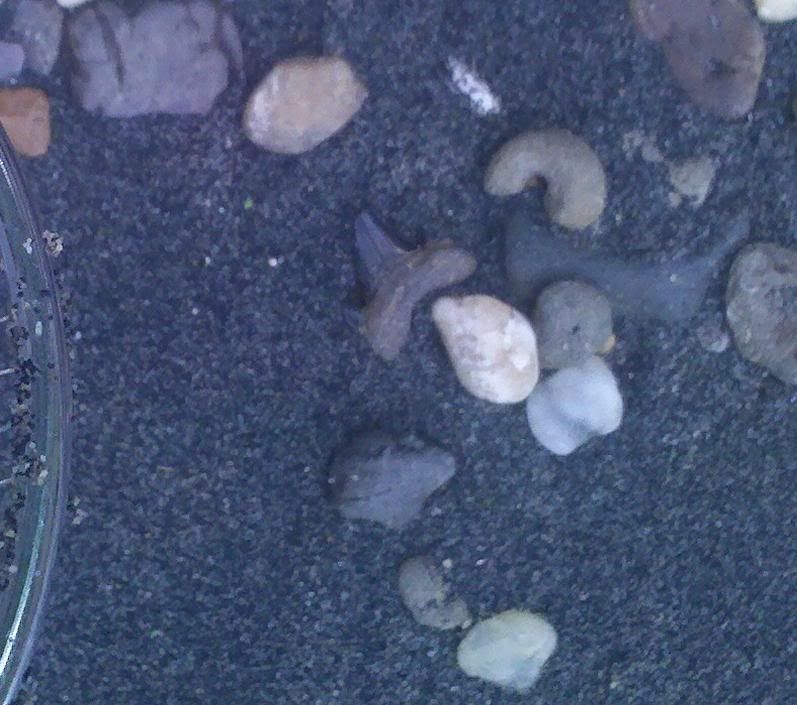
Where's the tooth?  When they lay on sand with nothing around them, they're pretty easy to spot.
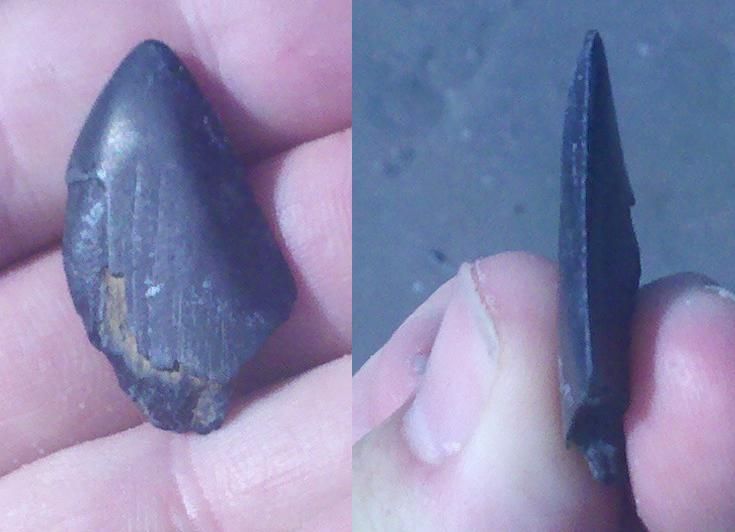
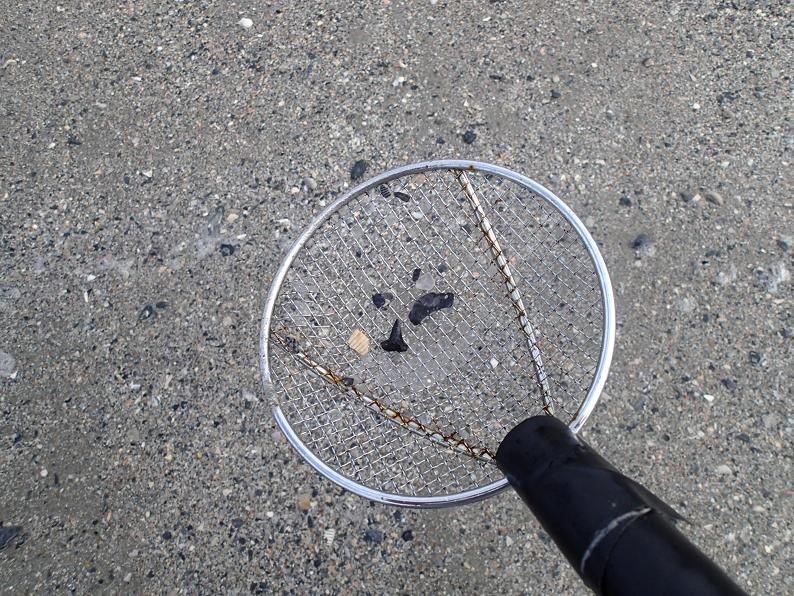
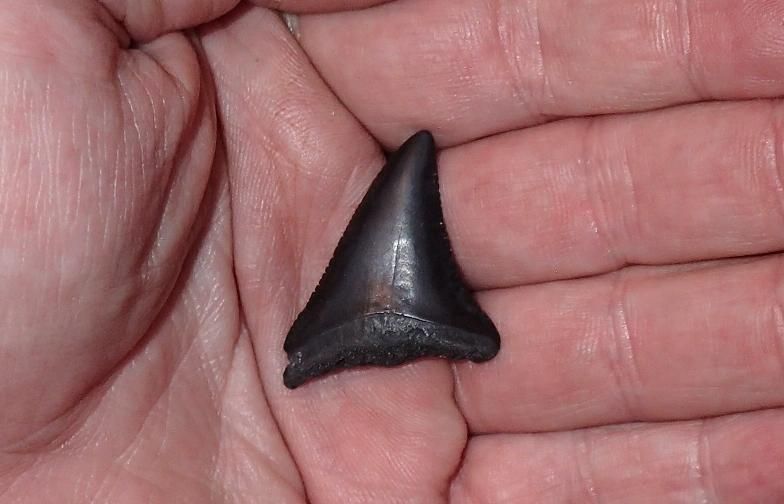
This is a typical tooth.  Small, maybe a bit broken, but still, a tooth.  Learn to distinguish teeth from non-teeth, and you'll find the unbroken and larger teeth in the future.  Get "the eye"!
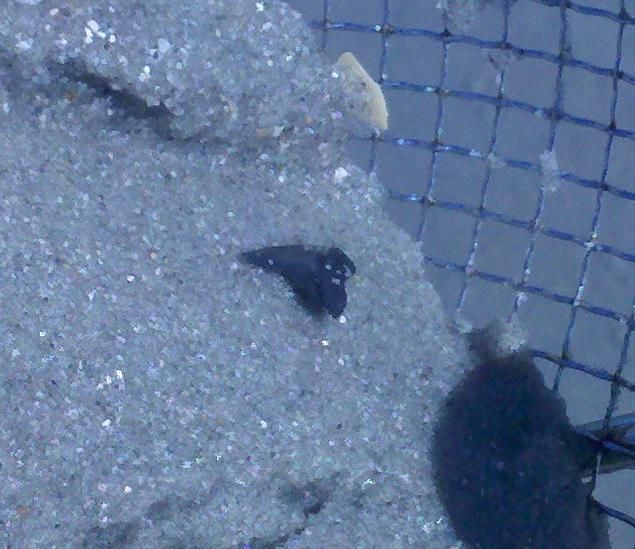
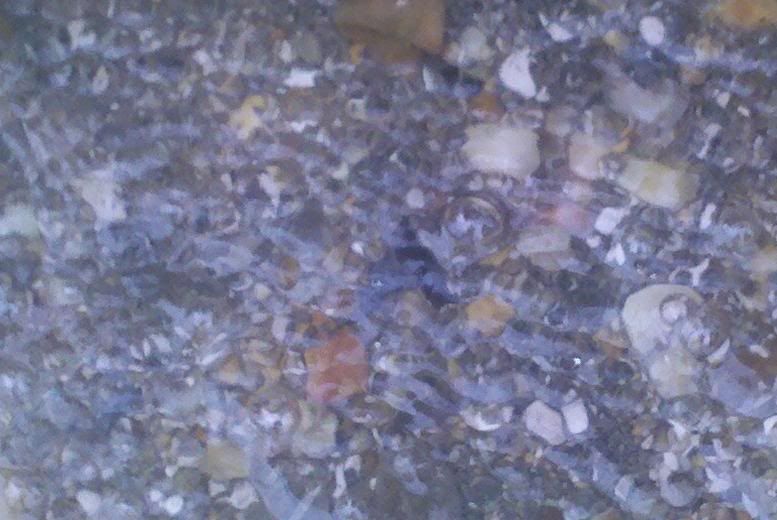
Can you spot the tooth here?  It's partially buried.

Here it is!

Yep, it's a tooth.  It looks like a bull shark or similar requiem shark lower tooth.

This one is even harder to see.  I've given you a hint though!
 
Here it is!

It's another requiem shark lower tooth!  Make sure that you check things out that are partially buried, they could be a shark tooth.

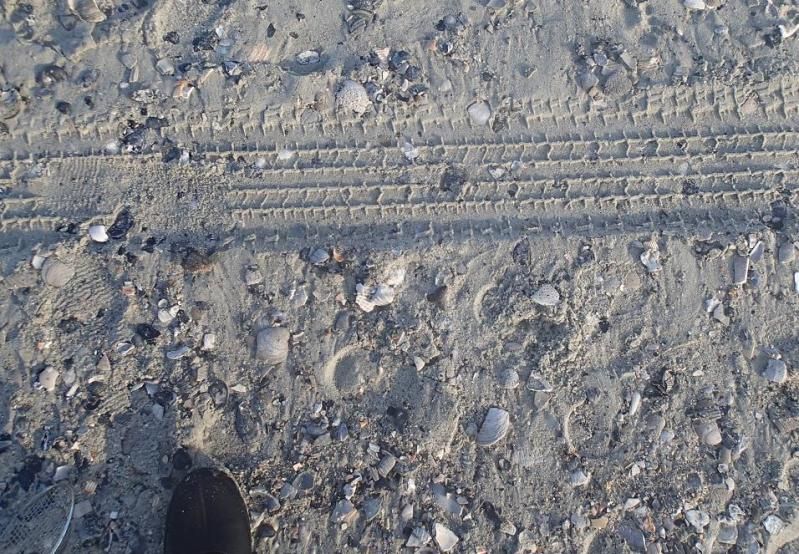
There's a bigger tooth here.  This, like many of the larger teeth, are higher up on the beach, perhaps because they are heavier, or perhaps because that beach material has yet to be eroded as much?  Notice how close a vehicle came to pushing this tooth deep into the sand!

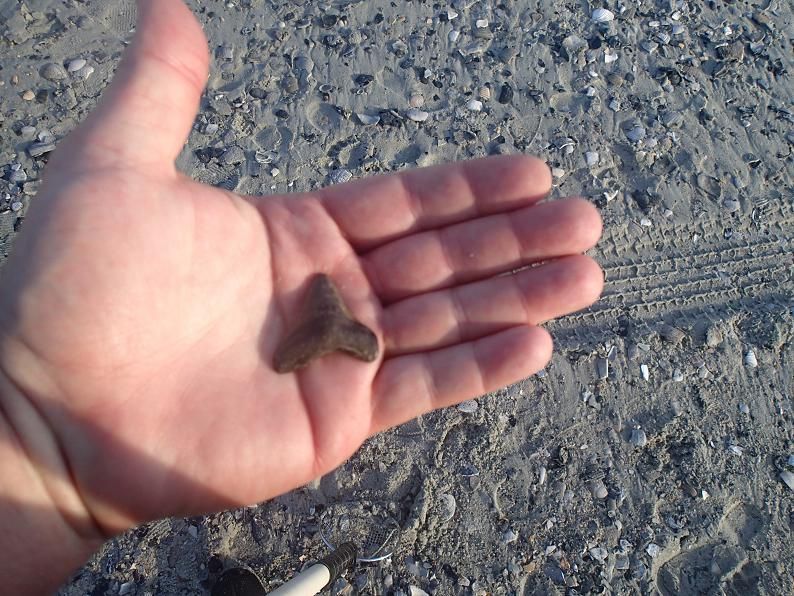
It's a small worn megalodon, or a "meg", tooth!  Meg teeth aren't common, but it's possible to find them at Myrtle Beach.  Sometimes you'll find fragments that are difficult to recognize as teeth.

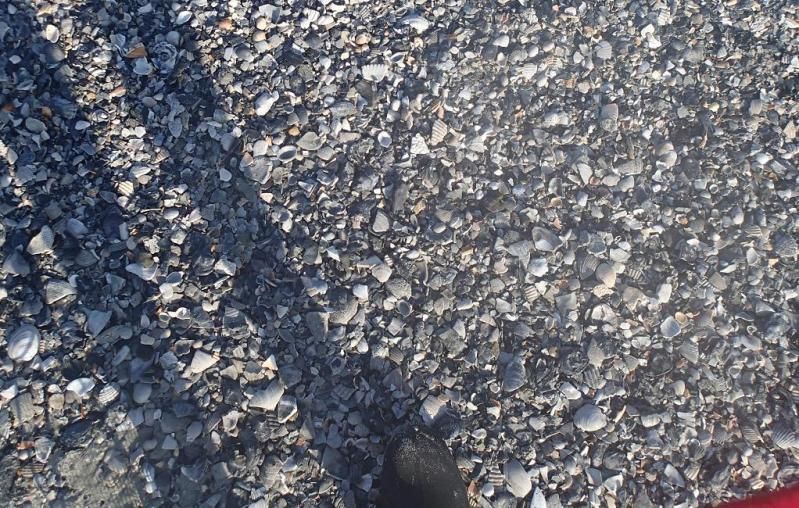
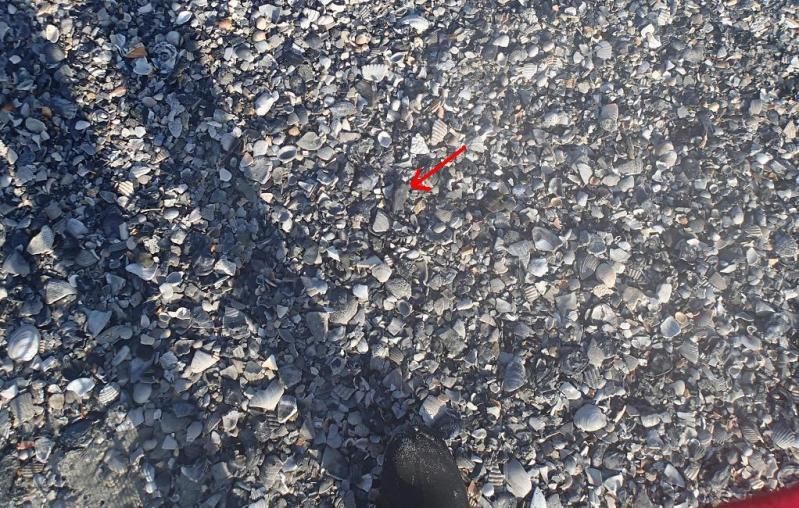
There's a large tooth amongst the shells.  Can you see it?
This one is very difficult to see because it's not black as are many of the other fossils.  The gray coloration blends closely with the colors of the shells.  What set this one apart was the shine of the enamel and the general shape.

It's a tooth from a great white shark.  Too bad the root has been broken off.  Still, this is a nice find at Myrtle Beach.

Here's another tooth found high on the beach.  A jogger or hiker stepped right over it!
Here's the tooth.  This great white shark tooth is pitch black.  It has a nice tip and almost all of the serrations, but the root has been partially broken off.  Still, a great find!
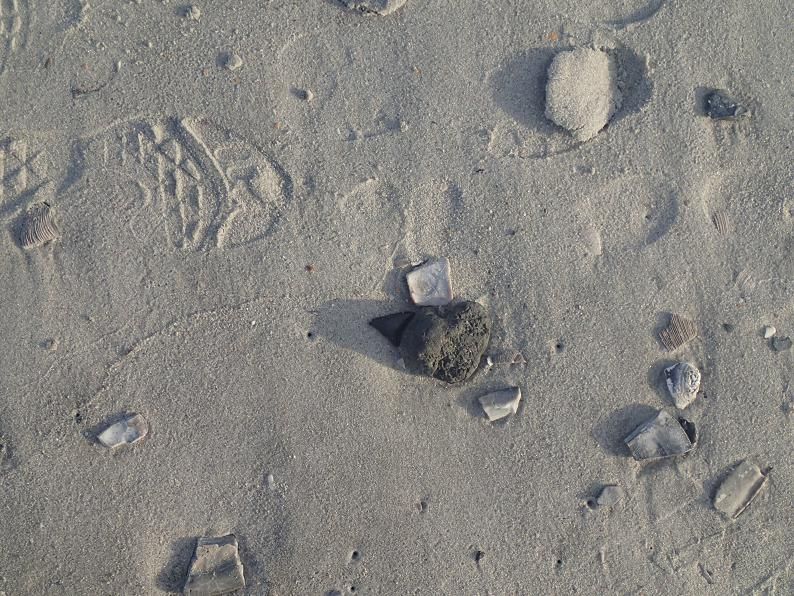
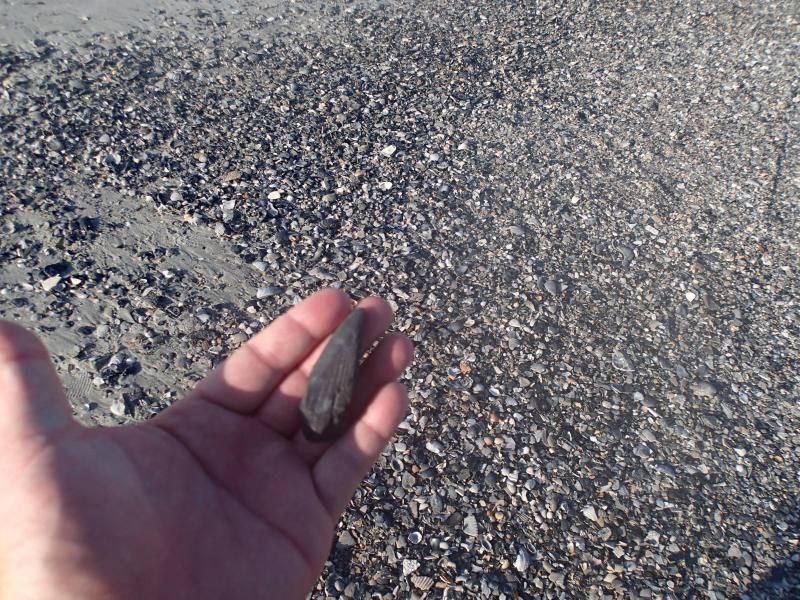
There's a meg fragment amongst the shells in this picture.  Can you spot it?
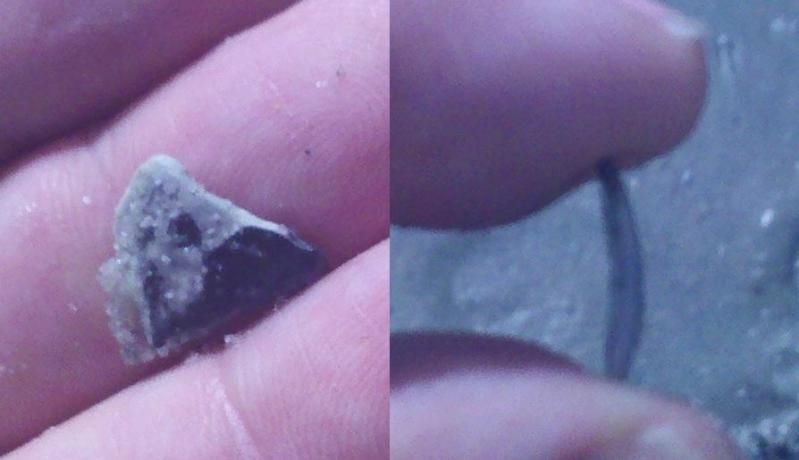
The meg fragment looks like a rock.  Several folks that I spoke to about this tooth mentioned that they'd toss it away not knowing that it was a shark tooth at all.

It's only half, and missing the root, but this megalodon fragment gives me hope that some day I'll find a whole one in good shape at Myrtle Beach.  It sure gives you an idea just how large these teeth can be.  This shark may have been forty feet long or more.  Megalodon became extinct more than two million years ago.


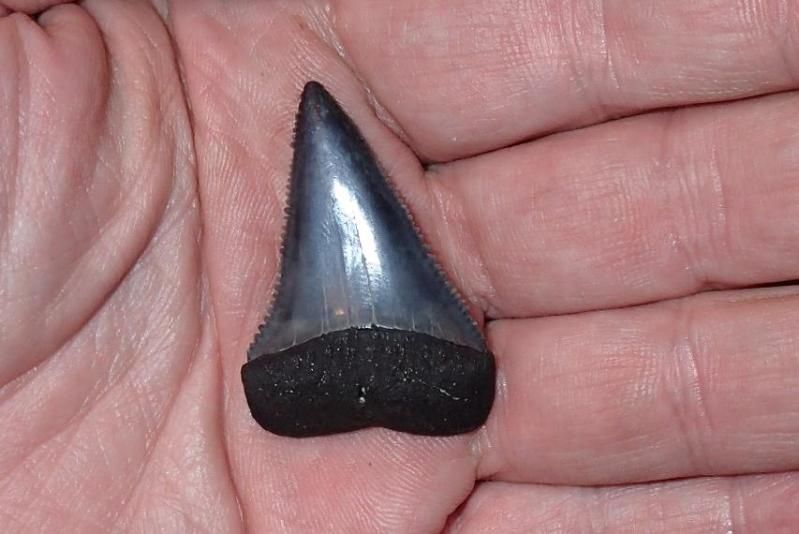
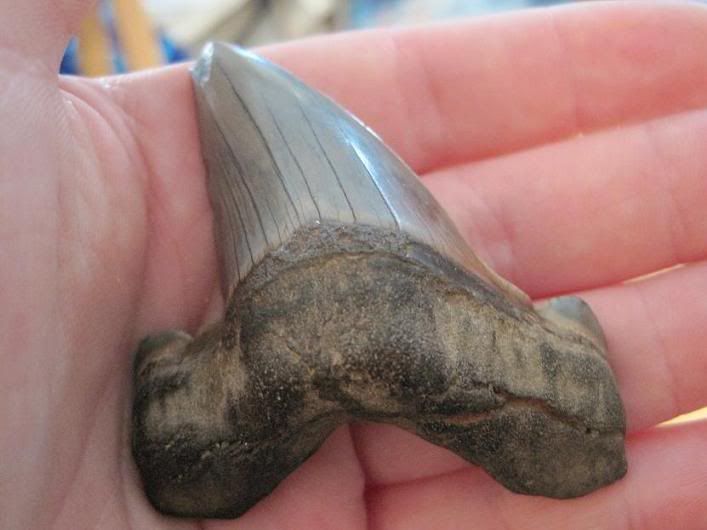
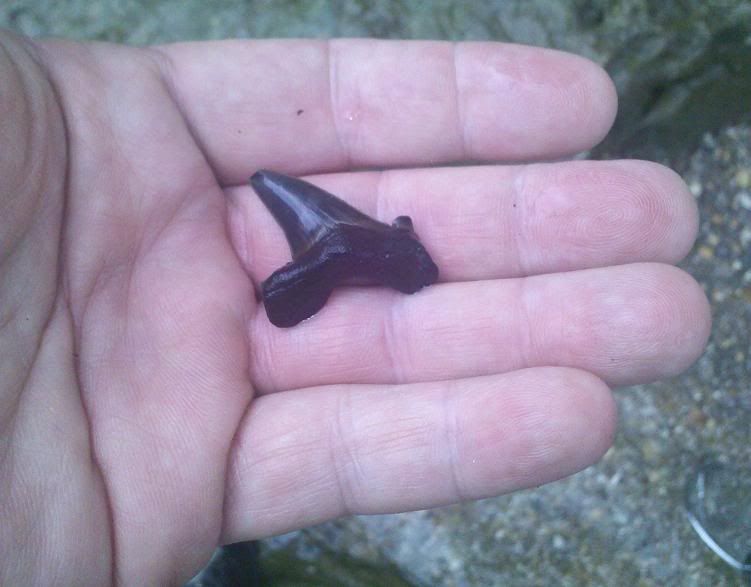
I saved the best for last.  Remember when I said that big teeth are found around big stuff?  I guess you could say that it's true here too, but this tooth was pretty much in the open.  It's my best great white tooth to date from Myrtle Beach.  I was actually walking back to my hotel, not really looking for teeth but with my head habitually looking down when I spotted this tooth.  I was stunned, but managed to snap a pic before jumping up and down.

Here's the labial view of that tooth.  Labial view refers to the side of the tooth that faces away from the sharks mouth.  If you see this as a shark approaches, you still have a chance to get away!
This is the lingual (tongue) view of that great white tooth.  If you see this side of the tooth, it's too late, you've already been consumed!  This not only is one of the best great white shark teeth that I've ever found at Myrtle Beach, it's one of the best in my collection.  The tip, root and all of the serrations except for one are intact.  Almost perfect!  But, it's perfect to me!
You may be wondering why I pick up the small broken teeth, or the small whole teeth, as long as there are teeth like those great whites pictured above on the beach.  I spoke earlier about getting "the eye", and spotting small teeth or even fragments of teeth keeps my eye sharp.  Also, I tend to give away almost as many of the smaller teeth that I find to kids and/or parents on the beach, to help them find teeth.  Giving them a tooth supplies them with an example of what to look for.  And, I enjoy seeing the faces of kids light up when I give them a nice tooth.  My daughter referred to me jokingly as the summer Santa of Myrtle Beach.  All I can do is laugh at that idea.

But, when you think about it, maybe when I give teeth away, good collecting Karma will come my way.  It does seem that when I give a tooth away, I find a replacement that is as good or better.  So, when you become adept at finding shark teeth, keep that in mind.  You'll pass on the hobby, make some friends on the beach, and bring a smile to someone's face, and in return, maybe you'll get some good toothin' karma!

Hopefully this info will help you find shark teeth at Myrtle Beach.  If you've never collected them, it's a great way to spend some time with your family doing something fun on the beach.  I've spent countless hours with my daughter looking for shark teeth at Myrtle Beach.  She has the eagle eye for them for sure, and even though she's now an adult finding her way through her college life, I still treasure my quality time while vacationing with her at the Beach. 

My next post will lay out the basic shapes and types of teeth and fossils that you'll find to help you identify what they are, so stay tuned. 

Monday, May 28, 2012

Just a Walk on the Beach

Serenity.  Peace.  One with nature.  The thrill of discovery and the satisfaction of the find.  The gentle slapping of waves against the shoreline acting as natures sorting machine while lulling you into imagining what life must have been like 65 million years ago along these waters.  That pretty much describes my experiences while beachcombing for fossilized shark teeth.  And it's even better as a family activity.  Imagine walking a beach, perhaps having the beach all to yourself with the only stress being how to navigate by wading around fallen trees or other obstacles, or perhaps climbing over them, to get to fresh collecting areas.  And it's even better when you have someone to share it with.
With fossil material all over the beach, all you have to do is enjoy the peace and quiet, and pick the fossils up off the beach.  What a great activity to share with my daughter, and bring home some of natures treasures as well.
In my case, it's a perfect way for me to bond with my daughter.  We've been collecting shark teeth and other fossils together for many years now.  Each trip results in the satisfaction of finding shark teeth, but more important than that, memories that last a lifetime sharing the experience with a loved one.  The great thing about my daughter now, is that although she's grown into a lovely college aged woman, she still loves to go with me.  And now she's getting back into fishing too, which is even better.

Our last trip was to a location where the finds consisted of Palaeocene shark, ray, and reptilian fossils.  For more information on fossils from this era, check out my post titled, "Catching Prehistoric Sharks".  We took some good friends from New York that were down for the weekend on a fossiling trip along with us in hopes of finding Otodus obliquus teeth, fossilized teeth of a gigantic great white shark of that era that grew from thirty to forty feet in length or perhaps some of the rarer teeth from that era.
Otodus obliquus, far left, was believed to be an ancestor of the famous gigantic shark Carcharocles megalodon (far right).

Palaeocarcharodon orientalis.  Photo courtesy of Kevin May.
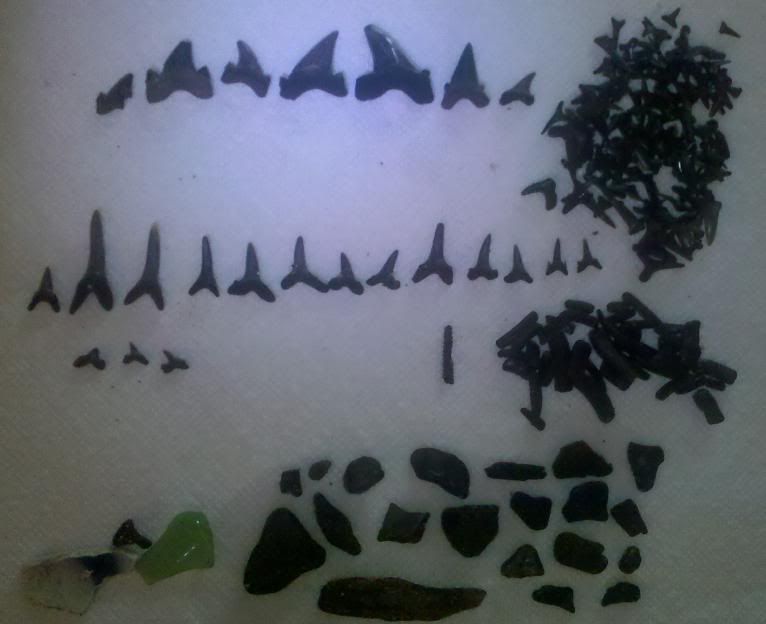
We all had a goal of finding teeth from two species of fossilized shark teeth from that time are very rare, the pygmy great white shark Palaeocarcharodon orientalis, and a bottom dwelling shark similar to todays cat sharks, Paraorthacodus clarkii, along with the impressive Otodus teeth.  You also have a chance to find crocodile and ratfish teeth.  But the most common type of tooth found there are those of the sand tiger sharks.

Sand tiger sharks were the dominant species of that time.  Not that they were the most dominant of sharks, rather, the number of species of that type of shark far outnumbered other types of sharks.

Last week, one of our friends found a worn but rather large (for this location) Palaeocarcharodon orientalis tooth within the first ten minutes after our arrival.  Amazing.  You never know what or when you'll find something like that!  My daughter and I weren't so lucky, but we did manage to find a good many shark teeth including some nice Otodus obliquus teeth and a pile of sand tiger shark teeth.
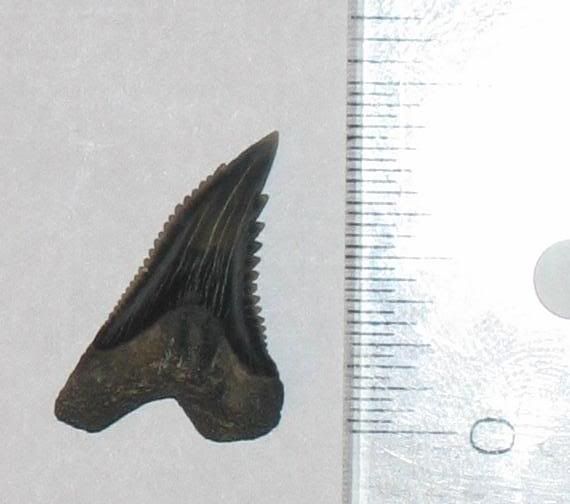
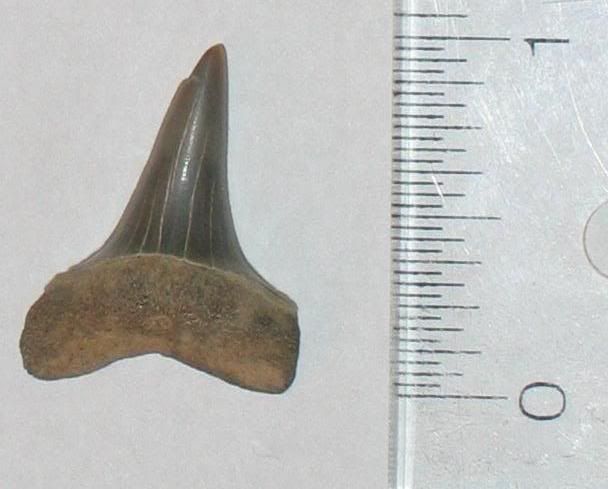
Otodus teeth like this one found by my daughter a couple years ago of this size are rare.  Although we didn't find any like this one on this trip, we did find several teeth up to an inch and a half long though, which are also a nice addition to our collection.


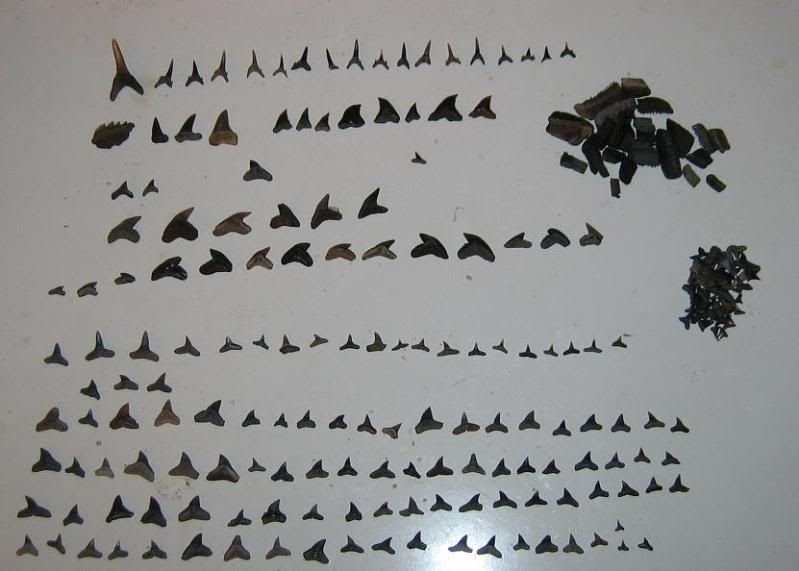
Although I didn't find the rare teeth, I did manage to find six nice Otodus teeth (top row) with the biggest having a slant height of an inch and a half.  I also found a piece of pottery (bottom left).

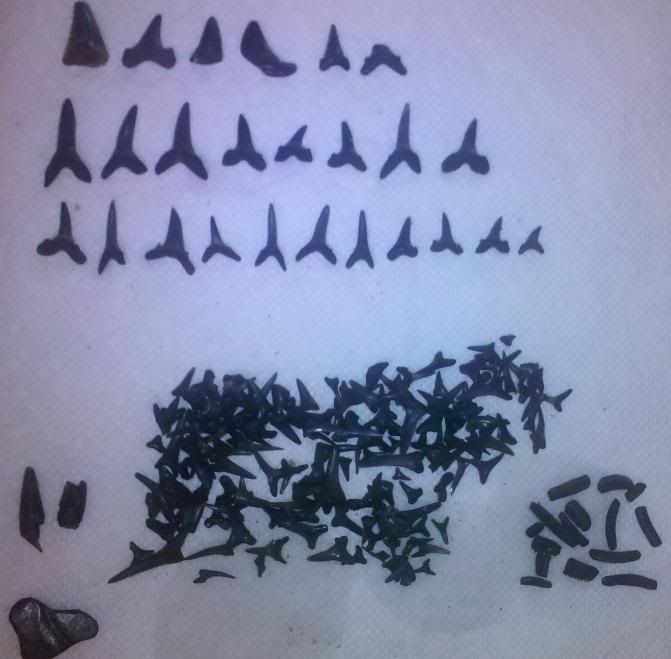
My daughter's finds on the trip, including a crocodile tooth (bottom left just above that piece of turtle shell).  She found some huge sand tiger shark teeth too (second and third row).
Finding shark teeth on the beach can be easy as some of them just seem to appear by themselves on the beach.  Others are much tougher to find because they blend in with the rocks, pebbles, sand and shell fragments making them difficult to see.  All it takes is one wave to wash away some sand and uncover a tooth.  There are other fossils there too, like internal molds of gastropods or even entire shells.  I've added a few of these to my collection over the years, but my preference is to collect vertebrate fossils, especially shark teeth.
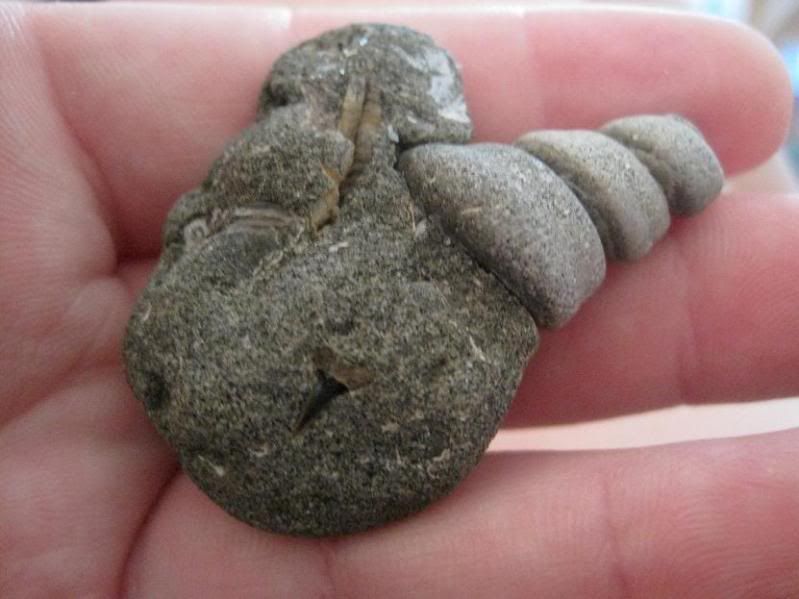
Although I prefer to collect vertebrate fossils like shark teeth but have added some gastropod fossils to my collection over the years, sometimes it's nice to find them all in one nice neat package.  Here is a shark tooth in matrix combined with an internal mold of the gastropod, Turritella.

See the Otodus tooth?  It's to the right of my skimmer tool.
Here's a close up of the Otodus tooth.

All it takes is one wave to wash a little sand away and uncover a tooth (center).
When the wave clears, here's the treasure left behind.  A nice sized Otodus tooth.
We also observed tournament anglers practicing for a big tournament later that weekend.  Prior to them moving to our location, large fish were feeding on the surface just a cast off shore.  The commotion was far too much for largemouth bass, so my guess was that they were either large striped bass feeding on shad or herring, or perhaps big blue catfish.  Either way, the fish busting the surface were massive.  I wondered if any of those anglers had hooked anything like that during the day while targeting largemouth.

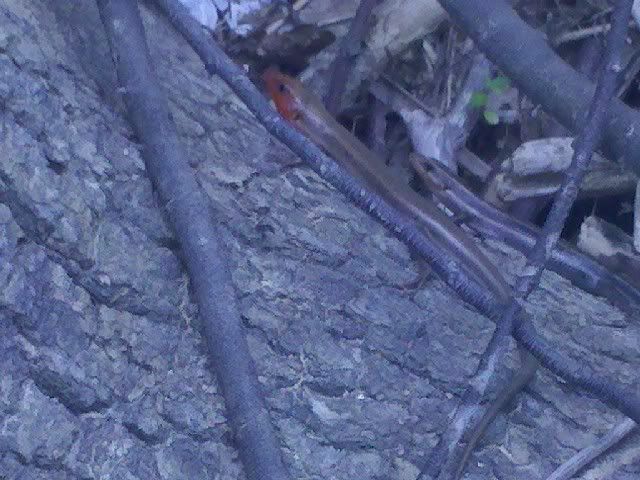
Another plus while beachcombing for shark teeth is that you often see things that most people don't get to see when it comes to nature.  Like hunting and fishing, fossil collectors often encounter wildlife.  Sometimes we'll encounter deer, fox, mink, or just about any animal that frequents a river bank.  The other day, we found a breeding pair of five lined skink.  These beautiful lizards could care less that we were there and let us sneak up to take a picture.
We were able to sneak up and take a picture of this breeding pair of five lined skinks. 
So, last week we had a great time sharing a fossiling spot with our friends Mike, Mike and Nick from New York.  In return, they invited us to collect at some of their spots further North.  I think that we'll take them up on their offer.  We had a great time socializing with them and collecting.

For me, any time I can get out with my daughter outdoors is a great day, whether it's finding shark teeth on the beach or out on a fishing trip.  I can't think of a better way to spend time with someone you care about.  Can you?

Saturday, November 19, 2011

Take a Visit to the Miocene

One of the most famous epochs containing formations with abundant shark teeth is the Miocene.  This post is displays pictures and information from the Calvert Formation, Miocene Epoch, approximately 18-25 million years old, and hopefully will give you a better idea what to find from this time period. 

If you find fossils like these, perhaps the pictures and descriptions below will help you in some way to either identify your fossils or perhaps give you some good information about them. 

I'm really blessed to live along the Mid-Atlantic Coast of the U.S.A. because of the rich fossil deposits along our tidal rivers, bays, and the Atlantic coastline.  I will cover several species in this post, but anything I don't get to here will be covered at a later date in future posts.


(Above) Pictured left to right, I think it's a small toothed whale, but could be a large porpoise tooth, both teeth to the right of that is Carcharocles chubutensis (ancestor to the famous megalodon), and the one on the right is Carcharocles megalodon (the "shamer" half tooth is almost 4 1/2 inches long).  These sharks are fossils of extinct giant white sharks, or megatooth sharks. 

Many experts believe that this lineage died out about two million years ago at the end of the Pliocene epoch.  Many theories exist as to why they became extinct, but we may never know.  Others believe that this is the ancestor to the modern great white shark, Carcharodon carcharias.  The evidence in the fossil record seems to point to a different ancestor to our modern great white, which may have been an extinct giant mako shark, Cosmopolitodus hastalis.  The teeth are remarkably similar in size, shape, and jaw position and the only difference appears to be that the extinct mako lacks the serrations of the modern great white shark. 

You can follow the comparisons here:  http://www.elasmo.com/genera/slides/gw_evo/gw_intro.html.  Make sure that if you follow that link to use the drop down menu at the top right to view each part of the article.  It's really fascinating to me.  C. chubutensis grew to over 40 feet long sporting teeth over four inches long, while many believe that C. megalodon grew to 60 feet or more with teeth exceeding a whopping seven inches long!!!!  By the way, the website http://www.elasmo.com/ is a great website that can assist you in identifying your finds.
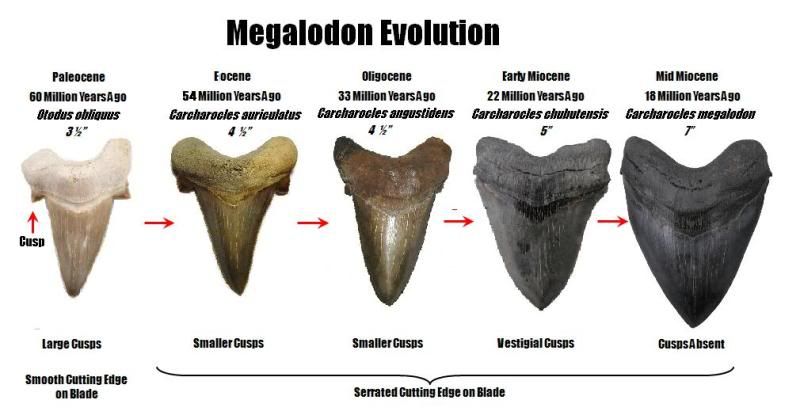
The chart above suggests the possible evolution of the massive megatooth extinct great white shark, Carcharocles megalodon.  There is one tooth not pictured that may have given rise to Otodus obliquus on the left of the chart called Cretalamna appendiculata from the Cretaceous and lived into the Paleocene.    
(link here:  http://www.elasmo.com/genera/cretaceous/cretalamna.html)  You'll notice that the older sharks, like Otodus obliquus, lack serrations, aren't as pronounced, or only partially cover the blade, and through evolution become more pronounced and completely cover the blade.  Likewise, the older teeth have large cusplets (basically, small blades or points jutting out of the root or blade).  As these sharks evolved, you'll notice the cusplet sizes decreased over time until non-existant in megalodon.  And finally, the blades become more robust and massive, and the teeth increase in size overall size (as the size of these sharks increased).

This is a posterior "meg" (the pet name palaeo types give megalodon).  This tooth position is the furthest from the center of the jaw.  I'm not sure if this is an upper or lower tooth.  Anyway, they aren't very common and always make my day when I find one.

The picture right below is "in situ" (latin for in position), in this case, a ground shot photo of the posterior meg tooth that I found in the previous picture.
Can you spot the tooth in this in-situ photograph?
When collecting shark teeth, often they are just laying on the ground, sometimes out in the open, other times hidden by gravel, shells, or partially covered by sand.  All it takes is a few waves to expose a tooth. 

To find these teeth, you not only need to recognize their shapes, how they glisten when wet or shine in the sun, sometimes their color, but especially when they are partially exposed.  You need to recognize a partial root, or part of a blade sticking out leaving a sharp even edge unlike the shells around it.  As you see in the picture at left, there is a lot of shell material on the beach.  I'd venture to say that about ninety five percent of the shells that you'll find along the Calvert Formation are fossil material.

How do the teeth and other fossils wind up on the beach?  Millions and millions of years ago, much of the Mid-Atlantic coastal plain of today was covered by the ocean.  As animals died they settled on the sea floor and became buried by silt or sand.  Those dead animals became fossilized eventually.  But, most of the shark teeth that you find were simply teeth that sharks lost as they fed.  Sharks shed teeth as they feed at the rate of five to ten thousand per year, per shark, depending on the species.  As prehistoric sharks lost their teeth, they settles into the silt on the sea floor and became buried.  Layer upon layer of silt and animal remains settled on the sea floor for millions and millions of years, eventually becoming clay and rock.  All the while, the fossilization of the animal remains occurred. 

After the oceans receded, what was once ocean floor, became exposed above sea level.  In our region, these exposed fossil deposits were eroded by water and wind eventually forming cliffs showing layers of the clay material.  Over time, as the cliffs eroded, chunks and boulders of clay crashed to the beach below.  Those boulders contained the fossils.  Waves and tidal currents stripped the clay material, and the boulders eroded quickly into small pebbles (like in the picture), or just sand and silt, and left the fossils strewn across the beach.  Waves and currents continually cover and expose the fossils that we're lucky enough to find.
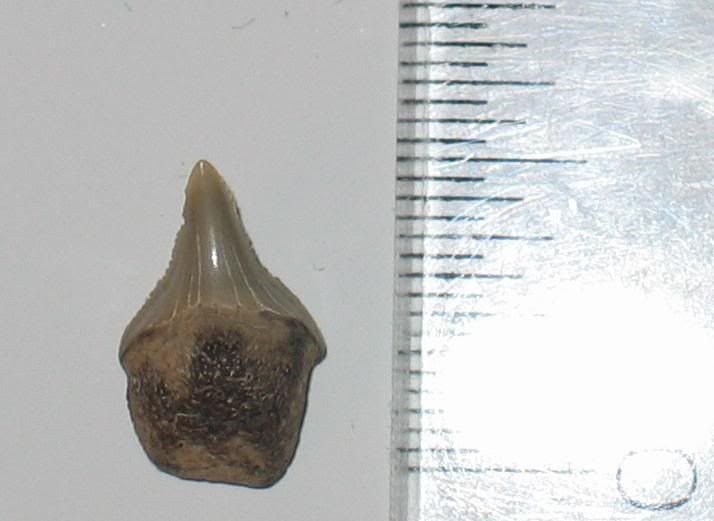

The tooth above is currently unidentified.  I found it in the Calvert Formation.  It's serrated and uniform, and several local amateur paleontologists and collectors believe that it could be a great white shark, Carcharodon carcharias.  But, modern great white teeth are so rare here that I have yet to hear of anyone finding one.  So, more than likely, it's probably a posterior juvenile tooth of Carcharocles  megalodon.  If anyone knows for sure, I'd appreciate a comment.  At any rate, even though it 's quite small, it's one of my coolest teeth from the Calvert Formation.  The root is robust, the blade serrated, and there are no notches.  Edit:  I've since had the tooth identified as a symphyseal megalodon tooth, probably from a smaller adult shark.

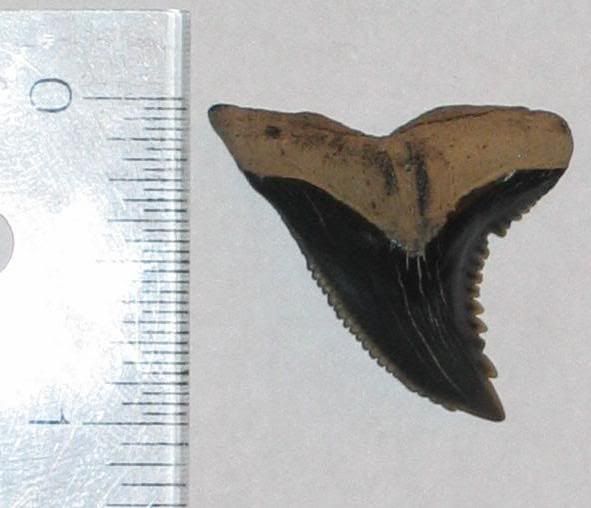
The next tooth pictured in the above two photos, is Hemipristis serra, commonly known as the snaggletooth shark.  This is one of my favorite species of shark teeth.  It became extinct after the Miocene about 18 million years ago.  Teeth from this shark sometimes exceed 1 1/4 inches long suggesting that this shark grew to about 15 to 20 feet perhaps.  This must have been quite an opportunistic feeder because it has such a varied array of teeth in the jaw (known as the animals dentition). 

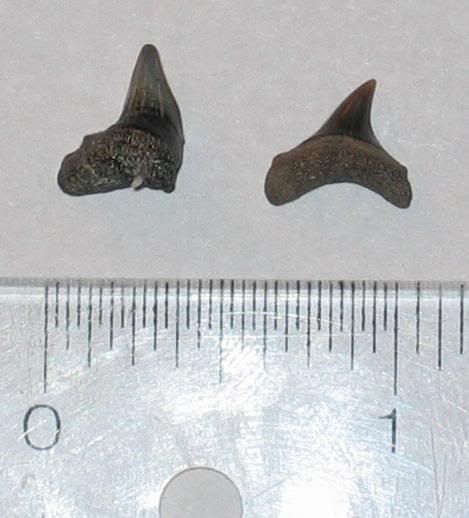
The upper teeth, like the two pictured above, have nasty huge serrations, like a steak knife and are extremely sharp.  The first picture shows an upper anterior (front) tooth.   The second pic, is an upper lateral (toward the side of the jaw) tooth.  These cool looking teeth are designed for cutting.  It's a fairly robust tooth as well with a root as strong as the modern tiger shark. 

The lower anterior (front) teeth, pictured above, resemble those of sand tiger sharks, although they all have serrated edges, some of serrations can be completely worn away and can confuse collectors who may misidentify them as a sand tiger shark.  The lower teeth are needle like (although a bit more robust) and somewhat hooked, which are perfect for grasping and holding prey while the upper teeth do the dirty work.  I imagine that this shark was a formidable predator in it's day. 

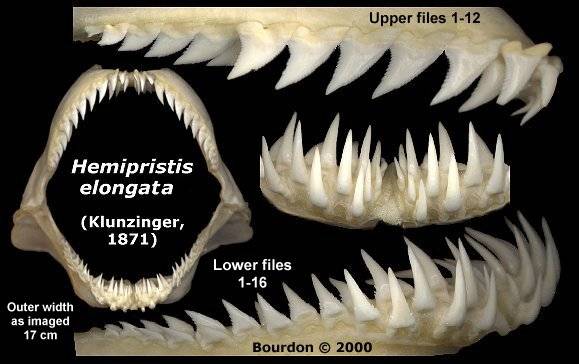
There is a modern day relative, Hemipristis elongata that lives off the coast of Africa.  The modern day shark only grows to about eight feet long, yet has a similar dentition, pictured on Elasmo.com here:  http://www.elasmo.com/selachin/slides/dent/pics/h_elongata-dent.jpg.
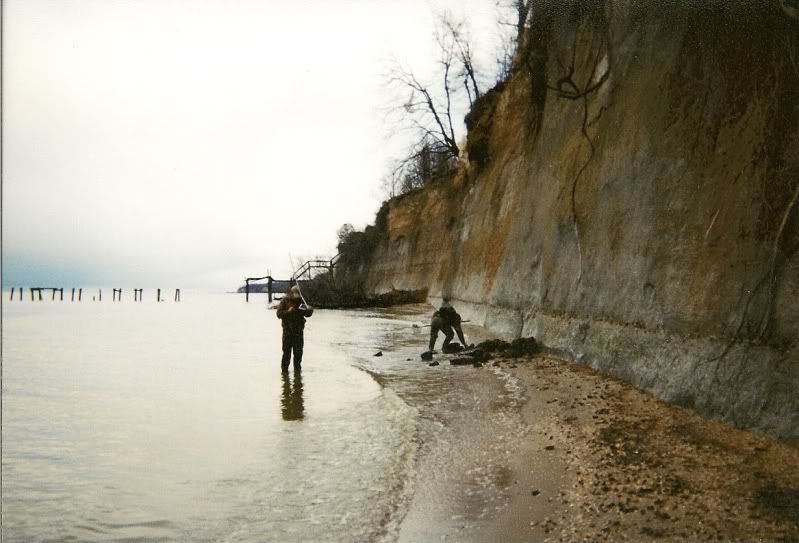
My brother and I were collecting along this beach years ago.  Not only did we find fossils, but, we enjoyed the peace and solitude, as our minds drifted back to the Miocene.
The scenery is quite beautiful along the Chesapeake Bay.  Sometimes you may find solitude while collecting, drifting back in prehistoric time, as the gentle slap of waves along the shore act as a sorting machine of the material on the beach. 

There are many techniques that people employ to find fossils, and I'll save that for a future blog post, but sometimes nature will do the work for you.  Each wave can expose something new to find.  Please note that it's illegal to dig into the cliffs.  Anything that you find here must come from the beach deposits.

Now, before we move on, let me clarify that the megalodon and chubutensis teeth above are not very common.  I may only find a few each year.  The teeth pictured at above are more of a typical mix of what you'd find on an average trip. The top left tooth is a sand tiger shark tooth. 

Notice the long, slender, needle like shape perfect for grasping prey, especially fish.  The lower anterior teeth of Hemipristis serra resemble these in shape.  Directly below that tooth is a cow shark tooth, Notorynchus primigenius, which has many cusplets.  These shark teeth also are some of my favorite finds and are very cool. To the right of those are mako teeth, more Hemipristis serra teeth, and below those are two species of extinct tiger sharks, and below that are lemon shark teeth and various requiem shark teeth that are extinct relatives of todays bull sharks. 

Anyway, you get a feel of how many shark teeth and different species that are likely to be found when conditions are right.  I'll get into more detail later about some of the species in that picture.
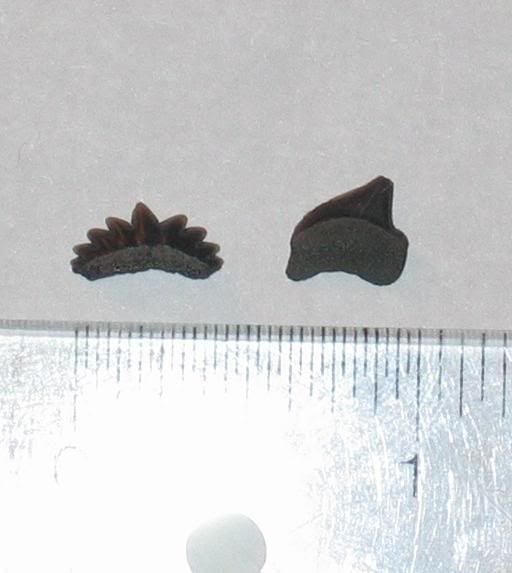


The above picture shows two very special finds.  The left tooth is cow shark, or sevengill shark, Notorynchus primigenius, a tooth that is fairly rare because of it's position in the jaw.  It's known as a symphyseal tooth, which is a fancy scientific word describing the center of the jaw.  This symphyseal tooth is from the cow sharks lower jaw.   As mentioned above, cow shark teeth really get me fired up when I find them.  They are not very common and just are very cool indeed. 

The tooth on the right is from a crow shark, Squalicorax kaupi, which became extinct long before the sharks of the Miocene.  It was a special find simply because it's from another time period, the Cretaceous, or the time of the dinosaurs, probably about a hundred million years old or so.  So what's so special about that?  Well, that formation is not near the Calvert Formation.  It's normally found about 50 miles away on the other side of the bay.  So, how did it get there?  We can only speculate.  Perhaps it was deposited during a flood millions of years ago after the Cretaceous period when the oceans receded.  Perhaps a collector that had been exploring Cretaceous deposits had one stuck in a sifter and accidentally dropped it.  More than likely, though, it was "reworked", which means that some other force of nature, perhaps and animal, like a shrimp, or crab, created a burrow and pushed the tooth from a deeper layer up into the Calvert Formation.  This could have even occurred from modern day animals burrowing, like ground hogs.  I've found two of these speces at this location.
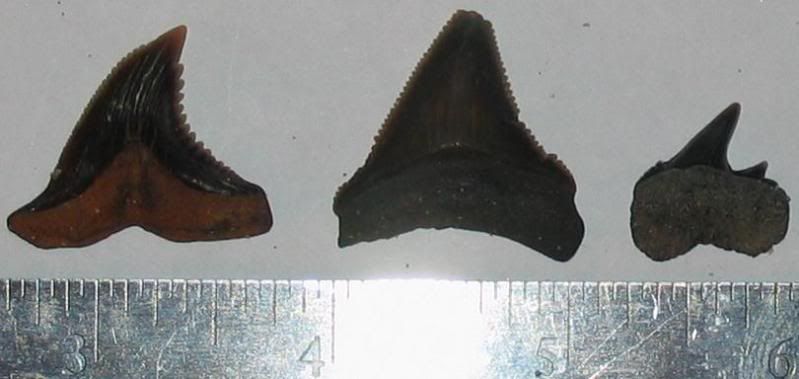


Back to cow sharks.  In the picture above, there is a tooth from the upper anterior of a cow shark jaw. It's the right most tooth in the picture. You'll notice that it has less cusplets than the symphyseal tooth shown earlier.  In case you're wondering, the tooth on the left is a snaggletooth shark, and the center tooth is a C. chubutensis, or extinct great white.


The most impressive cow shark teeth are the lower anterior and lateral teeth.  The picture at left shows one of these teeth in situ.  In this particular species, you can have as many as seven cusplets.  There's another species, Hexanchus gigas that can have as many as a dozen cusplets!  That species is quite rare.  Both of these species are extinct, but both have very close relatives that are nearly identical from a tooth morphology standpoint.  Most of the teeth that you find from these sharks are broken.  You'll find segments of cusps, or perhaps a complete number of cusps but the root may have been broken off.  It's pretty rare to find a complete tooth. 

The main cusp was damaged on the one in the in situ photo.  But, on a different trip, I found a real nice one, above.  It was complete and perfect.  Notice the serrations ahead of the main cusp on the right edge of the blade.  The root is thin and fragile, but deep.  Cow shark teeth are not the primary goal of the collector.  In fact, most everyone leaves their house for a hunt hoping to find the elusive megalodon.  If you don't find a "meg" on your trip but come home with a cow shark tooth, then that's a real nice consolation prize if you ask me.  Always remember though, that no collection is complete unless you have representative specimens of each species of shark.  The tooth on the right is a porpoise tooth.

A riker mount full of teeth like this makes for a very impressive display, one that would cause jealousy among many fossil hunters around the world.


The next tooth that I'll show you is a mako shark Isurus desori (pictured above).  There are three types of extinct mako sharks that you can find in the Calvert Formation.  Isurus desori, or shortfin mako, and Isurus retroflexus, or longfin mako, are very similar to the shortfin and longfin makos of today.  The only difference is probably that the size of the mako teeth from the Miocene are slightly larger than their modern relatives.

Cosmopolitodus hastalis, is the third species found in the Calvert Formation. Many palaeontologists think that C. hastalis was the direct ancestor to our modern day great white shark.  I'll have pictures of those teeth in future fossil updates.


The right most tooth in the picture above is from a Bigeye Thresher shark Alopias superciliosus.  These teeth are not common at the cliffs.  The teeth are always less than an inch long, but have robust roots and blades, and are unserrated.  There are two species of thresher sharks that lived around here millions of years ago.  Thresher sharks, it's believed, use the upper lobe of the tail, which is extremely long, to herd baitfish in huge baitballs, and the sharks gorge themselves while feeding on the bait ball.  Some people think that they can actually use their tails to maim prey, like fish.

There are several types of commonly found teeth, but I'll post about those at a later date.  Hopefully, for a while, this will be enough for you to absorb!

While you're waiting for the next update, check out these great fossil websites and forums:  http://www.thefossilforum.com/ and http://www.blackriverfossils.org/.

There's a lot of information on those sites in addition some knowledgeable and friendly people.