Showing posts with label Spinnerbaits. Show all posts

Tuesday, April 30, 2019

The "Make Fun of Me, Will Ya" Bass...

Continuing with my story telling, as we sit around our virtual campfire, let me tell you about a what might have been my first bass over five pounds out of my home lake.   It's a kind of an "I'll show you" story, sort of a tale of an underdog, overcoming the odds and achieving a goal.  But for me, it turned out to be a good memory that may have shaped my approach to bass fishing altogether.

This story took place in the late 1980's, way before anyone, that I knew of, heard of blogging or the internet.  In fact, I don't think that Al Gore had even invented the internet yet!  This particular lake was one that I learned to fish on, just a couple miles from where I grew up.  This lake never really got any serious bass fishing pressure.  Most of the anglers that fished there were focused on fishing for the stocked with trout, as I had also done for several years prior to this event.

Spring was in full force.  The spring peepers had been chirping for a few weeks, forsythia bushes were in full bloom for almost as long, and eastern redbud and cherry tree flowers filled the landscape splashes of pink and purple. Other trees and shrubbery sprouted new leaves that tinted the landscape with a hint of green.  Parking was limited, because just a week earlier, the Maryland DNR  stocked several thousand rainbow trout into the lake.   As we'd come to learn, all these signs meant that big bass cruised the shallows in search of a fishy meal.
Howard sports a nice spring time bass caught on the lake that I grew up fishing.
Certain popular access points were packed with anglers that fished for the stocked trout, most of them seated on buckets that contained their tackle, bait, supplies and perhaps, lunch.  Their rods were seated between the twigs of carefully selected fork sticks that they stuck in the bank in front of them, intensely focused on their rod tips for the slightest of nibble of finicky trout.  The hot baits at the time were round globs of Velveeta Cheese or Berkeley Powerbait molded to their hook, or the commonly used and equally effective bait, a juicy fat night crawler.

Other trout seeking anglers found room  and cast out Roostertail, Mepps, or Joe's Flies spinners in search of more aggressive trout.  That day, many of those using bait or lures already had stringers with a few trout dangling in the water as they sought their limit of five trout per person per day.

One of these access points was at the upper end of the lake, where a road bridge crossed the main feeder creek.  On both sides of the bridge, trout anglers stood or sat shoulder to shoulder in pursuit of their coveted limit of trout.

The upper end of this lake also was, as we discovered, a pretty good area to find bass.  It made sense.  There was shallow water near a deeper channel, with a nice gravel point that we suspected was a spawning area.  There was plenty of debris and cover on the bottom.  On the other side of the channel, there were stumps on the flat providing nice ambush points.  Also, the upper end of the lake happened to be the Northern end of the lake, where the lake received plenty of sunshine from the Southern sky, providing the warmest water in the lake that time of year.

The incoming creek sported a good population of minnows.  Stocked trout roamed in and out of the creek.  My buddies and I always wondered if the largest bass in the lake fed on these stocked trout as opportunities arose.  Or, perhaps they kept minnows on the move into locations where largemouth could wait in ambush.

My fishing pals that day, Howard and John, joined me at the lake after work on one warm cloudy afternoon in April.  Although the vast majority of anglers that frequented this lake targeted trout, there were, at times, guys like us that liked to target crappie or bass.

On the East side of the bridge, there was a swampy area that most of the fishermen avoided walking through.  After the swampy area, there was a long, shallow point that led to the creek channel about a cast away.  There, brush piles often held good populations of panfish and bass.  The creek channel ran through the bridge, along the Eastern shore, and then turned and followed the point out into main lake.  The use of hip boots or waders allowed us to traverse the swamp like area, and provided us with more room to fish or wade out off the point, away from the crowd.

Howard and John waded out off the point, and tossed Texas rigged plastic worms fished on light spinning gear to the brushpiles, where they hooked into a few keeper sized bass.  I decided to lob a bigger lure, a half ounce white tandem spinnerbait, along the creek channel, hoping for a lunker largemouth bass.  I changed out the outer blade in favor of a huge size 7 willowleaf blade.  This spinnerbait put out a lot of flash and vibration, and I felt that it surely would call in a big bass if there was one nearby.  If that didn't work, my plan was to switch off to fishing soft plastics. 

I thoroughly worked the side of the point along the channel to the right of the brush piles, and then cast parallel to shore to my right along the creek channel.  The oversized willowleaf blade moved a lot of water, perhaps a key to tickling a big mama bucketmouth's lateral line and allow her to hone in on the beefy bait.

The spinnerbait created a loud splash on each cast, prompting the trout guys to grumble that, perhaps, I was scaring their fish.  My lure never went near anyone's lines or where they were casting, but many of the trout guys, sitting on their buckets, rather than concentrating on their rod tips, joked out loud  and made fun of me tossing such a large bait.

Why were they mocking me?  I have no idea.  Perhaps they felt that the splash of my spinnerbait chased their precious trout away.  Maybe they just didn't know that there were nice bass in this lake and trout were the only game in town.  Maybe the sight of such a large lure seemed silly to them.  I have no idea, but, they were laughing it up pretty good.  I just ignored them and kept casting.  I had a good feeling about my lure choice.

After several casts worked parallel to shore along the creek channel, a fish finally annihilated my spinnerbait.  After I set the hook, my rod doubled over, and she shot straight up out of the water and fell back with a tremendous splash.  My immediate thought was one of elation and surprise that I hooked this big bass, followed by the thought, "That outta scare the trout away!"

I fought her for a bit, and, as she tired, I was able to wade out and lip her.  I hoisted her out of the water, and showed off her massive mouth and bulging gut to my fishing pals.  This fish was at least twenty inches long, perhaps slightly longer, and may have been my first five pound or larger bass out of my home lake.  I didn't carry a tape or scale back then, or a camera, for that matter.  Heck, I was just out there for fun.
I used a white half ounce tandem spinnerbait with an oversized willowleaf blade to catch the bass mentioned in the story that was similar in size to this fat one.
As you may suspect, the laughing and mocking ceased.  At first, it was so quiet that you wouldn't know anyone was there.  The trout guys observed, jaws agape, wondering what they had witnessed.  My friends started giving me props, and it felt good.  I felt vindicated.  I was extremely thrilled by the experience, so much so, that my hands shook.  The trout guys really gasped when I released her back into the lake and watched her swim off.

After that, wouldn't you know, that some of them scrambled through their tackle boxes in search of spinnerbaits!  That was pretty funny.  As it turns out, I had the last laugh that afternoon!  But, the overall lesson for me was to confirm that, what I read about in my fishing magazines, that big lures catch big springtime bass, a lesson that I'd remember time and again throughout my angling years.


Wednesday, April 24, 2019

Another Big Bass Fishing Story

Last week, I posted a couple stories of a couple of my biggest bass caught in my local area.  I hope you all enjoyed them.  I have more stories to share, and will post more over the next few posts.  Later, I will mix in some other funny or adventurous stories that I have experienced over the years.  The way that I will try and tell these stories is as if we are sharing our experiences over a campfire.  I plan on posting more adventures and less tutorials in the future.  I won't stop posting tips and stuff, rather, I just plan on posting more fun experiences that I've had in the outdoors.  Please let me know in the comments if you like these types of posts.

Five Five Pounders and a Lunker
It's funny, but I keep mentioning stories shared with my fishing buddy, Howard.  The last two stories, he was there, and this next one, he's in it too.  Why?  I don't know, maybe he's good luck for me, but we've caught a ton of big bass together over the years.  This story happened between my boat owning years, where all we did is wade or bank fish.  We found some of these spots while fishing out of our boats, and then found ways to reach them from shore.  Some spots required tough hikes or wades to get to them effectively, but it was worth it.

We arrived at the parking lot of a public park, and hiked along a boardwalk style nature trail as far as we could go.  Then, we hopped off the boardwalk and into the water to wade the rest of the way.  We fished our way forward until we reached our destination, an old wharf along the tidal river.  We'd done well over the years at this spot while boat fishing, and figured it would be worth the wade.

It was about this time of year, a beautiful warm spring day.  Just about every tree was flowering and the woods was greening up fast.  It was time for big female bass to make their ways to the spawning areas.  The tide was falling, and that usually means that fish are active.

Both Howard and I were lobbing large, double willowleaf, tandem spinnerbaits.  Our color of choice in the spring was chartreuse with chartreuse blades.  This was a hot bait for us over the years at this location.  A local fishing guide once told me a saying, "If it ain't chartreuse, it ain't no use!"  That was a great lesson, and it applies to almost any water in my state.

About ten casts into the day, Howard hooked up and yelled, "Fish on!"  After a brief battle, he landed the fat largemouth bass that measured twenty inches.  The bass, at that time, hadn't spawned yet, so this female was fat with eggs.  I estimated her to be about five pounds or so.

On the very next cast, Howard again yells out, "Another one"!  I'm a bit perplexed, because he cast exactly to the spot where I placed my previous cast, where I ran my spinnerbait along and parallel to a log, and did not hook up.  Usually, that is a money cast.  He showed me how it was done, and landed the fat female bucketmouth.  He measured her at twenty one inches, another probably five pounder, and we weren't even anywhere near our hot spot!

We both waded and cast our way for the next quarter mile without a bite, and reached the point of our destination, and area with much flooded timber, and tougher wading, that stretched for about three hundred yards, culminating at a very old, abandoned, flooded wharf.  This particular spot also has four small points sandwiching three coves.  The depths varied with the tides, but low tide ranged from two to five feet deep, with flooded logs and debris just about everywhere, with pea gravel banks, perfect for bass searching for good spawning locations.

When we reached the first point, Howard hooked up again.  "Fish on!"  I still hadn't had a bite.  Again, he landed another very nice bass, and it measured nineteen inches.  Two casts later, Howard had another fat bass hammer his spinnerbait.  This one measured twenty inches.  Man, did he have the hot hand!  Meanwhile, I wondered if my wife had put a curse on my spinnerbait, or perhaps poison!

As we waded around that cove, I hear, "Holy hand grenades, I'm into another one!"  Howard landed that fish, and it measured, you guessed it, twenty inches!  This fish was the fattest one of the day and had to weigh a good six pounds.

I still hadn't had a bite, and I'm wondering what in the world I did to have the good Lord punish me this way.  Don't get me wrong, I was very happy for him.  Any time your fishing buddy is catching fish, big fish, one after another, you have to feel good for him.  Seeing that still gives you hope that the next bite will be on your lure.  Still, I felt it would be nice if I could just get that first bite.

We worked our way around all of the coves, and, although the total numbers weren't that high, Howard still landed a bag limit of five big bass that would have made the Bassmaster Classic guys envious.  Of course, all of these bass were released.  Meanwhile, I forgot what a bite felt like.  I was just going through casting practice.
Howard shown here with an eighteen inch fat tidal largemouth bass.  He caught five nineteen to twenty one inch bass on our trip that day!  Unfortunately, neither of us brought a camera.
At that point, the old reliable chartreuse spinnerbait wasn't working for me, so I switched to a tandem white spinnerbait with gold blades.  The larger blade was a huge size 7 willow leaf that really provided a ton of flash, but had much water resistance on the retrieve.  I added an all white ringworm as a trailer to give the bait a larger profile.  I figured that I had to try something different.  Howard's pattern worked for Howard, but not for me.

On our way back, I stopped at a point that was a huge gravel bar.  It was now almost low tide.  I heaved a cast as far as I could, not aiming for any cover or anything.  I'd made some great casts throughout the day along flooded timber without a so much as a sniff, so why not try something different?  The channel edge wasn't far away in the direction of that cast, and the bottom was littered with debris and sunken logs that you couldn't see.

I reeled immediately as the lure hit the water.  About four cranks of line back, my lure just stopped cold, and then yanked back.  I set the hook as if it was going to be the last fish of my life, and hooked it solidly.  I felt a few head shakes, and then she came to the surface.  She rolled on the water with a tail splash.  Howard turned around after the splash and watched me fight the fish.

This fish turned and bulldogged, not letting me gain any line for about fifteen seconds.  It was the biggest bass, if it was a bass, that I'd hooked so far all year.  I wondered if it was a big catfish that sometimes fool bass anglers like me into thinking that we've caught the mother of all bass.  Either way, this was a good fish.

The water had some color to it, a slight brownish stain, with about two feet of visibility.  Until she reached the shallows close to me, I still didn't know that type of fish that I was dealing with.  Then, her head popped up, and this huge bucket of a mouth shook at me, tossing water droplets on my face and sunglasses.  I waded out and grabbed her huge lower jaw, and hoisted her out of the water.

I pulled out my measuring tape and Howard measured her for me, and she was twenty four inches long.  This was the first big largemouth bass that I was able to measure.  In previous years, I didn't worry about carrying a measuring tape, but, for some reason, it was important to know these things, especially since I started keeping fishing logs.  We did not have a scale.  And, neither of us had a camera.  This was prior to the waterproof digital camera years, and my budget at the time did not include an expensive, waterproof camera.  I released the fish as both Howard and I admired her.
I've caught a bunch of fish like this in our tidal river, but the fish described in this story was another class of fish.  The fish pictured was twenty two inches, while the one caught years ago was a whopping twenty four inches long!  What a fish that was, but it was my only bite of the day!
We both worked the entire way back to our parking area without a single bite the rest of the day.  When it was over, Howard had the thrill of catching five big bass, all weighing at least five pounds.  That's a heck of a day for anyone.  At that point, my only bass caught might have been the biggest largemouth of my life at that point in time.  It was the only bite that I had that day, and what a bite it was!  It's funny how one bite, and one fish, can make your day, or perhaps wind up being your personal best!

Monday, July 11, 2011

Spinnerbait and Buzzbait Money Saving Tips

Spinnerbaits and buzzbaits are very popular with bass anglers and have been around for years and years.  They are a bit more costly, fancier and more polished looking than those of 30 years ago, but one thing that they have in common is that they still catch good fish.  I will get into some "how to" spinnerbait and buzzbait fishing tips later, but my main focus in this post is to discuss some money saving tips that will help you stock up with some spinnerbaits and buzzbaits by customizing or assembling your own.  After that, I'll discuss some options of how to construct them so that you have maximum options while using them on the water.

Making your own spinnerbaits and buzzbaits will save
 you money and get you lots of bass this size and bigger
Most anglers purchase their spinnerbaits and buzzbaits in tackle shops, retail stores, and on-line stores.  Often they range in price from five to ten dollars each or more.  These baits are usually very high quality, flashy, fancy, and are just as good at catching anglers as they are at catching fish.  Don't get me wrong, these lures are very good at catching bass.  Those that buy and use them feel that they're worth every penny because they really do catch fish.  But, you can catch just as many fish on your home made specials while building these lures with just about the same quality and looks too.  What you get out of your final product depends on what you put into it.  I find that purchasing off the shelf products gives me less flexibility in the field unless I want to either stock up with a LOT more spinnerbaits to do what I want them to do or find ways to modify them.  Again, what you choose to do depends on your needs.  Also, I purchase top quality parts and still save money.

First, where can you get parts to build your own spinnerbaits and buzzbaits?  Your local tackle shop may have some lure building supplies.  But if they don't, just about everything you need can be purchased on-line from several vendors.  I've personally ordered stuff from Jann's Netcraft, Barlow's Tackle, Cabelas, and Bass Pro Shops.  I've been quite satisfied with the products that I've ordered and the service that I've received.  I've heard some good things about other vendors that are also worth checking out but if haven't yet ordered from them yet.  I did check out their on-line catalogues and they have good selections.  These vendors include:  Lure Parts Online, Luremaking.com, and Tackle-craft.com.  I'm sure that there are more if these don't have what you're looking for and a Google search will help you find them.  These companies have just about everything you need to make your own spinnerbaits and buzzbaits, and just about anything else fishing related that you can think of.

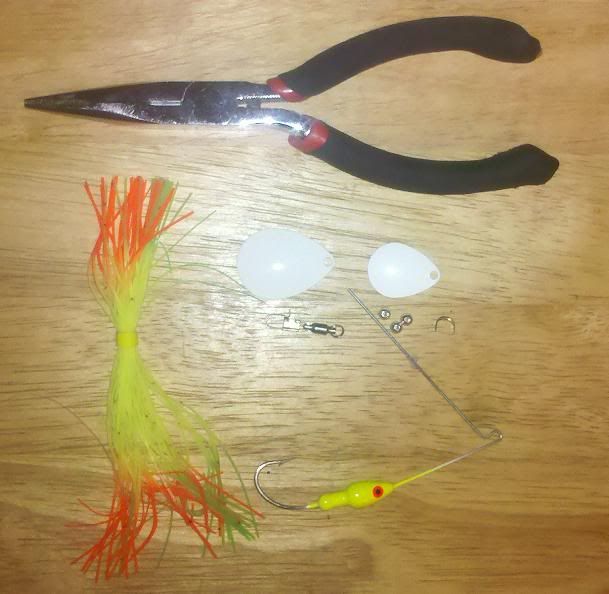
The only tool you'll need is a good pair of long nosed pliers. 
Parts pictured are the spinnerbait head, metal beads, clevis,
quality ball bearing snap swivel, blades, and the final touch
of fish attacting action and color - the skirt.
Now, how to build your own:  The easiest way to get started making your own lures is to simply purchase the lure components and assemble them.  For spinnerbaits, you'll need at a minimum to purchase pre-formed spinnerbait heads, metal beads, clevises, spinnerbait blades, skirts, split rings, and swivels or snap swivels.  As far as tools go, a good pair of long nose pliers is sufficient.  I believe strongly in using quality ball bearing snap swivels to get the best action on your blades.  For buzzbaits, you'll need to purchase pre-formed buzzbait heads, metal beads, buzzbait blades, rivet bearings and skirts.  You can also purchase clacking blades and rattles too.  Again, there are many choices.  And, if you really want to save some money, you can mold your own spinnerbait and buzzbait heads or make your own spinnerbait skirts.  The greater quantity of any item that you order, the cheaper the price.  In some cases, as with skirts, some companies let you mix and match colors to achieve your quantity ordered.  Finally, you can purchase them painted or unpainted if you want to paint your own. 

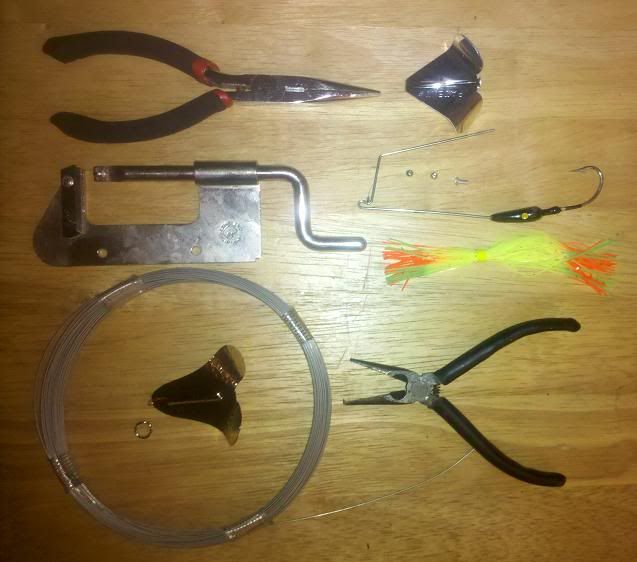
To make the standard buzzbait, you need a good set of long
nose pliers.  Parts include a rivet bearing, metal beads, blade
and skirt.  You can make in-line buzzers from wire, spinner-
bait or buzzbait heads, split rings, metal beads and a skirt. 
A wire bending tool and a pair of split ring pliers will help.
Tools that make the job easier:  There are many tools out there that make life easier when making these lures.  You may find a wire bender, various pliers and wire cutters, a wire straightener, a skirt making tool, or lead molding supplies and tools helpful in achieving your lure making goals.  The wirebender and split ring pliers are a must for making custom in-line buzzers. Also, if you want to customize, you may need to add some stainless steel wire to your supply list.  You can purchase pre-made wire forms, coiled wire, or wire shafts.  Generally, for bass, most spinnerbaits are made with 0.38" diameter wire and buzzbaits are made with 0.41" diameter wire.

Once you obtain the tools, supplies, parts and are ready to assemble your lures, the only thing left to add is your own creativity.  You can build standard lures or design your own.  I get a certain satisfaction in making my own lures especially when they turn out to be effective fish catching lures.  I am particularly proud of some of the buzzbaits that I've made because they catch fish often when traditional buzzers don't.  I've made several different styles of in-line buzzers and they all work.  Traditional styles of buzzers have their place in your arsenal too.  The skirt and hook ride lower and give you better hook ups than the in-line styles.  In-line buzzers tend to cast better, offer a bigger profile, and if you make weed guards are more snagproof that traditional types.  There are advantages and disadvantages to both types and it's up to you to figure out while on the water which one works best.  Let the bass tell you. 

What can you do to maximize your flexibility and keep your selection to a minimum when using spinnerbaits?  I build the spinnerbaits in a few basic colors.  I purchase spinnerbait pre-formed heads in chartreuse, white, and black in 1/4 oz., 3/8 oz., 1/2 oz., and 3/4 oz.  Of course, if you can find them you can build spinnerbaits in other sizes to suit your needs, but these are the ones that I carry.  I make a selection of single blade, tandem, and double willow spinnerbaits in each size and color.  For tandems and double willows, for each color and size, I make one with an inner blade in the following colors:  nickle, brass, copper, white, and charteuse.  I also build my home made spinnerbaits with a snap swivel instead of a standard swivel because that way I can easily change the blades to any color or size that I want.  I keep a selection of blades and skirts so I can customize and "match the hatch" while on the water.  You can do this at home and carry less with you on the water too assuming that you know ahead of time what will work given the conditions that you're fishing.

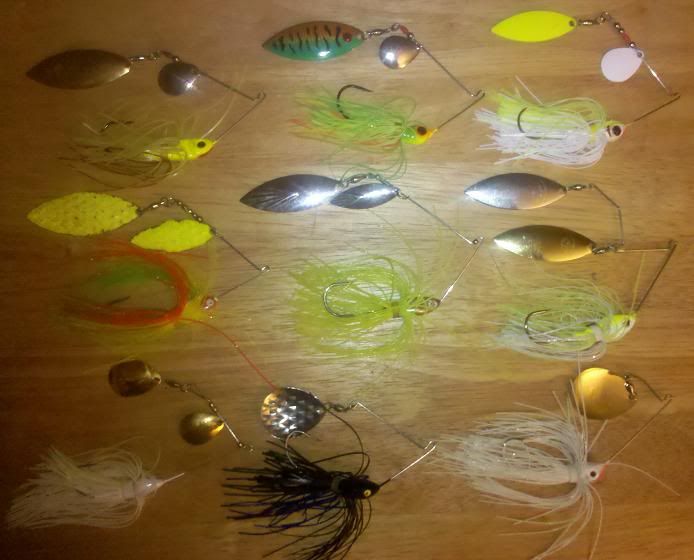
Top row - tandem , middle row - double willowleaf,
bottom row - tandem Colorado blades, single spin, and
 short arm spinnerbaits.  This is just a small sample
of the many different combinations of spinnerbait
features that you can assemble yourself.  Note:  some
of these pictured are off the shelf products, but once
you gain experience making these lures then you
 can make any type that you want.
When constructing your spinnerbaits, I use a size 2 or 3 Colorado blade for tandem spinnerbaits, and a size 2 or 3 willow leaf blade for double willows, but you can customize to any size you want.  Try different things and you may discover that one of your creations works better than anything anyone else is using.  You can create unique baits that fish just haven't seen before!

For the outer blades on all types of spinnerbaits, I stock and carry a wide selection including various sizes from 3 through 7, and various styles.  Willow, Colorado, Indiana, French, specialty blades, hammered, smooth, or painted can be used in various combinations to achieve any effect that you want.  The combinations are many and the possibilities are endless.

When on the water, you can make decisions to match the time of year, size of forage, water conditions, and weather conditions simply by choosing the color of the spinnerbait head, color skirt, and blade colors.  Here are some qualities of blades, color, and sizes of baits that can help you decide what to use:
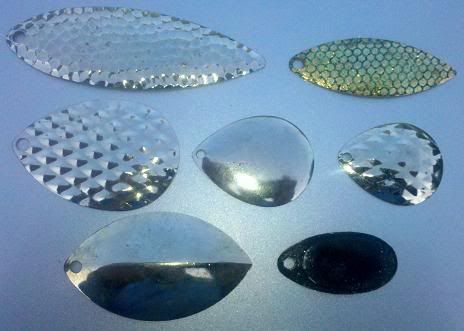
Top row - willow leaf, middle row - Colorado, bottom row-
"musky' willow leaf and Indiana blades.  Carry different
sizes, styles, metal type, and colors for maximum flexibility.

Blade style:  Colorado blades offer the most vibration, followed by Indiana and French, and willowleaf.  Willowleaf blades offer the least amount of vibration.  When it comes to flash that the blades produce, the reverse order is true.  Willowleaf blades create the most flash followed by Indiana and French, and with the Colorado blades producing the least amount of flash.  Vibrations appeal to the sixth sense of bass, the lateral line, which helps bass detect vibrations emitted by prey and allow them to zero in and attack unsuspecting baitfish when visibility is poor.


Blade finish or color:  Metal blades produce the most flash.  Hammered blades and smooth blades produce different flash and vibration patterns, both being productive.  What you offer the fish depends on you.  Flash from a metallic spinnerbait blade mimics the flash of scales that baitfish often display when changing direction.  Bass have excellent eyesight as far as fish go, so appealing to their sense of sight is important for that reaction strike that spinnerbaits are known for.  Bass are also attracted to color.  Chartreuse and white are very effective in murky, stained, and muddy water and allow fish that have detected your lure via the lateral line the ability to visually hone in on your lure for that final strike.  Black is also a nice color for blades.  An all black lure offers a nice silhouette when night fishing and sometimes in clear water provides just enough action to attract strikes without spooking fish.  It works well to imitate a shadow of a prey item in clear water especially when working your lure quickly.  There are many lifelike blade finishes available that give you good options for clear water to tempt finicky bass and match prey items.

Blade and spinnerbait size:  Prey items are larger in the spring because most prey species haven't spawned yet.  Bass are feeding on adult forage for the most part this time of year.  Larger blades and large profile spinnerbaits are good imitations of these larger prey species.  As summer approaches, smaller juvenile prey are abundant.  This doesn't mean that bass focus on smaller prey all the time, but there are times when they'll feed on smaller prey.  Remember, bass are creatures of opportunity, so be willing to adapt and try different sizes to get results.  The old saying that big fish like big baits, and that is also true with spinnerbaits, so they are always worth trying.  I also want to add that if you are planning on using large blades, like sizes 6 and 7, you need to make sure that you match them with heavier weight spinnerbaits so they don't roll over and are sure to run true.  Smaller baits tend to draw more strikes but you may sacrifice bass size in doing so.  Size 7 willowleaf blades effectively imitate large adult forage while the smaller sizes like 3and 4 imitate average minnow and juvenile chubs effectively.  You can see that you can match the hatch by adjusting blade and lure size, so it pays off to learn what forage species are in the body of water that you fish.

Skirt selection depends on you, what you want to present to the fish.  Basic white, chartreuse, and black are always solid fish catching colors.  Also, there are multicolored skirts available to provide different attraction qualities and color combinations.  Just adding a suggestion of something, like red suggesting blood from a wounded baitfish could be enough to tempt bass into striking.  Also, some multicolored skirts are good imitations of forage fish like bluegill or shad.  The most popular spinnerbait skirts are chartreuse, chartreuse/white, white and black.  Colors to imitate baitfish like bluegill and sexy shad are popular big fish catching skirts.

This is one of my best buzzbaits.  You can tell it gets
some use as it's all beat up.  It still calls the fish in
though.  The blades are counter rotating.
When making buzzbaits, you can create a wide varieity of combinations with different buzzbait styles, skirt and lure colors.  Yet, they don't have the same flexibility as with spinnerbaits when it comes to customizing in the field except by changing skirt colors.  I carry several different types of buzzbaits in a few favorite colors.  You can make traditional buzzbaits or make your own in-line buzzers.  The wire bending tool really comes in handy when making your own in-line buzzbait wire shafts.  The only tool that you'll need to make the traditional buzzbait is a good pair of long nose pliers.  Metal blades squeak more, clackers add more noise, and thicker diameter shafts make more of that squeaking noise than thinner diameter shafts do.  Plastic blades are more subtle and come in handy for a more plop plop type of sound but lack the squeak of metal blades.  Sometimes quiet is better.  The bell shaped blades are a bit heavier but work well for the in-line style of buzzer.  Even though they are heavier, they displace a lot of water and keep the lure up high in the water.  The in-line style also casts like a bullet.

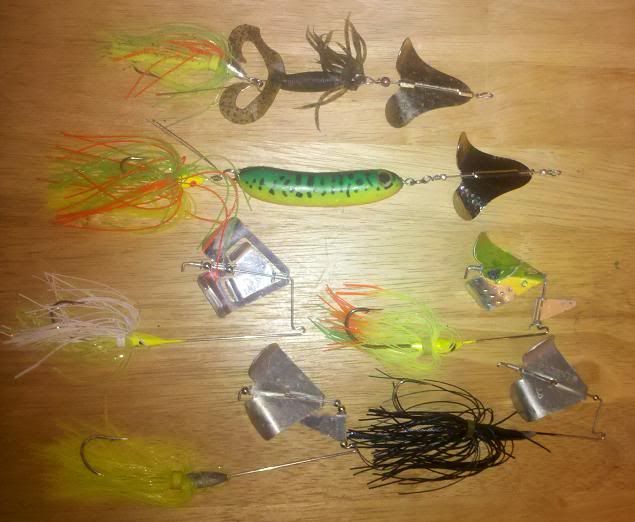
The top two buzzbaits are home made in-line buzzers.  The
next row has a traditional buzzbait and a triple wing one
with a clacker for more noise.  The bottom row shows two
traditional buzzbaits, the one of the left has a clacker.  These
versions all have metal blades, but you can assemble buzzbaits
with plastic blades also.


My selection of spinnerbaits and buzzbaits that I carry on the water depends on the body of water that I'm fishing, the species that I'm fishing for, forage base, and the time of year.  I don't carry everything that I own on every trip.  But, I make sure that I have a selection that helps me adapt on the water to varying conditions.  If I was to compare this to any other strategy, it's like a fly angler carrying a streamside fly tying kit.  You can change blades and skirt combinations on the size lure that you select, almost modifying your tackle on the water to "match the hatch".  What you wind up carrying depends in the confidence you have in your selection which comes from your fishing experience and your ability to carry what you need and still fish effectively.  When I fish from a boat, I bring a little more.  When I fish from shore, I pack a little lighter.  But I always carry a base selection of spinnerbaits and buzzbaits in the sizes and colors that I plan to use, and a selection of blades, skirts and trailers to "match the hatch" while on the water. 
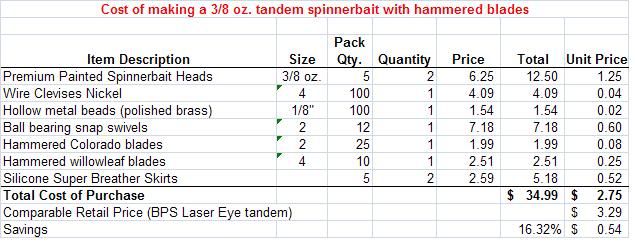
This is a cost analysis showing that if you order the minimum quantity of each lure component to make 10 spinnerbaits, you'd spend $35 and your price per spinnerbait would be 16% cheaper than a comparable store bought model, plus, you'd have some extra hardware that you wouldn't have to purchase next time making your next 10 even cheaper.  If you purchased 10 store bought comparable spinnerbaits then you'd spend $5.40 more than if you made them yourself.

I'll defer discussing "on the water fishing" techniques for fishing spinnerbaits and buzzbaits for a future post.  Hopefully this will help you prepare for your next spinnerbait bite while saving you some money at the same time.