Showing posts with label fall fishing. Show all posts

Thursday, October 27, 2011

Cold Front Fishing Challenge

The great thing about fishing in the fall is that big fish are willing to bite a variety of baits despite adverse conditions.  Cold fronts, extreme changes in temperatures, and shorter days contribute to not only changes in fish behavior, but also to their ecosystem and prey as well.  Two weeks ago my buddy and I fished a lake on the Eastern Shore of Maryland, and found a multitude of bass and chain pickerel in areas where weeds and lily pads were abundant.  That area teemed with life.  Baitfish and predators could be seen easily in the clear water slightly tinted by tanic acid.  Just about every piece of woody cover, point of lily pads or pocket of weeds held a predator of one sort or another.  We hit that spot again on Tuesday and that area was devoid of life after only two weeks had elapsed from our last trip. 

What happened?  Where did the fish go?  After spending all morning looking for them, we had only one toothy chain pickerel to show for it, and we all but gave up looking for them opting to catch panfish instead.  We weren't in a tournament, rather, we were out for fun.  And on these particular lakes, multispecies fishing opportunities can expand your fun and panfish can make your day.  But, that last trip spoiled me.  I wanted more chain pickerel and largemouth bass.  I craved that big reaction strike.  So, I'll detail the rest of the trip in this post on how we finally got on those big fish.

We were out on a beautiful fall morning, but the fishing was tough.  Here, Howard is tossing a chatterbait looking for the big reaction bite of big bass and chain pickerel.  We faced post cold front conditions, bluebird skies and other adverse conditions, but were determined to find them, and later we did.
So, before I move on, let me set the stage on what we were up against.  First, the weather wasn't in our favor.  A strong cold front had moved through, and another one was on the way.  The weather normally after a cold front, about three days later, stabilizes and the fishing improves, but when one front moves through soon after another one, the weather doesn't stablize and the fish feel those effects, and the bite is often tough.  And, even though daytime temperatures have been relatively stable, the night time low temperatures have been dropping.  Sometimes though, shorter days trigger feeding behavior in predatory fish that will set them on a feeding binge even during conditions that normally give the lock jaw, and that was what we were banking on.

In addition to the weather conditions, the State Department of Natural Resources launched their electroshock boat to study our lake on this particular day.  They hit four prime spots on the lake, shocking, sampling, and measuring fish along large sections of prime shoreline, deep in cover, out from cover, just about everywhere.  Their modified pontoon boats emit about a thousand volts of electricity using two long metal probes. 

The staff of three DNR Biologists include someone to drive the boat, and two staff to net fish.  After netting stunned fish of all species, they record measurements and population numbers for each species to determine the health of the lake population.  This data helps the DNR to determine the best way to regulate fishing on the lake and to help them determine other management options for the future health of the fishery.  Even though this usually puts a large population of the lakes fish in a non-feeding mode, all of the fish are released alive and well to feed another day, and more importantly will lead to better fishing for all anglers in the long run.  So, we had to decide if it was worth fishing here or moving to another lake. 
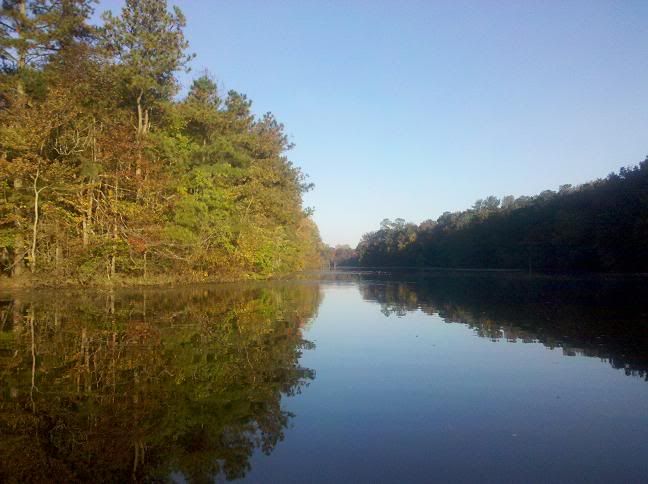
We launched on a beautiful morning.  At first, the lake was like a sheet of glass, but that would change.
Also, on a weekday, normally places like this seldom have other anglers.  On our last trip, we arrived to find only one other boat on the water all day long.  But on this day, three other boats followed our launch on the lake throughout the day.  That doesn't sound like much, but on a small lake, it's another concern.  Normally, if the DNR wasn't electroshocking the lake, we wouldn't think twice about that since there's more than enough fish for that number of boats, but about half the lakes prime spots have been fried.  So, that was another reason for us to move.

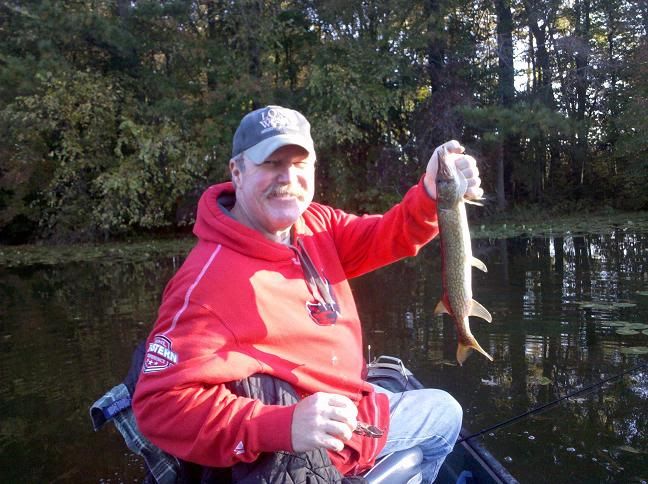
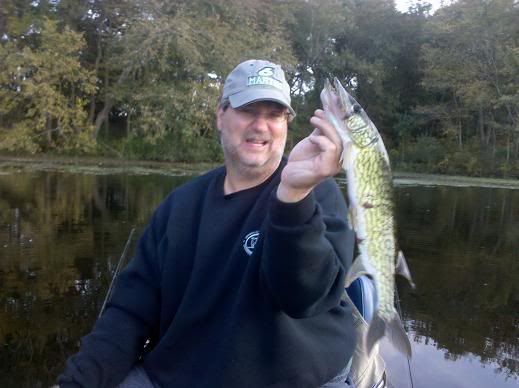
We fished last trips hot spots all morning and all we had to show for it was this lone chain pickerel.   The question about a spot change lingered in our minds, or should we stick it out?  Quality fish are in this lake, but would they bite?
Finally, the bite seemed to be off.  Where fishing was hot and fish activity once flourished a two weeks prior, it seemed lifeless and dead, and we didn't see but only a few small fish.  The baitfish and predators were gone.  Why?  Where did they go?  We noticed that the lily pads seemed to be dying off.  Also, the milfoil and hydrilla seemed to by dying off as well.  We theorized that the oxygen levels in those areas were low, leaving the fish uncomfortable enough to migrate to other areas of the lake.  The other option was that they may be deep into the cover, up in the lily pads.  We decided to take a look, pushing the boat into the pad fields to see if we could see any predatory fish or spook them, but we saw nothing.  They had migrated to other holding spots.  That was our challenge the rest of the day, to find them.

So, we moved down the lake.  The lake is situated along a wooded shoreline on each side along a Northwest to Southeast direction.  The Northwest winds were picking up as the sun rose over top of us.  The skies were bright blue, and the sunlight and glare were making visibility tough even with sunglasses.  The lake was no longer a sheet of glass.  Maybe the winds were piling up warmer water, oygenated water, down the lake, and maybe that's where the baitfish and predators were.  Our numbers were pitiful at this point, so we both opted to find some panfish to pad our catch rate.  Also, by doing that, you find baitfish and eventually predators.  Once you know where they are, a change in fishing methods is the only thing left to catch them, but that is sometimes a challenge in itself.

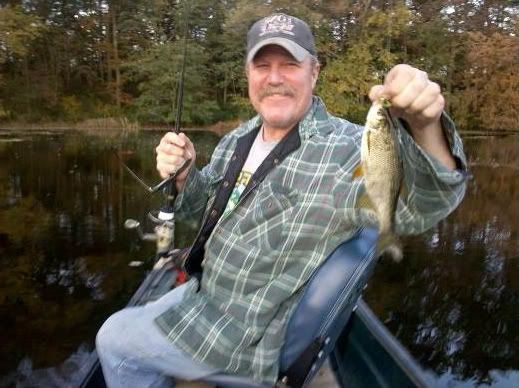
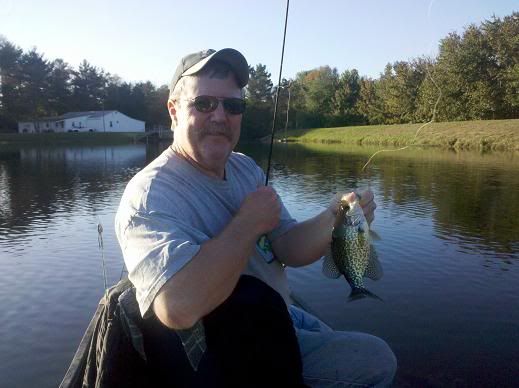
Finding panfish like this nice crappie can pad your catch numbers, but also help you find where conditions may be right for finding predatory fish like chain pickerel and largemouth bass.
We found plenty of good sized bluegills, shellcrackers, and a few crappie scattered around lily pad fields further down the lake near deeper water.  In some spots, the panfish bit just about every cast while casting small two inch twister tails on 1/32 ounce jigheads and light line.  That was fun, but I had big fish on my mind, and the panfish were starting to bore me.  We each had several chain pickerel bite our jigs off, leaving our line dancing in the wind.  We also picked up a few small bass on the panfish jigs.  We found the predators.  Now we had to figure out a way to catch them.

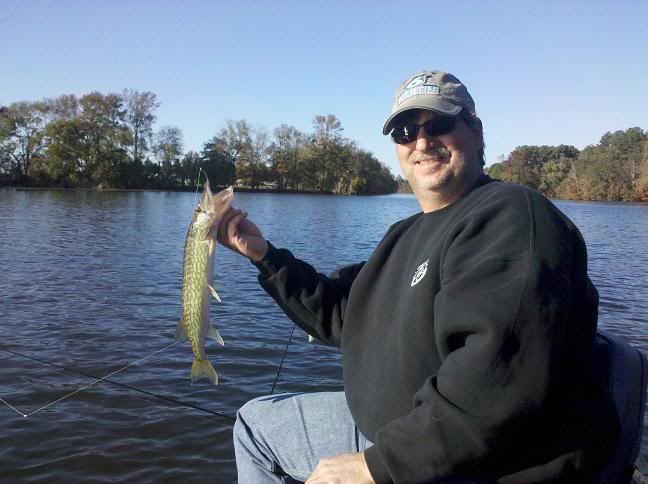
Chain pickerel like this one were biting off our panfish jigs.  We also caught a few smaller bass on the small lures, so the predators were here.  We just had to find a way to get more of them.  Plus, getting bitten off and retying new lures wastes fishing time and hurts the wallet.  If they're going to bite, I want to boat them.
By now, we had moved all the way to the other end of the lake.  The wind was stronger here, especially on the Southeastern shoreline, where the warmer water was piling up.  Howard and I tried several reaction baits and finesse presentations, but nothing seemed to work.  I managed to catch a pickerel using a larger grub and jighead, but just about every cast brought back some algae on my lure that I kept having to clean off, and that irritated me.  If the fish were actively striking that presentation, I'd put up with it, but the bites were few and far between.  Something had to change.  The fish had to be here.

Last time we fished this lake, we found lots of these golden
shiners, which we assumed were the coveted forage for
both bass and chain pickerel.
I opened up my crankbait box and searched for an answer.  This lake was shallow and weedy, so deep and medium divers were out.  I needed a good shallow crankbait.  Then, something in my box caught my eye and jarred my memory.  Last time we fished this lake, we found huge schools of golden shiners, and when we found them, we also found big chain pickerel and good sized bass.  In my box, the lure that caught my eye should be the perfect imitation of a golden shiner, a half ounce Bill Lewis Rat-L-Trap in the gold with black back color. 

Lipless crankbaits are a good choice when imitating large baitfish like golden shiners, blueback herring, and various species of shad.  And, the rattling noise and vibrations on the retrieve often draw reaction strikes on both active and inactive fish.  The strikes when fishing these lures are often violent, and that was what I was hoping for. 

I had never tried lipless crankbaits in this particular lake.  I never had to, because the things that we tried on this day, like spinnerbaits, chatterbaits, and plastic worms normally kept us busy with plenty of bites.  But not today.  So, I thought that I'd give it a shot.

On my first cast, I put the lure into an area that was about three feet deep.  After a few cranks I could feel the bait wasn't working properly, so I quickly reeled it in only to find thick hair like algae hanging from both treble hooks.  At first, I thought that I might be wasting my time, but then decided to place a cast toward deeper water, and try keeping my rod tip high while maintaining a medium retrieve speed.  The next cast went out to the deeper water.  After a few cranks, I had a bone jarring strike and a big fish on.  What did I have?  I wondered if I had hooked a chain pickerel or a big largemouth bass.  It didn't matter as I am tickled to catch either species, and besides, this fish was fighting like crazy.  The fish seemed to dig for the deep against the resistance of my medium power fast action St. Croix Avid baitcasting rod.  After a really good fight, the fish finally came up and boiled near the boat. 

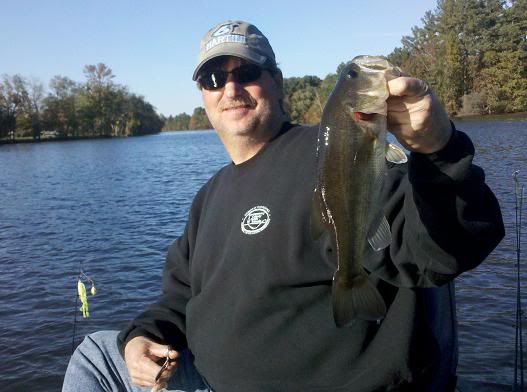
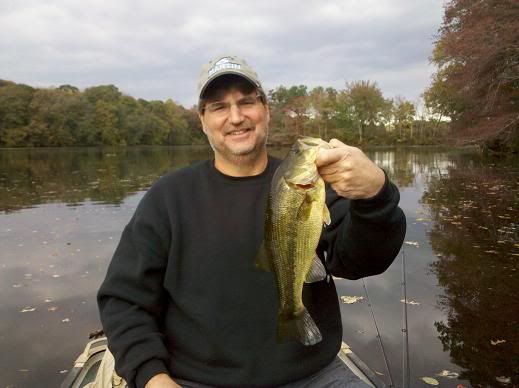
Big bass...I wasn't sure how big, but it was big, and on a tough day of fishing, a fish like this can make your day.  Finally, I was able to get the bass to the side of the boat, careful to lip the fish and boat it without leaving two treble hooks imbedded in my hand.  We measured it and weighed it, twenty inches and four pounds, then I released it to fight another day.
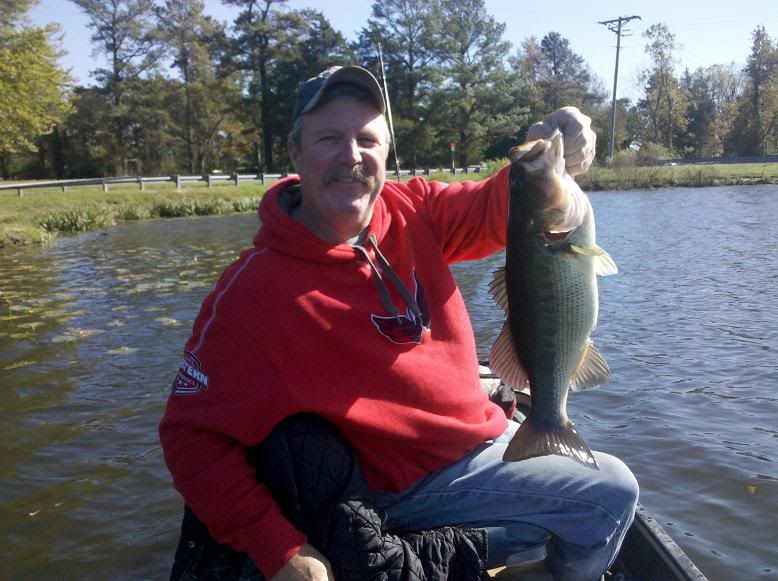
This bass fell for a gold Rat-L-Trap, a good imitation of the golden shiner, probably the meal that this four pound largemouth bass was hunting for.  "Traps" make for great reaction bites especially on weedy lakes.
We figured that the predatory fish were in the deep end of the lake, so we decided to use the wind to drift across the lake while tossing our lipless crankbaits in search of them.  At first, it seemed as if I had a one fish wonder bite.  That is, I wonder why only one fish would bite it.  Maybe I didn't find a pattern, but rather, a lone fish that I fooled, while many others were down deep laughing at us.  Howard put on a six inch Senko and caught a couple decent bass and pickerel, so maybe he found a pattern.  I followed suit and tried one also, but no hits for me as we both drifted that deeper water in search of fish.

Howard found a couple nice bass and pickerel using a six inch Senko in the deeper water.
Well, I wasn't about to give up on my gold trap.  Fish like that bite for a reason.  There had to be more.  So, I went back to it, making cast after cast, joking that bass and pickerel were a fish of ten thousand casts, like the mighty musky.  After about thirty more casts, I gave up and went back to panfishing for a bit, kind of like a rest.  Panfish and minnows were dimpling the surface all around us, tempting me to try and catch them just to see what they were.  I landed a nice bluegill, followed by a nice crappie, only to be bitten off a few casts later by another toothy chainside.  Ah hah!  More predators.  Maybe they want my Rat-L-Trap again. 

So, I picked it back up and began chucking it.  Three casts later and I had a massive strike.  What did I have this time?  Again, the fish fought, sounding for the depths, even taking drag.  Big fish, but was it a pickerel or a bass?  Again, I'm thrilled as I fought this fish.  Finally it came to the surface and thrashed about, splashing Howard in the process.  It was a nice sized chain pickerel, my biggest one so far this year.  Now, maybe I was on to something. 

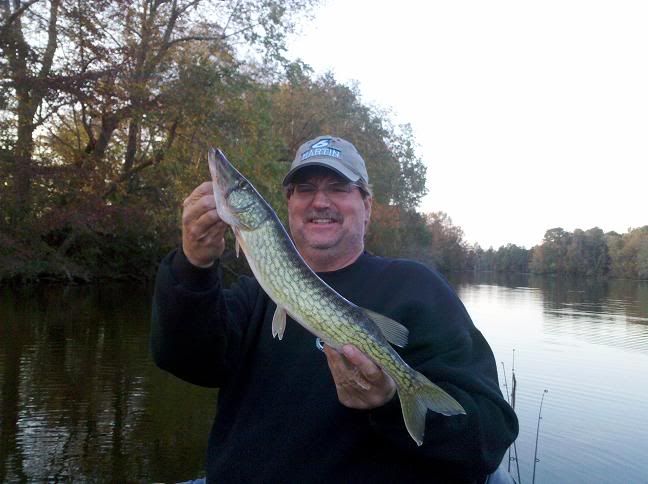
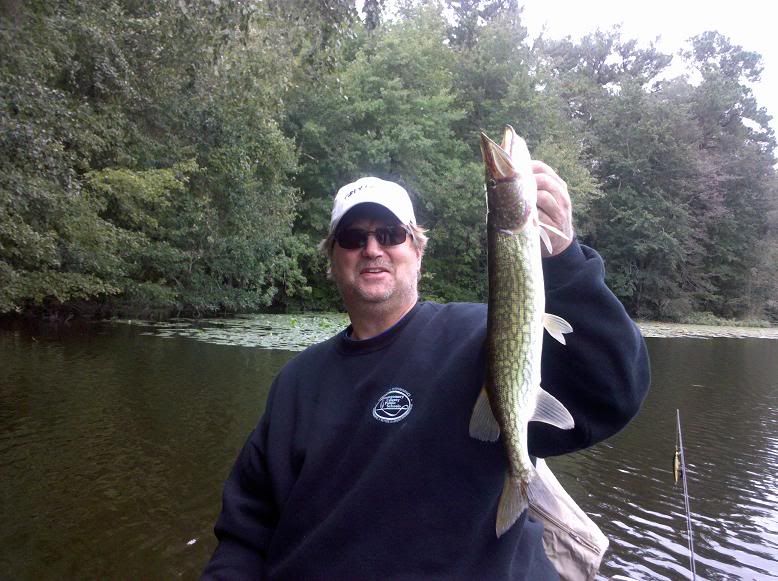
I brought the mighty pickerel to the side of the boat, and with those teeth and treble hooks thrashing about, I decided it wouldn't be the best idea to try and grab the fish, so I hoisted it into the boat.  Bad idea.  The fish thrashed even more and wouldn't you know, one of the treble hooks headed right for my crotch!  I tried my best to avoid the hooks but one of them stuck in the pants leg of my blue jeans, two of the hooks piercing all the way through my pants, right along my right groin area, with the fish still attached and flopping.  I was happy that I wasn't wearing shorts, because that would have been a nasty result.  Finally, the toothy predator calmed down and I was able to remove it from the lure.  I turned and posed as Howard snapped my photo with the fish, with the lure still hooked to my pants.  I released the beast and spent several minutes removing the lure from my pants, thankful that the hooks didn't penetrate any skin.

This nice size chain pickerel hammered my Rat-L-Trap, then proceeded to hook me!
The afternoon was finally heading to toward a close.  I was happy that I had two quality fish slam my lure.  So far, the catch  numbers weren't great, but any time I catch quality fish it's a good trip, and I'm thankful.  Howard and I decided to fish our way back to the ramp and hit the Western shoreline.  Howard tied on a chatterbait and I stuck with my Rat-L-Trap, fishing it as if it was a spinnerbait, working pockets along the weeds and lily pads, around woody cover, and out to deeper water.  We stayed away from shore knowing that the predators were not deep in the cover, but rather, they seemed to be hunting in the deeper water out from the cover.  We proved this on the trip back, as Howard and I hooked several chain pickerel and largemouth bass.

Several more bass and pickerel hit my gold Rat-L-Trap as we fished our way back to the ramp to end the day.
Howard with a quality chain pickerel that attacked his chatterbait.
After landing several bass and pickerel on our way back, some of them being decent size, we both marveled about how tough the day had been, but were glad that we made the right decision to stay and fish this lake out despite the tough conditions.  I finished with some nice crappie, well over a dozen nice bluegills, a good number of chain pickerel, and a bunch of nice largemouth on the day.  Howard did equally well, although he probably caught two to my one on the bluegills...that boy was on fire with those gills!

In summary, when facing tough conditions but you know that you're on a good lake with quality fish, don't give up on it especially in the fall.  When daylight is short, that's less fishing time, and a spot change takes time away from fishing.  You have to pull the boat out, drive to another spot, and launch again.  Plus, even if it's a good lake, you have to start from scratch to figure them out, and there's no guarantee that the fishing will be any better than what you left.  On the other hand, a spot change could really make your day, so it's a tough decision.  On this particular day, I feel that we made the right decision to stay.  I'll take a four pound bass and a big pickerel any day.  Fall fishing, big fish, that's what it's all about.

Wednesday, October 19, 2011

Mixed Bag Multispecies Fishing Fun

So far, the vast majority of my blogging about fishing has centered around bass fishing, and you'd think that's all I like to do.  Without a doubt, bass fishing for bass is a passion of mine.  However, some of my favorite places to fish are the ones that give me the opportunity to catch good size fish, good numbers of fish, and different types of fish.  Variety, size, and numbers translate to fishing fun in my book.  Multispecies action gives the saying, "Variety is the spice of life" great merit in my book.  This time of year, October, is one of my favorite times to put together multispecies catches that leave me anxious to return another day.  My past two fishing trips were to such a place, where we were blessed with good catches of chain pickerel, largemouth bass, black crappie, bluegill sunfish amongst other species.  The pictures on this post were from my latest trip.

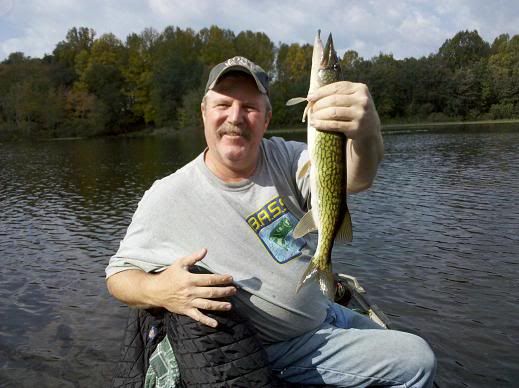
This chain pickerel fell for a white Z-man chatterbait with a white ringworm trailer.  Pickerel are toothy, agressive, strike with reckless abandon, and just plain fun to catch.  On this day, a front moved through and the bass shut down, but these toothy critters didn't disappoint, increasing my catch rate and fishing excitement.
My buddy Howard and I fished out of his pond hopper boat, an eleven foot Coleman Crawdad that, for years, supported the hefty weight of our bodies and tackle, enabling us to catch many very good fish of all kinds over the years.  Howard and I loaded the boat with two batteries, attached the trolling motor, paddles, life vests, tackle, snacks, drinks and fishing rods, slid the boat down the ramp, and were off just after first light in search of everything that lived in that lake to catch, photograph, and release. 

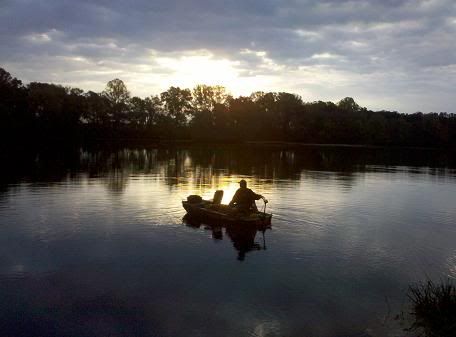
The three days prior to our trip were extremely windy, but the winds on this day had died down, and when we launched, the lake was like a sheet of glass.  The sun had just risen but was hidden behind clouds lingering from the low pressure system that had passed through the area a couple days earlier, leaving me with an irresistable photographic opportunity to shoot the silhouette Howard and his craft after he launched his boat.  We had a lot of rain during the week so the lake was full.  The water clarity was excellent, almost crystal clear except for the slight stain of tanic acid, jokingly refered to as "satanic acid" by Howard.  Warm temperatures thoughout the week probably had a positive effect on fish activity by keeping the lake water temperature up a bit in the fishes comfort zone.

The Coleman Crawdad, Howard's fishing machine, launches on a beautiful fall morning.
I loaded the boat with my tackle, and six rods rigged for all my possible hot patterns.  Six rods, really?  Well, when targeting multiple species, you need different rigs, right?  All week long when planning this trip, I spent hours at home fiddling with my tackle and rigging my rods in anticipation of the patterns that might have worked given the conditions that we were about to face. 

For largemouth bass and chain pickerel, I had my flipping/pitching rod rigged with a skirted Strike King Hack Attack jig and Denny Brauer chunk trailer on fifty pound Suffix 132 green braided line, to power fish out of heavy cover and pads.  I also had my medium power, fast action spinning rod Texas rigged with a four inch green pumpkin plastic worm rigged with a light wire hook and light weight on light eight pound Nanofil line for a fine finesse presentation.  I had another medium action outfit rigged with a popping plug on eight pound fluorocarbon line for possible topwater action.  I had a medium action baitcasting outfit rigged with a 1/2 ounce white chatterbait with a white plastic worm trailer, and another heavy action long baitcasting rod rigged with Live Target frog with heavy braided line in case the fish were hunkered down in the lily pads. 

And finally, for panfish, I had an ultralight rod rigged with a Kalin's Triple Threat grub in the lemon meringue color, using six pound test Nanofil that has a diameter equivalent to two pound test monofilament line.  That's a lot of fishing rods for a small pond hopper boat, but really, it's just being prepared for all of the situations that I thought that I'd encounter on the day.  That way, I didn't have to take time to cut a lure off and re-tie a different lure on, at least not as much.

Chain pickerel, sometimes nicknamed "jack fish" particularly in parts of Virginia, like this one can attack with lightning speed, giving the angler a thrill and a good fight.  This pickerel had a run in with one of the lakes predatory species.  Perhaps this pickerel was an osprey survivor.
My first fish was an average sized chain pickerel that came off a chatterbait being pulled from the weeds into the water.  As soon as it fell off the slop, the pickerel exploded on it.  Esox niger, the chain pickerel, is the smaller cousin of northern pike and muskellunge, or musky.  They have sharp teeth and can attack with lightning speed, and are known to cut your line if you don't use a steel leader.  I personally don't use a steel leader, accepting the fact that a few of my inexpensive jigs or plastic worms will be bitten off even when using heavy line, simply because I feel that the lures get better action and draw more strikes.  For some reason, on this day, the chatterbait was driving the pickerel nuts.  I finished with nineteen of them, with some of them approaching 23 inches in length.

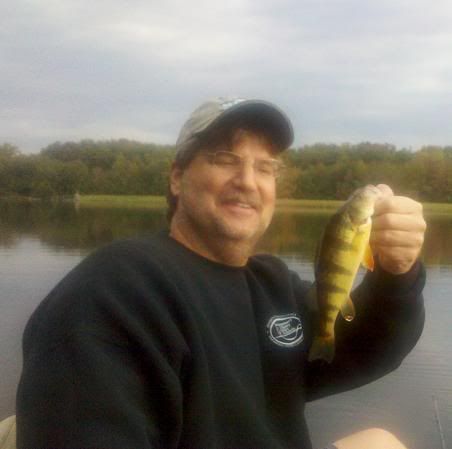
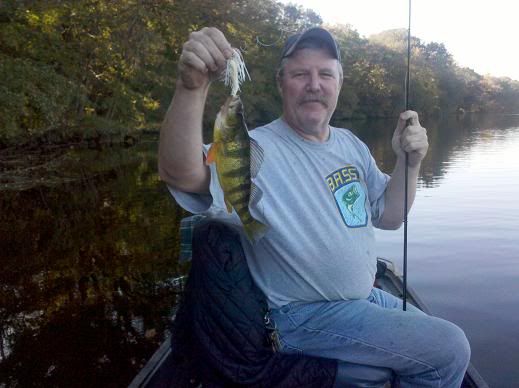
Yellow perch like this on can provide good action and, if you really get into them, can really pad your numbers for the day.  They are agressive and hit any lure that will fit into their mouth.  This one hit a plastic worm.
Not long after that, Howard caught his first fish of the day, a chunky yellow perch, caught while he was targeting largemouth bass using a four inch plastic worm, traditionally on this particular day a hot bass lure.  The yellow perch were also very aggressive even after the front moved through and the wind picked up.  On the day, the perch attacked my plastic worm, Kalin's grub, and I even caught one on the large chatterbait!

This nice yellow perch attempted to engulf my 1/2 ounce chatterbait for lunch, showing how aggressive they were.
Soon after Howard's perch, I changed tactics and went to the ultralight.  I caught a nice bluegill sunfish right off the bat.  In my earlier posts, I talked about Nanofil line, the six pound line that I was using that had two pound diameter, or even thinner maybe.  For fishing plastic worms, it casts a country mile, but the thin line would break on my hook sets.  So, I went to the eight pound test for that purpose.  Now, I wasn't about to waste the thinner line, so I spooled my ultralight with the thinner Nanofil to fish for panfish with. 

I was very pleased that I could cast my 1/48 ounce jig just as far as when using four pound fluorocarbon line, if not further, with very little effort.  The line has no memory either, and is very sensitive, which is nice for jigging panfish so you can feel the bites easily.  You can feel every little thing, and the thump of a fat bluegill bite feels like a BIG thump.  At first, I was worried about the line visibility, but the fish weren't line shy at all, at least on this trip, including a bunch of fat bluegills caught throughout the day.  The Nanofil passed the panfish test.  My next test of that line will be through the ice this winter, and thus a final review of the brand for that purpose.

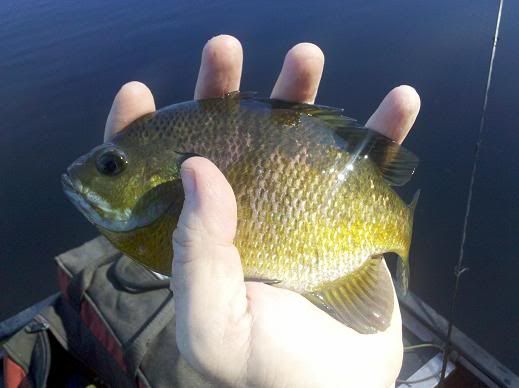
Bluegill sunfish like these were willing biters on my little jigs even on the white Nanofil line.
Normally, this lake produces good catches of fat slab crappie.  But on this day, the calicos were tough to find, but we both caught a few of them.  We were casting and slowly jigging our ultralight jigs.  Perhaps a change in technique would have landed more crappie.  Maybe that change would have been a micro tube jig, or perhaps a Berkley Power Wiggler fished under a float?  With other species cooperating, I wasn't going to spend much time re-rigging, so I stuck with my original plan.  Even though the crappie didn't cooperate as much as I had liked, the pickerel, perch, and 'gills gave us plenty of action.

Usually, on this particular lake, crappie are abundant.  But on this day, we only caught a few.  The other species kept us busy though, with plenty of action on the ultralight from pickerel, perch and bluegills.
What about the bass?  This lake has some big bass in it, and on some days you can rack up some decent numbers of quality largemouth.  Howard and I each caught a three pound bass, but once the front passed through and the wind picked up, the bluebird skies seemed to send the bass off the feed.  We each managed to catch our bass on the chatterbait.  Howard later lost one while jigging his chatterbait in deeper water.  He all but had the bass landed when it decided to behave like an acrobatic smallmouth bass, and leap high out of the water tossing Howard's lure back at him. 

Although the bass numbers didn't pile up, we knew that in future trips they will.  In the mean time, the chainsides kept us busy.  Perhaps one reason my bass numbers were low was because I spent a considerable amount of time catching the panfish on my ultralight.  The way I look at it though, I was really enjoying myself doing that and the fish were cooperating, and the action kept me giggling like a child every time I set the hook and fought the spunky fish to the boat.  After each catch, no matter the species, I took the time to admire the size of the fish, plus the beautiful coloration of each of them.  But, not so much time admiring as to harm them, so each one was carefully released to fight another day in a reasonable amount of time. 

I'm sure that I could have brought home a nice stringer for the dinner plate, but right now I still have plenty of fish in my freezer from my winter ice fishing trips, enough to get me through until we get ice again.  I don't know, but to me, the fish taste better when caught through the ice.  I don't have any scientific merit or reasoning behind that statement, but it just seems that way to me.  For me, open water fishing has become traditionally catch and release for many species (except for some saltwater or brackish fish that I can't get through the ice, like an occasional rockfish or white perch), while ice fishing fills my freezer only to meet my needs and no more.

This chunky largemouth bass annihilated my chatterbait.  The bass shut down not long after this fish was caught.
Howard with a nice fall chatterbait caught largemouth bass.
This golden shiner rounded out our sixth species caught
on the day.  Big baitfish like these are one reason that
the chain pickerel and bass in this pond reach good size.
We found a lot of chain pickerel active in one to three feet of water, relating to weeds that hadn't died off yet, in areas where baitfish were abundant, and especially in shallow water.  They attacked the bass lures that we threw, including Howard's favorite pickerel choice, a Bagley's perch color minnow, plastic worms, and of course, the chatterbait.  Towards the end of the day, the pickerel would charge out for the lures leaving a big bulging wake as they attacked our offerings.

Chain pickerel aren't huge like muskies or northerns, but they are every bit as aggressive.  It seemed as if every other cast along the lily pads, submerged weedbed clumps, or any sunken wood resulted in a savage pickerel strike at the end of the day. 

The evening bite was hot.  I finished with nineteen chainsides, one fat bass, sixteen bumphead bluegills, two fat crappie, one huge golden shiner, and fourteen nice sized yellow perch for a total of 53 fish, and six different species caught.  Not a bad multispecies day!  Howard had similar numbers, not a lot of any one species, but good numbers of everything including some nice sized pickerel.. 

The action picked up at the end of the day with chain pickerel attacking our lures nearly every cast, along with a few fat yellow perch getting in on the feeding action as well.
In summary, lakes like this one that provide good fishing for many different species, all of which are relatively good size, that make for difficult choices on the water.  It's a dilemma, what species to fish for?  The answer to me is clear, and it's spelled F-U-N.  What I mean by that is, I like to go with the flow, for what's biting, to try different techniques for different species, and let the fish tell you what to use.  If I catch many different species along the way, then my day is complete.  This is typical for this lake, to catch some of each species, but not really tear them up, and at the end of the day when you add up your numbers, you realize that you've had a pretty good doggone day of fishing.  On this particular day, the pickerel, perch, and bluegills gave us the most action and kept us quite busy all day long.  So, rather than beat my brains against the side of the boat trying to catch more bass when they weren't as active as we normally find them, I prefer to adapt to make the most of my experience on the lake, and sometimes it's the species that you don't normally target that make your day.  I'll take it!  And I'll take it every time!


Monday, October 3, 2011

White is Tight for Bass!


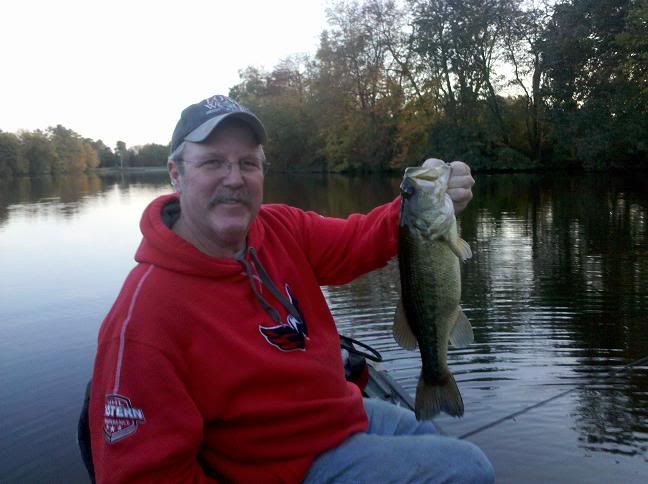
This largemouth fell for a white chatterbait as temperatures
locally began to cool.
 These days, when you ask a bass angler, "what's your favorite color?", you'll get a variety of responses.  We've heard many times that when you have those bluebird skies and clear water, that we should use natural colors that best imitate prey, i.e. green pumpkin, watermelon, smoke.  Or when the water is muddy, the experts recommendation for us to use chartreuse or black.  Or when the water is clear and the skies are dark, we'd do well to use darker colors like junebug, or black and blue, or maybe bright colors like chartreuse.  Those are good suggestions, for sure, but often the most basic of colors falls off the radar that could possibly be the best color choice in many situations,and that is the color white.

During the fall, bass go on a feeding binge, fattening up presumably for the upcoming winter, with that behavior being triggered by cooling water temperatures and shorter days.  Reaction baits and faster moving lures work quite well, like spinnerbaits and crankbaits, and during cold fronts, soft plastics take fish when the reaction bite is off.  The bottom line is that even during fronts, bass in the fall seem more willing to strike in general than other times of the year, at least, that's my observation.  What I'm getting at here is that the fish just aren't as picky, and while all of their senses are on high alert, the visual attractiveness of the color white to them is often too tempting to resist, and it's not just bass, but many other species as well.  Why?  Because of the visibility of the color white, they simply can see it easier than anything else.

Chain pickerel also hammered our white chatterbaits.
So, given the varied characteristics of bass lures that draw strikes, the color white allows them to visually hone in on their target resulting in savage strikes.  As you know, white reflects all light, so it's the most visible color throughout the water column.  Reaction lures like spinnerbaits and chatterbaits already drive them nuts, and throw in the most visible color and the bass just can't miss. 

White is also a versatile color.  Because of it's light reflecting ability, it's a great color to use in muddy or stained water all year long.  White is a color that's common in nature, yet when mother nature paints an individual animal in all white in the form of albinism, natural selection tends to weed those individuals out of the population.  White prey items disappear faster than their more commonly hued brethren.  So, perhaps white as a color tends to reflect albinism which enhances that feeding instinct.  Therefore, it's really a color that can be effective all year long.

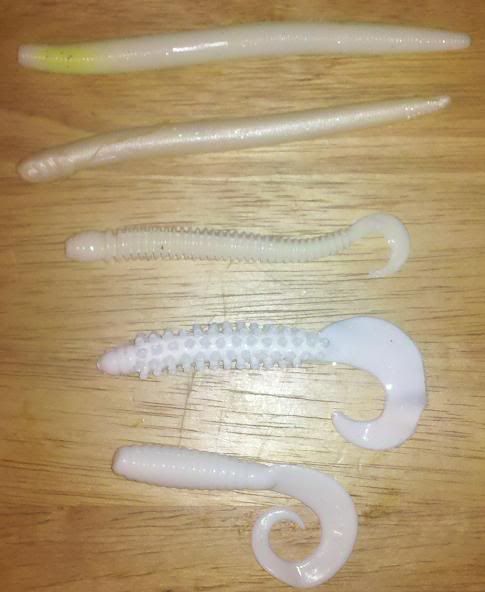
White soft plastics make great trailers for lures like
spinnerbaits and chatterbaits, but also are
terrific when fished like your other favorite soft
plastics.
How about seasonal hot patterns with this color?  In the spring, white spinnerbaits maybe with a hint of chartreuse are one of the most popular colors of all.  The crankbait colors of Tennessee shad and the more recent sexy shad colors suggest white prey, or, natural colors of prey over a white background or imitated belly coloration.  Late spring and early summer for jig pitchers is a great time to try swim jigs around weed beds or heavy cover for largemouth.  During hot weather, white floating worms and other soft plastics can be very effective too.  White buzzbaits or curl tailed grubs are candy for summer smallmouth on moving water.  Thick clouds of white mayflies on August smallmouth and trout streams send the predatory fish into a feeding frenzy often imitated with great success by fly anglers with white miller and white Wulff dry flies, and even white wooly buggers.  White spinnerbaits and the fall go hand in hand, and tend to be one of my top lure choices for largemouth.  And white twister tails and tubes fishing in the colder months can be deadly for more inactive bass when fished through the ice.

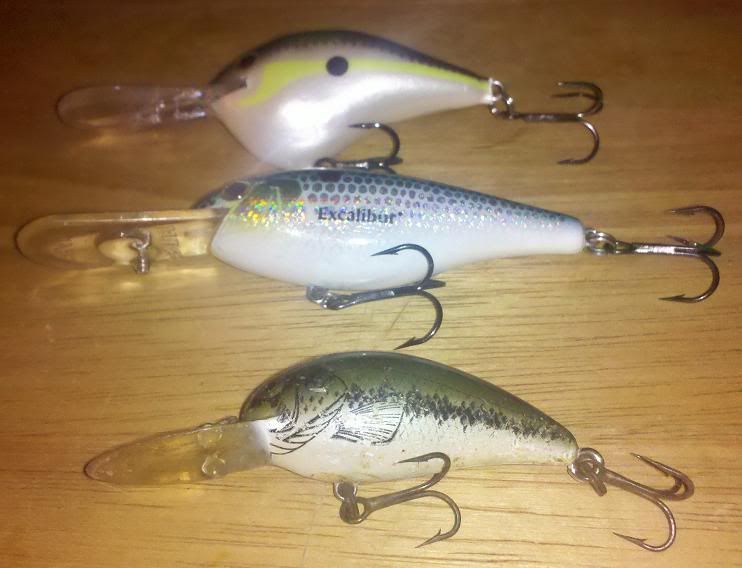
Many lures, from topwater plugs to crankbaits, have white
bellies that perfectly imitate the natural coloration of the
bellies of baitfish.
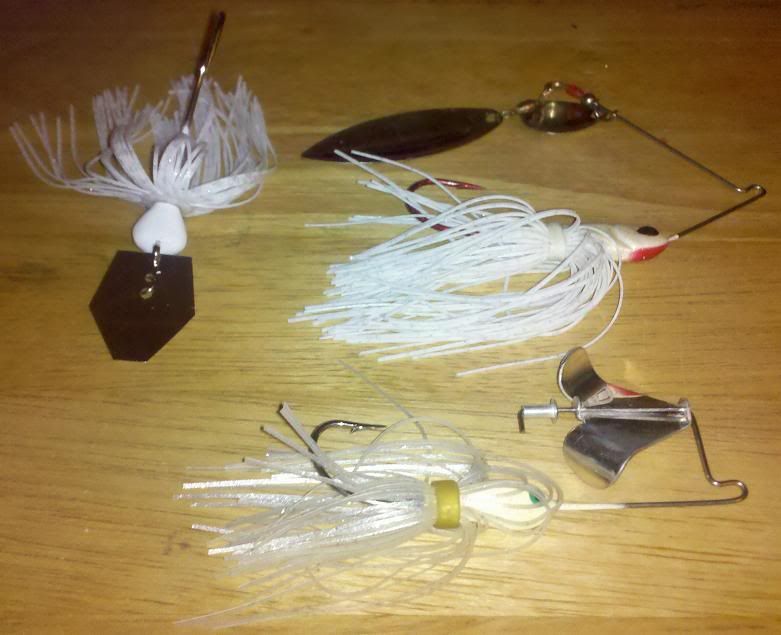
Chatterbaits, spinnerbaits, and buzzbaits in white are one
of the best reaction bait combinations that you can use any time.

The visibility of the color white also helps anglers when fishing shallow water subsurface retrieves on lures like spinnerbaits, chatterbaits, moving plastics and jigs, and even crankbaits because often if the water is clear enough, you can see the strikes, or at least your lure being engulfed.  Not only does that give you an edge knowing that a fish is striking, but it seems to make that strike seem even more exciting than those that you don't see.  I guess it's not on par with topwater strikes, but it may be the next best thing!

In summary, when choosing colors of your favorite lures, don't overlook one of the most basic of colors.  So really, it's a great choice, any time, any season, but particulary effective during the cooling temperatures leading through the fall.

.