Sunday, July 24, 2016

Hire a Fossil Collecting Guide?


I've always collected fossils on my own, for years, beginning with shark tooth trips with my Parents, sitting on the beach digging holes in the sand, sifting with our fingers, and finding shark teeth.  We found jars of them.  Later in life, I sought out better specimens and explored various sites in my region.  I expanded my collecting to the inland formations, searching the Devonian fossil beds for older material.  I did this on my own, with my daughter, and a few friends along the way.  I never imagined going with a guide to fossil collect...until recently.

Cathy Young, of Mid-Atlantic Fossil and Nature Adventures, contacted me via a fossiling friend, to help on one of her trips, using my boat to transport kids that were attending her paleontology camp to various local spots only reachable by boat, and some on private property where access is extremely limited except by her and her experts, who have permission on those sites.  I agreed to help and was very curious about her program.

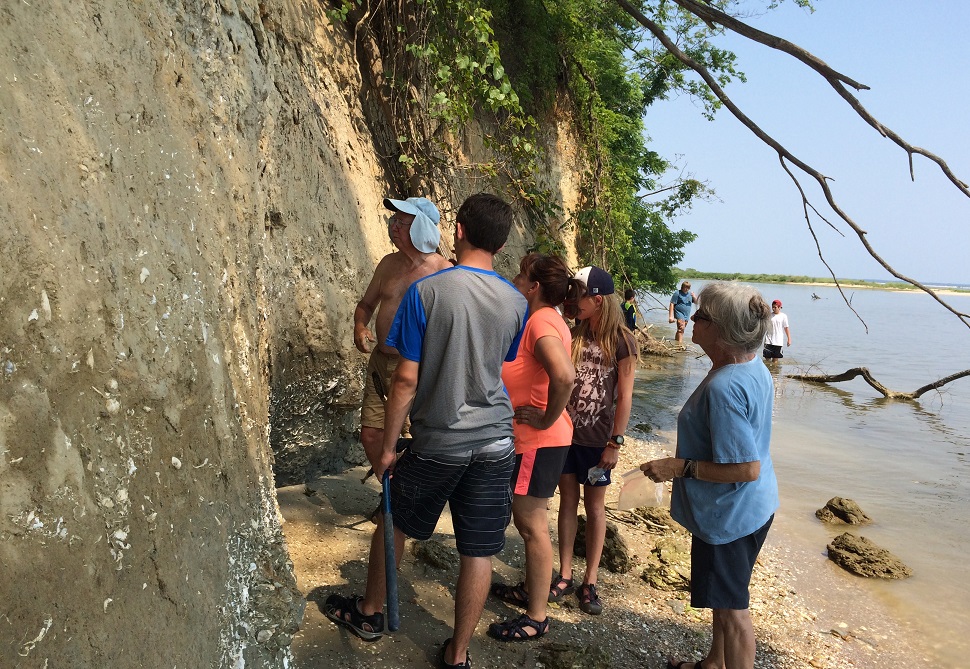
As it turns out, looking back on my experience, Cathy, her experts, the volunteers helping as boaters and guides, really impressed me, not only on their knowledge, but how great they were with the campers attending her paleontology camp.  My bonus was to see a couple sites that I've never been to.  I didn't have much time to collect, as I had to be ready to move when the experts were ready to move.  That included gathering the campers assigned to my boat and keeping track of them so we could move quickly and safely.
Cathy Young is so nice and knowledgeable, and it was my honor to help her service out during the paleontology camp.  Cathy is the proprietor of the Mid-Atlantic Fossil and Nature Adventures.
The 2015 Paleontology Camp Experts:
In addition to Cathy, who is an expert in her own right, the experts, some world renowned, participate in each of Cathy's trips or activities, that occur from New York South to Alabama, ranging from fossil and mineral collecting expeditions to nature trips.  The experts for each trip specialize in the subject matter and location for each trip.

The 2015 paleontology camp had two experts.  I missed the first night's presentation by world renowned Dr. Bretton W. Kent, the author of one of my most prized books, Fossil Sharks of the Chesapeake Bay Region, that is so helpful for identification purposes.  I couldn't get off work earlier enough to make the trek down to where we were staying.  I did, however, get to meet him at breakfast the next morning, and that was a treat in itself.  Other than some small talk, I pretty much found myself tongue tied!

The other expert at the camp was Dr. Lauck "Buck" Ward, retired Curator of Invertebrate Paleontology at the Virginia Museum of Natural History (VMNH), and is currently a Curator Emeritis at VMNH.  I was fascinated by everything that he said, because there were teaching moments for all of us, the volunteers and the campers.  He had a way with the campers too, seemingly grumpy at first, but they all loved him, and I believe the feeling was mutual for him as well.  I really enjoyed talking with him as he answered my endless questions.
Dr. Lauck "Buck" Ward presenting his fossils to the campers.  He had a way with the campers that grabbed their attention, taught them and made it fun for them.
Dr. Ward provided enthusiastic discussion on the geology, formations, and fossils of each site that we visited as the campers collected fossils of all kinds, including fossilized shells, shark teeth and other vertebrate fossils.
Dr. Ward in action teaching both campers and volunteers at one of the collecting sites.
Campers and volunteers having a great time collecting fossils at one of the sites.

Some of the campers and a volunteer searching for fossils along the beach of one of the sites.
Cathy's paleontology camp included all kinds of activities after collecting hours, most were organized, others just happened.  Meals were entertaining, and each evening there was a presentation about fossils and geology for the campers, and even a session about how to construct a necklace for shark teeth found during the trip!
One of the unplanned activities during free time between volunteers and campers was a water balloon fight.  At first, there seemed to be distinct teams, but eventually it was a free for all.  At any rate, I avoided getting wet, but many became drenched.
I was very impressed with the program itinerary.  It was very organized and well planned.  Everyone seemed to find their share of fossils and had a great time, campers and volunteers alike.  If the other trips are as well planned and organized as the paleontology camp, and in my mind there is no doubt of that, then you may have a great time attending one of Cathy's trips.  I'd say the trips are worth every penny spent.  You'll get to meet and collect with experts to some places that are off limits to most people, and others where access is limited.

So, would I hire a guide?  I'd say yes, and in this case, you'd get your money's worth.  I plan on attending trips as a customer in the future along with my daughter.

For more information, you can visit the website  Mid-Atlantic Fossil and Nature Adventures, or email Cathy Young at cathy@fossilandnaturetrips.com.  You have a chance to find some great fossils and learn from the experts at the same time.  More importantly, you'll have fun.


Thursday, July 21, 2016

Want Your Largemouth Big? Fish a Jig!


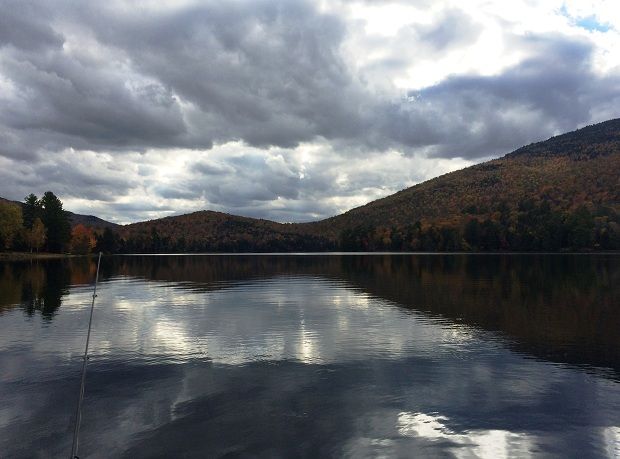
It was a cool fall day. We had a really good morning plastic worm bite catching big fish consistently.  Around mid-morning, the action died.  Did the fish move?  Did we catch them all?  I didn't think so, it was a classic fall spot.  It had plenty of structure with weeds, next to deep water.  The sonar lit up like a Christmas tree all around the area especially in deep water, so there was plenty of bait nearby.  Yeah, the fish were there.  They had to be.

I tied on a black and blue jig, leaving a chewed up plastic worm as the trailer, and tossed it out, let it sink, keeping a tight line as the jig fell.  All of a sudden, the line went slack as I felt a tap, so I set the hook hard and my rod stopped as if I'd set into a rock, but all of a sudden there were head shakes.  The fat largemouth lept out of the water trying to throw the hook as I plunged my rod down into the water to prevent it.  It failed in it's next attempt to dislodge the hook after rocketing under my boat hull, and I finally brought it to the surface and netted it.  That first fish went 19 inches long.

After that, the action continued all morning as I caught 17 more fat bellied largemouth bass, all over 18 inches and my 5 biggest over 20 inches long, with the largest one being 22.5 inches long!  Man, did they ever love that jig that day.  My love for skirted jigs and efforts to reincorporate them into my daily bass fishing arsenal finally paid off.  What a day!

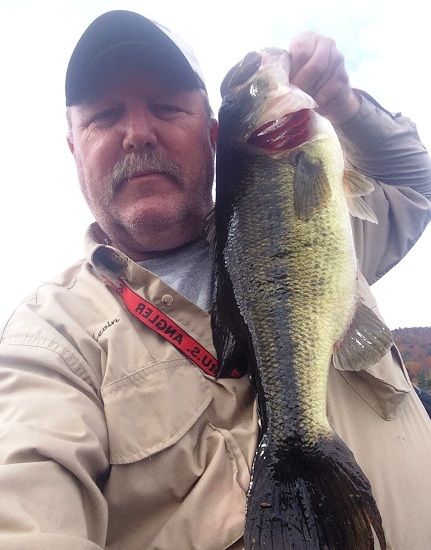
This was one of five fat largemouth over 20 inches that fall day that fell for my jig and eel combo.

My jig and eel combo from that day that caught a bunch of bass like the one pictured above, and in the basses mouth in the picture below.  Plastic worms make great trailers, by the way.
A few years ago, one of my goals was to become proficient in flipping and pitching skirted jigs because they catch big bass.  There is no questioning that.  Denny Brauer became famous on the B.A.S.S. circuit catching massive limits, winning tournaments and tons of money using them, as have others over the years.  They aren't new by any means, but one thing is for certain, when that jig bite is on, it's big bass time.
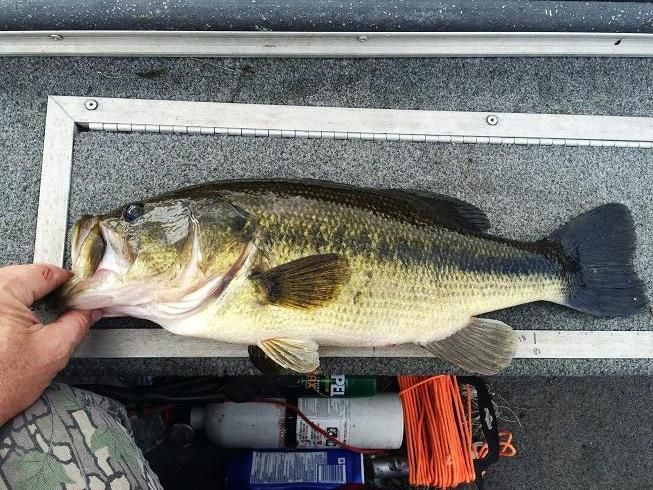
This largemouth bass hammered this jig and eel combination.
Now let me just say right now that I've always been a believer in these lures.  Many years ago, I fished them from shore and from my boat and landed quite a number of good sized largemouth bass.  But, for some reason, given the effectiveness of soft plastics, I sort of got away from using them.  A few years ago, upon remembering those good times, I was determined to make it part of my arsenal again.

My first step to meet that goal a few years ago was to replace my old flipping rod.  I purchased a Powell Max medium heavy pitching rod and an Ardent flipping reel.  I didn't care for the reel, so it has since been shelved.  Instead, I use my old Shimano Castaic, which to this day I feel is the best pitching reel that I've ever owned.  I spooled up some Power Pro braid, and I was in business.  By the way, I don't believe that the fish care about seeing the line, so I tie directly to the lure.  I set the hook very hard and found myself snapping off fluorocarbon leaders, so heck with that.  So far, so good without the leader.
My current pitching/flipping rig consists of the Powell MH pitching rod teamed with a Shimano Castaic Reel.  I love this combo.
The next step was to practice.  I stood on a stool in my back yard every night and pitched jigs of different sizes into a coffee cup.  At first, I started close in, about 15 feet away, and missed often.  Then, I got the hang of it.  I practiced every night, moving the cup further away, and eventually was able to put it in the cup most of the time, or at least hit it at distances out to 30 feet.  After that, I used multiple cups and pitched or flipped to all of them.  It was fun to practice too.  One evening, a mockingbird chased my jig a few times making it more interesting.  I had to reel it in quickly to keep the bird from getting hooked.  I couldn't wait to put my skills into action, and it didn't take long for the fish to cooperate.

Jigs are awesome.  They come in plenty of colors, sizes, head shapes, and they can be teamed with many different types of trailers, ranging from pork to soft plastic ones in a zillion shapes and sizes.
My last outing had this box with a decent selection of jigs and trailers, along with some Carolina rig supplies and a few odds and ends.  I carry a box of jigs every time I go largemouth fishing now.  


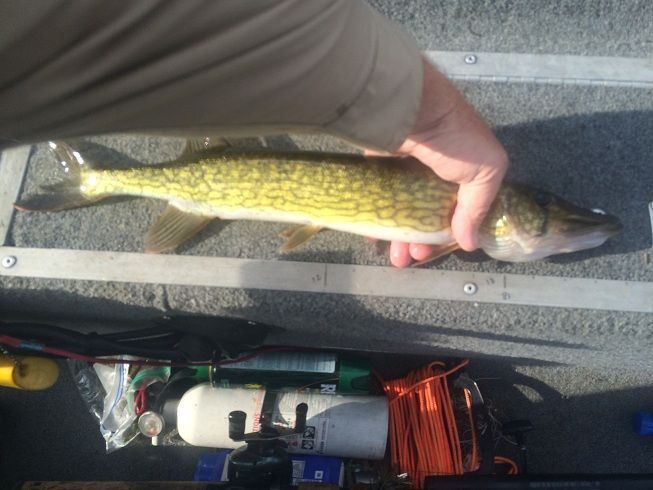
This green pumpkin jig and plastic craw combo not long ago caught a nice bass and chain pickerel on back to back pitches.  I may have caught more on it that day, but I didn't pull it out until the end of the day.  Prior to that, we were on a good chatterbait bite.
Chain pickerel and other predatory fish love skirted jigs too!   This medium sized chainside inhaled my jig and eel.
So here's the deal, everyone knows jigs work.  They catch plenty of fish and more often than not, they'll be big.   Don't take my word for it, read up on other successes or check out the countless articles in fishing magazines and on-line forums.  Better yet, if you haven't tried them, give them a try, and don't give up!  Some day, they'll pay off for you.

Tuesday, July 19, 2016

What the ??? Interesting Fishing Stuff

Big fish pictures always catch my attention when viewing forums or Facebook, but often the ones that I get a kick out of are the unusual photographs of unusual things that happen to us while we are outdoors.  So, in the spirit of the blog revival, I thought that I'd share a few of my favorites.

I love big fish pics, as I said earlier.  Even more interesting are views of the business end of a predatory fish, like this lake trout caught by Bob Barber:


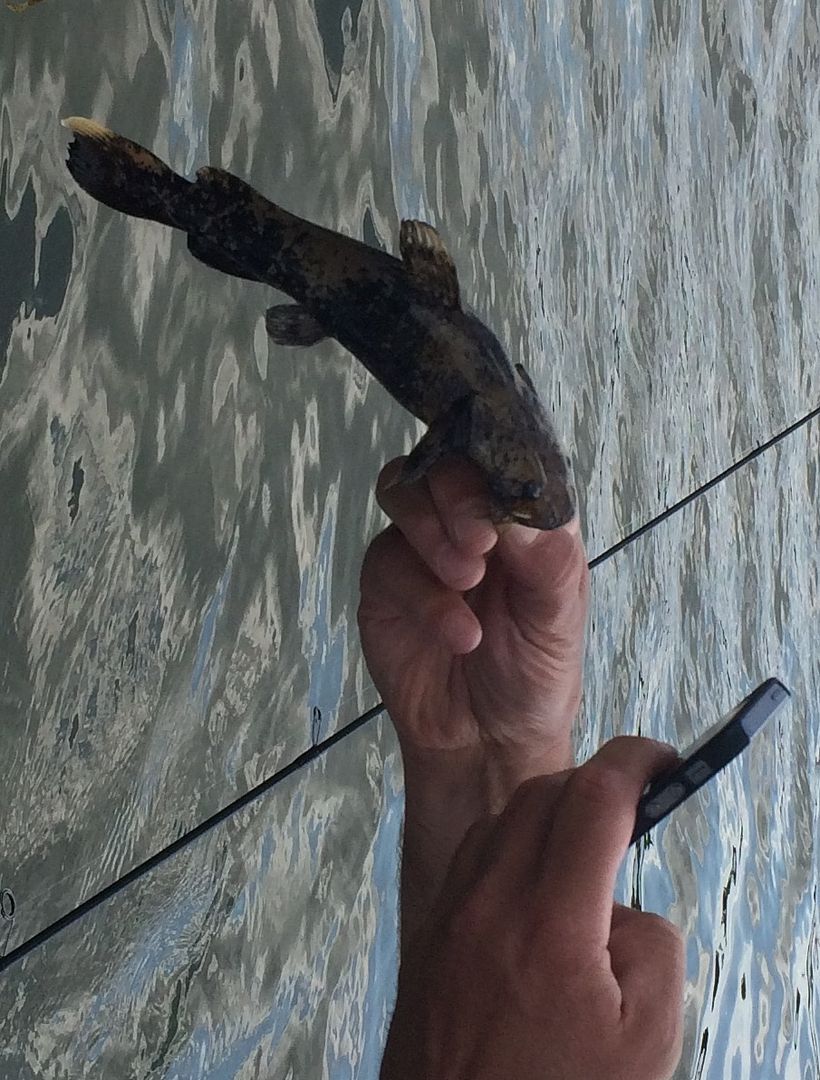
OK, so this is a catfish.  So what?  Well, for us, in our small fishing circle, it means quite a bit.  This fish is a flathead catfish, not from these parts.  Yep, they're invasive.  Even more unusual, is that my buddy Mark caught it on a plastic worm!


It took me a couple hours to pick out this backlash of expensive heavy braided line.  You can bet I'm not wasting that money if I can fix it.  The only problem, is, which one took the most time to straighten out, the backlash or the mustache?

Last year, my friend Howard and I were fishing for bass and chain pickerel on the Eastern Shore, and I had a fish slam my Rat-L-Trap very hard.  However, there was little fight after a couple head shakes.  The fish came in like a wet sock.  Here's why:

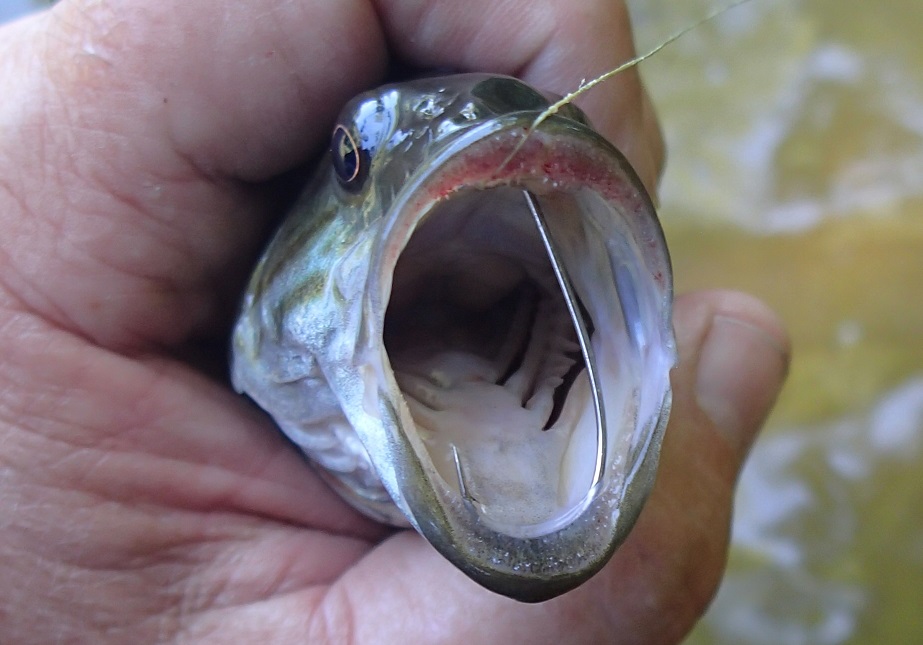
So the fish above cooperated so much it hooked itself twice.  Here's a dinky smallmouth bass that I caught a month ago that wasn't even hooked while wading a local river.  The hook was wedged between the upper and lower jaw!  Pretty smart little fish, eh?

While fishing with my buddy Ed one day out of his boat, he saw something on the bottom.  It's not every day that you see a wagon wheel!

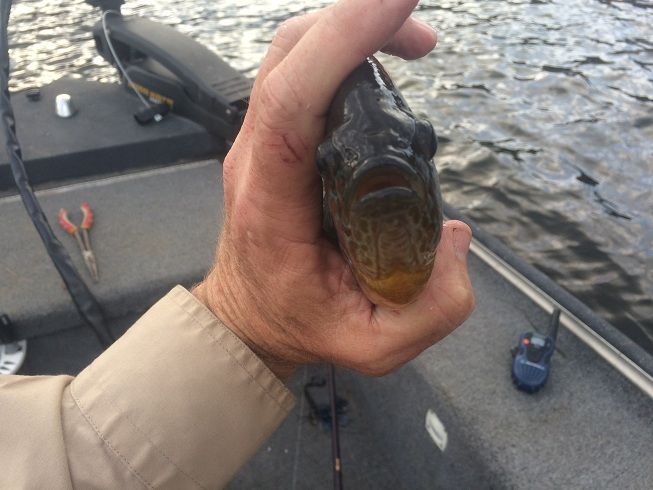
How about the business end of a pumpkinseed sunfish?  Check out this fat one:

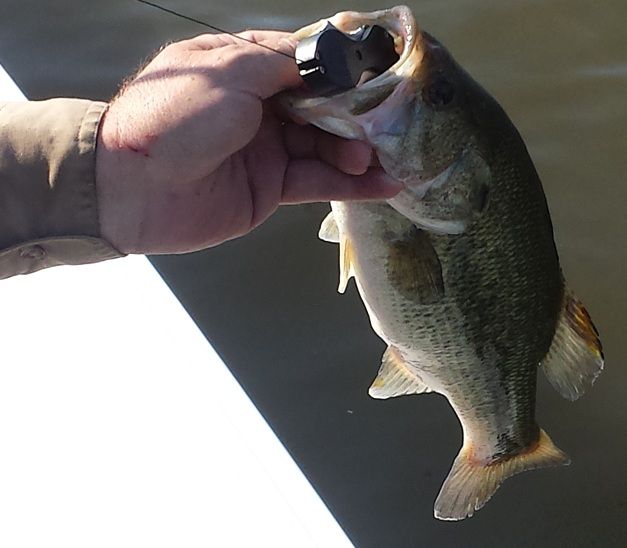
Largemouth bass will eat anything that fits in their mouth, but a line clipper?

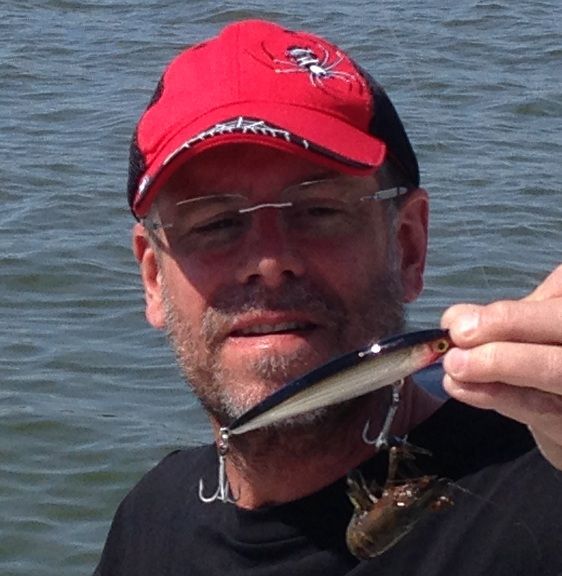
My good friend Rodger found a great way to catch crayfish.  I'm not sure it's all that productive though:

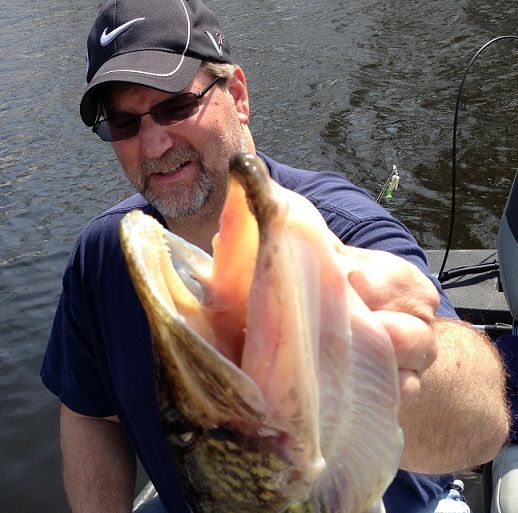
My buddy Howard shows us the business end of the toothy chain pickerel:

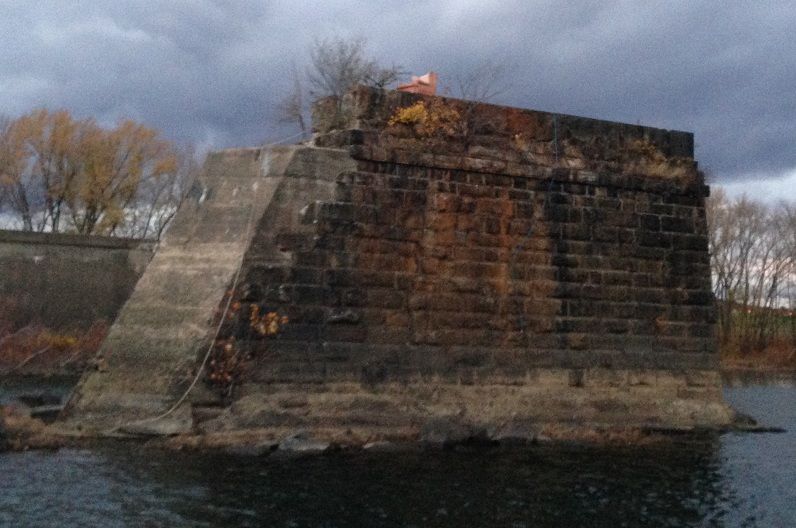
This pic speaks for itself...where's the TV?

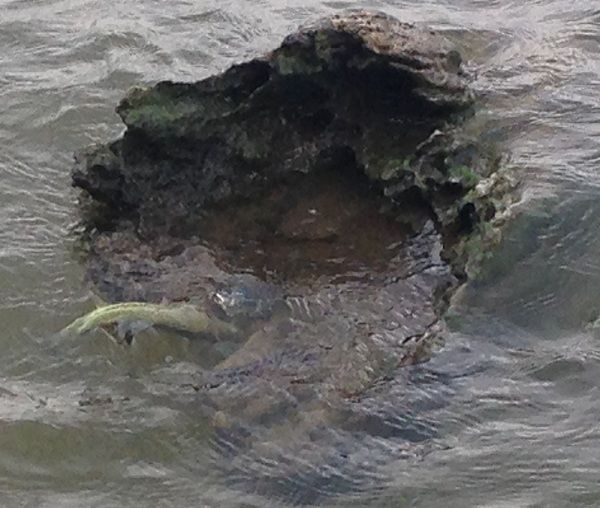
How about snagging your crankbait on a stump, and while trying to shake it free so as to not spook a good fishing hole, a fish bites your snagged crankbait?  Yep, it happened:

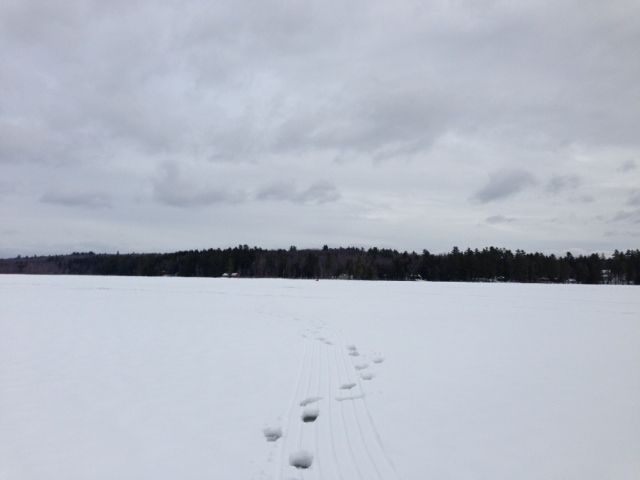
What does it look like when your buddy tromps through slush and ice faster than you do to get to your fishing hole?  Yeah, that's my good friend Jim Cumming far in the distance.  No, he wasn't drinking!

We'll leave on that note...until next time my fishing friends!

Monday, July 18, 2016

Fat Boy's Outdoors Blog Revival

Well my guilt has been overpowering, and with no excuse for lack of time right now due to a long bout with food poisoning, it's time to revive Fat Boy's Outdoors Blog.  I apologize to followers and readers of this blog for my absence.  Call it writers block, call it lack of motivation, or just call it lazy, whatever funk I've been in ends with this post.  I'll resume weekly posts, articles, and anything else that comes to mind in the outdoors world that I share with my friends and family.  This week, however, I'll try and post daily, if not every other day.

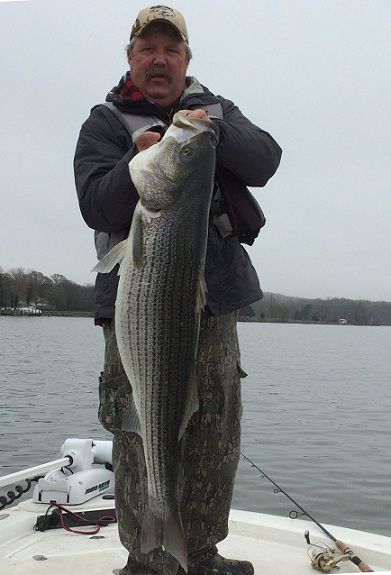
I'll start with some highlights since my last post, today, it's about fishing.  How about some noteworthy catches since then!  I would say my most memorable catch was that I all but tied my personal best striped bass catch at 45 1/2" long, a half inch shorter than my longest, but this fish was much fatter.  I caught this beast casting a Bomber Magnum Long A minnow bait, cranking it was fast as I could with stops and jerks along the way.
This may be the biggest rockfish (a.k.a. striped bass or striper) that I've ever caught.  My hands were cramped after the catch, and I shook for about a half hour from shock!
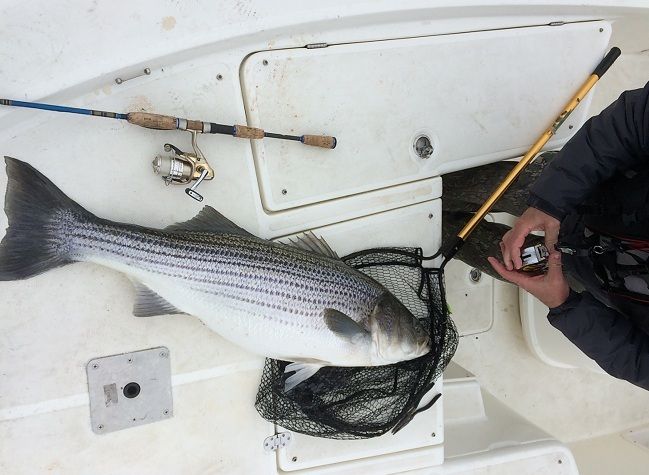
I knew this was a different class of fish when I hooked it.  The rod in the background of the picture was my buddy's rod and reel combo.  I was actually using an XH musky rod and reel combo, and this fish still took me around the boat three times during the fight.  My buddy Steve Kelley and I will never forget that experience.
Despite the net being seemingly a bit undersized, my buddy Steve expertly lead this fish into the bag!
My buddies and I made the trek to fish the Niagara River and had a great time.  For the first time, being the stubborn sort, I fly fished the majority of the time.  I managed to land several lake trout on the fly, including this one caught stripping a chartreuse wooley bugger.  It's not the biggest lake trout that I've ever landed on the fly, but it sure was a brute, leaving my forearm cramped and my knees knocking.
I love catching these fish on the fly, what a thrill!
Not all fish that are memorable are mine.  My friend Mark McWilliams caught the biggest laker that I've ever seen in person.  This picture still blows my mind.
This lake trout is massive.  The picture does not do it justice.  Incredible fish Mark!
Now, that was an amazing trip, and I have to acknowledge the incredible angling ability of my friend Bob Barber.  His ability to establish a pattern on the Niagara and many other bodies of water that he fishes is incredible.  He had the fish dialed in, landing big lakers and steelhead often, including this beauty.
Here's Bob with one of his many fish caught on that trip.  He had the fish dialed in. 
And kudos to Bob's Son Carson, nicknamed by our circle of friends as "Carson Van Dam" or "CVD"  due to his knack of putting fish in the boat at his young age, for not only catching his share of fish on that trip, but for netting many of them.  He was always first to the net and became quite the net man.  Perfect?  Not yet, but he's as good as many that I've fished with.  He'll be perfect soon, you can count on that.
CVD in action!
I have more fishing to catch up on, some with the "how to" format, and some more as updates to specific trips in future blog posts.  I've had plenty of good action of the past two years, too much for one post, although not enough fishing trips for my liking in total.  I hope to change that over the next few years, to get out more, and post here.

Thanks for your patience in waiting for my posts, and I hope that the past two years fared well for you!


Thursday, August 14, 2014

A Special Day...

I want to take this time to say special kind of thanks and pay tribute to someone near and dear to me.  I'm thankful for many things from this person, and here is a very short list that are relevant to this blog.

As a bowhunter, scent control is very important.  Whitetail deer have a keen sense of smell that can detect odors that are strange to them from great distances, putting them on alert or worse, send them scurrying away tails up while ruining your hunt.  Being anal about scent control improves your odds and your hunting experience.  Wearing Scent Lok or similar gear, controlling your laundry and showering with scent free soaps and shampoos, spraying down your equipment with scent elimination products, are all keys to doing this.  My Brother Kyle taught me that.  Thank you Kyle.
Kyle consistently shot bucks like this with his bow.  I got him started in hunting at a young age, but it was he who taught me how to hunt, sharing his secrets for success.
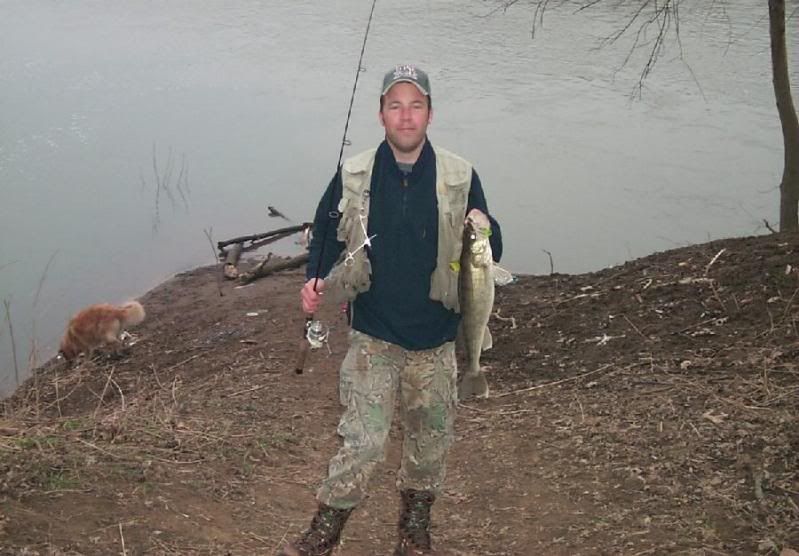
Catching walleye has always been a cool thing as a bass angler.  Most over time I've caught while fishing for bass, as accidents and surprises.  Each one was a bonus.  Later in my angling life, someone taught me how to target them, when my odds were best, and what lures and techniques worked the best.  I was able to target them and catch these special fish consistently afterwards.  My Brother taught me that.  Thank you Kyle.
Kyle figured out how to catch walleye on a consistent basis, and caught some very nice ones.  He fished from shore and also from his kayak.  His determination to learn how to pattern them paid off, and it was he who taught me his secrets.  My friends and I benefit to this day from his research and success.
As a bowhunter, finding ideal locations to place your stand are critical to success.  I learned to use 3D on-line maps and GPS to find and locate ideal stand locations on properties that I hunt.  Since then, my odds have improved and I've bagged more whitetails.  My Brother taught me that.  Thank you Kyle.

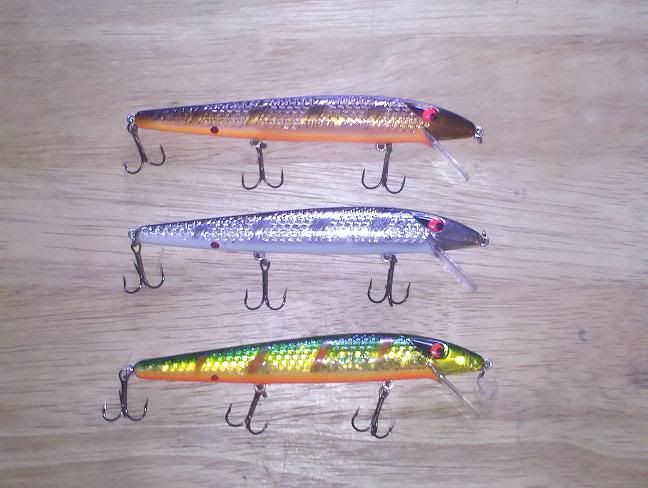
Using suspending stick baits or jerk baits, like Husky Jerks and Rattlin' Rogues for walleye and smallmouth are deadly.  One technique that is extremely effective is to basically cast it out to a likely fish holding river eddy, crank it down a bit, and let it sit motionless with only the current moving it ever so slightly, and almost dead stick it.  Sometimes the bass, walleye or other predators just can't stand it any longer and hammer it, and usually these are bigger fish.  It's quite a thrill.  My Brother taught me that.  Thank you Kyle.
Jerkbaits like these Rattlin' Rogues are deadly when cast into a river eddy and dead sticked for big walleye and bass.  And I don't mean let 'em sit for a minute, I mean a lot longer.  And when you work them back, work them "painfully slow".  This is a very effective coldwater technique that my brother taught me years ago.
The same suspending jerk baits work extremely well for sea trout, flounder, bluefish and rockfish along our coast.  I learned that working these baits along rip rap eddies during tide changes would draw savage strikes from these tasty saltwater species, and put up quite a fight at the same time.  My Brother taught me that.  Thank you Kyle.

These are just a few things that I learned from my Little Brother.  He was a man that worked extremely hard to achieve high levels of success at everything he did, whether it was coaching a swim team, honing his hunting skills, fishing a river, saltwater body of water, or out of a kayak on a lake.  He passed away in 2007 at the young age of 36 years old, and I miss him greatly each and every day.  His story can be found linked as one of the pages on this site, a tribute to him.  But it's not enough, so here I am today wishing him thanks and a Happy Birthday.
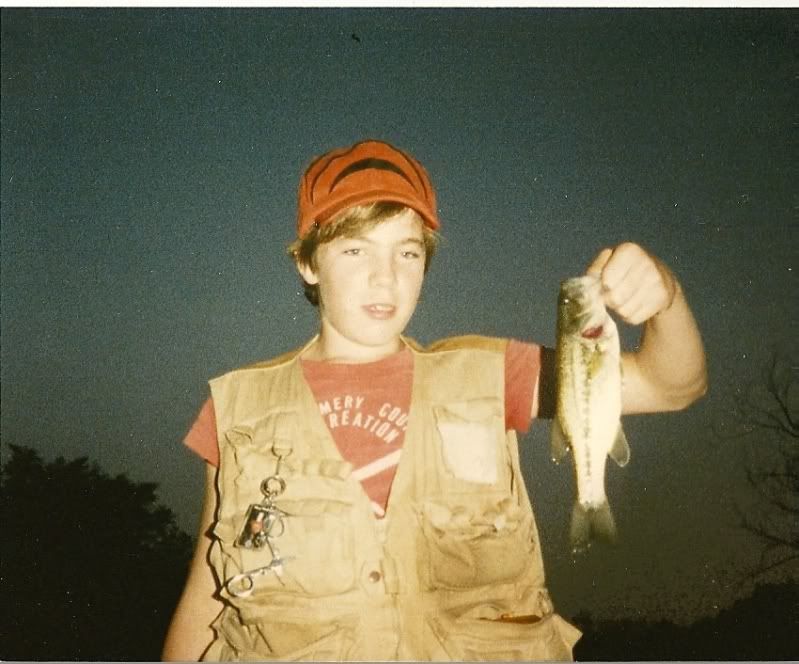
At twelve years old, Kyle was catching fish, and learned to be extremely successful as he grew up in just about everything he did.  I may have given him his start in fishing, and inspired him to take up bowhunting later on, but it was Kyle that taught me a thing or two later in life.  And I greatly appreciate it and miss him every day.

Happy Birthday Kyle!

Monday, March 3, 2014

On the Hardwater - Salvaging a Tough Day

In my last blog post, I discussed my approach to finding fish on a small lake.  The major theme basically was to move until you find good sized fish, ingnore the sniffers, and move away from catching small fish, or "dinks".  Usually by following the plan laid out in that post, On the Hardwater - Attacking a Small Lake for Panfish, you will eventually find the fish that you are looking for, although it may take time and a ton of effort cutting many holes.   But what happens when you try those suggestions and things just don't work out?  How can you salvage a tough day?
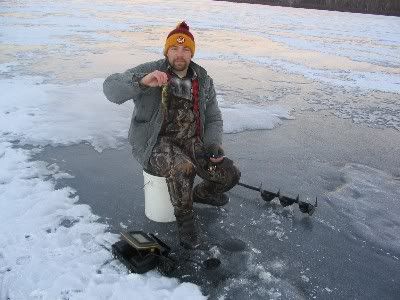
My enthusiastic ice angling friend, Glenn Cumings, working fish that he marked during mid morning.  Glenn kept moving and eventually found a few nice bluegills mixed in with mostly small bluegills.  Remembering what he did at this hole helped us finally solve the puzzle later.
My buddy Glenn Cummings and I decided to hit a lake known for good sized panfish.  In the past, we've had great success icing a mixed bag of fat keeper sized perch, slab crappie, and bull bluegills.  My experience on this particular lake was at a different area than we opted to fish.  Glenn insisted that this spot, new to me, would produce the output that we were hoping for.  Conditions were perfect, leaving us both feeling very enthusiastic about our chances at finding big panfish.
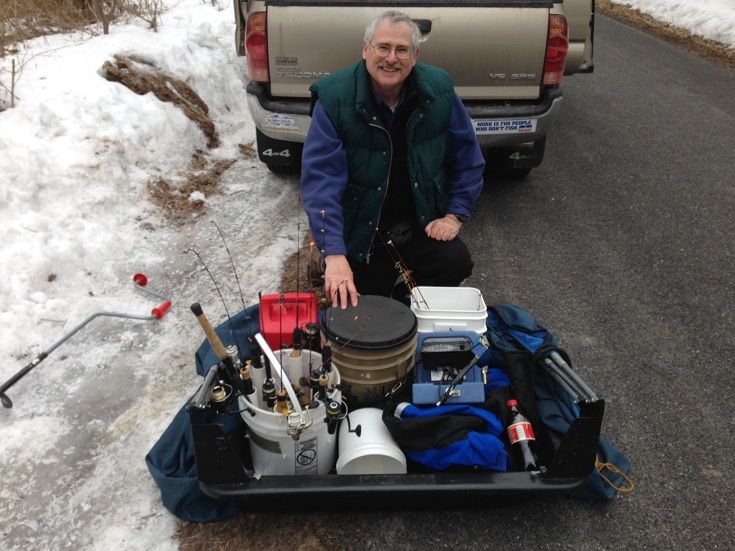
After finding a suitable parking place to access our lake, Glenn poses with his gear, nearly ready to attack our small lake in search of jumbo sized panfish.
Glenn and some of my other buddies have had good experience at this new spot on our lake, and Glenn assured me that he could put us on fish.  I was game to expand my horizons and find new spots.  My past experiences were very productive at my spots on this lake, so previously, I had no reason hunt for new spots.

Once out there, we began our regimen by moving out to the mid basin of the cove, a typical location to find panfish during mid winter ice.  I cut a series of holes through sixteen solid inches of ice with my hand auger until my shoulders cramped.  Twenty six cranks on each hole had me stop after six holes, each spaced about thirty feet apart.  But, it was enough that I could scoop out the ice chips and check them with my sonar.  Each hole was over twenty four feet of water, a prime area for this time of year.

Well, things looked up right off the bat as I marked fish at each hole, some suspended and some on the bottom.  The next step, of course, is to drop a lure down there and find out what we're dealing with.  My rig of choice was my favorite dual Ratso rig, my hottest set up of the year so far.  But the fish were sniffers in each of the holes.  It was weird because the fish charged up off the bottom, then either bit very lightly or not at all.  My first impression was that I was dealing with dinks.

I moved toward the far shore a bit and cut six more holes.  Again, after checking the holes and marking fish in each one, I dropped a different offering down there to see if that would make a difference, this time, a tiny tungsten chartreuse Northland Fireball Jig teamed with a pair of spikes to add some scent, in case the sniffers were decent sized finicky fish.  This time, a fish charged up and nailed my jig, confirming my earlier suspicion.
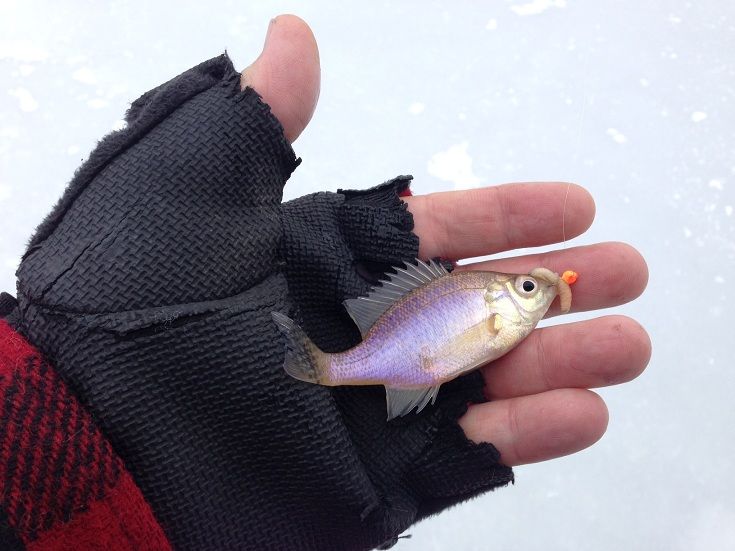
My first fish confirmed my suspicion...dink.  that's a tiny lure, and a very tiny bluegill.  I wasn't interested in catching these all day.
Meanwhile, Glenn was doing the same thing, but heading toward the center of the cove.  He was also catching dink bluegills now and then.  After chatting with another guy on the ice, Glenn used some of his new intel to move to another spot.  His next hole produced a few nice bluegills mixed with the dinks.

I, on the other hand, moved again.  I noticed that one shoreline had a nice draw, leading to me to think that a spring or creek, even a runoff one, might provide enough structure out into the lake to hold fish.  I moved over to that area and mustered enough energy to cut eight more holes.  Again, I marked fish in every hole, this time in twenty one feet of water.

After working these fish a while, I picked up a few nice bluegills, a decent yellow perch, and a small crappie mixed in with some dinky bluegills.  I bounced around from hole to hole and caught fish here and there, but didn't have that hot hole so that I could set up my camera and haul 'em in.  Plus, the water seemed too dingy to use the camera.  The dingy water may have played a role in the mood of the fish too.

We had action, and including the dinks, my totals were just shy of twenty fish for about five hours of fishing.  That's not the bite that I'd hoped for.  Plus, the size of the fish weren't impressing me.  So, at three in the afternoon, with the magic hour looming, I convinced Glenn to make a major change.  He agreed, because it really wasn't happening for him either.

We had two options for a major change, move on this lake to an entirely different depth and structure, or make a spot change to another lake.  We figured that the latter would waste too much time, so we took a hike to a new previously productive area.
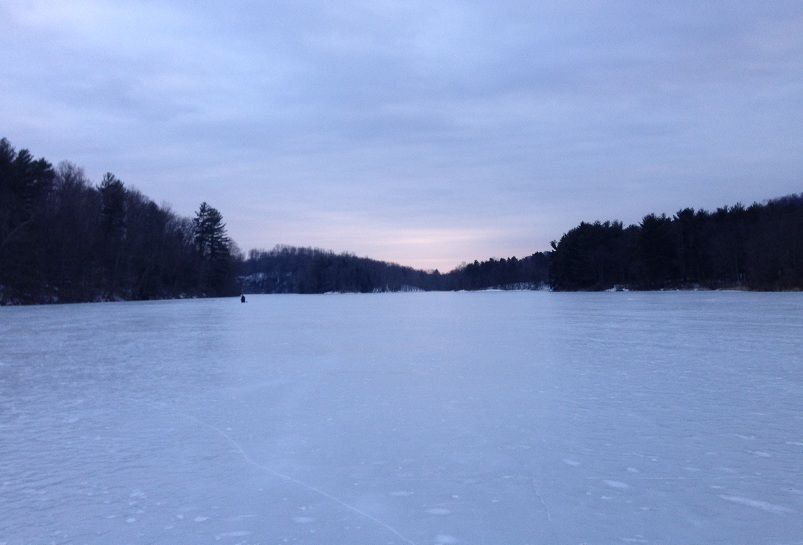
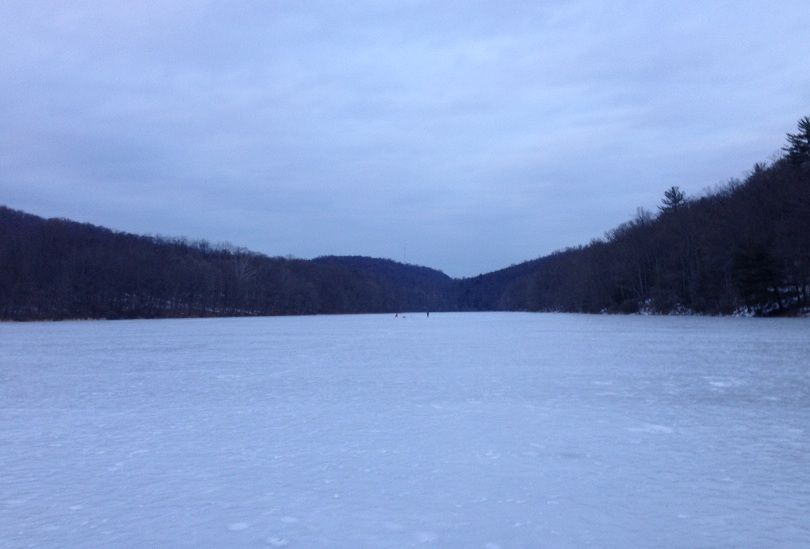
The major move included a long hike during prime fishing time, past the guy on the left and around the point to a deep thirty eight foot basin.
We had a nice hike ahead of us, but with the ice pretty slick, towing our portable Fish Traps full of gear wasn't an issue. But, it did use up valuable fishing time.  We went to one of my past productive spots, around a point and into another cove.  We head out to the deeper water basin, a notorious hangout for fat yellow perch and crappie in the past.

I cut eight more holes.  Again, each hole held fish, and the result was the same.  I quickly managed a seven inch perch and a small bluegill, but not the size of the fish that I had hoped.  This group of fish were far more active, but my third yellow perch of the day sealed my decision to move again.  It may have been the smallest yellow perch that I've caught in my life.  It couldn't have been even three inches long!

Glenn was working the fish in his holes, and hooked and lost a couple fish on his ultralight outfit.  But, he agreed that this might not have been a good move.  I headed toward a long sloping point, hoping to find twenty to twenty five feed of water off the end of the point.  After cutting five more holes, I found that spot.  My first four holes didn't mark fish, but my fifth one did.  I caught that one fish, another dinky bluegill.

Now, I was getting discouraged, and after Glenn met up with me, he was too.  So, we agreed that we had enough time to hike back up the lake to our original spot.  Again, another half hour of hiking wasting fishing time.  By the time that we reached our old holes, the magic hour was half over.
Our long walk back to our original holes cost us half of the magic hour.  Our destination was beyond those folks in the distance.
Remember in my last post when I wrote this?
"Later in the day though, it might be wise to remember where those sniffers are, especially if you catch one and it's a good sized fish.  Because, often low light conditions, commonly thought of at the magic hour, that last hour of daylight, finicky fish might become more active later."
I checked my best holes from earlier and one of them had fish stacked on the sonar.  So, I set up camp there for the evening bite.  My first drop with my tandem Ratso rig resulted in a nice fat crappie.  The next drop was a bigger bluegill, followed by another one.  After that, I lost a slab crappie at the hole that was easily thirteen inches.

Daylight ran out quickly, so Glenn, who had also been catching better sized fish, and I fired up our lanterns and set up for the night bite.  After dark, the fish became finicky again, but, if you worked them enough, you could coax them into a solid bite.  The bite wasn't hot, but I marked enough fish to keep me interested, and enough of them were reacting to my lures.
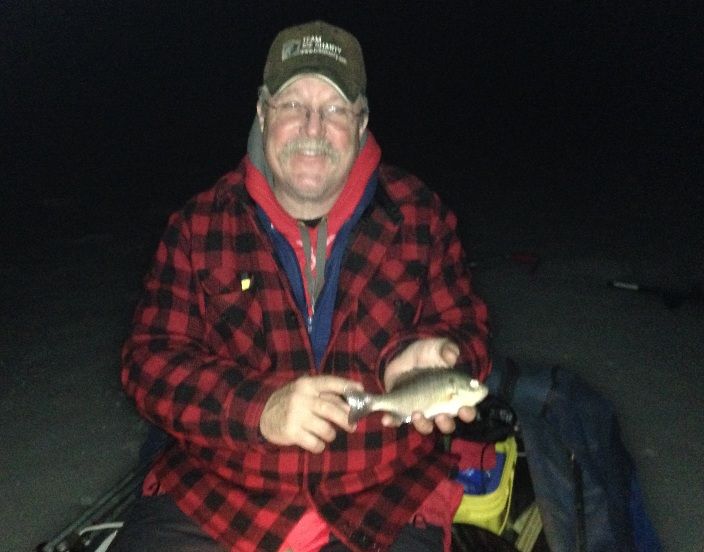
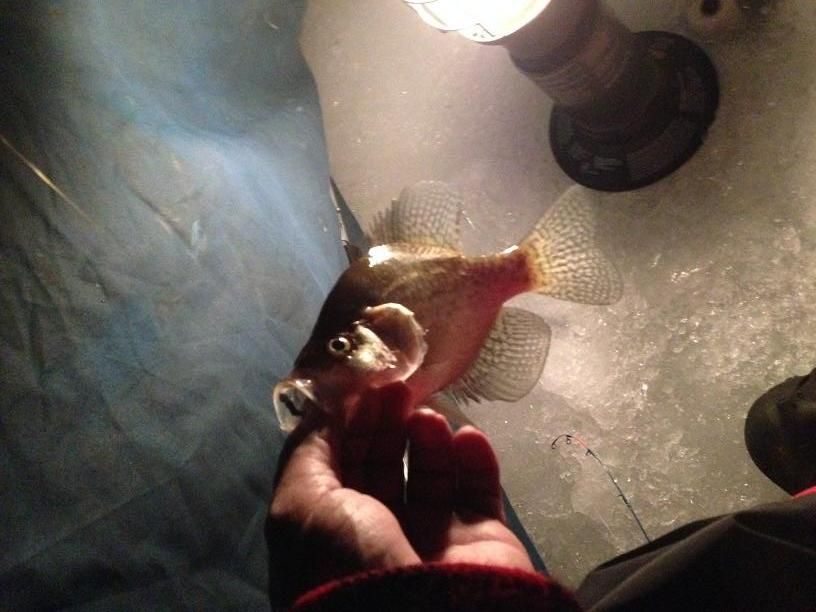
This isn't a monster bluegill by any means, but a much better average size compared to the dinks earlier in the day.  I caught several of these after dark, jigging aggressively, trying to imitate the tiny hopping crustaceans that flooded my sonar.  The fish were mixed with them, actively feeding.
I caught several more crappie and a nice bluegill that was suspended at ten feet over twenty four feet of water.  Glenn struggled a bit with tackle problems and also problems with his lantern, but managed to catch some nice crappie and bluegills too.

Remember earlier in the post that I mentioned that the water was dingy?  I think that the fish didn't seem aggressive because they had a hard time seeing the lure in the murky water.  I used glow jigs and worked them very aggressively.  As it turns out, when the fish finally found the lure, they were very active and hit readily.
Here's a medium crappie that I worked for and caught after dark.  Aggressive jigging in the dingy water was the key to catching this crappie along with several more of his buddies.
I finished with a forty fish plus day, if you include the dinks, but we worked hard for them.  It was my toughest day of the year on the ice.  But, that final move paid off, the one where we went back to old semi-productive holes where the sniffers were actually decent sized panfish.

I'm sore today, two days later, from cutting holes.  We had twelve inches of snow last night, so shoveling my hundred foot driveway isn't helping my aging bones either.  I was miffed at my decision to make that major move to deep water, because it may have cost us a dozen or more nice sized fish from wasting half the magic hour.  But looking back, even though it was a tough day, the reward was that we finally solved the puzzle.

The system worked, finally.  But, perhaps some patience would have worked better this time by sticking to holes that gave up a few nice fish early.


Friday, February 21, 2014

On the Hardwater - Attacking a Small Lake for Panfish

Why people ice fish means many things to many people.  Some like the outdoors experience, just being out there, opting to not sit on the couch watching outdoors shows on the television.  Others like the social aspect of ice fishing, even bringing cooking devices out on the ice to have a big party while catching a few fish.  It's all good!  But my goal is to catch as many fish jigging as I can...that's how I have fun on the ice.  Smaller lakes often give you that opportunity.  I like to improve my chances by hitting the hardwater on the smaller lakes.  So, how do I approach my goal?
Small lakes offer an easy advantage to finding active panfish because you can cover a ton of ice in a single day.  During mid winter, I like to start deep near dams or creek channels, then work towards more shallow types of structure, or cover like weed beds or tree blowdowns.
I like solving the puzzle, not only finding where the fish are, but where I can find the ones that are willing to bite.  Sometimes it takes a little work, and at other times it could be a lot of work.  Rarely, you might cut only one hole!  But the most fun is catching them, one after another.  It takes some knowledge, either learned via experience or from various media, such as videos, magazines, books, television shows, fishing forums and even from other ice anglers.  And a little luck doesn't hurt.

The first step is to pick a lake that has a good panfish population.  When I'm talking about a small lake, I'm thinking about a two hundred or so acres or less.  The vast majority of the lakes in my region are man made, featuring a dam, flooded creek channels, points, islands, and other structure.

An advantage of finding a gem of a small lake is that you can cover most of if not then entire lake to find fish. You can still make that major change if the bite is off by fishing a totally different area on your lake or by having another nearby small lake as a back up plan.  Sometimes, that major change will put you on active fish.

My favorite fish to target through the ice are crappie, but I also love a good bluegill or yellow perch bite.  So I tend to prefer lakes with historically good crappie populations and size.  
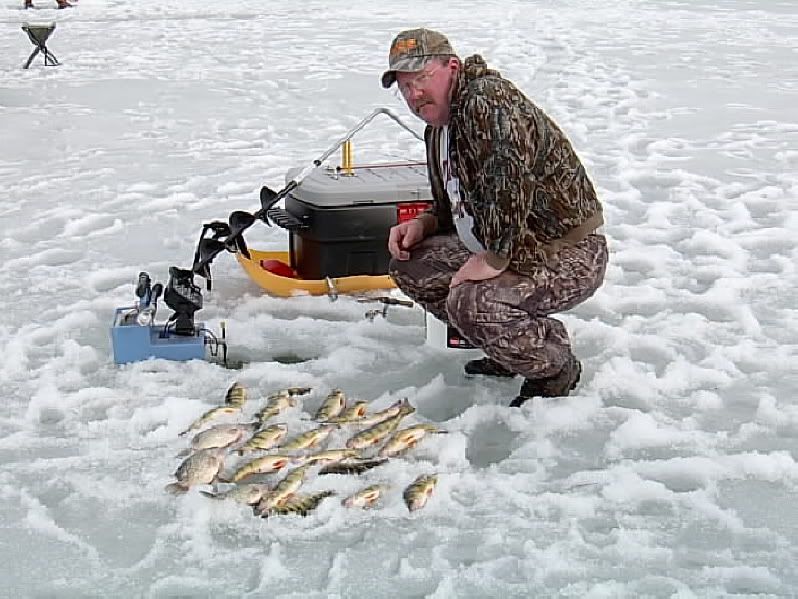
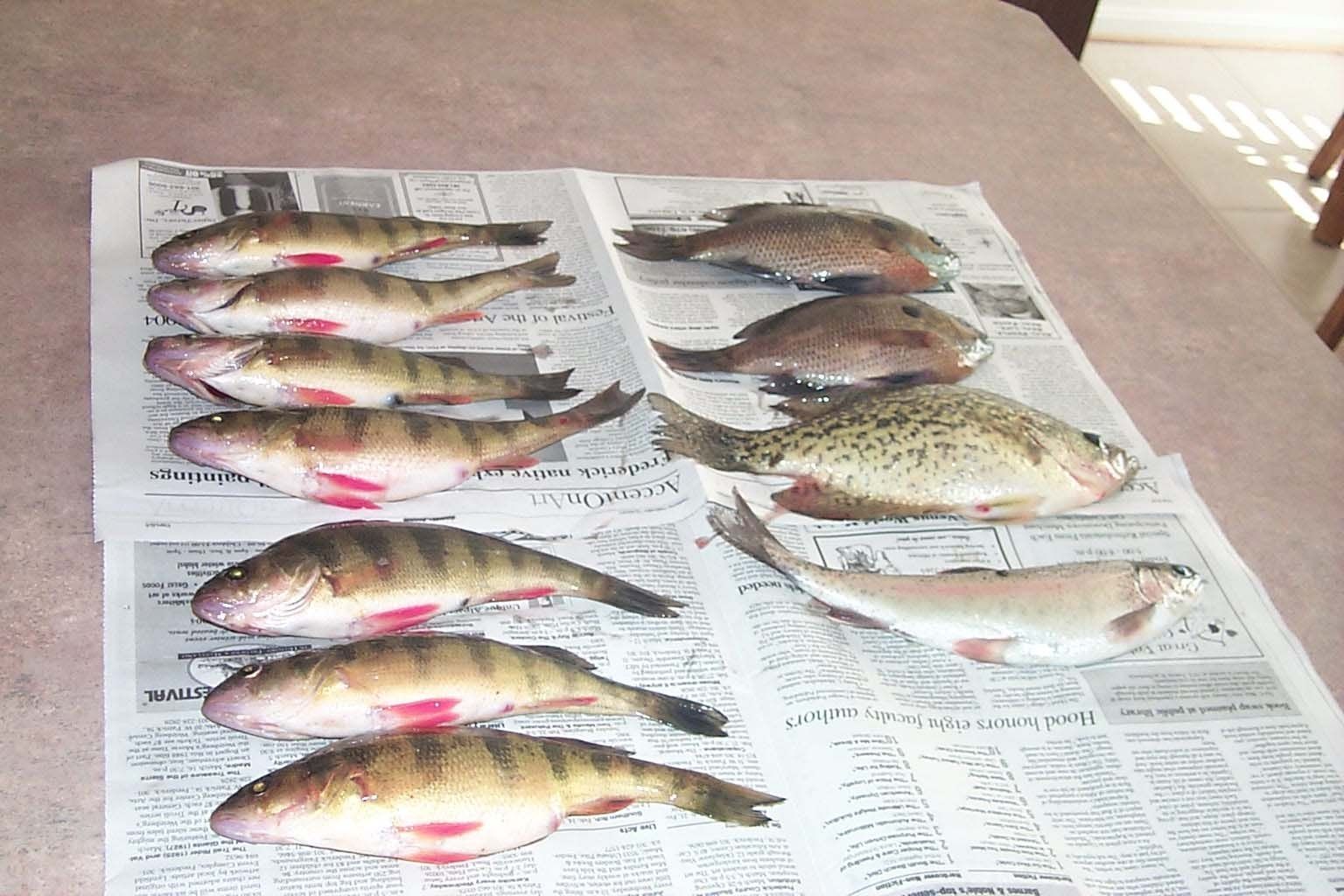
Mixed bags of slab crappie, yellow perch, and bluegills are a real fun time.  These fish were all caught in thirty feet of water over a creek channel not far from the dam.  Smaller lakes give you the opportunity to catch a bunch.
Small lakes offer an advantage over larger ones with respect to finding fish simply because you have less water to search to find them.  But panfish size vary from year to year, especially with crappie populations where sizes often vary.  Some years yield those fat slab crappie, others give up the medium sized ones.  The same holds true for perch and bluegills.

Other lakes may have large populations of "dinks" and but sometimes give up the larger ones.  Those bigger fish are harder to find.  But if you're into dinks, move to another location on the lake and hunt for the bigger ones if you know that lake supports them.  This frequently occurs with bluegills and perch one some of the lakes that I frequent.

If' I'm marking a lot of fish, it's tough to leave them.  But if they are four to six inch perch, or tiny bluegills or crappie, it's best to move from my experience.  Usually, I'll move to a different structure or area of the lake.  If the dinks are deep, then I move to weedy break lines, for example.  Often that change results in bigger fish.
My brother Kyle poses with a dink perch.  If you're catching dink perch like this, move and go find bigger panfish.  Tiny perch like this often group in large schools like this as a defense against predators.   Later, we'd find a nice mixed bag of  bigger panfish to bring home for a fish fry.
Finding good sized panfish on larger lakes (near 200 acres) could prove to be tougher.  Basically, you have to break the lake down into more manageable water size to cover.  Use lake contour structure maps to locate an area where the structure is more suitable for panfish and work that area.  Have a back up location if you have to make a spot change to get on fish if your first spot doesn't pan out.

It helps to have experience on a particular lake.  I have a few favorites, and patterns from one year to the next tend to hold true depending on how late you are in the ice season.  Sometimes that past experience pays off by cutting down on the time spend searching for fish..

During early and late ice, I look for mid depth fish first, fifteen feet or less, then adjust accordingly.  But it depends on what species your targeting.  Weed lines or flats near structure, points or a creek channel, are good places to find perch.  The creek channels tend to be good crappie spots, or any cover, such as a sunken tree or brushpile, or man made fish structure.
After cutting a bunch of holes, we finally found some bigger panfish and a bonus stocked trout.  These were stacked up near a creek channel off the end of a long sloping point on one of my favorite small lakes.
During mid winter, my approach is to start deep, then work shallower.  The Eastern waters that I fish are usually small reservoirs, with maximum depths of twenty to forty feet.  I typically look for fish in the twenty to thirty foot range first, them move deeper in my search.  If that doesn't pan out, then I move shallower.

I've found that schools of crappie during mid ice tend to hold over the deeper basins of lakes that I fish, or off creek channels near dams.  Often, you'll find yellow perch and bluegills with them this time of year.  Our lakes are man made, so most of the time there are creek channels, flats, points, primary and secondary drop offs to check.  I like to search the channel edges first.  As you move shallow, search for weeds because they could be the key when the deeper waters seem like a dead sea.
To me, crappie like this slab are what I look for and expect on the smaller lakes that I fish.  I am in seventh heaven catching crappie like these through the ice all day long!
Start by using either your own past experience on the lake, where you've caught crappie during mid ice, or locate the type of structure that you'd like to fish on a lake contour map.  Start by cutting a series of holes over the location of the structure, or where you think it may be.  I use a hand auger because, in my neck of the woods, the ice rarely gets thicker than a foot.  So, cutting a good number of holes becomes an obvious workout the thicker the ice gets.  That's when a power auger becomes effective.
I use my Clam Fish Trap Pro as my home base, then start cutting and checking holes.  Don't waste time on inactive fish.  Move and find fish.  Small changes at first might work.  If not, think bigger changes.
I usually cut a half dozen holes to start, then check them with my sonar.  I search for either suspended fish, or fish marked on the bottom.  For those fish on the bottom, the sonar shows the bottom jumping.  When the fish moves, the mark flickers, and if that mark is close to the bottom, it appears as if the bottom is flickering.   If the bottom doesn't jump or move, most likely you're not marking fish.  If your sonar transducer hangs or is supported by a float, make sure that it's stabilized and not moving, which could give you a false reading of marked bottom fish.

If I mark fish, then I'll drop a lure down and see how they react.  I can see my jig fall as a bar on my sonar toward the bottom.  If another bar moves off the bottom toward it, then I know the fish are active, and that means a fish is either moving toward my lure or interested in it.  When the bar representing the fish meets the bar representing my jig, I take my eyes off the flasher (sonar) and watch my rod tip.  If there is any movement of the rod tip or line, set the hook.

Now, marking fish is one thing, even ones that appear interested, catching active fish is another.  Just because a fish moves in to inspect your lure doesn't guarantee a bite.  Fish sometimes are curious, but finicky, and it either takes extra effort to tease them to bite or they just aren't interested.  We call those "sniffers."  If you routinely mark sniffers, move.  If they are in every hole that you cut, move and cut more holes.

Later in the day though, it might be wise to remember where those sniffers are, especially if you catch one and it's a good sized fish.  Because, often low light conditions, commonly thought of at the magic hour, that last hour of daylight, finicky fish might become more active later.  If you get into a good bite and it dies off, it may pay to go back and recheck the sniffer holes again.

Some anglers may try a variety of jigs to tempt the sniffers into biting, hoping that the magic jig will turn on the bite swtich.  At times, making changes in your offering, either tipping with bait or downsizing, will work.  But more times than not, moving is the key.  While those guys are trying to get that one fish to bite, I'm looking for multiple biting fish.  You can pad your numbers in a hurry by finding those biters.

Another thing about sniffers.  They may not be big finicky fish, but rather could be dinks.  Dinks often will sniff because, quite frankly, your jig might be too big for them.  If you mark a fish that charges up to your lure but then gets spooked the second that you give it a jig, most likely it's a small fish.  Move!

Since I really love crappie fishing, I tend to search for suspended fish.  I have very little patience when dealing with sniffers and fish that won't rise off the bottom much.  I search for suspended fish when I can.  There are times when you won't find them, but sometimes you do.  When you do, the reward usually means more bites and active fish.  Perch really like to feed off the bottom, so that might explain why my crappie and bluegill numbers when catching a mixed panfish bag are higher than my perch numbers.
This is what I'm looking for when searching for big schools of panfish.  When reading this sonar, the bottom was nineteen feet, shown at about eight o'clock.  The surface of the sonar is at twelve o'clock.  All of the marks in between are suspended fish.  Fish also were on the bottom.  We call this, "sonar lit up like a Christmas tree!"
When I finally find the crappie, I will fish that hole out because they usually hold in big schools.  If they are suspended, often you'll catch perch and sunfish that suspend with them.  That situation may result in that nice hundred fish day!  If you plan on fishing for crappie after dark, remember what holes you caught them in because it's likely those holes may produce near or after dark. I'll provide some night fishing secrets in a future post.

The key to being successful to this type of fishing is to move when things aren't going well, and find those active fish.  It may mean cutting a ton of holes or making major spot changes, but the reward could be worth it.  This isn't a new concept.  I learned it many years ago from my ice fishing mentor, Jeff Redinger, who taught me the Dave Genz approach, using sonar to find fish and a comfortable portable shanty that allows you to easily make those important spot changes.  I'm sure that there are other pioneers out there, but that's how I learned.
My ice fishing mentor and friend, Jeff Redinger, posing with a massive redear sunnie.  Jeff has caught countless slob sunfish like this over the years using the techniques that he taught me, techniques made popular by ice fishing legend Dave Genz.
Many of you may apply these tactics already and have experienced that success.  But some of you may not have learned this yet, and my hope is that this helps you.  Just because you have a sonar unit and are marking fish, doesn't mean that those are the fish that you should be targeting.  Move away from sniffers and go find some biters!  Move away from dinks and go find bigger panfish!

My best of luck wishes go out to all of you hardwater anglers, and please be safe during these next few weeks of late ice!